1 336 résultats
1927012917Paris André Delpeuch 1927 In-4 Broché, couverture rempliée.
174857794Madrid, Joseph Mathias Escrivano, ( 1748). Titel, 11 Bll., 392 S.; 442 S., 1 Bl. Kl.-8vo. Flexibles Pgt. d. Zt.
1510151129(Paris, um 1510). Blattgröße: 17,5 x 11,5 cm. Schriftspiegel: 16 x 9,5 cm.
190497764Leipzig, 1904. 79, [5] S. Mit mont. illustr. Titel u. 8 Tafeln (4 montiert), Notenbeispiel im Text sowie Schlußvignette. 19,5 cm. OHPgt m. goldgeprägter VDeckelillustr. u. Kopfgoldschnitt.
167477185Salisburgi [Salzburg], Johann Bapt. Mayr, 1674. 7 Bll., 319 S. Mit 1 Kpfr.-Taf. 12mo (13 x 7,5 cm). Pgt. d. Zt.
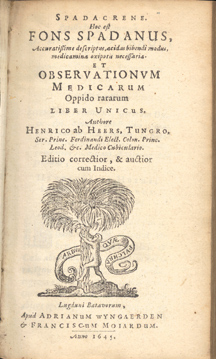
16456365Leyde, Adrianus Wyngaerden et Franciscus Moiardus, 1645 ; in-12 ; plein vélin ivoire rigide, titre manuscrit au dos (reliure de l'époque) ; (1) f. blanc, (22), 159, (15) pp. (index) ; (8), 254, (23) pp., (1 bl.), (2) ff. blancs.
1947100148297Les Editions de l'Elan 1947 in12. 1947. Relié.
1947100148652L'Elan 1947 in12. 1947. Broché. Édition originale de 1947 du roman "Sous le signe du vampire" de Maurice Constantin-Weyer publié par L'Elan. Un des 100 exemplaires numérotés du tirage de tête sur vélin Lafuma
1952015764Paris Pierre Seghers 1952 In-4 Broché à la japonaise Signé par l'auteur
85539Grasset, 1956, 1 volume de 195x240 mm environ, 53 pages, broché sous couverture rouge rempliée. Edition originale, Exemplaire N° 55, un des 3000 sur Vélin de Rives numérotés de 1 à 2700, avec un envoi de l'auteur sur la page de faux-titre. Petits frottements sur le haut et le bas du dos et sur les coupes inférieures, sinon bon état.
19475446Éditions Tiranty 1947 460 pages in8. 1947. broché. 460 pages.
191396908Leipzig, Xenien-Verlag, 1913. 82 S. 25 cm. OHPgt.
1943001377Paris Grund 1943 In-4 En ff., couv., chemise et étui
1930005585Paris Gallimard 1930 In-12 Broché Edition originale
27Fribourg, Egloff, 1944 16 x 22, 266 pp., broché, très bon état
190996334München, Hyperion, 1909. 3 Bll. Vakat, 33 Bll., 2 Bll Vakat. Mit 32 tls. farb. Lithpographien a. Taf. Folio. 49,5 cm. OHPgt. m. Ganzgoldschnitt.
193067582Berlin, Atlantis-Verlag, [1930]. XLVI, 280 S. Mit zahlr. Abb. in Kupfertiefdruck (= Orbis terrarum, Reihe 1,4). OHPgt. Mit Kopfgoldschnitt.
3252In 4 en feuillets,couverture rempliée,avec titre en bleu, au dos,et sur le premier plat.Titre illustré d’un dessin d’Albert MARQUET,143 pages,1 feuillet justificatif de tirage.7 illustrations d’Albert MARQUET.24 aquarelles et 23 dessins gravés sur bois.Jacques Klein éditions de la Cigogne 28 février 1950.Casablanca-Paris.Un des 185 exemplaires numérotés sur Rives à la forme,deuxième et dernier grand papier(tirage total 225 exemplaires plus 25 exemplaires réservés aux collaborateurs)chemise cartonnée, dos muet toile bleue, plats avec papier imitation paille tressée.emboîtage cartonné toilé bleu et papier imitation paille tressée;très bon état,proche de l’état de neuf,coloris très frais.
19158494Portland Maine: Thomas Bird Mosher 1915. First edition thus number 22 of 25 copies printed on Japan Vellum. 8vo 19x14cm v xvi 3 142 1pp. Two initials printed in red text printed within borders few leaves unopened. Bound in gilt stamped parchment boards and in near fine condition with bumped corners. In original plain paper jacket which shows toning and a few tears and housed in toned paper slipcase with two ownership signatures one being Primrose Rupp Hinton. <br /> <br /> Very scarce and beautiful Mosher printing on Japanese vellum. Sirenica is a 1913 novel by Leith which explores the myth of the Siren Song and the struggle by man for the unobtainable. <br /> <br /> <br /> This copy with an interesting ownership provenance from journalist Primrose Rupp Hinton who was longtime society editor for the Aberdeen Daily World in Aberdeen WA. . Thomas Bird Mosher unknown
1833250641833 Planche 304 de La Caricature N° 145.La Caricature, August 15, 1833 1833. Lithographie originale sur Velin blanc. . Delteil 67. Belle épreuve en noir et pli horizontal,plis;lithographie en noir sur velin blanc,Delteil 67,tirage bien noir malgré l'image jaunie
19023402<p> F. Lumachi publisher. 1902. Florence. Full vellum limp with leather ties. This is a nice example of one of the Florence gift bindings done around the turn of the century. The front cover is hand painted titling and decoration in a fine hand. A slight bit of discoloration to the vellum otherwise a clean unmarked copy. Yapp edges all ties present.</p> F. Lumachi hardcover books
19023402<p>F. Lumachi publisher. 1902. Florence. Full vellum limp with leather ties. This is a nice example of one of the Florence gift bindings done around the turn of the century. The front cover is hand painted titling and decoration in a fine hand. A slight bit of discoloration to the vellum otherwise a clean unmarked copy. Yapp edges all ties present.</p> F. Lumachi hardcover
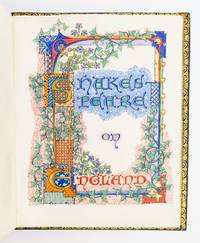
1944ST19310Sheffield England December 1944. 265 x 215 mm. 10 1/2 x 8 1/2". 6 leaves illuminated on rectos final leaf also illuminated on verso with colophon. <br/> VERY ATTRACTIVE DARK BLUE MOROCCO GILT stamped-signed "Bound by Slinn" on front pastedown upper cover with monogram of Edwin Goddard Stokes framed by gilt-ruled compartments containing gilt lettering elaborate gilt foliage and a gilt crown tool at top the panel surrounded by a double gilt rule frame and dogtooth roll border with additional foliate tools rear cover with quatrefoil design in floral tools and pointillé dogtooth roll border smooth spine with gilt-ruled compartments. In a rather worn felt-lined brown paper wallet case with handwritten titling on spine. Each recto with one or two large two- to three-line initials either painted or gilt TITLE PAGE WITH A FULL BORDER and others with a large complex border all of them elaborately painted with a variety of patterns styles motifs and with gilt embellishments one border incorporating three coats of arms AND ANOTHER PAGE WITH A QUARTER-PAGE MINIATURE OF A KNIGHT ON HORSEBACK. Trivial wear at top of front joint otherwise in pristine condition.<br/> <br/> This is a charming modern illuminated manuscript penned during WWII that contains two excerpts from Shakespeare in praise of "this other Eden demi-paradise" called England--specifically passages from John of Gaunt's dying speech in "King Richard II" and lines from "King John." As stated in the colophon the manuscript "was Designed Written out and Illuminated by John Wilfred Clarke of Ecclesall Sheffield for his great friend Edwin Goddard Stokes of Ringinglow Sheffield." Clarke d. 1954 was a municipal engineer and town planner by trade professions for which skill in the visual arts particularly draftsmanship is not only preferred but required. He was clearly a talented amateur with a flair for pattern and design. Though he incorporates elements found in Medieval manuscripts--trailing ivy leaves penwork decoration tessellation and line enders--the style is at the same time modern utilizing bold color combinations and layered shapes and patterns. Given the artist's location it is quite possible that he was involved with the Sheffield School of Art which was founded in 1843 and offered classes in fine arts and crafts. We know that the binder Walter Slinn d. 1964 was a staff member at the school as well as a prominent local bookbinder. Nationalistic sentiments are made clear in the choice of material celebrating England in Shakespeare's voice and this manuscript is all the more poignant when seen in the context of its time and place. Sheffield an industrial city was a major producer of steel and armaments during WWII --and thus a high-value target for German air raids. The so-called "Sheffield Blitz" of 1940 resulted in hundreds of deaths and nearly 80000 damaged homes. In December of 1944 when this manuscript was completed the end of the war was not yet in sight. Despite the bleak circumstances the manuscript radiates color light and hope. The recipient of Clarke's attractive manuscript was Edwin Goddard Stokes 1902 - ca. 1957 one of the sons of the prominent Sheffield businessman Robert James Stokes founder of R. J. Stokes & Co. a tile company that still flourishes in the city now. It is clear that this item was carefully looked after by this "great friend" of the artist. So far as we have been able to determine Clarke is an unrecorded artist except for the present Shakespeare work and one other similar manuscript featuring excerpts from Chaucer now in Stanford University Library. unknown
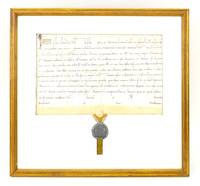
ST16379-036Rome 2 December 1210. 206 x 293 mm. 8 1/8 x 11 1/2". 12 lines in a papal documentary script. <br/> Attractively framed. Lead bulla suspended on silk threads. Very light rubbing to ink in places one horizontal and three vertical creases each with a tiny hole where the folds meet lead seal showing a bit of wear around edges and to protuberances of the faces but these faults all quite minor and on the whole an excellent specimen.<br/> <br/> Beautifully preserved and with the original lead bulla still attached this document issued by one of the most powerful popes of the Middle Ages resolves a dispute between the monastery attached to the Lateran Palace and the priory of Santi Quattro Coronati Four Holy Martyrs. The two groups seem to have been in conflict over their respective parish boundaries and the inclusion or exclusion of certain churches and therefore the tithes and legal dues stemming from those churches within their particular networks of influence. According to this bull the cardinal priest of Sts. Peter and Paul was charged with hearing their petitions; based on his report Pope Innocent III decrees that the boundaries of the priory's parish will extend to the church of St. Nicholas "de formis" on one side and the arch of John the Baptist "intra formis" on the other side with "de formis" and "intra formis" possibly referring to their relative position to certain aqueducts in the city. The document also notes that it does not alter parish boundaries as formerly defined by Pope Calixtus II r. 1119-24. The present item falls into a category of papal documents known as "litterae solemnes" comprising solemn letters and simple privileges. Though somewhat shorter and less formal than the so-called "Great Bulls" which were very large and included many marks and signatures for authentication "litterae solemnes" still followed strict rules in terms of format and appearance and included a lead seal displaying the pope's name on one side and the visages of Sts. Peter and Paul on the other as here. For a full overview of papal bulls and their various formats see Clemens & Graham "Introduction to Manuscript Studies" pp. 230-36. Innocent III born Lotario dei Conti di Segni 1160 or 1161-1216 was considered the most powerful person in Europe during his reign 1198-1216 having done much to consolidate the power of the Holy See and exert influence over the affairs of nations near and far. Notably he proclaimed the supremacy of the church over secular authority launched the Fourth Crusade which ended in the sacking of Constantinople presided over the Fourth Lateran Council excommunicated King John of England and nullified the Magna Carta and vigorously suppressed heretical sects such as the Cathars. Papal bulls issued by Innocent III seem to be of the utmost rarity on the market; we could find just one other example recorded by ABPC and RBH as sold in the past 100 years going for a hammer price of €9000 $10999 in 2013. unknown
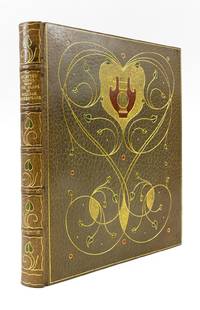
1920ST16608<p>London: Designed written out and illuminated by Alberto Sangorski Colophon 1920. 255 x 212 mm. 10 1/8 x 8 1/2". 25 3 pp.</p><p>ELEGANT LIGHT OLIVE GREEN CRUSHED MOROCCO GILT AND INLAID by Riviere for London bookseller Charles J. Sawyer stamp-signed "Chas. J. Sawyer Ltd. London" on front turn-in upper cover with inlaid mahogany-brown morocco lyre at head "strung" with gilt fillets and surrounded by dense gilt stippling six gilt fillets emanating from the top of this ornament and curling extravagantly below it with inlaid green morocco leaves at the tips of its extensions and inlaid red dots accenting the perimeter raised bands spine compartments with gilt and inlaid leaf sprig gilt titling turn-ins framed with five gilt fillets stippled and inlaid cornerpieces ivory moiré silk doublures and endleaves. In a fine full morocco plush-lined box with raised bands and gilt titling. ILLUSTRATED THROUGHOUT WITH EIGHT LARGE MINIATURES within extraordinarily elaborate illuminated borders FIVE FINE ROUNDELS FOUR LARGE HISTORIATED INITIALS a portrait of a young woman a leaping stag a skull and a landscape with a castle tower AND 25 ILLUMINATED INITIALS all with burnished gold. New expertly matched silk guards. SIGNED by Sangorski in the colophon following the statement: "This manuscript will not be duplicated." With an early typescript list of the contents laid in at front. Ratcliffe "Alberto Sangorski" SJR 338 attributing the binding to Riviere. ◆Spine slightly sunned to olive brown just a hint of sunning to head and fore edges of boards spine with half a dozen barely perceptible tiny dark spots but A VERY FINE COPY OF AN EXTRAORDINARILY BEAUTIFUL MANUSCRIPT the binding unworn and lustrous and the interior pristine with vellum clean and bright and the paintings perfectly preserved.<br /><br />Written out decorated and painted by one of the most accomplished illuminators of the modern era this attractively bound work celebrates some of Shakespeare's best-known plays with sumptuous miniatures that are in a perfect state of preservation. Songs from "The Tempest" "As You Like It" "Hamlet" "A Midsummer Night's Dream" and other works provide the inspiration for the many delightful miniatures seen here which display an impressive variety of portraits outdoor views and figural scenes--everything from reclining nudes to a particularly lush scene in which a group of spirited hunters return from the woods. The illustrations are all painted with exquisite attention to detail and demonstrate the artist's innate understanding of color rendering each composition delicate yet vigorous and vibrantly hued. All Sangorski manuscripts with miniatures are painted with great skill but this one is particularly arresting. Alberto Sangorski 1862-1932 started his professional life as secretary to a goldsmith's firm became attracted to the book arts at the age of 43 and began doing illuminated manuscripts that were then bound by his brother Francis' firm Sangorski & Sutcliffe. Sometime around 1910 Alberto and Francis had a falling out and the artist went to work for Riviere the chief competitor to his brother's firm. <br /><br />The gracefully tooled binding here was commissioned by London bookseller Charles J. Sawyer 1876-1931 who opened his shop in 1894. According to Brown and Brett's "The London Bookshop" Sawyer provided "anything suitable for a gentleman's library" with specialties in "rare items early English literature fine bindings and sporting and colour-plate books." While the binder fulfilling the commission did not sign this work Sangorski bibliographer Stephen Ratcliffe attributes it to Riviere & Son and there are examples of Riviere bindings decorated in this Art Nouveau style. But the design here with its delicate curving lines creating uncommon shapes also resembles the work done by members of the Guild of Women Binders. Whoever the artisans involved the binding is attractively designed and executed using premium materials and it provides a pleasing cover for the glorious illuminations within.</p> [D]esigned, written out, and illuminated by Alberto Sangorski [Colophon]