RASI Luigi.MareMagnum

105 166 résultats
3 voll. in-4, pp. VIII, 536; (3), 540-1068 (num. cont.); (8), 786, (2), leg. cart. color. edit. con etichetta ai piatti ant. Con ill. n.t., 4 tavv. a colori raff. costumi e ritratti, una tav. in b/n e altre 5 tavv. di facsimili di autogr. Ediz. orig., molto rara, di opera significativa per la storia del teatro italiano dal Cinquecento in avanti. Manca al cat. Pregliasco 2005. Olschki 11348: "Ouvrage fort importan pour l'histoire du theatre italien". Enciclopedia dello Spettacolo VIII, 735: "Vasta trattazione biografica dei principali attori italiani dal Rinascimento in poi [...] precisa prospettiva critica (che è quella della cultura umanistica italiana di fine Ottocento) pur nella cordialità affettuosa che lo anima, il lavoro costituisce non solo una preziosa fonte di informazioni ma anche, seppur indirettamente, un vivace profilo storico della scena italiana". Minimi dif. alle cerniere, esempl. perfettamente conservato. [S]
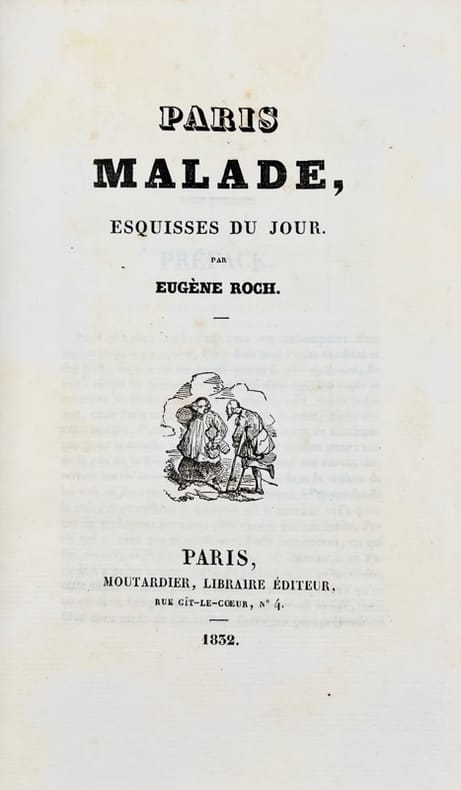
183242019Paris, Moutardier, 1832-1833. 2 vol. in-8 de 435-(1) pp. ; 384 pp., demi-veau fauve, dos orné à nerfs, pièces de titre et de tomaison en maroquin noir, tranches marbrées (reliure de l'époque).
2 ouvrages reliés en un volume in-8, plein veau de l'époque, dos à 5 nerfs fleuronné et cloisonné, tranches rouges. 1- Edition originale. La réponse de Rousseau à l'article "Genève" qui venait de paraître dans l'Encyclopédie, dans lequel D'Alembert suggérait des réformes pour la ville de Genève: projet pour une "cité philosophe" de liberté politique et culturelle, notamment par la levée de l'interdiction d'un théâtre permanent. Rousseau résume dans sa critique tout ce qu'il dénonçait déjà comme une illusion: "le théâtre comme école de l'hypocrisie, le bel esprit, la civilité telle qu'on la conçoit à Paris sont inconciliables avec les mœurs de véritables citoyens. Ses thèses sur les spectacles ne sont qu'un aspect de sa réflexion sur la modernité: à quelles conditions la république est-elle possible ? Comment lier adéquatement morale, esthétique et politique" (B. Bachefen, ENS éditions). (Gagnebin, V, 1812. Tchemerzine-Scheler, V, 535). 2- Edition originale et unique de cet ouvrage composé par Paul-Antoine Nolivos de Saint-Cyr, qui rencontra Rousseau à Venise. Membre de la "coterie holbachique", l'auteur était un proche de madame d'Holbach. Devenu "Laval", comédien aux portes de Genève, il mène ici une polémique ardente pour "venger" d'Alembert et Voltaire de la 'Lettre sur les spectacles' de Rousseau. "Apologie de la comédie et des comédiens en réponse à Rousseau. C'est sans contredit le meilleur de tous les ouvrages qui parurent en réplique à cette lettre" (Quérard, 'Supercheries littéraires', 1847, II, n°3889). (Conlon, 'Ouvrages relatifs à J.-J. Rousseau', n°87. Soleinne, 'Bibliothèque dramatique', V, I, n°674). Quelques épidermures. Coiffes restaurées. Mors frottés et fendillés. Intérieur frais.
366322 ouvrages reliés en un volume in-8, plein veau de l'époque, dos à 5 nerfs fleuronné et cloisonné, tranches rouges.
Edizione originale. CON DEDICA Esemplare numero 144 di una tiratura 1-300 «sur Lafuma», pregiato da dedica autografa dell’autore Le Bret. Mancanza all’angolo di testa della prima carta (rimozione del destinatario della dedica), per il resto in ottime condizioni. Il saggio è impreziosito da dieci xilografie di gusto futurista della Saint-Point: un autoritratto e nove pose “metachoriche”. «Ancora nel 1913, presenta al Théatre des Champs-Elysées la Métachorie, genere di espressione corporale attraverso cui cerca di introdurre nel balletto i principi della rivoluzione estetica avvenuta in pittura. [...] L’idea [...] anticipa i principi enunciati da Marinetti nel suo manifesto sulla danza e ne prefigura gli esiti successivi. Nel 1917, il balletto Métachorie viene eseguito dall’autrice sulla scena del Metropolitan Opera House di New York, dopo aver fatto il giro in Europa» (Diz. Fut., p. 377a). «La complessità di questa danza pantomimica sperimentale è risolta iconograficamente nel 1923 grazie all’ausilio della xilografia: nel libretto di Henri Le Bret “Essai sur Valentine de Saint-Point” esce una suite di nove incisioni raffiguranti i “gestes métachoriques”; i legni sono lavorati direttamente da Saint-Point, che sigla “VSP”, e offrono spunti sicuramente futuristi nel tentativo di registrare insieme movimento e simbologia della danza “ideista”. La figurazione dei volumi del corpo tramite brevi tratti di punta fitti e sottili, usati poi in spirali e volute a rendere movimento ed energia, fa pensare ad alcuni momenti di Marchi e soprattutto a Spartaco di Ciolo: con la differenza, non banale, che qui l’artista inverte il segno negativo-positivo e usa i bianchi per i contorni, alla maniera delle “impressioni sulla lavagna”, come Bot amava chiamarle» (I futuristi e l’incisione, p. 93). Salaris, Pentagramma elettrico, pp. 122-124; Ead., Filippo Tommaso Marinetti (Firenze 1988), p. 121 nn. 154-161; I futuristi e l’incisione (2018), n. 118
Edizione originale. Eccellente esemplare, freschissimo e pulito: condizioni estremamente rara per questo tipo di edizione. Molto raro, il testo non è stato più ristampato, nemmeno nelle «Opere» pubblicate da Bompiani, ma solo parzialmente rifuso in Pirandello e la Sicilia, pubblicato dallo stesso editore nisseno nel 1961. «Una delle prime cose che ho pubblicato — più che un quarto di secolo addietro, in un volumetto che non ho più riletto e neanche visto — è un saggio intitolato “Pirandello e il pirandellismo”. Credo vi siano molte ingenuità e qualche rozzezza; ma trovano compenso in una ricerca, piuttosto accurata, di tutti gli elementi che riguardano i rapporti tra Pirandello e Adriano Tilgher, comprese alcune lettere di Pirandello, fino a quel momento inedite, che Liliana Scalero mi aveva generosamente affidato. Tema della mia ricerca, del mio saggio, erano appunto questi rapporti: dello scrittore col suo critico più lucido e perentorio; dell’uomo Pirandello con l’uomo Tilgher. Rapporti per entrambi alquanto ossessivi e che si potrebbero tout court dire pirandelliani» (Sciascia, Nero su nero, Torino 1978, p. 240). -- «Edito nel 1953, “Pirandello e il pirandellismo” vince il “Premio Pirandello” della Regione siciliana (ma nonostante questo riconoscimento, finché l'autore visse il libro non fu più ripubblicato in Italia, né egli volle che venisse inserito da Bompiani nei primi due volumi delle sue Opere complete). Sono pagine stringate e pregnanti, in virtù di quella brevitas che costituisce, nella sua pratica di scrittura, e come dimostrano quasi tutti i suoi libri, un imperativo kantiano [...]» (Monforte, I teatri di Leonardo Sciascia, p. 33).
187816920Paris, Garnier (imprimerie Motteroz), 1878 ; fort in-12, maroquin rouge, dos à nerfs décoré aux petits fers, double encadrement des plats, chacun de 3 filets dorés, fleurons d'angles, filet doré sur les coupes, large roulette intérieure, tranches dorées (fine reliure de l'époque, non signée) ; XLIV, 461 pp. , (1) f. de table.
in-4, pp. (20, compr. tit. inc.), 254, (18), leg. m. perg. ed angoli, titolo in oro su tassello al dorso. Magnifico frontesp. fig. inc. in rame con trofei di armi, bandiere ed in alto stemma del cav. Cosimo di Castiglione, cui l'opera è dedicata. Prima edizione di questa commedia in cinque atti, in prosa, e prologo in versi. La scena ''è l'uccellatoio nel contado di Firenze''. Il testo è preceduto da un dialogo introduttivo ed accompagnato, scena per scena, da lunghe e dettagliate annotazioni, anch'esse dell'autore. Bella ed accurata veste editoriale, di grande formato, eccezionale per il XVII secolo, in quanto tutti i testi teatrali, per essere pratici e maneggevoli durante la rappresentazione, venivano stampati in formato tascabile. L'autore era fiorentino, vissuto a cavallo dei secoli XVI-XVII. Buon esemplare, puro e genuino.. Allacci 802. Clubb 794. Regenstein 568. BMC, XVII sec., 856. Michel-Michel VII, 135. Cat. Vinciana 3997..
Edizione originale. Esemplare 238 di 299 numerati, molto ben conservato (dorso lievemente scolorito, carte leggermente brunite, come usuale). Raro così. Rarissima prima prova letteraria di Giovanni Testori, censita solo in una manciata di piccole biblioteche italiane: manca alle biblioteche nazionali e al catalogo internazionale OCLC. Gli esordi del celebre scrittore e drammaturgo milanese furono indissolubilmente legati alla sorprendente attività editoriale che si andò sviluppando, nei primi anni della seconda guerra mondiale, presso il GUF di Forlì, dove Walter Ronchi aveva preso le redini dell’editrice «Pattuglia». L’attività dell’editrice nacque precisamente attorno a due filoni: quello artistico, che aveva come referente unico il diciottenne Testori, e quello teatrale, diretto invece da Paolo Grassi,-- «C’era a Forlì, ai tempi del fascismo, una rivista che si chiamava “Pattuglia”, chiusa d’autorità. Una rivista di cultura che faceva la fronda. Ricordo che facemmo anche alcune edizioni, nelle quali uscirono, fra l’altro, due piccole baggianate mie […] due cose di teatro che si intitolano ‘La morte’ — guarda un po’ — e ‘Un quadro’. Su questa rivista uscirono poi dei miei disegni, dei miei sgorbi; e i primi tentativi di critica d’arte» —Gianni Testori (cit. in La morte-un quadro, Milano 2003, p. 13) Sebastiani, Libri e riviste, p. 149; ed. Milano 2003, cur. Frasnedi & Tassani, passim
in-12, (162x88 mm), pp. 418, (2), legatura in pergamena coeva, tit. ms. al dorso e sul piatto super. Bel frontespizio inciso con Apollo che regge la lira entro la quale è iscritto il nome dell'A., fregi silogr., impresa tipogr. in fine. Prima edizione. L'Apollo è una raccolta di poesie in metri vari, mentre le tre composizioni seguenti sono più che altro componimenti destinati a rappresentazioni encomiastiche e di corte e predisposti per una successiva ''messa in musica''. Ottavio Tronsarelli, esponente di alcune Accademie romane, fra cui quella degli Ordinati e degli Umoristi, fu autore di veri e propri drammi musicali, fra cui ''Le catene di Adone'', tratto dal Marino, e di una raccolta di componimenti latini in versi, pubblicata nel 1639. ''L'isola della felicità'' è dedicata al card. Maurizio di Savoia, ''Il giuoco degli affetti'' al Duca Vittorio di Savoia e ''La Corte'' alla ''Invittissima città di Roma''. Buon esemplare (malgrado brunitura della carta e due timbri di collezioni nel margine dei due primi fogli).. Manca al Cat. Vinciana. Michel-Michel VIII, 77. BMC, XVII sec. 921..
in-4, pp. CXXIV, leg. cartonato rustico coevo. Varie belle incisioni: vignetta al titolo, elaborata testata col ritratto di Benedetto XIV cui l'opera è dedicata; 6 testate a mezza pagina, una dello Zucchi, con ritratti di pontefici ed imperatori, 4 finalini, alcune iniziali istoriate ed un gran numero di fregi tipografici, singolarmente incise in rame. Prima edizione. In questa tragedia. Il Varano riuscì ad affiancare ai suoi intendimenti religiosi un efficace nucleo drammatico, che ne fa la sua opera più stimata. Bell'esempl. a margini pieni.. Morazzoni p. 259..
Milano, dall’I. R. Stabilimento Nazionale privilegiato di Tito di Gio. Ricordi, Cont. degli Omeoni, n. 1720 e sotto il portico a fianco dell’I.R. Teatro alla Scala, 24281. (1853 anno della prima rappresentazione). In 16mo (cm. 16,8); copertina originale di lusso in stile romantico con decorazioni in rilievo in oro; pp. 40. Nella collezione di libretti rari di “Thomas Fisher - Toronto”. Dai nomi degli attori si evince che il libretto è stato utilizzato per la rappresentazione del 26 XII 1853 a Modena, Teatro Comunale. Axs
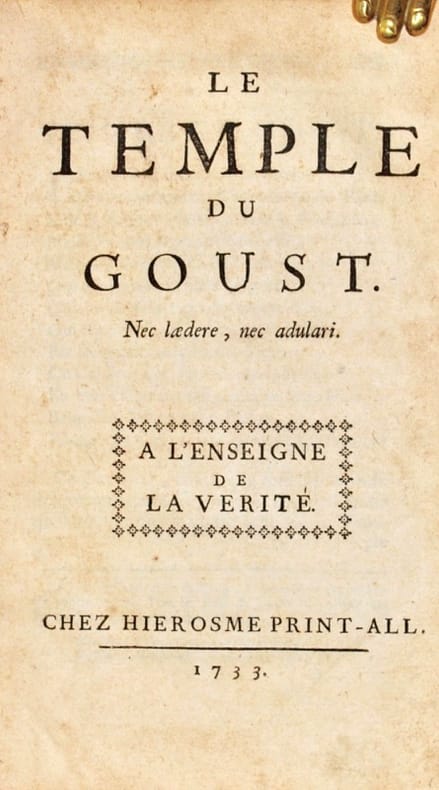
17336451A l'enseigne de la Vérité, Chez Hierosme Print-All, 1733. In-8 de (2)-63 pp.VOLTAIRE. Hérode et Mariamne, tragédie de M. de Voltaire. A Paris, Chez Noel Pissot et chez François Flahault, 1725. In-8 de (20)-95-(5) pp.VOLTAIRE. L'Indiscret, comédie de M. de Voltaire. A Paris, Chez Noel Pissot et chez François Flahault, 1725. In-8 de (2)-59-(1) pp.FAGAN (Barthélemy-Christophe). La Pupille. Représentée pour la première fois le 5 du mois de juillet 1734. A Paris, Chez Chaubert, 1734. In-8 de 62-(2) pp.Ensemble 1 vol. in-8, veau marbré havane, dos orné à nerfs, pièce de titre en maroquin rouge, tranches rouges (reliure de l'époque).
2004132996Los Angeles: Pandemonium Theatre Company 2004. An archive of 10 original posters for productions staged by Ray Bradbury's Pandemonium Theatre Company from 1988 to 2004. The plays were performed in Southern California predominantly at The Court Theatre Falcon Theatre Theatre West The Raven Playhouse and Melrose Theatre. <br /> <br /> The archive includes posters from 10 productions including "Fahrenheit 451" "The October Country" "Past Present & Future" "The Time of Going Away" and "Drunk and In Charge of a Bicycle." and his Irish play "Falling Upward!" "Falling Upward!" was one of Bradbury's favorite plays and especially as he advanced in age he was know to encourage its frequent production simply for the joy of being able to see it again. <br /> <br /> Bradbury was an avid playwright and a familiar and enthusiastic presence in the Southern California theatre circuit near his home. In 1963 he and director Charles Rome Smith founded Pandemonium Theatre Company. The two friends would go on to work with the company together for the next four decades until Rome's death in 2004. This archive is a solid representation of the company's latter half before Smith's passing and Bradbury's hearing loss which would necessitate that he stop attending performances. <br /> <br /> Posters approximately 11 x 17 inches. About Fine condition. Pandemonium Theatre Company unknown
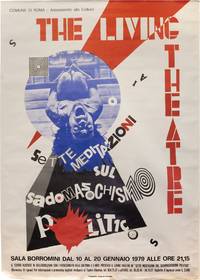
1979162878Rome: Comune di Roma 1979. Vintage poster for an Italian staging of the 1974 groundbreaking American experimental theatre production. Staged in Rome at the Teatro Alberico circa 1979.<br /> <br /> Founded in 1947 in New York by Julian Beck and Judith Malina The Living Theatre is the oldest active experimental theater group in the United States. In the fifties and sixties the company became an epicenter for revolutionary culture performing both original and repertory works.<br /> <br /> "Seven Meditations" was largely written in response to the imprisonment of several members of the company under the Medici dictatorship in Brazil in 1971 drawing on their experiences of suppression and torture in the Brazilian prison system. The show addressed seven different types of actions relationships or statements governed by power including sexuality capitalism private property and law enforcement and attempted to begin a dialogue with audience members regarding ways to move forward from these dynamics. <br /> <br /> As with many of the group's performances "Seven Meditations" proved controversial and even courted obscenity charges largely due to a section of the show depicting a simulated torture scene-as shown in the poster on offer.<br /> <br /> 39 x 55 inches. Rolled. Very Good plus. Comune di Roma unknown
63-2333London: St. James Theatre 1942. 8 X 10 inch leaf with Original Autographs by Michael Redgrave Leslie Banks & Merwyn Johns on recto. From Autograph album with signatures by prominent stage actors dancers and conductors comprising photographs clipped signatures pasted onto album pages. VG. London: [St. James Theatre], 1942. unknown
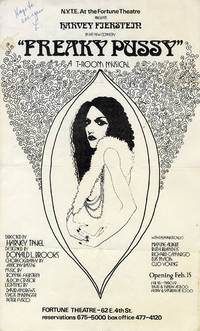
1973WALTER-FILM006850<p><em>N.Y.T.E. at the Fortune Theatre. No binding. Very Good. New York: N.Y.T.E. at the Fortune Theatre 1973. Vintage original 14 x 9" 35 x 22 cm. poster folded with a marginal note at top left in an unknown hand light stain in top left very good. </em></p><p>An exceedingly scarce mini-poster documenting a very early moment in Harvey Fierstein's career. He made his stage debut in Andy Warhol's <em>Pork</em> and appeared in two additional plays done at the La MaMa Theatre. He was all of nineteen years-old when this play made its debut.</p><p>Not in World Cat.</p> N.Y.T.E. at the Fortune Theatre
WALTER-FILM001001No binding. Very Good. Fine Art Print Vintage original 20 x 14"" 51 x 36 cm window card poster USA. In the years immediately following Stonewall there were some off-Broadway plays which depicted the lives of LGBTQ people. This one apparently a bitchy comedy about a group of young men at a gay bath house had its initial run off-Broadway first at the Mercer Arts Center then when that center had to be closed due to structural problems in the building it then moved to the Players Theatre from which this poster emanates. It was moved a year later to a Broadway production and a successful national tour followed with the gay icon Casey Donovan in the cast. Unfolded with some minor creasing and very light stains at margins VERY GOOD. unknown books
185444955San Francisco: Herald Steam Presses 1854. 1st printing presumed ca 1854. Self wrappers. Slight age-toning to paper; creases where its been folded lower quarter has been excised imperfect copy. Single sheet folded once to make four pages verso blank Unfolded: 18-7/8" x 11-3/4" <br/><br/>A scarce only other known copy at UC Berkeley Bancroft Library playbill from the early days of theatre in San Francisco with numerous reviews of the play from other newspapers. The theatre was at this time leased by Catherine Sinclair the former wife of the famous actor Edwin Forrest. This performance included a young Edwin Booth a favorite friend of Sinclair in the role of "Luis a soldier of fortune". Sinclair had to give up the theatre around 1855 due to financial difficulties but continued to support Booth despite his drinking and gambling problems. The theatre had a short run but played an integral part in the careers of both Booth and Sinclair. Montgomery Street was cut through by Columbus Ave. in 1873 and the theatre closed though a small slice of it remained until the 1906 earthquake. [Herald Steam Presses] unknown books
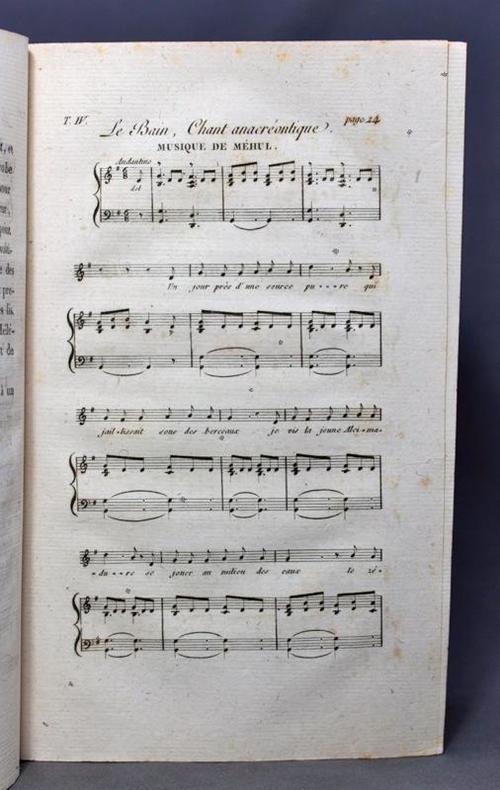
- A. Nepveu, Paris 1827, Grd. in-8 (16x24,5cm), 378pp. ; 152pp., relié. - Nouvelle édition, illustrée d'un portrait sur chine appliqué par Gérard et de 10 figures sur chine appliqué par Desenne (une par Girodet) ainsi que de 2 planches de musique de Grétry, le tout sur papier fort. Les illustrations reprennent celle de l'édition en 4 volumes donnée par Nepveu en 1826. Reliure en plein veau glacé rouge "A la cathédrale" signée en queue Thouvenin. Dos orné de divers fers à froid monastiques et de filets dorés. Grande plaque à la cathédrale sur les plats, larges fers dorés dans les angles, succession de filets dorés d'encadrement. Frise intérieure. Tranches dorées. Quelques rousseurs, notamment en page de titre. Quelques feuillets brunis. Légères traces de frottement. Très bel exemplaire dans une riche reliure à la cathédrale signée du maître dans le genre : Thouvenin. Cette édition est plus complète que celles parues plus tôt. Elle contient la correspondance de l'auteur. Le principal intérêt aujourd'hui de Ducis est son imitation des pièces de Shakespeare : Roméo et Juliette, Macbeth, Othello, Le roi Lear, toutes écrites en vers suivis ; et de Oedipe à Admette d'après Sophocle et Euripide. Pourtant adaptés au goût français, les pièces firent grand bruit et la plupart eurent un profond succès qui valurent à Ducis une grande notoriété. Ces pièces retracent la difficile acceptation par le public français du théâtre shakespearien. [ENGLISH DESCRIPTION ON DEMAND]
CCC0043611 volumes sur 12, il manque le vol.12. In-8 13 X 20 cm, Reliure d'époque plein veau marbré, frontispice de Pierre gravé par Watelet, pièces de titre rouges, tres frottés, certains dos sont usés. Il n'a que 30 gravures sur 34. Date d'édition : 1764 Reliure : Couverture rigide Etat du livre : Moyen. Photos possibles
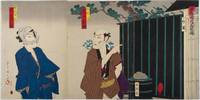
1892218409東京. Tokyo.: 福田熊治良. Fukuda Kumajiro. Meiji 25 1892. Three colour woodblock prints a triptych panels loose each 24 x 35.4cm Japanese text in red identifying the actors and in yellow identifying the roles in the upper left of two panels and program title in the top right of the third panel further text within in a red fish-shape in the lower right of the third panel some offsetting of red ink on the first panel but not affecting the main image slivers of affixing tape to the verso of each print some surface wear and abrasion mainly to the verso but the three images in very good bright condition. Dramatic depiction of the famous Kabuki actors Onoe Kikugorō V 1844-1903 as Yosaburô and Onoe Matsusuke IV 1843-1928 playing the role of Kômori Yasu in the 1892 staging of "Yowa Nasake Ukina no Yokogushi" commonly called "Kirare Yosa". <br> <br>Images such as these were collected by Kabuki fans of the day who bought woodblocks of their favourite actors and then had the prints made up into albums so that they could be enjoyed much in the way poster books and other fan memorabilia of famous movie stars is enjoyed today. <br> <br>The artist Toyohara Kunichika 1835-1900 was acclaimed as one of "The Three Greats of Meiji Ukiyo-e". Many stories surround him including his boast that he had moved 100 times which appears unlikely but this claim combined with his hard drinking womanising lifestyle and overall "live for the day" attitude all contributed to his colourful reputation. His work was very popular during his lifetime with his use of bright imported chemical dyes and his technique of focussing the image on the actors face combining to make up his individual style. see 'Time Present and Time Past: Images of a Forgotten Master' by Amy Reigle Newland. <br> <br>From the collection of the late John Caiger lecturer in Asian studies ANU. . 福田熊治良. [Fukuda Kumajiro]. unknown
120710aafA Rotterdam (à la sphère), M D CC XXXVIII., (1738), in-8vo, 4 ff. (titre - personnages - l’idée du sujet + 1 f. blanche) + 274 p. + 4 ff. (2 ff. d'errata: fautes a corr. - autres fautes + 2 ff. blanches), reliure plein veau, dos richement orné or, coiffe sup. avec manque, charnières part. fendus, sup. avec galerie de vers, avec galerie de vers, coins touchés, pages de gardes d’origine, tranches rouges.
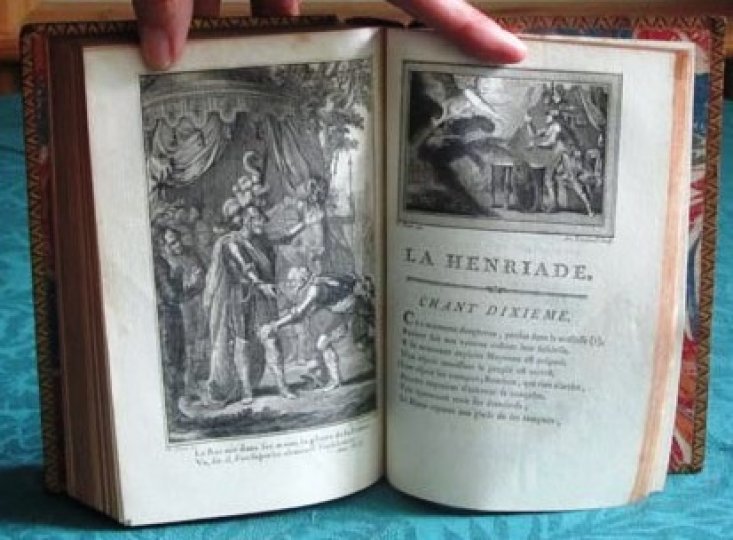
176916974Premier tirage des gravures de Eisen. A Paris, chez la Veuve Duchesne, Saillant, Desaint, Panckoucke et Nyon - 1769-1770. Ex-libris au monogramme.Ouvrage orné d'un frontispice, d'un titre gravé au portrait de Voltaire (T1), de 10 gravures et dix vignettes de chapitre de Eisen, gravées par Longueil. Bandeaux, culs-de-lampe.Préface par Marmontel. Suivi de : Essais sur la Poésie épique - Discours en Vers sur l'Homme - le Temple du Gout - le Poème de Fontenoi - Poème sur le désastre de Lisbonne.Belle reliure plein veau blond glacé de l'époque. Triple filet doré encadrant les plats avec fleurons angulaires. Dos lisse orné et doré avec pièces de titre et de tomaison vertes. Tranches dorées. Roulette intérieure. Filet sur les coupes. Pas de rousseur. Parfait état. Format in-12°(18x13).
18038426A Paris, Chez Barba, 1803. 4 volumes in-8 de [6]-CIV-444 / [6]-438-[2] / [6]-383 et [6]-XII-466-[2] pages, demi-veau brun à coins, dos lisses ornés de roulettes et filets dorés, étiquettes de titre bordeaux, pastilles de tomaison noires (chiffre arabe), tranches mouchetées. Quelques très légers frottements, quelques rousseurs, belle condition générale.