658 résultats
Original Wraps for each issue, bound by publisher into illustrated boards. 4to. [approx. 18 pages per issue]. 29 cm. Begins with the special "Yubelai Numer," April/May 1922, and running a full calendar year, though Volume/Issue numbering follows a different system! Run of Kinder Zhurnal, Wrappers in various colors, almost always with beautiful period front cover illustrations and, internally, period modernist yiddish illustrations by artists including Aaron Goodelman. "Kinder zhurnal and Farlag Matones were both founded by the Sholem Aleichem Folk Institute, an organization established in New York in 1918 to coordinate a secular Yiddish school system. Kinder zhurnal, a children's magazine, was in existence from 1920 to 1981. Its first editor, Shmuel Niger, served from 1922 to 1948. The magazine published works by writers such as Mani Leib, Aleph Katz, Jacob Glatstein, Kadia Molodowsky. " - Guide to the Yivo Archives. For more, see Naomi Tozman's 1993 masters thesis, :Kinder zhurnal: a microcosm of the Yiddishist philosophy and secular education movement in America," which can be downloaded at https://escholarship.mcgill.ca/downloads/1c18dg573?locale=en. Subjects: Children's literature, Yiddish - Periodicals. Kinder Zhurnal Kinder Journal Kinder Zshurnal Sholem Aleichem Folks Shuln. Sholem Aleichem Folk Institute (New York, N. Y. ) . Yiddish periodicals - New York (State) - New York. Jews - Education - New York (State). OCLC: 179197128. Most libraries which have any issues at all appear to have limited runs, oftentimes only a year or two. Some paper covers, with browning paper, have come loose (all are present) with a tough of edgewear, some wear to cloth, Good condition overall (YID-22-51D-E-'e)
Original Wraps for each issue, all bound together at spine but lacking boards. 4to. [approx. 18 pages per issue]. 29 cm. The publisher generally bound Vol II, Nr. 11/12 (Jan/Feb 1923) with Vol III as a 1923 volume, so is not present here. Run of Kinder Zhurnal, Wrappers in various colors, almost always with beautiful period front cover illustrations and, internally, period modernist yiddish illustrations by artists including Aaron Goodelman. "Kinder zhurnal and Farlag Matones were both founded by the Sholem Aleichem Folk Institute, an organization established in New York in 1918 to coordinate a secular Yiddish school system. Kinder zhurnal, a children's magazine, was in existence from 1920 to 1981. Its first editor, Shmuel Niger, served from 1922 to 1948. The magazine published works by writers such as Mani Leib, Aleph Katz, Jacob Glatstein, Kadia Molodowsky. " - Guide to the Yivo Archives. For more, see Naomi Tozman's 1993 masters thesis, :Kinder zhurnal: a microcosm of the Yiddishist philosophy and secular education movement in America," which can be downloaded at https://escholarship.mcgill.ca/downloads/1c18dg573?locale=en. Subjects: Children's literature, Yiddish - Periodicals. Kinder Zhurnal Kinder Journal Kinder Zshurnal Sholem Aleichem Folks Shuln. Sholem Aleichem Folk Institute (New York, N. Y. ) . Yiddish periodicals - New York (State) - New York. Jews - Education - New York (State). OCLC: 179197128. Most libraries which have any issues at all appear to have limited runs, oftentimes only a year or two.Light wear to outer wrappers at first and final issue, touch of worming to two issues, Overall Good+ condition. (YID-22-51B-L-'e)
Original Wraps for each issue, all bound into publisher's distinctive illustrated boards. 4to. [approx. 18 pages per issue]. 29 cm. Run of Kinder Zhurnal, Wrappers in various colors, almost always with beautiful period front cover illustrations and, internally, period modernist yiddish illustrations by artists including Aaron Goodelman. "Kinder zhurnal and Farlag Matones were both founded by the Sholem Aleichem Folk Institute, an organization established in New York in 1918 to coordinate a secular Yiddish school system. Kinder zhurnal, a children's magazine, was in existence from 1920 to 1981. Its first editor, Shmuel Niger, served from 1922 to 1948. The magazine published works by writers such as Mani Leib, Aleph Katz, Jacob Glatstein, Kadia Molodowsky. " - Guide to the Yivo Archives. For more, see Naomi Tozman's 1993 masters thesis, :Kinder zhurnal: a microcosm of the Yiddishist philosophy and secular education movement in America," which can be downloaded at https://escholarship.mcgill.ca/downloads/1c18dg573?locale=en. Subjects: Children's literature, Yiddish - Periodicals. Kinder Zhurnal Kinder Journal Kinder Zshurnal Sholem Aleichem Folks Shuln. Sholem Aleichem Folk Institute (New York, N. Y. ) . Yiddish periodicals - New York (State) - New York. Jews - Education - New York (State). OCLC: 179197128. Most libraries which have any issues at all appear to have limited runs, oftentimes only a year or two. Two issues show some toning, three cover pages have come loose but are present. Some wear to spine. Overall Good condition. (YID-22-51A-L-'e)
Original Wraps for each issue, all bound into publisher's distinctive illustrated boards. 4to. [approx. 18 pages per issue]. 29 cm. Run of Kinder Zhurnal, Wrappers in various colors, almost always with beautiful period front cover illustrations and, internally, period modernist yiddish illustrations by artists including Aaron Goodelman. "Kinder zhurnal and Farlag Matones were both founded by the Sholem Aleichem Folk Institute, an organization established in New York in 1918 to coordinate a secular Yiddish school system. Kinder zhurnal, a children's magazine, was in existence from 1920 to 1981. Its first editor, Shmuel Niger, served from 1922 to 1948. The magazine published works by writers such as Mani Leib, Aleph Katz, Jacob Glatstein, Kadia Molodowsky. " - Guide to the Yivo Archives. For more, see Naomi Tozman's 1993 masters thesis, :Kinder zhurnal: a microcosm of the Yiddishist philosophy and secular education movement in America," which can be downloaded at https://escholarship.mcgill.ca/downloads/1c18dg573?locale=en. Subjects: Children's literature, Yiddish - Periodicals. Kinder Zhurnal Kinder Journal Kinder Zshurnal Sholem Aleichem Folks Shuln. Sholem Aleichem Folk Institute (New York, N. Y. ) . Yiddish periodicals - New York (State) - New York. Jews - Education - New York (State). OCLC: 179197128. Most libraries which have any issues at all appear to have limited runs, oftentimes only a year or two. Overall very clean and fresh, not aged, and well kept. Some wear to cloth on spine, internally very clean and nice, overall about Very good- condition. (YID-22-51-L-'e)
1st Yiddish edition. Original decorated boards. 8vo. 288, 309, 350, 485, 275, 402 pages [1834 pages total![, 23 cm. Title translates to The Deluge. Yiddish translation of Henryk Sienkiewicz masterpiece historical novel The Deluge. It was originally published as a trilogy in 1886 and tells a story of a fictional Polish-Lithuanian Commonwealth soldier and noble Andrzej Kmicic and shows a panorama of the Commonwealth during its historical period of the Deluge, which was a part of the Northern Wars (Wikipedia, 2019). SUBJECTS: Polish fiction -- Translations into Yiddish. OCLC lists 9 copies worldwide (OCLC:173031593). Ex-library with usual markings. Cloth on all volumes are lightly worn. Pages browning as expected with interwar paper, but not too bad. Overall good condition. (YID-33-52'elx)
1st edition. Original boards. 8vo. 134, 160, 191, 128, 160, XIV +80, 174 columns (2 columns per page). 25 cm. In Yiddish. Title translates to Language and Science. Complete 1910 run of obscure Vilna periodical that ran from 1909-1912. Includes poetry and prose by David Einhorn and H.N. Bialik. The final undated/unnumbered issue in this run does not appear to be missing a masthead page, as all columns/pages are present, and it is titled Lebn un Visenshaft at the top of each page, but has no indication of where it fits in the series. Includes errata slip tipped in at end. The Dec 1910 issue has a typo on the masthead indicating "Vol II," No. 12 but it is obviously Vol I, No. 12 because of it's place in the sequence. SUBJECTS: Jews -- Lithuania -- Periodicals. OCLC: 19048526. Binding repaired. Internally very good condition. Rare and important. (YID-33-68-ELX)
1st edition. Period boards. 8vo. pages 315-438; 125, 119, 123 + ads. [490 pages total + ads] . 24 cm. In Yiddish. Nrs. 9-11 sub-titled: "Di yudishe velt." Title translates to Literature and Life: The Jewish World Literary Social Monthly. Featuring some of the biggest names in Yiddish literature, such as I. L. Peretz and Shalom Asch. It appears that 3 volumes were published between 1914-1915. SUBJECTS: Jews -- Periodicals. OCLC lists 23 copies worldwide (OCLC 19048582) . Small tear to title page, paper bright, binding solid Very Good+ Condition. (YID-40-68A-'++)
1st edition. Original, beautifully illustrated boards. 8vo. 745 pages, 23 cm. In Yiddish. Title translates to The New Life. A complete 1st year of this important Yiddish monthly. Zhitlowsky, an immigrant socialist revolutionary, sought to synthesize socialism with nationalism as early as 1883. He demanded for Jews "national equal rights with all peoples" and asserted that only through the Yiddish language could the social and national revival of the Jewish people be effected. He maintained that one could remain identified with the Jewish nationality even if abandoning the Jewish religion. He urged the Jewish masses to participate in the class struggle as a national unit. Alone among the cosmopolitan Jewish socialists he favored national socialism. In 1897 he began publishing philosophical studies in Jewish history and a comprehensive program of action which later appeared in book form as Pisma o starom I novom yevreystvie ("Letters on Old and Modern Judaism, " 1907) . His main thesis was that national consciousness consists mainly of spiritual-cultural determinants and that these national characteristics can be maintained by the Jews in the future in the lands of their dispersion, just as they have survived the lack of territory or unity of language since the end of the second commonwealth. After emancipation of the individual the Jews as a group should be granted national self-government within the framework of the state along with other national minorities. His secularization of the national idea as opposed to those who saw the essence of Judaism in religion, and his optimistic view of the future of Judaism in the Diaspora, were the main underpinnings of his insistence on national cultural autonomy. Zhitlowsky was "in favor of the centrality of Yiddish in the national Jewish experience and labored toward the recognition of that language, and of those who lived out their lives in it, as one of the several cultural linguistic communities of Eastern Europe, and of the Western world as a whole" (Isaac Levitas, et al, in EJ) . Ex-library with usual, minimal markings. Lacks Zhitlowskys original 16 page prologue entitled This program and the dissemination of the monograph The New Life and the title page of issue one. Boards fading and worn, but in tact; hinges starting. Internally Very Good with original illustrated boards. (YID-30-11)
1st edition. Period boards. 8vo. 15 pages each, 31 cm. In Yiddish. Title translates to Jewish Literary World. Vokhenshrif? Far li? Era? Ur, ? Uns? , kritik un kultur-fragen. " Abraham Reisen was leading Yiddish writer and a founder (with his brother Zalman, Chaim Zhitlovsky, I. L. Peretz, and his close friends Scholem Asch and Hersch Dovid Nomberg) of the Yiddishist movement and took part in the Czernowitz Yiddish Language Conference of 1908 at which Yiddish was proclaimed a national language of the Jews (Wikipedia, 2019) . SUBJECTS: Yiddish literature - periodicals. OCLC lists 16 copies worldwide (OCLC: 33025197) . Ex-library with usual markings. Binding is starting. Some pages are lightly worn. Overall Very good condition. (YID-32-25-DL)
First and only edition of this extremely rare and important bibliography of books and manuscripts in Hebrew and Yiddish up to 1863, with the almost equally rare supplement. Over 15,000 items thoroughly described. Title-pages in Hebrew, Russian, Latin, and German. Text in Hebrew (some titles in Yiddish), in two columns. Over 700 pp. Printed in a very small edition, much of which has surely been destroyed. WITH THE 481-PAGE SUPPLEMENT BY MENACHEM MENDEL SLATKINE, published in 1965. Slatkine provides numerous additions, corrections, and notes to the original work, as well a s a complete index. Small 4tos. Bound in original hardcover bindings. Light wear, else fine and bright. Slatkine also has dustjacket (none issued with Benjacob). Brisman gives a long, detailed, and highly favorable account of these works (A History and Guide to Judaic Bibliography, pp. 19-24, 33, etc.), in which he calls them "the most reliable and accurate Hebrew bibliography."
1st edition. Original boards. 8vo. 12 issues per year, each issue is 31 pages. 26 cm. April 1922-April 1923. Periodical ran from 1920-1951. Features Yiddish literature (generally short stories) , along with illustrations and songs. Edited by Beyle Schaechter-Gottesman (1920-2013) , the well-known American Yiddish poet and songwriter. Schaechter-Gottesman won the 2005 National Heritage Fellowship awarded by the National Endowment of the Arts (the highest honor in the folk and traditional arts) . She was the first Yiddish poet to receive this honor (Wikipedia, 2019) . SUBJECTS: Children's literature, Yiddish -- Periodicals. Boards lightly faded. Issues are coming loose from boards. Pages browning but good. (YID-33-81)
Folio (Large); 1st edition. Period Cloth, Folio (newspaper), ca 600 pages. Bound volume of the ACWA's Yiddish paper. (Its English language counterpart was called ADVANCE) The Amalgamated Clothing Workers of America originalted as a heavily Jewish & Italian union out of the successful 1910 strike against Hart, Schaffner & Marx in Chicago, aided by middle class progresssives like Jane Addams and the Women's Trade Union League. "Among it's founding cadre, " note Buhle, Buhle & Georgakas (Encyclopedia of the American Left, pp. 16-18) , "nearly every variety of left-wing politics was represented: Lithuanian revolutionary nationalism, Bohemian free-thought, Italian syndicalism, the revoltionary unionism of the IWW, Jewish and Italian anarchism, the orthodox socialism of the American Socialist Party...and thetactically bolder socialism of the Jewish Bund. " This political rainbow is cleary evident in the pages of the FORTSCHRITT.SUBJECT(S): Jews -- Employment -- Periodicals. Labor unions. OCLC: 40576795. OCLC lists 5 holdings, of unclear completeness, worldwide (JTS, U of I, Dept of Labor, YIVO, IISH). Front board has edgewear, paper is browning and somehwat fragile, but with minimal wear . Good Condition thus. (yid-35-2)
1st edition. Period boards. 8vo. 119, 123, 122, 124, 124, 126, 123, 60 pages. 24 cm. In Yiddish. Title translates to Literature and Life: The Jewish World Literary Social Monthly. Featuring some of the biggest names in Yiddish literature, such as I. L. Peretz and Shalom Asch. These 3 volumes, published between 1914-1915, appear to be the only one published; we could find no record of later issues anywhere. SUBJECTS: Jews -- Periodicals. Contains OCLC lists 23 copies worldwide (OCLC 19048582) . Ex-library with usual markings. Bound out of order. Edge wear to boards. Contents are very good. Binding is starting. Overall Good Condition. (YID-40-68)
Both 1st editions, bond together (apparently as issued? ) . Original boards. 8vo. 310, 139, 180 pages. 23 cm. In Yiddish. Titles translates to The Jewish Peoples Library: A Book for Literature, Critique, and History and Yossi the Nighingale: A Novel. Sholem Aleichem was probably the most important Yiddish author and playwright. Apart from his own literary output, Sholem Aleichem used his personal fortune to encourage other Yiddish writers. In 188889, he put out two issues of an almanac, Di Yidishe Folksbibliotek ("The Yiddish Popular Library") which gave important exposure to young Yiddish writers. In 1890, after he lost his entire fortune, he could not afford to print the almanac's third issue, which had been edited but was subsequently never printed (Wikipedia, 2018) . SUBJECTS: Yiddish literature. OCLC lists 9 copies worldwide (OCLC: 44873369) . Moderate wear to boards. Pages lightly soiled in margins. Overall Very Good Condition. Important. (YID-41-4)
1st edition. Original binding with leather spine and gold gilt lettering. 8vo. 745 pages, 23 cm. In Yiddish. Title translates to The New Life. A complete 1st year of this important Yiddish monthly. Zhitlowsky, an immigrant socialist revolutionary, sought to synthesize socialism with nationalism as early as 1883. He demanded for Jews "national equal rights with all peoples" and asserted that only through the Yiddish language could the social and national revival of the Jewish people be effected. He maintained that one could remain identified with the Jewish nationality even if abandoning the Jewish religion. He urged the Jewish masses to participate in the class struggle as a national unit. Alone among the cosmopolitan Jewish socialists he favored national socialism. In 1897 he began publishing philosophical studies in Jewish history and a comprehensive program of action which later appeared in book form as Pisma o starom I novom yevreystvie ("Letters on Old and Modern Judaism, " 1907) . His main thesis was that national consciousness consists mainly of spiritual-cultural determinants and that these national characteristics can be maintained by the Jews in the future in the lands of their dispersion, just as they have survived the lack of territory or unity of language since the end of the second commonwealth. After emancipation of the individual the Jews as a group should be granted national self-government within the framework of the state along with other national minorities. His secularization of the national idea as opposed to those who saw the essence of Judaism in religion, and his optimistic view of the future of Judaism in the Diaspora, were the main underpinnings of his insistence on national cultural autonomy. Zhitlowsky was "in favor of the centrality of Yiddish in the national Jewish experience and labored toward the recognition of that language, and of those who lived out their lives in it, as one of the several cultural linguistic communities of Eastern Europe, and of the Western world as a whole" (Isaac Levitas, et al, in EJ) .Includes volume title pages and Zhitlowskys 16 page prologue (usually missing) entitled This program and the dissemination of the monograph 'The New Life.' Ex-library with usual, minimal markings. Binding repaired. Pages are clean and good. Good condition. (YID-30-6)
1st edition. Period boards. 4to. 14 pages each, 33 cm. In Yiddish. Title translates to The Jewish Militant. Complete second year run. An important Labor Zionist periodical of Poale Zion, initially published in Philadelphia from 1906-1907 before moving to New York from 1907-1920. US Poale Zion published a Yiddish newspaper, the Yidisher Kempfer, and an English journal, Jewish Frontier, edited by Hayim Greenberg and Marie Syrkin (Wikipedia, 2018) . SUBJECTS: Labor Zionism -- United States -- Periodicals. OCLC lists 3 copies worldwide (NYPL, YIVO, Harvard) . Boards defective, pages wavy from old dampness, but contents are good. (AMR-54-13)
1st edition. Original boards. 8vo. 690, 16 pages. 23 cm. In Yiddish. Title translates to The New Life. A complete second year of this important Yiddish monthly. Zhitlowsky, an immigrant socialist revolutionary, sought to synthesize socialism with nationalism as early as 1883. He demanded for Jews "national equal rights with all peoples" and asserted that only through the Yiddish language could the social and national revival of the Jewish people be effected. He maintained that one could remain identified with the Jewish nationality even if abandoning the Jewish religion. He urged the Jewish masses to participate in the class struggle as a national unit. Alone among the cosmopolitan Jewish socialists he favored national socialism. In 1897 he began publishing philosophical studies in Jewish history and a comprehensive program of action which later appeared in book form as Pisma o starom I novom yevreystvie ("Letters on Old and Modern Judaism, " 1907) . His main thesis was that national consciousness consists mainly of spiritual-cultural determinants and that these national characteristics can be maintained by the Jews in the future in the lands of their dispersion, just as they have survived the lack of territory or unity of language since the end of the second commonwealth. After emancipation of the individual the Jews as a group should be granted national self-government within the framework of the state along with other national minorities. His secularization of the national idea as opposed to those who saw the essence of Judaism in religion, and his optimistic view of the future of Judaism in the Diaspora, were the main underpinnings of his insistence on national cultural autonomy. Zhitlowsky was "in favor of the centrality of Yiddish in the national Jewish experience and labored toward the recognition of that language, and of those who lived out their lives in it, as one of the several cultural linguistic communities of Eastern Europe, and of the Western world as a whole" (Isaac Levitas, et al, in EJ) . Ex-library with usual, minimal markings. Some wear to boards. Binding repaired. Contents clear. Good+ Condition. (YID-30-9)
Original Wraps for each issue, bound by publisher into illustrated boards. 4to. [approx. 18 pages per issue]. 29 cm. Begins with the special "Yubelai Numer," April/May 1922, and running a full calendar year, though Volume/Issue numbering follows a different system! Run of Kinder Zhurnal, Wrappers in various colors, almost always with beautiful period front cover illustrations and, internally, period modernist yiddish illustrations by artists including Aaron Goodelman. "Kinder zhurnal and Farlag Matones were both founded by the Sholem Aleichem Folk Institute, an organization established in New York in 1918 to coordinate a secular Yiddish school system. Kinder zhurnal, a children's magazine, was in existence from 1920 to 1981. Its first editor, Shmuel Niger, served from 1922 to 1948. The magazine published works by writers such as Mani Leib, Aleph Katz, Jacob Glatstein, Kadia Molodowsky. " - Guide to the Yivo Archives. For more, see Naomi Tozman's 1993 masters thesis, :Kinder zhurnal: a microcosm of the Yiddishist philosophy and secular education movement in America," which can be downloaded at https://escholarship.mcgill.ca/downloads/1c18dg573?locale=en. Subjects: Children's literature, Yiddish - Periodicals. Kinder Zhurnal Kinder Journal Kinder Zshurnal Sholem Aleichem Folks Shuln. Sholem Aleichem Folk Institute (New York, N. Y. ) . Yiddish periodicals - New York (State) - New York. Jews - Education - New York (State). OCLC: 179197128. Most libraries which have any issues at all appear to have limited runs, oftentimes only a year or two.Bit of discoloration to illustration boards, otherwise an excellent copy with no damage, Very good condition (YID-22-51D-L-'e)
Original Wraps for each issue, all bound into publisher's distinctive illustrated boards. 4to. [approx. 18 pages per issue]. 29 cm. Run of Kinder Zhurnal, Wrappers in various colors, almost always with beautiful period front cover illustrations and, internally, period modernist yiddish illustrations by artists including Aaron Goodelman. "Kinder zhurnal and Farlag Matones were both founded by the Sholem Aleichem Folk Institute, an organization established in New York in 1918 to coordinate a secular Yiddish school system. Kinder zhurnal, a children's magazine, was in existence from 1920 to 1981. Its first editor, Shmuel Niger, served from 1922 to 1948. The magazine published works by writers such as Mani Leib, Aleph Katz, Jacob Glatstein, Kadia Molodowsky. " - Guide to the Yivo Archives. For more, see Naomi Tozman's 1993 masters thesis, :Kinder zhurnal: a microcosm of the Yiddishist philosophy and secular education movement in America," which can be downloaded at https://escholarship.mcgill.ca/downloads/1c18dg573?locale=en. Subjects: Children's literature, Yiddish - Periodicals. Kinder Zhurnal Kinder Journal Kinder Zshurnal Sholem Aleichem Folks Shuln. Sholem Aleichem Folk Institute (New York, N. Y. ) . Yiddish periodicals - New York (State) - New York. Jews - Education - New York (State). OCLC: 179197128. Most libraries which have any issues at all appear to have limited runs, oftentimes only a year or two. Gorgeous flawless copy, a stunning copy, Very good+ condition. (YID-22-51-L-'e)
193743101Kharkov: Ukrmelukhenatsmindfarlag 1937. First edition. Original illustrated paper wrappers 8vo issues range from 129-196 pages each. Includes illustrations. 21-23 cm. In Yiddish. Title translates roughly as “Challenge: A Literary Artistic and Critical Bibliographical Journal.â€<br> At the time the only Yiddish literary periodical in Ukraine.<br> Farmest 1933–1937 was a monthly Yiddish literary magazine published in Kharkhiv Ukraine by the Ukrainian Committee for Soviet Writers. “Edited by the poet Itsik Fefer 1900–1952 it was continued in Sovetishe literatur: Literarish-kinstlerisher un kritish-bibliografisher zhurnal Soviet Literature: Literary-Artistic and Critical-Bibliographical Journal; 1938–1941.<br> In 1927 Fefer was a founding member of the Jewish Section of the All-Ukrainian Union of Proletarian Writers and from 1928 one of the editors of its Kharkov-based journal Prolit Proletarian Literature. He also coedited the nonproletarian Kharkov journal Di royte velt The Red World from 1929. From 1933 to 1937 he edited the Kiev periodical Farmest Challenge; known as Sovetishe literatur Soviet Literature between 1938 and 1941 which replaced Prolit and Di royte velt and was thereafter the only Yiddish literary periodical in Ukraine.†YIVO. Avrom Gontar was also involved in the collective and editorial committee. <br> The editor Itsik Fefer 1900–1952 “began writing poems in 1918 and in 1922 joined Vidervuks New Growth in Kiev a group of young Yiddish literati whose mentor was Dovid Hofshteyn. That same year the appearance of Fefer’s small collection Shpener Splinters established him as a rising literary star. His poetry amalgamated the Kultur-lige poets’ revolutionary romanticism with the propagandist objectives of the workers’ movement.<br> Fefer was known for his literary credo of proste reyd simple speech a concept he formulated in 1922. In the early 1920s poetry particularly avant-garde poetry swamped the literary pages of Soviet Yiddish periodicals. This phenomenon worried editors and critics who were wary of the fact that Yiddish readers usually could not identify with this style of literature. All Yiddish readers by contrast could understand Fefer’s proste reyd.<br> In 1927 Fefer was a founding member of the Jewish Section of the All-Ukrainian Union of Proletarian Writers and from 1928 one of the editors of its Kharkov-based journal Prolit Proletarian Literature. He also coedited the nonproletarian Kharkov journal Di royte velt The Red World from 1929†Gennady Estraikh.<br> For more see: Gennady Estraikh “The Kharkiv Yiddish Literary World 1920s–Mid-1930s†East European Jewish Affairs 32.2 2002: 70–88; Chone Shmeruk “Yiddish Literature in the U.S.S.R.†in The Jews in Soviet Russia since 1917 ed. Lionel Kochan pp. 242–280 London and New York 1970.<br> SUBJECTS: Yiddish literature -- Ukraine -- Periodicals. Yiddish literature. OCLC: 35051038.<br> Some pages brittle some wear to spines. Overall Good Condition. Rare. YID-46-2-LGG-’excc. Kharkov: Ukrmelukhenatsmindfarlag unknown
First edition. Original Printed Wrappers, 8vo, 6, 8, 12, 32 pages ; 26 cm. In Yiddish. Title translates as, A Bouquet of Flowers: In Four Parts. Singerman 4953. Contents: 1. Ale Lider fun Akaydes Yitshak, fun A. Goldfaden; 2. Kupleten un Folks Lider, fun M. Avramovits [Max Avramovich]; 3. Ale Lider fun Kuzari, fun Prof. Hurvits; & Anekdoten, fun G. Broyda. Abraham Goldfaden, (18401908), was a Yiddish poet, dramatist, composer, and father of the Yiddish theater. Born in Staro Konstantinov, Ukraine, he received not only a thorough Hebrew education but also acquired a knowledge of Russian, German, and secular subjects. To avoid the draft, Goldfaden was sent to a government school at 15 and there came under the influence of his teacher Abraham Ber Gottlober, a Hebrew writer who was also a lover of Yiddish. Graduation from this school in 1857 permitted Goldfaden to enter the rabbinical seminary at Zhitomir, which trained rabbis, teachers, and Jewish officials for government service. Under the guidance of sympathetic teachers, including such leaders of the Haskalah movement as E. Z. Zweifel, H. S. Slonimsky, and Gottlober, he was encouraged to compose Hebrew lyrics. The first of these were published in 1862 in Ha-Meliz. A year later Goldfaden's first Yiddish poems appeared in Kol Mevasser. In 1865 Goldfaden published a booklet of his Hebrew songs Zizim u-Ferahim. In 1866, the year of his graduation as a teacher, his first collection of Yiddish songs Dos Yudele offered rich material for badhanim and folksingers. It was followed by a supplementary booklet Di Yudene (1869). In 1875 he joined a former classmate Isaac Joel Linetzki in founding and editing in Lemberg a short-lived humorous magazine Der Alter Yisrolik. Goldfaden then went to Rumania where he came in contact in Jassy with the Broder Singers, who were singing and acting out Yiddish songs, including his own, in wine cellars and restaurant gardens. He then conceived the idea that the dramatic effect of the songs and impersonations could be heightened if they would be combined with prose dialogues and woven into an interesting plot. He gathered a few singers and rehearsed with them scenarios composed by himself. The first performances in October 1876 initiated the professional Yiddish theater. Encouraged by the enthusiastic reception accorded his performances in Jassy, Goldfaden engaged wandering minstrels and cantors' assistants as additional actors, toured other Rumanian cities, including Bucharest, and then went to Odessa. By 1880 his troupe was giving performances throughout Russia and his phenomenal success was encouraging theatrical ventures by other enterprising actors and librettists. The Yiddish theater expanded and flourished until 1883, when the Russian government, fearing this new mass medium, banned performances in Yiddish. This action compelled authors, actors, and producers to migrate to other lands. Yiddish theaters were established in Paris, London, and New York. In 1887 Goldfaden was invited by some of his actors who had moved to New York to join them, but when he arrived he encountered severe competition from producers who had preceded him and from scriptwriters who were even more prolific than he. He found Europe more congenial and returned to produce and direct performances of his plays in London, Paris, and Lemberg. He returned to the United States in 1903 and spent his last five years in New York. Many of Goldfaden's 60 plays - not all of them published - continued to be adapted by actors and producers and entered into the permanent repertoire of the Yiddish theater. His characters from Schmendrik and Kuni Lemel to Hotzmakh, the good-natured peddler, and Bobbe Yakhne, the malevolent witch, have been real figures to several generations of theatergoers. (EJ, 2007).OCLC: 41454623. OCLC and Singerman together list 3 copies worldwide (Harvard, NYPL, NLI), with the NYPL copy described as defective. Scarce. Our copy: Paper brown, old damps stains, edgewear. Good- Condition. (YID-42-14)
1st edition. 4to, Original Paper Wrappers, 8 pages each issue, 13 numbers in 12 separate issues, as published. In Yiddish. Title translates as Bulletin of the Bund. Complete run of this early post-Holocaust iteration the Bunds monthly newsletter (also serving Kindred Jewish Socilaist Organizations), reflecting the concerns of its membership of secular Polish Holocaust survivors as well as pre-war immigrants to the US. Full of interesting articles including: Reports and declarations from the World Bund Conference in Brussels, including declarations on Antisemitism the workers movement, etc; The 1947 Socialist conference in Zurich; Bund activity in postwar-Poland, Belgium, Italy, France, Brazil, and Argentina; Jewish Socialists in Rumania; Bund Resolutions on the Camps; German Socialists and the Jewish Question; Professor Hirsh and Palestine; Discussion in the Bun on the Status of Palestine; On the Bundist Youth Movement in Poland; Special Camps; The Bulletin of the Bund [ie this periodical] in the [DP] Camps; Five Years in the Warsaw Ghetto, by Bernard Goldshtein; Bundist Academy in the Gan Eden Camp in New York; A Memorial for the Bund at the Congress of the French Socialists; etc. The General Jewish Labour Bund in Lithuania, Poland and Russia (Yiddish: algemeyner yidisher arbeter-bund in lite, poyln un rusland), generally called The Bund or the Jewish Labour Bund, was a secular Jewish socialist party.... founded in Vilnius on October 7, 1897 ..In 1917 the Polish part of the Bund, which dated to the times when Poland was a Russian territory, seceded from the Russian Bund and created a new Polish General Labor Bund which continued to operate in Poland in the years between the two world wars .The Bund sought to unite all Jewish workers in the Russian Empire into a united socialist party, and also to ally itself with the wider Russian social democratic movement to achieve a democratic and socialist Russia. The Russian Empire then included Lithuania, Latvia, Belarus, Ukraine and most of present-day Poland, areas where the majority of the world's Jews then lived. They hoped to see the Jews achieve a legal minority status in Russia. Of all Jewish political parties of the time, the Bund was the most progressive regarding gender equality, with women making up more than one-third of all members. The Bund actively campaigned against anti-Semitism. It defended Jewish civil and cultural rights and rejected assimilation. However, the close promotion of Jewish sectional interests and support for the concept of Jewish national unity (klal yisrael) was prevented by the socialist universalism of the Bund. The Bund avoided any automatic solidarity with Jews of the middle and upper classes and generally rejected political cooperation with Jewish groups that held religious, Zionist or conservative views. Even the anthem of the Bund, known as "the oath" (di shvue in Yiddish), written in 1902 by Sh. An-ski, contained no explicit reference to Jews or Jewish suffering. At the heart of the vision of the future of the Bund was the idea that there is no contradiction between the national aspect on the one hand and the socialist aspect on the other. As a strictly secular organization, the Bund renounced the Holy Land and the sacred language (Hebrew) and chose to speak Yiddish .In its early years the Bund had remarkable success, gaining an estimated 30,000 members in 1903 and an estimated 40,000 supporters in 1906, making it the largest socialist group in the Russian Empire . the Bund was a founding collective member at the RSDLP's first congress in Minsk in March 1898. For the next 5 years, the Bund was recognized as the sole representative of the Jewish workers in the RSDLP, although many Russian socialists of Jewish descent, especially outside of the Pale of Settlement, joined the RSDLP directly .The Bund generally sided with the party's Menshevik faction led by Julius Martov and against the Bolshevik faction led by Vladimir Lenin during the factional struggles in the run-up to the Russian Revolution of 1917 .In the Polish areas of the [Russian] empire, the Bund was a leading force in the 1905 revolution. At that time the organization probably reached the height of its influence. It called for an improvement in living standards, a more democratic political system and the introduction of equal rights for Jews. At least in the early stages of the first Russian Revolution, the armed groups of the "Bund" were likely the strongest revolutionary force in Western Russia. During the following years, the Bund went into a period of decay .The Bund eventually came to strongly oppose Zionism, arguing that emigration to Palestine was a form of escapism. The Bund did not advocate separatism. Instead, it focused on culture, rather than a state or a place, as the glue of Jewish nationalism. . The Bund also promoted the use of Yiddish as a Jewish national language and to some extent opposed the Zionist project of reviving Hebrew. The Bund won converts mainly among Jewish artisans and workers, but also among the growing Jewish intelligentsia. It led a trade union movement of its own. It joined with the Poalei Zion (Labour Zionists) and other groups to form self-defense organisations to protect Jewish communities against pogroms and government troops. During the Russian Revolution of 1905 the Bund headed the revolutionary movement in the Jewish towns, particularly in Belarus and Ukraine ..In 1921, the Communist Bund [in the USSR] dissolved itself and its members sought admission to the Communist Party....Many former Bundists, like Mikhail Liber and David Petrovsky, perished during Stalin's purges in the 1930s. The Polish Bundists continued their activities until 1948. During the latter half of the 20th century the Bundist legacy was represented through the International Jewish Labor Bund, a federation of local Bundist groups around the world .Among the exiled Bundists who went on with Socialist politics in America was Baruch Charney Vladeck (18861938), elected to the New York Board of Aldermen as a Socialist in 1917 [and] 1937 [and] manager of The Jewish Daily Forward Moishe Lewis (18881950)....the father of David Lewis (19091981), a leader of the New Democratic Party in Canada .David Dubinsky (18921982), though never formally a member of the party, had joined the bakers' union, which was controlled by the Bund, and was elected assistant secretary within the union by 1906 ..He later became a member of the Socialist Party of America, helped found the American Labor Party in 1936 and was from 1932 till 1966 the leader of the International Ladies' Garment Workers' Union ..under the name Max Goldfarb, David Petrovsky (18861937) was a member of the Central Committee of the Jewish Socialist Federation of America, a member of the Socialist Party of America, and the labor editor of The Forward (Wikipedia). SUBJECT(S): Jews -- United States -- Periodicals. Jewish socialists -- New York (State). Jewish labor unions. OCLC: 234327189. OCLC: 234327189. OCLC-Worldcat lists 6 holdings worldwide (NYPL, NLI, YIVO, Harvard, Yale, USHMM), though some listings may be for partial runs. Light wear, Very Good Condition. Rare and important complete set. (Yid-33-51)
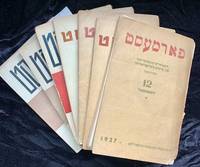
Varsha [i. E. Warsaw]: Di Welt, 1927-37. Paper Wrappers or Cloth, 4to (tabloid format) , 16 pages each issue. Partially Bound in Cloth. Many with photos or Socialist Realism illustrations on cover. This Yiddish Socialist bi-monthly newspaper for Young people ran from Dec. 1, 1922 until sometime in 1948, in various formats at different times. In addition to these issues from 1922-1937 out of Warsaw, the journal was later published instead in Lodz and Paris, and was edited, in succession, by L. Hechtman, J. Mendelsohn, J. Gutgold, & L. Blit. Issues present here are: 1927 [1(38) - 24(60) ]; 1928[1(61) - 24(84) ]; 1929 [ 2(86) -5(89) , 7(91) -10(94) , 12(96) , 13(97) , 16(100) , 18(102) , 19(103) , 21(105) , 22(106) , 25(109) ]; 1930 [2(111) -14(123) , 20(129) ]; 1934 [21(232) ]; 1931[7 (141) , 16(15) , 17(151) ]; 1937[6 (299) ]. SUBJECT(S) : Jewish socialists -- Poland -- Periodicals. Jewish youth -- Poland -- Periodicals. Jews -- Poland -- Periodicals. OCLC lists only 1 holding (NYPL) . Bound volume (1927-1928) has heavily worn boards. All are printed on newsprint, so paper is brown, sometimes fragile, sometimes not, generally not split at the binding but sometimes so. In any case, all wear is at the extreme margins, with, remarkably, no text loss whatsoever. (Y-28)
1st edition. Original dramatic constructivist paper covers 8vo, 135 pages ; 22 cm. In Yiddish. Title also in Russian on copyright page: Dlia stseny. SUBJECT (S) Yiddish literature. OCLC lists 3 copies worldwide (LOC, UMaryland, NLI) . Ex-library, but only with bookplate to later boards and faint blindstamp on non-illustarted title page. 1 inch closed tear to illustrated cover, one corner repaired, lacks spine. Paper browning with dampstaining throughout, but staining is not obtrusive on the illustrated cover. Lacks backstrip, otherwise Good Condition thus. (YID-26-10)
1st edition. Period full leather with spine label, 8vo, viii, 9-408 pages. Singerman 322; Rosenbach 209. The tipped in recommendation slip sign "Ph. Milledolar, " as noted by BAL, is present. President John Adams wrote of this literary anthology that it was "worthy to be presented by every father to every child, and deserve a place in every family. " Gomez's Jewish affiliation resonates in the book with his decision to include a selection from The History of Pope Pius V, which is the source for the "pound of flesh" incident in Shakespeare's Merchant of Venice. As opposed to Shakespeare's telling, in the History of Pope Pius V, it is the Jew who is the victim and the Christian who threatens him. Gomez prefaced the selection by writing: "The following subject shows that Shakespeare altered the character of Shylock, making him to be of the Jewish nation, when in reality he was not. " As Louis Harap notes (The Image of the Jew in American Literature, p. 260) , "Gomez was obviously trying to combat the effects of the Shylock stereotype. " Isaac Gomez (1768-1831) , whose great-grandfather had fled from Portugal to New York in 1703, was active in New York's Jewish community. The few early literary contributions by American Jews "was anything but impressive, but Gomez's book is worth remembering as one of American Jewry's earliest literary efforts⦠Gomez, both a devotee of the humanities and a committed Jew, lived comfortably ensconced in the two worlds of the Jew and the cultured American" (J. R. Marcus, United States Jewry, vol. 3, page 455) . See also Blau and Baron, The Jews of the United States, 1790-1840, Vol. II, pages 440-2. The last copy to appear at auction in the US, in 2013, sold for over $1800 (with commissions) . Foxing as expected. All endpapers present, and original period binding remains very handsome. A very good copy in outstanding period binding. (AMR-57-12)