658 résultats
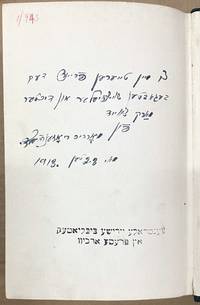
191243120Nyu York New York: Forverts 1912. First edition. Original boards 8vo 266 266 268 pages. 20 cm. In Yiddish. Title translates as “Collected Writings.â€<br> Full set of Morris Rosenfeld’s collected works. Volume 1 contains poetry Volume 2 and 3 contain stories. Warmly inscribed by Rosenfeld in 1913 to Yiddish actor and director Mark Schweid 1891-1969: “To my dearest friend actor and poet Mark Shvayd. From Morris Rosenfeld 3. 2nd i.e. 3 of Feb 1913.†<br> “Rosenfeld known as the ‘Poet Laureate of Labor’ was a pioneer of Yiddish poetry in the US. Born in Russian Poland he came to New York by way of London in 1889 and worked as a presser in a sweatshop. His sweatshop songs were often sung by Jewish workers in factories and at mass meetings. Moshe Starkman notes in the EJ that when his Lider-Bukh ‘The Book of Songs’ 1897 was translated in 1898 by Leo Wiener under the title Songs from the Ghetto his fame spread to non-Yiddish circles. Starkman also notes that ‘his proletarian poems and national songs stirred the Jewish masses during their early struggles in the New World and at the beginning of the Jewish national renascence’ sic. Aaron Kramer notes as well that ‘Of all Yiddish poets Morris Rosenfeld alone.was acknowledged by the non-Jewish literary world as a notable singer;’ Wiener's translation of Songs from the Ghetto ‘immediately established Rosenfeld's reputation among America's literati.†EJ 1971 14: 285-286; Kramer trans: The Teardrop Millionaire and Other Poems 1955.<br> Mark Shveyd Schweid 1891-1969 to whom Rosenfeld inscribed this copy was a “playwright poet translator and artist born in Warsaw. His original Jewish given name was Volf-Mortkhe.…in 1911 he graduated from a Polish drama school in Warsaw and went on to act in Yiddish theaters and on the Polish stage as well. In 1911 he emigrated to the United States performed in New York’s Yiddish theaters and from 1921 was one of the principal artists in Maurice Schwartz’s Yiddish Art Theater. From 1926 he was also acting on the English-language stage.<br> He wrote poetry drama studies one-act plays plays and longer articles on theater. He debuted in print in 1907 with poems in Roman-tsaytung….From 1946 he was an internal contributor to Forverts Forward in New York.<br> Shveyd wrote adapted or translated roughly fifty plays†as well as 9 books. <br> “Shveyd also translated novels from Polish Russian German and English some of which were published such as: Israel Zangwill Troymers fun’m geto Dreamers of the ghetto vol. 1 New York: M. Yankovitsh 1929 341 pp.; Stanislaw Przybyszewski Fun’m obgrund Out of the depths original: De Profundis New York n.d. 79 pp.; Fyodor Dostoevsky Erniderigte un baleytigte Humiliated and insulted original: Unizhennye i oskorblennye New York: Max Jankovitz 1920s 2 vols. Two novels he adapted were published in Warsaw’s Moment†Yekhezkl Lifshits in Leksikon Fun Der Nayer Yidisher Literatur.<br> Schweid was director of the Bronx Art Theatre in 1930-1931; a partial collection of his papers is at the Center for Jewish History in New York. SUBJECTS: Yiddish language. Yiddish poetry. Short stories Yiddish. OCLC: 3758034<br> Vol I with inscription has unobtrusive number on spine and old Yiddish institutional stamp at bottom of inscribed endpaper with gutter taped at contents page. Otherwise a Very Good Condition set with important inscription. YID-46-36--’cc. Nyu York [New York]: Forverts unknown
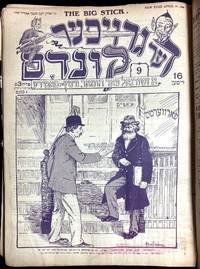
190942930New York: Ferlag "Kibets 1909. 1st Edition. Original publisher’s binding Folio newspaper. Complete first volume Starting with Vol I Nr 1 of “Der Kibitser†Dec. 15 1908 renamed and renumbered first as Vol I Nr 1 Jan 22 1909 of “Der Groyser Kibetser The big kibetzer†with the following issue of Feb 5 numbered as "3" to correctly follow from the first issue and then with Vol I Nr 6 March 19 1909 onward as “Der Groyser Kundes The Big Stick†or “The Big Prankster.†Incidentally the other set of this volume we examined also did not have a Nr 2 so we are confident this is complete as issued. <br> One centerfold cartoon by Zuni Maud see image features "Der Kaptialistisher Tayfel"--the Capitalist Devil–holding back a "mother" by the hair to stop her from interfering as "baby's milk-bottle" is drained off by the "milk-trust" cat. <br> The caption reads "The Capitalist Devil: - to the mother: Never mind madam all in English in Hebrew letters you go to the factory the milk-trust will take good care of your baby."<br> This cartoon-laden periodical was a New York City Yiddish language satirical bi- weekly which ran from 1908 until 1927.<br> The humor paper was issued biweekly this volume for its first 20 months and then weekly after that. OCLC also references another Vol I Nr 1 from April 15 1908 a special S´imhes` Toyreh Simchas Torah issue but this may have been a one-off. <br> Founded by the humorist Yosef Tunkel or Der Tunkeler his pen name meaning 'The Dark One' the paper was taken on by Jacob Marinoff when Tunkel left to work for an established paper in Warsaw. The paper consciously set itself up in opposition to the serious Yiddish-language press of the time such as the socialist Forverts.Naturally more traditional religious Judaism did not escape its satire: The later 1915 "Christmas" edition included a parodic conversation between Jesus and the prophet Elijah. <br> Despite its irreverent attitude to everything it also published poetry by Di Yunge "The Young Ones" poets such as Moyshe-Leyb Halpern and Zuni Maud. At its height it had a circulation of 35000 but folded in 1927 due to flagging sales. Der Groyer Kunds is highlighted in this recent talk by Yiddish comics scholar Eddie Portnoy on the reactions in the Yiddish press to restrictions on Jewish immigration to the US: https://www.yiddishbookcenter.org/collections/archival-recordings/recorded- programs/ybcr-nybc-ybcr-1048/door-slams-shut-reactions-yiddish-press-immigr ation .<br> SUBJECTS: Yiddish wit and humor -- Periodicals. OCLC: 28297536. Most holdings appear to be fragmentary and do not include these issues. Issue 18 with torn cover. In final issue the bottom margin suffers some loss to the final leaves none to the dramatic front cover though. Damaged boards are loose and most issues are coming loose though the quality paper used has remaind strong and bright much better than standard newsprint would have. Important graphic Yiddish humor from the great migration period. Dramatic and displayable! BK5 YID-43-9A-LEX. [New York]: Ferlag "Kibets unknown
1st Edition. Original paper wrappers bound into period cloth, 4to, 6-16 pages per issue. In Yiddish. Includes some cartoons and other illustrations, including one we noticed by William Gropper. Der Yunion Arbayter (The Union Worker) lasted 2 volumes, running weekly until 1927. The first volume, complete, is here. A.L.G.V.Y / I.L.G.V.Y. stands for the Yiddish name for the heavily Yiddish speaking International Ladies Garment Workers Union; this newspaper was published by an Anarchist section within the union. Yiddish-speaking Jewish anarchists were one of the pillars of the U.S. anarchist movement before World War II. This largely immigrant radical milieu was centered in New York City and opposed capitalism, the state, and organized religion. Yiddish-speaking anarchists built militant unions, anarchist newspapers, and other organizations to further their cause. Many famous anarchists were linked to this movement, including Johann Most, Emma Goldman, Alexander Berkman, and Rudolf Rocker. Yiddish-speaking anarchists played a pivotal role in unions like the International Ladies Garment Workers Union (ILGWU), while the Yiddish anarchist newspaper the Fraye Arbeter Shtime (The Free Voice of Labor) was the largest and longest-lasting U.S. anarchist publication and formed a significant part of the Yiddish cultural landscape. In the 1930s a second generation of bilingual Jewish anarchists emerged, including Sam and Esther Dolgoff, and Audrey Goodfriend, whose influence is still felt in todays anarchist movement.Despite the importance of Yiddish anarchism to the histories of both the U.S. Left and the Jewish community, it has been largely forgotten and written out of historical scholarship (YIVO). Cited in Paul Avrichs Anarchist Portraits (Princeton, 1988) pp 192 & 196. Listed in John Pattens Yiddish Anarchist Bibliography - Periodicals (https://www.katesharpleylibrary.net/w9gk09). SUBJECT(S): Jewish anarchists. OCLC 10218086. OCLC lists 3 holdings worldwide LOC, YIVO, NYU), with NYU holding only this one volume and the Union List of Serials suggesting that the run may have "Ceased with Sept. 26, 1927 issue?" Rear hinge starting. Three issues printed on lower quality paper have darkened, but without any edgewear or breakage. The other 49 issues, printed on quality paper and well protected, remain bright white. All issues clear and very well preserved. Very Good Condition. An outstanding complete volume of a very rare and important Yiddish Anarchist periodical. (YID-42-20)
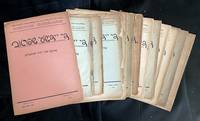
1st editions. Original publisher's boards. 8vo. Each issue is 31 pages. 26 cm. Features years 1921-1923 and 1929-1930 in 3 volumes. Periodical ran from 1920-1951. Features Yiddish literature (generally short stories) , along with illustrations and songs. Edited by Beyle Schaechter-Gottesman (1920-2013) , the well-known American Yiddish poet and songwriter. Schaechter-Gottesman won the 2005 National Heritage Fellowship awarded by the National Endowment of the Arts (the highest honor in the folk and traditional arts) . She was the first Yiddish poet to receive this honor (Wikipedia, 2019) . SUBJECTS: Children's literature, Yiddish -- Periodicals. OCLC lists 29 copies worldwide (OCLC: 10158059) . Boards are lightly worn. 1921-1922 volume is slightly more edge worn with repaired spine. Otherwise very good. Gorgeous rare set of 3 complete volumes. Price per volume. (YID-33-80-L)
193042139Kiev: Katedr far Yidisher Kultur ba der Ukr. Visnshaftl. Akademye Filologishe Sektsye 1930. Paper Wrappers. 1st edition. Original printed publisher’s color paper wrappers 4to large ca 72-116 columns ca 36-58 pages per issue. 28 cm. In Yiddish. Title translates roughly as “The Yiddish Language.†Succeeded in 1931 by “Afn shprakhfront.â€Di Yidishe Shprakh was a “Yiddish linguistic journal published in Kiev from 1927 to 1930. A bimonthly journal Di yidishe shprakh The Yiddish Language was published by the cooperative publishing house Kultur-lige and was the main philological publication of the Kiev Yiddish academic center. Its editor was the veteran Yiddishist Nokhem Shtif a founder of YIVO who had returned to Kiev from Germany in 1926. The journal’s inaugural issue March–April 1927 was published under the auspices of the Central Yiddish Bureau of the Ukrainian Commissariat for Education. With the next issue Di yidishe shprakh was an organ of the Chair and from July to October 1929 it was an organ of the Institute for Jewish later Proletarian Jewish Culture at the Ukrainian Academy of Sciences. Initially defined as a 'journal for practical Yiddish linguistics' from May to June 1927 it appeared as simply a 'journal for Yiddish linguistics. 'Shtif distinguished three language registers: the vernacular of the old generation partly represented in the works of Sholem Aleichem and predecessors; the highbrow language of modern writers such as Dovid Bergelson; and the contemporary 'culture language' most notably of the press. Although Shtif sought to target speakers of the mass 'culture language' the journal’s circulation hovered around 500 copies read mainly by Yiddish teachers.Apart from Shtif who published articles on various language-planning problems the most active contributors to Di yidishe shprakh were Ber Slutski Ayzik Zaretski Elye Falkovitsh Lipe Reznik and Shimen Dobin. In early 1929 Moscow literary critic Aron Gurshteyn criticized the journal for its purist approach to language planning. In the July–October 1929 issue Shtif published his article 'Di sotsyale diferentsiatsye in yidish' The Social Differentiation in Yiddish heralding an intensification of Soviet linguists’ anti-Hebraist campaign. That issue of Di yidishe shprakh adopted completely reformed Soviet spelling omitting for example final consonant letters.Although the last—twenty-fifth—issue of the journal was dated November–December 1930 it included materials from the First All-Union Yiddish Language Conference convened in Kiev from 8 to 13 February 1931 that issue is present here. Published under the imprint of the Central Publishing House this issue also signaled the demise of the remaining vestiges of the Kiev Kultur-lige. Yoysef Liberberg’s article 'Far parteyishkayt in der yidisher visnshaft-arbet' For a Party Approach to Yiddish Linguistics marked a full break with YIVO scholars particularly with YIVO director Max Weinreich whom Liberberg ridiculed for presenting Yiddish as an emanation of the Ashkenazic Jews’ soul. The Yiddish Language Conference decided to change the name of the journal. Between 1931 and 1939 it appeared sporadically under the title Afn shprakhfront On the Language Front reflecting its new more aggressive and politically charged approach' Gennady Estraikh in YIVO Encyclopedia of Jews in Eastern Europe 2010. For more see David Shneer “Yiddish and the Creation of Soviet Jewish Culture 1918–1930†Cambridge and New York 2004. SUBJECTS: Yiddish language -- Periodicals. Title also listed on covers in Russian “Ievreis'ka Mova†and German “Jiddische Sprachâ€. OCLC: 22840298. Most holdings in OCLC appear to be fragmentary. Covers are browning and fragile as expected but are otherwise very well preserved with very little edgewear. Internal text pages are also toning but remain relatively strong as pulp paper. Very important journal scarce in this degree of completeness Note that Estraikh suggests a circulation of only 500!. B YID-43-5-E. Kiev: Katedr far Yidisher Kultur ba der Ukr. Visnshaftl. Akademye, Filologishe Sektsye unknown
1st edition. Period boards. 8vo. 416 pages, 25 cm. In Yiddish. Issues 1-52. Title translates to Literary Suppliment to the Workers Friend. Arbeter Fraynd was a London-based weekly Yiddish radical paper founded in 1885 by socialist Morris Winchevsky. After the emigration of Saul Yanovsky to the United States in 1894, Woolf Wess became the editor in 1895. In 1898, Rudolf Rocker, a German non-Jewish anarchist who had immersed himself into the Yiddish radical culture of London's East End, became the editor of the paper. The paper was suppressed at numerous times by the British government (Wikipedia, 2018) . Prager p125. Also listed in John Pattens Yiddish Anarchist Bibliography Periodicals. SUBJECTS: Yiddish literature - England - Periodicals. OCLC lists 9 copies worldwide (OCLC: 174120785) . Binding repaired and spine rebacked. Paper brown but solid, occational margin wear, Overall good condition. Important. (YID-40-97)
1st edition. Mixed period and later boards. 8vo. 745 pages; 550, 16, 24, 24, 24 pages; 690 pages. 23 cm. In Yiddish. Title translates to The New Life. The complete first three years of this important Yiddish monthly. Zhitlowsky, an immigrant socialist revolutionary, sought to synthesize socialism with nationalism as early as 1883. He demanded for Jews "national equal rights with all peoples" and asserted that only through the Yiddish language could the social and national revival of the Jewish people be effected. He maintained that one could remain identified with the Jewish nationality even if abandoning the Jewish religion. He urged the Jewish masses to participate in the class struggle as a national unit. Alone among the cosmopolitan Jewish socialists he favored national socialism. In 1897 he began publishing philosophical studies in Jewish history and a comprehensive program of action which later appeared in book form as Pisma o starom I novom yevreystvie ("Letters on Old and Modern Judaism, " 1907) . His main thesis was that national consciousness consists mainly of spiritual-cultural determinants and that these national characteristics can be maintained by the Jews in the future in the lands of their dispersion, just as they have survived the lack of territory or unity of language since the end of the second commonwealth. After emancipation of the individual the Jews as a group should be granted national self-government within the framework of the state along with other national minorities. His secularization of the national idea as opposed to those who saw the essence of Judaism in religion, and his optimistic view of the future of Judaism in the Diaspora, were the main underpinnings of his insistence on national cultural autonomy. Zhitlowsky was "in favor of the centrality of Yiddish in the national Jewish experience and labored toward the recognition of that language, and of those who lived out their lives in it, as one of the several cultural linguistic communities of Eastern Europe, and of the Western world as a whole" (Isaac Levitas, et al, in EJ) . Includes Zhitlowskys original, first volume, 16 page prologue entitled This program and the dissemination of the monograph The New Life. Some internal binding repair, but solid, paper toning as expected but nice and clean, a Good, solid complete set. (YID-30-8)
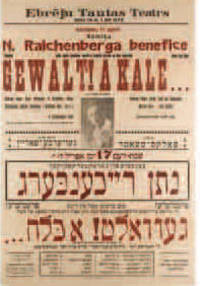
51-1032Latvia: 1920s-1930s. A Collection of 8 Yiddish Theater posters from the 1920s and 1930s. Yiddish Latvian poster of the Ebreju Tautas Teatrs Jewish people Theater. Letter press in red and black on fine paper mounted on canvas. 91 x 60.5 cm. Riga Spiestuve vards 1930 announcement of an event on Saturday April 17 d. j.: Bene_ z of the character comedian Natan Reichenberg. Premiere! For the first time in Riga the large entertaining equipment operetta with completely new vocal pieces help! A bride. The comic role of "Kivele Feldsher" Akiva the medics the Bene_ acquires ziant. -Printed in Latvian and Yiddish language with photographic print. -Paper browned minimal fold marks on the outer edge. -Rare poster.Yiddish Latvian poster of the Rigas teatris zidu minoritates Riga Jewish minorities Theater. Letterpress in red and black on fine paper. 71 x 53.5 cm. Riga SP. extra 1925. announcement of the _ eaterstücks the Jewish robber on November 26. -Printed in the Latvian and Yiddish languages. -Paper slightly tanned with vertical folding kl. Defects especially upper-right corner on the outer edge with small tears. -Very rare poster.Yiddish Latvian poster of the Rigas teatris zidu minoritates Riga Jewish minorities _ Theater. Letter press in red and black on fine paper. 71 x 50 cm. Riga SP. extra 1925. announcement of different theatrical works: A man an unlucky guy. -The curly haired blonde -In life tri_ all . -The Jewish Bandit November 17-22. -Printed in the Latvian and Yiddish languages. -Paper minimally tanned with vertical and horizontal folding Small Defects minimal _ square on the outer edge with small tears. -Very rare poster.Yiddish Latvian poster of the Rigas teatris zidu minoritates Riga Jewish minorities Theater. Letterpress in red and black on fine paper. 106 x 71 cm. Riga SP. extra 1933 announcement of solemn Erö_ regulation IX season on Saturday Sept. 30 Sunday 1 Oct 1933 8.30 evening. Performed by: Genia Schalit Nina Talini oSIP Runitsch in the well-known piece of David Golder. In four acts by A. Nemirowskaja. -With 2 dates. -Printed in the Latvian and Yiddish languages. -Paper minimally tanned partly with resounding mount tracks with vertical and horizontal folds & light Abklatsch small. Defects somewhat spotted and knicked. -Very rare poster. Latvian Yiddish poster. Woodcut on fine green paper. 66 x 51 cm. Daugavpils Latvia Pilsetas spiestuve litogra_ Yes 1920s. The translated content of the poster: Sunday August 15 7: 00 the Dünaburger Trade Association invites in the Riga road 42 in the Novonowitsch-Hall to a meeting on the election of the municipal administration. Speaker are: Al Kopelowski A. Bulavko Sch. Heller Salman Barak N. Magid and others. "Dealer! Come numerous. Dealers and sellers. Bear in mind that your list is the list of 5 the Listedes of trade association."- printed in the Latvian and Yiddish languages. -Paper with vertical & horizontal folds and knicks-Rare poster.Latvian Yiddish poster. Woodcut in blue on fine paper. 93 x 62.5 cm. Daugavpils Latvia Pilset. spiestuvelitogra _ Yes 1920s. Election poster: David challenge the dealer! 'Remember - no voice of the dealer for a different list than the list 5 vote for the list of dealers no. 5' - 3 languages printed in Yiddish Russian and Latvian. -Paper with vertical & horizontal folding some with red marks. Knicks and small tears -Rare poster.Latvian Yiddish poster. Woodcut on fine Orange paper. 49.5 x 31.5 cm. Daugavpils Latvia Pilsetas spiestuve litogra_ Yes 1920s. The translated content of the poster: Agudat Israel Daugavpils. Taking place on Monday August 17 8 o'clock in the evening. A folk Assembly in Klingmann Hall Riga Street 42. The elections. Asked to show! -Printed in the Latvian and Yiddish languages. -Paper with horizontal folds tears and stains-Rare poster.Images of all the posters are available Latvia: 1920s-1930s unknown