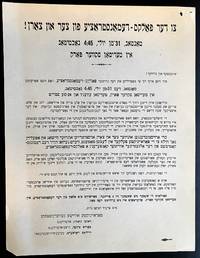
00O [A Yiddish Call to Action for Massive Madison Square Park Anti-Nazi Rally] United Hebrew TradesBiblio.com
658 résultats
194443416No Place New York Fereynigte Yidishe Geverkshaftn United Hebrew Trades 1944. 1st edition broadside single-sided flyer 4to. In Yiddish. <br> <br> Translation: "ALL OUT TO THE PUBLIC DEMONSTRATION OF GRIEF AND RAGE!<br> Monday July 31st 4:45 PM<br> in Madison Square Park<br> <br> Sisters and brothers!<br> We invite you to participate in the great public demonstration that will take place<br> Monday July 31 4:45 p.m.<br> in Madison Square Park Madison Avenue and 24th Street<br> <br> Millions of Jews were murdered by the Nazis in all parts of Europe. Young and old women and men were driven into gas and death chambers and destroyed. In the current hour the greatest danger for those still alive in the Nazi countries.<br> The Hitlerian beast which conquered and humiliated countries and murdered millions of people is ready to strangle and murder the surviving remnants of the Jewish people. Hundreds of thousands of Jews from Hungary are now in danger of death the tens of thousands of Jews left alive in Poland in France in Belgium in the Czech Republic where they are under Hitler's rule.<br> <br> In order to express our grief and anger to cry out our grief and appeal for help to the United Nations at the last moment a public demonstration is called by the Rescue Committee of the General Jewish Conference.<br> <br> We cannot and must not remain silent. People must help save the survivors. Come express your feelings desires and demands! It is demanding that the United Nations do everything possible to stop the death march! It is demanded that all those who are guilty of the murders will be brought to justice!<br> The Nazi victims who are now struggling between death and life must know that we are with them.<br> At a conference of representatives of the trade union organizations called by the Jewish Labor Committee it was decided to actively participate in the great national demonstration. We must do everything we can so that the demonstration will be imposing and effective.<br> <br> Leave the store no later than 4 o'clock. Marched to the site of the demonstration in Madison Square Park. Overtime is not allowed on this day.<br> With Trade Union Regards<br> United Hebrew Trades<br> Reuven Guskin President<br> Maurice Tigel Vice-President<br> William Wolpert Executive Secretary"<br> <br> <br> The rally was covered by the Jewish Telegraphic Agency JTA the next day:<br> <br> "Tens of thousands of Jews and non-Jews crowded Madison Square Park today at an open-air mass-demonstration in behalf of the Jews of Hungary and other parts of Nazi Europe sponsored by the 64 affiliated agencies of the American Jewish Conference with the cooperation of the American Jewish Committee and other national organizations.<br> Speakers at the demonstration included Assistant U. S. Attorney General Norman M. Littell who is secretary of the National Committee Against Persecution of Jews; Dr. Stephen S.Wise president of the American Jewish Congress and co-chairman of the American Jewish Conference; Judge Joseph M. Proskauer president of the American Jewish Committee; Henry Monsky president of B'nai B'rith and co-chairman of the American Jewish Conference; Adolph Held president of the Jewish Labor Committee and many other noted Jewish and Christian leaders.<br> The huge mass-meeting in which Jews from all walks of life participated adopted a declaration stating that it is not yet too late 'to save thousands upon thousands' of Jews for the day of liberation. The meeting appealed in the first instance to President Roosevelt and the Government of the United States and through them to the United Nations and to the neutral states." <br> <br> The original JTA covers including a full list of the demands from the rally and other details can be viewed at www.jta.org/archive/huge-open-air-demonstration-in-new-york-demands-rescue-of-jews-from-europe<br> <br> Leading national Jewish organizations organized this July 31 1944 Madison Square Park mass rally to demand Allied action against the Nazi slaughter of European Jews. <br> New York had at the time the world's biggest Jewish population with a Jewish community of around 2 million. The city had hosted numerous similar rallies over the previous decade all focused on building opposition to Hitler and support for the struggling Jews of Europe. <br> <br> Beginning on March 4 1934 "One year after Hitler's ascension to power in Germany tens of thousands of New Yorkers gathered at Madison Square Garden to hear the words of Rabbi Stephen Wise. 'Despite the oceanic tragedy which has befallen us' Wise pronounced 'we Jews tonight joining in the chorus of civilization indict Hitlerism as humans as members of civilized society before the high court of human judgment.' <br> Wise's words resonated for audience members attending the rally that March night. Over the course of the evening they heard from a chorus of voices representing the American public self-identifying across different racial religious and ideological lines. Framed as a 'court' the speakers at the rally gathered to indict Hitler for his crimes against civilization an intentionally pointed term that would offend Nazi ideologues claiming to protect civilization through Aryan supremacy. This mock trial was part of a larger trend of American Jewish protest performances staged during the Third Reich that intended to garner support for the rescue of European Jews.<br> On March 27 the AJCongress American Jewish Congress successfully staged a rally titled Stop Hitler Now to an audience of twenty thousand Jews in Madison Square Garden. Outside of the Garden thirty-five thousand people stood protesting and ten thousand more marched through Brooklyn in solidarity. Simultaneous protests also occurred in major cities across the country. The United Press estimated that one million protesters participated in the nationwide demonstration that day. <br> In retaliation to the American uproar Hitler threatened a one-day boycott against German Jewish businesses to be resumed three days later if 'international protests' did not cease. Wise after speaking with Undersecretary William Phillips at the State Department agreed to a brief silence on the matter" Gonzalez Maya. Imagining the "Day of Reckoning": AmericanJewish Performance Activism during the Holocaust. Masters Thesis UMass-Amherst 2023. https://hdl.handle.net/20.500.14394/33069 <br> We could locate no recorded examples of this flyer anywhere using OCLC ArchiveGrid or a google search. <br> <br> Staple hole in upper right corner margin slight corner loss to lower left margin no text affected in either case light toning about Very Good Condition. Rare and displayable Holo2-163-30. No Place [New York], Fereynigte Yidishe Geverkshaftn [United Hebrew Trades] unknown
RARE memorial volume of the small town Boiberke in eastern Galicia near Lvov (Lemberg) in Hebrew, Yiddish and English. The book is profusely illustrated by the eminent Israeli artist Arieh Allweil (1901-1967). 345x250mm. 38+218 pages. Illustrated yellow board Hardcover with grey cloth spine. Black lettering on spine. Cover yellowing/age-stained. Cover/binding curved. Cover corners worn and slightly peeling. Cover and spine slightly stained. Front cover upper right corner near spine bumped/wrinkled. Binding slightly visible on rear inner cover. [SUMMARY]: This extremely rare memorial of a Jewish community annihilated in the Holocaust is otherwise in good condition. PLEASE NOTE: This item is overweight. We may ask for extra shipping costs.
1st edition. Period boards, 8vo, 168, [2], 148, [2], 152, 149, [1], 157, [1] pages [780 pages total]. In Yiddish. Title translates as, The Jewish World: A Literary Societal Monthly. Includes frontis portraits, a self-portrait by Max Lieberman, and many text and full-page-plate illustrations by E.M. Lilien. Di Yudishe Velt appears to have run only 4 volumes over 3 years, 1913-1915. OCLC Number: 10652260. Paper browning but solid. Institutional marks to final issue, which is bound separately with original wrappers, Solid good condition. (YID-33-48-LX)
191026282Jerusalem: Druck vermutlich bei Gebr. Monsohn. um 1910). Quer-Oktav, 10,5 x 16,5 cm. (etwas beschabt, eine kleine Ecke des hinteren Deckels fehlt, innen etwas gebräunt, Stempel auf Titel verso, insgesamt abr recht gut erhalten und farbfrisch) 12 Blatt. Original-Halbleder mit Orig.-Zedernholz-Deckeln,
Original Paper Wrappers, 8vo, ca. 100 pages. Monthly Bundist periodical ran from Vol. I, Nr, 1 (Oct. 1927) to 1932. 23 cm. In Yiddish. Unobtrusive Bund rubber stamp. Levin (1977) reports that it was in UNZER TSAYT that the very first reports of the Bund's split over the National Question with the Russian Social Democrats were published (in 1927). The Bund in Poland, here providing its unique Polish Jewish Socialist anti-Zionist perspective. The General Jewish Labour Bund in Lithuania, Poland and Russia (Yiddish: algemeyner yidisher arbeter-bund in lite, poyln un rusland), generally called The Bund or the Jewish Labour Bund, was a secular Jewish socialist party.... founded in Vilnius on October 7, 1897 ..In 1917 the Polish part of the Bund, which dated to the times when Poland was a Russian territory, seceded from the Russian Bund and created a new Polish General Labor Bund which continued to operate in Poland in the years between the two world wars .The Bund sought to unite all Jewish workers in the Russian Empire into a united socialist party, and also to ally itself with the wider Russian social democratic movement to achieve a democratic and socialist Russia. The Russian Empire then included Lithuania, Latvia, Belarus, Ukraine and most of present-day Poland, areas where the majority of the world's Jews then lived. They hoped to see the Jews achieve a legal minority status in Russia. Of all Jewish political parties of the time, the Bund was the most progressive regarding gender equality, with women making up more than one-third of all members. The Bund actively campaigned against anti-Semitism. It defended Jewish civil and cultural rights and rejected assimilation. However, the close promotion of Jewish sectional interests and support for the concept of Jewish national unity (klal yisrael) was prevented by the socialist universalism of the Bund. The Bund avoided any automatic solidarity with Jews of the middle and upper classes and generally rejected political cooperation with Jewish groups that held religious, Zionist or conservative views. Even the anthem of the Bund, known as "the oath" (di shvue in Yiddish), written in 1902 by Sh. An-ski, contained no explicit reference to Jews or Jewish suffering. At the heart of the vision of the future of the Bund was the idea that there is no contradiction between the national aspect on the one hand and the socialist aspect on the other. As a strictly secular organization, the Bund renounced the Holy Land and the sacred language (Hebrew) and chose to speak Yiddish .In its early years the Bund had remarkable success, gaining an estimated 30,000 members in 1903 and an estimated 40,000 supporters in 1906, making it the largest socialist group in the Russian Empire . the Bund was a founding collective member at the RSDLP's first congress in Minsk in March 1898. For the next 5 years, the Bund was recognized as the sole representative of the Jewish workers in the RSDLP, although many Russian socialists of Jewish descent, especially outside of the Pale of Settlement, joined the RSDLP directly .The Bund generally sided with the party's Menshevik faction led by Julius Martov and against the Bolshevik faction led by Vladimir Lenin during the factional struggles in the run-up to the Russian Revolution of 1917 .In the Polish areas of the [Russian] empire, the Bund was a leading force in the 1905 revolution. At that time the organization probably reached the height of its influence. It called for an improvement in living standards, a more democratic political system and the introduction of equal rights for Jews. At least in the early stages of the first Russian Revolution, the armed groups of the "Bund" were likely the strongest revolutionary force in Western Russia. During the following years, the Bund went into a period of decay .The Bund eventually came to strongly oppose Zionism, arguing that emigration to Palestine was a form of escapism. The Bund did not advocate separatism. Instead, it focused on culture, rather than a state or a place, as the glue of Jewish nationalism. . The Bund also promoted the use of Yiddish as a Jewish national language and to some extent opposed the Zionist project of reviving Hebrew. The Bund won converts mainly among Jewish artisans and workers, but also among the growing Jewish intelligentsia. It led a trade union movement of its own. It joined with the Poalei Zion (Labour Zionists) and other groups to form self-defense organisations to protect Jewish communities against pogroms and government troops. During the Russian Revolution of 1905 the Bund headed the revolutionary movement in the Jewish towns, particularly in Belarus and Ukraine ..In 1921, the Communist Bund [in the USSR] dissolved itself and its members sought admission to the Communist Party....Many former Bundists, like Mikhail Liber and David Petrovsky, perished during Stalin's purges in the 1930s. The Polish Bundists continued their activities until 1948. During the latter half of the 20th century the Bundist legacy was represented through the International Jewish Labor Bund, a federation of local Bundist groups around the world .Among the exiled Bundists who went on with Socialist politics in America was Baruch Charney Vladeck (18861938), elected to the New York Board of Aldermen as a Socialist in 1917 [and] 1937 [and] manager of The Jewish Daily Forward Moishe Lewis (18881950)....the father of David Lewis (19091981), a leader of the New Democratic Party in Canada .David Dubinsky (18921982), though never formally a member of the party, had joined the bakers' union, which was controlled by the Bund, and was elected assistant secretary within the union by 1906 ..He later became a member of the Socialist Party of America, helped found the American Labor Party in 1936 and was from 1932 till 1966 the leader of the International Ladies' Garment Workers' Union ..under the name Max Goldfarb, David Petrovsky (18861937) was a member of the Central Committee of the Jewish Socialist Federation of America, a member of the Socialist Party of America, and the labor editor of The Forward (Wikipedia). SUBJECT(S) : Jews -- Poland -- Periodicals. Jewish labor unions -- Periodicals. Socialism and Judaism -- Periodicals. Yiddish literature -- Poland -- Periodicals. OCLC Number: 642969688. OCLC lists only 4 runs (Arizona State, Stanford, LOC, U of Washington), all of which appear to be incomplete. Use wear, paper brwoning but not fragile. Good Condition. (y-1-11)
1st edition. Original red boards with gitl lettering and design, 8vo, 96, 96 pages, illustrated, in Yiddish. Contents: 1. Mayzele ganev un andere 2. Yankele shneyele un andere. Both volumes are overflowing with gorgeous Yiddish modernist woodcut illustrations by Aharon Gudlman (1890-1978), with 15 full- or partial-page illustrations and 20 fanciful initial Yiddish letters in Volume I; and 12 full or partial page illustrations and 15 initial letters in Volume II. Detailed red bordering on each page add to the deluxe illustrated feel of the work as well. "Goodelman grew up in Russia and studied at an art school in Odessa. After graduating, he moved to New York and attended the Cooper Union, the National Academy of Design, and the Beaux-Arts Institute of Design, working during the day to support himself. He traveled to Paris for a brief time, but was forced to return to America at the outbreak of World War I. He was a member of the Yiddish branch of the Communist Party, and art editor for YKUF, a Jewish cultural magazine. He...was a founding member of the Society of American Sculptors. Goodelman created sculptures in wood, metal, and stone, and illustrated many childrens books in English and Yiddish" (National Museum of American Art, 1996). "Chaver Paver" was the pen name of Gershon Einbinder. Einbinder was born on February 8, 1901 in Bershad (today in the Ukraine) . At the age of 19, he moved to Romania and eventually settled in the United States in 1924. He lived in New York and Los Angeles, where he died in 1964. Chaver Paver made his debut in Yiddish literature in the 1920s as a childrens writer. He wrote five volumes of childrens stories and several plays. However, the majority of his literary works were stories and novels for adults. SUBJECT(S): Children's stories, Yiddish. Children's literature. OCLC: 15009977 Lacks backstrips (spine coverings) as usually found, internally very nice and clean on beatuful strong white paper. Good Condition thus. (YIDCHI-5-10E-L-'excc)
1st edition. Vol 1 in period red boards; Vol 2 in original red boards with gilt lettering and design, 8vo, 96, 96 pages, illustrated, in Yiddish. Contents: 1. Mayzele ganev un andere 2. Yankele shneyele un andere. Both volumes are overflowing with gorgeous Yiddish modernist woodcut illustrations by Aharon Gudlman (1890-1978), with 15 full- or partial-page illustrations and 20 fanciful initial Yiddish letters in Volume I; and 12 full or partial page illustrations and 15 initial letters in Volume II. Detailed red bordering on each page add to the deluxe illustrated feel of the work as well. "Goodelman grew up in Russia and studied at an art school in Odessa. After graduating, he moved to New York and attended the Cooper Union, the National Academy of Design, and the Beaux-Arts Institute of Design, working during the day to support himself. He traveled to Paris for a brief time, but was forced to return to America at the outbreak of World War I. He was a member of the Yiddish branch of the Communist Party, and art editor for YKUF, a Jewish cultural magazine. He...was a founding member of the Society of American Sculptors. Goodelman created sculptures in wood, metal, and stone, and illustrated many childrens books in English and Yiddish" (National Museum of American Art, 1996). "Chaver Paver" was the pen name of Gershon Einbinder. Einbinder was born on February 8, 1901 in Bershad (today in the Ukraine) . At the age of 19, he moved to Romania and eventually settled in the United States in 1924. He lived in New York and Los Angeles, where he died in 1964. Chaver Paver made his debut in Yiddish literature in the 1920s as a childrens writer. He wrote five volumes of childrens stories and several plays. However, the majority of his literary works were stories and novels for adults. SUBJECT(S): Children's stories, Yiddish. Children's literature. OCLC: 15009977 Vol 2 Lacks backstrip (spine coverings) as usually found, internally very nice and clean on beatuful strong white paper. Good Condition thus. (YIDCHI-5-10F-L-'excc)
1st edition thus. Later paper wrappers, 12mo, 24 leaves, 155:90 mm. In Yiddish, with title also transliterated on title page ("Hanoges Odom"). Title translates as, The Book of Man's Leadership: ... How Every Jew Should Conduct Himself All His Days From Early to Evening ... and Many Laws. Proper daily behavior for Jews. Contains Kabbalistic customs and practices based on the teachings of the Ari. The text includes detailed descriptions of the halakhot and customs of the Ari for weekdays, Shabbat and festivals, and daily occasions.Although published anonymously, this appears to be similar to the work of Rabbi Meir ben Judah Leib Poppers (died 1662). He was a kabbalist of Ashkenazi descent who was active in Jerusalem after 1640. A pupil of Rabbi Jacob Zemah, he became the last editor of the Lurianic writings. He divided the mass of Rabbi Vital's different versions of Rabbi Luria's teachings into three parts, Derekh Ez Hayyim, Peri Ez Hayyim, and Nof Ez Hayyim. Rabbi Poppers' version became the one in most widespread use in Poland and Germany. After 1640 he composed a large number of his own kabbalistical writings in the vein of Lurianic Kabbalah. They are said to have comprised 39 books, each of which contained the word or ("light") in its title, the entire corpus being called Kokhevei Or. Several parts have been preserved (Ms. Jerusalem no. 101, Ms. Rabbi Alter of Gur no. 170). They included commentaries on Sefer Bahir, on Nahmanides' Torah commentary, on the Zohar, and on Luria's writings according to his own edition (Ms. Jerusalem no. 102). In the latter manuscript Poppers reports that he had studied Rabbi Luria's writings for 17 years. Only two of these books have been published, this work and Or Zaddikim (Hamburg, 1690), written in Jerusalem in 1643, and later incorporated in Rabbi Moses Katz's compilation, Or ha-Yashar (Amsterdam, 1709); and Me'orei Or, a dictionary of kabbalistic symbolism, published with copious notes by Jacob Vilna and Nathan Neta Mannheim under the title Me'orot Natan (Frankfurt, 1709). In addition, Mesillot Hokhmah, a booklet summarizing Lurianic metaphysics in 32 paragraphs, later published under Rabbi Poppers' name (Shklov, 1785), was first printed anonymously (Wandsbeck, c. 1700). Rabbi Poppers is credited with the authorship of a graphic description and summary of the Lurianic system, in the form of a scroll, published under the title Ilan ha-Gadol (1864). This tree, however, shows the distinct influence of Rabbi Israel Sarug's version of Lurianism, which is not to be found in Poppers' other writings. Part of his homilies on the Torah were published as Tal Orot (1911). He mentions as his teachers one Rabbi Israel Ashkenazi and his father-in-law, Azariah Ze'evi (probably from Hebron). During the 1650s Poppers spent about two years in Constantinople. He died in Jerusalem. (EJ, 2007). SUBJECT(S): Jewish ethics. OCLC: 233362307. OCLC lists only one copy (NLI), which, it is noted is missing the end, after 24 leavesexactly the same as our copy, so possibly as issued??? Some toning and stains. Good Condition, very rare. (YID-42-23)
1st edition. Issue with Singers Photo on cover and lead article being the transcript of an interview with Singer on pages 2-12, which includes 6 additional photos interspersed throughout the text. The Editors note, Isaac Beshevis Singer visited the Cincinnati campus for a week of lectures and dialogue with the teachers and future rabbis of a movement which does not actually forsake Jewishness but has taken out of Jewishness its very essence. Interestingly, Lawrence Kushner, then a rabbinic student, is listed on the masthead of this issue for Photography and New York representative. The Variant ran a total of 8 volumes, 1961-1969, generally appearing 3 times per year. Issued by the student body of the Hebrew Union College, Jewish Institute of Religion. SUBJECT (S) : Jewish college students -- Periodicals. Reform Judaism -- United States. OCLC lists 11 institutions with holdings for at least some of the issues, but it is unclear which are complete. Only one Ivy League Institution (Harvard) lists any holdings at all. Somewhat rare. Very Good Condition (KH-8-64)
Presume 1st Yiddish edition [Title page indicates II uflage (2nd edition), but we could locate no earlier Yiddish edition, so we presume this to indicate that the first edition was in Russian and this Yiddish edition is the 2nd edition]. Original modernist color illustrated paper wrappers bound into protective folder, 8vo, 25 pages. Includes photo illustration of author with her little brother, V.I. Lenin. 21 cm. In Yiddish. Title translates as, Ilichs Childhood Years. Nr. 10 in the serices, Shul-un pyonern-bibliyotek. SUBJECT(S):Lenin, Vladimir Il'ich, 1870-1924 -- Childhood and youth. OCLC: 998762705. OCLC lists only 2 copies worldwide (LOC and Harvard). Paper browning, stamps to cover, institutional stamp on copyright page, Good Condition Thus. Very Rare (Yid-42-5A)
195743419New York: Shalom-Alekhem folks shuln 1957. ; First edition. Original illustrated paper wrappers bound by year into later paper outer wrappers for each yearly volume 4to each issue contains 18 pages includes illustrations. 26 cm. In Yiddish. Title translates as "Children's Journal."<br> All published copies of the famous Yiddish children's magazine Kinder Zhurnal from 1956 and 1957 during the Cold War. Six issues per year. <br> "Kinder zhurnal a children's magazine was in existence from 1920 to 1981. Its first editor Shmuel Niger served from 1922 to 1948. The magazine published works by writers such as Mani Leib Aleph Katz Jacob Glatstein Kadia Molodowsky. Farlag Matones was established in 1925 as a publisher of children's books but became a leading publisher of Yiddish literature and of well-known authors such as Menahem Boraisha Jacob Glatstein Chaim Grade Moses Moyshe Leib Halpern Leibush Lehrer Isaac Bashevis Singer Hillel Zeitlin Aaron Zeitlin. Lippa Lehrer was the manager and leading figure of both organizations and was editor of Kinder zhurnal for a number of years." YIVO<br> SUBJECTS: Children's literature Yiddish -- Periodicals. Children's literature Yiddish. OCLC: 10158059<br> Outer blank paper wrappers faded with light rusting to staples but issues themselves remain in Very Good Condition. YID-48-104-GGLEX-'cc. New York: Shalom-Alekhem folks shuln unknown
004A71Printed in the Jewish Year Salomon ben Joseph Proops Amsterdam: 1721. 5482 156 leaves. Probably lacks the colophon. A few other leaves are defective including the title page. Yiddish text in Hebrew lettering. 4to. 220 mm. Original full leather binding worn and broken; with the boards tooled in a crude but interesting geometric pattern. The festival liturgy according to the German-Polish rite translated into Yiddish by Asher Anshel ben Joseph Mordecai in the 16th century for the use of Ashkenazi Jews living in Germany and Holland. The Mahzor is the prayer book used by Jews on the High Holidays of Rosh Hashanah and Yom Kippur. Many Jews also make use of specialized mahzorim on the three "pilgrimage festivals" of Passover Shavuot and Sukkot. The prayer book is a specialized form of the siddur which is generally intended for use in weekday and Shabbat services. The word mahzor means 'cycle' "to return". It is applied to the festival prayer book because the festivals recur /return annually. SAWF. Hardbound. Rare. Apparently only two examples of this edition are held in U.S. Libraries. Roest 706; Mehlman Ginzei 327; Vinograd Amsterdam 1166. SCARCE. CHEST 2 /4 $ 500.00. Hardcover. Fair. (Printed in the Jewish Year ) [Salomon ben Joseph Proops, Amsterdam: 1721]. hardcover
1st edition. Stiff Wrappers, 4to, 8-36 pages each issue. In Yiddish. Daily writeups from the Workmens Circle Annual convention, here bound together with the annual joke issue, "Der Bezem, " a kind of April Fools Day-like response to the convention. This is not a kind of post-convention wrap-up, but rather daily news for the delegates as it unfolds. Most issues include numerous cartoons, photos, etc. Important Depression-era volume. "Aroysgegebn fun der konvenshon arandzshments komite; redagirt fun F. Gelibter un L. Ratman." Presume given only to delegates and not published and distributed further afield. We were unable to locate a single holding of this volumes anywhere, and only 3 holdings of any other volumes of it (Harvard, Brandeis, Illinois). SUBJECT(S) Jews -- United States - Congresses. Workmen's Circle (U. S. ) -- Congresses. Very Good Condition. Rare. (Y-4)
Varsha [i. E. Warsaw] & Paris: Tsukunft, 1946-49. Paper Wrappers, 4to (tabloid format) , 24 pages each issue. Many issues include photos or illustrations on cover. This Yiddish Socialist bi-monthly newspaper for Young people ran from Dec. 1, 1922 until sometime in 1949, in various formats at different times. Very interesting vision of a postwar world of Jewish Socialism by the surviving rememnant in Poland, clearly expressing the Bund position of Dokeit ("thereness") , remaining to build Jewish life within a socialist framework with other nationalities, rather than Zionism; this even on Polish soil in the immediate of the aftermath of the Shoah. SUBJECT(S) : Jewish socialists -- Poland -- Periodicals. Jewish youth -- Poland -- Periodicals. Jews -- Poland -- Periodicals. OCLC lists only 1 holding (NYPL) . Newsprint, so paper is brown, but for the most part very solid. What wear there is is at the extreme margins, with, no text loss (Y-28A)
156 leaves. Probably lacks the colophon. A few other leaves are defective, including the title page. Yiddish text in Hebrew lettering. 4to. 220 mm. Original full leather binding, worn and broken; with the boards tooled in a crude, but interesting, geometric pattern. The festival liturgy according to the German-Polish rite, translated into Yiddish by Asher Anshel ben Joseph Mordecai in the 16th century for the use of Ashkenazi Jews living in Germany and Holland. The Mahzor is the prayer book used by Jews on the High Holidays of Rosh Hashanah and Yom Kippur. Many Jews also make use of specialized mahzorim on the three "pilgrimage festivals" of Passover, Shavuot, and Sukkot. The prayer book is a specialized form of the siddur, which is generally intended for use in weekday and Shabbat services. The word mahzor means 'cycle' ("to return"). It is applied to the festival prayer book because the festivals recur /return annually. SAWF. Hardbound. Rare. Apparently only two examples of this edition are held in U.S. Libraries. Roest 706; Mehlman (Ginzei) 327; Vinograd, Amsterdam 1166. SCARCE. CHEST 2 /4 $ 500.00
Varsha [i. E. Warsaw] & Paris: Tsukunft, 1946-49. Paper Wrappers, 4to (tabloid format) , 24 pages each issue. Many issues include photos or illustrations on cover. This Yiddish Socialist bi-monthly newspaper for Young people ran from Dec. 1, 1922 until sometime in 1949, in various formats at different times. Very interesting vision of a postwar world of Jewish Socialism by the surviving rememnant in Poland, clearly expressing the Bund position of Dokeit ("thereness") , remaining to build Jewish life within a socialist framework with other nationalities, rather than Zionism; this even on Polish soil in the immediate of the aftermath of the Shoah. SUBJECT(S) : Jewish socialists -- Poland -- Periodicals. Jewish youth -- Poland -- Periodicals. Jews -- Poland -- Periodicals. OCLC lists only 1 holding (NYPL) . Newsprint, so paper is brown, but for the most part very solid. What wear there is is at the extreme margins, with, no text loss (Y-28A)
1st edition. Original illustrated paper wrappers, 16mo (small) , 63 pages, 17 cm. Includes portrait of the author (tipped in as published) . A rare Yung Vilne publication. The cover makes use of an interesting period modernist font and design; the title page uses a different but striking constructivist layout and font as well. hil'e getseykhnt? , Roz'e Sutskever ; portret? , Bentye Mikt? Om. Rosa Sutzkever was one of the best-known artists of Vilna, and had trained at the Art Academy there (Bogen, 1991) and was part of Yung Vilna. Yung-Vilne (Young Vilna) , was a Yiddish literary group, introduced in the daily Vilner Tog in 1929 with the headline: Young Vilna Marches into Yiddish Literature. It aroused excitement through its miscellanies (Yung-Vilne, 193436) , its contributions to local and international Yiddish journals, and individual books of verse and fiction. Principal members included poets Chaim Grade , Shimshon Kahan, Peretz Miransky, Abraham Sutzkever , Elkhanan Wogler, and Leyzer Wolf , prose writers Shmerke Kaczerginski and Moyshe Levin, and artists Bentsie Mikhtom and Rokhl Sutzkever. Dozens more were associated with the group, whose members were united by generation, place, a shared humanistic orientation, and the encouragement of local intellectuals like Zalman Rejzen and Max Weinreich . A Yung-Vilne evening in the Vilna ghetto, the participation of several members in the partisan underground, and the accomplishments of Grade and Sutzkever as leading postwar Yiddish writers assure that Yung-Vilne will be remembered as one of the great incubators of Jewish creativity in interwar Poland (Lipzin & Cammy, 2007) . OCLC lists 11 copies worldwide (NYBC, HUC, McGill, TAU) . Title penned on spine, paper toning, touch of wear to corner, about Very Good Condition. Rare, important, and attractive (Yid-29-35)
1st edition. Original illustrated paper wrappers, 4to. 161 + 23 pages [184 pages total]. 28 cm. ICOR Yearbook 1936. Final Volume Published. In Yiddish and English. Published by the National Executive Committee of the ICOR, Organization for Jewish Colonization in the Soviet Union. Includes photos as well as a 33-page Unzer Flamiger Grus des Land, Vos Hot Befrayt ale Felker: Unzer Flamiger Grus der Ershter Idisher Autonomer Teritorye in der Velt! with approximately 9,000 [Nine Thousand!!!] names listed underneath, organized by city or organization. Other Contents: Rapid Stries of Biro-Bidjan; A Call for a Peoples Delegation to Biro-Bidjan; Declaration of Representatives of Workers Mass Organizations; What is the Race-Theory and Wy does German Fascism Need It; Facts About the U.S.S.R.; A Person Like You Can Get Thousands to Go with You. Subjects: Jews - United States - Periodicals. Jews - Russia (Federation) - Birobidzhan - Periodicals. Jews - Colonization - Russia (Federation) - Birobidzhan - Periodicals. Jewish periodicals - United States. OCLC Number: 27350933. OCLC lists 16 copies. Wear to foot and crown of spine, some light staining, otherwise clean, about Very Good- Condition (YID-16-2D-L'ex)
5627 [1867]. Original publisher's boards, 12mo, vi 212 pages. The "Stereotyped" edition, revised, based on the 3rd revised and enlarged edition (The 1st edition was issued in 1830) . With a new preface by Leeser, and including Leeser's original preface (preface to the 1st edition) and, of course, his additions and changes of the preceding 37 years. A work primarily directed at American Jewish juvenile of the early and mid 19th Century. "Leeser's career as a translator also began in Philadelphia in 1830 with the publication of his rendering from German of J. Johlson's Instruction in the Mosaic Religion. Leeser, as part of his ongoing efforts to contribute to the development of Jewish education and culture in America, translated a number of important works into English from German, Spanish, French and Hebrew." (University of Pennsylvania). "Leeser brought with him to Philadelphia his translation of J. Johlson's Instruction in the Mosaic Religion. He had it published there in 1830, appropriately dedicated to his uncle Zalman Rehine. The book is a catechism published in Germany and translated and adapted by Leeser for 'the instruction of the younger...of Israelites of both sexes, who have previously acquired some knowledge of the fundamental part...of their religion.' Leeser undertook its publication because there was a great scarcity of elementary textbooks for Jewish children. It is significant that this Instruction in the Mosaic Religion, Leeser's first issued work, is a textbook of religious instruction for the young, for though Leeser attained distinction as an author, translator, editor, and a national leader of the American Jewish community, he considered himself, first and foremost, an educator." (Jewish Virtual Library). Spine rebacked, lacks blank front endpaper. Ex-library with usual marks, including stamps on title page. Good Condition (AMR-57-6)
1st edition. Original paper wrappers. 8vo. 63, 47, 48 , 133 pages, 27 cm. In Yiddish. Title translates to Chicago: A Literary Monthly Journal. SUBJECTS: Yiddish - periodicals. OCLC lists 9 copies worldwide (OCLC: 34385123) . Light edge wear to wrappers and some chipping. Front wrapper repaired for May 1932 issue. Some pencil markings. Pages browning. Overall Very Good Condition. (YID-40-80)
5575 (1815) 1st edition. Later Paper Wrappers, 8vo, 10, 10, 2, 2, 56, 56, [1], 6 pages [143 pages total]. Includes the often missing 6-page list of subscribers. The Introduction states that the book was undertaken at the behest of the Rabbi of the Aschkenazic community of London, Solomon Hirschell, together with Raphael di Meldola, Rabbi of the Sephardic community. It also includes the approbation of di Meldola as well as that of Rabbi Solomon ben Zevi Hirsch, the purpose of the work being to protect Jewish children from the inroads of Christian missionaries.The author indicates that the lack of understanding of Judaism among youth is the principle reason why he composed this work. Yet it was intended not just for Jews: Prof. David Ruderman has noted that, "except for its denunciation of Christian missionaries, Cohen's catechism with its English translation, seems to be nothing more than an innocent, uncontroversial presentation of the Jewish faith meant for both Jewish and Christian eyes" (D. B. Ruderman, Jewish Enlightenment in an English Key: Anglo-Jewry's Construction of Modern Jewish Thought, p. 250). Cohen's work was indeed shared with American non-Jews. The Jewish merchant David Isaacs, in his correspondence with Thomas Jefferson, sent the President a copy of the book [see University of Virginia exhibit (2001), To Seek the Peace of the City: Early Jewish Settlement in Charlottesville]. In 1818 Rebecca Gratz offered a copy to her friend Maria Fenno Hoffman, wife of the Attorney General of New York, Ogden Hoffman [see E. Wolf & M. Whiteman, The History of the Jews of Philadelphia, p. 304]. Jacob Marcus Rader lists Cohen's work as one of the Jewish educational books available to Rebecca Gratz when she began operating her Sunday School in Philadelphia [see United States Jewry, 1776-1985, 1-2, p. 393]. A review of this book was printed by Rabbi Yom Tov Benet in his book Tene Bekorim (1767). Shalom ben Jacob Cohen (17721845) himself was a Hebrew writer, poet, and editor. Born in Mezhirech, Poland, he studied German and read the new Hebrew literature, particularly Ha-Me'assef. His first book, Mishlei Agur (1799), was a collection of Hebrew fables in rhyme, with German translation, aimed at teaching Jewish children simple and clear Hebrew. Cohen went to Berlin in 1789 and taught in the Hinnukh Ne'arim school and in private homes. After the publication of several works he renewed the publication of Ha-Me'assef and served as its editor (180911). In 1813 Cohen left Germany, spent a short period in Amsterdam, and moved to London where he tried unsuccessfully to establish a Jewish school. From London, Cohen moved to Hamburg (1816 or 1817), where he spent three controversy-laden years. In a posthumously published poem he attacked the hypocrisy of the "reformists" for their lack of religious belief and national feelings and considered the establishment of the Reform temple in Hamburg an act of blasphemy. However, he refrained from public intervention on this controversy. In 1820 Cohen was invited by Anton Schmid to serve as head proofreader in the Hebrew section of his printing press in Vienna where he remained for 16 years. In 1821 Cohen established the annual Bikkurei ha-Ittim, three issues of which appeared under his editorship. In 1834 he published his poetic work, Nir David, a description of the life of King David, one of the first romantic works in Hebrew literature. In 1836 Cohen returned to Hamburg, where he lived until his death. His last extensive work was Kore ha-Dorot, a history of the Jewish people (1838). His other works include: Mattaei Kedem al Admat Zafon (1807), poetry; Amal ve-Tirzah (1812), an allegorical and utopian drama, a sequel to M.H. Luzzatto's La-Yesharim Tehillah; and Ketav Yosher (1820), a literary miscellany. Roth, Magna Bibliotheca Anglo-Judaica, p. 428, no. 2. Vinograd London 205. Roest 283. BE shin 2421; EJ; CD-EPI 0140837. SUBJECT(S): Judaism -- Juvenile literature. Juvenile works. OCLC: 44005964. OCLC lists 17 copies worldwide, High quality 18th Century paper and internal binding are in exceptionally good condition a very nice copy. (BR-4-2-B-xr)
1922N442Berlin: Rimon Publ. House 1922. First Edition . Hardcover. Near Fine. Folio. 1922-1924. Issues 1 - 6 all published. Some 250pp. for the 6 parts bound together in the ORIGINAL PUBLISHER'S HALF CLOTH. Each issue HAS A FINE DECORATIVE COVER PRESERVED HERE. PROFUSELY ILLUSTRATED. MANY IN COLOR. Contributors included Bialik Lissitzky Chagall Tchernichovsky Nathan Altman and others many of the Jewish-Russian Avantgarde. This YIDDISH language journal published in BERLIN between 1922-1924 was dedicated to Jewish arts and literature and unique in its paper and printing quality. It served as a parallel publication to the Hebrew edition "Rimon" but varied in the literary content which was edited by the famous Yiddish writers Dovid Bergelson and Der Nister. The initiators of this exquisite production were Dr. Mark Wischnitzer and his wife famous art historian RACHEL BERNSTEIN-WISCHNITZER who had joined a group of Russian-Jewish intellectuals immigrants in Berlin with multi-lingual literary needs. Text in yiddish except for the additional content page in each issue which is in German for the first issue and in English for all the others issues. Condition of binding: Head and tail of spine with small expert repair hard to notice Cover with a few minimal markings. A VERY GOOD CLEAN AND FRESH COPY .RARE in this complete and fine state! ---ERSTE ORIGINAL -AUSGABE 1- 6 alles erschienen. Ca. 250 S. für die 6 Teile zusammengebunden in dem Original-Halbleinen des Herausgebers. Jede einzelne der 6 Ausgaben hat ein eindrucksvolles dekoratives Umschlagsblatt alle sind erhalten. Reich illustriert teils farbig. Mit Beiträgen von Ch.N. Bialik Marc Chagall Eli Lissitzky Nathan Altman u.a. viele Vertreter der JÜDISCH- RUSSISCHEN AVANTGARDE. Dieses jiddische Journal wurde in Berlin zwischen 1922 -und 1924 veröffentlicht und war der jüdischen Kunst und Literatur gewidmet. Es erschien parallel zu der hebräischen Edition genannt "Rimon" hatte aber einen anderen literarischen Inhalt. Text in jiddisch mit Ausnahme der zusätzlichen Inhaltsgabe der jeweiligen der 6 Ausgaben beim ersten Heft in deutsch bei Heft 2- 6 in englisch.Die Initiatoren dieser herausragenden Produktion in herausragender Druckqualität waren Dr. Mark Wischnitzer und seine Frau die berühmte Kunsthistorikerin Rachel Bernstein-Wischitzer.Beide hatten sich einer Gruppe von russisch-jüdischen Intellektuellen in Berlin angeschlossen.: Einband am Kopf des Rückens und unten mit einer kleinen kaum sichtbaren professionellen Restauration. Einband mit einigen wenigen minimalen Gebrauchsspuren. Ein sehr sauberes und frisches Exemplar. SELTEN! <br/> <br/> Rimon Publ. House hardcover
Folio (Large); 1st edition. Period Cloth, Folio (newspaper), ca 600 pages. Bound volume of the ACWA's Yiddish weekly. (Its English language counterpart was called ADVANCE) The Amalgamated Clothing Workers of America originalted as a heavily Jewish & Italian union out of the successful 1910 strike against Hart, Schaffner & Marx in Chicago, aided by middle class progresssives like Jane Addams and the Women's Trade Union League. "Among it's founding cadre, " note Buhle, Buhle & Georgakas (Encyclopedia of the American Left, pp. 16-18) , "nearly every variety of left-wing politics was represented: Lithuanian revolutionary nationalism, Bohemian free-thought, Italian syndicalism, the revoltionary unionism of the IWW, Jewish and Italian anarchism, the orthodox socialism of the American Socialist Party...and the tactically bolder socialism of the Jewish Bund. " This political rainbow is cleary evident in the pages of the FORTSCHRITT. Subjects:Jewish labor unions -- United States -- Periodicals. Yiddish newspapers -- United States -- Periodicals. Labor movement -- New York -- Periodicals. OCLC: 40576795. OCLC lists 5 holdings, of unclear completeness, worldwide (JTS, U of I, Dept of Labor, YIVO, IISH). Paper very brown and fragile, lacking 2 leaves from the first issue and the remaining first 6 leaves loose with some loss. otherwise Good Condition.(yid-35-3)
Folio (Large); 1st edition. Period Cloth, Folio (newspaper), ca 600 pages. Bound volume of the ACWA's Yiddish paper. (Its English language counterpart was called ADVANCE) The Amalgamated Clothing Workers of America originalted as a heavily Jewish & Italian union out of the successful 1910 strike against Hart, Schaffner & Marx in Chicago, aided by middle class progresssives like Jane Addams and the Women's Trade Union League. "Among it's founding cadre, " note Buhle, Buhle & Georgakas (Encyclopedia of the American Left, pp. 16-18) , "nearly every variety of left-wing politics was represented: Lithuanian revolutionary nationalism, Bohemian free-thought, Italian syndicalism, the revoltionary unionism of the IWW, Jewish and Italian anarchism, the orthodox socialism of the American Socialist Party...and thetactically bolder socialism of the Jewish Bund. " This political rainbow is cleary evident in the pages of the FORTSCHRITT.SUBJECT(S): Jews -- Employment -- Periodicals. Labor unions. OCLC: 40576795. OCLC lists 5 holdings, of unclear completeness, worldwide (JTS, U of I, Dept of Labor, YIVO, IISH). Aproximately 25 leaves are loose, with occational text loss at the edges. Paper is browning and somehwat fragile, but generally with minimal wear otherwise. Good Condition thus. (yid-35-2A )
Original Paper Wrappers, 8vo, ca. 100 pages. Monthly Bundist periodical ran from Vol. I, Nr, 1 (Oct. 1927) to 1932. 23 cm. In Yiddish. Unobtrusive Bund rubber stamp. Levin (1977) reports that it was in UNZER TSAYT that the very first reports of the Bund's split over the National Question with the Russian Social Democrats were published (in 1927). The Bund in Poland, here providing its unique Polish Jewish Socialist anti-Zionist perspective. The General Jewish Labour Bund in Lithuania, Poland and Russia (Yiddish: algemeyner yidisher arbeter-bund in lite, poyln un rusland), generally called The Bund or the Jewish Labour Bund, was a secular Jewish socialist party.... founded in Vilnius on October 7, 1897 ..In 1917 the Polish part of the Bund, which dated to the times when Poland was a Russian territory, seceded from the Russian Bund and created a new Polish General Labor Bund which continued to operate in Poland in the years between the two world wars .The Bund sought to unite all Jewish workers in the Russian Empire into a united socialist party, and also to ally itself with the wider Russian social democratic movement to achieve a democratic and socialist Russia. The Russian Empire then included Lithuania, Latvia, Belarus, Ukraine and most of present-day Poland, areas where the majority of the world's Jews then lived. They hoped to see the Jews achieve a legal minority status in Russia. Of all Jewish political parties of the time, the Bund was the most progressive regarding gender equality, with women making up more than one-third of all members. The Bund actively campaigned against anti-Semitism. It defended Jewish civil and cultural rights and rejected assimilation. However, the close promotion of Jewish sectional interests and support for the concept of Jewish national unity (klal yisrael) was prevented by the socialist universalism of the Bund. The Bund avoided any automatic solidarity with Jews of the middle and upper classes and generally rejected political cooperation with Jewish groups that held religious, Zionist or conservative views. Even the anthem of the Bund, known as "the oath" (di shvue in Yiddish), written in 1902 by Sh. An-ski, contained no explicit reference to Jews or Jewish suffering. At the heart of the vision of the future of the Bund was the idea that there is no contradiction between the national aspect on the one hand and the socialist aspect on the other. As a strictly secular organization, the Bund renounced the Holy Land and the sacred language (Hebrew) and chose to speak Yiddish .In its early years the Bund had remarkable success, gaining an estimated 30,000 members in 1903 and an estimated 40,000 supporters in 1906, making it the largest socialist group in the Russian Empire . the Bund was a founding collective member at the RSDLP's first congress in Minsk in March 1898. For the next 5 years, the Bund was recognized as the sole representative of the Jewish workers in the RSDLP, although many Russian socialists of Jewish descent, especially outside of the Pale of Settlement, joined the RSDLP directly .The Bund generally sided with the party's Menshevik faction led by Julius Martov and against the Bolshevik faction led by Vladimir Lenin during the factional struggles in the run-up to the Russian Revolution of 1917 .In the Polish areas of the [Russian] empire, the Bund was a leading force in the 1905 revolution. At that time the organization probably reached the height of its influence. It called for an improvement in living standards, a more democratic political system and the introduction of equal rights for Jews. At least in the early stages of the first Russian Revolution, the armed groups of the "Bund" were likely the strongest revolutionary force in Western Russia. During the following years, the Bund went into a period of decay .The Bund eventually came to strongly oppose Zionism, arguing that emigration to Palestine was a form of escapism. The Bund did not advocate separatism. Instead, it focused on culture, rather than a state or a place, as the glue of Jewish nationalism. . The Bund also promoted the use of Yiddish as a Jewish national language and to some extent opposed the Zionist project of reviving Hebrew. The Bund won converts mainly among Jewish artisans and workers, but also among the growing Jewish intelligentsia. It led a trade union movement of its own. It joined with the Poalei Zion (Labour Zionists) and other groups to form self-defense organisations to protect Jewish communities against pogroms and government troops. During the Russian Revolution of 1905 the Bund headed the revolutionary movement in the Jewish towns, particularly in Belarus and Ukraine ..In 1921, the Communist Bund [in the USSR] dissolved itself and its members sought admission to the Communist Party....Many former Bundists, like Mikhail Liber and David Petrovsky, perished during Stalin's purges in the 1930s. The Polish Bundists continued their activities until 1948. During the latter half of the 20th century the Bundist legacy was represented through the International Jewish Labor Bund, a federation of local Bundist groups around the world .Among the exiled Bundists who went on with Socialist politics in America was Baruch Charney Vladeck (18861938), elected to the New York Board of Aldermen as a Socialist in 1917 [and] 1937 [and] manager of The Jewish Daily Forward Moishe Lewis (18881950)....the father of David Lewis (19091981), a leader of the New Democratic Party in Canada .David Dubinsky (18921982), though never formally a member of the party, had joined the bakers' union, which was controlled by the Bund, and was elected assistant secretary within the union by 1906 ..He later became a member of the Socialist Party of America, helped found the American Labor Party in 1936 and was from 1932 till 1966 the leader of the International Ladies' Garment Workers' Union ..under the name Max Goldfarb, David Petrovsky (18861937) was a member of the Central Committee of the Jewish Socialist Federation of America, a member of the Socialist Party of America, and the labor editor of The Forward (Wikipedia). SUBJECT(S) : Jews -- Poland -- Periodicals. Jewish labor unions -- Periodicals. Socialism and Judaism -- Periodicals. Yiddish literature -- Poland -- Periodicals. OCLC Number: 642969688. OCLC lists only runs (Arizona State, Stanford, LOC, U of Washington), all of which appear to be incomplete. Very light wear, a beautiful set! Very Good Condition. (Y-1-12) xx