658 résultats
IN YIDDISH. VOLUME 5 ONLY dedicated to Yiddish theatre personalities who were victims of the Holocaust. SIGNED BY AUTHOR WITH DEDICATION dated June 1967. Zalmen Zylbercweig (1894-1972) was an historian of Yiddish theater, best known as the author of the six volume 'Leksikon fun Yidishn teater' (Encyclopedia of the Yiddish Theatre or Lexicon of the Yiddish Theatre), the largest reference work on the history of Yiddish theatre. 300x235mm. 28+XVI pages & 1150 columns (575 pages: two columns to each page; this volume contains columns 3705-4854). Black cloth Hardcover with gilt front cover and spine. Cover and spine slightly rubbed. Cover edges and corners rubbed. Cover corners and spine edges bumped. Stain on spine. Author's dedication written in pen on front whitepage upper corner. Binding slightly loose and visible on inner cover. Few pages corner slightly wrinkled. Some pages slightly yellowing. [SUMMARY]: Save for some light external wear, this extremely rare volume of the largest and most authoritative lexicon of once vibrant Jewish theatrical scene is in good condition. PLEASE NOTE: This item is overweight. We may ask for extra shipping costs.
IN YIDDISH. VOLUME TWO ONLY of the six volume 'Leksikon fun Yidishn teater' (Encyclopedia of the Yiddish Theatre or Lexicon of the Yiddish Theatre), the largest reference work on the history of Yiddish theatre. This comprehensive six-volume encyclopedia was compiled and edited by the eminent historian of Yiddish theater - Zalmen Zylbercweig (1894-1972). 300x235mm. VI+800 columns (575 pages: two columns to each page; this volume contains columns 801-1600). Black patterned rebound Hardcover. Gilt decoration on front cover. Gilt decoration partly peeled. Cover corners and edges slightly bumped. Spine edges and hinges wrinkled. Ex-library copy with stamps on front whitepage and English title-page. Endpapers wrinkled. Front whitepage and several first pages age-stained. Hole on rear white page fore edge - NO damage to text. Pages I-VI corners and edges tattered - NO damage to text. Last page partly detached from binding. Binding slightly visible between two last pages (columns 1596-1597). Some pages slightly age-stained (mainly edges/corners). Pages yellowing and slightly wavy. [SUMMARY]: Save for some mostly external wear, this extremely rare volume of the largest and most authoritative lexicon of once vibrant Jewish theatrical scene is in good condition. PLEASE NOTE: This item is overweight. We may ask for extra shipping costs.
IN YIDDISH. THIS VOLUME ONLY. 30.5x24 cm.16+26 pages+1149 columns (3705-4854). Gilt hardcover. Cover and spine are scuffed, dirty and stained. Spine partially visible between cover and body of book. Front white page is slightly damaged. Pages are slightly yellowing. Else in good condition. PLEASE NOTE: This item is overweight. We may ask for extra shipping costs.
IN YIDDISH. THIS VOLUME ONLY. 305x240mm. 1278 Columns [4855-6132]. Gilt hardcover. Cover slightly rubbed. Cover edges and corners slightly bumped. Spine slightly loose and slightly bumped. Pages yellowing. Else in good condition. PLEASE NOTE: This item is overweight. We may ask for extra shipping costs.
IN YIDDISH. 285x225 mm. XIV+812 pages. Hardcover. Cover slightly rubbed. Spine edges slightly bumped. Gilt lettering on cover and spine. Pen inscription on first whitepage. Else in good condition.
IN YIDDISH. 23x15.5 cm. 64 pages. Hardcover. In good condition.
1st Yiddish Edition. Original publishers decorated cloth, 12mo, 114 pages ; 18 cm. In Yiddish. The translator, Itzik Feffer (1900 1952) was a Soviet Yiddish poet executed on the Night of the Murdered Poets during Joseph Stalin's purges During the Second World War, he was a military reporter with the rank of colonel and was vice chairman of the Soviet Jewish Anti-Fascist Committee (JAC). He and Solomon Mikhoels traveled to the United States in 1943 in a well-documented fund-raising trip. In 1948, after the assassination of the JAC Chairman Solomon Mikhoels, Feffer, along with other JAC members, was arrested and accused of treason. Feffer had been an informer for the NKVD (predecessor of the KGB) since 1943. FeFfer reportedly cooperated with the investigation, providing false information that would lead to the arrest and indictment of over a hundred people, but at the trial, he made openly nationalistic statements and expressed pride in his Jewish identity. Feffer had also allegedly been one of the most loyal and conformist Yiddish poets, who had helped to enforce strict ideological control over other Yiddish writers, and had a history of denouncing colleagues for their nationalistic hysteria. However, in 1952, Feffer, along with other defendants, was tried at a closed JAC trial, and executed on August 12, 1952, at Lubyanka prison ..The American concert singer and actor Paul Robeson met Feffer on July 8, 1943, in New York during a Jewish Anti-Fascist Committee event chaired by Albert Einstein, one of the largest pro-Soviet rallies ever held in the United States. After the rally, Paul Robeson and his wife Eslanda Robeson, befriended Feffer and Mikhoels. Six years later, in June 1949, during the 150th anniversary celebration of the birth of Alexander Pushkin, Robeson visited the Soviet Union to sing in concert. According to David Horowitz: In America, the question "What happened to Itzik Feffer?" entered the currency of political debate. There was talk in intellectual circles that Jews were being killed in a new Soviet purge and that Feffer was one of them. It was to quell such rumors that Robeson asked to see his old friend, but he was told by Soviet officials that he would have to wait. Eventually, he was informed that the poet was vacationing in the Crimea and would see him as soon as he returned. The reality was that Feffer had already been in prison for a half year, and his Soviet captors did not want to bring him to Robeson immediately because he had become emaciated from lack of food. While Robeson waited in Moscow, Stalin's police brought Feffer out of prison, put him the care of doctors, and began fattening him up for the interview. When he looked sufficiently healthy, he was brought to Moscow. The two men met in a room that was under secret surveillance. Feffer knew he could not speak freely. When Robeson asked how he was, he drew his finger nervously across his throat and motioned with his eyes and lips to his American comrade. They're goin to kill us, he said. When you return to America you must speak out and save us. During his concert in Tchaikovsky Hall on June 14 - which was broadcast across the entire country - Robeson publicly paid tribute to Feffer and the late Mikhoels, singing the Vilna Partisan song Zog Nit Keynmol in both Russian and Yiddish .Feffer was a prolific poet who wrote almost exclusively in Yiddish, and his poems were widely translated into Russian and Ukrainian. He is considered one of the greatest Soviet poets in the Yiddish language and his poems were widely admired inside and outside Russia (Wikipedia, 2019). SUBJECT(S): Yiddish literature -- Translations from Russian. Russian literature. OCLC: 19304065. OCLC lists 15 copies worldwide, but 13 of these are in a listing which indicates Also issued online, so some (or many of these?) may be online access copies. Very Good Condition, a beautiful copy. (yid-41-82A)
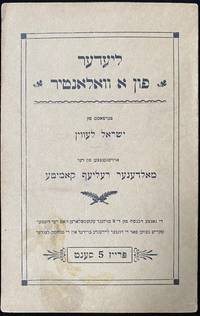
191942896No Place Malden MA: Maldener Relief Komite 1919. No Date 1919. 1st Edition. Original printed paper wrappers 8vo 14 pages. 21 cm. In Yiddish. Title translates as “Verses of a Volunteer.†No city or date listed but clearly published during or immediately after WW I with the Leksikon suggesting Malden MA 1919 OCLC suggests Boston the location of the printer and a clearly incorrect date of 1900 perhaps intending "1900s". Malden the poet’s home town just outside of Boston and clearly the home of the "Maldener Relief Komite" makes much more sense making this is the first documented yiddish publication in Malden MA north of Boston.<br> "The poet dedicated the entire income of 5 thousand copies to the brothers suffering from hunger in the countries at war†Translated from the front cover. Includes 4 poems: Der Volontir; Ikh Zukh a Vort; Nach der Milhome; Hazkharot Neshimot. The final poem is “in memory of the fallen Jewish heroes in all the war-torn lands.â€<br> Israel Levine 1878-1970 “was born in a village in Minsk district Byelorussia. In 1895 he arrived in the United States lived in various cities worked as a teacher in Talmud Torahs and was secretary for Mizrachi in the town in which he lived Malden Massachusetts. <br> He debuted in print in 1904 in Fraye arbeter-shtime Free voice of labor in New York with a poem entitled ‘Funken shpritsn’ Sparks fly and from that point he went on to contribute poetry and translations from Tanakh and from ethical books to: Yidishes tageblat Jewish daily newspaper Forverts Forward Dos yudishe folk The Jewish people Di varheyt The truth and Idisher kemfer Jewish fighter—in New York; Idishe shtime Jewish voice in Boston; and more. He published in book form: Lider fun a volontir Poems of a volunteer Malden 1919 16 pp.; Sefer naim zemirot tehilim Naim Zemirot on Psalms translated into a poetic form with short prefaces by Dr. Meir Vaksman and Aharon Kaminska Jerusalem 1934 19 pp†Khayim Leyb Fuks in Leksikon Fun Der Nayer Yidisher Literatur<br> OCLC: 19307496. OCLC lists 4 copies worldwide YIVO Brandeis Harvard NYBC none outside the northeast. A few stains & discoloring Very Good Condition an excellent copy. Scarce. B YID-45-9XX-LE-’. No Place [Malden, MA]: Maldener Relief Komite unknown
1st edition. Period boards. 8vo. 15 pages each, 31 cm. In Yiddish. Title translates to Jewish Literary World. Vokhenshrif? Far li? Era? Ur, ? Uns? , kritik un kultur-fragen. " Abraham Reisen was leading Yiddish writer and a founder (with his brother Zalman, Chaim Zhitlovsky, I. L. Peretz, and his close friends Scholem Asch and Hersch Dovid Nomberg) of the Yiddishist movement and took part in the Czernowitz Yiddish Language Conference of 1908 at which Yiddish was proclaimed a national language of the Jews (Wikipedia, 2019) . SUBJECTS: Yiddish literature - periodicals. OCLC lists 16 copies worldwide (OCLC: 33025197) . Ex-library with usual markings. Binding is starting. Some pages are lightly worn. Overall Very good condition. (YID-32-25-DL)
1st edition. Period boards. 8vo. 119, 123, 122, 124, 124, 126, 123, 60 pages. 24 cm. In Yiddish. Title translates to Literature and Life: The Jewish World Literary Social Monthly. Featuring some of the biggest names in Yiddish literature, such as I. L. Peretz and Shalom Asch. These 3 volumes, published between 1914-1915, appear to be the only one published; we could find no record of later issues anywhere. SUBJECTS: Jews -- Periodicals. Contains OCLC lists 23 copies worldwide (OCLC 19048582) . Ex-library with usual markings. Bound out of order. Edge wear to boards. Contents are very good. Binding is starting. Overall Good Condition. (YID-40-68)
1st edition. Period boards. 8vo. pages 315-438; 125, 119, 123 + ads. [490 pages total + ads] . 24 cm. In Yiddish. Nrs. 9-11 sub-titled: "Di yudishe velt." Title translates to Literature and Life: The Jewish World Literary Social Monthly. Featuring some of the biggest names in Yiddish literature, such as I. L. Peretz and Shalom Asch. It appears that 3 volumes were published between 1914-1915. SUBJECTS: Jews -- Periodicals. OCLC lists 23 copies worldwide (OCLC 19048582) . Small tear to title page, paper bright, binding solid Very Good+ Condition. (YID-40-68A-'++)
1st edition. Original boards. 8vo. 89, 111 pages, 23 cm. In Yiddish. Title translates to "Literature-Lore. " Two parts: Ershter teyl: Elementn fun ritm un stil -- Tsveyter tley: Geboy fun Kinstlerishn verk un literarishe zshanren. Hofstein (1889-1952) was a prominent Russian-Yiddish poet. He rose to prominence through his elegies of the Jewish communities that suffered during the White pogroms of 1922, many of which were illustrated by Marc Chagall. He emigrated to Palestine in 1923 as a result of the official banning of Hebrew and subsequent persecution of Hebrew writers. He ultimately returned in 1939 and joined the Communist Party. Hofstein was executed on the Night of the Murdered Poets in 1952, along with 12 other Yiddish writers and artists (Wikipedia, 2019) . SUBJECTS: Yiddish language -- Rhetoric. Poetics. OCLC lists 16 copies worldwide (OCLC: 19306025) . Spine rebacked. Boards are worn and browning. Contents very good. (YID-33-72-EJLXGG'o)
Mm 140x215 Prima edizione italiana. Collana "La Gaja Scienza" - Traduzione di Bruno Oddera. Volume in copertina rigida con sovraccoperta, taglio superiore di color celeste, 323 pagine. Copia eccellente, mai letta. SPEDIZIONE IN 24 ORE DALLA CONFERMA DELL'ORDINE.
IN YIDDISH. 21x16cm. 350 pages. Hardcover. In good reading condition.
IN YIDDISH. 23.5x16.5cm. 541 pages. Hardcover. Cover corners slightly bumped. Spine slightly bumped. Text block edges slightly stained. Pages slightly yellowing. Else in good condition. PLEASE NOTE: This item is overweight. We may ask for extra shipping costs.
1st Yiddish edition. Original illustrated paper wrappers. 12mo. 95 pages, 14 cm. In Yiddish with some Russian. Title translates to Lublin Extermination-Camp Majdanek. Soviet war correspondent and poet Konstantin Simonovs booklet on the atrocities of the Majdanek camp, published simultaneously in several languages, was only the second monograph published on the atrocities at Majdanek. Simonov (1915-1979) was a highly decorated poet, novelist, playright, and war correspondent whose works were widely known (Wikipedia, 2018) . A Polish-Soviet Special Criminal Court was established in Lublin in August 1944 in order to investigate the Nazi crimes in the Majdanek extermination camp, with Simonov covering the proceedings as the basis for this work. The Majdanek concentration camp was established on Heinrich Himmler's order and operated from October 1, 1941 until it was liberated by the Soviet Army on July 22, 1944. It is known to be the best preserved Nazi concentration camp of the Holocaust, as the Germans did not have enough time to destroy the evidences of their crimes. The Commission for investigating the German crimes was established in August 1944 and soon they published this booklet in several languages. Despite of the importance of this statement it must be mentioned that the Commission made many erroneous assumptions regarding the duration of the camp or number of people killed at Majdanek, probably because they were motivated rather by political and propaganda agenda than by a search for historical facts. The total number of the victims is still controversial, in this report 1.5 million victims of different nationalities were counted, however according to the latest researches there were 79, 000 victims, 59, 000 of whom were Jews. [Kranz, T. : Bookkeeping of Death and Prisoner Mortality at Majdanek. Pp. 81-110. In: Silberklang, D. (ed. ) : Yad Vashem Studies. Vol. 35: 1. Jerusalem, 2007.]. SUBJECTS: World War, 1939-1945 -- Atrocities. World War, 1939-1945 (OCLC: 145083668) . Light wear to wrappers and pages browning. Otherwise very good condition. (HOLO2-142-4-ALR)
102.791Paris, Gallimard, 1973. 14 x 20, 396 pp., reliure d'édition pleine toile + jaquette, bon état.
Hardcover in-8, 393 p., lexique, cartonnage sous jaquette illustrée. Très bel exemplaire. [CA-13] Réunis ici : Lumières allumées et Première rencontre, écrits de 1935 à 1944, date de la mort prématurée de Bella Chagall.
1st Yiddish edition. Original decorated boards. 8vo. 288, 309, 350, 485, 275, 402 pages [1834 pages total![, 23 cm. Title translates to The Deluge. Yiddish translation of Henryk Sienkiewicz masterpiece historical novel The Deluge. It was originally published as a trilogy in 1886 and tells a story of a fictional Polish-Lithuanian Commonwealth soldier and noble Andrzej Kmicic and shows a panorama of the Commonwealth during its historical period of the Deluge, which was a part of the Northern Wars (Wikipedia, 2019). SUBJECTS: Polish fiction -- Translations into Yiddish. OCLC lists 9 copies worldwide (OCLC:173031593). Ex-library with usual markings. Cloth on all volumes are lightly worn. Pages browning as expected with interwar paper, but not too bad. Overall good condition. (YID-33-52'elx)
Traduzione: Oddera Bruno dall'inglese . Edizione: Seconda edizione . Pagine: 208 . Formato: 8° . Rilegatura: Brossura editoriale . Stato: Ottimo . Collana: I narratori n°8 .
004A71Printed in the Jewish Year Salomon ben Joseph Proops Amsterdam: 1721. 5482 156 leaves. Probably lacks the colophon. A few other leaves are defective including the title page. Yiddish text in Hebrew lettering. 4to. 220 mm. Original full leather binding worn and broken; with the boards tooled in a crude but interesting geometric pattern. The festival liturgy according to the German-Polish rite translated into Yiddish by Asher Anshel ben Joseph Mordecai in the 16th century for the use of Ashkenazi Jews living in Germany and Holland. The Mahzor is the prayer book used by Jews on the High Holidays of Rosh Hashanah and Yom Kippur. Many Jews also make use of specialized mahzorim on the three "pilgrimage festivals" of Passover Shavuot and Sukkot. The prayer book is a specialized form of the siddur which is generally intended for use in weekday and Shabbat services. The word mahzor means 'cycle' "to return". It is applied to the festival prayer book because the festivals recur /return annually. SAWF. Hardbound. Rare. Apparently only two examples of this edition are held in U.S. Libraries. Roest 706; Mehlman Ginzei 327; Vinograd Amsterdam 1166. SCARCE. CHEST 2 /4 $ 500.00. Hardcover. Fair. (Printed in the Jewish Year ) [Salomon ben Joseph Proops, Amsterdam: 1721]. hardcover
156 leaves. Probably lacks the colophon. A few other leaves are defective, including the title page. Yiddish text in Hebrew lettering. 4to. 220 mm. Original full leather binding, worn and broken; with the boards tooled in a crude, but interesting, geometric pattern. The festival liturgy according to the German-Polish rite, translated into Yiddish by Asher Anshel ben Joseph Mordecai in the 16th century for the use of Ashkenazi Jews living in Germany and Holland. The Mahzor is the prayer book used by Jews on the High Holidays of Rosh Hashanah and Yom Kippur. Many Jews also make use of specialized mahzorim on the three "pilgrimage festivals" of Passover, Shavuot, and Sukkot. The prayer book is a specialized form of the siddur, which is generally intended for use in weekday and Shabbat services. The word mahzor means 'cycle' ("to return"). It is applied to the festival prayer book because the festivals recur /return annually. SAWF. Hardbound. Rare. Apparently only two examples of this edition are held in U.S. Libraries. Roest 706; Mehlman (Ginzei) 327; Vinograd, Amsterdam 1166. SCARCE. CHEST 2 /4 $ 500.00
Paper Wrappers, 95 pages, 18 cm. Fiction. In Yiddish. Series: Kleyne bibliotek; Other Titles: Malkhus geto. Title on title page verso:; Krolewstwo ghetta SUBJECT(S): Holocaust, Jewish (1939-1945) -- Poland -- Lódz -- Fiction. Jews -- Poland -- Lódz -- Fiction. Originally bound in flimsy and fragile paper wrappers, this copy has been rebound in paper wrappers with original illustrated cover mounted on front. Paper browning as generally found, but solid. Good Condition. Scarce (H-40-17)
17.5x24.5cm. XII+307 pages. Hardcover with dust jacket. Inner back cover slightly stained. Else in good condition.
Later Boards. 8vo. 55 pages. 22 cm. First edition. Introduction in German. Text in Hebrew with German translation on facing pages. Printed on fine ragpaper. The only work published by J. Harburger, Rabbinate Candidate. Also the first Hebrew book printed in Bayreuth (Freimann, Gazette) . Jehuda Harburger (1808-1854) studied in Fuerth and Munich, became Substitute Rabbi for Rabbi Aub in Bayreuth, finally Rabbi in Reckendorf, where he died. Subjects: Commentaries. Talmud. Minor tractates. Derekh erez - Commentaries. Talmud. Minor tractates. Derekh erez. OCLC lists 16 copies. Light wear to boards, light foxing throughout, overall clean and fresh. Very good condition. (GER-43-47)