3 889 résultats
181590277Charles-Joseph Panckoucke | Paris 1815 | 12.3 x 20.7 cm | Relié
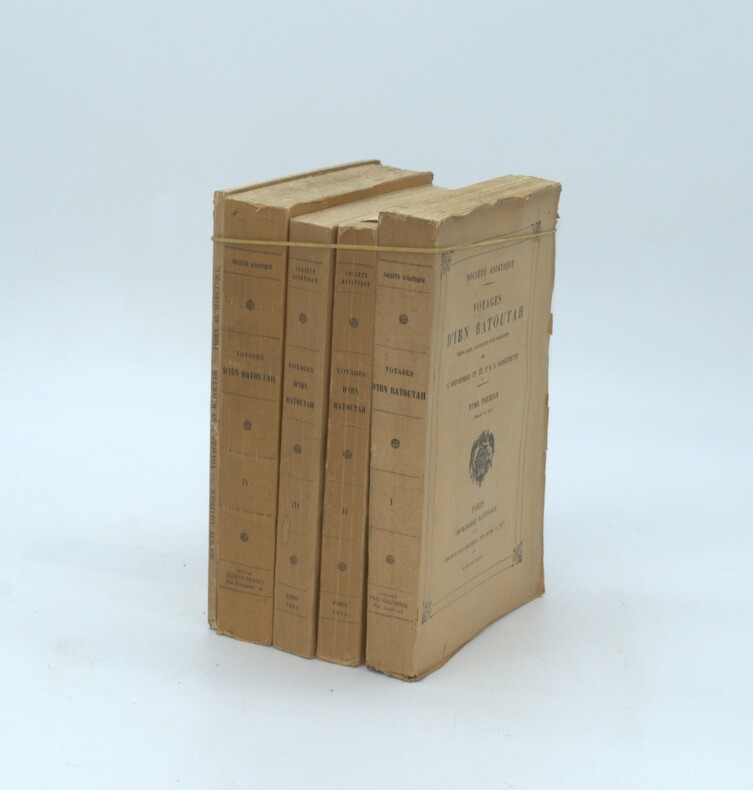
PHO-1451A l'Imprimerie Nationale, Paris, Ernest Leroux et Paul Geuthner Éditeur, 1922-1949. . Édition bilingue: Texte arabe avec traduction française en regard. 5 volumes In-8° de: Tome I (4e tirage,1927) 2ff-XLVI & 443pp. Tome II (5e tirage,1949), XIV & 465 pp. Tome III (5e tirage, 1949), XXVI & 476 pp. Tome IV (4e tirage, 1922), 479 pp. Le Tome V, constitue l'index ,(3e tirage , 1927) 91 pp.. Broché avec couverture éditeur ,non coupé .
19470042991947 Sans lieu [Paris], Éditions Manuel Bruker, sans date [1947]. In-folio en feuilles (252 X 338) sous chemise rempliée illustrée, chemise et étui de l'éditeur ; 94 pages, (2) ff..
Very Good Arabic Original creme bdg. HC. Folio. (32,5 x 27 cm). Texts in Arabic with a bilingual title on verso of the cover in English and Arabic. [18] p., [15] unnumbered full paged color plates of the buildings in Jeddah separately tissue papers. Signed and inscribed in Turkish by Cidde emini [i.e. The Lord Mayor of Jeddah] Mohamed Said Farsi, dated 8.5.1984 to Turkish architect Selim Sabuncuoglu as 'Sayin Selim Sabuncuoglu, en güzel temennilerimle Jedda'dan bir hatira. Jeddah emini, Sait Farisi'. Sealed "YÜTAS: Construction Production Industry and Trade Co.". Dr. Mohammed Said Farsi, (1937-2019), was a former Lord Mayor of Jeddah, and a man of such aesthetic integrity that he traveled the world to meet with sculptors, painters, and musicians before replanning the city according to his own meticulously constructed vision. (Source: The Rake). Dr. Farsi was a visionary civic leader and philanthropist who is widely considered to be the father of modern Jeddah. He presided over a five-fold increase in the city's population, led its transformation, including creating the famous Jeddah corniche - a unique public space and an open-air gallery. Dr. Farsi, a noted art lover, was also the first mayor to introduce Western art and sculpture to an Arab city. He is survived by his son Hani Farsi and former wife Naglaa Asaad. Born in Makkah in 1937, Dr. M S Farsi qualified as an architect in Alexandria and returned to Saudi Arabia in the early 1960s. He entered government service in 1963 and rose rapidly. Just two years later he was appointed to the post of Planning Officer for the Western Region of Saudi Arabia. Covering an area larger than the United Kingdom and having within its boundaries the port city of Jeddah and the Holy Cities of Makkah and Medinah, this territory was in effect Saudi Arabia's window to the world and it was under Dr. Farsi's aegis that plans for these three cities were drawn up; given the immense significance of this work, Dr. Farsi liaised with the very highest levels of government. In 1972, Dr. Farsi became Mayor of Jeddah, a city that had grown from the historic walled city of his childhood to a large modern conurbation of more than 300,000 people. Until the middle of the following decade, Dr. Farsi presided over a period of spectacular and unprecedented growth for the city, which saw its population increase five-fold. That chaos was averted in the face of such a population explosion was due in no small part to Dr. Farsi's enlightened leadership. It is remarkable that in the midst of creating much-needed infrastructure, Dr. Farsi found time to create a city that was as beautiful as it was functional; with a carefully preserved historic center, gracious boulevards, and charming parks. A collector of Islamic and Western art, Dr. Farsi's vision as a city planner was to integrate important contemporary art into public spaces, thus enriching the lives of the inhabitants and reflecting the on-going cultural significance of the city, and his mayoralty is today remembered for its artistic flowering and for being at the forefront of design. Dr. Farsi made use of local artists and materials as well as commissioning works from many great Western masters, including Henry Moore, Victor Vasarely, Alexander Calder, Arnaldo Pomodoro, Joan Miró, Cesar Baldaccini, Sylvestre Monnier, Jean Arp, and Jacques Lipchitz, among many other stellar names in the international art world. He was the first mayor to introduce Western art and sculpture to an Arab city, as well as the first to display art that depicted the physical human form. At the time he stepped down, in 1986, Jeddah boasted over 400 pieces of public art. When he retired in 1986, Dr. Farsi returned to one of his primary passions - education. Within just one year he successfully qualified for his doctorate, attaining a Ph.D. from the University of Alexandria. (Source: Pressat).
Fine Fine English Original brown imitation leather bdg. Dust wrapper. In publisher's special slip-case. Folio. (31 x 26,5 cm). Texts in entirely English, bilingual title on the slipcase in English and Arabic. 143, [1] p., fully color and b/w photos. Signed and inscribed in Turkish by Cidde emini [i.e. The Lord Mayor of Jeddah] Mohamed Said Farsi, dated 8.5.1984 to Turkish architect Selim Sabuncuoglu as 'Sayin Selim Sabuncuoglu, en güzel temennilerimle Jedda'dan bir hatira. Jeddah emini, Sait Farisi'. Sealed "YÜTAS: Construction Production Industry and Trade Co.". Dr. Mohammed Said Farsi, (1937-2019), was a former Lord Mayor of Jeddah, and a man of such aesthetic integrity that he traveled the world to meet with sculptors, painters, and musicians before replanning the city according to his own meticulously constructed vision. (Source: The Rake). Dr. Farsi was a visionary civic leader and philanthropist who is widely considered to be the father of modern Jeddah. He presided over a five-fold increase in the city's population, led its transformation, including creating the famous Jeddah corniche - a unique public space and an open-air gallery. Dr. Farsi, a noted art lover, was also the first mayor to introduce Western art and sculpture to an Arab city. He is survived by his son Hani Farsi and former wife Naglaa Asaad. Born in Makkah in 1937, Dr. M S Farsi qualified as an architect in Alexandria and returned to Saudi Arabia in the early 1960s. He entered government service in 1963 and rose rapidly. Just two years later he was appointed to the post of Planning Officer for the Western Region of Saudi Arabia. Covering an area larger than the United Kingdom and having within its boundaries the port city of Jeddah and the Holy Cities of Makkah and Medinah, this territory was in effect Saudi Arabia's window to the world and it was under Dr. Farsi's aegis that plans for these three cities were drawn up; given the immense significance of this work, Dr. Farsi liaised with the very highest levels of government. In 1972, Dr. Farsi became Mayor of Jeddah, a city that had grown from the historic walled city of his childhood to a large modern conurbation of more than 300,000 people. Until the middle of the following decade, Dr. Farsi presided over a period of spectacular and unprecedented growth for the city, which saw its population increase five-fold. That chaos was averted in the face of such a population explosion was due in no small part to Dr. Farsi's enlightened leadership. It is remarkable that in the midst of creating much-needed infrastructure, Dr. Farsi found time to create a city that was as beautiful as it was functional; with a carefully preserved historic center, gracious boulevards, and charming parks. A collector of Islamic and Western art, Dr. Farsi's vision as a city planner was to integrate important contemporary art into public spaces, thus enriching the lives of the inhabitants and reflecting the on-going cultural significance of the city, and his mayoralty is today remembered for its artistic flowering and for being at the forefront of design. Dr. Farsi made use of local artists and materials as well as commissioning works from many great Western masters, including Henry Moore, Victor Vasarely, Alexander Calder, Arnaldo Pomodoro, Joan Miró, Cesar Baldaccini, Sylvestre Monnier, Jean Arp, and Jacques Lipchitz, among many other stellar names in the international art world. He was the first mayor to introduce Western art and sculpture to an Arab city, as well as the first to display art that depicted the physical human form. At the time he stepped down, in 1986, Jeddah boasted over 400 pieces of public art. When he retired in 1986, Dr. Farsi returned to one of his primary passions - education. Within just one year he successfully qualified for his doctorate, attaining a Ph.D. from the University of Alexandria. (Source: Pressat). Jeddah: 'Bride of the Red Sea'. This is a cosmopolitan city, ancient and modern hub, the unique seat of civilis[.]. R
Very Good Turkish Original silver gelatin photographic print mounted on cardboard. 53x42 cm (Photo size: 38x30 cm). Signed by Yildiz Moran. Yildiz (Vahid) Moran Arun was born on 24 July 1932, in Istanbul. She is the youngest of three children born to Nemide Moran and Ahmet Vahid Moran. Her father, Ahmet Vahid Moran, was a military officer who served in important positions both at home and abroad. He was the writer of Turkey's very first English-Turkish dictionary printed in Latin script in 1924. In 1950, Yildiz Moran quit her high school education during her final year at Robert College and, following the guidance of her uncle, the art historian Mazhar Sevket Ipsiroglu, went to Great Britain to study photography. After completing her education at Bloomsbury Technical College (1950-52) and Ealing Broadway Technical College, she began to work for John Vickers, the acclaimed photographer of The Old Vic. Moran combined her technical and theoretical knowledge with the practical experience she gained at the studio and stage shoots. She had the opportunity to meet famous artists of the time. The exhibitions and works she saw during her time in Great Britain helped her develop her photographic vision. Following her internship period, she began to make a living taking portrait and lobby photographs. She opened her first exhibition in 1953 in Cambridge. In 1954, she held four more exhibitions in London. All these shows attracted much attention. In her first exhibition, her entire collection was sold. She went traveling in Europe. After making a photo book on Spain and Portugal, she returned to Turkey in 1954. Between 1955 and 1962, she held five solo exhibitions. In 1963, she married Özdemir Asaf (Halit Özdemir Arun) and gave birth to three children in four years. She dedicated the rest of her life to her children. She opened her last exhibition in 1970, in Istanbul. After that, she only took part in retrospective exhibitions. She quit her professional photography career and began to work as a translator and dictionary writer. Between 1981 and 1987, she prepared the complete works of Özdemir Asaf for publication and translated some of his poetry and prose into English. In 1982, the Istanbul State Academy of Fine Arts Photography Institute awarded her honorary membership on account of her contributions to the art of photography. Lyrically conveying a universal language through her own perspective, Moran became a school in herself with her "timeless" photographs. Turkey's first academically-trained photographer, Yildiz Moran is renowned for the new vision and aesthetic she introduced into photography and is considered to be one of the best photographers of all time. Masterfully combining the tradition of the East with the aesthetic of the West, she left behind a legacy of black and white photographs beautifully composed to capture the world of light and shadow reflecting on people and lands. Considering the conditions in the world of photography in the 1950s and 1960s, it is a great achievement that she defined the age of 20 her passion for photography as the foundation of her life, became the first academically-trained woman photographer in her country, acquired in-depth knowledge of the discipline and combined this knowledge with her talent and hard work. "The camera must be like an extension of your being so that it doesn't create an obstruction between you and your subjects. Anything that has poetry in it is the subject of photography. My only intention has always been to photograph what was universal while staying true to the concept embodied by my subject." Besides her portraits, landscapes, and abstract details, she is also known for her photographs reflecting the lives of the Anatolian people. As a woman photographer traveling in Anatolia, she accessed otherwise inaccessible environments, moments, and perspectives; and, with profound respect, she conveyed the purity of the people she met there and allowed us... (Biography: Merih Akogul).
189489789J. Rothschild | Paris 1894 | 14.5 x 23 cm | Relié
49132Librairie orientaliste Paul Geuthner.1934.2 vols.in-4. Texte broché de 209 p.Atlas sous chemise cartonnéz avec dos toilé et lacets.Plats décorés.Sont joints un plan et des photos supplémentaires.CLXI planches. TBE.
First edition, 4to, 15,[1]pp., purchase note in Sir Thomas' hand "Sotheby 66", orig. blue paper wrappers bound in, uncut, middle hill boards, spine chipped. A catalogue of 127 manuscripts rich in Arabic and Persian works, purchased by Guise between 1788 and 1795, at great personal expense, while he was Head Surgeon to the General Hospital. "His rarest manuscripts (according to his catalogue published in 1800) were purchased from the widow of Dastur Darab who between 1758 and 1760 had taught Avestan to Anquetil du Perron, the first translator of the Avesta into a European language."?British Library. ESTC locates copies at the British Library, National Library of Scotland, Gottingen (Germany) & New York Public Library.
1845PHO-1947Au Kaire, Chez Benjamin Duprat, Libraire de l'Institut et de la Bibliothèque Royale & chez le Traducteur, 1845. In-8, LXXXVIII-491pp., demi basane verte, dos lisse avec titre, cachets, étiquette au dos, rousseurs, déchirure sur la grande carte, frottements Épître dédicatoire à Mohammed Aly Vice-Roi d'Égypte. Préface par M. JOMARD contenant des remarques sur la région du Nil Blanc supérieur. Portrait-frontispice du sultan Abou Madian. Ouvrage bien complet des 5 planches repliées dont 2 cartes in fine ainsi que du feuillet d'Errata.
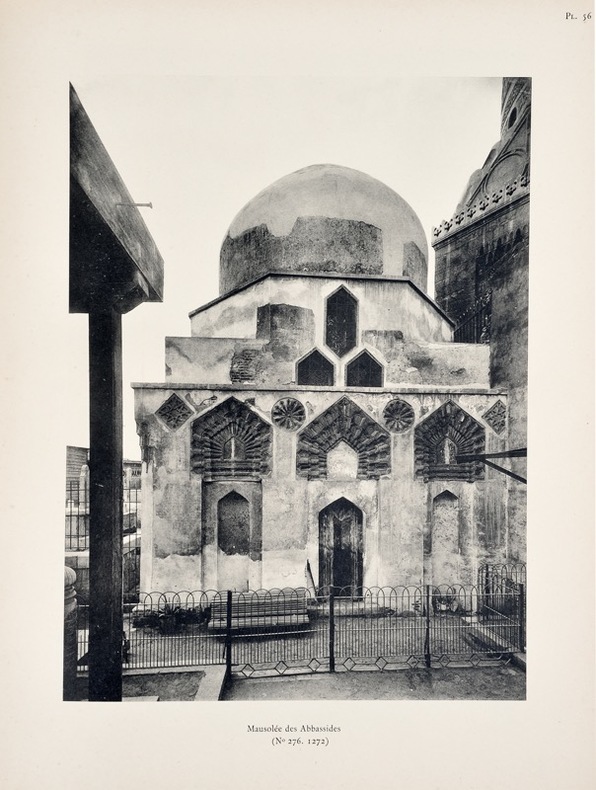
193221719Paris, Ernest Leroux, 1932 ; 2 tomes in-4° (Texte et Album), broché ; 276 pp., [2] ff. de tables ; [11] ff. de planches de Plans, 247 planches photographiques de 1 ou 2 vues chacune, pour un total de 386 pp.
196178653Les Editions de Minuit | Paris 1961 | 14 x 22.50 cm | broché
13491Grabadin h.e. compendii secretorum medicamentorum libri duo cum Mundini, Honesti, Manardi et Sylvii observationibus et Cui access. Plantarum descript. Imagines ex vivo Ionnis Costaie annott. Venize. Juntas. 1623. Fort in-folio (35x23 cms). 6 ff. dont titre-252-6 ff. dont titre-278 ff. et 12 feuillets dont 1 blanc. Reliure de l'époque très mauvais état, sans dos (cassé).
Tholuck's investigation of Sufism as an independent phenomenomas taking it to be a pantheistic interpretation of Islam. xii, 331 pages. Bookplate and inscription of William Farrer on front pastedown and front free endpaper. Missing lower two thirds of spine. Light spotting to title page, annotation in red ink opposite title page.
4430P., Barbin, 1680. Deux volumes in 12 basane de l'époque (coiffes usagées).
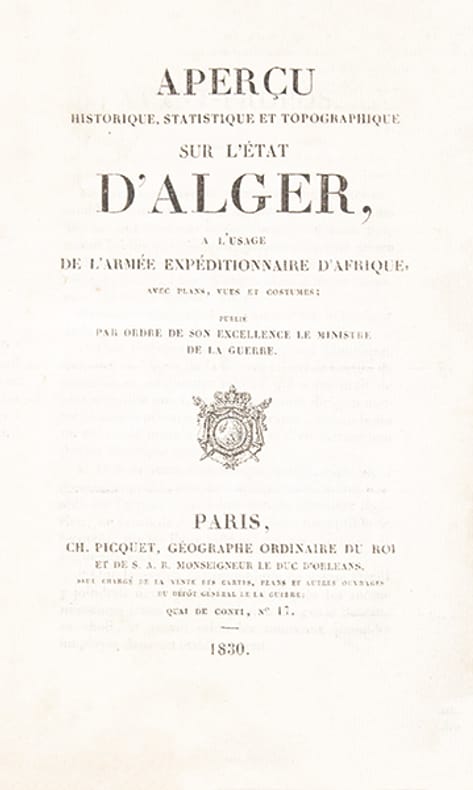
388922 volumes: un volume de texte in-12 (180 x 110 mm), broché, couverture imprimée, (4), xiii, 256 p. et un volume d'atlas in-folio oblong (265 x 347 mm), 6 cartes et plans dépliants et 11 planches. Paris, Charles Picquet géographe du roi (), 1830.
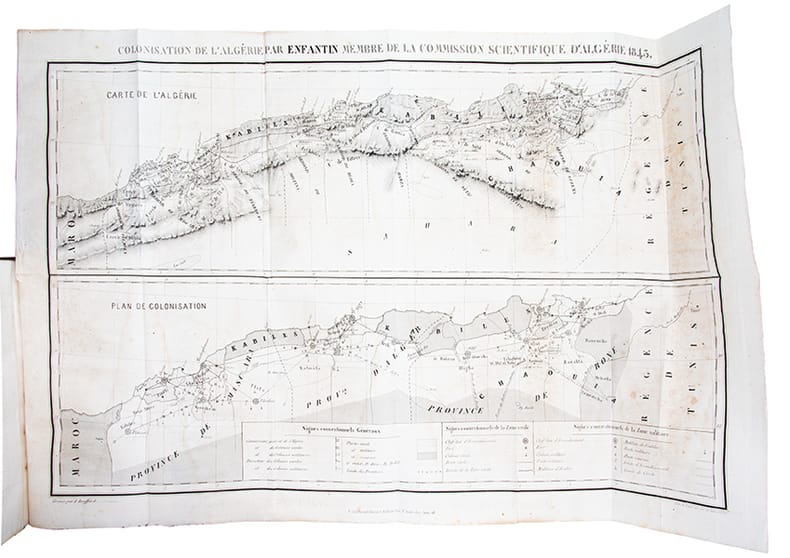
39394In-8 (225 x 142 mm), demi-chagrin bordeaux, pièce de titre de veau bronze (rel. moderne), (4), 542 pages, 4 pages de catalogue, grande carte (42 x 66 cm) et tableau statistique dépliants. Paris, P. Bertrand, 1843.
- Théophile Barrois et Benjamin Duprat, Paris 1831, In-8 (13x21cm), 189pp. 32pp., relié. - Mention de seconde édition, corrigée et augmentée. La première est parue sans nom d'auteur et n'a bénéficié que d'un tirage confidentiel, c'est pourquoi on ne la trouve que très rarement. L'illustration comprend un portrait au frontispice de Hussein Pacha, une carte repliée, et 10 tableaux sur l'état de l'armée. 7 planches pour L'univers pittoresque. Reliure en pleine basane verte d'époque. Dos lisse orné de 2 fers et d'un grand fer central romantique en miroir, filets et roulettes. Pièce de titre en maroquin bordeaux. Traces de frottements en coiffes et coins. Bel exemplaire. Le commandant Fernel (1793-1854) était attaché à l'état-major de l'armée d'Afrique, il nous conte dans cet ouvrage à tendance légitimiste l'histoire de la prise d'Alger. Le dernier chapitre est consacré aux particularités de la région, dattier, canne à sucre, grenades, chameaux... Cette campagne, on le sait, aura des répercussions considérables sur la presence française en Afrique du nord. In fine, l'exemplaire a été truffé de la partie de L'Univers pittoresque sur Algers, écrite par Rozet, capitaine du génie, qui contient 7 planches sur acier. [ENGLISH DESCRIPTION ON DEMAND]
- Maison Quantin, Paris 1890, In-4 (24,5x31,5cm), 245pp., relié. - Edition originale de cet ouvrage magnifiquement illustré d'un titre-frontispice en couleurs, d'une quatrième de couverture en couleurs et de 150 aquarelles par Charles Lallemand gravés par Michelet. Tirage sur grand papier, vélin fort. Les aquarelles ont été faites in situ par l'auteur. Cartonnage d'éditeur bleu ciel biseauté. Dos lisse orné d'un croissant et une étoile, de roulettes et d'un tunisien en couleur en tenue pittoresque. Tranches dorées. Sur le plat supérieur le titre et le drpeau tunisien. Plaque signée Lenègre & cie. Salissures sur le premier plat. Dos devenue légèrement turquoise. Coiffes un peu affaissées. Traces de frottement. Parfaite fraîcheur du papier. Bel exemplaire de cette superbe publication, dont le texte constitue un témoignage sur la Tunisie de la fin du XIXe et une réelle admiration pour son peuple, son histoire et sa contrée. [ENGLISH DESCRIPTION ON DEMAND]
- Paulin, Paris 1832, 13x20,5cm, 3 volumes reliés. - Edition originale de la traduction française. Reliures à la bradel en plein cartonnage vert sapin, dos lisse partiellement décolorés et ornés de filets dorés, traces de frottements sur les mors, gardes et contreplats de papier vert d'eau, coins émoussés, tranches jaunes, reliures de l'époque. Ouvrage illustré de figures dans le texte et bien complet de ses 2 cartes ainsi que de ses 5 gravures hors-texte. Indications de rangement de bibliothèque, à l'encre rouge, en têtes des contreplats, quelques petites rousseurs. [ENGLISH DESCRIPTION ON DEMAND]
1886RO80101671LEROUX Ernest. 1880 - 1886. In-Folio. Relié demi-cuir. Bon état, Couv. légèrement passée, Dos satisfaisant, Intérieur acceptable. 975 + 860 pages. Titre et fleurons dorés sur demi-chagrin marron. Légères épidermures sur le cuir. Coins légèrement frottés. Etiquette de code sur la coiffe en-tête et tampons de bibliothèque sur la page de titre et dans quelques marges.. . . . Classification Dewey : 492.7-Arabe
Very Good Turkish, Ottoman (1500-1928) Original lithograph map with brown, white and blue tons. 81x57 cm. In Ottoman script (Old Turkish with Arabic letters). All toponyms are in Ottoman Turkish and Arabic. Scale: 1:500,000. Shows Mediterranean shores on the north, Bahr-i Lût [i.e. the Dead Sea], Aqaba Bay, areas of Arabic tribes in very detail, in addition, special huge lands like 'Al-Hism Land'. Also, it shows holy places, antiquities, fortresses, rivers; and Turkish Sanjaks, Qazas, Nahiyes, Qariyes based on the Ottoman administrative system. Cartographer is not indicated, but, it's composed for military purposes in the last period of the Imperial Ottoman, especially for showing Arabian tribes spreading over vast areas in its period, just before World War 1 (date of the printing of this map), such as 'Houtat Tribe'. A very detailed and attractive map of Palestine and Quds area and their topography. Following the Muslim conquest of Palestine in 636-640, several Muslim ruling dynasties succeeded each other as they wrestled control of Palestine: the Rashiduns; the Umayyads, who built the Dome of the Rock and the al-Aqsa Mosque in Jerusalem; the Abbasids; the semi-independent Tulunids and the Ikhshidids; the Fatimids; and the Seljuks. In 1099, the Crusaders established the Kingdom of Jerusalem in Palestine, which the Ayyubid Sultanate conquered in 1187. The Crusaders failed to retake Palestine despite further attempts. The Egyptian Mamluks took Palestine from the Mongols (who had conquered the Ayyubid Sultanate) in 1260. The Ottomans captured Palestine in 1516 and ruled it until Egypt took it in 1832. Eight years later, the United Kingdom intervened and returned the region to the Ottomans. Considerable demographic changes happened during the 19th century and with the regional migrations of Druze, Circassians, and Bedouin tribes. The emergence of Zionism also brought many Jewish immigrants from Europe and the revival of the Hebrew language. Arabs in Palestine, both Christian and Muslim, settled and Bedouin, were historically split between the Qays and Yaman factions. These divisions had their origins in pre-Islamic tribal feuds between Northern Arabians (Qaysis) and Southern Arabians (Yamanis). The strife between the two tribal confederacies spread throughout the Arab world with their conquests, subsuming even uninvolved families so that the population of Palestine identified with one or the other. Their conflicts continued after the 8th-century Civil war in Palestine until the early 20th century and gave rise to differences in customs, tradition, and dialect which remain to this day. Beit Sahour was first settled in the 14th century by a handful of Christian and Muslim clans (hamula) from Wadi Musa in Jordan, the Christian Jaraisa and the Muslim Shaybat and Jubran, who came to work as shepherds for Bethlehem's Christian landowners, and they were subsequently joined by other Greek Orthodox immigrants from Egypt in the 17th-18th centuries. Due to the legacy of the Ottoman period, the ethnic origins of some rural and urban Palestinians are either Albanian, Circassian, or from other non-Arab populations.
Very Good Turkish, Ottoman (1500-1928) Paperback. Foolscap 8vo. (18 x 13 cm). In Ottoman script (Turkish with Arabic letters). 80 p., [10] unnumbered b/w plts. Yenisehirlizâde Halit Eyüp was the son-in-law of Ahmet Midhat Efendi, one of the shaded names of Turkish literature. This rare book has 10 unnumbered b/w plates shows firstly Abd Al-Rahman Khan, (1845-1901), who was Emîr of Afghanistan and played a prominent role in the fierce and long-drawn struggle for power waged by his father and his uncle, A'?am Khân, against his cousin Shîr 'Alî, the successor of Dost Mo?ammad Khân. And then, Khaybar Fortress, Peshaver city in India, Tajik chief of Afghanistan: Maaz Khan (two-paged print), a view of Kabul city (two-paged print), Ghaznawid Fortress, North Gate of Kandahar, Herat Fortress (two-pages print), Cohat Fortress, a portrait of Afghan Sufi. An extremely rare and richly illustrated book of the history of Afghanistan. Hegira: 1316 = Gregorian: 1899. First and Only Edition. TBTK 12178.; Özege 19966.; Three copies located in OCLC: 944246927 (One copy in Library of Congress - Karl Süssheim Collection, No. 7.).; 163633157 (Orient-Institut Istanbul and Bayerische Staatsbibliothek).
- Lucien Vogel éditeur, Paris 1922, 18x24cm, relié. - Set of eight original prints in color, drawn on laid paper. The XXXIII and XXXVI sketches are signed lower left and right boards. The boards are introduced by a text Joan Ramon Fernandez. Original prints made ??for the illustration of The Gazette fashionable, one of the finest and most influential twentieth century fashion magazines, celebrating the talent of creators and artists French burgeoning art deco. Famous fashion magazine founded in 1912 by Lucien Vogel, The Gazette fashionable appeared until 1925 with an interruption during the War of 1915 to 1920, due to mobilization of its editor. She is 69 Deliveries from just 2000 copies and is illustrated including 573 color plates and 148 sketches depicting models of fashion designers. Upon publication, these luxury publications "are for bibliophiles and worldly aesthetes" (Françoise Tétart-Vittu "good Gazette of tone" in the fashion dictionary, 2016). Printed on fine laid paper, they use a typeface created specifically for the magazine by Georges Peignot, the Cochin character, taken in 1946 by Christian Dior. The prints are made with the technique of metal stencil, enhanced color and some outlined in gold or palladium. The adventure began in 1912 when Lucien Vogel, man of the world and fashion - it has already participated in Femina magazine - decided to found with his wife Cosette de Brunhoff (John's sister, the father of Babar) Gazette good tone in which the subtitle is then "Art, fashions and frivolities." Georges Charensol quotes the editor: "In 1910, he observed, there was no truly artistic fashion magazine and representative of the spirit of his time. So I thought of making a glossy magazine with truly modern artists [...] I was certain of success because for any fashion country can compete with France. "(" A great art editor. Lucien Vogel "in literary News, No. 133, May 1925). The success of the magazine is immediate, not only in France but also the US and South America. Originally, Vogel therefore brings together a group of seven artists: André-Édouard Marty and Pierre Brissaud, followed by Georges Lepape and Dammicourt; and finally his friends from the School of Fine Arts as are George Barbier, Bernard Boutet de Monvel or Charles Martin. Other talents come quickly reach the equipped Guy Arnoux, Léon Bakst, Benito, Boutet de Monvel, Umberto Brunelleschi, Chas Laborde, Jean-Gabriel Domergue, Raoul Dufy, Edward Halouze Alexander Iacovleff, Jean Emile Laboureur Charles Loupot, Charles Martin, Maggie Salcedo. These artists, mostly unknown when Lucien Vogel appealed to them, will eventually become iconic figures and artistic sought. These are the same illustrators who make the drawings advertisements Gazette. The boards highlight the dresses and sublime seven artists of the time: Lanvin, Doeuillet, Paquin, Poiret, Worth, Vionnet and Doucet. The designers provide for each number of exclusive models. Nevertheless, some of Illustrations contained no real model, but only the idea that the illustrator is done in the fashion of the day. Gazette fashionable is a milestone in the history of fashion. Combining the aesthetic requirement and plastic unit, it brings together for the first time the great talents of the world of arts, literature and fashion and imposed by this alchemy, a new image of women, slender, independent and bold, also driven by the new generation of designers Coco Chanel, Jean Patou, Rochas Marcel ... Recovery in 1920 by Condé Montrose Nast, Gazette fashionable modeled for the new composition and the aesthetic choices of the "little dying newspaper" that Nast had bought a few years ago: the Vogue magazine. [FRENCH VERSION FOLLOWS] Ensemble de huit estampes originales en couleur, tirées sur papier vergé. Les croquis XXXIII et XXXVI sont signés en bas à gauche et à droite des planches. Les planches sont introduites par un texte de Jeanne Ramon-Fernandez. Reliure à la bradel en plein papier à motif décoratif, do
- Librairie de L. Hachette et Cie., Paris 1859, In-8 (13x21,1cm), 526pp., relié. - Edition originale. Reliure en demi chagrin rouge d'époque. Dos à nerfs orné de 4 fleurons dans des caissons à froid. Auteur, titre et date dorés. Tête dorée. Papier bien frais (quelques rares pâles rousseurs). Bel exemplaire. En décembre 1854, Joseph-Arthur de Gobineau (1816-1882), alors premier secrétaire à la légation de Francfort, est nommé secrétaire d'une mission extraordinaire en Perse, conduite par le ministre Prosper Bourée et ordonnée par l'empereur Napoléon III. Sur le chemin de la Perse, Gobineau parcourt Malte, l'Egypte et les pays de la péninsule arabique. La deuxième partie de Trois ans en Asie est certainement la partie la plus riche de cet ouvrage, une mine d'informations sur la société persane de cette époque. Animé par le même enthousiasme pour la Perse, Gobineau publiera, en 1864, Religions et philosophies dans l'Asie centrale, puis, en 1869, une Histoire des Perses et enfin, entre 1872 et 1874, son recueil des six Nouvelles Asiatiques. [ENGLISH DESCRIPTION ON DEMAND]