Antiquariat.de

54 410 résultats
16200977-13(Salodii, apud Bernard. Lantonum 1620/21). 4°. 15 Bll. 1 w. Bl., 111 S., 15 Bll., 1 w. Bl.; 80 S., 1 Bl. Mit Initialen Manuskripteinband. Hinterdeckel mit einer anderen Handschrift restaur. Letzte Bll. braunfleckig. Alter Stempel a. d. ersten Bl.
Acquaforte. Lastra mm 118x152, foglio 160x222 mm. Firma a matita a sinistra Luigi Bart. Titolo a matita in basso a sinistra non ben leggibile. Possiamo ipotizzare Invadenza. L’incisione non è catalogata in nessuno dei numerosi repertori sull’artista da noi consultati; è notorio che la catalogazione delle opere di Bartolini non è ancora completa. Bellissima prova, impressa su carta coeva, piccolo strappo perfettamente restaurato nella parte superiore, leggera abrasione al verso, per il resto in ottimo stato di conservazione. Luigi Bartolini è considerato uno dei maggiori incisori italiani del Novecento, insieme a Giorgio Morandi e Giuseppe Viviani. Oltre ad essere un prolifico incisore (al suo attivo oltre mille acqueforti), fu anche pittore e scrittore. Partecipò sia come pittore che come incisore a diverse edizioni della Biennale di Venezia dal 1928 al 1962. Presente a varie manifestazioni artistiche, sviluppò diverse maniere definite: ‘maniera bionda’, ‘lineare’ e ‘nera’. Ricordiamo soprattutto le acqueforti della serie Marche e della serie Sicilia. Iniziò la sua produzione grafica nel 1914 e il suo stile si rifà alla tradizione naturalistica dell’Ottocento. Molte sue incisioni si possono ricollegare ad alcune opere del Goya, di Telemaco Signorini e di Giovanni Fattori. Eccellente nella rappresentazione della natura morta e del paesaggio, spesso il Bartolini rappresentò dolcemente le cose e gli oggetti più umili, i soggetti di natura più dimessi. In essi ritroviamo il sentimento che diviene immagine e la forma che si sviluppa in espressione. Con Bartolini l’incisione torna ad essere un mezzo di espressione poetica libera dal simbolismo e dal vedutismo allora in voga presso le accademie. Nelle sue acqueforti prevale ora un tratteggio leggero (genere biondo), ora una ricerca del chiaroscuro alla Rembrandt (genere nero). Etching. Plate mm 118x152, sheet 160x222 mm. Signature in pencil on the left Luigi Bart. Title in pencil at lower left not well readable. We can assume Invadenza. This work is not catalogued in any of the several repertories we consulted about the artist; it is well known that the cataloguing of Bartolini's works is not yet complete. Beautiful proof, printed on contemporary paper, small tear perfectly restored in the upper part, light abrasion on the back, otherwise in excellent condition. Born in Cupramontana near Ancona, Luigi Bartolini was the twentieth century Italian etcher, who came closest to the stature of his great rival, Morandi. As a teenager, he saw the collection of etchings, including work by Callot, owned by the Corradi family in Iesi. From 1907 to 1910 Bartolini studied at the Istituto di Belle Arti in Siena, and started to etch c. 1909. He moved to Rome in 1910, where until 1912 he frequented the Accademia di Belle Arti, while also attending lectures on literature and the history of art, and courses on anatomy at the University in Rome. Bartolini studied the etchings of Goya and took lessons on drawing at the Accademia di Spagna. From there, he went to Florence in 1913, where he attended the Scuola del nudo. Bartolini continued his anatomical research, as well as studying architecture, making himself the most assiduous student of all Italian twentieth century printmakers. He also visited the Uffizi and Florentine print dealers to look at the etchings of Rembrandt and Fattori. Bartolini painted his first oils just before the outbreak of the First World War. Although he painted pictures throughout the rest of his career, and was awarded the Premio Marzotto for them in 1956, they have been far eclipsed in fame by his etchings and writings. During the First World War, Bartolini published his first collection of poetry. A very prolific and accomplished writer, in this field he is best known today as the author of the novel, 'Ladri di biciclette' (Bicycle thieves), of 1946, which was quickly turned into a celebrated film by Vittorio de Sica and Cesar Zavattini. After the First World War, Bartolini held a series of minor teaching posts in Macerata, Sassari, Avezzano, Pola, and Caltagirone, while he continued to etch, and started a long career as a polemical journalist and critic of art and architecture. From 1923 to 1929, he wrote for the Naples periodical, 'Cimento', but he also contributed to 'Il Selvaggio', 'Quadrivio', 'Italia letteraria', and 'L'Ambrosiana'. Bartolini's 1924 exhibition of etchings at the Casa d'Arte Bragaglia in Rome was a great success, and later that year he showed 70 etched landscapes of the Marches at the Casa Palazzo di Roma. The following year he visited Paris, where he paid particular attention to the paintings of Van Gogh. Bartolini's political convictions led him to being assaulted by Fascists and hospitalised in 1928. Two years later, he won a prize at the Venice Biennale, where he had exhibited a portfolio of etchings. In 1930, the Turin publisher, Buratti, began to issue a series of portfolios of etchings by contemporary Italian artists under the editorship of Cipriano Oppi, selecting Bartolini for the first album. The following year, Buratti published 'Le carte parlanti', a portfolio of 10 of Bartolini's etchings, which was published in an edition of 20. In 1932, Bartolini shared the first prize at the Prima mostra dell'incisione moderna at the Uffizi with Morandi and Boccioni. His close friend, the leading anti-Fascist art historian, Lionello Venturi, acted as his agent selling his etchings in Paris. Bartolini's correspondence with his compatriots in exile led to his imprisonment, from which he was released on Mussolini's personal intervention. He was then placed under political surveillance. From 1933 to 1938, Bartolini taught in Merano, where he painted and etched in the open air, finding subjects on the banks of the fast flowing Adige. Despite being under political su...
Documenti del Centro Studi Colautti, Salerno. Catalogo di mostra, a cura di Germano Celant, Amalfi, Arsenali, 4-6 ottobre 1968. Testo introduttivo di Germano Celant. Interventi di Germano Celant, Giovanni Maria Accame, Giuseppe Bartolucci, Vittorio Boarini, Pietro Bonfiglioli, Achille Bonito Oliva, Gillo Dorfles, Piero Gilardi, Henry Martin, Filiberto Menna, Daniela Palazzoli, Concetto Pozzati, Angelo Trimarco, Tommaso Trini. Fotografie in bianco e nero stampate su carta rosa che documentano le opere le azioni di Ableo, Giovanni Anselmo, Alighiero Boetti, Riccardo Camoni, Jan Dibbets, Luciano Fabro, Piero Gilardi, Paolo Icaro, Pietro Lista, Richard Long, Gino Marotta, Plinio Martelli, Mario Merz, Marisa Merz, Giulio Paolini, Gianni Piacentino, Michelangelo Pistoletto, Emilio Prini, Marcello Rumma, Ger van Elk, Gilberto Zorio e altri. Fotografie di Bruno Manconi Copertina di Valerio Ferrara. Impaginazione di Livio Cristini. 8vo (cm 24 x 16). pp. 108. . Ottimo (Fine). . Prima edizione (First Edition). . "Ad Amalfi, nei giorni 4,5, 6 di ottobre, in occasione della RA3 organizzata dal Centro Studi Colautti di Salerno, l'arte povera, le azioni povere, la critica repressiva, la profezia di una società estetica sono stati i temi dell'o.d.g. L'impoverimento delle tecniche e delle immagini, il riscatto di un sotterraneo filo antitecnologico, un deciso allargamento dell'iconografia attingendo a zone inaccessibili, lo spazio inconscio, un giocare con le proprie emozioni e con il proprio essere, segnano la direzione di marcia di queste esperienze artistiche. I materiali esibiti sono il segno e la testimonianza di un vivere in comune, di un modo di intendere il mondo."
15652771-12Venezia Giorgio de Cavalli 1565. 3. Ausg. gr.-8°. 20 Bll., 1262 S. Mit Initialen. Flex. Pgmt. d. Zt. Stellenw. gebräunt od. fleckig. Durchgeh. kl. Wurmfraß im Kopfsteg v. S. 440-880. Letzte Bll. fleckig. Kl. Loch im w. Rd. d. Schlußblattes. Hint. Vors. erneuert.
Xilografie originali di Adolfo De Carolis: Ritratto della Baccara in sanguigna, frontespizio, testatine, finalini Brossura a due colori con xilografia in rosso di Adolfo De Carolis. 16mo (cm 14x21). pp. 44. . Ottimo (Fine). . Prima edizione (First Edition). . Due scritti sulla pianista che visse con l'Autore al Vittoriale dal 1920 al 1938, già apparsi su periodici dello stesso anno.
183229711ABFlorenz, Dante, 1832. Gr.-folio. (4), 41, (2) S. Mit 1 gest. Frontisp., 1 kl. Titelvignette und 44 (von 46) gest. Tafeln und 1 gest. Textillustr. Pergamentband des 20. Jahrunderts. + Wichtig: Für unsere Kunden in der EU erfolgt der Versand alle 14 Tage verzollt ab Deutschland / Postbank-Konto in Deutschland vorhanden +, 29711A
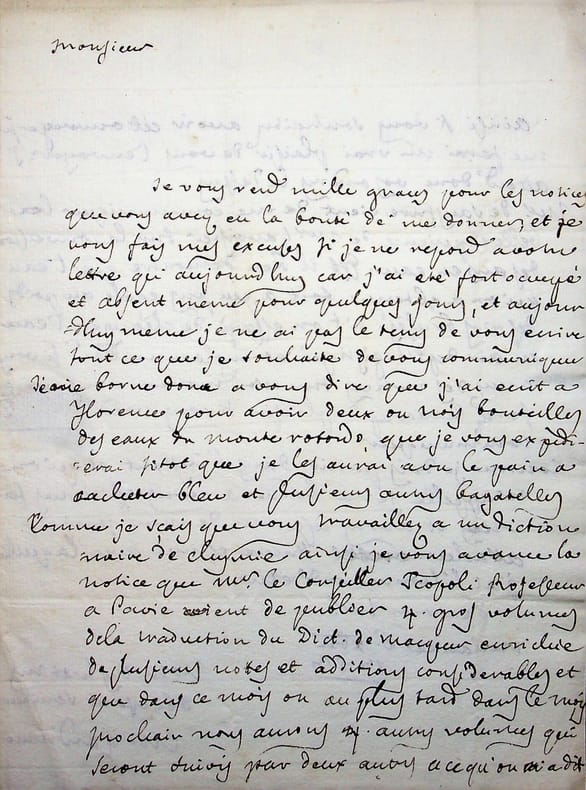
018532Marsilio Landriani (1751-1815), physicien, chimiste, météorologue italien. L.A.S., Milan, 6 décembre 1783, 2p in-4. Au chimiste et homme politique Louis-Bernard Guyton de Morveau (1737-1816) : « Monsieur, Je vous rends mille grâces pour les notices que vous avez eu la bonté de me donner et je vous fais mes excuses si je ne réponds à votre lettre qu'aujourd'hui car j'ai été fort occupé et absent même pour quelques jours, et aujourd'hui même je n'ai pas le temps de vous écrire tout ce que je souhaite [de] vous communiquer. Je me borne donc à vous dire que j'ai écrit à Florence pour avoir deux ou trois bouteilles des eaux du Monte Rotondo que je vous expédierai sitôt que je les aurai avec le pain à [mot illisible] bleu et plusieurs autres bagatelles. Comme je sais que vous travaillez à un dictionnaire de chimie. Aussi je vous avance la notice que Mr le conseiller [Giovanni Antonio] Scopoli professeur à Pavie vient de publier 4 gros volumes de la traduction du Dict. de Macquer enrichie de plusieurs notes et additions considérables et qua dans ce mois ou au plus tard dans le mois prochain nous aurons 4 autres volumes qui seront suivis par deux autres à ce qu'on m'a dit. Ainsi, si vous souhaitez avoir cet ouvrage, je me ferai un vrai plaisir de vous l'envoyer. J'attends donc vos ordres là-dessus. Mr [Nicolas Théodore] de Saussure vient de me communiquer la belle expérience de Mr Lavoisier sur la conversion des airs en eau. Et il a eu démontré que l'eau qu'on a obtenu soit à peu près égale au poids des airs brulés. A-t-on essayé de changer l'eau en air déphlogistiqué et inflammable. Si vous avez des notices sur cette matière, vous me ferez beaucoup de plaisir si vous voudrez me les communiquer. Comme je dois partir dans l'instant et qu'on m'appelle, je me borne à vous offrir mes services et à vous assurer de mon parfait attachement et sincère estime avec laquelle j'ai l'honneur d'être de vous Mr, votre humble et très obéissant serviteur M Landriani ». Cette lettre est très intéressante car elle est en pleine révolution chimique. Landriani parle déjà de la découverte de Lavoisier qui montre que la combustion de « l'air inflammable » (hydrogène) et de « l'air déphlogistiqué » (oxygène) produit de l'eau. Landriani se demande si on a tenté l'expérience inverse. On notera qu'il utilise encore les anciens noms de ces éléments, signe que la phlogistique n'a pas encore disparu. Sa demande concerne donc une expérience qui ne sera réussie qu'en 1800 : l'électrolyse de l'eau. Très belle lettre scientifique. [184]
19941002CGModena, Biblioteca Estense, 1994. 103 x 220 cm. 2 Kommentarbändchen in Schuber. + Wichtig: Für unsere Kunden in der EU erfolgt der Versand alle 14 Tage verzollt ab Deutschland / Postbank-Konto in Deutschland vorhanden +, A
157830466DBBologna, Societatem Typographiae, 1578. Folio. 564 S., 24 n.n. Bl. Index. Mit Holzschnittdruckermarke auf dem Titel. + Wichtig: Für unsere Kunden in der EU erfolgt der Versand alle 14 Tage verzollt ab Deutschland / Postbank-Konto in Deutschland vorhanden +, 30466D
158030457DBBologna, Societatem Typographiae, 1580. Folio. 666 (recte 668) S., 33 n.n. Bl. Halbpergament des 17. Jahrhunderts mit goldgeprägtem Rückenschild. + Wichtig: Für unsere Kunden in der EU erfolgt der Versand alle 14 Tage verzollt ab Deutschland / Postbank-Konto in Deutschland vorhanden +, 30457D
Volume I: Neoclassici, La nuova Scuola Lombarda, pittori veneti, pittori piemontesi pittori liguri, pittori emiliani. Volume II: La Nuova Scuola Toscana. Pittori dell'Italia Centrale. La Nuova Scuola Napoletana. Con 641 tavole (39 tricomie). 2 volumi Rilegatura con nervi dalla Torriani and C. di Milano, taglio superiore in oro. 4to. pp. 660-630. . Ottimo (Fine). . Prima edizione di 1000 es. numerati. .
Traduzione: Ugo Foscolo (1778-1827) . Edizione: Prima traduzione italiana . Pagine: viii+251+2 . Illustrazioni: All'antiporta ritratto inciso di Sterne, prima della Notizia intorno a Didimo Chierico ritratto inciso di Ugo Foscolo . Formato: 16° . Rilegatura: Brossura rossa con rinforzi in adesivo, . Stato: Discreto . Caratteristiche: Mancanza di metà foglio comprendente le pg. 141-142. Famosissima opera, edita nel 1768, nota per essere stata tradotta da Ugo Foscolo sotto lo pseudonimo di Didimo Chierico. L'opera di traduzione fu svolta tra il 1807 e il 1813. Didimo Chierico fu il secondo alter ego di Foscolo: opposto all'Ortis, Chierico è un disilluso, conscio che pur non abbandonando gli ideali dell'Ortis, mai potrà realizzarli. Opera rarissima. Sono presenti grosse bruniture all'inizio e al termine del volume: in particolar modo il segno della gora coinvolge l'incisione del Foscolo, e in margine quella dello Sterne.Dorso parzialmente rovinato. In allegato il testo mancante.Foto disponibili .
ISBN : 8834345711. Vita e Pensiero. 1922-1992. In-8 Carré. Broché. Etat d'usage. Couv. légèrement passée. Dos fané. Intérieur bon état. 31 ouvrage brochés. Texte en italien. Etiquettes et annotations sur le dos et le 1er plat de la plupart des ouvrages. Quelques dos et plats abîmés. Anni Accademici: 1922-23, 1924-25, 1925-26, 1926-27, 1927-28, 1929-30, 1930-31, 1931-32, 1932-33, 1933-34, 1934-35, 1935-36 + 1936-37, 1937-38, 1938-39, 1944-45 + 1945-46 + 1946-47, 1947-48 + 1948-49, 1949-50 + 1950-51, 1951-52 + 1952-53, 1953-54 + 1954-55, 1955-56 + 1956-57, 1957-58 + 1958-59, 1959-60, 1960-61, 1961-62, 1962-63, 1965-66, 1966-67, 1969-70 + 1970-71 + 1971-72, 1972-73 + 1973-74, 1988-89 + 1989-90, 1990-91 + 1991-92.
La Rivista Europea, Firenze. 1869-1876. In-8 Carré. Broché. Etat d'usage. Couv. légèrement passée. Dos abîmé. Quelques rousseurs. 11 volumes (recueils de 3 numéros chacun) et 42 numéros d'env. 200 pages chacun. Etiquettes de code sur les dos. Jan.-mai 1870, déc. 1870, déc. 1873, jan.-mars 1875 manquants. Quelques plats de couverture déchirés. Molto raro. Si pubblica a Firenze il primo d'ogni mese, dal Prof. Angelo De Gubernatis. Dal fasc. I, Anno I, dic. 1869, al fasc. III, anno VII, nov. 1876. Sommario del n° 1, dic. 1869: I racconti del Dottore, La Fuggitiva, Ludovico de Rosa. Anima e Mondo (poema), G. Prati. Il Canale di Suez, Giovanni Sances. Gli Inglesi, Il Realismo Inglese, Gustave Strafforello. Uniformità delle monete d'oro, d'argento et di rame, Luigi Rameri. Giovanni Turghenieff, Tatiana Svetoff. Traduzioni, Il Teatro Tedesco dopo l'Anno 1830, di Rodolfo Gottschall, trad. A. Tedeschi. Archeologia Rumena, Aristide Dossios. Le Riforme scolastiche in Olanda. Gli Italiani all'estero, Angelo De Gurbernatis. Une recente parola di Carlo Darwin sulla Pangenesi, a proposito di una pubb. del Pr Delpino. Corrispondenze e Riviste, etc. Sommario del fasc. III, nov. 1876: Riordinamento degli Istituti Tecnici in Italia, Luigi Rameri. Libera Chiesa in Libero Stato, Apollo Sanguinetti. Lettere di Viaggio, A. De Gubernatis. Chi la fa l'aspetti (fine), Paolo Tedeschi. Delle origini del dramma moderno (fine), A. Graf. La poésie des Nations Turques (cont.), Dora d'Istria. La Vita della Terra d'Otranto (cont.), L.G. de Simone. Lettera intorno al dialetto di S. Fratello al dott. G. Ricca-Salerno (fine), Luigi Vasi. Rassegna scientifica, letteraria ed artistica...
1876RO40191769La Rivista Europea, Firenze. 1869-1876. In-8. Broché. Etat d'usage, Couv. légèrement passée, Dos abîmé, Quelques rousseurs. 11 volumes (recueils de 3 numéros chacun) et 42 numéros d'env. 200 pages chacun. Etiquettes de code sur les dos. Jan.-mai 1870, déc. 1870, déc. 1873, jan.-mars 1875 manquants. Quelques plats de couverture déchirés.. . . . Classification Dewey : 450-Italien, roumain, rhéto-romain
1698IC10-681Roma, Chracas, 1698. Pergamentband der Zeit, 4?, 7 Blatt, 402 Seiten und 12 Blatt mit 2 gestochenen Vignetten,guter Zustand, a good copy
1980ZB394798NY 1980-2003. volumes 6-7; 9-10; 14-16; 18; 21 1980-2003 complete volumes partly bound library markings textually clean & tight PRICE IS FOR THE LOT. - If you are reading this this item is actually physically in our stock and ready for shipment once ordered. We are not bookjackers. Buyer is responsible for any additional duties taxes or fees required by recipient's country. Photos available upon request. NY unknown
103-Io.J. Gouache über Bleistift und Kohle, auf grauem Papier, rechts unten signiert ?W. Conz?. 32,3:48,6 cm. Nettuno liegt im italienischen Latium und gehört zu Rom.
77-BFo.J. Bleistift, auf Bütten, rechts unten bezeichnet ?Palermo Guadambia (sic!)?. 31,6:21,3 cm. - Verso: Pilgersäule. Bleistift, mit eigenhändigen Farbangaben. - Mit einem größeren und kleineren Braunflecken sowie mit Knickspuren. [2 Warenabbildungen]
78-BFo.J. Bleistift, auf Bütten mit Wasserzeichen: Giuse. Baccari und Lilienwappen, mit mehreren eigenhändigen Farbangaben, rechts unten bezeichnet ?Palermo?. 21:31,5 cm. - Wenig stockfleckig.
508-Eo.J. Bleistift, auf chamoisfarbenem Velin, rechts unten bezeichnet und datiert ?Campagna di Roma. 14. April 1869?, verso Nachlaßstempel. 21,8:30 cm. - Verso: Felslenabbruch. Bleistift. Eindrucksvolle Landschaftsstudie, entstanden zu Beginn des 1. Italienaufenthaltes! [2 Warenabbildungen]
1846062-W1846. Aquarell, Bleistift, mit Deckweiß gehöht, auf festem gelblichem Velin, links unten signiert und datiert ?Elise De la Lippe pinx.: 46.?. 28,6:20,4 cm. Verso Reste alter Verklebung, Deckweiß oxidiert.
17431-0-131Amsterdam, Paris, Clousier, David, l, 1743. kl8°(17x10,5cm), 72 Tafeln in 4 Bde, 2 Bll., XLVIII, 352 S., 22 Tafeln; 3 Bll., 366 S., 41 Tafeln; 3 Bll., 295 S., 2 Tafeln; 2 Bll., 474 S., 9 Bll., 7 Tafeln, Ledereinbände
099-Ao.J. Kupferstich mit Plattenton, nach Raphael, auf Bütten mit Fragment eines Wasserzeichens. 24,4:18,8 cm. Literatur: Bartsch 483 (Raimondi and his School); Passavant, VI, 63, 116. Mit dem Monogramm ?AV? in der Platte. Guter, klar zeichnender Abdruck mit meist schmalem Rändchen um die Plattenkante. Ecken mit winzigen, leicht durchscheinenden Klebespuren, mit geglätteter, kaum sichtbarer horizontaler Mittelfalte. - Selten!
032-Io.J. Bleistift, auf gelblichem Velin. 21,2:35,8 cm. Knickfalte in der rechten oberen Ecke. Entstanden vermutlich nach der Lithographie von L. Kuntz oder Fr. Eisenlohr, 1834, nach einer Zeichnung von E. Fries, entstanden 1826 (vgl. S. Wechsler, Ernst Fries (1801-1833). Heidelberg, 2000, Nr. 470 mit Abbildung (Zeichnung) sowie Nr. 822 mit Abbildung (Lithographie).