54 417 résultats
Erste Auflage. (ca. 24 x 16,5 cm). 154 S. Blaues Halbleder der Zeit mit teils blindgeprägtem und goldgeprägtem, dekoriertem Rücken- und Deckeltitel. Dreikantgoldschnitt. Einband etwas berieben und bestoßen, Vorderdeckel etwas fleckig, sonst wohlerhalten. Altersentsprechend guter Zustand. Eingangs mit der gedruckten Widmung: "Sr. Königlichen Hoheit dem Prinzen Adalbert von Preußen, dem Fürstlichen Freunde und Forscher der Natur". Der Band enthält die Farblithographien "Das Sternbild der Krone" und "Das Sternbild der Leier", sowie die Tafel "Mikroskopische Lebensformen des Mont-Blanc". Ohne den Atlasband. Sehr seltene Erste Auflage aus dem Jahr 1860!
17173854Modena, nella Stamperia Ducale, 1717. Bd. 1 (von 2). Gest. Frontispiz, XXXI, 439, (1) SS. Mit 12 gedr. genealogischen Tafeln und einigen figuralen Initialen in Holzschnitt. Pergamentband der Zeit mit goldgepr. Rückenschildchen. Dreiseitiger Rotschnitt. Folio.
170017404CBAmsterdam, Mortier, about 1700. Octav. 56 pages; 16 pages index. With 12 maps. (10 detailled maps and 2 overview maps), all with contemporary coloured frontier lines and an engraved mileage scale. Contemporary marbled cardboard. Die Versandkosten für Kunstwerke und mehrbändige Werke können von den Standard-Versandkosten abweichen. A bit waterstained. The spine has been restored professionally. Private stamp on title, otherwise fine and complete.
180265790CBLyon, Bruyset Ainé et Comp., 1802. 8°. 22,5 x 14,5 cm. Vortitel, [1] Faltkarte, Titelblatt, 347 Seiten, [3] Tafeln. Vortitel, [1] Faltkarte, Titelblatt, IV, XVI, 494 Seiten, [3] Tafeln. Gebundene Interims-Pappbände mit goldgeprägten Rückentiteln auf schwarzen Lederschildchen. [6 Warenabbildungen]
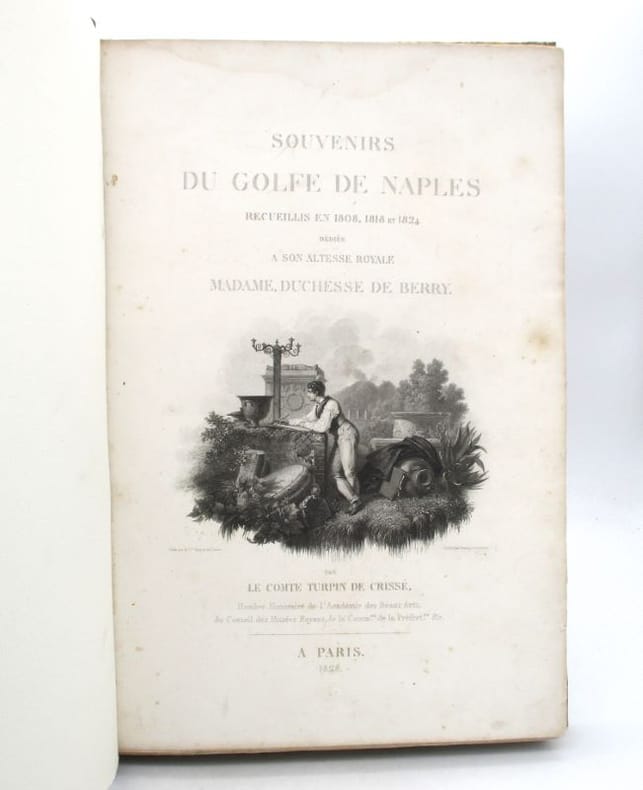
22506Paris, [chez l'auteur et Chaillou-Potrelle], 1828. In-folio, 65 pp. 39 pl., demi-oasis noir moderne, ancien dos remonté orné de filets et frises dorés (reliure restaurée, petits frottements, pl. du Vésuve, des Ruines de bains antiques et du temple de Vénus restaurées, importantes mais pâles mouillures marginales, quelques rousseurs, quelques minuscules déchirures marginales sans atteinte, pp. 18 à 20 et certaines planches reliées au mauvais endroit).
1872249147Roma, Salviucci, 1830-1872. In 23 unif. Ppbdn. d. Zt. m. Rsch. u. Rsign. Einbde. etwas bestoßen, angeschmutzt u. fleckig. Gebräunt u. braunfl. St. verso Tit.
67796aafRoma, 1869, in-4to, 50 gravures (planches) non reliées, brochure originale, non reliée, pages un peu cornées sinon bel exemplaire.
195251905BB1952. 23 x 28 cm. In gestalteter Kartonhülle.
17611188BB2 Tle. in 1. Florenz, Andrea Bonducci, 1761-62. Gr.-8°. LXX, 1 Bl., 251 S., IV. 280 S., 1 Bl. Mit 1 gest. Frontisp., 1 Tafel (gef.) u. 1 beigelegter Tafel (gehört nicht zum Buch). Orig.-Ldr. m. goldgepr. Rücken (etwas berieben u. bestossen).
17334290BBPadua, Giuseppe Comino, 1733. 4°. (16) XXXII, 629 (1) S. Mit 1 gest. Portrait von Francesco Zucchi nach Giovanni Battista Tiepolo sowie 1 gest. Titelvignette, 10 gest. Textvignetten u. 4 gest. Initialen. Pergamentbd. mit handschriftl. Rückentitel u. goldgepr. Rückenschild (berieben u. bestossen, etwas fleckig).
18853914DBProtektor-Ausgabe. 7 von 11 Bänden. München, Verlagsanstalt F. Bruckmann, 1885-1909. 2° 1 Registerband (VIII, 102 S. 4°. Loseblattausgabe in Mappen mit zahlreichen Illustrationen in Lichtdruck und Stahlstich. Leicht berieben und bestossen, fingerfleckig.
182454871BBZürich, Orell, Füssli & Comp. (1824). 19x27,5 cm.
182454871BBZürich, Orell, Füssli & Comp., (1824). 19x27,5 cm.
179326835London: Printed by J. Davis; For R. Faulder New Bond-Street 1793. 1st edition. Full red morocco-style sheep. AEG. Marbled paper eps. Overall VG some extremity rubbing/usual foxing. xiv 241 pp. Illustrated with 6 copperplate engravings 5 folding. 4to. 8-1/2" x 6-1/4" <br/><br/> Printed by J. Davis; For R. Faulder, New Bond-Street unknown books
RGW26573Hardcover. Very good. 25 leaves all written in a clear neat style on sheets with colour printed decorative borders before each such sheet is a leaf with the name of the language in Italian written within a decorative printed vignette. Large folio 35.5 x 25.4 cm later full dark green morocco spine with raised bands decorated in compartments with single rule in gilt covers with single rule border in gilt Sangorski Sutcliffe stamp on gilt turndown a.e.g. The languages include Albanian Arabic Armenian Chaldean Cingalese Danish Dutch English French Gaelic Georgian German Greek Hungarian Latin Italian Russian Spanish Tamil and Turkish. There are two leaves of script for Italian and Literary Greek. An unusual manuscript recording the scripts of diverse languages. hardcover
21957Earlier letters on letterheads of his Helsinki publishing house Eurographica; later letters on his personal Helsinki letterhead. Between 1984 and 1996. 43 letters in 8vo and 12mo making a total of 44 pp. Signed 'Rolando Pieraccini' and latterly 'Rolando'. Thirteen of the letters 1984-1986; all 8vo on 'Eurographica' letterhead the others 1986-1996; 27 in 12mo and 3 in 8vo on Pieraccini's personal letterhead. Also present is a carbon copy of a two-page letter from Pieraccini to Penny Eckley of Oxford University Press regarding copyright matters. The collection in good condition lightly-aged. Pieraccini published several limited editions of Fry's works for the Finnish market and the correspondence is by turns businesslike courteous and personal. Pieraccini begins by introducing himself: 'I am a publisher of art books. During recent years I have also started publishing a series of short stories in different languages in Signed Limited Editions 350 copies printed in Italy on special hand-made paper. I have already published a Play in one act by Graham Greene short stories by Erskine Caldwell Alan Paton Leonardo Sciascia Norman Mailer also a play Luise Rinser and am now working on short stories and plays by Ionesco Heinrich Böll John Updike Italo Calvino Halldor Laxness Anthony Burgess etc.' He explains that he will be 'very pleased and honoured to publish any play or short story' if Fry has 'something suitable for my project'. He explains the specifications including the way in which the 'signing operation is made simple'. On 23 December 1984 he writes in response to Fry's reply stating that he has 'read the three plays with great interest and curiosity and that 'A Phoenix Too Frequent' will make a beautiful and valuable book'. He discusses the terms noting that Fry is 'very generously not overvaluing your signature and the time you will need to sign 350 frontispiece pages which with no hurry should not be more than two hours'. Regarding his 'outright fee' he states: 'I must tell you that only in one case I have paid $3.00 per copy but it was in the case of perhaps the greatest contemporary author Graham Greene who is among other things giving a very high value to his signature.' Subsequent letters discuss the practicalities of printing and publishing: proofs payment arrangement with Fry's British publisher Oxford University Press difficulties with Italian customs and other matters. On 15 January 1985 following a mix-up over payment in dollars rather than pounds he writes: 'I hope you and your agent will be satisfied with my offer anyway if you like I am prepared to print 12 extra copies of the book for your personal use as I have done for Mr. Graham Greene. Have you perhaps still the original manuscripts of this play It would be a wonderful idea to have a few pages of it reproduced as well in my Signed Limited Edition as again I have done in the case of Mr. Greene play YES AND NO.' In March 1985 he asks Fry to inscribe copies 'one for Mrs. Tellervo Koivisto wife of the President of the Republic of Finland; one for the Helsinki University or Helsinki University Library and one for myself'. In April 1985 he asks if it might be possible for him to have a signed photograph as 'Every year in December I hold an exhibition of the books I have published during the year together with manuscripts proofs photographs etc. relating to the authors published during the year'. Three months later he asks for another signed photograph 'that I could have kept after the exhibition for myself the greedy collector'. On 27 May 1985 he asks him 'to write for me by hand on one of your small letterheads a few lines from A Phoenix Too Frequent For instance what Dynamene says at the very end of the comedy This short “manuscript†would go very well on the exhibition together with the photograph.' Letters between 1986 and 1987 relate to a similar edition of 'The Lady's Not for Burning' and on 8 June 1987 he explains difficulties in typesetting the text. Subsequent letters discuss the practicalities of printing and publishing: proofs payment arrangement with Fry's British publisher Oxford University Press difficulties with Italian customs and other matters. On 15 July 1987 he suggests delivering Fry's copies in person on 'a short afternoon visit' to Chichester but it is only in 1991 that such a visit takes place with Pieraccini thanking Fry 30 July 1991 for his hospitality and adding: 'You live in a most beautiful place in a very charming village a real discovery for me.' In 1989 an edition of 'The Dark is Light Enough' is mooted but plans have still not been finalised two years later. On 30 December 1990 he asks Fry whether he would like to contribute to 'another important project' a book 'as a tribute/homage to Julian Symons on the occasion of his 80th birthday May 1982'. He lists the numerous contributors he has lined up 'I have just started enquiring'. On 30 July 1991 he writes regarding another of Fry's plays: 'I have read Venus Observed and enjoyed it very much. It would certainly make a good book. However as I have already mentioned to you when I first saw it it is a rather long play and it would need even more pages than The Lady's which was itself a little bulky with the kind of paper we use. If only possible I would really like to do something else with you this time particularly in consideration of the special occasion next year we know. i.e. Fry's 85th birthday' As there is no time for a 'larger project' previously discussed he asks: 'Could we think of something different A selection of poems for instance a short story a collection of thoughts or “philosophical†notes or similar something you have already written or you might have time to write by February-March next year'. An edition of Venus Observed is planned and then dropped at the beginning of 1994 due to 'such economic difficulties that the kind of books I produce do not sell anymore at all. I think the many thousands I still have in stock will suffice at least for my next three lives' 23 January 1994. He asks Fry if he would consider leaving the typescript of the play 'with my archives and book collection which will one day go to the Helsinki University Library'. On 22 March 1994 Pieraccini thanks Fry for being allowed 'to keep the manuscript of Venus Observed a most valuable contribution to my collection'. Following another meeting at Fry's home The Toft Pieraccini gives 22 April 1996 three suggestions for 'another project' to celebrate Fry's forthcoming ninetieth birthday including 'A story of The Toft which could also mention East Dean and its inhabitants. With one/two photographs of the house and/or an etching by your artist-friend I've forgotten his name the one you collect'. In the last letter 13 July 1997 he expresses regret that 'our exciting project has fallen. It sounded so nice: 90 copies of 90 lines for your 90th birthday. Well it will be for your 100th. With some inspiration and a little more time to spare I am sure you can write 100 beautiful verses.' Several letters veer into the personal. On 8 September 1986 he explains that his 'real first name the one I still have in my Italian passport is Rolando; but having spent almost half of my life 20-22 years abroad I got used to and I actually prefer to use the more European version of it Roland'. On 8 January 1987 'a lot of snow -30º' Pieraccini writes of one of his art books: 'Onni Oja Finnish artist 1909-2004 was very pleased to know that you liked his work. Your good and generous words were also the best reward for me as editor and publisher of the book. To complete one of such volumes I usually need about two years. Well yesterday I have mailed to you the other volume published in the same series dedicated to the work of Veikko Vionoja one of the greatest contemporary Finnish artists. I hope you like it as well and I'll be curious to know which of the two you and your family prefer.' On 27 November 1987 he complains of 'a hard autumn which besides the usual business rush included also a painful illness kidney stones or renal calculus which took me to hospital'. On 5 December 1988 he states that he has 'recently attended a lecture on Peter Brook here in Helsinki' ad that he 'had the opportunity of mentioning his production of your play The Dark is Light Enough in 1954. Although he had already proved his talent Peter Brook was still quite young then'. He asks 'what kind of experience' it was to work with Brook. Earlier letters on letterheads of his Helsinki publishing house Eurographica; later letters on his personal Helsinki letterhead. unknown
1842C086Ca. 1840?1842. Der Berliner Historien-, Tier- und Landschaftmaler Carl Steffeck schuf das Aquarell von der Zisterzienser-Abtei Fossanova in Latium während seines Italienaufenthalts von 1840 bis 1842. Die Abtei wurde im 9. Jahrhundert von Benediktinern gegründet. 1135 errichteten Zisterzienser aus dem savoyischen Hautecombe auf den Grundmauern des alten Baus ein neues Kloster: Der Name Fossanova [Fossa aus dem Lateinischen bedeutet Graben] spielt auf das ausgeklügelte Drainage- und Entwässerungssystem an, das die Mönche vor dem Neubau anlegen mussten. Das Kloster, ein Meisterwerk der Zisterzienser-Gotik mit starkem Einfluss sowohl auf Sakral- als auch auf Profanbauten in Italien, wurde 1208 von Papst Innozenz III. geweiht, während an den Konventsgebäuden noch weit bis ins 13. Jahrhundert gebaut wurde. Im Jahr 1274 starb der Philosoph und Theologe Thomas von Aquin (um 1225?1274) hinter den Klostermauern von Fossanova. Steffecks Aquarell zeigt die Arkaden mit Kreuzgratgewölbe und den menschenleeren Innenhof der "Foresteria", der Herberge für die Pilger. Mit Akribie widmet sich der Künstler der Wiedergabe des facettenreichen Spiels von Licht und Schatten. Hier und dort hat sich Vegetaion an den Gebäuden angesiedelt, bei einem Pflanzentrog im Vordergrund scheint das Blattwerk und die Gräser die steinerne Barriere überwunden zu haben: Üppiges, sattes Grün sprießt aus den Ritzen des Bodens und des Mauerwerks. Steffeck zeigt sich hier mit seiner hellen Farbpalette und seiner Malerei als ein Meister der Pleinairmalerei, die er in den Ateliers der Franzosen Paul Delaroche (1797?1856) und Horace Vernet (1789?1863) kennen gelernt hatte, und die sein späterer Schüler Max Liebermann schließlich im Impressionismus deutscher Prägung zu einem Höhepunkt führte. Steffeck war für seine schnelle, aber exakte und einfühlsame Arbeitsweise bekannt: Liebermann erzählte über seinen Lehrer, dass dieser die zahlreichen Pferde- und Hundebilder zu sechs Friedrichsdor das Stück in einem Zug heruntermalte und diese meist noch nass waren als sie die Auftraggeber mit nach Hause nahmen. Carl Steffeck studierte seit 1837 an der Berliner Akademie bei Franz Krüger und Karl Begas. Nach seiner Italienreise ließ er sich in Berlin nieder, wo er ab 1859 eine Professur an der Akademie inne hatte. 1880 wurde er Direktor der Akademie im preußischen Königsberg. Bekannt machten ihn vor allem seine hervorragenden Pferde- und Hundebilder. Vereinzelt einige wenige Stockflecke.Vgl. Thieme-Becker XXXI, 533.
183630405-zn4Napoli (Neapes): Fibreno 1836. 176 p., 8 tav. Halbleder der Zeit mit reicher Rückenvergoldung (etwas berieben und bestoßen, der vordere Vorsatzpapier erneuert, sonst sehr gutes und sauberes, vollständiges Exemplar). Gr.-8° (22,5 x 14,5 cm). [2 Warenabbildungen] fest gebunden
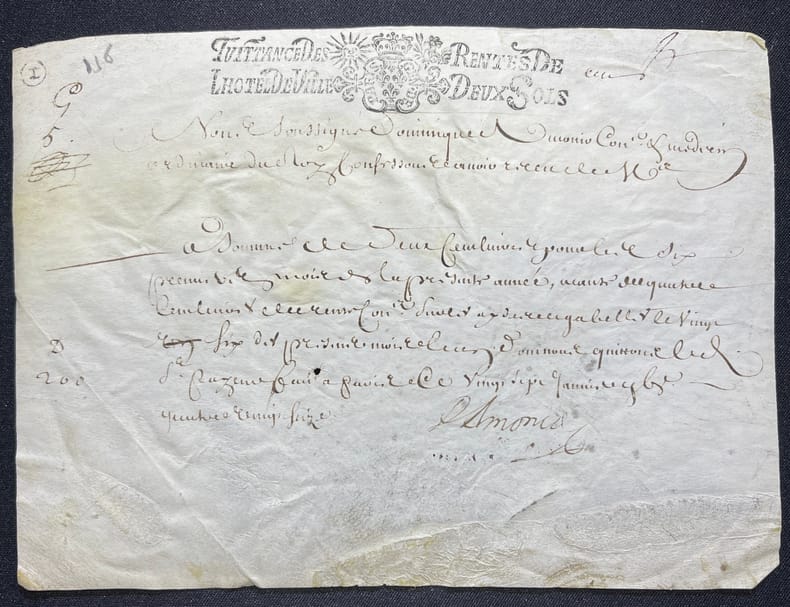
013737Dominique [Domenico] Amonio (1653-1721), conseiller et médecin ordinaire du roi Louis XIV, médecin de madame de Sévigné, italien naturalisé par Louis XIV. P.S., 27 janvier 1696, 1p in-8 oblong. Sur parchemin. Quittance pour le paiement de sa rente. Amonio avait accumulé une fortune considérable. Sévigné parle de lui ainsi dans une lettre : « Ma chère, c'est un homme de 28 ans dont le visage est le plus beau et le plus charmant que j'aie jamais vu ; il a les yeux comme madame de Mazarin et les dents parfaits, le reste du visage comme on imagine Rinaldo, de grandes boucles noires qui lui font la plus agréable tête que vous ayez jamais vue ». Le docteur Le Paulmier a publié sa biographie en 1893. [278-2]
19039841Wien, Staatsdruckerei, 1903. 39 S. 76 (4 gefalt.) größtenteils farb. lithograph. Tafeln. Gr.-8°. OHLwd. (gebräunt, fleckig, Gebrssprn., Rückengelenke angeplatzt).
As New English Zagor Ad/de comics. 1-32 set., Ad/de yayincilik, Ist., 1996. 32 volumes set. Each fascicule is 98 p. Large 8vo. (22 x 15 cm). Mint. Comics, fumetti. Zagor. 32 volumes set. Extremey rare as set.
169377504Rotterdam, Abraham Acher, 1693. 4 Bll., 287 S.; 288 S. Kl.-8vo (15 x 10 cm). GanzLdr. d. Zt. mit RVergold.
165541039Venedig, Giovanni Giacomo Hertz, 1655. 12°. Mit gest. Frontispiz. Titel m. kl. Holzschn.-Vignette. 11 Bll., 356 S., Pgmt. d. Zt. m. durchzogenen Bünden u. handschriftl. Rückentitel.
Volume con nuova copertina (anni '60) in pelle e carta marmorizzata, con scritte e decorazioni in oro zecchino sulla costa. Sia interni che esterni in ottimo stato