42 282 résultats
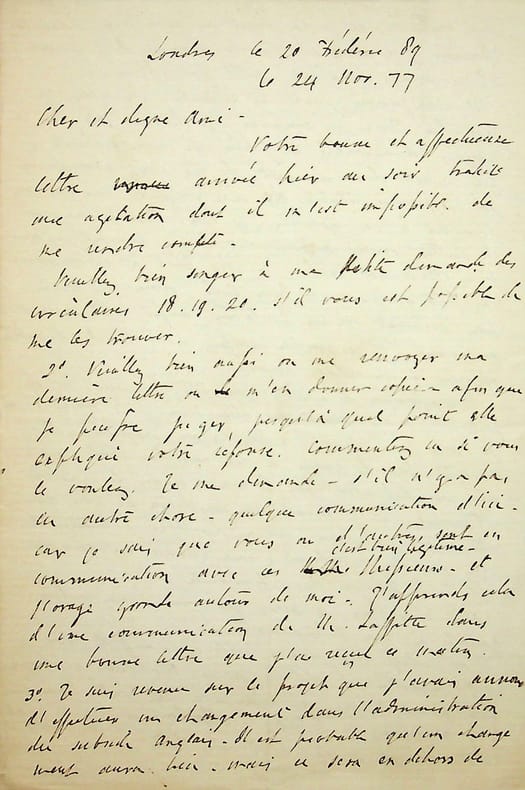
018959[Positivisme] Richard Congreve (1818-1899), philosophe anglais, figure de proue du positivisme en Angleterre, à l'origine du schisme en 1878. L.A.S. en français, Londres, 20 Frédéric 89 [24 novembre 1877], 4p 1/2 in-8. Au docteur Jean-François Robinet (1825-1899), médecin d'Auguste Comte et important positiviste français. « Cher et digne ami, Votre bonne et affectueuse lettre arrivée hier au soir trahit une agitation dont il m'est impossible de me rendre complète[ment]. Veuillez bien songer à ma petite demande des circulaires 18.19.20 s'il vous est possible de me les trouver. 2° Veuillez bien aussi ou me renvoyer ma dernière lettre ou m'en donner copie afin que je puisse juger jusqu'à quel point elle explique votre réponse. Commentez la si vous voulez. Je me demande s'il n'y a pas eu autre chose - quelque communication d'ici - car je sais que vous ou d'autres, c'est bien légitime, sont en communication avec ces Messieurs et l'orage gronde autour de moi. J'apprends cela d'une communication de M. [Pierre] Laffitte dans une bonne lettre que j'ai reçue ce matin. 3° je suis revenu sur le projet que j'avais annoncé d'effectuer un changement dans l'administration du subside anglais. Il est possible qu'un changement aura lieu mais ce sera en dehors de mon initiation[?]. Le projet avait ses avantages mais je reconnais que ce n'est pas le moment d'y penser. 4° Je prends d'abord votre postscriptum. Je n'ai jamais parlé de retraite.Où avez-vous pris cela. Tout au contraire, je cherche par tous les moyens d'agrandir la sphère de mon activité. Si par hasard, il m'arrivait de me voir abandonné par la presque totalité de mes confrères anglais, ou d'avoir à les quitter, je continuerais toujours de lutter comme auparavant. Il y a vingt-deux ans que j'ai commencé seul. Je suis prêt à recommencer non pas seul mais bien isolé, dans un cercle bien restreint mais peut-être aussi utile que celui qui existe. Et je compte réussir avec l'aide de certains appuis à un certain degré. Ma situation à Londres peut être essentielle - honorée peut-être - mais elle sera, je le crains, ébranlée sous peu par l'action de ces messieurs. Mais en tout état de cause, si ma carrière est brisée, cela ne dépendra pas de moi mais de l'action extérieure. et j'aurais la consolation de voir que cette action extérieure aura développé l'énergie de ceux qui la prendront - une énergie en somme utile à la Religion de l'Humanité. Ainsi, cher ami, je pense que vous serez calmé quant à ma détermination. J'ai rédigé une longue lettre à M. Laffitte que je vais soumettre à certains amis. Elle vous expliquera mon point de vue et cela m'a trop coûté pour que j'y revienne en détail. En attendant, je lui ai répondu ce matin. Maintenant je réponds à votre lettre. Vous avez senti un refroidissement - et vous avec eu raison. À quoi tient-il ? Libre à vous de vous ranger du côté de M. Laffitte, de juger que le statu quo amélioré était le seul admissible. Je puis différer mais enfin votre avis avait beaucoup eu sa faveur. Mais, après tout ce qui s'est passé entre nous, j'ai été choqué de la manière dont vous m'avez présenté l'action de M. Laffitte et aussi de la manière dont préoccupé du soin de me détourné de toute opposition, vous avez interprété mon action. Mais c'était long, et peut-être impossible de débrouiller des difficultés pareilles. (Je remarque en passant que la Fête de l'Humanité n'est pas proprement parlant une fête commémorative d'Auguste Comte - encore moins de sa naissance). Si vous m'aviez dit, je le crois de bonne politique de soutenir M. Laffitte, puisque il faut choisir, je n'aurais eu rien à dire. Votre jugement sur lui m'aurait paru peu conciliable, peut-être, avec cette conclusion. Mais voilà tout. Mais l'argumentation m'a déplu. Je vous l'avoue franchement. Ensuite, quant à ma venue, dans les conditions telles que vous les aviez "rêvées", elle devait avoir envie à une époque plus ou moins éloignée de me substituer à M. Laffitte. Mais dans vis der
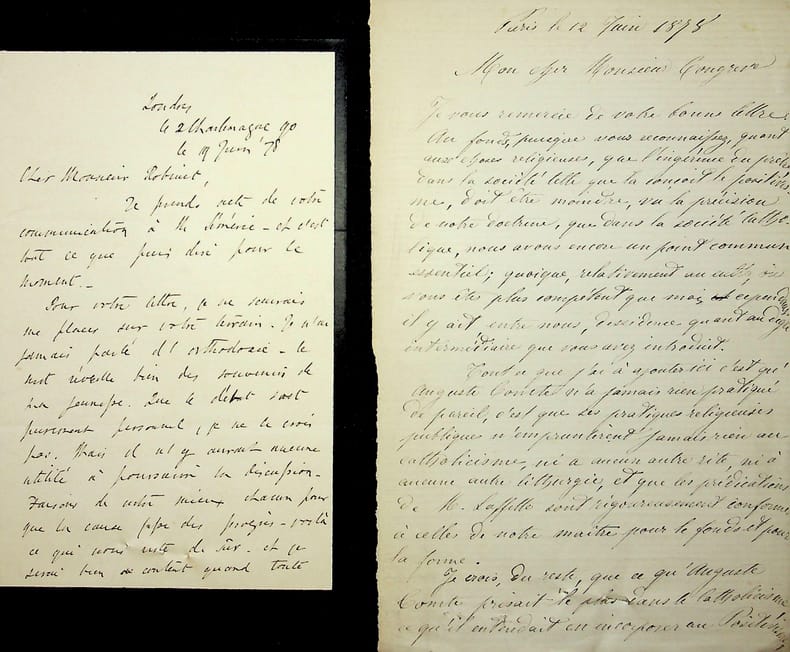
018960[Positivisme] Richard Congreve (1818-1899), philosophe anglais, figure de proue du positivisme en Angleterre, à l'origine du schisme en 1878. L.A.S. en français, Londres, 2 Charlemagne 90 [19 juin 1878], 2p in-8. Au docteur Jean-François Robinet (1825-1899), médecin d'Auguste Comte et important positiviste français. « Cher Monsieur Robinet, Je prends acte de votre communication à M. Sémérie et c'est tout ce que je puis dire pour le moment. Pour votre lettre, je ne saurais me placer sur votre terrai. Je n'ai jamais parlé d'orthodoxie - le mot réveille des souvenirs de ma jeunesse. Que le débat soit purement personnel, je ne le crois pas. Mais il n'y aurait aucune utilité à poursuivre la discussion. Faisons de notre mieux chacun pour que la causse fasse des progrès - voilà ce qui nous reste de sûr. Et je serai bien content quand toute lutte aura cessé - ce qui ne peut guère manquer d'arriver tôt ou tatd. Mais quel chaos actuel. Je vous transmets le premier versement de cette année. C'est à jeudi ou à vendredi qu'en est l'échéance. Et je ne dois pas être en retard. Reste à voir quelle sera l'influence de nos tiraillements sur le subside. Je m'abstiens de toute prévision. Si je pouvais causer avec vous de tout cela à la bonne heure - mais sur le papier )- bah ! Nous nous associons pour vous exprimer nos meilleurs voeux et sentiments ainsi, bien entendu, qu'aux vôtres. Richard Congreve ». Cette lettre répond à une lettre du 12 juin dont nous avons le brouillon (secrétaire) signé : « Mon cher Monsieur Congreve, Je vous remercie de votre bonne lettre. Au fonds, puisque vous reconnaissez quant aux choses religieux, que l'ingérence du prêtre dans la société telle que la conçoit le positivisme, doit être moindre, vu la précision de notre doctrine, que dans la société catholique, nous avons encore un point commun essentiel ; quoique, relativement au culte où vous êtes plus compétent que moi, cependant, il y ait entre nous, dissidence quant au degré intermédiaire que vous avez introduit. Tout ce que j'ai à ajouter ici c'est qu'Auguste Comte n'a jamais rien pratiqué de pareil, c'est que ses pratiques religieuses publiques n'empruntèrent jamais rien au catholicisme, ni à aucun autre rite, ni à aucune autre liturgie, et que les prédications de M. Laffitte sont rigoureusement conformes à celles de notre maître pour le fonds et la forme. Je crois, du reste, que ce qu'Auguste Comte prisait le plus dans le catholicisme, ce qu'il entendait en incorporer au Positivisme, ce n'était ni le dogme, ni même le culte, mais la base morale et surtout l'organisation politique, la division des deux pouvoirs et l'unité hiérarchique du pouvoir spirituel. Cela dépendait de ce qu'il se plaçait toujours et avant tout au point de vue social. Je ne pense donc pas que M. Laffitte et ceux qui le suivent soient hors de l'orthodoxie, même quant au culte. Et comme d'autre part vous reconnaissez que la scission ne porte pas sur le dogme, il s'en suit qu'elle n'a, en réalité, que des motifs personnels. C'est là, en effet, ce qui m'a toujours paru être le noeud de la question. La majorité des Positivistes l'a compris ainsi, et la scission, à ce qu'il me semble, s'est faite sur des noms propres, le votre et celui de Monsieur Laffitte, et non sur les questions politiques, philosophiques, ou religieuses. [Partie barrée par Robinet] Ceci posé, et je suis certain que vous l'acceptez comme moi, il me reste à exprimer, si délicate que soit la chose, le regret que j'éprouve des procédés qui ont été employés pour consommer la séparation. Au lieu d'aggraver des mécontentements, au lieu d'imaginer un partage de la direction, un coadjutariat, qui s'est aussitôt transformé en sommation faites à Mr [Laffite] [Fin de la partie barrée, il manque probablement une petite partie] C'est là, en effet que m'a finalement paru être le noeud de la question. La majorité des Positivistes semble l'avoir compris ainsi, et la scission s'est
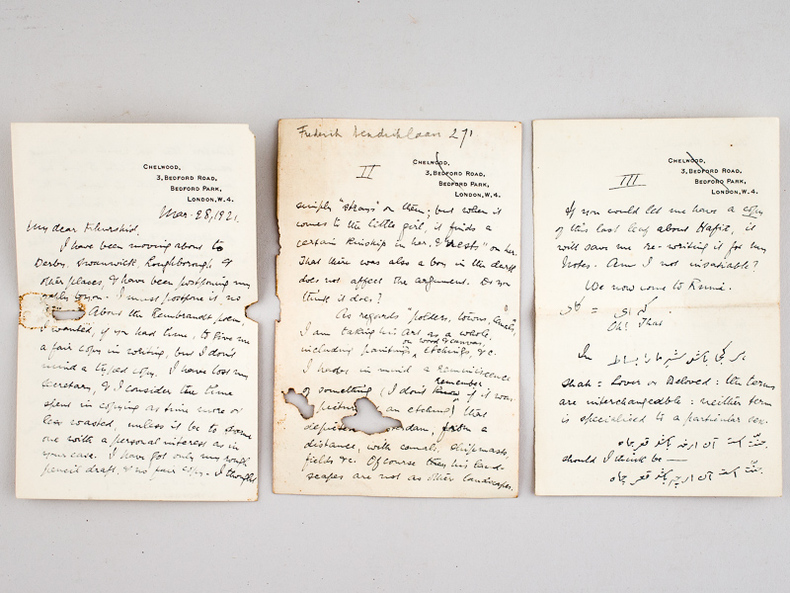
192057812Dec. 22 1920, 4 pages, with small lackings : "My Dear Khourshed, warmest greetings & best wishes for Xmas & the New Year. I am sorry to hear that you have been ill [ ... ] Your husband write to me just before he was leaving London, to let him know when time came, if I would let him this house. I have decided nothing yet, & shall not I think be in a position to decide till the Spring. It is [ ... ] to hear that [ .... ] thinks your plan can be performed if certain conditions are fulfilled, which you are in a position to fulfill. [... ] It is evidently a musical Plan. Do you want my collaboration in the Libretto ? What is the idea underlying it ? For title, either "At feet of Shiva" or "At Shiva's Feet" would be good English. Some [ ... ]might prefer the one, and some other prefer "At Shiva's Feet". It is shorter, and the rythm is more balanced. As regards [ ... ] I agree with your remarks in the abstracts, but am puzzled to see later application. What is the question that I did [ ... ] but which you want to answer ? What is the question & what is the answer ? Perhaps the sand & waves of Scheveningen are necessary before I can solve the puzzle ? Or perhaps a [ ... ] chair of musical laughter, or perhaps after all, not among these things, but simply [... ] I don't know. That's unfinished conversation - or interrupted [ ... ] : shall we just treasure it because it began at all, & not be impatient because it did not finish ? [ ... ] sunbeams, love themselves in [... ]Mar.7, 1921, 4 pages, with small lackings : "My dear Khourshed, I a glad you are better, & I hope you will soon recover this weakness which must make an eager soul like yours free under the compulsory withdrawal from fields words & the ever-sounding sea. We are having such beautiful weather - [ ... ]summer spring days, with a bite of frost in the mornings, our clear blue skies, through which Orion & Sirius & all the great summer constellations are gradually making their [ ... ] overload. Do you remember the glorious summer days we had in The Hague ? It was autumn then. Now is the sun of Spring, increasing in splendour and strength. Good [ ... ] About my Lecture on Hafiz in the Lyceum Club an Mar. 5th. : I am going to give an account of Hafiz & illustrate his poetry to this audience : 1 - by the singing of one of his Tales in Persian ; 2 - by the singing of this same Ode in an English verse translation in the original metres, & 3 - by explanations of his meanings. I have transleted the Ode which begins [persian text ] [ lacking ] who are going to set it to music & also to find singers if possible. [... ] But you are at a distance, & in this state of your health, I dare not ask you to undertake the strain. I have not seen any english translation of Hafiz that is satisfactory. I do not claim for my translation that it is satisfactory. But it is an honest presentment. [ ... ]I send you my Poem on Rembrandt. If you can make, or have made, two copies without mistakes, I shall ask for one copy to be sent to me & the other for publication to the Gazette de Hollande or any other paper that may like to publish it." Mar. 28,1921, 10 pages, with important lackings : [long letter about his poems on Rembrandt, then, on a second part, about Hafiz ] "Hafiz first addresses his master, the beloved Shiraz. He offers him whole heards, but if he only finds acceptance, what will he not give ? The black mole is rules a blemish, but even for a blemish of their master, he will give what is to him most precious. Samarkand & Bokhara were reputed the two finest cities of the time [... ] The turkish painter whom picture : "Jeune Emir à l'étude" I saw in Liverpool was Osman Hamdu Bey, of Constantinople. He frequently exhibited in Paris and died within this century. If you can get any reproduction of this picture, I shall be obliged" [ ... ]. Apr. 7, 1921 4 pages, very damage, half of the text lacking
Dec. 22 1920, 4 pages, with small lackings : "My Dear Khourshed, warmest greetings & best wishes for Xmas & the New Year. I am sorry to hear that you have been ill [ ... ] Your husband write to me just before he was leaving London, to let him know when time came, if I would let him this house. I have decided nothing yet, & shall not I think be in a position to decide till the Spring. It is [ ... ] to hear that [ .... ] thinks your plan can be performed if certain conditions are fulfilled, which you are in a position to fulfill. [... ] It is evidently a musical Plan. Do you want my collaboration in the Libretto ? What is the idea underlying it ? For title, either "At feet of Shiva" or "At Shiva's Feet" would be good English. Some [ ... ]might prefer the one, and some other prefer "At Shiva's Feet". It is shorter, and the rythm is more balanced. As regards [ ... ] I agree with your remarks in the abstracts, but am puzzled to see later application. What is the question that I did [ ... ] but which you want to answer ? What is the question & what is the answer ? Perhaps the sand & waves of Scheveningen are necessary before I can solve the puzzle ? Or perhaps a [ ... ] chair of musical laughter, or perhaps after all, not among these things, but simply [... ] I don't know. That's unfinished conversation - or interrupted [ ... ] : shall we just treasure it because it began at all, & not be impatient because it did not finish ? [ ... ] sunbeams, love themselves in [... ] Mar.7, 1921, 4 pages, with small lackings : "My dear Khourshed, I a glad you are better, & I hope you will soon recover this weakness which must make an eager soul like yours free under the compulsory withdrawal from fields words & the ever-sounding sea. We are having such beautiful weather - [ ... ]summer spring days, with a bite of frost in the mornings, our clear blue skies, through which Orion & Sirius & all the great summer constellations are gradually making their [ ... ] overload. Do you remember the glorious summer days we had in The Hague ? It was autumn then. Now is the sun of Spring, increasing in splendour and strength. Good [ ... ] About my Lecture on Hafiz in the Lyceum Club an Mar. 5th. : I am going to give an account of Hafiz & illustrate his poetry to this audience : 1 - by the singing of one of his Tales in Persian ; 2 - by the singing of this same Ode in an English verse translation in the original metres, & 3 - by explanations of his meanings. I have transleted the Ode which begins [persian text ] [ lacking ] who are going to set it to music & also to find singers if possible. [... ] But you are at a distance, & in this state of your health, I dare not ask you to undertake the strain. I have not seen any english translation of Hafiz that is satisfactory. I do not claim for my translation that it is satisfactory. But it is an honest presentment. [ ... ]I send you my Poem on Rembrandt. If you can make, or have made, two copies without mistakes, I shall ask for one copy to be sent to me & the other for publication to the Gazette de Hollande or any other paper that may like to publish it." Mar. 28,1921, 10 pages, with important lackings : [long letter about his poems on Rembrandt, then, on a second part, about Hafiz ] "Hafiz first addresses his master, the beloved Shiraz. He offers him whole heards, but if he only finds acceptance, what will he not give ? The black mole is rules a blemish, but even for a blemish of their master, he will give what is to him most precious. Samarkand & Bokhara were reputed the two finest cities of the time [... ] The turkish painter whom picture : "Jeune Emir à l'étude" I saw in Liverpool was Osman Hamdu Bey, of Constantinople. He frequently exhibited in Paris and died within this century. If you can get any reproduction of this picture, I shall be obliged" [ ... ]. Apr. 7, 1921 4 pages, very damage, half of the text lacking Scarce set of 4 autograph letters by Abdullah Yusuf Ali (1872-1953), the famous british-indian scholar known for is his translation into English and commentary of the Qu'ran. Formed by Hazrat Inayat Khan, his correspondent Elisabeth Pop (1888-1981) then gave recitals of Indian and Persian songs, under the stage name of "Khourshed de Ravalieu". She will officially married in 1923 to a famous Javanese dancer, Raden Mas Jodjana and changed her name in "Raden Ayou Jodjana" (a large set if archives coming from them available in our catalogue). Anglais
8vo, full editor cloth, George Routledge & Sons, Ltd, 1922, VIII-351 pp. et 3 ff. With a manuscript annotation : "Ce livre appartient à J. Schumpeter" [ trad. : this book belongs to J. Schumpeter ]. From Georges-Henri Bousquet's library. Bousquet (1900-1928) was a french economist, disciple and friend of both Vilfredo Pareto and Joseph Schumpeter. Les deux hommes se connaissaient personnellement depuis une première rencontre à Vienne en septembre 1923. A cette époque, G.-H. Bousquet fut présenté à Joseph Schumpeter, à Vienne, par Paul Lazarsfeld. Comme Bousquet le raconte lui-même : "A ce moment, Schumpeter avait 40 ans. Il était alors totalement ignoré en France, mais connu aux Etats-Unis où il avait été invité à professer quelque temps, et en Angleterre, où il avait eu également l'occasion de se faire entendre". Les deux hommes, qui deviendront amis, se rencontreront beaucoup plus longuement en 1933-1934 à Harvard, où Schumpeter sera devenu professeur. Georges Bousquet y effectuera en effet un long séjour de recherche, financé par la fondation Rockfeller. Toute sa carrière, Georges Bousquet sera fasciné par l'oeuvre de Schumpeter, qu'il fera notamment découvrir, tant par ses articles que par les discussions, à l'économiste François Perroux. On peut signaler que le Professeur Bousquet est l'un des rares économistes français contemporains à être plusieurs fois cité dans la monumentale Histoire de l’Analyse Economique écrite par Joseph Schumpeter à la fin de sa vie. Français
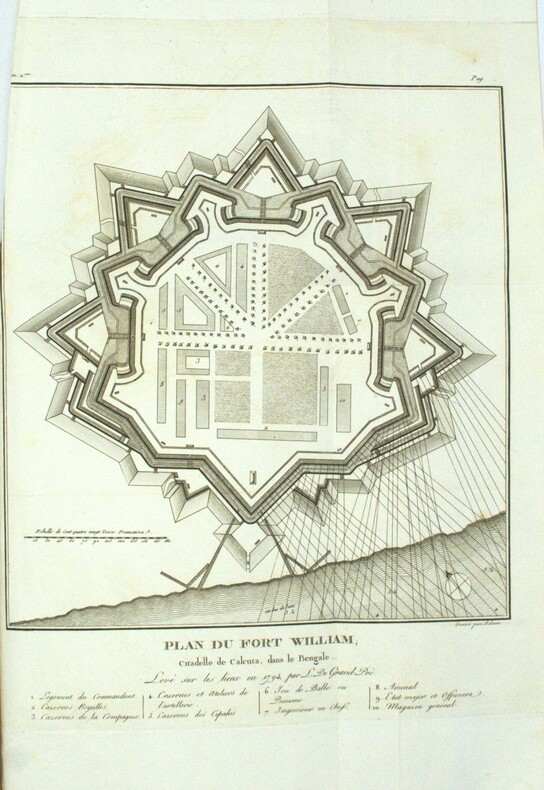
1801PHO-1972Paris, Dentu, an IX (1801); Atlas seul, in-4 (33x24,5cm),composé de 7 planches gravées dépliantes dont une grande vue de la citadelle de Calcutta et un plan du Fort William.. Bel exemplaire, relié basane époque, roulette aux plats et à l’intérieur, tranches dorées, manque au dos, coins usés, intérieur frais.
''The present edition may be considered as the definitive standard edition, as it has been specially revised, at the author's request, by Stuart Gilbert''. Edizione definitiva, rivista su richiesta dello stesso Joyce, da Stuart Gilbert. Opera in 2 volumi . 16mo. pp. 792. . Ottimo (Fine). . Quarta edizione (4th Edition). .
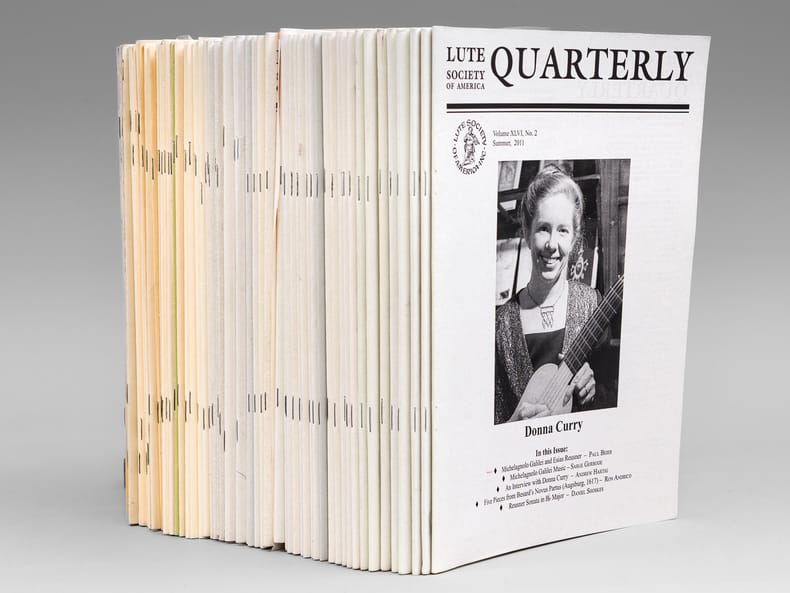
19906956479 vol. 4to., Lute Society of America Quarterly, Lexington Virginia, 1990, 1991, 1992, 1993, 1994, 1995, 1996, 1997, 1998, 1999, 2000, 2001, 2002, 2003, 2004, 2005, 2006, 2007, 2008, 2009, 2010 and 2011, approximately 2,500 pages in total. A very uncommon set of 73 issues of this quarterly journal, from no. XXV/2-3 (May/August 1990) to XLVI/2 (Summer 2011), representing 21 complete years, minus 4 issues. Missing issues are : XXXVI /4, XLI /2, XLIII /4 and XLIV /1. - Ensemble de 73 numéros de cette revue trimestrielle, du n° XXV / 2-3 (Mai/Août 1990) au XLVI / 2 (Eté 2011), soit 21 années complètes, sauf 4 numéros : XXXVI /4, XLI /2, XLIII /4 and XLIV /1 ]
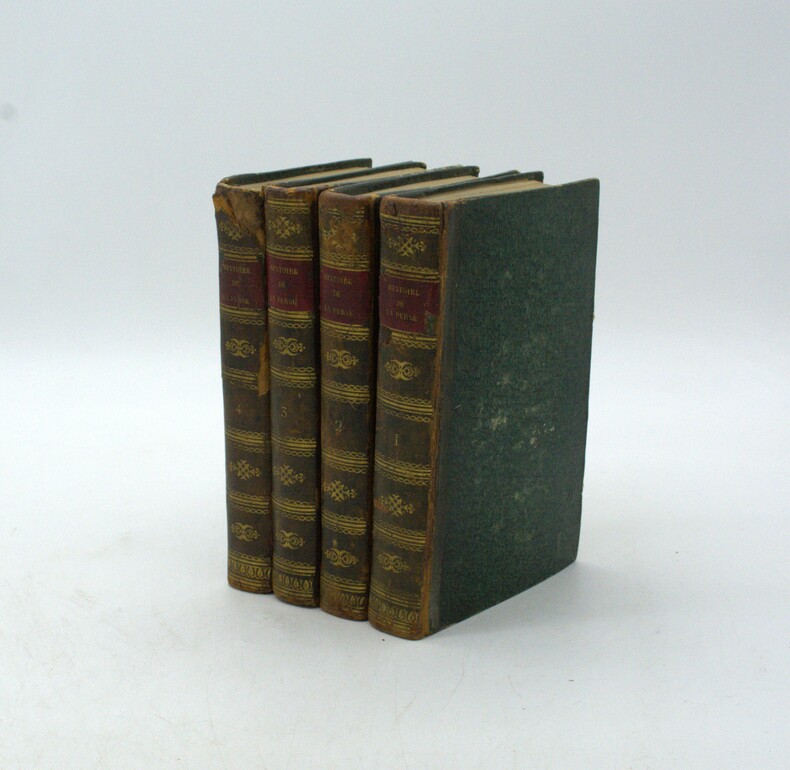
1821PHO-1948Paris, Pillet, 1821. 4 volumes in-8 (213x130) xxxvi-467pp, 479pp, 483 (catalogue), 465 pp, illustré d’un frontispice et 7 gravures Hors Texte (manque la carte), relié demi basane époque, dos lisse avec pièce de titre grenat, tranche jaunes, frottements aux charnières, manque au dos et charnière fendillée tome 4, coiffes usées, rousseurs éparses.
43866Oxford et Cambridge.1953.In-8 br.145 p.Ex.n°62/350 HC. BE.
1899AMO-2427Important fragment d'article autographe rédigé pour l'Echo de Paris (vers 1897-1899) Article intitulé : 17 mars - Simplification d'existence des anglo-saxons 6 pages in-8 oblong (long article) - Composée de fragments de feuilles collées les unes aux autres comme cela était le plus souvent le cas pour les manuscrits remis aux compositeurs dans les imprimeries à cette époque. Le feuillet 5 est incomplet de quelques lignes (le dernier morceau de papier en partie basse a été perdu) Voir photos. Provenance : Ancienne collection Bertrand Hugonnard-Roche.
174916081ABLondon, Dodsley, 1749. 26 : 21 cm. 13 Pages, 206 pages, 1 leaf; 117 pages; 315 pages, 1 leaf. Modern half calf. 5 part in 1 volume.
180663642CBLondon, Luke Hansard [printer], 1806. 4°. 29 x 23 cm. [563; 509] Blatt. Lederband der Zeit auf 5 Bünden mit goldgeprägtem Rückentitel und Fileten, Innenkantenvergoldung und händisch in rotem Schneckenmarmor gefärbtem Schnitt. [10 Warenabbildungen]
1769254985Cambridge: John Archdeacon Printer to the University 1769. 2 vols. 12mo. Bound in contemporary green morocco covers with outer dog-tooth roll border surrounding floral roll border spines in five compartments with raised bands a.e.g comb-marbled endleaves light rubbing to extremities binder's blanks removed from both volumes. 2 vols. 12mo. Archdeacon was University Printer from 1766 to 1793. Darlow & Moule 889; t95018. Provenance: Mary Carlton contemporary bookplate; Nancy Barr gift inscription "given her by her aunt Mary Carlton" John Archdeacon, Printer to the University unknown
180513759London: C. Clarke 1805. Nouvelle Edition réimprimée après celle de Didot. With 12 full-page engraved plates. 255 3; vi 246 1 pp. 2 vols. 8vo. Full contemporary English straight-grain red morocco gilt classical border of Greek key and acanthus design on upper and lower covers panelled spine gilt with similar motifs a.e.g. hinges and extremities slightly rubbed occasional foxing but overall fine and attractive. From the library of Marshall Field with his engraved armorial bookplate on each pastedown. Nouvelle Edition réimprimée après celle de Didot. With 12 full-page engraved plates. 255 3; vi 246 1 pp. 2 vols. 8vo. C. Clarke unknown
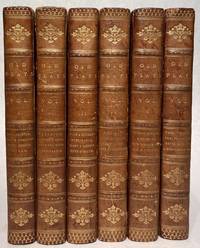
181632820636<p>8vo. Six volumes. Contemporary calf nicely rebacked at an early date spines gilt. Some wear browning. An attractive set.</p><p>Contains the following: Christopher Marlowe Doctor Faustus and Lust's Dominion; John Lyly Mother Bombie Endymion and Midas; Middleton Women Beware Women A Trick to Catch the Old One The Spanish Gypsy The Changeling More Dissemblers Besides Women; Dekker Wonder of a Kingdom Old Fortunatus; Rowley A New Wonder a Woman Never Vext; Webster Appius and Virginia; Chapman May Day Monsieur D'Olive Bussy D'Ambois; Webster and Rowley Thracian Wonder; Marston's Antonio and Mellida What you Will and Parasitaster: or the Fawn; Heywood The English Traveller The Royal King and Loyal Subject A Challenge for Beauty.</p><p>This very scarce set was conceived as a continuation of Dodsley's famous <i>Select</i> C<i>ollection of Old Plays</i> 1744.</p> London: Rodwell and Martin
201717208JLondon 2017. Production scripts for the three episodes of A Very English Scandal 2017 based on the book about the Jeremy Thorpe affair - by John Preston scripts by Russell T. Davies each copy signed by Hugh Grant who played the part of Jeremy Thorpe and director Stephen Frears spiral bound film script style. Very minor wear VG unknown
176242105Oxford: Printed by Thomas Baskett Printer to the University 1762. With the New Testament title page bearing the name of "Mark Baskett." Herbert says M. only. 2 vols. 12mo. Contemporary full crimson morocco gilt panelled spines a.e.g. Fine. Bookplate of Isabella Hildebrand and ownership inscriptions of Charlotte Milles 1767 Margaret Brutoon Isabelle Hildebrand 1912 and Sir Hector Livingston Duff 1936. With the New Testament title page bearing the name of "Mark Baskett." Herbert says M. only. 2 vols. 12mo. Herbert 1145 Printed by Thomas Baskett, Printer to the University unknown books
166153527Cambridge: Printed by John Field Printer to ye Universitie 1661. Old Testament only. With Apocrypha in separate volume. With elaborate engraved title page by Vaughan. 2 vols. 8vo. Bound in contemporary black calf in the 'somber" mode. Bookplate of Daniel M. Friedenberg. Old Testament only. With Apocrypha in separate volume. With elaborate engraved title page by Vaughan. 2 vols. 8vo. Herbert 674 Printed by John Field Printer to ye Universitie unknown books
1819OB737<p>Philadelphia: Printed and published by M. Carey and Son No. 126 Chesnut Street 1819-1821. Hard Cover. 1080 72 pages 2 maps 1 folding frontispiece; 28.5 cm. The Old Testament pp. 1-634 is dated 1819; the New Testament pp.835-1080 is dated 1820; the Concordance by John Brown 72 pp. at end is dated 1821. The frontispiece folding map is of "The Journeyings of the Children of Israel." Rebound in full leather; folding map repaired; title-page soiled from pre-rebinding era; very good. Stock#OB737.</p> Printed and published by M. Carey and Son No. 126, Chesnut Street hardcover
1769254985Cambridge: John Archdeacon Printer to the University 1769. 2 vols. 12mo. Bound in contemporary green morocco covers with outer dog-tooth roll border surrounding floral roll border spines in five compartments with raised bands a.e.g comb-marbled endleaves light rubbing to extremities binder's blanks removed from both volumes. 2 vols. 12mo. Archdeacon was University Printer from 1766 to 1793. Darlow & Moule 889; t95018. Provenance: Mary Carlton contemporary bookplate; Nancy Barr gift inscription "given her by her aunt Mary Carlton" John Archdeacon, Printer to the University unknown books
179426207New Haven: Pr. by Abel Morse for the Rev. David Austin 1794. 4to 26.3 cm 10.4". 1168 pp. lacking frontis. portrait pp. 12128. <br><br>First American edition following the British first of 170003 of this successful and remarkably often reprinted New Testament with commentary by Anglican clergyman William Burkitt one online database erroneously describes a few holdings of this edition as having been printed in 1793. The Rev. Thomas Hartwell Horne called it a "deservedly popular work" with much "practical utility"; Spurgeon admired it too and useful in its way it still is.<br>Â Â Â Â The Biblical verses with interspersed exegesis are printed in double columns. <br>Â Â Â Â <br>Â Â Â Â ESTC W32224; Evans 26668; Hills English Bible in America 47; O'Callaghan 49; Trumbull Connecticut 423; Horne Introduction to the Critical Study & Knowledge of the Holy Scriptures III 54. Contemporary mottled sheep rebacked with speckled calf spine with gilt-stamped leather title-label and gilt-stamped decorations; original leather rubbed edges and corners refurbished. First few leaves institutionally pressure-stamped. Title-page with edges browned and chipped margins repaired with tiny losses to two letters carefully supplied by hand; dedication leaf with repaired tear; last leaf with repaired tear. Pages age-toned with intermittent offsetting and foxing some corners bumped a few edge chips. Frontispiece and pp. 12128 early parts of Mark lacking. A sturdy handsome Bible for family use. Pr. by Abel Morse for the Rev. David Austin hardcover books
180513759London: C. Clarke 1805. Nouvelle Edition réimprimée après celle de Didot. With 12 full-page engraved plates. 255 3; vi 246 1 pp. 2 vols. 8vo. Full contemporary English straight-grain red morocco gilt classical border of Greek key and acanthus design on upper and lower covers panelled spine gilt with similar motifs a.e.g. hinges and extremities slightly rubbed occasional foxing but overall fine and attractive. From the library of Marshall Field with his engraved armorial bookplate on each pastedown. Nouvelle Edition réimprimée après celle de Didot. With 12 full-page engraved plates. 255 3; vi 246 1 pp. 2 vols. 8vo. In Contemporary Red Morocco Binding. C. Clarke unknown books
169233756London: Charles Bill 1692. Letterpress broadside approximately 15 x 11 1/4 inches. Woodcut royal arms at the head of the sheet. Broadside proclamation impressing English seamen into service.<br/> <br/>Wing W2621. Charles Bill unknown books
1899688601899. Washington D.C. 1899. Washington D.C. 1899. An Uncommon Nineteenth-Century Law Dictionary English Arthur. A Dictionary of Words and Phrases Used in Ancient and Modern Law. Washington DC: Washington Law Book Co. 1899. iv 979 pp. Main text in parallel columns. Small folio 10" x 6-1/2". Recent period-style quarter calf over cloth gilt-edged raised bands and lettering piece to spine endpapers renewed. Light toning to text faint dampstaining to heads of a few leaves. A handsome copy of a scarce title. $750. Only edition. "In this work the effort has been to make the definitions as short as possible yet so clear that a man without legal education can understand them. . Essays or long discussions of subjects have been avoided because few have time to read such and fewer care to while those who have time prefer to investigate for themselves" Explanatory Statement. This is an uncommon book. OCLC locates 29 copies a low number for a law dictionary published at the turn of the twentieth century. This is the second non-reprint copy we have seen. Not in the Catalogue of the Library of the Harvard Law School 1909. unknown books