Gillray James (Londra 1757 - 1815)MareMagnum

42 317 résultats
Acquaforte, 1808, firmata in lastra in basso a sinistra. Edita da H. Humphreys a Londra.Bellissima prova, impressa su carta coeva, rifilata al rame, in ottimo stato di conservazione.L'opera raffigura, nello stile satirico tipico del Gillray, il ritratto di George Granville (1758–1833), secondo Duca di Stafford, all'ingresso della casa d'aste Christie's nel 1808. Etching, 1808, signed at lower left. A fine impression, printed on wove paper, trimmed to the platemark, very good condition. Published by H. Humphreys, London.This print is the satirical portrait of George Granville (1758–1833), the 2nd Marquis of Stafford walking into Christie's Auction House. Wright & Evans 560; British Museum Satires VIII.11076; Grego, p. 360; reprint G.W.G. (1830) II.66; Godfrey, Gillray 180B
Monotipo o herkomergravure, 1891, firmato e datato sulla lastra in alto a destra Hubert Herkomer '91. Una bella impressione, stampata su carta contemporanea, con margini, condizioni perfette. “Il monotipo è il mezzo di stampa più diretto. L'artista dipinge su una superficie liscia e impermeabile, mette un pezzo di carta bianca sopra il dipinto e applica una pressione in modo che l'immagine dipinta venga trasferita sulla carta. […] Durante il diciannovesimo secolo ci fu molto ingegno nel trovare un modo per gli stampatori di creare edizioni che fossero pittoriche come il monotipo. Generalmente, gli inventori sperimentavano un composto speciale che poteva essere applicato al dipinto dell'artista ancora umido, non appena eseguito su una lastra di rame. Quando la lastra veniva asciugata e galvanizzata, poteva essere inchiostrata come una lastra incisa e stampata più e più volte, fornendo la spontaneità del monotipo, ma con la ripetibilità di altri mezzi di stampa. Vari inventori inventarono processi simili, e alla fine del 1800 erano disponibili tre processi per coloro che desideravano fare una stampa che avesse alcune delle qualità visive di un monotipo, ma che potesse anche essere prodotta in un'edizione di stampe identiche: il galvanografo, l'elettrotinta e l'herkomergravure, dal nome del suo inventore, Hubert Herkomer (1849-1914). William Merritt Chase (americano, 1849-1916) introdusse Herkomer al processo del monotipo nel 1885. Herkomer sviluppò il suo processo nel 1897, ma ne scrisse per la prima volta nel 1892. Potrebbe essere stato nel 1902 che Herkomer ricambiò il favore di Chase introducendolo all'herkomergravure, quando Chase tornò in Inghilterra. Il processo implicava la spalmatura di inchiostro su una lastra di rame e la creazione dell'immagine con le dita e/o i pennelli, come nel processo del monotipo. Poi la lastra veniva spolverata con una combinazione di polveri speciali, asciugata e placcata. L'immagine risultante era un quasi monotipo" (cfr. Andrew Stevens, American Monotypes from the Baker/Pisano Collection, pp. 3-6). Sir Hubert von Herkomer era un artista britannico di origine tedesca, e anche un regista e compositore pioniere del cinema. Sebbene fosse un ritrattista di grande successo, soprattutto di uomini, è ricordato soprattutto per le sue prime opere che avevano un approccio realistico alle condizioni di vita dei poveri Bibliografia Herkomer, Hubert. Etching and Mezzotint Engraving: Lectures Delivered at Oxford. New York: Macmillan, 1892; Andrew Stevens, American Monotypes from the Baker/Pisano Collection, Exh. Cat., by Russell Panczenko, Andrew Stevens, and D. Frederick Baker, pp. 3-6. Monotype or herkomergravure, 1891, signed and dated on plate at the upper right Hubert Herkomer ’91. A fine impression, printed on contemporary wove paper, with margins, perfect condition. “Monotype is the most direct print medium. The artist paints on a smooth, impermeable surface, places a blank piece of paper on top of the painting, and applies pressure so that the painted image is transferred onto the paper. […] Through the nineteenth century there was much ingenuity expended on finding a way for printmakers to create editions that were as painterly as monotype. Generally, inventors came up with a special compound that could be applied to the still-wet artist’s painting executed on a copper plate. When the plate was dried and electroplated, it could then be inked like an etched or engraved plate and printed again and again, providing the spontaneity of the monotype, but with the repeatability of other print media. Various inventors came up with similar processes, and by the end of the 1800s three processes were available for those wishing to make a print that had some of the visual qualities of a monotype, but could also be produced in an edition of identical prints: the galvanograph, the electrotint, and the herkomergravure, named after its inventor, Hubert Herkomer (English, 1849–1914). Herkomer was a popular painter of portraits and social genre scenes, and an inveterate experimenter in the arts. William Merritt Chase (American, 1849–1916) introduced Herkomer to the monotype process in 1885. Herkomer developed his process by 1897, but first wrote about it in 1892. It may have been in 1902 that Herkomer returned Chase’s favor by introducing him to the herkomergravure, when Chase next returned to England. The process involved smearing ink onto a copper plate and creating the image with fingers and/or brushes, as with the monotype process. Then the plate was dusted with a combination of special powders, dried, and electroplated. The resulting image was a quasi-monotype” (cfr. Andrew Stevens, American Monotypes from the Baker/Pisano Collection, pp. 3-6). Sir Hubert von Herkomer was a German-born British artist, and also a pioneering film-director and composer. Though a very successful portraitist, especially of men, he is mainly remembered for his earlier works that took a realistic approach to the conditions of life of the poor. Bibliografia Herkomer, Hubert. Etching and Mezzotint Engraving: Lectures Delivered at Oxford. New York: Macmillan, 1892; Andrew Stevens, American Monotypes from the Baker/Pisano Collection, Exh. Cat., by Russell Panczenko, Andrew Stevens, and D. Frederick Baker, pp. 3-6.
166273Londres, George Nicol, 1798-février 1799 2 parties en un vol. in-4, 40-59 pp., cartonnage Bradel de papier marbré, dos lisse (reliure moderne). Très bon exemplaire.
205082Londres, John Murray, 1909 in-8, xv-582 pp., avec un portrait-frontispice sous serpente, toile brique, dos lisse orné d'une coquille dorée (reliure de l'éditeur). Rebords des plats un peu touchés par l'humidité.
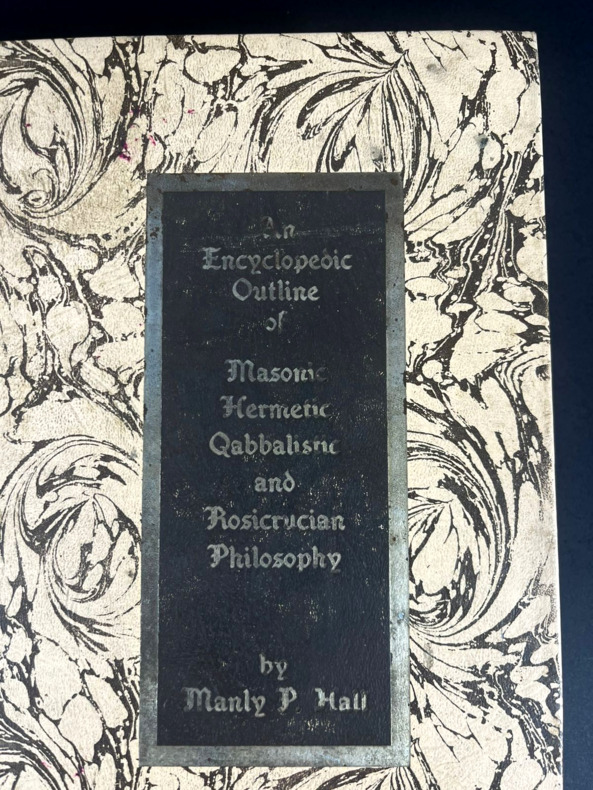
1988QZI-23Los Angeles, Philosophical Research Society, 1988. Diamond Jubilee Edition, first printing. Elephant folio, a very long 32 x 48.5 cm (!) book, unpaginated, CCXLV chapters, 48 colored pictures and many more black and white pictures throughout. Patterned boards, 1/4 leather spine, leather cover label, gilt cover/spine titles. Seems to be a reprint of the 1928 subscriber edition. No former ownership marks. Light rubbing on the front cover plate, first 5 pages show some foxing, fore-edges slightly yellowed, otherwise very clean and sound, in great shape. The grandest compendium ever gathered of esoteric lore, mythology, and historical anecdote. Filled to the brim with ancient woodcuts. A dense encyclopedia and a solid starting point from which to dive into subjects such as the Qabbala, Alchemy, Tarot, Ceremonial Magic, Neo-Platonic Philosophy, Mystery Religions, and the theory of Rosicrucianism and Freemasonry.
220519Santa Barbara [Californie], Wallace Hebberd, 1927 in-4, [2] ff. n. ch., 76 pp., avec un frontispice en couleurs et des illustrations en noir dans le texte, cartonnage gris, premier plat illustré (reliure de l'éditeur). Accroc à un mors supérieur.
1736000248Londres et Amsterdam Pierre Dunoyer, et Jean Frédéric Bernard 1736
172028437ABLondon, printed by T.J. for the Company 1720. Kl.8°. 5 Bll. (das 1. weiß), XVII-XXXVI, 149, (1) S., 1 (weißes Bl.), 95 S. Ldr der Zt mit Rückentitel. Name im oberen weißen Rand des Portraits überschrieben.
Acquaforte e bulino, 1747, stampata da H. Woodfall per John e Paul Knapton a Londra, nel 1749. Ottima impressione su carta vergata coeva, con margini, perfette condizioni. Questo raro lavoro fa parte dello splendido atlante anatomico del XVIII secolo, il The Tables of the Skeleton and Muscles of the Human Body di Albino. Venne pubblicato da John e Paul Knapton, a Londra, senza il permesso dell'autore solo due anni dopo la prima edizione del 1747, a Leida. Questa seconda edizione è stampata nello stesso enorme formato della prima edizione, con le illustrazioni derivanti dalle celebri tavole di Jan Wandelaar, curate qui da Charles Grignion, Jean-Baptiste Scotin, Ludovico Antonio-Ravenet e Louis-Pierre Boitard. Wandelaar posò scheletri e figure muscolose contro lussureggianti sfondi ornamentali per dare loro l'illusione di vitalità, arricchiti con contrasti di massa e luce per produrre un effetto tridimensionale. Etching with engraving, 1747. Printed by H. Woodfall for John and Paul Knapton, London, 1749. A very good impression on contemporary laid paper, with margins, perfect condition. This rare work is part of the most splendid anatomical atlas of 18th century, The Tables of the Skeleton and Muscles of the Human Body, published by John and Paul Knapton in London without author's permission (later that year they issued an English translation of the work), only two years after the 1st edition was published in 1747 in Leiden (largely at Albinus' own expense). This second edition is printed in the same enormous format as the first of 1747, with the celebrated Jan Wandelaar's plates re-engraved for this edition by Charles Grignion, Jean-Baptiste Scotin, Ludovico-Antonio Ravenet and Louis-Pierre Boitard. Wandelaar placed his skeletons and musclemen against lush ornamental backgrounds to give them the illusion of vitality, using contrasts of mass and light to produce a three-dimensional effect. ESTC (RLIN) N49651 Garrison-Morton (5th ed.), no. 399 Russell, K.F. British anatomy (2nd ed.), no. 5 Wellcome cat. of printed books, vol. II, p. 26.
196747198ABNew York und Toronto, Random House 1967. 4°. [36] Bl., davon 2 gefaltet. Illustrierter flexibler Original-Karton, mit 'Wahol'-Preisschild am Vorderdeckel. Im Rand geringf. gebräunt, leichter Rauchgeruch. (=A Black Star Book).
1898RO40254610Funk & Wagnalls Co.. 1898. In-4. Relié plein cuir. Etat d'usage, Coins frottés, Dos abîmé, Intérieur acceptable. 2318 pages. Illustré de très nombreuses gravures en noir et blanc et en couleur, dans et hors texte. Texte sur 3 colonnes. Pages à onglets. Titre doré sur le dos. Motifs en cuir repoussé sur le dos et les plats. Tranche marbrée (passée). Etiquette de code sur la couverture. Mors gauche fendu.. . . . Classification Dewey : 423-Dictionnaire anglais
Funk & Wagnalls Co.. 1898. In-4 Carré. Relié plein cuir. Etat d'usage. Coins frottés. Dos abîmé. Intérieur acceptable. 2318 pages. Illustré de très nombreuses gravures en noir et blanc et en couleur, dans et hors texte. Texte sur 3 colonnes. Pages à onglets. Titre doré sur le dos. Motifs en cuir repoussé sur le dos et les plats. Tranche marbrée (passée). Etiquette de code sur la couverture. Mors gauche fendu. Complete in 1 volume. Upon original plans designed to give in complete and accurate statement, in the light of the most recent advances in knowledge, and in the readiest form for popular use, the orthography, pronunciation, meaning and etymology of all the words, etc. Prepared by more than 200 specialists and other scholars. Under the supervision of Isaac K. FUNK, Francis A. MARCH, Daniel S. GREGORY, etc.
19580451New York, John Day Company, 1958. First edition. An octavo volume of 217 x 142 mm for 188 pp. Bound in full black publisher's cloth with dust jacket with flaps. Blank covers, author's name, title and publisher written vertically on the spine on a pink background. Dust jacket with a drawing of African-Americans playing drums, black and red on a yellow background. Autograph dedication from Langston Hughes on the first white guard: "For Paula-Lima, with a hearty welcome to our U.S.A. Sincerely, Langston Hughes, New York, July 26, 1960" in turquoise blue pen. The table of contents, at the beginning of the book, was also annotated by Hughes with the same pen p. 11. A major figure in the African-American cultural movement known as the Harlem Renaissance, the poet and novelist Langston Hughes (1901-1967) wrote works depicting the lives of black proletarians shared between joys, disillusions, hope, etc. all tinged with jazz and blues. "Through his work, he sought to show the importance of a "black consciousness" and a cultural nationalism that unites men rather than sets them against each other. This pride was subsequently taken up by many men of letters such as Jacques Roumain, Nicolás Guillén, Léopold Sédar Senghor and Aimé Césaire." (Wikipedia) ******************************************** New York, John Day Company, 1958. En anglais. Édition originale. Un volume in-8 de 217 x 142 mm pour 188 pp. Relié plein tissu noir éditeur avec jaquette à rabats. Plats muets, nom d'auteur, titre et éditeur écrits à la verticale au dos sur fond rose. Jaquette à dessin d'Afro-Américains jouant du tambour, noir et rouge sur fond jaune. Envoi autographe de Langston Hughes sur la première garde blanche : "Pour Paula-Lima, chaleureusement la bienvenue chez nous aux États-Unis. Sincèrement, Langston Hughes, New York, 26 juillet 1960" (traduit) au stylo bleu turquoise. La table des matières, en début d'ouvrage, est également annotée par Hughes avec le même stylo p. 11. Figure majeure du mouvement culturel afro-américain dit de la Renaissance de Harlem, le poète et romancier Langston Hughes (1901-1967) écrivit des œuvres dépeignant la vie des prolétaires noirs partagée entre joies, désillusions, espoir, etc. le tout teinté de jazz et de blues. "Par son travail, il a cherché à montrer l'importance d'une « conscience noire » et d'un nationalisme culturel qui unit les hommes plutôt que les oppose. Cette fierté a par la suite été reprise par de nombreux hommes de lettres comme Jacques Roumain, Nicolás Guillén, Léopold Sédar Senghor ou encore Aimé Césaire." (Wikipédia)
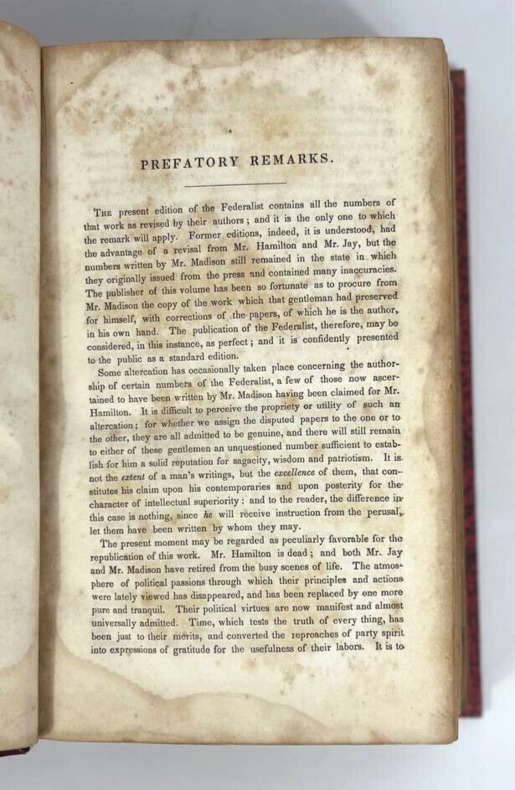
18420054Hallowell (ME), Glazier, Masters & Smith, 1842. Mention of "New Edition". A thick octavo volume, 234 x 150 mm, 484 pp. Hardcover, modern half-leather binding, authors' name and main title written in gold on the spine, four raised bands. More commonly known as the Federalist Papers, this text includes 85 essays, most of which were originally published in New York newspapers under the pseudonym "Publius." This "New Edition" identifies the authors of the individual papers, and the "numbers written by Mr. Madison corrected by himself." It has been called the "most famous and influential American political work". Howes H114; Sabin 23981. Name handwritten with blue ink on the top of the title page, foxing on the first page and then lightly scattered through, dampening on the margins with all text square and intact. Not ex-library, has only belonged to private collectors.
First and only edition of this collection of carefully rendered yet somewhat naive lithographic views of York churches. 23 plates, including the frontispiece, each accompanied by a page of letterpress description. Complete with the 24th and final plate, which was published as an afterthought and thus is not included in the list of plates. A LARGE-PAPER COPY, WITH THE PLATES IN INDIA PROOF STATE. With the bookplate of John Tricks Spalding. 4to. Attractively bound in 19th century half crushed morocco and cloth, WITH SPALDING'S INITIALS, IN STYLIZED LETTERS, BEAUTIFULLY LAID INTO THE FRONT COVER IN MOROCCO. Light wear to extremities of binding, light occasional internal spotting. Plates bright and fine. A very good copy of a rare book.
188 pages. Occasional black and white illustrations in text. Copyright 1902. No indication of prior printings. Includes 72 reading lessons with titles such as Confucious and the Wise Boy, A Cunning Fox, and The Camel and the Miller, plus exercises on vowel sounds, consonant sounds, and articulation. "The lessons cover quite a large range of subjects. In this way the Chinese scholar will acquire much valuable knowledge." - from Preface. Includes text in English and Chinese, side-by-side, on each page. Minimal faint markings to contents. Binding intact. Average wear to maroon cloth. A sound copy of this wonderful vintage reader. Book
Pages 413-452 plus xvi pages of great vintage ads. Many great black and white photos. Features: "Indian Ridge" - The Summer Home of Dr.l F.B. Harrington, at Ipswich, Massachusetts; Decorations and Furnishings for the Home - IV - Furnishing a Young Girl's Room; English Garden Mazes; A Group of New England Homes - nice two-page photo spread of homes belonging to Mr. E.B. Stearns at Brookline, T.P. Hollander on Misery Island, and Mrs. Frances Robeson at Brookline; Handicraftsman - Home-made Pottery; Glue for Model Making; The Steam Radiator in France; Residence of William L. Bailey, Esq., at Ardmore, PA; The Mirror; The Wasp's Year (life cycle); Stucco Houses of Distinction; The City of the Sun; Garden Notes - Tennis Courts; Conservatory and Greenhouse Heating; Glass Espalier Walls; L. Wolff Mfg. Co. ad features Chicago home of Walter H. Miller; Back cover color ad for the Columbia Grafonola includes photos of ten famous vocalists of the day; and more. Printed on glossy stock. Complete and unmarked with average wear. Covers loose but present. A worthy copy of this great vintage issue. Magazine
266 pages including index of authors cited. Second printing of 1939 First Edition. "In the first and longest essay Hayek develops his well-known theory of industrial fluctuations beyond the point at which it was left in his Prices and Production. While the central argument of this theory remains the same, it is now restated on somewhat different and more realistic assumptions and in less abstract forms and certain important improvements are introduced. The main advance concerns the relationship between the rate of interest and the rate of profit. The other essays deal with particular problems in the same field such as demand for capital, capital maintenance, the factors governing investment, and the supply of savings. The first essay appears for the first time; the others are collected, and in part translated from various English and foreign journals in which they were originally published." - from dust jacket. Contents clean and unmarked. Light wear to red boards. Slight lean to spine which bears bright gilt lettering. Average wear to dust jacket which bears several small chips and tears, primarily at spine ends, and several small marks upon back panel. Overall a nice solid copy. Book
A.J. Casson cover art features robin hunting for worms amongst trilliums. 80 pages. Additional features include: Nostalgic colour ad for new KB International Trucks inside front cover - ad features photo insert of Jule Chartrand and Frank Bell - Champion Canadian truck drivers; Four-photo full-page ad for Ipana toothpaste features Eileen Cochrane of Montreal and her seven-year-old son Michael; Editorial - Are the Communists entitled to Liberty?; 2-colour full-page ad for DeSoto cars; Top Man in Totem Poles - Marius Barbeau is hot on the trail of that strange beast - the Canadian; Wives Have It So Easy, by James Bannerman; Nightmare Pills - Pierre Berton on Sleeping Pills; Fiction by Arthur Gordon - Listen to Your Heart; Can we Prevent Race Suicide?, by Arnold Toynbee; Newsboy - James Joseph Murph (Murph) has been selling papers outside the Canadian National Railways Building on the northwest corner of King and Yonge, Toronto's busiest intersection, for 58 years - with photo; Fiction - Double or Nothing by Henry Norton; Are Fishing Laws Bunk? - what use are limits when we make our rivers unfit homes for fish?; Nice full-page colour ad for Old English Rubbing (Floor) Wax; What's Wrong with Work?, by Gwethalyn Graham; The Old Man - Lionel Barrymore; You, Too, Can fly, by Eva-Lis Wuorio; Fiction by Arthur Mayse - Someday You'll Thank Me; Leper Colony on Bentinck Island in BC; Black and white Fargo truck ad; Nice two-colour Plymouth car ad; Full-page black and white Austin Motor company ad; Half-page colour photos Pepsi ad shows ping pong players; Lovely full-page colour Lifesavers ad; Dawes Black Horse Brewery ad honours weathermen; Great full-page colour ad for Pontiac cars; Very attractive Gene De Nunzio-illustrated ad for Wabasso Cottons inside back cover shows mother and daughter and their print dresses; Carling Breweries ad on back cover illustrates the main flyways of North American waterfowl; plus many more wonderful ads. Pages yellowed with age. Clean and unmarked with light wear. A quality copy of this wonderful A.J. Casson collectible. Magazine
97-192, [158] ads, pages. Profusely illustrated with black and white photos and drawings. Printed upon glossy stock. The many pages of ads include an abundance of nostalgic photos and illustrations. Features: Residence of Otto H. Kahn, Esq., New York - J. Armstrong Stenhouse, Architect; The Hampton Normal and Agricultural Institute, Hampton, VA - Ludlow and Peabody, Architects; Some Principles of Design and Construction in Church Building; English Architectural Decoration, Part IXb; The Jade Fence About the Gardens of the Pan-American Building, Washington, D.C. - Albert Kelsey, Architect; Portfolio of Current Architecture; Workingmen's Houses in Italy; The Architect's Library; Notes and Comments. Above-average external wear. Covers nearly loose.. Binding intact. Two small binding holes near spine. A worthy copy of this wonderful vintage issue. Book
97-192, 126 [ads] pages. Profusely illustrated with detailed drawings and black and white photos. Printed upon glossy stock. Includes dozens of magnificently illustrated ads. Features: The Residence of Charles D. Blaney, Esq., Saratoga, California - Willis Polk & Co, Architects; The Art of the Middle Ages - Part I; The Destruction of Historic Buildings as Revealed by the Official French War Photographs - Part III - Parish Churches; The Memorial Quadrangle of Yale College - James Gamble Rogers, Architect; English Architectural Decoration - Part IV - text and measured drawings; The Small Country School House; Community Courts for Factory Workers; The Architect's Library - War Books of the Cathedrals - Part II - Verdun; Notes and Comments. Above-average wear. Lacking covers. Two small binding holes near spine. Last page of advertising loose but present. Not pretty but a worthy vintage copy. Book
1877676718vo, hardcover, green cloth with gilt embossing, Journal Printing House, Newburg N.Y., 1877, 460 pp. with folded plate
190613704Macmillan 1906. 2 vols. 8vo. First Edition on laid paper with 2 portrait frontispieces in photogravure original tissue guards present 6 plates in photogravure and 10 cartoons one coloured and facsimiles one folding some mild spotting throughout; original armorial red cloth gilt gilt backs uncut backstrips mildly sunned corners lightly bruised else a very good bright clean copy. Churchill's account of his father was his first biographical work. Woods A8a. Macmillan, hardcover
1806N3738aLondon: J. Taylor 1806. First English Edition . Modern Half Leather. Very Good/Fair. 8vo . 144pp15 folding plates with many illustrations. Bound with A CATALOGUE OF MODERN BOOKS ON ARCHITECTURE THEORETICAL PRACTICAL AND ORNAMENTAL. ON SALE AT J. TAYLOR'S ARCHITECTURAL LIBRARY HIGH HOLBORN LONDON 20pp. Edges with minimal foxing title page with some darkening. A very good copy of this RARE FIRST EDITION ITEM. <br/> <br/> J. Taylor hardcover
1996596061 vol. in-8 br., Published by British Museum Press for the Trustees of the British Museum, 1996, IX-98 pp. et 34 planches