218 935 résultats
149365208Venedig, Bonetus Locatellus für Octavianus Scotus, 4. Juni 1493. Fol. Mit großer Metallschnitt-Druckermarke am Schluss u. einigen meist schwarzgrundigen Holzschn.-Initialen. 313 num., 5 nn. Bll. (2 Kol., 66 Z., Got. Typ.), HPgmt. d. 19. Jhds. m. marmor. Deckeln u. Schnitt.
19755062DBLondon, Casell - A Michael Dempsey Book, 1975. 241 S. Leinenband mit illustriertem Schutzumschlag. + Wichtig: Für unsere Kunden in der EU erfolgt der Versand alle 14 Tage verzollt ab Deutschland / Postbank-Konto in Deutschland vorhanden +, 5062DB|5062DB_2 [2 Warenabbildungen]
<p> in folio, 30 cm, rilegatura in cartone alla rustica con tit. manoscritto al dorso, p. (6), CXV carte. Grande Marca editoriale incisa al frontespizio con due leoni che sorreggono uno stemma con le iniziali I. P. (Iohannis Petit). Numerosi ed ordinati appunti in grafia cinquecentesca sulle prime 20 carte. Alcune leggere tracce d'inchiostro al taglio superiore lontane dal testo, minimo forellino alle ultime 40 carte. Testo in latino, su due colonne. Iniziali xilografate alcune con motivi floreali ed altre animate con un dragone. Raro commentario della politica di Aristote.</p>
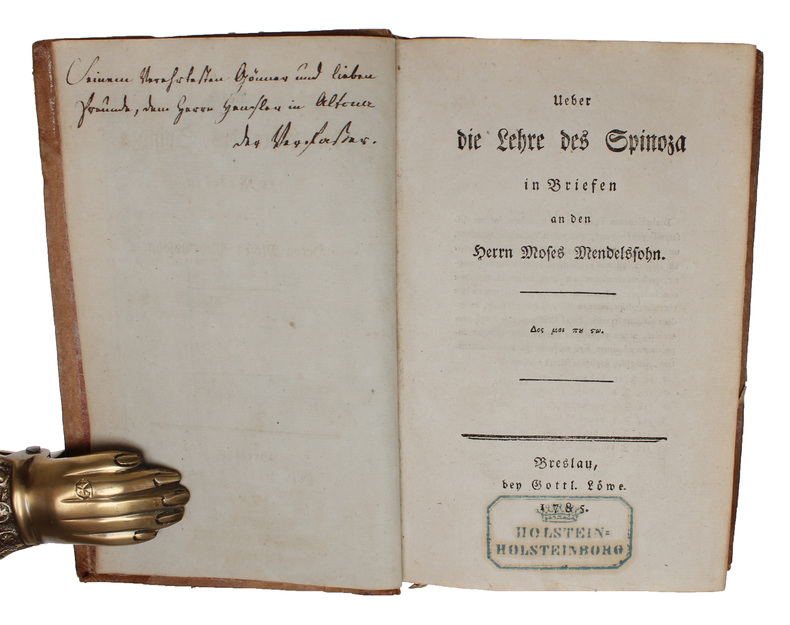
178551687Breslau, Löwe, 1785. 8vo. Nice contemporary half calf with five raised bands, gilt lines, and gilt title-label to spine. A bit of wear to extremities. Internally very nice and clean. Printed on good paper. A stamp to title-page (Holsteinborg). Inscribed by the author on front free end-paper. (8)215, (1, - errata) pp.
191660625Tübingen, J.C.B. Mohr (Paul Siebeck), 1916. Lex 8vo. Uncut and unopened in the original printed wrappers. A stain to the front wrapper, from the removal of a bookplate on verso, which has also removed some of the advertisement-print to the top of the inside of front wrapper. Apart from this removed book plate the only real flaw that the copy has is a vertical break down the middle of the spine, from opening the block. Otherwise there is just minimal edgewear and slight brownspotting to the title-page. Inscribed by Heidegger ""Vom Verfasser/ M.H."" to top of title-page. (8), 245 pp.
173360085London, C. Davis and A. Lyon, 1733. 8vo. Lovely contemporary full Cambridge-style binding with five raised bands to spine and blindstamped ornamental borders to boards. . Double gilt line-borders to boards. All edges of boards with gilt borders. Gilt title to spine. Hinges neatly and professionally re-inforced. Internally very nice, clean, and fresh. A lovely, crisp, and large copy with good margins, printed on heavy, fine paper. (16, -including preface, contents, advertisements), 253, (1), (18, -Index) pp.
Breslau, Löwe, 1785. 8vo. Nice contemporary half calf with five raised bands, gilt lines, and gilt title-label to spine. A bit of wear to extremities. Internally very nice and clean. Printed on good paper. A stamp to title-page (Holsteinborg). Inscribed by the author on front free end-paper. (8)215, (1, - errata) pp.
Berlin u. Libau, Lagarde und Friederich, 1790. 8vo. Oiginal cardboard binding. Spine somewhat worn with parts of paper missing. Corners a bit bumped. Contemporary handwritten title to spine. A few leaves of the preface with a couple of underlinings and with some marginal annotations. Otherwise very nice, clean and fresh. With an old owner's signature (""Dr. P. Müller"") to title-page and a gift inscrption to front free end-paper stating that the book was given as a present by Dr. Montgommery in 1863 in London. LVIII, 476 pp., 1 f. (Errata).
London, C. Davis and A. Lyon, 1733. 8vo. Lovely contemporary full Cambridge-style binding with five raised bands to spine and blindstamped ornamental borders to boards. . Double gilt line-borders to boards. All edges of boards with gilt borders. Gilt title to spine. Hinges neatly and professionally re-inforced. Internally very nice, clean, and fresh. A lovely, crisp, and large copy with good margins, printed on heavy, fine paper. (16, -including preface, contents, advertisements), 253, (1), (18, -Index) pp.
London [recte: Amsterdam, M.M. Rey], 1770. 8vo. Bound in two beautiful contemporary uniform full mottled calf bindings w. 5 raised bands to richly gilt back title- and tome-labels in red and green. Crcak to front- and back-hinges at top and bottom, but still tight. A bit of wear w. minor loss to capitals. Internally fresh, fine and clean with only a few brownspotted leaves. Ex libris to inside of front boards: Bibliothêque de Me Le Cte Frédéric de Pourtales. (12), 370 " (4), 412 pp.
in-24, pp. (16), 213, (20), 1 cb; 142, (2); 96; 105, (1)2 cb, leg. p. pelle coeva con picc. fregi oro al d. Tagli color. Con 6 tavv. inc. in rame nella prima opera, di cui 5 sono carte geografiche. Qualche insignificante alone ma belliss. esempl. Importante insieme di rari trattati sull’utopia, tra cui l’edizione della Città del Sole di Campanella per la prima volta pubblicata autonomamente dopo la prima stesura del 1623 contenuta nell'opera Philosophia Realis pubblicata a Francoforte col commento del filosofo Tobia Adami. Il testo corrisponde alla seconda edizione. L'edizione comprende in successione il Mundus Alter che il vescovo anglicano J. Hall pubblica sotto lo pseudonimo di Mercurius Britannicus, il testo latino della Civitatis Solis e infine la Nova Atlantis di F. Bacon. Si tratta di tre unità bibliografiche distinte, ognuna delle quali ha frontespizio, segnature e paginazione propri. Firpo, Bibliografia, 2, pag. 95. Rarissimo. Ottimo esempl. [053]
Kjøbenhavn (Copenhagen), Andr. Fred. Høst, 1851(1850)-52. Indb. i fire samt. ensartede hldrbd. m. forgyldte rygge. Bd. m. lidt rifter. På velin. - Med en halvsides dedikation til Ørsteds datter Mathilde Ørsted : ""Til/ min Kjære Datter Mathilde Ørsted/ Denne Bog har Ingen læst i dens Helhed/ förend Du, min Kjære Mathilde, da Du saa troligt hjalp mig med Rettelsesarbeider, som en Bogs Trykning medförer, og med tænksomme Soörgsmaal og Bemærkninger gav mig Anledning til mangen Forbedring. Modtag derfor Bogen, der allerede Skulde tilfalde Dig som en elsket Datter, tillige som et Minde om de Underholdninger (?) imellem os, hvortil du gav Anledning. H.C. Ørsted."" Mathildes navn findes i bind III,V og VI, og hun var Ø's yngste datter.Bound in 4 cont. uniform hcalfs w. richly gilt backs. Bindings w. a few scratches. A fine copy printed on vellum-paper. With a long (half-page) orig. handwritten dedication from Oersted for his youngest daughter, Mathilde Ørsted : ""Til/ min Kjære Datter Mathilde Ørsted/ Denne Bog har Ingen læst i dens Helhed/ förend Du, min Kjære Mathilde, da Du saa troligt hjalp mig med Rettelsesarbeider, som en Bogs Trykning medförer, og med tænksomme Spörgsmaal og Bemærkninger gav mig Anledning til mangen Forbedring. Modtag derfor Bogen, der allerede Skulde tilfalde Dig som en elsket Datter, tillige som et Minde om de Underholdninger (?) imellem os, hvortil du gav Anledning. H.C. Ørsted.""With the orig. handwritten signature of Mathilde in vols. III, V and VI.
180931327Paris & Genève, Chez J.J. Paschoud, 1809. 8vo. Bound in three nice uniform cont. hcalfbdgs. w. gilt backs, red leather title-labels w. gilt lettering and gilt round green tome-labels on backs. Capitals w. a bit of wear. Internally nice and clean. W. half-titles in all three volumes and advertisement-leaf in vol. one. XIII, (1), 424, (5) (6), 395, (1) (4), 392 pp.
162151094Paris, Abraham Picard, 1621. Folio. Nice mottled full calf binding (ab. 1850) with richly gilt spine and gilt title-labels. Minor wear to extremities. Lower blank margin of first two leaves repaired, far from affecting text, and very neatly restored wormhols to lower blank margin to a number of other leaves leaves, barely visible and also far from affecting text (apert from the index, where it touches a couple of letters). A bit of very light scattered brownspotting. All in all a very nice, clean, and fresh copy. Engraved title-vignette, woodcut ornamental borders and large woodcut initials to first leaves. (22), 521, (41, -Index) pp.
Paris, Gallimard, (1939). Bound uncut with the original printed wrappers, also the back-strip, in a magnificent, elegant, and highly artistic black full calf binding with onlays of blood-red lacquered calf in stipes of varying thickness to all of front and back board as well as to spine, elegantly representing a ""wall"". Gilt author and title to spine. Inside of boards and recto and verso respectively of free end-papers coved with exquisite red suede and with white calf edges. Hand-sewn capital-bands in red and black. All edges gilt (also the uncut ones). Blindstamped super-ex-libris to inside of front board. Housed in an exquisite chemise with elegant patterned paper in red and grey tones and with black calf spine (same gilding as to binding) and edge, chemise covered with exquisite red suede on the inside, and an elegant slip-case of the same patterned paper, with black morocco edges. Binding signed to bottom of inside of front board: ""C. et J-P. Miguet"" and to bottom of inside of back board: ""2003"". A mint copy.
Paris & Genève, Chez J.J. Paschoud, 1809. 8vo. Bound in three nice uniform cont. hcalfbdgs. w. gilt backs, red leather title-labels w. gilt lettering and gilt round green tome-labels on backs. Capitals w. a bit of wear. Internally nice and clean. W. half-titles in all three volumes and advertisement-leaf in vol. one. XIII, (1), 424, (5) (6), 395, (1) (4), 392 pp.
Paris, Abraham Picard, 1621. Folio. Nice mottled full calf binding (ab. 1850) with richly gilt spine and gilt title-labels. Minor wear to extremities. Lower blank margin of first two leaves repaired, far from affecting text, and very neatly restored wormhols to lower blank margin to a number of other leaves leaves, barely visible and also far from affecting text (apert from the index, where it touches a couple of letters). A bit of very light scattered brownspotting. All in all a very nice, clean, and fresh copy. Engraved title-vignette, woodcut ornamental borders and large woodcut initials to first leaves. (22), 521, (41, -Index) pp.
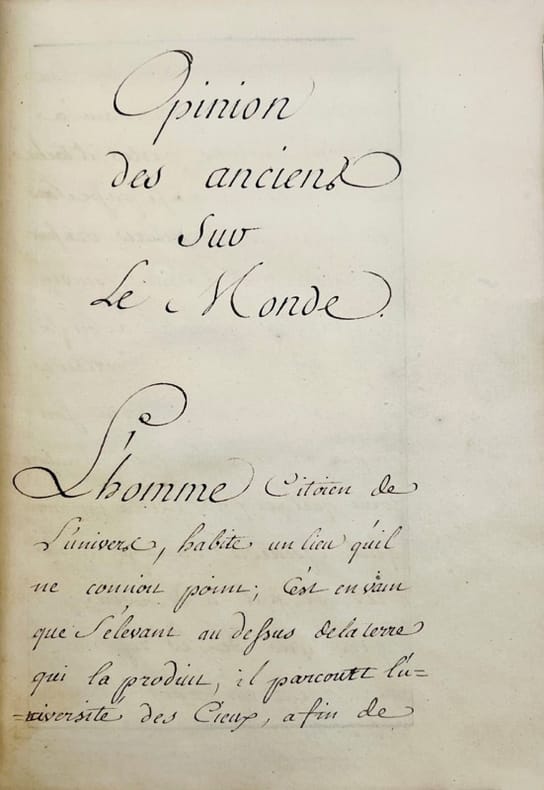
172744640Sans lieu, , 1727. Manuscrit in-4 de (335)-(5) ff., index, 2 portraits gravés et 1 feuillet imprimé replié (thèse), veau brun granité, dos orné à nerfs, titre en lettres dorées « PETRUS / DE BEC / DELIEVRE / DEQUEVILLY », tranches dorées (reliure de l'époque).
In-12 (150 x 91 mm), plein veau marbré de l'époque, dos lisse orné de caissons cloisonnés et fleuronnés, pièce de titre de maroquin bordeaux, coupes et coiffes filetées, tranches rouges, (1) f. de titre ("Pensées sur l’interprétation de la nature, 1754"), (3) p. "Aux jeunes gens...", (1) p. bl., (1) f. de titre ("De l'interprétation de la Nature, 1753"), [-3], 206 p., (6) f. de table et errata. Exceptionnel exemplaire possédant deux pages de titre : celle de la rarissime première édition de premier tirage 'De l'interprétation de la Nature' à la date de 1753, connu à deux exemplaires dans le monde, et celle du deuxième tirage: 'Pensées sur l'interprétation de la nature' à la date de 1754. Le corps de l’ouvrage est conforme aux exemplaires de ce second tirage décrits par Adams (PE2), hormis quelques différences quant aux feuillets cartonnés. Sont cartonnés dans cet exemplaire : les pages 3-4, les feuillets 88, 89, 97, les pages 145-146, 173-174 et 205-205 (?). "L’œuvre emblématique de l’esprit des Lumières", que l’on a qualifié de Discours de la méthode du dix-huitième siècle. "C'est un livre qui suggère nombre des plus importants problèmes de la philosophie des sciences, un livre exploratoire qui lance des éclaireurs sur les frontières de la connaissance" (Wilson, 'Diderot', p. 158). Petites auréoles à la reliure en bord externe d’une partie du deuxième plat. Coins et coupes un peu frottés. Quelques légères auréoles claires. Un note calligraphiée à la plume à l’époque sur le premier titre critique: "Par Diderot, philosophe sans sagesse et sophiste orgueilleux". (Adams, PE1-PE2. Tchemerzine-Scheler, II, 936-937). Bel exemplaire, très bien conservé, frais, grand de marges.
172644760, , 1726 ca. Manuscrit in-8 carré (190 x 135 mm) de (133) ff., veau fauve, dos lisse orné, pièce de titre en maroquin rouge, triple filet doré d'encadrement sur les plats, tranches dorées (reliure de l'époque).
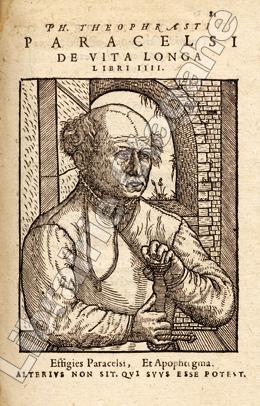
156713778Paris, aedibus Rovillii, (1567) ; in-8 ; plein veau havane marbré, dos décoré et doré, roulette sur les coupes, tranches mouchetées de rouge (reliure du XVIIIe) ; 376, (21) pp. (Index rerum et verborum et Index Autorum), (1) p. blanche, (1) f. blanc. ; portrait gravé sur bois (p.81).
166049107Zürich, Johann Jakob Bodmer, 1660. (20), 600, (24) SS. Zeitgenöss. Pergamentband auf 4 durchzogenen Bünden mit übergreifenden Deckelkanten. 4to.
181776800Chez Pigoreau | Paris 1817 | 9.50 x 16 cm | 4 volumes reliés
In folio (mm. 300x210); 112 carte. Fascicolazione: a-s6, t4; testo su due colonne con carattere gotico di due differenti dimensioni: su 56 linee il testo, su 69 il commento. Alcune silografie nel testo illustrano schematicamente quanto affermato nella trattazione. <BR>Piena pergamena all'olandese settecentesca con titolo e autore manoscritti al dorso. <BR>Paolo Nicoletti da Udine (Udine 1368 ca. - Padova 1429), detto Paolo Veneto, fu il primo ad arrecare una reale innovazione nella tradizione dottrinaria dell'Università di Padova. L'autore infatti costituisce il punto di riferimento per tutta la speculazione successiva sia per quanto riguarda la metodologia logica che lo studio della fisica. Nell'ambito della logica, infatti, Nicoletti sistemò la teoria del regressus demonstrativus, raccogliendo i risultati della millenaria riflessione dell'aristotelismo sul ruolo della demonstratio quia e della demonstratio propter quid. Nello studio della fisica, invece, applicò le dottrine averroiste provenienti dalle università di Oxford e Parigi, che puntavano ad un orientamento fisico-sperimentale e logicista, alieno da interpretazioni metafisiche e teologiche. Egli fu così l'iniziatore di una tradizione di pensiero destinata a divenire il "metodo ufficiale" della riflessione scientifica che, in seno allo Studio di Padova, si potrasse fino a quella del giovane Galilei. Il commento del faentino Manghi inizia a pag. 68. <BR>Buon esemplare con alcune note manoscritte all'occhietto e timbro antico di appartenenza: "Preposto D. Giacinto Amati". Leggere fioriture, limitate tracce di umidità, maggiormente degne di nota alle ultime 5 carte. Piccoli lavori di tarlo: al margine interno, dalla carta n5 a tutto il fascicolo p; al margine superiore della carta k5 alla fine; due forellini anche a centro pagina alle ultime tre carte. Restauro all'angolo superiore delle carte a3-b1 e piccola mancanza allo stesso angolo delle carte b2-4.<BR>Goff P-230; Hain 12504; Polain (B) 3019; Sander 5483; IGI 7362 cita 7 copie in Italia; BMC V 569. <BR>
In-8 (188 x 113 mm), plein veau fauve de l'époque, dos à 5 nerfs richement ornés de caissons fleuronnés et cloisonnés, jeux de filets et palettes dorés en pied, pièce de titre de maroquin bordeaux, filet à froid en encadrement des plats, roulette dorée sur les coiffes et les coupes, tranches rouges, (1) f. de titre, (3) p. de préface, 66 p., planche frontispice gravée. Rare édition originale de premier tirage, imprimée à petit nombre d’exemplaires, identifiable par son fleuron de titre, tirage probablement réservé à l’usage des membres du jury et des proches de l'auteur. Elle est en tous points conforme aux caractéristiques mentionnées par B. Gagnebin (édition de La Pléiade) et par Th. Dufour (coquilles typographiques aux pages 12 et 16). Planche frontispice gravée par Ch. Baquoy: "Satyre, tu ne le connais pas". Si cette édition a bien été imprimée à Paris, chez Pissot, l'imprimeur accepta de la faire paraître sous la fausse adresse de Barillot à Genève, à la demande de Rousseau qui souhaitait l'accorder avec le titre de "Citoyen de Genève" figurant pour la première fois (cf. Sénelier, p. 57-58). "Le livre qui rendit Rousseau célèbre"; son succès foudroyant le propulsa à l’avant-scène de la République des Lettres. En répondant par la négative à la question mise au concours par l'Académie de Dijon, Rousseau prend le contre-pied de ses contemporains pour dénoncer un ordre social fondé sur le luxe et les inégalités, corrompu et bafouant les véritables valeurs. Et de démontrer que les progrès indéniables des sciences et des arts ne se sont pas accompagnés d’un progrès moral. La descendance de cet essai sera immense. "Une force insoupçonnée et sincèrement rebelle apparaît dans ce Premier Discours, une pensée novatrice qui sonne juste. Et la lumière que Rousseau jette sur l'homme et sur le lien social va contribuer à remettre en cause une certaine idée du progrès" (Jacques Berchtold). (Dufour, n°13. Gagnebin, III, p. 1854-1855). L'ouvrage est relié avec trois autres pièces de l'époque (Lefranc de Pompignan, Fagan et anonyme). Quelques petites traces de restauration à la reliure. Petites piqûres éparses. Provenance: "Domou" et A. Grandjean (marque au premier titre) et ex-libris armorié gravé ancien. Bel exemplaire, très bien relié à l'époque.