"[MORELLY, ETIENNE-GABRIEL].Livre Rare Book
218 899 résultats
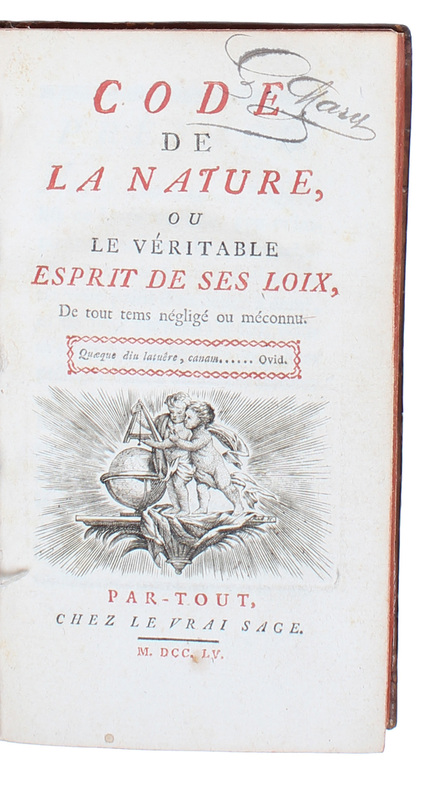
175550872Par-Tout (i.e. Paris or Liège), Chez le vrai Sage, 1755. Small 8vo. Lovely contemporary full mottled calf with five raised bands to richly gilt spine. And excellent nice, clean, and fresh copy, printed on good paper. Old owner's name to title-page and a bookplate to inside of front board (M. Ph. de Planterose). Title-page printed in red and black and with an engraved vignette. 236, (4) pp.
Par-Tout (i.e. Paris or Liège), Chez le vrai Sage, 1755. Small 8vo. Lovely contemporary full mottled calf with five raised bands to richly gilt spine. And excellent nice, clean, and fresh copy, printed on good paper. Old owner's name to title-page and a bookplate to inside of front board (M. Ph. de Planterose). Title-page printed in red and black and with an engraved vignette. 236, (4) pp.
Leipzig, C.G. Naumann, 1889. 8vo. Bound with the original printed wrappers in a nice near contemporary brown half cloth with gilt lettering to spine. Lovely marbled end-papers. A bit of light soiling and brownspotting to wrappers, which are otherwise very well preserved. A few leaves with some very light brownspotting and a couple of leaves with small closed tears to blank inner margin, far from affecting text. Overall very nice. With the engraved book plate of Adolf Fischer to inside of front board. (8), 144 pp.
198412722Ffm., Suhrkamp, 1963-1984. 497 Nummern (die Nummern 460,475 und 493 sind nicht erschienen). Kl. 8°. Tausende Seiten. OBroschur und OBroschur mit Schutzumschlag von Willy Fleckhaus. Bis auf einzelne Bände mit kleineren Gebrauchsspuren schöne, gut erhaltene Reihe. Papier z.T. minimal vergilbt.
150038587(Hagenau, Heinrich Gran für Johann Rynmann, 18. September bzw. 8. Dezember 1500). Fol. 250 (davon 2 weiße); 366 (davon 2 weiße) nn. Bll. (Got. Typ., 2 Kol., 58 Zeilen, Min. f. Init.), Blindgepr. Ldr.-Bd. d. Zt. über Holzdeckeln a. 3 Bünden m. handschriftl. Deckelschild.
In 8°. Pregevole rilegatura in piena pelle coeva con nervature e titoli in oro su tassello al dorso. Lievissime macchie, qualche legatura con pelle leggermente usurata. Stato di conservazione molto buono. Magnifica edizione svizzera della monumentale Enciclopedia di Diderot e D'Alembert, uno dei capisaldi del pensiero e della cultura umana, composta di 36 volumi di testo e di 3 volumi di splendide tavole incise. La presente edizione è la ristampa identica di quella curata alcuni anni prima da Pellet a Ginevra. Fine coeval full leather binding with ribbing and gold titles on the spine. Very slight spots, some binding with slightly worn leather. Very good state of conservation. Magnificent Swiss edition of the monumental Encyclopedia by Diderot and D'Alembert, one of the cornerstones of human thought and culture, consisting of 36 volumes of text and 3 volumes of splendid engraved plates. This edition is the identical reprint of the one edited a few years earlier by Pellet in Geneva.
58068Venedig, Johann von Köln u. Johann Manthen, 27. August 1478. Fol. Mit eingemalten Alinea-Zeichen alternierend in Rot und Blau sowie eingemalter Kopfzeile in Rot und Blau. 228 nn. Bll. (das erste weiß; Rom. Type mit griech. Einsprengseln, 37 Zeilen, Blindgepr. Ldr. d. 20. Jhds. auf 5 Bünden m. goldgepr. Rückentitel.
178945724Breslau, Gottl. Löwe, 1789, 8vo. Very beautiful contemporary red full calf binding with five raised bands and gilt green leather title-label to richly gilt spine. elaborate gilt borders to boards, inside which a ""frame"" made up of gilt dots, with giltcorner-ornamentations. Edges of boards gilt and inner gilt dentelles. All edges gilt. Minor light brownspotting. Marginal staining to the last leaves. Engraved frontispiece-portrait of Spinoza, engraved title-vignette (double-portrait, of Lessing and Mendelssohn), engraved end-vignette (portrait of Jacobi). Frontispiece, title-page, LI, (1, -errata), 440 pp. Magnificent copy.
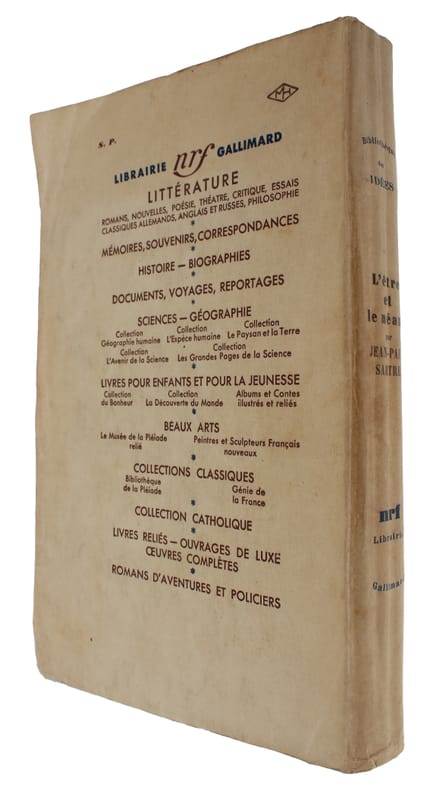
194360084Paris, nrf, Librairie Gallimard, 1943. 8vo. Orig. printed wrappers, uncut and first quire unopened. Light traces of use, but overall remarkably fresh. Spine very slightly darkened and wrappers with very light scattered brownspotting. A small, vague couloured thump bark to lower corner of front wrapper (and first leaves). An unusually good copy, as the fragile wrappers are often much more worn. Also internally unusually fresh. Wrappers printed in red and blue. With half-title. 722, (2) pp, 2ff. (one with colophon).
173361360London, 1733. 8vo. Bound in a lovely, contemporary English Cambridge-style full calf binding with a plain spine with five raised bands. Spine a bit cracked vertically and with minor loss to capitals. Corners a bit bumped and adges of boards a bit worn. Binding overall nice and tight. Small damp stain at the lower blank corner of the first few leaves, otherwise a very good, clean copy on thick, crisp paper. (16, -including preface, contents, advertisements), 253, (1), (18, -Index) pp.
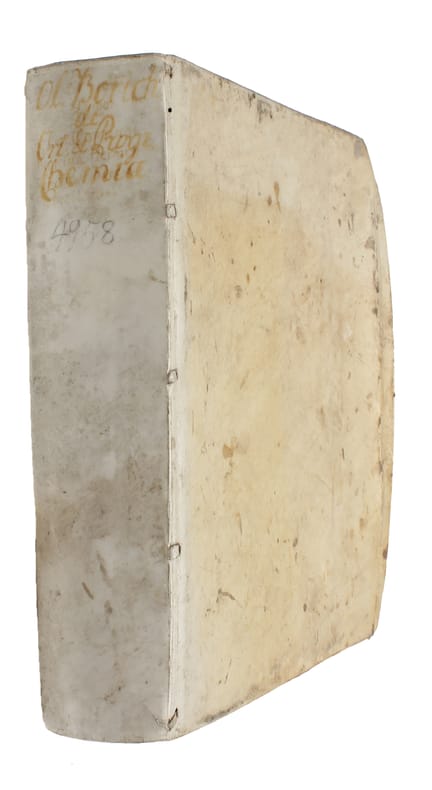
166960763Helmstedt, H. Muller, 1669 (De Hermetica) & Copenhagen, Matthias Godiche for Peder Haubold, 1668 (De Ortu). 4to. In contemporary vellum over wooden boards. Title in contemporary hand to spine. Extremities with soiling and some marks and dots. Vellum gapping at the outer edge of the front board, partly detaching and showing the underlying wooden board. Light occassional discolouration throughout, stain to upper outer margin, not affeting text. Last leaf detached. [De Ortu...:] (14), 150, (2) pp. [De Hermetica...:] (24), 447, (51) pp.
Breslau, Gottl. Löwe, 1789, 8vo. Very beautiful contemporary red full calf binding with five raised bands and gilt green leather title-label to richly gilt spine. elaborate gilt borders to boards, inside which a ""frame"" made up of gilt dots, with giltcorner-ornamentations. Edges of boards gilt and inner gilt dentelles. All edges gilt. Minor light brownspotting. Marginal staining to the last leaves. Engraved frontispiece-portrait of Spinoza, engraved title-vignette (double-portrait, of Lessing and Mendelssohn), engraved end-vignette (portrait of Jacobi). Frontispiece, title-page, LI, (1, -errata), 440 pp. Magnificent copy.
Heidelberg, (Druck und Papier von Brede in Offenbach), 1817. 8vo. Nice cont. cardboardbdg. w. title-label to back. Corners and capitals professionally restored. Hinges w. a bit of paper-loss. Occational brownspotting. Front free end-paper w. vast cont. annotations by former owner Fr. Selasinski.
Paris, nrf, Librairie Gallimard, 1943. 8vo. Orig. printed wrappers, uncut and first quire unopened. Light traces of use, but overall remarkably fresh. Spine very slightly darkened and wrappers with very light scattered brownspotting. A small, vague couloured thump bark to lower corner of front wrapper (and first leaves). An unusually good copy, as the fragile wrappers are often much more worn. Also internally unusually fresh. Wrappers printed in red and blue. With half-title. 722, (2) pp, 2ff. (one with colophon).
Kjøbenhavn, C.A. Reitzel, 1843. 8vo. Two very nice, contemporary, uniform half calf bindings with blindstamped square ornamentations and quadruple gilt line-decorations to spines. Light wear to capitals and corners. A bit of light browning and brownspotting due to the paper quality (less than usual). An very nice copy, with the often lacking half-titles. Book plate to inside of front boards. XX, (2), 470 " (8), 368 pp.
- Sumptibus authoris. Typis Georgi Deckeri, Basileae [Bâle] 1660, in-4 (16x20,5cm), (50 p.) 455 pp. (29 p.), relié. - Sumptibus authoris. Typis Georgi Deckeri | Basileae [Basel] 1660 | 4to (16 x 20.5 cm) | (50 pp.) 455 pp. (29 pp.) | modern vellum First edition of the Latin translation by Johannes Buxtorf The Younger of the first translation into Hebrew by Juda ibn Tibbon, Juda Halevi's Arabic text not being rediscovered till 1887 (today in the Bodleian). Modern vellum binding, flaps. Skillful restoration to inside margin of final third of work, without loss to text. A few small wormtracks, filled in, to lower margins of pastedowns as well as first and final endpapers. A few dampstains to lower portion and some pages browned. Stamp of the University Library at Leiden («Acad. Lugd.») to edges and title. Stamp of the restorer Willem Nicolaas du Rieu («Ex auct. Curatt. vendidi W. N. du Rieu») indicating its deaccession. A very rare copy of this classic of Medieval Jewish philosophy, presenting the fears of Spanish Jews, faced with two powerful religions, Christianity and Islam. Written in 1140 in Arabic, the Kuzari is couched in the form of a dialogue in five books. Charles Touati, in his 1994 preface to the text, summarizes the narrative thread of the work thus: «The king of the Khazars or Kuzari, tormented by the religious question, interrogates - in turn - a philosopher, a Christian theologian and a Muslim one. Disappointed in their answers, he feels he must turn to a learned man of the mocked and vilified minority, a Rabbi, who ends up convincing him, at which the king converts to Judaism and continues his studies with the aid of this teacher.» This apologia allowed Juda Halevi to critique the appeal of philosophy, Christianity and Islam for his contemporaries. According to him, «philosophy denies all possibility of dialogue between Man and God, and does not understand the religious phenomenon» (ibid.). Right from his starting point, a proof of the existence of God, he believes that we need only look to history and the revelation of God on Mount Sinai, witnessed by thousands. Christianity and Islam are for him nothing but forgeries of Judaism: «they jeer at the humiliations and suffering of the Jews without realizing that they exalt, in the founder of their own religions, precisely that humiliation and suffering» (ibid.). The Kuzari is an emblematic text in the sense that it calls for the exiled community to return to Zion rather than submit. «It is better to leave everything and go back to Zion and there regain Divine favor, instead of wearing ourselves out winning the favor of gentiles which in any case we will never have» (ibid.). [FRENCH VERSION FOLLOWS] Édition originale de la traduction latine de Johannes Buxtorf Fils établie d'après la première traduction en hébreu de Juda ibn Tibbon, le texte arabe de Juda Halevi ne sera retrouvé qu'en 1887 et est aujourd'hui conservé à la Bodleian Library. Reliure moderne en plein vélin à rabats, dos lisse muet. Habile restauration de papier en marge intérieure du dernier tiers de l'ouvrage, sans perte de texte. Quelques petits travaux de vers comblés en marges basses des contreplats ainsi que des premiers et derniers feuillets de garde. Quelques mouillures en partie basse du volumes et certaines pages brunies. Tampon de la bibliothèque universitaire de Leyde («?Acad. Lugd.?») sur les tranches et la page de titre. Tampon du conservateur Willem Nicolaas du Rieu («?Ex auct. Curatt. vendidi W. N. du Rieu?») indiquant la sortie du fonds. Rarissime exemplaire de ce classique de la philosophie juive médiévale, traduisant les préoccupations du peuple Juif espagnol confronté aux deux puissantes religions chrétiennes et musulmanes. Achevé en 1140 et rédigé en arabe, le Kuzari se présente sous la forme d'un dialogue se déroulant sur cinq livres. Charles Touati, dans sa préface au texte publiée en 1994, expose ainsi la trame narrative de l'ouvrage?: «?Le roi des Khazars ou Kuzari, tourmenté
184350186London, John W. Parker, 1843. 8vo. 2 uniform contemporary half calf bindings with five raised gilt bands to gilt spines. Marbled edges. A nice and tight set with only minor wear to extremities. Vol. 1 with tiny damp-stainin to upper margin, barely affecting but a little bit of the end-papers and the first three leaves - here only the top blank margin, far from affecting any text. Blank leaves a bit brownspotted, otherwise also internally very nice and clean. (2), XVI, 580" (2), XII, 624 pp. Bookplate of ""Reginald Dykes Marshall"" to inside of both front boards.
London, John W. Parker, 1843. 8vo. 2 uniform contemporary half calf bindings with five raised gilt bands to gilt spines. Marbled edges. A nice and tight set with only minor wear to extremities. Vol. 1 with tiny damp-stainin to upper margin, barely affecting but a little bit of the end-papers and the first three leaves - here only the top blank margin, far from affecting any text. Blank leaves a bit brownspotted, otherwise also internally very nice and clean. (2), XVI, 580 " (2), XII, 624 pp. Bookplate of ""Reginald Dykes Marshall"" to inside of both front boards.
178054177Halle, Oels, Breslau, Berlin, Bernstadt, Leipzig, Festenberg und Schmollen, 1776-1780. Deutsche, französische, griechische, lateinische und englische Handschrift auf Papier. 114 Bll. mit ca. 170 Einträgen. Mit eingebundener Gouache auf Seide sowie 2 Aquarellen, 5 Federzeichnungen und 3 Bleistiftzeichnungen. In reich geprägtem hellbraunem Pergamenteinband der Zeit mit Monogramm "G.L.F." und Jahreszahl "1777" auf dem Vorderdeckel. Gestempelte Vorsätze. Qu-8vo. Zusammen mit einem fadengebundenen Heft mit alphabetischem Verzeichnis und fünf weiteren Einträgen. 16 Bll. Qu.-8vo.
160953968Frankfurt, Johann Theobald Schönwetter, 1609. 4to. (16), 48 (recte: 44), 171, (16) pp., final blank page. Title-page with engraved border. With several woodcut illustrations in the text, and 2 folding plates. 17th century full vellum. Marbled endpapers. All edges marbled.
4to. (16), 48 (recte: 44), 171, (16) pp., final blank page. Title-page with engraved border. With several woodcut illustrations in the text, and 2 folding plates. 17th century full vellum. Marbled endpapers. All edges marbled. Rare edition of the extensive commentary on Plutarch's essay "De virtute morali" by the humanist and Duke of Atri, A. M. Acquaviva (1458-1529), first published in 1526. The present edition, published nearly 80 years later, is a reprint of the first, and was edited by the humanist Giulio Belli (1570-1650). Apart from the four-book commentary, which makes up the largest part of the volume, it includes Plutarch's text in Greek type and Latin translation. The majority of the woodcut illustrations accompany the commentary on Plutarch's writings on astronomy (pp. 78-96), displaying the orbits of the sun, moon, Earth, and other planets, as well as the section on Pseudo-Plutarch's "De musica" (pp. 26-77), showing bells and musical scales. Attributed to Plutarch, "De musica" was included in several editions of the "Moralia", a text corpus of 78 essays and speeches ascribed to the first-century Greek scholar. - Handwritten ownership of the Venice senator and collector Giacomo Soranzo (1686-1761), dated 1736, to second flyleaf. His library, comprising 4,000 manuscripts and 20,000 printed books, was dispersed in 1780. The first flyleaf bears a handwritten note of acquisition, dated December 1803, as well as another note in a different handwriting referencing reviews of other works by the editor Belli. - Lower portion of spine somewhat rubbed; covers slightly soiled. Title-page duststained, margins worn, rebacked with paper; upper margins of flyleaves and of 3 first leaves of text flawed, the latter rebacked with paper strips; paper occasionally browned and brownstained; gutter slighlty waterstained in places. A single copy in auction records. Only 12 copies in libraries internationally, none outside of Europe. VD 17, 12:188378T. RISM BVI 64. OCLC 844058263. STC (C17 German) P778. Houzeau/Lancaster 5038. Not in Gregory/Bartlett or Hirsch.
149165634(Köln, Heinrich Quentell, 1491). 4°. 10 nn. Bll. (Got. Typ., 38-39 Zeilen, rubriziert u. mit ausgefüllten Initialspatien), Ldr. d. 20. Jhds. m. goldgepr. Rückenschild.
63018Brescia, Jacobus Britannicus, 5. Januar 1486. 8° (14 x 10,5 cm). Mit zahlr. eingemalten Initialen in Rot. 171 nn. Bll. (ohne das erste weiße; Rom. Type, 26 Zeilen), Späterer Pgmt.-Bd. m. goldgepr. Rückenschild u. dreiseitigem Rotschnitt.
57405[Straßburg, Martin Schott], o. J. (um 1485). Fol. 117 nn. Bll. (ohne das letzte weiße; Got. Typ., 2 Kol., 47 Zeilen, Rubriziert u. mit Initialen in Rot), Blindgepr. Schweinsldr.-Bd. d. Zt. über Holzdeckeln m. abgeschrägten Kanten.
1939: 2 vol.: Tome 1 première année : William Blake, Sommaire : Présentation de Jean Lescure - Panorama de Jean Vagne - Blake et la Révolution par Jean Audard - Blake et la pensée moderne par Denis Saurat. Poèmes Jean Wahl - L'Imagination chez Blake par Geoffrey Stutfield. - Le Poète graphique par Herbert Read. Edition bilingue. Deux hors-texte : Tome 1 première année. Deuxième cahier : Métaphysique et Poésie. Sommaire : Poésie et Métaphysique de Jean Wahl. - Propositions non métaphysiques sur la poésie par Pierre Petitbon. - De l'inquiétude par Jules Prussen. - Etre et Poésie de Raymond Balmes. - Instant poétique et instant métaphysique par Gaston Bachelard - Jeux vagues [La Poupée]. Et en encart imprimé sur papier couché vert d'eau. Quatorze poèmes de Paul ELUARD. Deux photos de HANS BELLMER. (8 pages). et Textes de O. V. Milosz, Jean Audard, Houang-Kia-Tcheng, T. S. Eliot, Albert-Marie Schmidt, Georges Blin, Daniel Simond, Herbert Read. 1942: 4 vol.: I: Elements (ex. n°66/513), II: Dramatique de l'espoir (ex. n°366/513), III: Exercice du silence (ex. n°773/1200), IV: Exercice de la pureté (ex. n°12/258), avec signatures autographes de Raoul Ubac et Jean Lescure. 1943: 1 vol.: Domaine français (ex. non numéroté). 1944: 4 vol.: I: Volonté d'impuissance (ex. n°303/520), II: Sources de la poésie (ex. n°440/1526), III: G. BATAILLE :L'Archangélique (ex. n°15/113), IV: Risques, travaux et modes (ex. n°1369/1513), 1946: 2 vol.: I: R.QUENEAU : Chêne et chien Très rare édition composée par Lescure à partir des invendus de l'édition Denoël de 37. La couverture a été entièrement recomposée ainsi que la page de titre et celle de dédicace. Un papillon collé sur l'ancienne justification annonce : " Cent exemplaires de Chêne et Chien numérotés de 1 à 100 ont été réservés aux Amis de Messages, le 31 janvier 1946 ". Notre exemplaire est le n° 13. (ex. n°13/100), 1946. Iet II: Les Mots et les Signes (ex. n°1080/2013). Poèmes de René Char " L'Extravagant ". Queneau Chêne et Chien et Georges Bataille L'Archangélique sont des tirés à part de la revue " Messages ".. Très bel état. Exceptionnel ensemble complet des années 1939-1946 de cette revue de la " Résistance lyrique " dirigée par Jean Lescure, en édition originale, dont le nom a été modifié au cours des années pour déjouer la censure (" Exercice du silence " en déc. 1942, " Domaine français " en 1943,...), publiée une année (1943) à Genève pour exister, et qui n'éditait et publiait que des poètes refusant les idées nazies et de l'Occupation. La revue est avant tout poétique, valorisant une rhétorique qui " échappe " ou " transcende " les événements historiques, et qui par conséquent soit synonyme de " liberté ". Y sont présents les plus grands auteurs du XXe siècle. En 1938 3 numéros sont parus à l'enseigne : Les Presses du Hibou chez Jean Flory.