COMTE (Auguste).Livre Rare Book
218 899 résultats
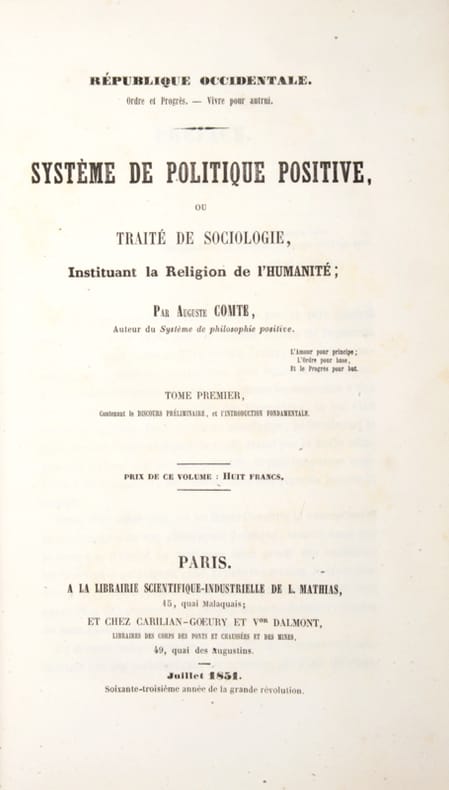
185142131Paris, à la Librairie scientifique-insustrielle de L. Mathias, 1851-1854. 5 tomes en 4 vol. in-8 de (4)-XXIV-XL-748 pp. 1 tableau dépliant ; XXXV-472-(1) pp. ; XLIX-624-(1) pp. ; XXXVIII-(2)-556-(10) pp. 1 feuillet blanc, 2 tableaux dépliants ; (4)-IV-229-(2) pp., maroquin janséniste rouge, dos à nerfs, filets sur les coupes, large dentelle intérieure, tranches dorées sur marbrure (Masson-Debonnelle).
1963013800Paris Jean-Janques Pauvert 1963 In-4 Cartonnage illustré éditeur Edition originale Dédicacé par l'illustrateur
15294012[Paris], Gilles de Gourmont, 1529. 36 nn. Bll. (linksläufig kollationiert). Mit breiter figuraler Titelbordüre in Holzschnitt sowie einer figuralen Initiale und einer großen Holzschnittvignette am letzten Bl. verso. Mod. Pergamentband. 4to.
157927985Paris, Michel Sonnius, 1575-1579. 8 Bde. in 3 und Appendixband. Zus. 9 Bde. in 4. Mit 4 wdh. Druckermarken. Blindgepr. Schweinslederbände der Zeit auf 5 Bünden über Holzdeckeln. Folio (250:370 mm).
In-16 (113 x 71 mm), plein veau grège retourné, dos gothique à 3 nerfs, plats ornés d'un jeu de filets gras d'encadrement estampés à froid (reliure postérieure dans le goût de l'époque), 82 [i.e. 80] feuillets [sign. A-K8], 5 planches gravées sur bois dont 3 dépliantes et une à volvelle mobile. "Le plus rare et le plus recherché des ouvrages de Raymond Lulle" (Caillet): 'De l'enseignement kabbalistique', ici dans sa troisième édition illustrée de 5 planches, dont trois dépliantes et une avec volvelle, montée avec ses deux parties mobiles conservées (les célèbres "roues kabbalistiques"), ainsi que 2 figures dans le texte. Lettrines et ornements typographiques gravés sur bois. La réputation de Lulle kabbaliste repose tout entière sur cet ouvrage que la recherche moderne a réattribué au médecin et humaniste véronais Pietro Mainardi (1456-1529), docteur de l'université de Ferrare en 1490, grand connaisseur de l'oeuvre de Lulle. Son nom figure d'ailleurs dans l'explicit de la première édition de l'ouvrage (Venise, 1518) pour disparaître des éditions suivantes et être remplacé par celui de Lulle. L'auteur eut l'ambition, par ce traité, d’accomplir l'idéal de Pic de la Mirandole: harmoniser l'art Lullien avec celui de la Kabbale. C'est encore en tant qu'oeuvre de Raymond Lulle que le livre a été lu et commenté par Giordano Bruno qui le rendit célèbre, pour être ensuite repris au sein des anthologies de Lulle éditées par Lazare Zetzner. Le succès et l'influence de ce traité ne se démentirent pas aux XVIe et XVIIe siècles, au long d'une réception qui s’étend de Giordano Bruno, Claude Duret, Athanasius Kircher jusqu'à Leibniz (cf. Eva Broner, 'Doctor Illuminatus: A Ramon Llull Reader', Princeton U. Press, 1993). Le livre est considéré par les catalogues de Stanislas de Guaïta (qui ne possédait qu'une édition de 1601) et par celui de Caillet, comme "le plus rare et le plus recherché des ouvrages de Raymond Lulle". (Caillet, 6846. Duveen, 'Alchimie', 370. Guaïta, n°530 et 1565. Palau, 143.864. Renouard, n° 376 pour la marque au titre. Rogent & Duràn, 'Bibliografía de les impressions Lullianes', Barcelona, 1927, n°120). Quelques piqûres d’humidité éparses. Cachet en pied du titre: "A.L.L.R". Très bon exemplaire, bien relié, bien conservé.
21128A Geneve, et se trouve à Paris, Chez P. Fr. Didot le Jeune, Librairie-Imprimeur de Monsieur, 1779. (2), vi, 85, (1) pp. 8vo. Contemporary marbled calf, spine elaborately gilt in compartments (corners lightly bumped). Printing and the Mind of Man, 225; En Français dans le Texte, 171; Garrison-Morton 4992.1; Grolier 100 'Medicine', 47; Norman M4. The very rare first edition. Discussing and describing one of the best-remembered 'alternative' medicines of all time. Mesmer maintained 'that a magnetic fluid pervades the universe, exists in every living being, and affects the nervous system. Experimenting with the use of his "magnetism" he found that there was a healing magnetic power in his own hands and that he could obtain results in treating nervous disorders without a magnet, a faculty which he called ''animal magnetism''' (PMM). Whilst 'Mesmerism' in its own right was discredited, Mesmer's theories laid the foundation for hypnosis and suggestion theories. Indeed Mesmer himself induced sleep, known as 'Mesmeric sleep' which term was used before James Braid coined the term 'hypnosis'. 'Since his time the investigation of how to release subconscious states through auto- and hetero-suggestion has continued, and the whole field of extra-sensory perception and spiritualism has affinity with mesmerism [as does] the development of psychoanalysis' (PMM).Mesmer lived for some time in a comfortable town house in Vienna before he moved to Paris, where he had enough time and money to indulge his passion for music. He was well befriended with the Mozarts and Mozart's first opera, Bastien und Bastienne took place in Mesmer's garden, and Mozart later made room for mesmerism in a scene in Cosi fan tutte.But there is another side to this book as well, a political side. 'The crashing failure of the Social Contract, Rousseau's least popular book before the Revolution, raises a problem for scholars searching for the radical spirit in the 1780's: if the greatest political treatise of the age failed to interest many literate Frenchmen, what form of radical ideas did suit their tastes? One such form appeared in the unlikely guise of animal magnetism or mesmerism. Mesmerism aroused enormous interest during the pre-revolutionary decade; and although it had originally no relevance whatsoever to politics, it became, in the hands of radical mesmerists like Nicolas Bergasse and Jacques-Pierre Brissot, a camouflaged political theory very much like Rousseau's' (R. Darnton, Mesmerism and the End of the Enlightenment in France, Boston, 1968). - Some light marginal browning.
167533486Rom, Sac. Congreg. de Propaganda Fide, 1675. 248 SS. Mit Druckermarke am Titel verso. Pergamentband des 18. Jhs. 8vo.
8vo. 248 pp. With printer's device on reverse of title page. 18th-century vellum. First Armenian edition of this devotional work, translated into Armenian in 1671 by the grammarian John of Constantinople (1635-91). - Insignificant browning; old shelfmarks to title and half-title (some ink bleeding). Of the utmost rarity. Nersessian 44. Kevorkian 177. Hakob Meghapart 94. OCLC 490245621 (only two copies, both in France).
57359[Straßburg, Johann Grüninger, 1487]. Fol. 1 nn., 88 num., 6 nn. Bll., 1 w. Bl. (Got. Typ., 2 Kol., Rubriziert), Mod. HPgmt. m. durchzogenen Bünden, goldgepr. Rückenschild u. dreiseitigem Rotschnitt.
1750384721750 In-8 (188 x 113 mm), plein veau fauve de l'époque, dos à 5 nerfs richement ornés de caissons fleuronnés et cloisonnés, jeux de filets et palettes dorés en pied, pièce de titre de maroquin bordeaux, filet à froid en encadrement des plats, roulette dorée sur les coiffes et les coupes, tranches rouges, (1) f. de titre, (3) p. de préface, 66 p., planche frontispice gravée. Genève, Barillot & fils, s.d. [i.e. Paris, Pissot, 1750].
156730252Wittenberg, Johann Schwertel, 1567. (8), 206 [recte: 208], (28) Bll. (a8, A-Z8, Aa-Ff8, Gg4). Titel sowie das "Calendarium generale" am Schluß in rot und schwarz gedruckt. Mit 3 astronomischen Holzschnittdiagrammen im Text. Halblederband um 1700. Dreiseitiger Rotschnitt. 8vo.
in-4, ff. (70, ff. 39 e 40 bianchi, segn. a-h8, i6), legatura moderna in pelle con impresssioni geometriche a secco, dorso a nervi. Ancora aldina sul titolo ed in fine, finissimo car. corsivo. Rara edizione originale, dedicata dall'a. a Nicola von Schonberg arcivescovo di Capua, di questo dialogo che si immagina avvenuto nel 1512 tra Giulio de' Medici, futuro Leone X, allora legato pontificio (da cui il titolo dell'opera), e Lorenzino de'Medici. L'Alcionio (1487-1527), professore di geco a Firenze, celebre traduttore di Aristotele, venne accusato dai contemporanei di aver tratto la sua opera dal ''De Gloria'' di Cicerone e di aver poi distrutto l'originale per evitare l'accusa di plagio. L'a. in calce riporta la notizia della traduzione da parte di Ermolao Barbaro dei testi aristotelici ''De Anima'' e ''De physica auscultatione'', per altro mai rinvenuta. Ottimo esemplare, ad ampi margini (al verso dell'ultimo f. antico timbro di collezione privata, tracce di polvere al titolo, lieve alone al margine esterno dei primi e ultimi ff.).. Renouard 95.6: "Volume fort rare". UCLA I, 187. Adams A-633. BMC 16.Censimento 16 CNC 859.
- Barillot, & fils [Durand], à Genève [Paris] s.d. (1749), in-4 (19x25cm), (8) XXIV, 522pp. (1) et (4) XVI, 564pp., 2 volumes reliés (18,8x25,1cm). - Second edition in order of publications. Parisian counterfeit published in January 1749 (it would have been printed by Prault); the original, extraordinarily rare, dates from October 1748. This counterfeit is distinguished by a few points: it reproduces the same pagination errors in the preface as in the first edition. The address only has one R in Barillot. There must be a errata sheet at the end of volume I, a detail which attests to the first issue of this second edition. Although rare, this counterfeit is much easier to find that the earlier 1748 edition, which was mainly sold in England. Contemporary binding in full brown sheep, spine in five compartments decorated with gilt panels and fleurons, title pieces in red morocco, triple blind tool frame on the boards, gilt roll tooling on the spine-ends, all edges red. Three caps and several corners skillfully restored. Emblematic and flagship book of the 18th century, @L'Esprit des lois# (The Spirit of the Laws), namely the principles and trends by which bills become law, will have a decisive influence on political life, and will be a guide for the writing of the 1791 constitution and that of the United States. Handwritten ex-libris: Madame de Dumesnil. [FRENCH VERSION FOLLOWS] Seconde édition dans l'ordre des publications. Contrefaçon parisienne parue en janvier 1749 (elle aurait été imprimée par Prault), L'originale, d'une rareté insigne, datant, elle, d'octobre 1748. Cette contrefaçon se distingue par quelques points : elle reproduit les mêmes erreurs de paginations dans la préface que dans l'édition originale. L'adresse ne comporte qu'un R à Barillot. Il doit se trouver un feuillet d'errata en fin du tome I, détail qui atteste de la première émission de cette seconde édition. Bien que rare, cette contrefaçon se trouve bien plus aisément que l'édition princeps de 1748 qui fut essentiellement vendue en Angleterre. Reliures de l'époque en pleine basane brune, dos à cinq nerfs ornés de caissons et fleurons dorés, pièces de titre de maroquin rouge, triples filets à froid en encadrement des plats, roulettes dorées sur les coupes, toutes tranches rouges. Trois coiffes et plusieurs coins habilement restaurés. Livre emblématique et phare du XVIIIème siècle, L'Esprit des lois, c'est-à-dire les principes et les tendances par lesquels se font les lois, aura une influence déterminante sur la vie politique, et sera un guide pour la rédaction de la constitution de 1791 et de celle des États-Unis. Ex-libris manuscrit : Madame de Dumesnil.
Paris, Chez Durand, 1758. 4to. Very nice cont. full mottled calf w. five raised bands on richly gilt back. All edges of boards gilt. Top-layer of leather on back-board gone. Upper hinges a bit weak, top-capital worn. Internally very nice and clean. W. the large armorial bookplate of Lord Viscount Lymington. W. half-title. Large woodcut title-vignette and many smaller vignettes throughout. (4), XII, 643, (1, Approbation + Privilege) pp.
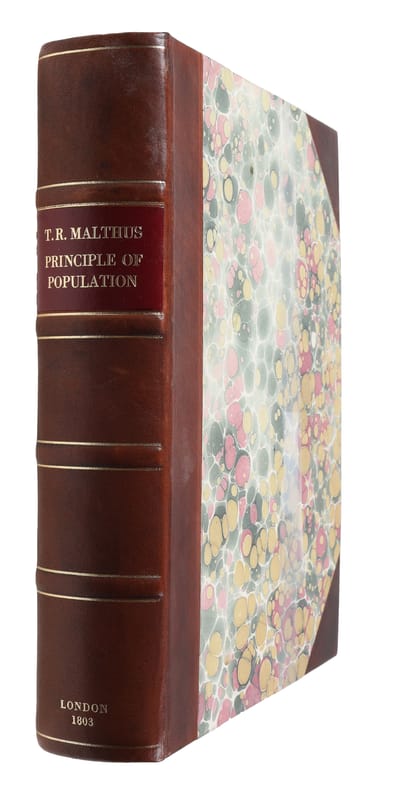
180362792London, Printed for J. Johnson, by T. Bensley, 1803. Large 4to. Later brown hcalf with four raised bands, single gilt lines and red leather title-label to spine. First three and last 14 leaves a bit brownspotted, title-page and last two leaves marginally repaired at hinge, otherwise a very nice, clean, and solid copy. VIII, (4), 610 pp.
Amsterdam et Leipzig, Chez Jean Schreuder, 1765. 4to. Uncut in the original marbled boards. Professionally rebacked preserving almost all of the original back. The fragile orginal binding is here preserved in its entirety, and it has quite a bit of overall wear. Apart from a small hole to two leaves in the index, affecting ab. one work on each of the four pages, it is internally nice and clean. Title-page printed in red and black. Beautiful eng. title-vignette and a few other woodcut vignettes and initials. (4), XVI, (2), 540, (18) pp.
Berlin, 1821. 8vo. A beautiful and excellently made pastiche binding in brown half calf with richly gilt spine and red gilt leather title-label. Previous owner's name to title-page (dated 1909) and a few light pencil-marginalia, otherwise internally very nice and clean with only occasional minor brownspotting. XXVI, 355, (1) pp. A very fine copy.
20112110502151003577Risosha/Waseda University Publishing Department/The Philosophy of Science Society of Japan 2011. Soft Cover. Fine. Number of books: 58 Risosha/Waseda University Publishing Department/The Philosophy of Science Society of Japan paperback
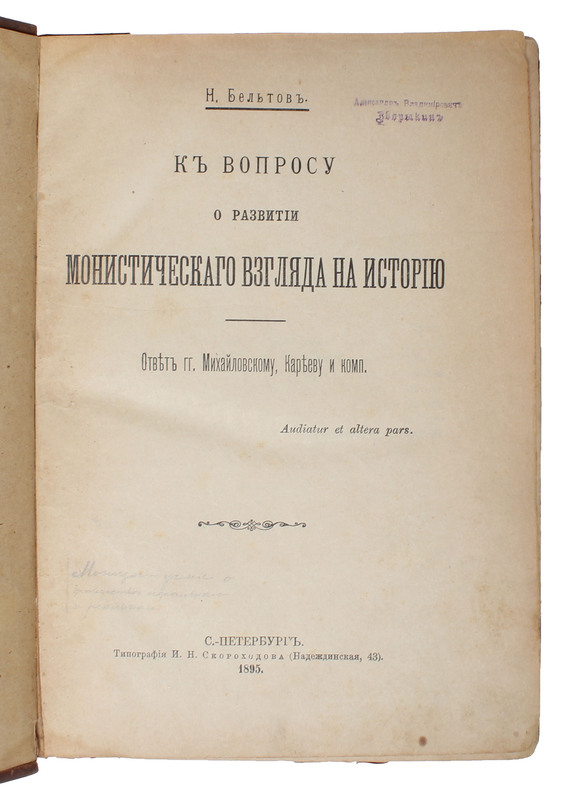
189553227St. Petersburg, 1895. 8vo. In contemporary half calf with (vague) title to spine. Extremities with wear. Small stamp to top of right corner of title-page, otherwise internally fine. (4), 287, (1) pp.
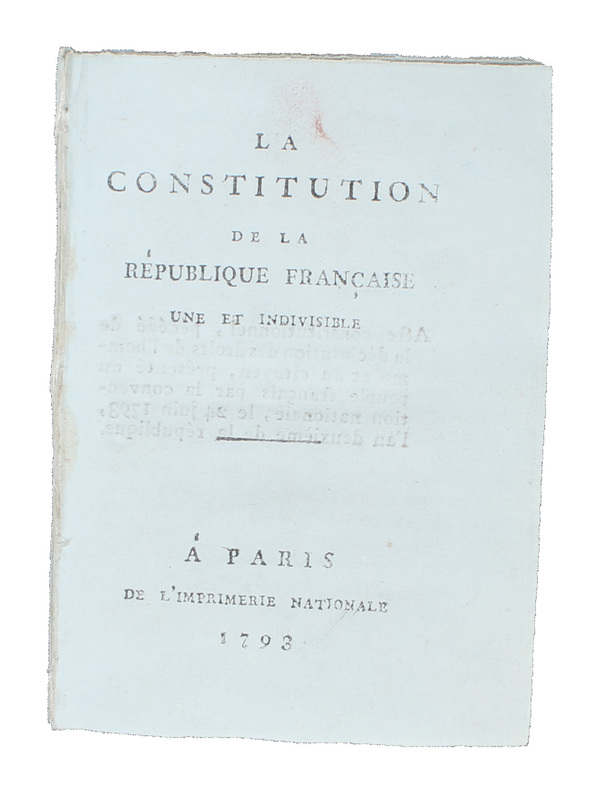
179352181Paris, l'imprimerie Nationale, 1793. 12mo. Uncut and unbound with original stitching. Printed on blue paper. A fine, clean, and fresh copy. 39 pp.
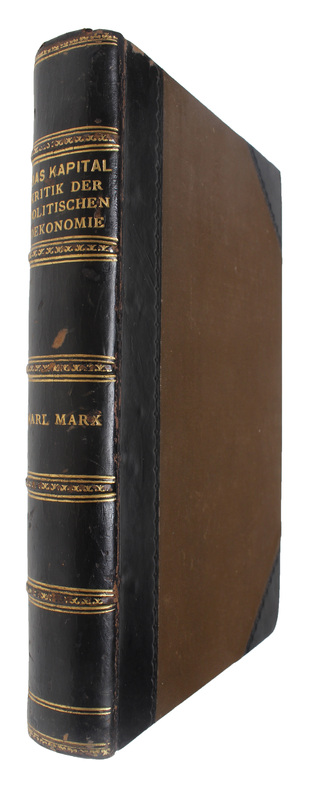
190163275Halle, Niemeyer, 1900-1901. Royal8vo. Uniformly bound in two contemporary half calf bindings with lettering to spines. Spines and corners with some wear and scratches. Lower compartments with traces from old labels. Previous owner's name ""K. Dammann / 1915"" to front free end-paper. Two small library stamps to front free end-paper and title-pages and accompanying deaccession stamps. Small tear to title-page in vol. 1, not affecting text. Otherwise a fine and clean copy. XII, 257, (1, -errata) pp."" XVI, 718 pp.
188557044Hamburg: Otto Meissner, 1885. 8vo. Very nice contemporary black half calf with gilt spine. A bit of wear to extremitoes. Inner front hinge a little weak. Title-page a littel dusty, but otherwise very nice and clean. Book-plate (Arnold Heertje) to inside of front board. XXVII, (1), 526 pp. + 1 f. With pp. 515-16 in the first state (""Consumtionsfonds"" with a C) and with the imprint-leaf at the end.
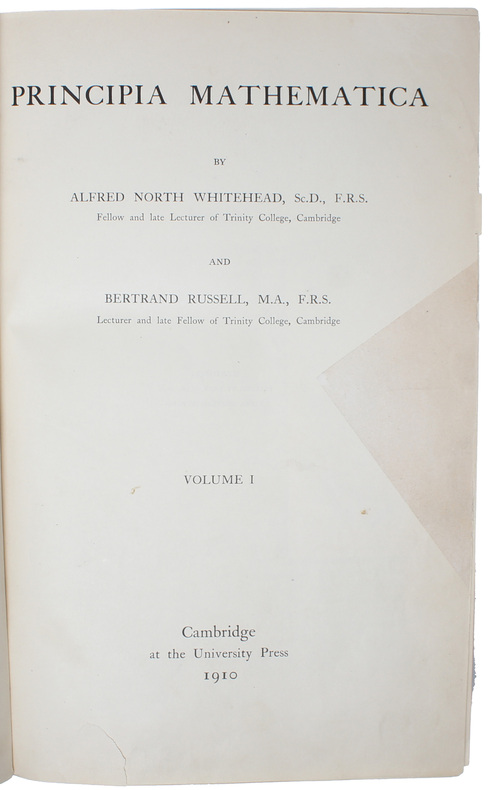
191055204Cambridge, 1910. Royal 8vo. In a recent half calf with four raised bands and green leather title-label with gilt lettering to spine. Repair to half title, not affecting text. Title-page with repair to outer margin, not affecting text. Previous-owner's name on whilte paper label pasted on to verso of title-page, not affecting text. Errata-leaf with repairs to lower margin. Otherwise, fine and clean. XIII, (3), 666 pp.
159959831Hannover, 1599. Small 8vo. Contemporary full vellum. Binding with some wear, especially to extremities. Lower spine restored. Evenly browned throughout. 210 pp.
St. Petersburg, 1895. 8vo. In contemporary half calf with (vague) title to spine. Extremities with wear. Small stamp to top of right corner of title-page, otherwise internally fine. (4), 287, (1) pp.