Schopenhauer, ABiblio.com

2 202 résultats
1995DADAX0631145524Wiley-Blackwell 1995-12-04. 2nd. paperback. New. 5.52x0.41x8.45. Buy with confidence. Excellent Customer Service & Return policy. Wiley-Blackwell paperback
48349Paris, LE LIVRE DE POCHE, 1999, in-12 broché, 220 pp. TRES BON ETAT
1999R100058085Le livre de poche / Librairie générale française. 1999. In-12. Broché. Bon état, Couv. convenable, Dos satisfaisant, Papier jauni. 220 pages.. . . . Classification Dewey : 110-Métaphysique
193046545La España Moderna 1930. hardcover. Bueno. Ed. La España Moderna. Madrid s/f Aprox 1930. Cartone lomo tela. 21x14. 268 pp. Traducción directa de la 7ª edición alemana por Edmundo González- Blanco. La España Moderna hardcover
Book is in excellent condition with red cloth HB covers and gilt print at spine. Binding is solid and square, covers have sharp corners, exterior shows no blemishes, text/interior is clean and free of marking of any kind with age-toned paper. Previous owner's name or sticker in front section of the book. 349 pages, contents include: Moral principle in nature, Moral conceptions of primitive peoples (dual nature of moral requirements among the savage tribes, Development of moral teachings -- ancient Greece, The renaissance, Moral teachings in the modern era, Cudworth, Cumberland, Spinoza, Locke, Clarke, Voltaire, Rousseau, Turgot , Condorcet, Hume, Adam Smith, Kant, Fichte, Schelling, hegel, Schleiermacher, Bentham, Stuart, Schopenhauer, Victor Cousin, Jouffroy, etc.
1993PHHHILO0215Paris, Fayard, "Corpus des oeuvres de philosophie en langue française", 1993, 14 x 22,5, 248 pages sous cartonnage éditeur imprimé. Suivi de : Un bouddhiste contemporain en Allemagne : Arthur Scopenhauer.
1961035775Madrid Spain: Biblioteca de Bolsillo 1961. Soft cover. Very Good. 16mo. Shipped from the Calico Cat Bookshop a brick and mortar bookshop established in 1975. <br/> <br/> Biblioteca de Bolsillo paperback
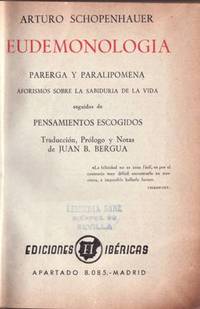
MN29595MEdiciones Ibéricas 1961 Madrid. 16x11. Tapa dura. 512 pgs. Canto amarillento. Forrado por el anterior poseedor. Portada impresa a dos tintas. Sello en portada. 689099 Ediciones Ibéricas, 1961, Madrid. unknown
1989F108753Tübingen, 1989 [4] + 189pp., 21cm., softcover, text in German, Doctoral dissertation (Inaugural-Dissertation zur Erlangung des Grades eines Doktors der Philosophie der philosophischen Fakultät der Eberhard-Karls-Universität Tübingen), stamp at verso of title page, text is clean and bright, good condition, F108753
[4] + 189pp., 21cm., softcover, text in German, Doctoral dissertation (Inaugural-Dissertation zur Erlangung des Grades eines Doktors der Philosophie der philosophischen Fakultät der Eberhard-Karls-Universität Tübingen), stamp at verso of title page, text is clean and bright, good condition, F108753
19952092902137703783Shiromizu-sha 1995. Soft Cover. Fine. The book is in fine condition. Shiromizu-sha paperback
19952091502135414464Shiromizu-sha 1995. Soft Cover. Fine. Number of books: 1 Shiromizu-sha paperback
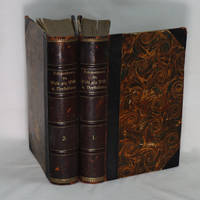
1891FB5707(1&2) /8<p>Brown calf spine with gilt banding and title. Brown marbled boards. dimensions are for one volume.</p><ul><li><strong>We provide an in-depth photographic presentation of this item to stimulate your feeling and touch. More traditional book descriptions are immediately available.</strong></li></ul><p>2 quality volumes of this prestigious work. Binding and contents are in good order.</p><p><strong><em>The World as Will and Representation</em></strong> <strong><em>WWR</em></strong>; <em>Die Welt als Wille und Vorstellung</em> <strong><em>WWV</em></strong> sometimes translated as <strong><em>The World as Will and Idea</em></strong> is the central work of the German philosopher Arthur Schopenhauer. The first edition was published in late 1818 with the date 1819 on the title page. A second two-volume edition appeared in 1844: volume one was an edited version of the 1818 edition while volume two consisted of commentary on the ideas expounded in volume one. A third expanded edition was published in 1859 the year before Schopenhauer's death. In 1948 an abridged version was edited by Thomas Mann. In the summer of 1813 Schopenhauer submitted his doctoral dissertation—<em>On the Fourfold Root of the Principle of Sufficient Reason</em>—and was awarded a doctorate from the University of Jena. After spending the following winter in Weimar he lived in Dresden and published his treatise <em>On Vision and Colours</em> in 1816. Schopenhauer spent the next several years working on his chief work <em>The World as Will and Representation</em>. Schopenhauer asserted that the work is meant to convey a "single thought" from various perspectives. He develops his philosophy over four books covering epistemology ontology aesthetics and ethics. Following these books is an appendix containing Schopenhauer's detailed <em>Criticism of the Kantian Philosophy</em>. Taking the transcendental idealism of Immanuel Kant as his starting point Schopenhauer argues that the world humans experience around them—the world of objects in space and time and related in causal ways—exists solely as "representation" <em>Vorstellung</em> dependent on a cognizing subject not as a world that can be considered to exist in itself i.e. independently of how it appears to the subject's mind. One's knowledge of objects is thus knowledge of mere phenomena rather than things in themselves. Schopenhauer identifies the thing-in-itself — the inner essence of everything — as <em>will</em>: a blind unconscious aimless striving devoid of knowledge outside of space and time and free of all multiplicity. The world as representation is therefore the "objectification" of the will. Aesthetic experiences release one briefly from one's endless servitude to the will which is the root of suffering. True redemption from life Schopenhauer asserts can only result from the total ascetic negation of the "will to life". Schopenhauer notes fundamental agreements between his philosophy Platonism and the philosophy of the ancient Indian Vedas. <em>The World as Will and Representation</em> marked the pinnacle of Schopenhauer's philosophical thought; he spent the rest of his life refining clarifying and deepening the ideas presented in this work without any fundamental changes. The first edition was met with near-universal silence. The second edition of 1844 similarly failed to attract any interest. At the time post-Kantian German academic philosophy was dominated by the German idealists—foremost among them G. W. F. Hegel whom Schopenhauer bitterly denounced as a "charlatan". <strong>Arthur Schopenhauer</strong> German: 22 February 1788 – 21 September 1860 was a German philosopher. He is known for his 1818 work <em>The World as Will and Representation</em> expanded in 1844 which characterizes the phenomenal world as the manifestation of a blind and irrational noumenal will. Building on the transcendental idealism of Immanuel Kant 1724–1804 Schopenhauer developed an atheistic metaphysical and ethical system that rejected the contemporaneous ideas of German idealism. Schopenhauer was among the first thinkers in Western philosophy to share and affirm significant tenets of Indian philosophy such as asceticism denial of the self and the notion of the world-as-appearance. His work has been described as an exemplary manifestation of philosophical pessimism. Though his work failed to garner substantial attention during his lifetime he had a posthumous impact across various disciplines including philosophy literature and science. His writing on aesthetics morality and psychology have influenced many thinkers and artists. Arthur Schopenhauer's paternal grandfather Andreas Schopenhauer de 1720–1793 was a wealthy merchant in Danzig. Arthur Schopenhauer's paternal grandmother Anna Renata Schopenhauer 1726–1793 was the daughter of a Dutch merchant and the Dutch ambassador to the Hanseatic city of Danzig Hendrik Soermans 1700–1775. Arthur Schopenhauer's maternal grandfather Christian Heinrich Trosiener de 1730–1797 was a merchant in Danzig and a councilor from the middle class. Arthur Schopenhauer's maternal grandmother Elizabeth Trosiener 1745–1818 was daughter of pharmacist Georg Lehmann died 1762 and his wife Susanna Concordia Lehmann née Neumann born 1718. Arthur Schopenhauer's paternal great-grandfather Johann Schopenhauer de 1670–after 1724 was the mentioned merchant in Gdansk. Arthur Schopenhauer's paternal great-grandfather through paternal grandmother Hendrik Soermans de 1700–1775 was a Dutch merchant and Ambassador of the Netherlands in Gdansk. Arthur Schopenhauer's paternal great-great grandfather Johann Schopenhauer 1630–1701 was a farmer in Petershagen and son of Simon Schopenhauer 1580–1660 and grandson of Salomon Schopenhauer born 1550.</p> F H Brohaus. hardcover
194252345BB1942 . 3. mehrfach berichtigte Auflage bearb. v. E. Bergmann. Leipzig: Reclam 1942. 464 S. Titelbild. Leinen Einband stockfleckig; sonst gut erhalten Sämtliche Werke Band 6; zugl. Reclams Universal-Bibliothek 2861/2865 Text in Fraktur. unknown
90686Paris, Stock, 1939. 12 x 19, 237 pp., broché, bon état (couverture défraîchie).
Paris, Librairie Stock, 1928, in-16, br., pp. XXX, (2), 236, (4). (N. 56 di una edizione in 200 esemplari su carta ordinaria, per la stampa). Collezione "Le Cabinet Cosmopolite", n. 25.
MIMESIS 2005, VOLUME ALLO STATO DI NUOVO. L'espressione "marxismo analitico" o "marxismo della scelta razionale" definisce un insieme di autori che cerca un nuovo approccio ai concetti fondamentali del materialismo storico, quali sfruttamento, classe, lotta di classe, agire collettivo, usando gli strumenti e le tecniche della scienza sociale analitica contemporanea. Questa corrente mostra un'esigenza di chiarezza e rigore non comuni nella tradizione marxista. È data grande importanza all'esatto significato dei concetti e al processo di deduzione attraverso il quale si arriva a determinate conclusioni. Gli esponenti più rappresentativi, presi in considerazione in questo lavoro, sono Jon Elster, Gerald A. Cohen e John Roemer.
1970feb08746Stiintifica si Enciclopedica 1970. Used. 1970; Romanian Edition of Filozofie si etica; For more details please contact me Stiintifica si Enciclopedica unknown
br. «Etichettato come inguaribile pessimista, Schopenhauer probabilmente non pensava che sarebbe diventato un maestro, ma è così che dobbiamo considerarlo ancora oggi. Un maestro di vita che non dispensa precetti, ma prospettive, riflessioni, metodi e, in ultima analisi, un esempio di pensiero che ci dà gli strumenti per costruire una nostra, personale idea della vita.» Da molti considerato il maestro del pessimismo, Schopenhauer è in realtà un pensatore articolato, controcorrente e attualissimo. Il suo pensiero, attraversato dalle tradizioni induiste e dal buddhismo, non solo ci aiuta ad andare oltre le apparenze e le vanità del mondo ma ci spinge verso il cambiamento, insegnandoci l'arte di lasciar andare.
8225Paris, Ernest Flammarion ("Les meilleurs auteurs classiques"), sans date ; in-12, broché ; (4), 364 pp. , (1) f.
8573211660.Gpaperback. Good. Access codes and supplements are not guaranteed with used items. May be an ex-library book. paperback
9788560156528WMF MARTINS FONTES LTDA. new. Os dois textos reunidos neste volume ""Esboo de uma hist�ria da doutrina do ideal e do real"" e ""Fragmentos sobre a hist�ria da filosofia"" fazem parte da obra tardia de Schopenhauer Parerga e paralipomena publicada em 1851. Esses textos se inseremna viragem efetuada na obra mxima do fil�sofo que aponta um princ�pio do mundo volitivo e irracional - o que diverge radicalmente da tradio ocidental do pensamento. Ao escrever seus fragmentos de hist�ria da filosofia o autor passa em revista aquelas que considera as mais relevantes filosofias para ao fim olhando o pr�prio sistema apontar o que julga ser sua novidade. WMF MARTINS FONTES LTDA unknown
9788573211665ILUMINURAS. new. O ensaio traduzido deste volume tem um duplo valor - por um lado a viso Schopenhaueriana da hist�ria da filosofia viso de um autor que se coloca como 'artista' que rel os textos e os interpreta com sua fora criativa por outro lado essa mesma viso polmica pessoal e provocadora nos remete constantemente aos textos dos pr�prios fil�sofos pois � esse o caminho que nos leva filosofia assim como � o mundo e no o que dele dizem os outros que � a fonte para sua pr�pria decifrao. ILUMINURAS unknown
LIGUORI 1968 318 PP. FONDO DI MAGAZZINO: LIEVI SEGNI DEL TEMPO ALLA COPERTINA, VOLUME INTONSO, MAI SFOGLIATO
IL MULINO 1968 532 PP. TALLONCINO DI CATALOGAZIONE DI BIBLIOTECA ESTINTA AL CONTROPIATTO ANTERIORE, LIEVI SEGNI DEL TEMPO ALLA COPERTINA (COME DA FOTO) E AI TAGLI, OTTIME CONDIZIONI GENERALI.