Honore de BALZACBiblio.com
15 208 résultats
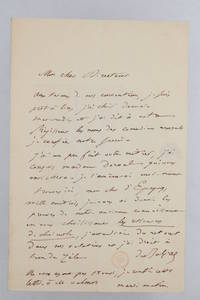
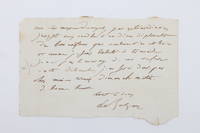
183386496s. l. Neuchâtel 1833. Fine. Eve's first kiss: 'The gods grant no favours untainted.' s. l. Neuchâtel 29 septembre 1833 13.40 x 21.10 cm une page sur un double feuillet Autograph letter signed by Honoré de Balzac addressed to his friend the writer Charles de Bernard. One page written in black ink on a bifolium. On the verso of the second leaf appears the address of the recipient Charles de Bernard du Grail written in Balzacs hand along with postal stamps and the seal bearing the arms of the Balzac dEntraigues family which the author had appropriated. A few minor holes not affecting the text; fold marks as usual from mailing. Published in his correspondence Paris Calmann Lévy 1876 CXIV pp. 252253. Balzac wrote this letter four days after his very first meeting and first kiss with Madame Hanska in Neuchâtel following many months of epistolary correspondence. « Jai été très heureux ici. Je suis très content de ce que jai vu le pays est délicieux ; mais vous savez que Jupiter a deux tonneaux et que les dieux nont point de faveurs qui soient pures. » ""I have been very happy here. I am most pleased with what I have seen; the country is delightful. But you know that Jupiter has two jars and the gods grant no favours that are untainted."" Two years after receiving the first letter from the Stranger Éveline Rzewuska a lovestruck Balzac left Paris to join her in Switzerland. His brief stop in Besançon ostensibly a convenient detour served as a polite pretext for his departure from the capitalwhere he took the opportunity to visit his correspondent Charles de Bernard. « Il me semble que je vous ai bien peu remercié de la bonne journée que vous mavez donnée ; mais jespère vous prouver que je ne suis point un ingrat. À mercredi donc ; vous devez penser que jaurai bien du plaisir à vous revoir vous qui avez fait que mon voyage à Besançon na pas été inutile et que jy ai trouvé du plaisir ». I fear I thanked you all too little for the delightful day you gave me; but I hope to prove that I am not ungrateful. Until Wednesday then you must know how much I look forward to seeing you again you who ensured that my journey to Besançon was not in vain and even brought me joy. After a day in Besançon and a chaotic journey by mail coach Balzac finally met his beloved though regrettably in the company of her husband Count Hanski. Seizing upon the Counts absence the writer stole a long-awaited kiss with Madame Hanska on an ancient stone bench upon the hill of Crêt. In the rapture of their first encounter he could not help but invoke La Fontaines ominous fable in his letter: « mais vous savez que Jupiter a deux tonneaux et que les dieux nont point de faveurs qui soient pures ». but you know that Jupiter has two jars and the gods offer no favours untainted. His love affair with Madame Hanska would prove far from serene as Gonzague Saint Bris aptly summed it up: eighteen years of love sixteen of waiting two of happiness and six months of marriage. Neuchâtel would remain a powerful emblem of their union recurring in some sixty of their letters. Neuchâtel is like the white lily he wrote to her pure with a penetrating fragrance youth freshness brilliance hope happiness glimpsed. De Bernard who had previously arranged his journey to Switzerland was once again tasked with organising Balzacs return: « Jaurai le plaisir de vous revoir mercredi 2 octobre. Voulez-vous avoir lobligeance de me retenir une place à la malle pour Paris ». I shall have the pleasure of seeing you again on Wednesday 2 October. Would you be so kind as to reserve me a place in the mail coach to Paris The journey separating him once again from his beloved proved wretched: The mail coach was fully booked for six days so my friend from Besançon Charles de Bernard was unable to secure me a place. I was thus obliged to travel on the roof of a diligence in the company of five Swiss from the canton of Vaud unknown
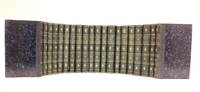
184273008Paris: FurneDubochetHetzel & Paulinpuis Alexandre Houssiaux 1842. Fine. Furne Dubochet Hetzel & Paulin puis Alexandre Houssiaux Paris 1842-1855 14.50 x 22 cm 20 volumes reliés Honoré de BALZAC & Honoré DAUMIER & Charles Constant Albert Nicolas d'Arnoux de Limoges Saint-Saëns dit BERTALL & Paul GAVARNI & Tony JOHANNOT & Célestin NANTEUIL uvres complètes de H. de Balzac Complete Works Furne Dubochet Hetzel Paulin puis Alexandre Houssiaux Paris 1842-1855 14.5 x 22 cm 20 volumes in contemporary half shagreen First collective edition sold as the Works comprising as well as numerous texts published for the first time a new version of the Human Comedy reviewed and revised by Balzac. This is also the first illustrated edition. Contemporary half blue shagreen over marbled paper boards spines slightly sunned in five compartments with thin raised bands decorated with gilt dots and compartments with triple blind-ruled frames gilt fleurons to centre marbled endpapers and pastedowns. A little foxing in some volumes a very small stain to page 119 of volume 4 another to page 321 of volume 8 a tear to half-title of volume 9 a small damp stain to corner of pages 449 and following of volume 10 stain to pp. 173-74 of volume 14 stains to pages 303 to 307 of vol. 16. The full set of 152 hors-texte plates by the best artists of the age including Bertall Daumier Gavarni Johannot Nanteuil as well as illustrations to text. Four rejected plates have been added bringing the number of plates in this copy to 156. There are so many reasons for emphasising the interest of this edition one of the most important in French literature. Having had a turbulent existence and confused and having been several times republished in a great number of copies it is very rare in its first form and in this first version even rarer in a contemporary uniform binding than with a modern binding and the wrappers preserved cf Clouzot. A very good and rare copy in a contemporary uniform binding ca 1855 with all the plates called for by Clouzot and four additional ones. FurneDubochetHetzel & Paulinpuis Alexandre Houssiaux hardcover
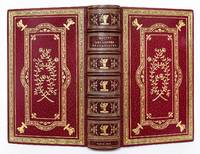
58836Paris: Bureaux de la Société générale de librairie 1855. FIRST EDITION THUS. PRINTED ON PAPIER VÉLIN SATINÉ. 8vo. 20 x 12.5 cm. pp.xxxi16141. Contemporary full crushed red morocco signed by David sides richly tooled in gilt with inlaid green morocco border and flowers four gilt cherubs to corners reflecting "la victime de l'amour" vignette to covers and title-page spine with raised bands and gilt-decorated compartments green morocco doublures stamped with gilt cherubic motifs decorative silk endpapers and additional marbled endpapers all edges gilt some pages uncut with the original wrappers dated 1856 bound in. 425 illustrations by Gustave Doré engraved on wood by Lavieille Rouget Pisan Brévière and Piaud. An extremely fine copy printed on immaculate papier vélin satiné and with particularly fine impressions throughout. First illustrated edition of the Contes drolatiques with 425 illustrations by Gustave Dore praised by Ray "Doré's early masterpiece" Carteret "le chef-d'œuvre d'illustrations de Gustave Doré" and Beraldi who though it the most likely to endure of all Doré's books - "S'il n'en reste qu'un seul ce sera celui-là !" Béraldi. Although the title refers to this edition as the "cinquiesme édition" it is actually the fourth edition of Les contes drolatiques which was first published between 1832-1837. It is well recorded that Balzac's widow granted permission for the illustrated edition only on the condition: "that no artist but Doré should be allowed to illustrate her husband's works" Anthony North-Peat Gossip from Paris 1864-69 p. 324. According to Carteret there were probably 25 copies printed on chine of which he lists 7 copies to have appeared in commerce. It is likely that copies printed on vélin are equally rare with Carteret again citing just 7 copies. Carteret III pp. 48-53; Bulletin de la Librairie Morgand et Fatout II 6445; Berny Livres anciens romantiques et modernes III 92; Rahir VI 1875; Ray 244. Paris: Bureaux de la Société générale de librairie, 1855. hardcover
194994179P., Maxime Cottet-Dumoulin 1949 In-4 en feuilles couverture imprimee. Emboitage et chemise de l’editeur a l’imitation de la peau de serpent. Bel exemplaire.
183077791Tours 23 juin [1830] | 13.20 x 19.90 cm | une feuille
183386496s. l. [Neuchâtel] [29 septembre 1833] | 13.40 x 21.10 cm | une page sur un double feuillet
184273008Furne Dubochet Hetzel & Paulin puis Alexandre Houssiaux | Paris 1842-1855 | 14.50 x 22 cm | 20 volumes reliés
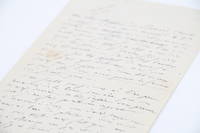
184183639s. l. Passy Paris 1841. Fine. s. l. Passy Paris « mardi matin » 28 décembre 1841 13.50 x 21.60 cm une page sur un double feuillet enveloppe jointe Autograph letter signed by Honoré de Balzac to Jean-Baptiste Violet d'Epagny director of the Odéon theater. One page in black ink on a double sheet. Enclosed and pasted on the second page is the envelope of this letter written in Balzac's hand.""My dear director under the terms of our agreements I am ready to read I have chosen tomorrow Wednesday and I have told your stage manager the names of the actors to whom I entrust our play. I've done a bit of your job I've conquered Madame Dorval who will make you rich I'll bring her myself. Find here my dear d'Épagny a thousand regards I have given you proof of our old acquaintance by choosing you for Les Ressources de Quinola I shall expect a return in our relations and I am entitled to a great deal of zeal."" Les Ressources de Quinola is both in the spirit Les Fourberies de Scapin and Les Noces de Figaro. From the 1840s until his death Balzac's ambition was to achieve a reputation comparable to his illustrious predecessors Molière and Beaumarchais. Although this proved to be a hope as vain as it was determined Balzac never doubted failure after failure that his success was imminent. On July 15 1841 d'Épagny was appointed director of the Odéon . as any theater director would have done in his place he spent summer vacations organizing his winter programme. He asked Balzac for a play and Balzac complied choosing Les Ressources de Quinola. . We all know what a fuss was made about Balzac's play and how childishly naive the author was in filling the room with the highest Parisian society and foreign elite in order to make snobs want to join such a brilliant assembly. . Madame Dorval more astute than the author refused the role intended for her as soon as Balzac read . She did well for one never saw a more complete failure"" L'Amateur d'autographes mai 1911 Interesting letter revealing the beginnings of the creation of Les Ressources de Quinola and the author's habit of reading his play for the actors who then voted to accept or reject it. Provenance: Arthur Meyer collection then ""AGR"" stamp on letter and envelope. unknown
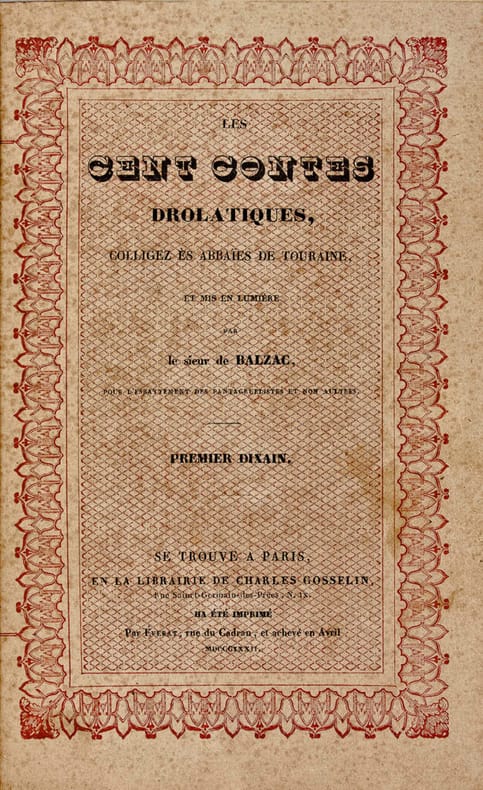
LCS-1864056Très rare réunion des trois dixains en éditions originales, l’incendie de décembre 1835 ayant détruit une grande partie du stock. Paris, Gosselin puis Werdet, 1832-1833-1837. 3 volumes in-8 de: I/ 396 pp., (2) ff. d’errata et table ; II/ 416 pp.; III/ 369 pp., (1) p. bl., (3) ff. de notes, table et errata. Plein maroquin chocolat, encadrement de six filets dorés autour des plats, dos à nerfs ornés de caissons aux cinq filets dorés, encadrement intérieur de 6 filets or, double filet doré sur les coupes, tranches dorées sur marbrures, couvertures imprimées conservées hormis le 2nd plat du tome III. Reliure signée Chambolle-Duru. 207 x 130 mm.
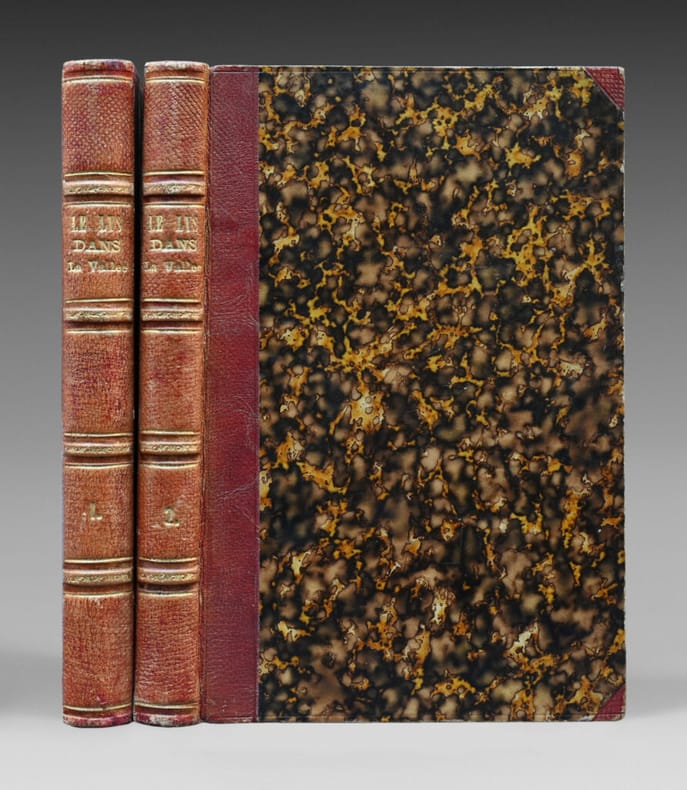
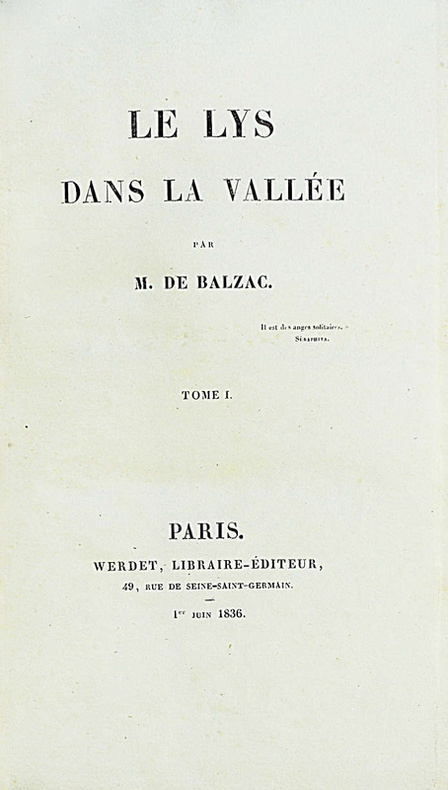
LCS-18577Précieux exemplaire d’une grande pureté conservé dans sa reliure de l’époque. Paris, Werdet, 1er juin 1836. 2 tomes reliés en 2 volumes in-8 de: I/ (2) ff., 4 pp. pour la Chronique de Paris, lv pp., 325 pp., (1) f. de table ; II/ (2) ff., 344 pp. y compris la table. Demi-chagrin vieux rouge à coins, dos à nerfs ornés de filets dorés, tranches jaspées. Dos très légèrement plus clairs. Etui. Reliure de l’époque. 194 x 126 mm.
183659886Paris: Werdet 1836. Fine. Werdet Paris 1836 12 x 19.50 cm 2 volumes reliés Rare and highly sought-after first edition . of which only a portion of the copies contains a preface cf. Clouzot. The important account of the lawsuit concerning The Lily of the Valley that precedes the novel was not retained in subsequent editions and is often lacking in a number of the copies published by Werdet. Copy complete with both the preface and the account of the lawsuit that opposed Balzac to the publisher François Buloz. Contemporary half green sheepskin bindings smooth spines decorated with gilt romantic typographical motifs gilt fillets at heads and tails marbled paper boards paste paper endpapers and pastedowns marbled edges contemporary romantic bindings. Some minor foxing bookseller's descriptive label pasted at head of front pastedown of the first volume. Exceptional copy in an elegant contemporary binding. Werdet hardcover
LCS-17346Rare édition originale dans sa reliure d'origine du seul grand roman d’amour de Balzac. Paris, Werdet, 1er juin 1836.2 tomes en 2 volumes in-8 de : I/ (2) ff., lv pp., 325 pp., (1) f. de table ; II/ (2) ff., 344 pp. y compris la table. Demi-toile bleue à coins, dos à lisses, pièces de tire de maroquin bordeaux, coiffes légèrement frottées, couvertures jaunes imprimées conservées, non rognés. Reliure de la fin du XIXe siècle.223 x 136 mm.
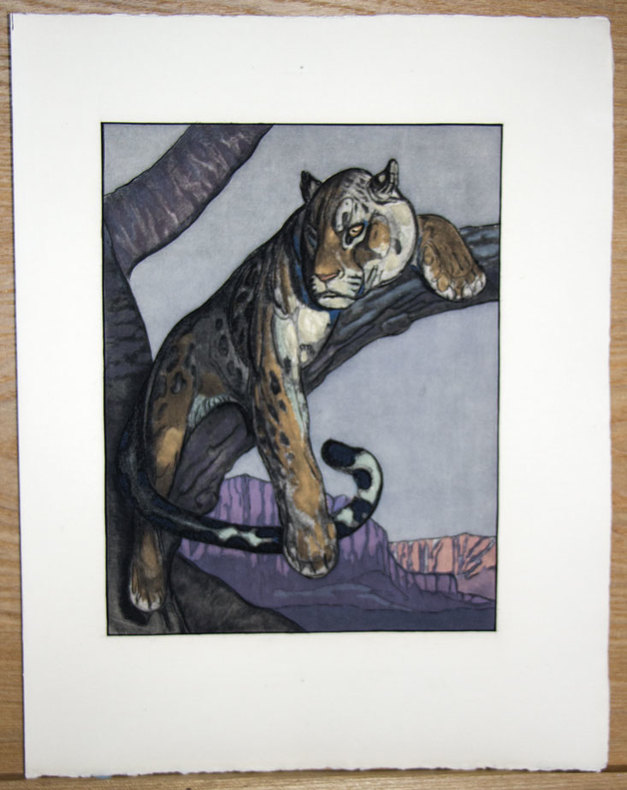
194969965Sous étui-chemise de l'éditeur à l'imitation d'une peau de serpent. Sous couverture beige rempliée.Splendide ouvrage orné de 67 eaux-fortes, dont 13 hors-texte aquarelles (dont 3 à double page), de Paul JOUVE, gravées par R. Haasen.
1835177783Paris: Librairie de Werdet 1835. A vast monument of Western prose fiction" Kanes First edition in book form first issue without the subsequently added preface this copy with the scarce original yellow wrappers bound in. Balzac's masterpiece and keystone of the Comedie Humaine not only provided his first systematic use of recurring characters but also a model which "determined the form and content of the European novel for the next century" Kanes p. 10. Le Père Goriot was published in four instalments in the Revue de Paris between 14 December 1834 and 11 February 1835. A sophisticated and pessimistic study of bourgeois society after the French revolution it was an immediate success and caused an upheaval in the press. It was reviewed by all major Parisian magazines both positively and negatively: the Journal de Femmes praised Balzac's analysis of female psychology while others questioned the morality of the story and accused him of plagiarising the theme of King Lear. Balzac responded to some of these comments in a preface which was separately printed and inserted in the second issue published on 8 March. A second edition appeared in May. Balzac proudly stated: "Le Père Goriot is a raging success; my fiercest enemies have had to bend the knee. I have triumphed over everything over friends as well as the envious" quoted in Kanes p. 12. The story was quickly adapted for stage appearing at the Théâtre des Variétés and Théâtre du Vaudeville in April 1835. As a testament to the novel's influence Zola remarked 35 years later that "how not to be Balzac" was one of his major problems. The well-known line that Varturin tells Eugene "In that case I will make you an offer that no one would decline" was famously reworked by Puzo in The Godfather. 2 vols octavo 210 x 128 mm. Bound with half-titles and table of contents at end as issued. Late 19th-century quarter calf red and blue spine labels compartments ruled in gilt marbled sides and endpapers top edges gilt fore and bottom edges untrimmed green silk bookmarkers original yellow front wrappers and vol. I rear wrapper bound in and with paper restoration at edges. Spines lightly toned mild rubbing sporadic foxing. A good set. Vicaire I 199-200. Martin Kanes Père Goriot: Anatomy of a Troubled World 1993. unknown
184183639s. l. [Passy] « mardi matin » [28 décembre 1841] | 13.50 x 21.60 cm | une page sur un double feuillet, enveloppe jointe
18421697391842. GRANDVILLE J.J. Scènes de la vie privée et publique des animaux. Two volumes. 8 386 6; 4 390 6 pp. with 201 engraved plates and 120 vignettes illustrating the text. Large 8vo 261 x 180 mm. uniformly bound in contemporary black half morocco. Paris: Hetzel et Paulin: 1842-1844. A splendid copy of a Grandville masterpiece accompanied by two original watercolours by Grandville and a long autograph letter from the publisher Hetzel. A fantastic example of anthropomorphic illustration and an important precursor of surrealism. These illustrations represent some of Grandville's most memorable creations. Many of the plates are of single figures but there are also satirical scenes of everyday life monsters animals looking at politicians caged at the zoo etc. The texts contained herein were written by such notable authors as Balzac Charles Nodier George Sand Louis Viardot and even J. Hetzel the publisher under the pseudonym of P.J. Stahl. Hetzel was the motivating force behind this work which he undertook in order to "give words to Grandville's marvellous animals and to join our pen with his pencil thereby coming to his assistance in criticizing the aberrations of our epoch and by preference among these aberrations those which are of every period and every country." Gordon N. Ray writes: "Through Grandville's animals Hetzel and his colleagues offered a witty and telling commentary on contemporary politics and personalities." Some slight edge wear one of the drawings with spotting else fine. PROVENANCE: Jacques Crepineau with his bookplate. Ray 194. Carteret III 552-59. Rebeyrat Catalogue bibliographique et bibliophilique in: J.J. Grandville 1985 pp. 289-90. unknown
04605Paris: H. Delloye & Victor Lecou Éditeurs 1838. An Incredible Early Twentieth Century 'Portrait' Binding by René Kieffer<br/>Specially Bound for Gérard de Berny in Memory of his Father Gabriel de Berny<br/>First Illustrated Edition with an additional set of Proof Illustrations on 'Large Thick Paper'<br/><br/>BALZAC Honoré de. KIEFFER René binder. La Peau de Chagrin. Études Sociales. Paris: H. Delloye & Victor Lecou Éditeurs 1838. <br/><br/>First Illustrated Edition First Printing of the Vignette Illustrations. <br/><br/>Specially bound by René Kieffer for Gérard de Berny in memory of his Parents.<br/><br/>'Thick Paper' copy with an additional 'proof' set of the illustrations.<br/><br/>Large octavo 11 1/16 x 7 1/2 inches; 281 x 191 mm. iv 402 1 Table des Matières 1 blank. One hundred and one decorative engraved vignettes in the text by Baron Janet-Lange Gavarni French and Marckl plus one on the title engraved on steel by Brunellière Nargeot Langlois etc. Additional engraved portrait on India paper of "Pauline" after Janet-Lange engraved by Félicie Fournier née Monsaldy as appearing on pp. 149. Some foxing throughout mainly marginal otherwise fine.<br/><br/>An incredible early twentieth-century 'Portrait' binding by René Kieffer stamp-signed in gilt on front turn-in and with his printed label on verso of front endpaper. Full brown morocco covers triple-bordered in gilt enclosing a highly elaborate symmetrical gilt diamond design with gilt stars. The front cover inlaid with a large oval nineteenth century 'medallion' portrait in oil of Honoré de Balzac and four smaller circular nineteenth century 'medallion' oil paintings titled "Enfance" childhood "Etude" study "Amour" love and "Plaisir" pleasure. The rear cover similarly inlaid with a large oval nineteenth century 'medallion' portrait in oil of Madame Louise Antoinette Laure de Berny Balzac's first love "La Dilecta" and four smaller circular nineteenth century 'medallion' oil paintings titled "Ambition" Misère misery "Desespoir" despair and "Suicide". Spine with five raised bands similarly decorated and lettered in gilt in compartments. Double-ruled gilt board-edges and multi-gilt ruled turn-ins surrounding an orange morocco liner elaborately decorated in gilt in a symmetrical design olive green watered silk endleaves blue-gray marbled endpapers all edges gilt. Original brown morocco over blue marbled boards chemise housed in the original brown morocco edged blue marbled boards slipcase. Spine of chemise sunned slipcase a little worn at extremities. The binding itself is near fine with just a few fragments missing from the edges of the 'medallions'. Original printed tan wrappers and spine bound in. Small square engraved bookplate of renowned collector Gérard de Berny on front endpaper. <br/><br/>A stunning example reflecting the love affair between Honoré de Balzac and Gérard de Berny's mother Laure de Berny. The nineteenth century 'Medallion' oil paintings are most certainly from the collection of Gabriel de Berny.<br/><br/>Roger Louis Gérard de Berny 1880-1957 was a French politician of the French Third Republic. He was born in Amiens France. He was elected senator for the Somme in January 1936 and was one of those who voted to give full power to Marshal Pétain on 10 July 1940. de Berny did not return to government after the Second World War. He died in his Hôtel on Rue Victor Hugo in Amiens now the Hôtel de Berny Museum. The Musée d'art local et d'histoire régionale or Musée de l'Hôtel de Berny is a local history museum for the region of Picardy. The Hôtel de Berny Museum includes 18th century tapestries and wood carvings such as those from the La Fayette salon in the château de La Grange-Bléneau and those by the Huet brothers Nicolas François and Jean-Baptiste the Younger the three sons of Jean-Baptiste Huet and Adrien Choquet a painter from Abbeville from the Salon du Zodiaque in the Long château as well as Art nouveau and Art déco ceramics by Montières French Revolution-era faïence paintings by Louis Jean François Lagrenée and Isabey a 1612 harpsichord pastels by Choderlos de Laclos and 16th-20th century ironwork and clocks. It also contains objects relating to figures from local and national history such as Gresset Choderlos de Laclos Jules Verne Édouard Branly and Maréchal Leclerc.<br/><br/>Gérard de Berny's father Charles Philippe Gabriel de Berny 1825-1884 was married to Laure de Berny née Louise Antoinette Laure Hinner 1777-1836. "In 1793 aged only fifteen Laure married Gabriel de Berny but their union was unhappy. He was 20 years old quite reserved and cold whereas his young wife was very sensitive warm-hearted and caring. Despite their differences they still managed to have nine children although five died in infancy and only two survived their mother. In 1815 the family bought a house in Villeparisis in northern France where they spent the summers. It was here that Laure first met Honore De Balzac. Laure was 42 at the time and already a grandmother but this didn't stop the young Balzac he was only 22 from falling in love with her. At first she resisted him but Balzac wouldn't give up. He courted her for months and in the end she gave in. The two become lovers. Of course nothing could remain secret for long in a small town. When Balzac's parents learned of it they tried to break off their scandalous relationship but to no avail. Laure wasn't just Balzac's lover. She was his confidante his muse and his benefactress. She gave him the love security and confidence he hadn't received from his parents as a child she supported his literary career she inspired the characters of Madame de Mortsauf in The Lily In The Valley and Pauline in Louis Lambert and helped him out financially when he needed it. She assisted him in his business ventures which always failed and helped him pay his debts. "La Dilecta" as Balzac called her also told him many stories about the ancient regime and of how some of her aristocratic friends and acquaintances managed to escape death during the Revolution while others weren't so lucky. His royalist principles would be strongly confirmed by Laure's influence and it's from her he also acquired his aristocratic longings. Thanks to her help he also managed to meet several influential people and would sometimes make an appearance in high society. Balzac would also talk to her about his relationship with other women such as Madame de Hanska who he would end up marrying a few months before his death. Laure De Berny died on 27th July 1836 at La Bouleaunière her country house at Grez-sur-Loing. Balzac was in Italy at the time but when he returned he visited her grave." historyandotherthoughts.blogspot.com.<br/><br/>René Kieffer 1875-1964 worked for ten years at the famed Chambolle-Duru bindery in Paris specializing in gilding before establishing his own workshop in 1903. He debuted at the 1903 Salon des Artistes Françcais and evolving toward to more modern approach became a disciple of the great Marius-Michel. At the time of this binding's creation he had begun to incorporate a transitional mix of flowers vines and colorful onlays in rather formal compositions their Art Nouveau motifs retained within symmetrical borders that revealed his classical roots. By the end of World War I he had emerged as one of Paris's leading binders his work sought after by collectors his fine workmanship matched by a wide range of progressive designs. <br/><br/>Before La Peau de Chagrin first published in 1831 was completed Balzac created excitement about it by publishing a series of articles and story fragments in several Parisian journals. Although he was five months late in delivering the manuscript he succeeded in generating sufficient interest that the novel sold out instantly upon its publication. A second edition which included a series of twelve other "philosophical tales" was released one month later. Although the novel uses fantastic elements its main focus is a realistic portrayal of the excesses of nineteenth century Parisian bourgeois materialism. Balzac's renowned attention to detail is used to describe a gambling house an antique shop a royal banquet and other locales. He also includes details from his own life as a struggling writer placing the main character in a home similar to the one he occupied at the start of his literary career. The central theme of La Peau de Chagrin is the conflict between desire and longevity. The magic skin represents the owner's life-force which is depleted through every expression of will especially when it is employed for the acquisition of power. Ignoring a caution from the shopkeeper who offers him the skin the protagonist greedily surrounds himself with wealth only to find himself miserable and decrepit at the story's end. La Peau de Chagrin firmly established Balzac as a writer of significance in France. His social circle widened significantly and he was sought eagerly by publishers for future projects. The book served as the catalyst for a series of letters he exchanged with a Polish baroness named Ewelina Ha ska who later became his wife. It also inspired Giselher Klebe's opera Die tödlichen Wünsche.<br/><br/>Carteret Volume III p. 41. Paris: H. Delloye [&] Victor Lecou, Éditeurs, 1838 unknown books
191376592Sous étui bordé. Reliure plein maroquin havane. Grand cuir incisé et teinté enchâssé sur chaque plat signé Charles MEUNIER, représentant sur le premier plat, le portrait de la Belle Impéria et sur le second plat, celui du moine Philippe, les deux placés au centre d'une composition de feuillages, rinceaux et chimères, inspirées sur Moyen-Age. Dos à nerfs avec fleuron mosaïqué au centre. Toutes tranches dorées. Reliure signée et datée par Charles MEUNIER, 1913.Remarquable édition illustrée de 14 gravures en couleurs d'Albert ROBIDA.
183659886Werdet | Paris 1836 | 12 x 19.50 cm | 2 volumes reliés
1839803451839. Fine. s. d. ca 1839 13 x 8 cm une feuille Signed handwritten letter to Louis Desnoyers ca 1839 13 x 8 cm one leaf Handwritten letter signed by Honoré de Balzac addressed to Louis Desnoyers written on a white piece of paper in black ink. My dear Mr Desnoyers extraordinarily today I attend a diplomatic dinner of good-natured folk who want to laugh and drink and as I am in a stupor at work I have not had the courage to refuse this debauchery; I will therefore not be at home. Come early Sunday morning. / Yours / de Balzac. Louis Desnoyers plays an important role in the foundation of the Société des gens de lettres which aims to protect literary and artistic property and to create a solidarity fund. Balzac supported the creation of this Society of which Desnoyers was vice-president. Amusing letter testimony of Balzac's love of good food. unknown
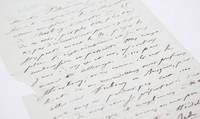
184686647Bâle Basel 1846. Fine. ""If the painting collection advertised in the newspapers on rue du Vieux Marché is still for sale"" Bâle Basel 18 mai 1846 13.6 x 21.8 cm 2 pages sur un feuillet Autograph letter signed by Honoré de Balzac to Gustave Silbermann dated 18 May 1846 with the blind stamp of the Hôtel des Trois Rois in Basel. A delicate document with fold marks that have caused some tears with some minute lacks of paper affecting a few letters including the last two letters of the author's signature. A fine epistolary testament to Balzac's unrestrained passion for art collecting in this likely unpublished letter addressed to his friend the Strasbourg bookseller and printer Gustave Silbermann. Balzac was planning a stay in Strasbourg during which he became engaged to Madame Hanska. Exhausted by the frantic pace of writing La Comédie Humaine Balzac set out to leave Paris for an extended tour of Europe. ""On 25 March 1846 Balzac joined Mme Hanska in Rome where he had never been before and was dazzled by the city. In Rome then in Civitavecchia Genoa and all along the way back to Basel via Lake Maggiore the Simplon and Geneva they bought paintings works of art furniture"" Balzac continuing ""with determination the creation of his interior décor"" M. Maximovitch Honoré de Balzac et Mme Hanska French Embassy in Ukraine. A year later he would publish Le Cousin Ponsarguably the finest literary expression of this passion in which the art collection is steeped into every page and the protagonist suffers from what Balzac himself called ""bricabracomania."" Writing from Basel Balzac still hoped to make further acquisitions in Strasbourg where he refers here to a ""painting collection advertised in the newspapers on rue du Vieux Marché."" It was for Madame Hanska that Balzac intensified his activities during this period ""driven by a genuine frenzy for acquisition. It was the time when he was preparing the home he had purchased on rue Fortunée now rue Balzac for his future wife. Even before moving in from 15 April 1847 onwards he was antiquing everywhere placing orders and enthusiastically pursuing real or imagined bargains."" Nicole Mozet Balzac collectionneur. This stay in Strasbourg would prove pivotal in their relationship as Balzac would later confide to his sister that they had made their engagement official there years before their long overdue marriage: ""we were engaged from 1846 in Strasbourg"" letter of 15 March 1850. In the same letter Balzac also asks Silbermann to arrange his transportationthis loyal friend even supported Balzac in his relationship with his future wife: ""Should Countess Hanska pass through Strasbourg during a journey it is this devoted friend Silbermann who is entrusted with delivering her a letter from her lover ensuring the comfort of her stay tending to her needs and even taking care of her travel provisions."" Yves Cambefort. An unpublished moment in the life of Balzac the tableaumaniac as he travels to Strasbourg to seal his union with his great love. ""I am counting on your kindness to reserve a seat for me in the mail coach to Strasbourg from the 25th of this monthnot earlier; later is no problem so long as Ive departed before the 31st. Pay for the seat if necessary and I will reimburse you when I pass through Write me a note in Heidelberg at the Hôtel de la Cour de Bade to let me know on which day the seat will be booked If the painting collection advertised in the newspapers on rue du Vieux Marché is still for sale "" unknown
1870201650Paris: George Barrie 1870. Limited. hardcover. very good. 45 volumes numerous engraved illustrations all with proof copies lettered tissue guards. Full brown polished calf colorful marbled endpapers all edges gilt. Paris: George Barrie circa 1870. An exquisite set with some wear to the bindings. Very good.<br/><br/> One of only 100 numbered sets on Japan paper.<br/><br/> George Barrie unknown books
186151287Sous étui bordé. Reliure plein maroquin brun. Dos à 4 nerfs sautés orné de filets et d'un fleuron central à froid. Panneau orné d'un décor à répétition dessiné par des fleurons disposés sur un pavage de losanges, encadrement intérieur de deux doubles filets dorés. Tranches dorées sur témoins. Reliure signée CONIL-SEPTIER.
19148826Albert Robida Imprimé Par Charles Meunier 30,5 x 36 Paris 1914 Grand in-4, sous étui marbré bordé de cuir et intérieur de velours, reliure mosaïquée de maroquin chocolat signée "Ch. Meunier 1925", dos à quatre doubles nerfs surlignés de filets à froid et prolongés sur les plats, auteur et titre dorés, "Paris 1914" doré en queue, deux fleurons estampés à froid, plats biseautés orné de grands cuirs ciselés et enchassés, de couleurs représentant sur le premier plat "La Connestable" en médaillon surmonté d'un cimier et entourée de lauriers et de larges filets dorés entrelacés, sur le second plat un amour archer en médaillon entouré d'un semblable décor, tranches dorées, dentelle intérieure dorée sur les contre plats composée de trois filets dorés agrémentée de fins motifs décoratifs, doublures et gardes de soie de bleu sombre éclairées d'éclats rouges semblable à un feu d'artifice, doubles gardes de papier marbré, couvertures conservées. Remarquable et rare édition tirée à 40 exemplaires numérotés, celui-ci prestigieux portant le numéro 7/12 sur Japon impérial, contenant trois états de toutes les gravures, dont l'eau-forte pure, ainsi qu'une aquarelle inédite d'Albert Robida et reliés par Charles Meunier. Intéressante provenance avec l'ex-libris armorié gravé sur la première garde blanche de la "Bibliothèque du duc de Massa", [Jean-Louis-Napoléon Régnier (1875-1946), 4e duc de Massa]. 2 ff. de garde, aquarelle, faux titre, justificatif de tirage, frontispice en couleurs, titre illustré, 41-[3] pp., 2 ff. de garde, suivi de 135 pp. d'états dont une série sur chine. L'illustration de compose de gravures en couleurs de centre de page et d'encadrements de pages dessinés par Robida. "La Connestable" fait partie des "Contes drolatiques" d'inspiration rabelaisienne, publiés par Balzac. Dans sa préface, Emile Bergerat (1845-1923) rappelle que "La Connestable" est un petit roman pseudo-historique, sur fond de cocuage médiéval, qui met en scène un personnage de célébrité fort terrible de nos annales, Bertrand d'Armagnac, et une autre figure légendaire Buridan, le sieur de Bois-Bourredon..." Robida a su faire revivre le passé avec fantaisie et précision dans le trait, notamment en illustrant les oeuvres de Rabelais ou de Balzac. Charles Meunier (1865-1948) a été formé par l'atelier de Marius Michel. C'est un des grands relieurs de la Belle époque. Ses reliures, si caractéristiques par ses décors floraux et végétaux, et par ses cuirs incisés, sont uniques. Notre exemplaire témoigne également de son oeuvre d'éditeur de livres de prestige, qu'il reliait lui-même, avec un décor composé pour chaque ouvrage. Il ne faut pas confondre cette édition grand in-4 tirée à 40 exemplaires et l'édition tirée à 100 exemplaires en petits in-4. Bel exemplaire remarquable.(ChalB87). PHOTOS NUMERIQUES DISPONIBLES PAR EMAIL SUR SIMPLE DEMANDE-DIGITAL PHOTOGRAPS MAY BE AVAILABLE ON REQUEST
19148826Albert Robida Imprimé Par Charles Meunier 30,5 x 36 Paris 1914 Grand in-4, sous étui marbré bordé de cuir et intérieur de velours, reliure mosaïquée de maroquin chocolat signée "Ch. Meunier 1925", dos à quatre doubles nerfs surlignés de filets à froid et prolongés sur les plats, auteur et titre dorés, "Paris 1914" doré en queue, deux fleurons estampés à froid, plats biseautés orné de grands cuirs ciselés et enchassés, de couleurs représentant sur le premier plat "La Connestable" en médaillon surmonté d'un cimier et entourée de lauriers et de larges filets dorés entrelacés, sur le second plat un amour archer en médaillon entouré d'un semblable décor, tranches dorées, dentelle intérieure dorée sur les contre plats composée de trois filets dorés agrémentée de fins motifs décoratifs, doublures et gardes de soie de bleu sombre éclairées d'éclats rouges semblable à un feu d'artifice, doubles gardes de papier marbré, couvertures conservées. Remarquable et rare édition tirée à 40 exemplaires numérotés, celui-ci prestigieux portant le numéro 7/12 sur Japon impérial, contenant trois états de toutes les gravures, dont l'eau-forte pure, ainsi qu'une aquarelle inédite d'Albert Robida et reliés par Charles Meunier. Intéressante provenance avec l'ex-libris armorié gravé sur la première garde blanche de la "Bibliothèque du duc de Massa", [Jean-Louis-Napoléon Régnier (1875-1946), 4e duc de Massa]. 2 ff. de garde, aquarelle, faux titre, justificatif de tirage, frontispice en couleurs, titre illustré, 41-[3] pp., 2 ff. de garde, suivi de 135 pp. d'états dont une série sur chine. L'illustration de compose de gravures en couleurs de centre de page et d'encadrements de pages dessinés par Robida. "La Connestable" fait partie des "Contes drolatiques" d'inspiration rabelaisienne, publiés par Balzac. Dans sa préface, Emile Bergerat (1845-1923) rappelle que "La Connestable" est un petit roman pseudo-historique, sur fond de cocuage médiéval, qui met en scène un personnage de célébrité fort terrible de nos annales, Bertrand d'Armagnac, et une autre figure légendaire Buridan, le sieur de Bois-Bourredon..." Robida a su faire revivre le passé avec fantaisie et précision dans le trait, notamment en illustrant les oeuvres de Rabelais ou de Balzac. Charles Meunier (1865-1948) a été formé par l'atelier de Marius Michel. C'est un des grands relieurs de la Belle époque. Ses reliures, si caractéristiques par ses décors floraux et végétaux, et par ses cuirs incisés, sont uniques. Notre exemplaire témoigne également de son oeuvre d'éditeur de livres de prestige, qu'il reliait lui-même, avec un décor composé pour chaque ouvrage. Il ne faut pas confondre cette édition grand in-4 tirée à 40 exemplaires et l'édition tirée à 100 exemplaires en petits in-4. Bel exemplaire remarquable.(ChalB87). PHOTOS NUMERIQUES DISPONIBLES PAR EMAIL SUR SIMPLE DEMANDE-DIGITAL PHOTOGRAPS MAY BE AVAILABLE ON REQUEST