26 629 résultats
FIRST EDITION OF ELUARD'S RAREST BOOK, WITH AN ORIGINAL SIGNED DRAWING BY MAURICE MENDJIZKI. Includes a 5-page poem by Eluard and 31 extremely high-quality (Jacomet process?) full-page reproductions of drawings by Mendjizki depicting the suffering and heroism of the Warsaw Ghetto and the Uprising. Dedicated to the artist's son Claude, shot by the Nazis in 1944 for being a member of the Resistance. THIS FIRST EDITION STRICTLY LIMITED TO 100 COPIES, of which this is number 100, SIGNED BY ELUARD AND MENDJIZKY AND CONTAINING AN WONDERFUL ORIGINAL SIGNED DRAWING BY MENDJIZKY, depicting three people trying to sleep in very cramped quarters (200 additional unsigned copies were also printed, 100 in French and 100 in Yiddish, which are not part of the first edition.) Printed on fine wove paper. 4to. Original wraps FINE AND BRIGHT, LIKE NEW WITH NO DEFECTS, IN THE ORIGINAL BOARD CHEMISE AND SLIPCASE. A wonderful example of extremely rare and haunting 20th-century Judaica.
223, 16 (ads) pp. Index. "The problem of the Jews in Britain, and the power they wield in public affairs, is a matter of the most absorbing interest in these days when propaganda has clouded the issue and made it almost impossible for the ordinary man to see the subject in its true perspective. This book is a critical but strictly impartial analysis written by a well-known Fleet Street journalist who has studied the whole problem for a number of years in the light of events since the Great War." - from dust jacket. Unmarked with moderate wear to publisher's orange cloth. Binding intact. Small contemporary Buenos Aires bookseller's sticker inside front board. Above-average wear to dust jacket, now preserved in archival-grade Brodart. A sound copy. Singerman 494. Book
171590103HBHamburg; etc.:, Liebezeit (Bd. 1); Felginer, 1715-1733. 4 Bände, (1) Bl. (gestochenes Frontispiz), (3) Bll., 40, 1161 [recte: 1157], (33), 24 Seiten; (1) Bl. (gestochenes Frontispiz), (5) Bll., 1484 Seiten; 4 Bll., 1226 [recte: 1220] Seiten, (30) Bll.; (1) Bl. (gestochenes Frontispiz), (6) Bll., 1226 [recte: 1224] Seiten, 36 Bll., Pergamentbände der Zeit mit auf den Falz gezogenen Pergamentriemchen, Rückentitel von alter Hand, farbiger Blattschnitt, 20,5 x 17 cm.
1st American Edition. Original Boards. 8vo. 79 pages. 23 cm. The First Published Jewish Response to Missionaries in America. In English, with some Hebrew. Singerman 0260. Kol Yaakov = Koul Jacob, in Defence of the Jewish Religion. Nikelsburger takes up the cudgels with an apostate Jew, Rev. Frey, so intent on converting his former coreligionists to Christianity that he is willing to take liberties with Scripture. Frey [to whom Niklsburger is responding here] was appointed agent of the ASMCJ [The American Society for Meliorating the Condition of the Jews, a conversionist organization], in 1822, and during that and the following year he travelled through the South and New England collecting money and establishing many local chapters .In January, 1823, the ASMCJ began publishing a periodical called Israels Advocate .The emergence of the ASMCJ and the considerable support that it had within the Christian community was a cause of concern to the Jews and they responded to it. The first Jewish literary response to the missionaries came in 1816, the year that Frey had arrived in America, with the publication of an American edition of Jacob Nikelsburgers Koul Jacob. Nickelsburger had published ins booklet in Liverpool in 1813 as a rebuttal to a series of pamphlets written by Frey and published bu the Londton Society on the subject of the messiah. The work contains a refutation of the christological interpretatiions of a number of messianic sections of the Bble. Nikelsburger couched his argument in a moderate tone, and assured his readers that he had not written his booklet in order to engage in religious controversy, but only because Frey had challenged the Jews to answer his arguments (Berlin, Defending the Faith: Nineteenth-Century American Jewish Writing on Christianity and Jesus, Albany, 1989, pp 7-8) Lacks backstrip, front hinge weak with a touch of separating at blank front end paper, some staining, good copy, good condition. (RAB-58-16A-D)
EXTREMELY RARE! FIRST EDITION of "Sefer Ha-Nizzahon" (the Book of Contention) by German Rabbi Yom-Tov Muhlhausen Lipman. The book, written around 1400, is a polemic against Christianity and Karaite Jews, laying forth arguments based on the different books of the Bible. This edition was printed by Protestant scholar Theodor Hackspan from the University of Altdorf. The edition is appended Latin introduction, a translation (and refutation) of the passages dealing with Christianity and a lengthy essay by Hackspan on Rabbinic literature. The book also features sidenotes in Latin. The title page is an elaborate woodcut ripe with Jewish motifs, and the text itself features several text decorations. 200x160mm, 512 pages (and ~150 unnumbered pages). Grey cloth hardcover. Page edges dyed blue. Cover worn and stained. Cover edges slightly bumped. Back cover detached. Spine torn at several places. Rear whitepage torn and detached. Last 5 pages nearly detached. Pages yellowing. Despite the external wear, this first printing of an influential Jewish text is internally in good condition.
No Date [1980s]. Black Frame. 20 X 16 Inches. Single-layer, painted paper-cut laid down on black background. Hebrew title surrounded by colorful floral, animal and geometric designs along with vignettes of Szyk-inspired images, including the elder teaching his students to 'Remember Amalek. ' This papercut is featured in J. Shadur, Jewish Papercuts, (1994) pl. 42. Very Good Condition. Rare and dramatic. (PAINT-1-3)
Mit 2 gest. und gefalt. Tabellen. XVI, 356 S., 32 Bll. HPrgt. d. Zt. Fürst III, 309; Avé-Lallement III, 296. - Sehr seltene Neubearbeitung des erstmals 1767 erschienenen Lehrbuchs des Jiddischen. Gottfried Selig (1722-1795), geboren als Philipp Heinemann und Sohn des Weißenfelser Hofjuden Mose Heinemann, veröffentlichte ab 1768 die Wochenschrift "Der Jude, oder Altes und Neues Judenthum", konvertierte aber trotz heftigen Widerstands der Vaters schon 1738 zum Christentum. - Die Tabellen mit dem hebräischen Alphabet und einer deutschen und hebräischen Schriftprobe. - Rücken berieben, Rückenschild mit Papierverlust, Decken etwas fleckig. Bücher de
171134640AKönigsberg (recte Berlin, Haude & Spener), 1711. Ca. 21,5 x 17,5 cm. 10 Blätter, 1016 (recte 998); (1) Seiten; 2 Blätter, 1111 Seiten, 1 Blatt. Pergamentbände der Zeit mit Rückentitel und Farbschnitt. 2 Teile in 2 Bänden.
15593-0-240Paris, Vascosan, 1559. Folio (35,5x23cm), 12 nn. Bll., Bll. 7-319, 26 nn. Bll., etwas späterer Ldr. mit goldgepr. Supralibros, RSchild, reicher RVergoldung und dreis. Goldschnitt
1st edition. Original boards. 8vo. 26, 62, 32, 52, 28, 8, 18, 20, 25, 24, 11, 56, 15 pages. Includes 15 parts in one volume. 24 cm. In Hebrew. Title translates to Articles and Conversations with the Rebbe from Lubavitch. Contents include:[2] Derushe hatunah 689--[10] Ma'amre Hasidut, Riga 691--[11] S´ihot Admor shlita bi-se'udat S´imhat Torah ve-19 Kislev 691--[12] Ma'amarim shel Admor shlita li-lemod ba-rabim be-yom 2 Nisan 691--[13] Kuntres Ma'amarim ve-s´ihot, 3 ma'amarim she-ne'emru be-Lita 691--[14] Ma'amarim le-limud ba-rabim bi-yeme hag ha-ge'ulah 12-13 Tamuz 691--[15] Kuntres Ma'amarim ve-s´ihot 691--[16] Kuntres Ma'amarim ve-s´ih?ot 692-- [17] Ma'amarim le-limud be-rabim be-yom 2 Nisan 692--[18] Ma'amarim le-limud be-rabim bi-yeme hag ha-ge'ulah 12-13 Tamuz 692--[23] S´ihah bi-seudah de-yom 2 de hag ha-Shavuot 693--[24] Ma'amarim shel Admor shelita le-limud be-rabim be-yom 2 Nisan 694--[25] Ma'amre Hasidut Riga 694--[26] Ma'amarim le-limud be-rabim bi- yeme hag ha-ge'ulah 12-13 Tamuz 694--[27] Ma'amre Hasidut Varsha 694. Joseph Schneersohn (1880-1950) was an Orthodox rabbi and the sixth Rebbe of the Chabad Lubavitch chasidic movement. Rabbi Yosef Yitzchak Schneersohn, the sixth rebbe of Chabad-Lubavitch, was one of the most remarkable Jewish personalities of the twentieth century. In his seventy years, he encountered every conceivable challenge to Jewish life: the persecutions and pogroms of Czarist Russia, Communism's war on Judaism, and melting-pot America's apathy and scorn toward the Torah and its precepts. The Rebbe was unique in that he not only experienced these chapters in Jewish history as did many of his generation but that, as a leader of his people, he actually faced them down, often single-handedly, and prevailed. The young Rabbi Yosef Yitzchak, in full-length chassidic garb, was a familiar figure in the receiving rooms of the government officials, ministers, and nobles of Moscow and Petersburg . He demanded the repeal of anti-Jewish decrees, the stopping of pogroms and the cessation of the government's program of forced enlightenment of traditional Jewish life His father appointed him the first executive director of the first Lubavitch Yeshivah; It was there, in the hamlet of Lubavitch in pre-soviet White Russia, that Rabbi Yosef Yitzchok trained the army of the faithful torchbearers who, under the impossible conditions of the decades to come, would literally give their lives to keep the flame of Jewish life ablaze throughout the Soviet Union. Upon his father's passing in 1920 Rabbi Yosef Yitzchak assumed the leadership of Russian Jewry just as Communism's all-out war on Jewish life was moving into high gear . He dispatched teachers and rabbis to the farthest reaches of the Soviet Empire, establishing a vast underground network of schools, mikvaos, and lifelines of material and spiritual support . In 1927 he was arrested, beaten, sentenced to death and exiled; but he stood his ground, and by force of international pressure he was finally allowed to leave the country. But in leaving the boundaries of the Soviet Union he left his emissaries and their infrastructure of Jewish life behind . When the all-powerful communist regime began to crumble in the closing years of the '80s, Rabbi Yosef Yitzchak's network of children's schools, outreach centers, and supply lines of kosher food and religious services simply moved out of cellars and attics into emptied Communist Party buildings. Upon arriving in New York after his rescue from Nazi-occupied Warsaw in 1940, Rabbi Yosef Yitzchak took on a no less formidable challenge: the frigid spiritual atmosphere of the western world. There was no telling Rabbi Yosef Yitzchak that his was a losing battle; from his wheelchair, he rallied the Jewish young of America under the cry that "America is no different, " that also in this bastion of materialism the timeless truths of Torah can take root and flourish. He established yeshivas and day schools, a publishing house for Jewish books, a social service organization and community support networks throughout the country. By the time of his passing in 1950 he had laid the foundation for the global renaissance of Torah-true and chassidic-flavored Jewish life, heralded by his son-in-law and successor, Rabbi Menachem M. Schneerson (Chabad, 2018) . SUBJECTS: Hasidism. Habad. OCLC: 40404938. OCLC lists 2 copies worldwide (JTS, Harvard) . Boards are worn and chipped. Pages are browning and fragile, but all contents are very good. Overall Good Condition. Rare, especially as a complete set. (RAB-64-65)
1st edition. Loose sheets as issued, in later custom clamshell box with original portfolio cover mounted on front. 4to. One of 3200 Numbered Copies. 111 plates of drawings, the first 100 relating to Buchenwald, plus 6 portraits, and 5 aquarelles in color. Captions in French, English, and Russian. 26 cm. Title page and preface in French. Boris Taslitzky began painting at the age of fifteen and attended the academie Montparnasse and the École des Beaux-Arts in Paris between 1925 and 1933. In 1933, he joined the Association of Revolutionary Writers and Artists (A. É. AR) where he became general secretary of the section of Painters and Sculptors, and then in 1935, he joined the Communist Party. In 1936, during the presentation of Quatorze Juillet, by Romain Rolland , Taslitzky participated in the exhibition that brought together Picasso , Léger , Matisse , Braque , Jean Lurcat , Laurens and Pinion in the lobby of the Alhambra Theatre. Taslitzky was captured in June 1940, escaped in August and joined the Resistance. He was arrested again in November 1941, sentenced to two years in prison, and then on July 31, 1944 was deported to Buchenwald , where he manages to make some two hundred drawings showing life in the camps. "If I go to hell, I will make sketches. Besides, I have experience, I've been there and I've drawn! ... ", he later said. His mother died at Auschwitz . In 1946, Taslitzky exhibited his works which were inspired by the Resistance and Deportation, winning the Prix Blumenthal. He was later awarded the Military Cross and Military Medal and in 1997 he received the insignia of Chevalier of the Legion of Honour under the Resistance and Deportation. He was both witness and actor in the story of French Resistance and the Holocaust. SUBJECT(S) : Concentration camps -- Pictorial works. Buchenwald (Camp de) Guerre mondiale 1939-1945. Prisonniers et déportés. Camps allemands. Buchenwald. Album. Concentration camps. Pictorial works. Wear to original illustrated cover, which has been mounted on front of box, but no damage to illustration. Moving, early, and important. (holo2-125-44) xx
1843022343Auf Kosten Des Verfassers / C. Reimarus, Berlin 1842/1843. Hartkarton Solide
Original Full Leather, 16mo, [6], iii-xii, 1243 pages. 17 cm. Title in Hebrew at head of title. The scarce Chicago Bloch edition, retaining the copyright page date of 1853, but probably published in the late 1860s given the inclusion of the Advertisement to the London Edition" (which appeared in 1865, with 7 holdings in OCLC,) and its mid-19th Century calf binding. Blochs first office in Chicago dates to the 1870s, and Bloch did also publish an 1884 edition, but, unlike our copy, it lists the 1884 date and only Cincinnati (not Chicago, as this copy does) and contains 1236 pages (not 1243 as ours does). A Bloch publication of Leesers bible could almost certainly not have occurred before Leesers death in 1868, given the enmity between the Leader of American Orthodoxy and the Reform-oriented publishing house owned by Isaac M. Wise brother-in-law, Edward Bloch. Leeser, famously, had printed an anonymous attack on Wise signed Lawyers in the pages of his Occident shortly after the appearance of Minhag Amerika in 1857; this anti-Reform rejoinder singled out Bloch & Co. for allegedly keeping its store open on the Jewish Sabbath and closing it on Sunday, the Christian Sabbath (Singerman). In our Bloch copy, the copyright is still held by Isaac Leeser; It was not until 1888 that his [Blochs] firm obtained the copyright of this popular and frequently reprinted landmark text. OCLC lists only 2 holdings of the Chicago Bloch [1853] edition (Andrews University in Michigan and the Community of Christ library in Missouri), both in the Midwest, perhaps reflecting Blochs still-Midwestern orientation at the time. Indeed, not many years later, Bloch left Chicago completely and moved its second headquarters to New York. This edition not listed in Singerman nor in Goldman. Edgewear to leather boards and many pages. Spine professionally rebacked. Good Condition thus. (AMR-38-23)
1st edition. Beautiful original period half-leather over marbled boards with raised bands and gilt spine design. Title translates as, The Jew, A Weekly. German interspersed with Hebrew. Device on title. Headpieces, initials, tailpieces. Includes graphics of Jewish ceremonial art [for example, in Vol. II, between pp. 52-53; Vol. II: pp. (12), 368. Vol. III: pp.(16) ]. The editor of Der Jude, Gottfried Selig (1722-95), was a convert to Christianity who sought reconciliation between Christians and Jews, to which end, this periodical appeared containing much information about Jewish history, rites and customs. His assumption was that, equipped with deeper insight into Jewish life, a greater sense of understanding would arise within society as a whole. Seligs goal in publishing Der Jude was to make peace between Christians and Jews, but the work earned him opposition from both sides, with Jews claiming that its true goal was to convert Jews to Christianity, and Christians claiming that it lacked historical veracity and presented a false neutrality. Der Jude was issued between 1768-1772 in nine volumes. Kirchner 2084. Furst III, 309. Diesch 773. Yiddish scholar Judah Joffes set with his photographic bookplate. Marbled endpapers. Slight internal binding error at rear of vol III, otherwise a beautiful dramatic period set in Very Good Condition. Price for all 74 issues, bound in 3 volumes (GER-60-5)
Original boards. 4to. 400, 400, 399, 399 pages. 29 cm. First edition. First edition of the Biblia Sacra Polyglotta, with advertisements on rear board for further volumes soon to be printed in other languages; text block with wide margins pages uncut, boards measure 29 cm. Printed in Hebrew, English, Greek, and Latin. Opposite pages bear duplicate numbering, and each page includes four numbered texts in two columns. Concordance to the following: Genesis, Exodus, Leviticus, Numbers, Deuteronomy; Joshua, Judges, Ruth, 1 Samuel (Vulgate 1 Kings) , 2 Samuel (Vulgate 2 Kings) , 1 Kings (Vulgate 3 Kings) , 2 Kings (Vulgate 4 Kings) , 1 Chronicles (Vulgate 1 Paralipomenon) , 2 Chronicles (Vulgate 2 Paralipomenon) , Ezra (Vulgate 1 Esdras) , Nehemiah (Vulgate 2 Esdras) , Esther, Job, Psalms. Ending with Psalms [CXIX], remaining fourth volume absent. Three volume set only (missing Hagiography and New Testament; also without prolegomena from Samuel Lee) . The most inclusive of the great Polyglots since the London, or Walton's, Polyglot of 1657, it was printed by Samuel Bagster of Paternoster Row: The first issue [our set] of the âBiblia Sacra Polyglotta Bagsterianaâ appeared between 1817 and 1828, four volumes in foolscap octavo and quarto form, containing, besides the prolegomena of Dr. Samuel Lee, the Hebrew Old Testament with points, the Samaritan Pentateuch, the Septuagint Greek version of the Old Testament, the Latin Vulgate, the authorised English version, the Greek Textus Receptus of the New Testament, and the Peshito or ancient Syriac version. However, due to a fire at the printers in March 1822, very few of these sets were actually distributed; In particular, Lowndes states only twenty-three copies of the New Testament portion [the one volume missing in our set] were preserved. A folio edition of the polyglot was published in 1828, repeated in 1831, and subsequently, presenting eight languages at the opening of the volume, and including all the ancient and modern versions above mentioned. Copies of the different texts and translations were brought out separately, and in various combinations. The two volume folio edition (1828; printed many times thereafter) , encompassing the complete old and new testament in eight languages, is more commonly found. The third fascicle in the set has a pasted in advertisement on verso of board, announcing that the polylglott bible will soon be issued in a two part series. Subjects: Polyglot Bible â 1827-1828. Biblia sacra polyglotta Bagsteriana. Not a single set of the first issue listed on OCLC. A single listing exists for a single volume, which survives at a library in Scottland. Original printed Boards worn and rubbed at edges, outer edges of leaves lightly bumped, spine rebacked, otherwise fresh and clean. Very good condition. (SPEC-39-20)
Signed by Hal Lindsey atop half-title. This, Hal Lindsey's first and best-selling book, examined biblical prophecy in light of current events to project when Christians could expect to be raptured prior to the second coming of Jesus Christ. pp. [10], 11-192. Footnotes. Map. Above-average wear. Prior owner's name at bottom of half-title page. Binding intact. Possibly a first printing copy but we cannot definitively state this. A rare early signed copy of this highly influential work which went on to sell by the tens of millions and continues to influence Christians today. Book
1st edition. Period full leather with spine label, 8vo, viii, 9-408 pages. Singerman 322; Rosenbach 209. The tipped in recommendation slip sign "Ph. Milledolar, " as noted by BAL, is present. President John Adams wrote of this literary anthology that it was "worthy to be presented by every father to every child, and deserve a place in every family. " Gomez's Jewish affiliation resonates in the book with his decision to include a selection from The History of Pope Pius V, which is the source for the "pound of flesh" incident in Shakespeare's Merchant of Venice. As opposed to Shakespeare's telling, in the History of Pope Pius V, it is the Jew who is the victim and the Christian who threatens him. Gomez prefaced the selection by writing: "The following subject shows that Shakespeare altered the character of Shylock, making him to be of the Jewish nation, when in reality he was not. " As Louis Harap notes (The Image of the Jew in American Literature, p. 260) , "Gomez was obviously trying to combat the effects of the Shylock stereotype. " Isaac Gomez (1768-1831) , whose great-grandfather had fled from Portugal to New York in 1703, was active in New York's Jewish community. The few early literary contributions by American Jews "was anything but impressive, but Gomez's book is worth remembering as one of American Jewry's earliest literary efforts⦠Gomez, both a devotee of the humanities and a committed Jew, lived comfortably ensconced in the two worlds of the Jew and the cultured American" (J. R. Marcus, United States Jewry, vol. 3, page 455) . See also Blau and Baron, The Jews of the United States, 1790-1840, Vol. II, pages 440-2. The last copy to appear at auction in the US, in 2013, sold for over $1800 (with commissions) . Foxing as expected. All endpapers present, and original period binding remains very handsome. A very good copy in outstanding period binding. (AMR-57-12)
1st edition. Original paper wrappers. 12mo. 51 pages, 17 cm. In German. Title translates to Convert You! Fries originally published this pro-nationalist tract anonymously. Fries (1773-1843) was a German post-Kantian philosopher who is perhaps best known for his dispute with Hegel, whom he regarded as an establishment figure (Wikipedia, 2018) . Fries was toxically anti-semitic and wrote about exterminating the Jews (Vital, 2001) . SUBJECTS: Germany -- Politics and government -- 1806-1815. OCLC lists 5 copies worldwide (Oberlin, UW-Madison, Cambridge, UBasle, UBern) , none in Germany and none in the American Ivy Leagues. (OCLC: 15530561) . Very good condition. Rare and important. (GER-54-2)
Original Wraps. 4to (large) . 48 pages. 30 cm. First edition. In French. Rare extremely early (1945) illustrated French Exposition of Nazi Crimes. Catalogue, in magazine format, of Nazi crimes; illustrated throughout; with testimony, articles, and prefatory declarations by P. Teitgen, Bidault, Soustelle, and Frenay, denouncing the Nazi Crimes. Illustrated throughout; emphasizes the crimes of Vichy as well. Publié à l'occasion de l'exposition 'Crimes hitlériens'-Déclarations, articles, souvenirs. Sections as follows: l'allemagne et le nazisme, l'ordre hitlérien (congrès de Nuremberg, charnier de Belsen) Mensonges et pattes de velours, le vol de la terre, la guerre biologique, avec une composition de Paul Colin, pleine page, SS et gestapo, Buchenwald, témoignages de ceux qui "en" sont revenus, camp de femmes , l'homme cobaye, bloc 46, le criminel de guerre. [Published on the occasion of the exhibition 'Crimes hitlériens' Declarations, articles, memories. Sections as follows: Germany and Nazism, Hitler's order (the Nuremberg Congress, the grave of Belsen) Lies and velvet paws, theft of land, biological warfare, with a composition of Paul Colin, full screen, SS and Gestapo, Buchenwald, testimonies of those who survived, the women's camp, the pig man, block 46, the war criminal. ]Subjects: Guerre mondiale 1939-1945. Atrocités allemandes. OCLC lists only one copy worldwide (Nanterre) , located in France. Scarce. Damage to lower left coner, no loss of text, otherwise, Very Good Condition. (HOLO2-117-4)
1st edition. Original paper wrappers, 12mo, 32 pages, chiefly photographic illustrations. 16 cm. Exhibition of Photographic Images of German Concentration Camps and Destroyed Arnhem. Catalog for the exhibition, with 24 pages of full-page photos, plus 8 pages of photo descriptions. Text in Dutch. On page 10 is the famous and controversial photo of the Nobel Laureate Elie Wiesel in Buchenwald (first published in the "New York Times" on May 6, 1945 with the caption "Crowded Bunks in the Prison Camp at Buchenwald" taken inside Block 56 by Private H. Miller of the Civil Affairs Branch of the U. S. Army Signal Corps on April 16, 1945.) . In the year following the defeat of the Nazis, exhibitions of photos showing the horrors of the Concentration Camps were a way to show the people of Europe what had been done by the Germans and their allies, and, eventually, to build support for the idea of War Crimes trials. Foto's ... Afgestaan door de U. S. I. S. (United States Information Service, Photographic Section, Amsterdam) en Jan Schiet, fotograaf, Amsterdam. Despite the title, there are no pictures nor text referring to Arnhem in the bookonly from the concentration camps. The Arnhem material may have appeared only in the exhibition itself. OCLC lists only 4 copies worldwide, all in the Netherlands (Sept 2015) . Blue wrappers are sunned with some spotting, spine repaired, otherwise Very Good Condition. Rare and important. (holo2-126-33A) xx
1st edition. Original paper wrappers, 12mo, 32 pages, chiefly photographic illustrations. 16 cm. Exhibition of Photographic Images of German Concentration Camps and Destroyed Arnhem. Catalog for the exhibition, with 24 pages of full-page photos, plus 8 pages of photo descriptions. Text in Dutch. On page 10 is the famous and controversial photo of the Nobel Laureate Elie Wiesel in Buchenwald (first published in the "New York Times" on May 6, 1945 with the caption "Crowded Bunks in the Prison Camp at Buchenwald" taken inside Block 56 by Private H. Miller of the Civil Affairs Branch of the U. S. Army Signal Corps on April 16, 1945.) . In the year following the defeat of the Nazis, exhibitions of photos showing the horrors of the Concentration Camps were a way to show the people of Europe what had been done by the Germans and their allies, and, eventually, to build support for the idea of War Crimes trials. Foto's ... Afgestaan door de U. S. I. S. (United States Information Service, Photographic Section, Amsterdam) en Jan Schiet, fotograaf, Amsterdam. Despite the title, there are no pictures nor text referring to Arnhem in the bookonly from the concentration camps. The Arnhem material may have appeared only in the exhibition itself. OCLC lists only 4 copies worldwide, all in the Netherlands (Sept 2015) . Blue wrappers are sunned with some spotting, otherwise Very Good Condition. Rare and important. (holo2-126-33) xx
193719628BBHamburg:, Hanseatische Verlagsanstalt, 1937-1941. Gr.-8°. 205; 232; 247; 272; 333; 314 S., Leinen 6 Bände. (Buchdeckel teilweise (leicht) verzogen; teilweise leicht stockfleckig; Stempel auf Titelblatt; Band 2: Ecken oben leicht bestossen; Band 4: Rücken abgeblasst; Band 6: Einband fleckig; insgesamt gut erhalten) (=Sitzungsberichte der Münchner Arbeitstagung des Reichsinstituts für Geschichte des neuen Deutschlands)
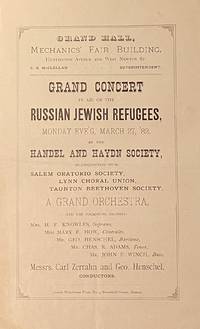
188232820516<p>5 x 8 1/2 in . 4pp. Very good.</p><p><b>This is the rare original announcement and program for a major early benefit concert supporting Jewish refugees from Russia. </b>The pogroms carried out in 1881-82 drove countless Russian Jews to the West. This era marks the beginning of the period of the greatest Jewish immigration to the United States.</p><p>The concert was held at Mechanics Hall in Boston in 1882. The featured conductors are Carl Zerrahn and George Henschel. Henschel had become the first conductor of the Boston Symphony Orchestra a year earlier. Here he leverages his position to support Jewish refugees.</p><p>"Beginning in the 1880s a much larger wave of Jewish immigrants arrived in Boston from the Pale of Settlement in Russia and Eastern Europe. During the nineteenth century the Russian czars had confined Jews to this region and subjected them to religious persecution expulsions and forced military conscription. Passage of the May Laws in the 1880s made matters worse by forbidding Jews from owning or renting land outside of towns or cities and limiting their access to education. From 1881-1883 and again in the early twentieth century Jews were also targeted in violent riots or "pogroms" that left thousand dead and caused many more to flee" Boston College 2018.</p><p>The concert program includes pieces by Jewish composers or with Jewish themes including selections from from Mendelssohn's <i>Elijah</i> Handel's <i>Samson</i> and Henschel's "There was an Ancient King" sung by Henschel himself the finest baritone of his day. The performance concludes with Handel's "Hallelujah" chorus performed by the Salem Oratorio Society and the Lynn Choral Union.</p><p>The conductor featured in this program Sir Isidor George Henschel 1850-1934 was a German-born Jewish baritone pianist conductor and composer. He became the first conductor of the Boston Symphony Orchestra in 1881. On his appointment he sent his ideas for an innovative seating chart to his close friend Johannes Brahms who replied in an approving letter of mid-November 1881.</p><p><b>Very rare. Not in WorldCat.</b> Robert Singerman <i>Judaica Americana</i>2d ed Penn Libraries website 2019 3064 notes that the sole located copy once ascribed to the AJHS was "not found in either the Boston or New York collection Jan. 2016."</p> Printed By Jewish Watchman Print[ers]
(20), 1016, (2) (recte 998) + (4),1111, (3) Seiten. 21,5 x 16,5 cm. Voluminöser Pergamentband der Zeit (Rückendeckel etwas fleckig). *Seltenes antisemitisches Werk, zweite Auflage (erste im Buchhandel verlegte). Die erste Ausgabe von 1700 wurde vom österreichischen Kaiser Leopold I. auf Wunsch der jüdischen Gemeinde in Frankfurt unterdrückt, die eine antisemitische Reaktion auf die Veröffentlichung des Werkes befürchtete. Die 2000 gedruckten Exemplare wurden 51 Jahre lang von der Öffentlichkeit ferngehalten. 11 Jahre später erlaubte der preußische König Friedrich I. den Erben Eisenmengers, 1711 eine zweite Auflage des Buches zu veröffentlichen, die in Königsberg gedruckt wurde, wohin die kaiserliche Zensur nicht reichte. Der Inhalt des Werkes bildete die angeblich "wissenschaftliche" Grundlage für den Antisemitismus, indem er durch Zitate aus hebräischen Quellen "bewies", dass das jüdische Denken antichristlich sei. Alle bis dahin längst, auch von christlicher Seite, widerlegten Lügenmärchen (Brunnenvergiftung, Pest, Blutbeschuldigung u.v.a.) wurden in diesem Buch neu aufgetischt und als unerschütterliche Wahrheiten dargestellt. Das Werk blieb bis ins 20. Jahrhundert die Quelle aller antisemitistischen Schriften. - Mäßige Altersbräunung, insgesamt sehr gut erhalten. Bücher de