29 774 résultats
First edition. Later boards. 8vo. 212 pages, 21 cm. In Hebrew. Title translates to "A Global Hatred for a Global People: A History of Antisemitism. " A first edition of Nahum Sokolow's first published work, written in response to the pogroms that were being unleashed across the region and fueling the new Zionist movement, and published in Warsaw, the site of the 1881 Christmas Pogrom. In fact, âThe term 'pogrom' became commonly used in English after a large-scale wave of anti-Jewish riots swept through south-western Imperial Russia (present-day Ukraine and Poland) from 1881 to 1884; during this time, more than 200 anti-Jewish events occurred in the Russian Empire, notably pogroms in Kiev, Warsaw and Odessa" (Wikipedia) . ÂThe First Aliya followed pogroms in Russia in 1881-1882, with most of the olim (immigrants) coming from Eastern Europeâ¦. Members of Hibbat Zion and Bilu, two early Zionist movements that were the mainstays of the First Aliya, defined their goal as 'the political, national, and spiritual resurrection of the Jewish people in Palestine'" (Israel Ministry of Foreign Affairs, 2019) . Sokolow (1859-1936) was a Zionist leader, author, and pioneer of Hebrew journalism. He was the first to translate Herzl's Altneuland into Hebrew, giving it the name Tel Aviv, which became the name of the first modern Hebrew-speaking city. SUBJECTS: Antisemitism -- History. OCLC: 457002328. OCLC lists 2 copies worldwide (YU, British Library) Binding repaired. Edgewear to margins of some pages. Contents very good. Very Rare and Very Important. (ZION2-2-1)
pp. x, 227. Footnotes. Index. List of Works Cited. Personalia. Black and white reproductions of historic documents. Frontispiece illustration of Isaac Aboab Da Fonseca (1605-93), the first rabbi in the New World. "Historiography has quite neglected the romantic and fascinating history of the underground and free-professing Jews in colonial Brazil, who formed the earliest Jewish community in America and became the "Jewish Pilgrim Fathers" of New York, as well as of Jamaica, Barbados, and other Jewish communities in the Caribbean area. The present work is an effort to fill this gap." - Preface. Wiznitzer was president of the Brazilian Jewish Institute of Historical Research and a frequent contributor to learned journals. Moderate wear to publisher's navy blue cloth brightly lettered in gilt upon backstrip. Binding intact. Prior owner's bookplate and small bookseller tag inside front board. Prior owner appears to have clipped author's photo/bio from dust jacket (not included) and mounted it upon recto of front free endpaper. Prior owner's blind stamp, name and date upon title page. Pencil underlining and marginal lines erased from about 45 pages. Foxing in vicinity of endpapers and, lightly, to edges. A sound copy of this important work. Book
19229121CFrankfurt/Main:, Omonuth., 1922. (ca. 16 x 16 cm). 12 Blatt / sheets. In Buchtasche / pocket: 5 gefaltete Blatt / 5 folded sheets (23 x 17 cm) und 4 kleine Blatt / 4 small sheets. (7,5 x 5,5 cm). Original-Halbleinen mit Deckeltitel / Original half cloth with title to front cover. [5 Warenabbildungen] Hinterer Deckel tintenfleckig, Blatt 3 mit blassen Tintenflecken, Blatt 10 mit kleiner Tinten-Anstreichung, sonst wohlerhalten. Altersentsprechend guter Zustand. / Rear board ink stained, one sheet with pale inkstains, another with small ink line, otherwi
17761896-08Fiorda [d. i. Fürth], Chaim ben Tsevi Hirsh 537 [d. i. 1776]. 2°. 704 S. Mit ill. Tit. in Holzschn. HLdr. d. 19. Jhdts. Tit. (m. kl. Fehlstelle) u. mehrere Bll. am Rd. verstärkt, gegen Ende tlw. m. gering. Textverl. Vors. m. Bleist. beschrieb.
159565397(Straßburg, Theodosius Rihel, 1595). Fol. Titelblätter in Rot u. Schwarz m. wiederh. breiter figürl. Holzschn.-Bordüre. Mit 132 tlw. wiederh. Textholzschnitten von Tobias Stimmer u. großer Holzschn.-Druckermarke am Ende des ersten Bandes. 6 Bll., 946 S., 20 Bll.; 6 Bll., 214 S., 5 Bll., Blindgepr. Schweinsldr.-Bd. d. Zt. über Holzdeckeln m. abgeschrägten Kanten a. 5 Bünden m. goldgepr. Rückenschild u. Rotschnitt (die beiden Mittelplatten zeigen Justitia bzw. Lukretia).
179540136New-York: Printed and Sold by Samuel Campbell No. 124 Pearl-Street 1795. 54 1 1 blank pp. Light to moderate foxing disbound corner chip costs a page number. Good. <br /> <br /> "Richard Cumberland's play The Jew was the first English play to have an admirable and virtuous Jew for its hero an innovation that Irish and American editions immediately underlined by renaming it The Jew; or the Benevolent Hebrew. The play was exceptionally popular. From the first it was repeatedly performed in London Dublin Philadelphia Baltimore and Boston as well as in Providence Rhode Island Norfolk Virginia and Charleston South Carolina. Within four years of its first printing in 1794 The Jew sold six London editions three Irish editions and three American editions not to mention the German and Dutch translations and it continued to be reprinted in Britain and America throughout the nineteenth century. . . <br /> "As Michael Ragussis observes The Jew 'represented a revolution in the representation of Jewish identity on the English stage.' Imitated by playwrights and novelists alike Cumberland's benevolent Hebrew Sheva became the ancestor of Rebecca in Sir Walter Scott's Ivanhoe of Daniel in George Eliot's Daniel Deronda and of the Monteverdos father and daughter in Maria Edgeworth's Harrington characters deployed like Sheva to counter anti-Semitic prejudice. On the other side of the Atlantic too as Louis Harap confirms The Jew was one of the most important. . . plays of Jewish interest that was produced on the American stage during the early period one that 'was familiar to practically the entire theater audience' in 'Philadelphia New York Charleston Providence and Charleston.' It was among the relatively few plays selected from the extensive English repertoire for repeated performance in America" online Free Library Cumberland's Benevolent Hebrew in eighteenth-century Britain and America.<br /> Rosenbach 102. Singerman 6092. Evans 28515. ESTC W27470. Printed and Sold by Samuel Campbell, No. 124, Pearl-Street unknown
1539Flavius-JosèpheIn-12, première édition complète latine des œuvres de Josèphe publiée à Lyon, compilation complète des œuvres de Josèphe par Sébastien Gryphius, intérieur frais, lettrines historiées. 582 pp. Quelques anciens surlignages, quelques rousseurs en marge extérieure. pièce de titre manquante. 1–469 : Antiquitates Judaicae Pages 1–469 : Antiquitates Judaicae (Histoire des Antiquités juives) • Pages 470–552 : Contra Apionem (Hebraei sacerdotis de antiquitate iudaerum contra Apionem) • Pages 553–582 : De Bello Judaico + Martyrium Machabaeorum (description graphique du martyre des Macchabées) Lugduni (Lyon), apud Sébastien Gryphe, 1539.
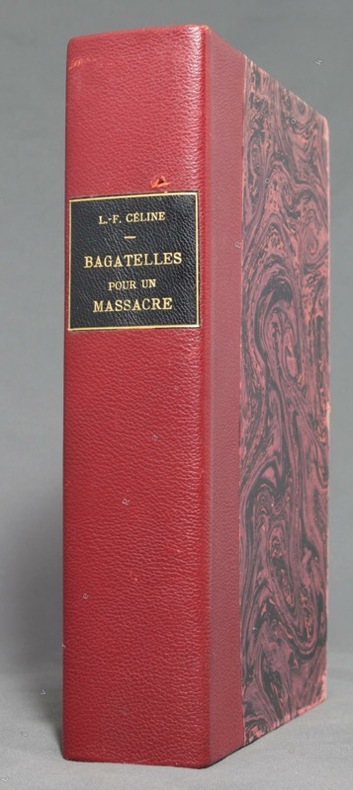
8979Paris, Editions Denoël, 1937. In-8 broché de 379-[3] pages, chemise, étui avec le dos en chagrin rouge, pièce de titre en chagrin noir (petit choc au dos du-dit étui).
SIGNED LIMITED EDITION copy of an elaborately-illustrated Haggadah. 480x325mm. This beautiful Haggadah is enclosed in a thick wooden box, with a colorfully-painted front lid. Inside are 34 color lithographs (not bound). Each lithograph comprises one page of the Haggadah, including the text (in Hebrew) relevant to the image on that lithograph - together making up the complete Haggadah text. Each lithograph is SIGNED by Eliyahu Sidi (in pencil), and marked with a number to indicate the exemplar to which it belongs. The box also contains a large 25-page booklet, wherein is found the introduction by David Moss, English translations for each of the 34 color lithographs (alongside a small image of each lithograph, for reference purposes), and concluding with an interpretation of each lithograph from an artistic viewpoint by David Moss and Noam Zion. The booklet is written entirely in the English language. All copies sold fresh (not second-hand) directly from the artist, and are in PERFECT CONDITION. PLEASE NOTE: This item is overweight. We may ask for extra shipping costs.
1st edition. Folio. Newspaper. Illustrated throughout. Includes many advertisements and numerous personal family announcements. Following the Kristallnacht pogroms of November 1938, Jewish life in Germany and Czechoslovakia was even further curtailed and all remaining Jewish newspapers were shut down by the government. In their place, the Nazi Party ordered the creation of a single, new Jewish newspaper, "Das Jüdische Nachrichtenblatt, " that would be directly under Gestapo control. It was published concurrently in Berlin, Vienna and Prague and was occupied to a large extent with announcing the ever-increasing number of anti-Semitic discriminations, orders and exclusions imposed by the Reich government. Over the course of its history, the editors of the Jüdische Nachrichtenblatt were Leo Kreindler (1938-42) and Willi Pless (1942-43) . The Berlin edition ran from the 23rd November, 1938 until the final issue of 4th June 1943. The Prague edition continued until 1945. In a ghoulish twist of Nazi irony, Gentiles were forbidden from reading the Jüdische Nachrichtenblatt yet the newspaper's targeted readership, the Jews, were literally hounded to their deaths by the very authorities who presided over the newspaper's ownership! See Reiner Burger, Von Goebbels Gnaden: "Jüdisches Nachrichtenblatt" 1938-1943 (2001) . A mixed collection of 102 issues from Berlin and Prague sold at auction in 2015 for 9225.00 USD. These issues were at one point bound, but the binding was at some point removed. The newsprint is brown and quite fragile, with edgwear and old dampstains, but there is generally little text loss, except to a few letters on the lower outer margins of the final 10 issues. Now housed in an acid-free sleeved portfolio, with each issue in a separate clear sleeve for easy protected viewing. Fair condition, but very rare, very important, and very powerful. (kh-5-47)
15192867FBParrhisii[s] [Paris], gedruckt bei Antoine Bonnemère, Francis Regnault & Jehan Petit, 1519. 4°. 29,5 x 20 cm. [1], CXCIIII [194, recte 193], CX, [86] Blatt. Später restaurierter Lederband der Zeit über Holzdeckeln auf 5 Bünden mit reicher Blindprägung. [7 Warenabbildungen]
Fine Turkish, Ottoman (1500-1928) Original cloth bdg. with gilt lettering in a very calligraphic style on the front board embossed decoratively. Demy 8vo. (22 x 14 cm). In Ottoman script (Old Turkish with Arabic letters). 107 p. Slightly fading on cloth and sporadically foxing on endpapers, otherwise a fine copy. Extremely rare first and only edition of this early Wien imprint of the "Book of Isaiah" translated into Ottoman script. It is the earliest example of three imprints in Adolf Holzhausen Printing House of Wien, in the Ottoman Turkish language according to the Özege catalogue. Adolf Holzhausen (1868-1931) was an Austrian publisher and bookseller. He was the son of Adolf Holzhausen the Elder (1827-1892), the head of the Viennese court, and the university's book printing company. He was trained in the family business (his father had owned the Manzsche book printing company since 1858). Holzhausen learned the typesetting of oriental scripts, and also provided the company with oriental letters. He later founded the university book printing company and his own publishing house, which mainly published art books and historical works. After the First World War, he was promoted to the head of the Military Geography Institute. Also, he suggested that Austrian educational book publishers worked together. Özege 18043.; TBTK 10281.; Only one copy in OCLC in Bogaziçi University Library of Turkey: 949512980.
Beautiful original tooled red publishers morocco leather, all edges gilt. 20 cm. Published just after the Civil War, a complete set. Dual Hebrew-English. SUBJECT (S) : Liturgy -- Texts. Mahzorim -- Judaism Liturgy. OCLC lists the volumes individually, with at most 5 sets listed. Some sunning to spines, some wear to crowns and feet of spines, but an attractive complete set in gorgeous original tooled leather bindings. Scarce, especially complete and in this condition (kh-9-11)
1978036043Tel Aviv (Israel)., Sinai Publishing., 1978. Mit deutscher Übersetzung und Erklärung von A. Sammter, Rabbiner. VI, 174S. Nachdruck der Ausgabe Julius Benzian, Berlin 1876 in einer einmaligen Auflage von 550 Exemplaren, hier Nummer 21. Die Ränder des Schutzumschlags sind minimal berieben, abgesehen hiervon ist das Buch in gutem Zustand. 4°. OKunstleder mit OUmschlag.
5704 (1944). Original blank paper wrappers. 8vo. 64 pages. 21 cm. Reprinted in early 1944 for Jewish refugees in Switzerland with some additional notations. In Hebrew and German in parallel columns (with diacritic vowel marks under the Hebrew, and with Yiddish translation between Hebrew). Original 1938 title page, with verso 1944 German title page: Den jüdischen Flüchtlingen in der Schweiz; Zur Feier des [Pesakh]-Festes im Jahre 5704; überreicht vom Schweizerischen Israelitischen Gemeindebund. (For the Jewish Refugees in Switzerland; For the celebration of Pesakh in the year 5704; presented by the Swiss Federation of Jewish Communities). Copyright by Lehrberger & Co. of Frankfurt. A European-published hagada from the darkest period of the Holocaust, produced specifically for those feeling the inferno. During 1943 and 1944, the extermination camps were working at a furious rate to kill the hundreds of thousands of people shipped to them by rail from almost every country within the German sphere of influence, and by the spring of 1944, up to 8,000 people were being gassed every day at Auschwitz (USHMM, 2012). Passover 1944 began on April 8, the day that the roundups of the Jews of Carpatho-Ruthenia and northern Hungary started. On April 14, the last day of the Holiday, László Endre & László Baky (German-installed heads of the Ministry of the Interior) and Eichmann made the official decision to deport all the Jews of Hungary. With ten illustrations; an early 19th century German Orthodox Haggadah originally compiled by Wolf Heidenheim in 1822. Published for German-Jewish refugees in Switzerland under the auspices of the Swiss Federation of Jewish Communities, founded in 1904 to help protect the general interest of Jews in Switzerland; during the second world war, the Federation helped support the refugee community in Switzerland: Prior to and during the Second World War, Switzerland gave refuge to about 23,000 Jewish refugees although the government decided that Switzerland would serve only as a country of transit. These Jews were protected during the Holocaust due to Swiss neutrality. The Jewish refugees, however, did not receive the financial support from the government that non-Jewish refugees received. Many more Jews were prevented from entering, effectively shutting the border. (Jewish Virtual Library; Switzerland). The publishers, Goldschmidt, issued an earlier printing in 1940 (listed in one library on OCLC), no copies of this issue (1944) listed in libraries on oclc. Subjects: Haggada shel Pesah. German-Jewish Refugees - Schweizerischen Israelitischen Gemeindebund. Holocaust. Previous Owner's name on front wrappers, with "Zurich 5" written underneath. Wraps lightly soiled, with small tear at bottom of backstrip; otherwise Very good condition. Rare and important. (HOLO2-104-15)
Full leather. 12mo. X, 285 pages. 19 cm Second edition, improved and enlarged (1st edition was 1823) . Singerman 0431. Exhibiting Chap. I. The destruction of Jerusalem. Chap. II. The certain restoration of Judah and Israel. Chap. III. The present state of Judah and Israel. Chap. IV. An address of the Prophet Isaiah to the United States relative to their restoration. An attempt to identify the lost tribes of Israel with the North American Indians. By Ethan Smith, Pastor of a church in Poultney (Vt. ) . Numerous scholars have identified the significant parallels between View of the Hebrews and the Book of Mormon (written in 1830) . Bound in original leather, plain design. Subjects: Indians - Origin. Lost tribes of Israel. Jews - Restoration. Light soiling to endpages, lightly foxed throughout, internal hinges previously reinforced with tape, overall very fresh and clean. Very good + condition. (KH-1-17)
1st Edition. 4to. Later Blue Boards with Original Wrappers bound inside for each issue. A full run of the first 3 years of The Jewish Tribune, from the year 1933 to 1936. 36 issues in total running about 1100 pages. Note that though these are consecutive they are marked as Volumes 1, 2, and 6. Includes a 1934 article titled, The Holocaust in Germany, " an EXTREMELY early use of this term to describe the growing attacks on the Jews of Germany by the Nazis. This rare run of the first three years of Bombays first Zionist periodical is inscribed by Joseph Sargon, who worked as managing editor of the Jewish Tribune during the publication of these issues. Born and educated in Bombay, Mr. Sargon came to the United States in 1939 (land lived in Brookline) after serving as managing editor of the Bombay Jewish Tribune for 13 years. During his world travels, he interviewed and wrote articles about Mahatma Gandhi, Pandit Nehru and other figures. (Boston Globe, 1990) The Bombay Tribune was established by the nephews of Nissim Elias Benjamin Ezra. N. E. B. Ezra, was a Baghdadi Jewish publisher and Zionist based in Shanghai. He founded the Shanghai Zionist Association in 1903 and its official newspaper, Israel's Messenger, one of China's oldest and most sophisticated Jewish periodicals Influenced by Ezra, his nephews started the newspaper Jewish Tribune in Bombay, India. (Wikipeida, 2017) These 36 issues of the Tribune include the 1st appearance of many articles and editorials from some of the leading Jewish thinkers from across the world including: NEB Ezra, Bernard S. Deutsch, Rabbi Julius J. Price, Haham Moses Gaster, Emanuel Neumann, Israel Cohen, Khan Bahadur Jackson B. Israel, Jl Magnes, Samuel Magnus, David Sassoon, Rabbi Leo Jung, Jl Landau, Rabbi Schlesinger, Laszlo Schwartz, Louis Golding, Jh Hertz (Then Chief Rabbi Of British Empire) , Jacob De Haas, Rabbi D. De Sola Pool, Edward Jacobs, Mrs. Israel Davidson, Lily Tobias, H. Pereira Mendez, Rabbi Benjamin Ouziel, and Cyrus Adler. Includes a few early reporting articles about Nazi Anti-Semitism, early reporting on the 1934 Nepal-Bihar Earthquake, and a few articles about Mahatma Gandhi, among other topics of Jewish and Zionist interest. Period Advertisements throughout. OCLC lists 12 copies worldwide. Ex-library with Jewish Institutional Bookplate and Usual Markings. Inscribed by Sargon on the Front-End Page. Also includes Sargons Personal Bookplate/Nametag. Damp Stains throughout and pages are wavy. Some edgewear. Overall in good condition. (SEF-55-8B)
1st edition. Original illustrated Cloth in dust jacket, 4to (large), [64] pages. Includes 34 full-page linocut illustrations, each one signed in pencil by the artist. Also signed and dated by the artist in pen on the title page. Calligraphic typeface, initials, double-sided dust jacket, and text illustrations, all in linocut, also by the artist. sheloshim ve-arba'ah ha-tsiyurim me-et Aryeh Alv'ail. Text in Hebrew. Beautiful accordion-style (double page) binding. In our research, we have come across no other copies with signed linocuts, so this may represent a special sub-edition, given that Allweil bound all published copies of the book himself. Published in the midst of the Holocaust, the ancient themes in Amos of abuse of the marginalized are everpresent in Allweils production. As Scott Ponemone notes, In his autobiographical essay in the book Allweil (Arieh Allweil, Max Brod and I.M. Lask, Sinai Publishing, Tel Aviv, Israel, 1955), Allweil again used the quote The prophet spoke to all generations that served as his motto. He then said: One of the writers advised me to quote these words as a motto in my illustrations to the book of Amos [this work]. This text I wrote with my personal lettering [i.e. his own Hebrew font], and opposite every written page I printed a Lino-cut. I similarly made three megillahs [scrolls, or more loosely translated, narratives]: Ruth, Esther and Lamentations. I put figures into our home, the people are our brothers, our parents and our children. I believe that what Allweil meant by the last sentence (I put figures into our home, ) is that his linocuts would reflect not only the Old Testament days of the Prophet Amos but the agonies of the Holocaust that began in the 1930s. In his essay, he then quoted from the biblical text of Amos and then indicated how he used contemporary events to illustrate that text: Shall a trumpet be blown in the city. This is a siren for an air-raid. On the day when I finished the book Amos, the first Italian bombs fell; they fell on our house, and we were saved. Though they climb up to heaven, thence will I bring them down. This mean[s] aeroplanes. With threshing instruments of iron. I know what this meanstanks. Indeed, several of the full-page linocuts show modern soldiers, a tank, an airplane, and German-style grenades, in addition to general scenes of death, destruction, and public torture, interspersed with the biblical-era characters and settings. Ponemone also notes that for Amos, Allweil printed, cut and bound the pages himself. This herculean effort, while notable, would not have been sufficient had his illustrations not exhibited tremendous energy and imagination. If his Amos had been an isolated accomplishment, Allweil would deserve lasting renown.Biographer and curator Galia Bar Or notes that Allweil (1901-1967) made a distinctive contribution to Israeli art in two very different and contrasting fields: a new visual interpretation of biblical texts by means of black-and-white prints and calligraphy, in works that in a unique and topical way express his suppressed anguish at the horrors of the Holocaust period, and an original development of richly colorful and pictorial landscape painting . The dialectical relations between these two orientations in Allweils oeuvre, nightmare and utopia, hints its complex character .In 1939 Allweil established an independent publishing firm named Hillel [after his father], and in the course of the war years and the Holocaust he published books that he produced with his own hands, among them The Anonymous Jew, Lamentations, Amos and Esther. He hand-gouged the texts on linoleum, interspersed the illustrations with allusions to events of the period, printed the sheets, cut, folded and bound the books all by himself.Galia Gavish, the author of two books on Allweil writes that he produced his illustrated books in a German expressionist style and in a Jewish spirit. Similarly to European artists, who used Greek mythology as an political allegory for their period, Allweil drew his allegorical materials from the Jewish classics the Bible. Allweils choice of the Scrolls of Esther, Lamentations and Amos, and the Passover Haggadah, are significant. Each of these books has an apocalyptic atmosphere with a hopeful ending.For more on Allweil, see Bar Ors catalog Arieh Allweil: Letters, Figures, Landscapes(https://museumeinharod.org.il/en/letters-figures-landscapes), Gavishs Arieh Allweil: Prints & Calligraphy and Arieh Allweil: From Bitania to Vienna and Back; and the Israel Museums information page on Allweil (https://museum.imj.org.il/artcenter/newsite/en/?artist=Allweil,%20Arieh). For more specifically on this work, Amos, see Scott Ponemones discussions online at http://www.scottponemone.com/arieh-allweil-the-book-of-amos-part-1/ and http://www.scottponemone.com/arieh-allweil-the-book-of-amos-part-2/. About the Biblical Book of Amos: The prophet Amoss connection to the simple life of the people made its way into the center of his prophecies, as he showed a heart for the oppressed and the voiceless in the world. Though he came from the southern kingdom of Judah, Amos delivered his prophecy against the northern kingdom of Israel and the surrounding nations, leading to some resistance from the prideful Israelites (Amos 7:12). Jeroboams reign had been quite profitable for the northern kingdom, at least in a material sense. However, the moral decay that also occurred at that time counteracted any positives from the material growth. Amos was fed up. While most of the prophets interspersed redemption and restoration in their prophecies against Israel and Judah, Amos devoted only the final five verses of his prophecy for such consolation. Prior to that, Gods word through Amos was directed against the privileged people of Israel, a people who had no love for their neighbor, who took advantage of others, and who only looked out for their own concerns. More than almost any other book of Scripture, the book of Amos holds Gods people accountable for their ill-treatment of others. It repeatedly points out the failure of the people to fully embrace Gods idea of justice. They were selling off needy people for goods, taking advantage of the helpless, oppressing the poor, and abusing young women (Amos 2:68; 3:10; 4:1; 5:1112; 8:46). Drunk on their own economic success and intent on strengthening their financial position, the people had lost the concept of caring for one another; Amos rebuked them because he saw in that lifestyle evidence that Israel had forgotten God. However, the people in the north used Amoss status as a foreigner as an excuse to ignore his message of judgment for a multiplicity of sins.Rather than seeking out opportunities to do justice, love mercy, and walk humbly, they embraced their arrogance, idolatry, self-righteousness, and materialism. SUBJECT(S): Illustrated works. Bible. Amos -- Illustrations. art and symbolism. Painting. OCLC: 54756106. OCLC lists only 6 copies worldwide, all of them in the US (JTSA, Stanford, Spertus, HUC, Penn, UToronto). OCLC does also list 4 copies of the second printing from 1941, all in Israel. Light edgewear to double-sided dustjacket with small tape residue stain on reverse side, bookplate removed, slight foxing to margins of final two pages. Very Good Condition in Very Good Jacket. A Very Nice Copy. (ART-28-2)
1st edition. Originally bound into 2 large volumes; Lacks outer bindings, original period internal sewn binding in tact. Folio, 840 pages (8 pages each issue. Complete for 1866 and first half of 1867. English with occasional Hebrew. The Jewish Chronicle, Founded in 1841, it is the oldest continuously published Jewish newspaper in the world. It was initially under the editorship of D. Meldola and M. Angel. On Oct 18, 1844, to the editorship of Joseph Mitchell, it took the title of "The Jewish Chronicle (New Series) and Working Man's Friend"; it appeared only fortnightly till July 9, 1847, when it became a weekly; from Aug. 18, 1854, it was edited by M. H. Bresslau, who changed the title to "The Jewish Chronicle and Hebrew Observer. " From Jan. 12, 1855, A. Benisch assumed the editorship, which he retained till April 2, 1869, when Michael Henry took charge of the paper until his death (JE, 1905) . This run from the final 2 years of the American Civil War, includes numerous ads and announcements from the period, indicating deaths, weddings, and celebrations of all kinds, from across the UK, the British Empire, English Speaking Jewry and, indeed, the entire world. Anniversary dinners and events often list participants, which sometimes read like whos whos of Anglo-jewry of the period, and at other times mention names from the far reaches of the British Empire. Too many various reports, letters, discussions, and ads to describe, SUBJECT(S) : Jews -- Great Britain -- Newspapers. First and final leaves show exposure wear, as expected, with a bit of loss along the outer margin of the first leaf (of issue 472) , and the final leaf (of issue 576) lacking about 1/8 of leaf, with text loss. Issue 550 has mostly come loose, with edgewear just touching the outer letters along the outside margins one one leaf. Mid-19th century paper has held up well, Good solid condition overall. Scarce to come up in the trade. (br-11-3)
1st edition. Later Cloth binding, Folio, 800 pages (8 pages each issue. Nearly complete for 1862 and 1863. English with occasional Hebrew. The Jewish Chronicle, Founded in 1841, it is the oldest continuously published Jewish newspaper in the world. It was initially under the editorship of D. Meldola and M. Angel. On Oct 18, 1844, to the editorship of Joseph Mitchell, it took the title of "The Jewish Chronicle (New Series) and Working Man's Friend"; it appeared only fortnightly till July 9, 1847, when it became a weekly; from Aug. 18, 1854, it was edited by M. H. Bresslau, who changed the title to "The Jewish Chronicle and Hebrew Observer. " From Jan. 12, 1855, A. Benisch assumed the editorship, which he retained till April 2, 1869, when Michael Henry took charge of the paper until his death (JE, 1905) . This run from the era of the American Civil War, includes numerous ads and announcements from the period, indicating deaths, weddings, and celebrations of all kinds, from across the UK, the British Empire, English Speaking Jewry and, indeed, the entire world. Anniversary dinners and events often list participants, which sometimes read like whos whos of Anglo-jewry of the period, and at other times mention names from the far reaches of the British Empire. Too many various reports, letters, discussions, and ads to describe, SUBJECT(S) : Jews -- Great Britain -- Newspapers. Internal hinges of binding broken. 1st issue with heavy edgewear, 2nd issue moderate edgewear, other issues in good solid condition with some old staining as expected. Scarce to come up in the trade. (br-11-5)
1st edition. Original paper wrappers. 8vo, 151 pages. Tables in back. Singerman S028, listing only 3 holdings of this volume in 2019 (Bnai Brith Archives, NYPL, HUC), none at any Ivy League Institution nor at the AJHS.. The exchanges and reports are surprisingly critical of decisions made by others in the lodge, perhaps emphasizing the internal nature of this report and therefore the lack of surviving copies. Includes reports on all aspects of life in and decisions by the organization and its many chapters from across the country. A few examples would include the IOBB's Maimonides Library; documents detailing charges against people in the Lodge; members charging other members with "riotous and unbecoming conduct in the lodge-room, and in using profane, scurrilous and insulting language, both in writing and in speech, toward the Lodge and members thereof;" appeals of decisions to seize the books belonging to various branches; financial and statistical information etc. This was definitely not a publication meant for public consumption. B'nai B'rith is the oldest Jewish service organization in the world. Its mission is the security and continuity of the Jewish people and the State of Israel and combating antisemitism and bigotry. The organization has historic roots stem to the system of fraternal lodges, like the Freemasons (Wikipedia, 2018) . Structurally, the B'nai B'rith is organized on three levels: international, regional, and local. The international operation has since 1935 been known as the "Supreme Lodge." Prior to that time, it was the "Constitutional Grand Lodge. " Julius Bien (1826-1909) was an American lithographer originally from Germany, as well as president of Bnai Brith for more than three decades. He also produced a lithographed edition of John James Audubon's The Birds of America. In Germany, Bien had fought on the side of the liberals in the 1848 Revolution, and fled to New York in 1848 or 1849 .[where he] began a lithography studio . Bien's studio produced work in different qualities, indicating he was willing to take on any jobcity views and maps, mechanical and architectural drawings and advertisementsbut on the whole his work was distinguished by its technical superiority and flexible manipulation of print media. He worked for the federal government as well after the American Civil War, and was noted as a skilled printer of maps with a new level of scientific accuracy (a 1902 map of Connecticut was praised as all that could be desired), winning many awards, and becoming a prominent citizen of New York as well as the first president of the National Lithographers Association. From 1854 to 1857, and again from 1868 to 1900, he was president of B'nai B'rith, contributing substantially to its internationalization. In the late 1850s, Bien was sought out by John James Audubon's youngest son, John Woodhouse Audubon, to produce a new full-size edition of The Birds of America, an edition to be sold via subscription .the Bien edition remains an important publication: his illustrations represent the highest standard chromolithography had achieved, and even now they stand as a landmark to the medium. Bien pushed against the limits of available technology with intuitive artistry in an effort to provide information and aesthetic pleasure to the mass audience of a democratic society (Wikipedia). SUBJECTS: Jews -- Periodicals. Jews -- United States -- Periodicals. Wear to spine,lacking bottom 1/4 of title page (which is an exact reproduction of the cover, which is fully intact) with loss only of publication info: "New York 1883." Good Condition Overall. Exceedingly rare and important. (AMR-57-5-D)
1st edition. Period boards, 8vo, 213 pages. Tables and graphs at end. Illustration of Bnai Brith Hall, San Francisco, CA opposite title page. Includes correspondence between Julius Bien and M. Ellinger. From Introduction by Julius Bien: I [Bro. Julius Bien, President Executive Committee.] desired to place this important subject [the persecution of Jews] in a more tangible form before the Order, and if possible to find some solution of the difficult problem involved; therefore I requested Bro. M. Ellinger, the late Secretary of the Executive Committee, in whose talent, knowledge, and devotion to the good cause, the entire brotherhood reposes the greatest confidence, to give the subject his careful attention, and embody his ideas in a formal report. B'nai B'rith is the oldest Jewish service organization in the world. Its mission is the security and continuity of the Jewish people and the State of Israel and combating antisemitism and bigotry. The organization has historic roots stem to the system of fraternal lodges, like the Freemasons (Wikipedia, 2018) . Structurally, the B'nai B'rith is organized on three levels: international, regional, and local. The international operation has since 1935 been known as the "Supreme Lodge." Prior to that time, it was the "Constitutional Grand Lodge. " Julius Bien (1826-1909) was an American lithographer originally from Germany, as well as president of Bnai Brith for more than three decades. He also produced a lithographed edition of John James Audubon's The Birds of America. In Germany, Bien had fought on the side of the liberals in the 1848 Revolution, and fled to New York in 1848 or 1849 .[where he] began a lithography studio . Bien's studio produced work in different qualities, indicating he was willing to take on any jobcity views and maps, mechanical and architectural drawings and advertisementsbut on the whole his work was distinguished by its technical superiority and flexible manipulation of print media. He worked for the federal government as well after the American Civil War, and was noted as a skilled printer of maps with a new level of scientific accuracy (a 1902 map of Connecticut was praised as all that could be desired), winning many awards, and becoming a prominent citizen of New York as well as the first president of the National Lithographers Association. From 1854 to 1857, and again from 1868 to 1900, he was president of B'nai B'rith, contributing substantially to its internationalization. In the late 1850s, Bien was sought out by John James Audubon's youngest son, John Woodhouse Audubon, to produce a new full-size edition of The Birds of America, an edition to be sold via subscription .the Bien edition remains an important publication: his illustrations represent the highest standard chromolithography had achieved, and even now they stand as a landmark to the medium. Bien pushed against the limits of available technology with intuitive artistry in an effort to provide information and aesthetic pleasure to the mass audience of a democratic society (Wikipedia). SUBJECTS: Jews -- Periodicals. Jews -- United States -- Periodicals. Singerman S028, listing only 4 holdings of this volume in 2019 (Bnai Brith Archives, NYPL, Columbia, HUC). OCLC: 271870458 Ex library with usual marks, Good Condition Overall. Scarce (AMR-67-4-KK-b)
173134217BBTe Leiden/Amsterdam by Samuel Luchtmans/de Wittstein en Smith. 1725-1731. 4 Teile in 3 Büchern. 2° Mit ca. 200 Kupfern. OLeder. Rücken mit Goldpräg., an den Kapitalen eingerissen, Rücken mit kleinen Fehlstellen, leicht berieben und bestossen.
19788Paris, Henri Floury, 1898. In-4, 107 pp. 10 pl., demi-chagrin rouge de Lambert orné d'un filet à froid, plats de chagrin noir ornés d'un filet à froid, dos long, tête dorée sur témoins, couverture illustrée conservée (petites épidermures, quelques petites taches, suite sur Chine manquante).
181042288Paris, Clament frères, 1810. In-8 de VI-166 pp., demi-basane marbrée, dos à nerfs orné à la grotesque, couverture muette conservée, non rogné (Creuzevault).