WOMENABAA

8 005 résultats
197048863Baltimore: Women: A Journal of Liberation Inc 1970. First Edition. Quarto 28cm; illustrated card wrappers stapled; 80pp; illus. Light wear and scattered foxing to extremities; Very Good. Early issue of this key journal the first national publication of the second wave women's movement. The journal was founded in Baltimore MD by four women - Dee Ann Mims Donna Keck Vicki Pollard and Carmen Arbona - with the goal of providing a forum for opinions and expression that were essential to the burgeoning women's movement. The journal was managed by a collective with each issue focussing on a different theme. The publication ran from 1969-1983 ultimately folding due to reduced readership and financial stress. Contents include contributions by Linda Gordon Sharon Wolfson Judy Miller Carol Driscoll Natalie Petesch Evelyn Frankford and others. Women: A Journal of Liberation, Inc unknown books
196948862Baltimore: Women: A Journal of Liberation Inc 1969. First Edition. Quarto 28cm; illustrated card wrappers stapled; 64pp; illus. Light wear and foxing to extremities else Very Good to Near Fine. Premiere issue of this key journal the first national publication of the second wave women's movement. The journal was founded in Baltimore MD by four women - Dee Ann Mims Donna Keck Vicki Pollard and Carmen Arbona - with the goal of providing a forum for opinions and expression that were essential to the burgeoning women's movement. The journal was managed by a collective with each issue focussing on a different theme. The publication ran from 1969-1983 ultimately folding due to reduced readership and financial stress. Contents include contributions by Dee Ann Pappas Roxanne Dunbar Donna Keck Janet Russo Peggy White Sheila Michaels and others. Women: A Journal of Liberation, Inc unknown books
201263134BBKöln., Verlag der Buchhandlung Walther König., 2012. 22 x 17 cm. [258] unpaginierte S. OHalbleinen., 63134BB Erste Auflage. Vorderer Einband an der unteren Kante mit winziger Bestoßung, sonst sehr gutes Exemplar.
212 pages. "These essays emphasize the social, cultural, economic, historical, and geographical contexts in which women work, and the effect of specific conditions on women's experineces." - from back cover. Soiling to top edge. Few markings to contents. Light wear. Sound working copy. Book
Library stickers on the spine, inside of the cover and FEP, Stamp on title page., Written by feminists and other researchers from the disciplines of psychology, sociology, anthropology, and management science, the 14 essays in this collection are about women's experience of paid work and women's ways of coping with employment stress. The opening essays highlight the social and cultural changes that have compelled women to develop new coping strategies. Several contributing authors examine specific workplace structures and describe women's experiences in different occupational contexts - whether hostile or hospitable. Shifting from a structural to an individual perspective, other contributors deal with psychosocial factors, such as gender differences, that have been found to moderate stress and enhance the coping process. They analyze individual experiences with work - related stressors, focusing on the mediating effects of cognitive appraisals. This work contains contributions by Nina Colwill, Bruce E. Compas, Esther R. Greenglass, Barbara Gutek, Catherine A. Heaney, Sharon E. Kahn, Ronald C. Kessler, Karen Korabik, Bonita C. Long, Judi Marshall, Diana L. Mawson, Lisa M. McDonald, Pamela G. Orosan, Hazel M. Rosin, Craig A. Smith, Anne Statham, Allison Tom, Elaine Wethington, and Lois M. Verbrugge. Government Reference Library
184p., illus. Hardcover Very good condition good
366 pages. Usual library markings. Average wear. Sound working copy. Book
About the book:- In the last couple of years there has been a spurt of growing interest in and awareness about questions of social exclusion and inclusion. While the nature of exclusion in India has centred around the caste system, other disadvantaged groups such as tribals, women and poor have also suffered from similar disabilities. Their politics of exclusion and inclusion, censure and celebration shows that they wish to be a part of the so-called mainstream academic discourse yet cannot be. The objectives of this book have been to discuss about social exclusion arising out of institutions of caste and gender in Indian society and the inclusive policies designed for them. Besides, the long history of struggle that led to the emergence of India's reservation policy as a mechanism of inclusion for the segment of the Indian population that has been subjected to social abuse , dispossession , indignity, impoverishment and discrimination for millennia demands, that is precisely what this book also tries to discuss, depicting from Jotiba Phule's contribution in the field of education to the framing of Constitution by Ambedkar. This book also attempts to address to what extent government's initiatives have been instrumental in translating the search for inclusivity into a reality. About The Author:- Sangeeta Krishna is currently an Assistant Professor-cum-Assistant Director in the Centre for the Study of Social Exclusion and Inclusive Policy at Babasaheb Bhimrao Ambedkar University, Lucknow, India. She did M.A. in History from Patna University. As a Junior and Senior Research Fellow of University Grants Commission, she did her doctoral dissertation on the 'Role of Bihar Legislature and Other Agencies in the Upliftment of Women-Five Decades of Progress (1921-67)' from Magadh University, Bodh Gaya. She has contributed to numerous projects on women's studies as Research Associate and Project Officer in the Centre for Women's Studies and Development, Banaras Hindu University. Her publication includes Single Women: Changing Perceptions in India (2007), besides some articles on major issues related to gender in journals, magazines and edited books. Apart from minor projects she has been handling a few major projects sponsored by the University Grants Commission (UGC), Indian Council of Historical Research and Indian Council of Social Sciences Research (ICSSR). Her current interests are in the fields of popular culture, social and women's history, Dalit and subaltern issues as well as folklore and oral tradition. Contents:- Preface 7 Acknowledgements 9 Introduction 11 1. Situating Social Exclusion within Phule, Periyar and Ambedkar Discourse 63 2. Dalit (Women’s Question) Struggle from the Perspective of Movement: From Alienation to Assertion 103 3. Contemporary Status of Dalit Women in India 137 4. Process of Inclusion: Concepts and Trends 173 Conclusion 237 Annexures 249 Bibliography 277 Index 291 Print to The Title 'Women, Social Exclusion and Inclusion written/authored/edited by Sangeeta Krishna', published in the year 2015. The ISBN 9789351280729 is assigned to the Hardcover version of this title. This book has total of pp. 304 (Pages). The publisher of this title is Kalpaz Publications. This Book is in English. The subject of this book is Women Studies. Size of the book is 14.34 x 22.59 cms Vol:-
401 p. Hardcover Very good condition good
Very light indentation on front cover and slight grubiness on rear cover. Otherwise as new.
201516888ABLondon/New York, Routledge, Taylor & Francis Group, 2015. 24,5 cm. IX, 244 S. mit 112 Schwarzweißabb. im Text, 16 Farbtafeln m. 38 Abb. auf Kunstdruckpapier. Illustrierter Originalkarton (Softcover). Einbanddecke unten mit einem mit Klarsichtband überklebtem Einriss. Mit zahlr. Unterstreichungen
Library sticker on spine and FEP. Stamp to FEP. Text is clean, tight and bright. Minor rubbing / wear to cover and page block corners. The abundance of data on women, health and medicine provided by researchers in various fields can be a source of confusion for those beginning to study the field. This book is to provide those who embark on such a project with a concise introduction to key arguments, problems and findings Government Library Reference
Library stickers and stamps to FEP, inside cover and page block. Ex - Library
Clear, bright and tight. No jacket. used
Previous owner's inscription and name label inside. Interior pages clean and unmarked; tight binding. Black and white photos. 246 pages. A History of the Smith College Graduate School of Architecture and Landscape Architecture in Cambridge.
xii, 624 pages ; 24 cm. Women in the political economy || Contents: Women, class, and the feminist imagination: an introduction / Ilene Philipson & Karen Hansen -- Women: the longest revolution / Juliet Mitchell -- The traffic in women: notes on the "political economy" of sex / Gayle Rubin -- Constructing a theory of capitalist patriarchy and socialist feminism / Zillah Eisenstein -- Capitalism, patriarchy, and job segregation by sex / Heidi Hartmann -- The social experience of bread and roses: building a community and creating a culture / Annie Popkin -- Women's unions and the search for a political identity / Karen Hansen -- The rise and fall of feminist organizations in the 1970s: Dayton as a case study / Judith Sealander & Dorothy Smith -- Class, race, and reproductive rights / Adele Clarke & Alice Wolfson -- Life without father: reconsidering socialist-feminist theory / Barbara Ehrenreich -- Conceptualizing and changing consciousness: socialist-feminist perspectives / Sandra Morgen -- Capitalism without patriarchy / Judith Van Allen -- The impasse of socialist feminism: a conversation / Deirdre English, Barbara Epstein, Barbara Haber, & Judy MacLean.; The fading dream: economic crisis and the new inequality / Elliott Currie, Robert Dunn, & David Fogarty -- Sexism by a subtler name? Postindustrial conditions and postfeminist consciousness in Silicon Valley / Judith Stacey -- Is the legacy of second-wave feminism postfeminism? / Rayna Rapp -- Minority families in crisis: the public discussion / Maxine Baca Zinn -- Heterosexual antagonisms and the politics of mothering / Ilene Philipson -- When women and men mother / Diane Ehrensaft -- I'm black and blue from the Rolling Stones and I'm not sure how I feel about it: pornography and the feminist imagination / Kate Ellis -- Beyond the virgin and the whore / Ilene Philipson -- Subverting power in sexuality / Lorna Weir & Leo Casey -- The just price, the free market, and the value of women / Alice Kessler-Harris -- Feminist political discourses: radical versus liberal approaches to the feminization of poverty and comparable worth / Johanna Brenner.; Radical challenges in a liberal world: the mixed success of comparable worth / Rossie Steinberg -- The new economy: female labor and the office of the future / Barbara Baran -- The future of motherhood: some unfashionably visionary thoughts / Elayne Rapping -- Second thoughts on the second wave / Deborah Rosenfelt & Judith Stacey -- The race for theory / Barbara Christian -- A manifesto for cyborgs: science, technology, and socialist feminism in the last quarter / Donna Haraway.
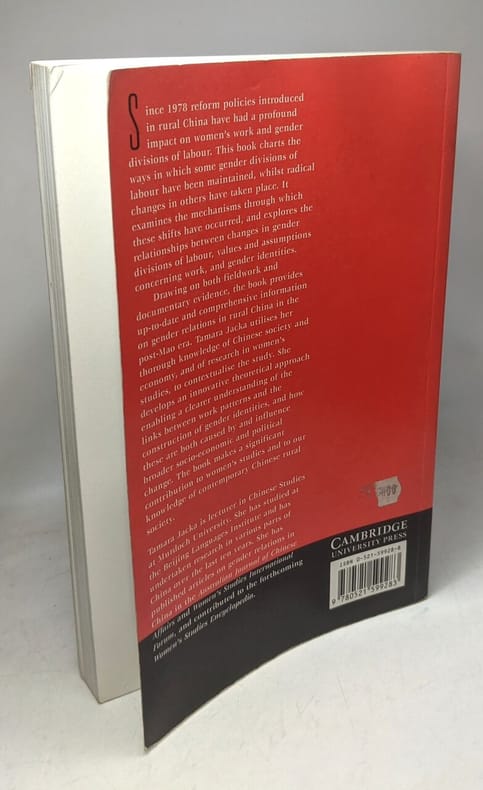
2008100122363Cambridge University Press 2008 276 pages 15 2x2 2x22 6cm. 2008. Broché. 276 pages.
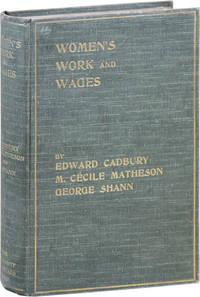
190711384Chicago: University of Chicago Press 1907. First American edition. Octavo. Green cloth boards; gilt spine titles; 368pp. Tight copy externally clean but with moderate foxing to text. Sociological study of female laborers in turn-of-the-century Birmingham. Illustrated with three halftone plates. Not common. University of Chicago Press unknown books
Fascinating account of the contibution of women to early cultures, with archaeological and anthropological evidence for their skills in weaving, spinning and the development of textiles. 334.illus Bibliography. index Book
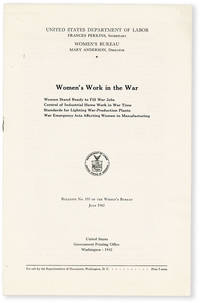
194250712Washington DC: United States Government Printing Office 1942. First Edition. Slim octavo 23cm; original printed wrappers stapled; 10pp. Mild wear and handling else Near Fine. Pamphlet issued as "Bulletin No.193" of the Women's Bureau U.S. Department of Labor highlighting the contributions of nearly 1.5 million newly-registered women in unemployment offices around the country. United States Government Printing Office unknown
1900231291900. Women's History Women's labor photo archive documenting women at work across millinery laundry commercial kitchen precision bench and wartime relief settings preserving a concentrated visual record of how female labor was publicly pictured in the years immediately preceding and overlapping World War I. Several photographs bear Brown Bros. New York stamps placing part of the group within the sphere of press photography while the verso inscription "Russian Women Filling Bandages for the front" situates one image within the culture of wartime female service and aid production. The photographs show women's work as a visible and varied part of early twentieth-century public life where skill repetition discipline and service shaped how female labor was pictured.<br /> <br /> Photo archive of 8 photographs 7 silver gelatin and one mounted sepia photograph ranging from 6 x 4 to 9.5 x 7 inches including New York and other unidentified locations circa 1900-1915. One Brown Bros. photograph shows a seated woman trimming or assembling hats at a worktable crowded with millinery forms and materials framing decorative labor as skilled commercial production rather than private handiwork. Another image shows four women and one man gathered around tables stacked with folded cloth corresponding to the handwritten verso note "Russian Women Filling Bandages for the front." A larger photograph inscribed on the verso "women workers / compass making" shows a woman seated at a bench adjusting a circular instrument with tools and components arranged before her. Another workplace view pictures a woman handling a metal object beside machinery and a crate with partial printed text ending in ".products. Cleveland." The photograph inscribed "women in Laundry" shows several women bent over long tables in a bright workroom lined with tall windows while the mounted sepia image depicts six apron-clad women at long counters beneath a large hooded vent in a commercial kitchen. Across the group aprons work dresses caps tables tools and stacked materials recur giving the photographs a shared emphasis on feminine labor as organized visible and socially legible.<br /> <br /> The archive belongs to a period when women's wage labor was expanding in both scale and visibility and when photography increasingly circulated images of female work as part of modern urban and wartime culture. Its strength lies in the range of roles pictured: decorative trade work industrial handling laundry labor food preparation and aid work directed toward the front all of which show how women's labor was understood through service dexterity endurance and collective effort. The bandage-making image is especially important because it connects ordinary workplace culture to the wartime recasting of women's labor as patriotic and humanitarian duty. Light surface wear scattered creasing minor silvering and fading and general handling wear; mounted sepia photograph with heavier toning. Overall good condition. A compact and pointed visual record of the cultural meaning of women's work at the point where everyday labor and wartime service converged. unknown
A butterfly symbolizes the beautiful, majestic life.One is enlightened where he takes life on its own terms as it unfolds. The meaning of life has to be created by every individual like a child borne of mother’s womb. One has to give life a purposes. It has to be created, chiselled, polished and made to shine with joy. That is why no two individuals are alike. Every human being is the creator of his own happiness. What is the sign of success? Success is a journey, not a destination. Successful person is one who has confidence, compassion, generosity and a true smile that none can snatch away. Today vast majority of people are running a mindless rat race because one is trying to be better than the other. “Being yourself is more than enough”. About The Author:- Asha Ranawat, born in the respectable family of Rajput – Rajawats in erstwhile state of Jaipur. She was married off early in the family of Ranawats in Mewar State. She is a woman of tremendous talent, with a multidimensional personality and full of joy de-vivre. Asha distinguished herself in various fields, prominent among them being a National winner is horse riding and an interior designer of repute. Extensively travelled round the world couple of times, Asha ran her own business for twenty two years with distinction till she found true joy of traversing mystic path of spirituality. Contents:- Acknowledgment • Introduction • My Life • Spiritual Journey • Count His Blessings • Some Images of Divine Help • My Travels Abroad. The Title 'Women's Triumph written/authored/edited by Asha Ranawat', published in the year 2006. The ISBN 9788178355085 is assigned to the Hardcover version of this title. This book has total of pp. 155 (Pages). The publisher of this title is Kalpaz Publications. This Book is in English. The subject of this book is Women Studies. Size of the book is 14.34 x 22.59 cms Vol:-
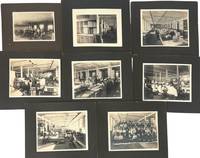
1918234351918. Women's industrial labor in an American textile finishing mill photographed likely between 1918 to 1922 documenting the inspection folding hemming and stamping of finished blankets and sheeting in the years around the First World War. The work shown belonged overwhelmingly to women who by 1920 made up about a fifth of the American labor force and were concentrated in exactly this kind of semiskilled textile work. The wartime labor shortage had pulled women deeper into industrial production and these images catch that expanded workforce on the floor before the 1919 recession and returning soldiers pushed women's share of factory labor back down. The conical galvanized fire buckets stenciled "Fire" mounted on posts in several frames date the images and tie them to the workplace fire safety reckoning that followed the 1911 Triangle Shirtwaist fire in which 146 workers most of them young women died.<br /> Photo archive of eight silver gelatin photographs approximately 6.5 x 8 inches mounted to card stock each measuring 12 x 10 inches with one smaller image American textile mill circa 1918 to 1922. Seven photographs show the mill interior: long finishing floors lined with cast iron columns and overhead pipe runs electric pendant lamps and tables stacked with uniform folded and rolled white goods tied with string. Women predominate at every station. They sit at inspection benches turning over folded cloth stand at long tables rolling and bundling sheeting and run a row of treadle and electric sewing machines hemming finished pieces with thread spools and machine heads sharp in the foreground. One worker operates a rack of hand stamps the date and numbering stamps used to mark finished goods before shipment. A few older men in vests dark suits and detachable collars stand among them as foremen and supervisors. One frame shows the shipping area with finished goods crated in wooden boxes stenciled for transport. The classroom image stands apart from the mill series: teenage students seated at ornate cast iron school desks a wall clock and a chalkboard covered in arithmetic. The eighth and largest subject is a full staff group portrait of roughly eighty workers overwhelmingly women posed on the production floor against stacked bundles of finished cloth with a length of white sheeting unrolled across the floor at their feet.<br /> The years these images were made were among the most volatile in American labor history. In 1919 more workers went on strike than in any year before some four million people twenty-two percent of the workforce and in June 1920 Congress created the Women's Bureau within the Department of Labor by Public Law 66-259 the first permanent federal agency charged with the welfare of wage-earning women which began studying the eight-hour day for women in 1921. The textile finishing trade these women worked in had been built on female labor since the start of the industrial revolution and the staff portrait records the scale and the gender composition of one such workforce directly. These photographs showing women's industrial work the fire buckets the stamping rack the sewing line the crated shipment ties the archive to specific developments in labor safety and women's employment law. Overall in very good condition with the mounts showing minor edge wear and some en verso pencil markings. unknown
ABOUT THE BOOK:- This book is here because of fifteen years of research. During this time, I was witness to women’s superiority, women doing better in every field. Women now control research and research outcomes. This has led to the destruction of old and dangerous myths about the biological inferiority of women espoused by men. Through this new research, women’s bodies and minds have in fact been proven superior. I want women and girls to continue on this trend of becoming scholars and progressive thinkers like Amina Wadud. Her authority over the Quran is not matched by anyone else. Upon reading her books, I knew my research was complete. She has the ability to be analytical without taking a man’s perspective. I hope that women and girls everywhere will take a stand for themselves and learn of their superiority. ABOUT THE AUTHOR:- I was born in Damoh on November 14, 1949. My maternal grandfather, Dr. N. Chetterge delivered me. His wife, my grandmother, was a jew and they raised my mother as a Christian. My father's family belongs to the landlords. His mother's first cousin was Zakir Hussain, the first Muslim President of India. I have four brothers who have remained in India. After a call from my Uncle to visit, I departed to America in 1975. In 1977, I married Mirza Baig. We have two children. My son Zameer is married and has a child, Noah. My daughter is a practicing lawyer who earned her J.D. from Northwestern University in Chicago. I was educated at St. John's College in Agra and Aligarh University. I later earned my political science degree from Clarion University of Pennsylvania. I became interested in women's empowerment so I received my PhD in Gender Equality from Lucknow University. CONTENTS:- ?Acknowledgements 11 Preface 13 1. Introduction 15 Why Men are Bad? Why women are not doing anything? All… are not enough; even oprah chooses obama and not Hillary for President? 2. The Superiority of Women 29 Myth about women and their real superiority… Women are not standing up for other women and their daughters. 3. World Religion 65 World religion speaks the same language, to put women down. They all say to put women in their place. Most men want to put women in their place… so they are denied for any rights – political, economical, social, religious or educational. 4. Women’s Rights and Superiority in Sixth Century 77 What happened to women’s rights that Qur’an gave in Sixth century? ? Qur’an Vs Hadees – when mullas talk they think they know but it is bad interpretation by men. 5. Conclusion 125 New rules and ideas about Human Rights gone Education for every one… New thinking and interpretation for and by women. Bibliography 163 Index 173 The Title 'Women's Superiority Through Quran written/authored/edited by Zubeda Baig', published in the year 2016. The ISBN 9788121213110 is assigned to the Hardcover version of this title. This book has total of pp. 179 (Pages). The publisher of this title is Gyan Publishing House. This Book is in English. The subject of this book is Women Studies. Size of the book is 14.34 x 22.59 cms Vol:-
Women's studies as an academic discipline in gaining ground at rapid pace view its multi-faceted development and infrastructure. An academic version of the solution of the feminist movement, this discipline studies the women's problems and reflects with solutions. The pioneering work will help understand the subject and evolve methodology for research. About The Author:- Dr. A. Suryakumari received he M. A. and Ph. D. degrees in History from Sri Venkateswara University Tirupati. She was Professor of History at St. Mary’s College, Tuticorin, before moving to Mother Teresa Women’s University, Kodaikanal, as Professor and Head of the Department of Historical Studies. Contents:- Foreword • Preface • Prefatory Note • Contributors • Beyond the Altekarian Paradigm: Towards a New Understanding of Gender Relation in the Early Indian History • Methodolgy in Women’s History––An Intergenerational Study of a Family • With in the Zenana : Readings From “ A Certain Housewife’s Diary” • Use of Field-Work in Research on Women • Reconstructing Women’s History : Problems and Paradigms • The Challenge of Women’s History • Towards a Historiography of Women in People’s Struggles • Special Address • Women’s Studies in Andhra Pradesh : A Historical Perspective • Index The Title 'Women's Studies: an Engineering Academic Discipline written/authored/edited by A. Surya Kumari', published in the year 1993. The ISBN 9788121204576 is assigned to the Hardcover version of this title. This book has total of pp. 143 (Pages). The publisher of this title is Gyan Publishing House. This Book is in English. The subject of this book is Women Studies. Size of the book is 14.34 x 22.59 cms Vol:-