8 005 résultats
1974ZB393093NY: Women Studies Abstracts 1974-1998. Volumes 3-26 1974-1998 partly bound library markings textually clean & tight price is for the lot. - If you are reading this this item is actually physically in our stock and ready for shipment once ordered. We are not bookjackers. Buyer is responsible for any additional duties taxes or fees required by recipient's country. Photos available upon request. NY: Women Studies Abstracts unknown
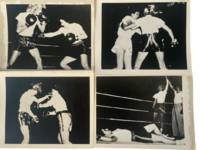
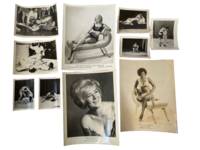
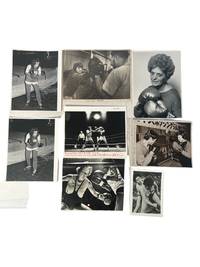
1970201881970. Women's boxing photograph archive 1974 to 1983 documents women as fighters trainers judges and sanctioned competitors during a period when boxing remained one of the most heavily gendered professional sports. The archive provides primary visual evidence of women's participation in combative athletics before women's boxing received Olympic recognition as a medal sport in 2012 and it records several forms of ring authority: women entering the ring as athletes women training male and female boxers and Eva Shain appearing as a pioneering judge. Shain became the first woman to judge a world heavyweight championship bout when she scored the 1977 Muhammad Ali and Earnie Shavers fight at Madison Square Garden placing one image in this group within the broader history of women claiming official authority in professional boxing.<br /> <br /> The archive consists of eight black-and-white silver gelatin photographs of women boxers and women in combat-sport settings circa 1970s to 1980s measuring from approximately 5 x 7 inches to 8 x 10 inches. One press photograph shows a co-ed boxing match between Sheila McGuire and Buddy DiBenedetto in a ring with a referee watching closely behind them. Another press photograph shows Eva Shain at age seventy-one wearing boxing gloves presenting her public identity through the equipment of the sport she judged. A 1983 photograph shows boxing coach Butch Fohndan training a young woman at Palmer Boxing Club in Alaska. A 1974 photograph from Japan shows Masako Takatsuki training a young male boxer; the attached press information identifies Takatsuki as a twenty-seven-year-old cosmetician and the only female boxing trainer-manager then licensed by the Japan Boxing Commission to spar and act as a second. Another action photograph shows an outdoor wrestling match between Gisa Pipa and Aggi Tillman with Tillman holding Pipa from behind. Two photographs show an unidentified woman near a boxing ring in a crouched stance with a direct combative expression suggesting training or promotional posing. The final 1975 photograph shows Sharon Allbery charging toward Zinda Foster at Seattle Center Arena in what contemporary women's boxing history sources identify as the first sanctioned female prizefight in Seattle Washington and the Pacific Northwest.<br /> <br /> The photographs are significant because they show women's boxing as a developing practice rather than a single symbolic breakthrough: fighters in sanctioned and mixed bouts a female judge associated with a heavyweight title fight a Japanese woman trainer-manager local gym instruction and women using combat poses to claim athletic presence. Their strongest research value lies in the way they document the infrastructure around women's boxing including referees licenses gyms press captions arenas and training relationships alongside images of women's physical force. Light handling wear and minor edge wear; press details present on several images; photographs remain crisp with clear ring gym and figure detail; overall very good. Concentrated women's sports photography archive documenting the contested expansion of women's boxing and combat-sport authority in the 1970s and early 1980s. unknown
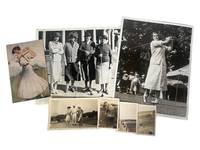
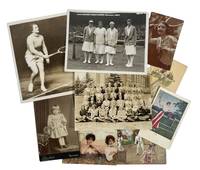
1900200841900. Women's tennis archive early 1900s to late 1930s documents female athletic participation across childhood portraiture illustrated popular culture press coverage and competitive play. The group is important for the history of women's sports because it records how women and girls were pictured entering a game that moved from elite recreation into organized competition during the late nineteenth and early twentieth centuries. The official history of Wimbledon notes that the Championships added Ladies' Singles in 1884 establishing one of the most visible formal venues for women's tennis and this archive preserves the visual culture that developed in the decades after that institutional change.<br /> <br /> The archive consists of ten visual items dated from the early 1900s to the late 1930s: three silver gelatin photographs one albumen cabinet card five brightly illustrated postcards and one real photo postcard with sizes ranging from approximately 1.75 x 2.75 inches to 6.5 x 8.5 inches. The largest press photograph dated 1933 shows Helen Jacobs in action and identifies her in the attached release as America's "outstanding woman athlete." Another press image shows four female champions standing side by side before a packed Wimbledon stadium with a newspaper article taped to the verso noting their scores. The earliest image an albumen cabinet card shows a little girl holding a small tennis racket while one illustrated postcard presents a co-ed trio on a tennis court in the early twentieth century. The remaining postcards and photographs extend the archive's range from playful and decorative representations of tennis to more direct evidence of women's organized competition. Half of the postcards bear handwritten inscriptions on the verso and two of the three press photographs retain original article clippings taped to the back.<br /> <br /> Taken together the group shows the changing public image of women's tennis from carefully posed early depictions shaped by restrictive dress codes to 1930s press photography centered on speed competition and celebrity. The official Wimbledon history also notes that equal prize money for men and women was not adopted there until 2007 a reminder that the athletic visibility seen in these images long preceded full institutional parity. Light handling wear overall with typical age toning and minor surface wear; inscriptions and verso attachments remain present; overall very good. Varied and visually engaging archive for the study of women's athletics press representation and the long development of competitive tennis culture. unknown
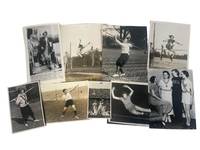
1910200811910. Women's competitive golf archive 1910s to 1930s documents women golfers in practice tournament and club settings during the formative decades of organized women's golf in the United States. The group provides visual evidence of women's athletic participation in a sport long associated with country-club respectability social access and gendered expectations about dress leisure and competition. The U.S. Women's Amateur Championship began in 1895 as one of the USGA's first three championships and the USGA identifies it as marking the beginning of women's competitive golf in the United States; these photographs and postcard show how that competitive culture appeared in everyday and press imagery in the decades that followed. <br /> <br /> The archive consists of seven items dated between the 1910s and 1930s: six silver gelatin photographs and one brightly illustrated postcard measuring from approximately 1.75 x 2.75 inches to 7.25 x 9 inches. The photographs include a 1934 press image of golfer Barbara Stoddard in a swing position; a 1935 lineup from the Annual Women's St. Valentine Golf Tournament identifying Helen Waring Sarah Fownes Wadsworth Myrom W. Marr and W.C. Fownes Jr.; three small circa 1928 photographs of women positioned with clubs on a golf range; and an early 1930s image of two women posed with a man at a country club the women holding several clubs with one woman wearing trousers. The illustrated postcard from the early twentieth century shows a woman swinging a club in an athletic outfit still shaped by long-skirted fashion rather than later sportswear. Across the group recurring details include golf clubs held as markers of athletic identity posed swings tournament lineup conventions country-club settings and changing women's clothing from long skirts to less restrictive dress.<br /> <br /> The archive records women's golf as both competitive sport and social performance making visible the relationship between athletic skill class-coded club culture and evolving public ideas about women's physical capability. Its strongest research value lies in the mix of press photographs vernacular practice images tournament documentation and illustrated popular culture allowing comparison between women as actual competitors and women as stylized sporting subjects. Light handling wear minor edge wear and typical surface wear to photographs and postcard; images remain clear and identifiable; overall very good. Cohesive women's sports archive documenting early twentieth-century women golfers as competitors club participants and subjects of changing athletic representation. unknown
1910201861910. Women's participation in boxing long preceded formal recognition of the sport for female athletes developing through informal exhibitions training clubs and novelty bouts that challenged prevailing gender norms. Although women were largely excluded from organized boxing competitions during the nineteenth and early twentieth centuries scattered photographic evidence demonstrates that women continued to box recreationally and publicly despite social restrictions. This archive of photographs dating from the early twentieth century through the mid twentieth century documents women participating in boxing across a range of informal settings illustrating the gradual emergence of female athletic culture in a sport historically defined as masculine.<br /> <br /> Archive of sixteen black and white photographs including six silver gelatin prints and one real photo postcard measuring approximately 2.5 x 3.5 inches to 3.5 x 5.25 inches dating from the 1910s through the 1950s. The earliest image a real photo postcard dated August 1914 depicts two women wearing corsets and long dresses while sparring with boxing gloves before a mixed group of spectators. The postcard bears a pencil inscription on the verso reading "August 1914 For fun women boxers Francis Edith." Another early photograph shows two women posing with gloved fists raised before a snowy background with the inscription "Grace Miss Vandehei boxing This is Grace's roommate. A fine girl she's here now." Later photographs from the 1920s depict staged boxing encounters between a man and a woman with the female boxer dressed in athletic trousers and high heeled shoes reflecting the novelty and spectacle often associated with early female boxing exhibitions. One image shows the pair squared off with raised fists while another captures the moment of a punch landing against the man's chest. Another photograph shows two women sparring on a ship deck while surrounded by onlookers one boxer wearing a dress and curlers beneath her head covering while raising her gloved fists before a mixed audience of men and women.<br /> <br /> Boxing has historically generated controversy due to its physical intensity and female participation in the sport remained marginal for decades. Women occasionally boxed publicly as early as the eighteenth century yet organized opportunities remained rare. Women's boxing appeared briefly as a demonstration sport at the 1904 Olympic Games in St. Louis and training clubs such as Andrew Newton's Women's Boxing Club in London emerged during the 1920s. Nevertheless women's boxing did not become an official Olympic sport until the 2012 Olympic Games. The photographs in this archive illustrate the persistence of women athletes who trained and competed informally despite these restrictions offering visual evidence of women's athletic experimentation and resilience during a period of shifting gender expectations in sport. Sixteen photographs including silver gelatin prints and a real photo postcard measuring approximately 2.5 x 3.5 inches to 3.5 x 5.25 inches. Photographs clear and well preserved with light handling wear. Overall condition very good. unknown
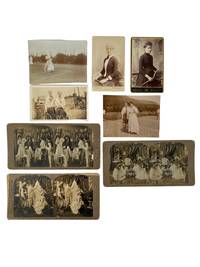
1880206021880. Unidentified photographers female tennis player photograph archive ca. 1880s-1910s documents women's participation in organized sport and recreational culture during the late nineteenth and early twentieth centuries supporting research into gender roles physical activity and educational environments for women in the Victorian and Edwardian periods. The group captures tennis as one of the few socially sanctioned athletic pursuits for women showing both formal portraiture and active play. The inclusion of seminary-based stereoviews alongside studio cartes-de-visite and outdoor scenes establishes a transatlantic visual record of how tennis intersected with women's education leisure and identity formation during a period of restricted physical and social mobility.<br /> <br /> Eight original photographs including five albumen prints and three stereoviews sepia toned ranging from approximately 2.5 x 4 inches to 3 x 4.5 inches. Two cartes-de-visite depict waist-length portraits of women holding tennis rackets dressed in late nineteenth-century attire including fitted bodices and high collars; versos bear photographer imprints for Hellis & Sons of London and George Goodman of Margate. Additional images show women engaged in doubles matches on grass courts including one action-oriented scene with players mid-swing wearing wide-brimmed hats and layered dresses. One photograph shows two young women in matching outfits possibly school uniforms standing in a yard holding rackets. The three stereoviews dated 1905 and issued by C.H. Graves of Philadelphia are captioned "A Masquerade at the Seminary Confidences" "Trying on the Costumes" and "Planning to Scare the Freshies" each depicting groups of young women in a dormitory interior; tennis rackets are visible mounted on the wall in the background linking athletic culture to residential school life. Based on the photographer and setting the images may relate to a women's seminary such as Darlington Seminary in West Chester Pennsylvania.<br /> <br /> Produced during the decades following the introduction of lawn tennis to the United States in 1874 the archive situates women's participation in sport within broader developments in leisure education and shifting norms of female physicality. The imagery documents the persistence of restrictive dress including corseted garments and long skirts even in athletic contexts underscoring the negotiation between mobility and propriety. Minor surface wear consistent with age with strong image clarity and tonal stability across prints. Overall in very good condition. unknown
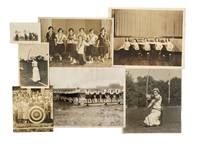
1910219051910. Archive of original photographs documenting women's participation in athletics and organized physical culture during the early twentieth century when women's sports and exercise programs increasingly became accepted within schools colleges camps and recreational organizations. The photographs show women engaged in archery synchronized gymnastics calisthenics and cheer leading during a period when female athletic participation expanded alongside broader debates concerning women's health education public visibility and social independence. The photographs provide visual evidence of the physical culture movement as it shaped women's recreational and educational environments in the United States and abroad preserving both formal athletic training and communal performance activities that contributed to changing expectations surrounding women's physical activity and public presence.<br /> Collection consists of seven original silver gelatin photographs dating approximately from the 1910s through the 1930s. The archive includes several photographs of women participating in organized physical education exercises and athletic activities while dressed in period sporting attire. One image dated July 5 1928 documents uniformed women performing synchronized gymnastic drills during a Sokol Festival dress rehearsal in Prague capturing rows of participants in coordinated motion during a major international physical culture gathering influenced by Central European nationalist and athletic traditions. Another photograph from the 1910s-1920s shows a group of young women posed with medicine balls Indian clubs and batons while wearing sailor-inspired gymnasium uniforms associated with school or collegiate athletic programs. A separate 1930s image depicts a cheerleading squad in matching lettered "S" sweaters posed in formation within a school auditorium. Archery appears prominently throughout the archive. One press photograph portrays Olympic diver and sportswoman Helen Meany Balfe standing with a bow on the grounds of White Sulphur Springs West Virginia as identified by a typed caption on the verso. Another image depicts Stella M. Ives identified in manuscript drawing a bow while dressed in full sporting attire. A vernacular photograph portrays four young women practicing archery in the hills above Troy New York including one identified as Louise Hatch of Troy with a handwritten verso inscription linking the group to Bridgewater Massachusetts. The final photograph shows a large assembly of young women gathered on outdoor steps beside a prominent archery target possibly at a camp or collegiate event emphasizing organized recreation and group participation.<br /> The archive documents the increasing visibility of women's athletic participation during the early twentieth century when organized exercise and sports became associated with women's education health reform and public modernity. Physical culture programs in schools colleges camps and civic organizations promoted athletics as both disciplined recreation and social training while sports such as archery and gymnastics offered women expanded opportunities for public competition and physical expression. Particularly notable is the range of activities represented from regimented calisthenic performance to recreational archery and cheerleading illustrating the broad spectrum of athletic environments available to women before the widespread professionalization of women's sports. Light wear and occasional handling marks consistent with age; photographs remain well-preserved overall in very good condition. A visually engaging archive documenting the growth of women's athletics and physical culture in the early twentieth century. unknown
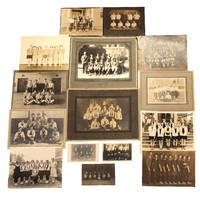
1918185121918. Women's basketball photograph archive 1918-1929 documents the early institutionalization of women's competitive athletics in the United States recording team organization uniform development and player identification in the decades following the sport's introduction to women's education. Basketball adapted for women in the 1890s under the direction of physical educator Senda Berenson at Smith College expanded into intercollegiate and regional competition by the early twentieth century despite ongoing debate over women's participation in organized sport. These images provide direct visual evidence of that expansion with named players and structured teams indicating the normalization of women's basketball within school and community settings during the interwar period.<br /> <br /> Archive of 15 silver gelatin photographs ranging in size from approximately 3.5 x 5.5 inches to 11 x 13 inches dating between 1918 and 1929. All images are formal team portraits with groups of six to twelve players in some cases accompanied by coaches. Many photographs include handwritten identifications on versos naming players or teams. Several compositions feature a central player holding a basketball marked with team initials and year. The photographs document changes in athletic dress including high top sneakers short skirts sailor style tops and later variations incorporating shorts reflecting evolving standards of movement and athletic practicality. Produced during a period when women's athletics expanded within educational institutions while remaining subject to cultural scrutiny the archive provides material for the study of gender norms physical education and the development of organized sport prior to formal Olympic inclusion of women's basketball in 1976. The progression of uniforms and team structures across the decade offers evidence of shifting expectations regarding women's physical activity and public visibility in competitive environments. Light edge wear and minor foxing to some prints; images remain sharp and fully legible. Overall very good condition. unknown
Women of Manipur both in the valley and the hills enjoy a comparatively better position than their counterparts in the rest of the country. For the last many decades they have actively participated in the social, economic, cultural and political life of the state. Though the society is deeply patriarchal, women are the major bread earners, and except in the policy making they enjoy considerable freedom in their day to day life. The book tries to bring out the fact that in spite of the vast differences in the life styles and social structures among the women of Manipur, there are considerable similarities too and as their roles widened they are mentally and intellectually equipped to tackle problems of the state, terrorism, violence inflicted on innocent citizens and other conflicting problems between the state and the insurgents. Patriarchal discourses however perpetuating evidently do not always succeed in drowning women out from the various social and political movements in Manipur. The study also covers present issues and a number of workable suggestions are also proposed to bring the women to the mainstream of development and bring about their emancipation completely. The study also tries to look at the women of Manipur like the Meiteis, the Kukis, the Nagas and the Meitei-Pangal or Muslim women from the traditional to modern scenario which provides vital information. It is hoped that this study which is an exploratory study will be of immense help to students, research scholars and others interested in women study. About The Author:- Dr. Tingneichong G. Kipgen, M.A., Ph.D. is a Selection Grade Lecturer in the Department of History, G.P. Women's College, Imphal, Manipur. She graduated from Leretto College, Darjeeling. She took her M.A. degree and Ph.D. degree from Manipur University. She has attended several seminars and also contributed seminar papers at the State level seminars and also at the North East Regional Seminar. Dr. Tingneichong is at present actively associated with women studies. Contents:- Foreword • Preface • Acknowledgements • Introduction • Meitei Women’s Role • Meitei Pangal Women’s Role • Kuki Women’s Role • Naga Women’s Role • Women and Health • Conclusion • Bibliography • Index. The Title 'Women's Role in the 20Th Century, Manipur: a Historical Study written/authored/edited by Teighei Chong Gangte', published in the year 2010. The ISBN 9788178358031 is assigned to the Hardcover version of this title. This book has total of pp. 202 (Pages). The publisher of this title is Kalpaz Publications. This Book is in English. The subject of this book is North-East Indian Studies / Women Studies. Size of the book is 14.34 x 22.59 cms Vol:-
197146195New York: Women's Rights Law Reporter Inc 1971-72. First Edition. Two quarto issues 27.5-28cm; stapled wrappers; 71; 55pp; illus. Some trivial dust-soil to wrapper extremities else very Near Fine. First two issues of this periodical dealing with legal issues facing women and women's rights. Includes poetry essays on childcare birth control mental health women in prison education unionizing legal workers etc. Women's Rights Law Reporter, Inc unknown books
Name on front end paper. No other marks or inscriptions. No creasing to covers. A very clean very tight pamphlet with slightly foxed unmarked rear cover and no bumping to corners. 20pp. A report on the problems facing women in gaining employment.
19992083002116411160Iwanamishoten 1999. Soft Cover. Fine. The book is in fine condition. Iwanamishoten paperback
1023921154.Ghardcover. Good. Access codes and supplements are not guaranteed with used items. May be an ex-library book. hardcover
1023926520.Gpaperback. Good. Access codes and supplements are not guaranteed with used items. May be an ex-library book. paperback
50665988like new. unknown
50650763like new. unknown
There is luminous literature available relating to women but very little attention is given towards the property rights of women. The law of inheritance is an important subject to be considered because it ensures the future security of women to arrival social tragedies. According to the UN. Report 1980, the women constitute half the world's population but possesse only one percent of immovable property. Despite the plethora of international conventions and declarations and legislative steps but the help system discriminates to inherit the property. In ancient times the women were devoid of any. Contents:- Contents, Preface 13, Abbreviation 17, Table of Cases 23, 1. Introduction 39-55, • An Overview 39, • Indian Scenario 45, • Practical Significance of Different Acts 50, • Another Legislative Step (The Amendment, Act of 2005) 51, • Hypothesis 53, • Scheme of Work 53, • Research Methodology 54, 2. Concept of Women’s Property under 57-78, Different Legal System, • An Overview 57, • Concept of Property 57, • Under Different Legal System 61, A. Islamic Law 61, • Hanafi School • Maliki School, • Shafii School • Hanalii School, • Shia School, B. Hindu Law 64, • Classification of Property, • Stridhana • Women’s Estate, C. Christian Law 72, • Concept of Matrimonial Property 48, D. Parsi Law 75, • Recapitulation 50, 3. Shares of Females under different, Legal System 79-191, • An Overview • Development of Family, System • Law of Inheritance in Different, Religo Legal System, A. Islamic Law 86, • Salient features • Nemo Est Heirs, Vevents • Dual Basis of Islamic Law of, Inheritance • Near in Degree Exclude, the Remorter • Rule of Representation, • Rule of Spes-Successionis • No, Concept of Joint Family • No Rule of, Primogeniture • No Birth Right • No, Concept of Survivorship • Rules, Relating to Illegitimate Child • Insanity, and Unchastity • Non-Muslim not be an, Heir • Homicide • Missing Person, • Unborn Person as being Heir, • Several death at a time, • Kinds of Heirs 89, • Sharer • Residuaries • Distant, Kindred, • Fluctuation of Shares among the, Sharers and Residuaries 98, • Apportionment of Heritage 100, • Doctrine of Awl • Doctrine of Radd, • Shia Law of Inheritance 101, • Comparison of Sunni and Shia, Law of Inheritance 104, B. Hindu Law 118, • Definition of Hindu • Position of, Women’s Property Right in Old Hindu, Law • Fundamental Changes Brought, by the Act of 1956 • Coparcenary • Joint, Family • Undivided Hindu Family, • Position of Women’s Property Right, after, 1956 • Critical analysis of Certain, Provisions of Hindu Succession Act of, 1956 • Section 6 before 2005 • Section, 6 after 2005 • Uniform Succession, whether really exist after 1956 ?, • Section 8, 8 Women’s Property Rights in India, • Kinds of Heirs 122, • Heirs specified Class I • Heirs, specified Class II • Heirs specified Class, III • Heirs specified Class IV., • Some Controversial Heirs 23, • Legitimate or Illegitimate Child, • Remarried Widow • Concubine., • Enlargement of Women’s estate (sec.14) 123, • Rao Committee Report 123, • Section 14 • ‘Any property’ - meaning 124-129, of • ‘possessed by female Hindu’, • Female Hindu • ‘Whether acquired, before or after the Commencement of, the Act’ • ‘Shall be held by her as full, owner thereof and not as a limited, owner’., • Succession of a Hindu Female Intestate 129-135, • Class I Heirs • Class II Heirs, • Class III Heirs • Class IV Heirs, • Class V Heirs • Section 15., • The Order and Manner of Distribution 135-136, • Some General Principles 136-137, • Preference of Full Blood over Half, Blood • Mode of Succession of two or, more Heirs • Unborn Child, • Simultaneous Death • Preferential, Right., • Section 23 before 2005 137, • Section 23 after 2005 137-140, • Heirs not Entitle to Inherit 141-142, • Remarried Widow after 2005, • Murderer • Conversion • Disqualified, Heir be Deemed Died • Abolition of the, Old Disqualification of Hindu Law., • Hindu Succession Amendment Act 2005 142-156, • The Effect of the Amendment Act,, 2005 • The Kerala Joint Hindu Family, System (Abolition) Act, 1975 • The, Andhra Pradesh Hindu Succession, (Amendment) Act, 1985 • Amendments, in other States • Critical Analysis of the, CONTENTS:- 9, 10 Women’s Property Rights in India, Amendment Act, 2005 • Deletion of Sub-, Section (2) of Sec. 4 of Principal Act •, Amendment of Sec. 6 • Induction of, Daughter as Coparcener • Prospective, Effect • Hindu Undivided Family •, Distinction between the Females of, Hindu Joint Family • Rule of, Survivorship • Mitakshara-Coparcenary, • Deemed Partition • Discrimination, between the Coparceners • No, Discrimination between Married and, Unmarried Daughters • No Provision, for the Devolution of the Interest of, Female Coparcener • Abrogation of the, Pious Duty of Son to Pay Father’s Debt, • Omission of Sec. 23 • Deletion of Sec., 24 • Amendment of Sec. 30 • Heirs, under the Amendment Act., C. Christian Law 156-158, • Indian Christian • Application of the, Act of 1925 • General Principles of the, Succession of a Christian., • Rules Regarding Domicile 158-161, • Trader or Merchant • Foreign, Representatives • Legitimate and, Illegitimate Child • Lunatic Person, • The Effect of Marriage to Regulate, the Succession • Abolition of English, Concept of Matrimonial Property, • Different Domicile of Spouses., • Intestate Succession 161-170, • Kinds of Heirs • Husband and Wife, • Widow and Widower • Judicial, Separation • Lineal descendants, • Lineal descendants of first degree, • Lineal descendants of Second degree, • Lineal descendants of third degree, • Lineal descendants not of same, degree • No Lineal descendant degree, • Doctrine of Escheat • In case of Nun, • Travancore Christian Succession Act, and the Cochin Succession Act., D. Parsi Law 170-191, • Succession of Parsis • General, principles of Intestate Succession of a, Parsi • Posthumous Child • PreContents, 11, Deceased Child • Remarriage, • Distribution of Property among, Widow, Widower, Children and Parents, • Distribution of Share of Predeceased, Child of Intestate leaving Lineal, Descendants., • Heirs 174, • If there is no lineal descendants but, a widow or widow of any lineal, descendant • If there is no lineal, descendants nor a widow or widower, nor a widow of any lineal descendant, The relatives who are not otherwise, entitle to inherit., 4. Comparative Study of Women’s Property, Rights under Different Legal System, • An Overview • Definition of, Comparative Law • Different Families, of Law • Romano Germanic Family •, The family of Common Law • The family, of Socialist Law • The family of, Religious Law., • Development of Different Religious Law 192-220, • Muslim Law • Hindu Law • Christian, Law • Comparison of General Rules of, Succession of Different Laws., • Comparative Charts 203-220, • Comparison of the Shares allotted to, Females in Different Capacities •, Mother, Grand mother, Great grand, mother, Step mother and Mother of an, illegitimate child • Widow, Widow of, predeceased son, Widow of predeceased, son’s son (his) and Widow of brother •, Sister, Consanguine sister and Uterine, sister • Daughter, Son’s Daughter and, Daughter’s daughter • Some, Comparative Illustration., 5. Judicial Responses 221-225, • An Overview • Historical Background, • Development of Indian Legal System, • Role of Judiciary in Developing the, Women’s Property Right., • Islamic Law 225-241, • Pre-lndependence Period • Post, Independence Period • During First, Decade • During Second Decade, • During Third Decade • During Fourth, Decade • During Fifth Decade., • Current Position 242, • Hindu Law 242, • Pre-lndependence Period • Post, Independence Period • During First, Decade • During Second Decade, • During Third Decade • During Fourth, Decade • During Fifth Decade., • Current Position 258-264, •Implementation of New (Amendment), Act of 2005 • Latest Cases upto 2009., • Christian Law 265-269, •Pre-lndependence Period • Post, Independence Period., • Current Position 269, • Parsi Law 270-272, • Pre-lndependence Period • Post, Independence Period., • Current Position 273, 6. Summation and Suggestion 281, Bibliography 295, Encyclopedias 307, Reports 307, Journals 309, Articles 309, Periodicals & Dailies 313, Acts and Statutes 313, International Conventions and Declarations 315, Index 319 The Title 'Women's Property Right's in India With Latest Amendments and Cases written/authored/edited by Urusa Mohsin', published in the year 2010. The ISBN 9788178357904 is assigned to the Hardcover version of this title. This book has total of pp. 330 (Pages). The publisher of this title is Kalpaz Publications. This Book is in English. The subject of this book is Women Studies. Size of the book is 14.34 x 22.59 cms Vol:-
Cover has general wear of edges and corners and crease at spine. Minor wear to corners of early and last pages. Pages are clean and bright throughout. Library stamps on prelims. Library sticker on tail of spine and front cover. Library pocket on half - title page. Illustrated with diagrams and tables. Third Edition, Reprint Ex - Library
1940206421940. Women's Sports Women's wrestling photograph archive documenting amateur competitions gymnasium training and professional wrestling performers between the 1940s and the 1970s. The images record women participating in a sport historically dominated by men illustrating the gradual emergence of female wrestling as both an amateur athletic activity and a professional entertainment circuit during the mid twentieth century.<br /> <br /> Archive of ten photographs including nine black and white silver gelatin prints and one sepia toned image measuring approximately 3.5 x 4.5 inches to 8 x 10 inches. Several early photographs from the 1940s depict women grappling in an indoor ring during staged matches. Later images show girls wrestling during a gymnasium class setting while classmates watch from the sidelines. Three studio photographs from the 1970s portray professional wrestlers associated with promoter Mary Lillian Ellison known professionally as The Fabulous Moolah.<br /> <br /> Portraits include full length promotional photographs of Joyce Grable of Ozark Alabama Lilly Thomas of Memphis Tennessee and a headshot of Paulla Kaye of Oklahoma City Oklahoma. These performers were active on the professional wrestling circuit during a period when women's wrestling was gaining visibility in regional promotions across the United States. Female wrestling remained controversial throughout much of the twentieth century facing both cultural criticism and sensationalized marketing. Light wear consistent with age. Very good condition. A visual record of women participating in amateur and professional wrestling across several decades of American sports culture. unknown
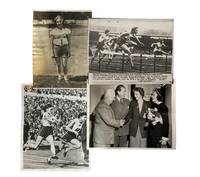
1925218901925. Women in Sports Archive of four photographs documenting women's track and field achievements from 1925 to 1956 highlighting pioneering female athletes in Olympic and exhibition competition. Includes NEA and United Press photo service stamps and typed caption slips on versos. The images span the 1920s to post-WWII era and depict notable moments in women's sports history from athletes representing Australia the Netherlands and beyond. They capture critical milestones in the visibility and legitimization of women in professional athletics especially in Olympic contexts where female participation was still relatively novel and contested.<br /> <br /> Included is a striking 1956 action shot of Australia's Shirley Strickland clearing the final hurdle en route to her gold medal victory in the 80-meter hurdles at the Melbourne Olympics where she set a new Olympic record of 10.7 seconds. The image is identified via an INP Radio Soundphoto caption. A 1952 United Press photo from Helsinki captures the dramatic baton drop in the women's 4x100 relay by Australia's Marjorie Jackson who had earlier taken gold in the 100-meter sprint; the caption dramatically underscores how the error "killed Australia's chances." A third image shows Dutch Olympic legend Fanny Blankers-Koen-winner of four gold medals at the 1948 London Games-greeted with tulips and accolades at New York's Idlewild Airport in May 1955. The accompanying caption notes her role as both a mother and athletic icon foregrounding the persistent framing of female athletes through maternal identity. Lastly a ca. 1925 press photo shows an unnamed track competitor on the field with the reverse stamped August 11 1925 suggesting the early presence of women in organized publicly documented competition during a decade when such participation was still controversial. All images well-preserved with clear annotations on three captioned photos. Overall very good condition. This archive offers an illuminating view into women's evolving presence on the global athletic stage highlighting moments of both triumph and adversity in a narrative of gender progress within competitive sports. unknown
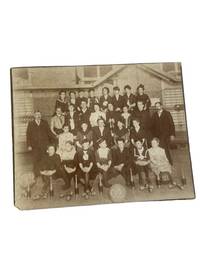
1902182601902. Original Albumen photograph of women in physical education class. 1902. Measures 9.75 x 8 inches. Mounted to photographer's board. Image shows 26 women and girls seated in tiers and posing with various early exercise equipment including dumbbells and large leather balls marked with the year. One man poses wiwth the women in suit and tie and two older men presumably instructors pose alongside the girls one of them extending a hand to touch the shoulder of the girl beside him who looks away. The women's eyes are turned from the camera expressions fixed and unsearchable. They appear to be in a school gymnasium a ladder hung like a track on the wall behind them and racks of free weights beneath it. Women's exercise was first introduced as calisthenics a European import in the 1830s which consisted of light choreographed movements not unlike dance steps. By the late 1800s exercise had been closely linked to women's educational reform. Educational activist Catherine Beecher advocated broadly for physical education as a safeguard for female health and for forming good physical habits in the young. Corner very slightly clipped on one side. Light sunning to image. Overall good condition. unknown
1921185131921. Unidentified photographers photograph archive of women's track and field athletes 1921 to 1949 documenting the expansion of women's participation in international athletics and Olympic competition during the early twentieth century. The material provides primary visual evidence of women competing in events historically excluded from female participation supporting research into gender and sport Olympic history and the institutional acceptance of women's athletic achievement across multiple nations.<br /> <br /> Archive of nine silver gelatin photographs many issued as press images with original article clippings or captions mounted on the verso while others include handwritten identifications of athletes. The photographs depict women actively engaged in track and field events including javelin throwing high jumping and discus. One press photograph shows Fanny Blankers-Koen arriving by airplane captioned as an Olympic champion and mother following her victories at the 1948 Summer Olympics where she won four gold medals. Another image issued as a photographic postcard captures Gisela Mauermayer mid-discussion throw during the 1936 Berlin Olympics with a full stadium and officials visible in the background. Additional photographs include three javelin throwers identified on the verso three high jumpers captured in motion clearing the bar and one press image depicting a coach with members of a women's Olympic track team in uniform accompanied by descriptive captions outlining their roles and achievements. The images emphasize athletic motion competition settings and formal presentation through press distribution.<br /> <br /> Nine photographs ranging in size from approximately 3.75 x 5.5 inches to 8 x 10 inches. These images emerge from a period in which women's track and field gained increasing international recognition following initial exclusion from Olympic competition with early twentieth-century advocacy and independent competitions contributing to eventual inclusion. The presence of Olympic medalists alongside lesser-known competitors situates the archive within a broader landscape of athletic participation and achievement. Minor edge wear and occasional surface markings including ink notation on one image; otherwise photographs remain clear and well-preserved; overall very good condition. A focused visual record of women's athletic advancement and Olympic participation in the early twentieth century. unknown
Good English Paperback. Pbo. 4to. (33 x 24 cm). In English and Turkish. 3 chapters: Pakistan: In English.; Turkey: In English.; Pakistan: In Turkish. 164 p. Women's newspaper special issue.= Pakistan. Kadin Gazetesi özel sayisi.
Contents:- Contents: Preface 9: 1. Introduction to Women’s Movements in India 13: Origin of the "Women's Movement" in India • The: Anti-Rape Movement: The beginning of a feminist: movement? • The Blank Noise Project• Dalit Women’s: Movement in India.: 2. Indian Women’s Movement : Towards a 33: Complete Mapping: Socio-Religious Reform Movements • Women’s: Organisations Started by Men • Women’s Organisations: Started by Women • National Women’s Organisations: • Votes for Women • Reform of Personal Laws• Women: in the National Movement • Women in the Labour: Movement • First Phase of Women’s Movement: An: Assessment • The Women’s Movement: 1970s to the: Present • Towards Equality Report • Human Rights,: Gender and Environment • Towards a Complete: Mapping the Women’s Movement in India • Social: Reform Movement and Pre-Independent India: • Women’s Participation in the Struggle for: Independence • The Western vs Ethnic Critique of the: Indian Women’s Movement • Post-Independent India: • ‘Towards Equality’ Report: A New Beginning • Birth: of the ‘Autonomous’ Women’s Movement • Law and: its Relationship with Empowerment • Birth of the: Women’s Movement in Goa • Times and Tides of: Change within the Women’s Movement.: 3. Women in India: Focus on Sexism and Sexual 73: Rights: History • Ancient India • Medieval Period • Historical: Practices • Independent India • Timeline • Culture: 6 Women’s Movement in India: • Education and Economic Development • Education: • Workforce Participation • Land and Property Rights: • Crimes Against Women • Sexual Harassment • Child: Marriage • Female Infanticides and Sex Selective: Abortions • Domestic Violence • Trafficking • Other: Concerns • Family planning • Notable Indian Women: • Sexism in India • Women’s Reservations: • Discrimination Against Women • Violence Against: Women • Sexual Harassment • Selective Abortion and: Female Infanticide • Education • Military Service: • Women Movements in India and its Importance on: Sexual Rights • Understanding the "Rights Approach": • Bringing Sexuality into Rights • Understanding: Sexuality • Sexual Rights: What are the Existing: Articulations? • Sexual Rights versus Human Rights:: What is the Relationship? • Sexuality and Identity:: Who will Claim Rights? • Sexual Rights in the Indian: Context • Sexual Rights, the State, and the Law: • Sexual Rights and Health • Sexual Rights and the: Women's Movement • Sexuality, Rights and LGBT: Movements • Sexual Rights and Funding • Sexual: Rights and Sex Work • Constraints to the Fuller Use: of Sexual Rights • Where does one speak of sexuality?: • Levels of Disconnect • Rights as Distancing: • Thematic Lessons and Ways to Move Forward: • Addressing the Knowledge Gap • Ideas, not Ideology: • Seeking Tangible Roots • The Need for Broader: Alliances • Grappling with Larger Structures.: 4. Feminism, Ecofeminism, Globalisation and 131: Women’s Movement in India: Types of Feminists • Feminism and Nationalism • Eco-: Feminism • Value System and Social Movement • For: Environmentally Sound Social Production • Dialectic: of Capitalist Patriarchy • Women Possess Power for: Change • Realities of Hierarchies • Women-Environment: Relations Historically Variable • Material Base of: Women's Knowledge Declining • A Wide Spectrum of: Social Conflicts • OIpposition to Dam Projects • Women: Role in Chipko Movement • Women's Participation in: Movements of Sixties and Seventies • Relationship: CONTENTS:- 7: between Religion and Patriarchy • Globalisation and: its Impact on Women's Movement in India: • Globalisation and Women in India: Some Macro: Considerations • Introduction to India's Women's: Movement.: 5. Towards Revisiting the History of Indian 169: Women’s Movements: Emergence of Gender Issues • Search for Cohesion: • Identity, Colonialism and Independence, and the: Nation-State • History of India and Its Women • The: "Woman's Question" and Men's Answers, 1820-1920: • The Social Reform Movement • The Colonial and: Nationalist Responses • Women Question and Seek: Answers, 1920-70 • Associations • Politics • The: Contemporary Women’s Movement: Solidarity and: Schism, 1970–99 • The New Women’s Movement: • The Uniform Civil Code Controversy • The: Development of Personal Laws • Efforts at and Debates: on Reform • Uniform Civil Code • The Shah Bano: Case and Its Aftermath • Overlooked Issues: • Uniformity and Diversity • The Law and the State: • Reserving Seats for Women in Legislative Bodies: • Empowerment and Political Representation • The: History of the Debate • Progress and Problems: • Current Arguments • Women, power, and politics: • Conclusion.: 6. Towards Understanding the Relationship 231: between Women’s Movements in India and Law: Relationship between Women’s Movement and Politics: of Identity • Relationship between Violence Against: Women and Politics of Ideology • The Role of the: Mathura Rape Case in Shaping the Movement’s: Ideology • Relationship between Dowry and Dowry: Violence • Relationship between Population Policy and: Women’s Movement in India • Relationship between: Political Reservation and Women’s Movement in India: • Indian Feminist Movement and Norms to Regulate: Vocations.: 8 Women’s Movement in India: 7 Modern Agenda and Major Challenges of 267: Women’s Movement in India: Towards Understanding the New Challenge to Existing: Social Movements • The Women’s Movement in India: • Towards Understanding the Secular Culture as an: Agenda • Women and Communal Forces • Towards: Merging of Demands : The Issues of Obscenity and: Uniform Civil Code • Towards Understanding the: Myth of a Progressive Hindu Code • Towards: Redfining Women’s Rights within Communal: Organisations • Towards Listing the New Challenges: during the Post-Riot Phase • Towards Understanding: the Extended Social Space for Women During Conflict: • Revisiting the Moment for Reflection in Women’s: Movement in India • Women's Movement in India :: Major Challenges • Gender Biases and Discrimination: • Issues Related to Sex Ratio •Issues Related to Health: and Survival • Issues Related to Discrimination in the: Political Sphere • Issues Related to Discrimination in: Access to Jobs, Land and Resources • Issues Related: to Demeaned and Denied Dignity • Issues Related to: Women Workers • Issues Related to Unequal Access: to Work • Issues Related to Women's Work: Least: Paid, Most Exploited • Issues Related to Agriculture: Sector and Rural Labour • Issues Related to Rural: Health and Education Workers • Issues Related to: Domestic Workers • Issues Related to Women in: SHGs • Issues Related to Impact of Economic Crisis: and Neoliberal Policies • Issues Related to Sex: trafficking and Sex Workers • Issues Related to: Women's Freedom Under Attack • Violence on Women: • Issues Related to Alarming Rise in Sexual Violence: • Issues Related to Laws Against Violence on Women: • Issues Related to Politicians, Police, and Violence on: Women • Issues Related to State Repression • Issues: Related to Communal and Caste Violence on Women.: Bibliography 305: Index 317 The Title 'Women's Movement in India written/authored/edited by B. Ramaswamy', published in the year 2013. The ISBN 9788182055339 is assigned to the Hardcover version of this title. This book has total of pp. 340 (Pages). The publisher of this title is Isha Books. This Book is in English. The subject of this book is Women Studies. Size of the book is 14.34 x 22.59 cms Vol:-
Depression and anxiety are rampant in America. Twice as many women as men are afflicted. They suffer in silence, are misdiagnosed, or aren't even aware of their risk. Here is a bold new explanation for why women's unique brain chemistry makes them vulnerable to mood problems.and what they can do about it. Only this book details all the risk factors, including the brain's sensitivity to female hormones, life stresses, reproductive events, and a woman's genetic history. Combining more than forty years of clinical work with their own personal experiences, the authors share a self-care program that helps the brain self-stabilize to alleviate and prevent problems. They also advocate early, customized use of medication before problems become entrenched. This powerful, proven approach is a call to awareness for women who have been trying to "be strong" for too long. 352p, bibliography. index. Book