Women HistoryBiblio.com

8 007 résultats
1944147961944. Bloom Barbara C. Typed Letter Signed to WAVES officer's mother and accompanying photographs 1944 documents United States Navy WAVES service during World War II and the recognition of women's military labor within the wartime home front. The material captures the relationship between enlisted women's service and familial acknowledgment situating women's naval participation within the broader Allied military campaigns against Germany and Japan. The letter explicitly ties the daughter's service to active wartime offensives while the accompanying photographs provide visual evidence of WAVES personnel in both formal and informal settings offering insight into daily life camaraderie and presentation of women in uniform during the final year of the war.<br /> <br /> Bloom Barbara C. Typed Letter Signed. Office of Naval Procurement December 1944. One page. Accompanied by six black-and-white photographs of Navy WAVES stationed aboard USS Hunter. The letter addressed to Mrs. Cadman praises her daughter's contribution to the war effort stating: "You have the right to be very proud of what your daughter has done in speeding our recent offensive ever closer to the heart of Germany and Japan" and includes statements attributed to Franklin D. Roosevelt and Ernest J. King recognizing the WAVES' service. It further references the daughter's conduct discipline and contribution to the reputation of the organization. The six photographs depict groups of uniformed WAVES women aboard USS Hunter including posed portraits group formations and informal off-duty scenes in which women are gathered socially. One larger photograph bears period handwritten identifications on the reverse naming the women pictured. Image sizes range from small personal formats to larger prints capturing both individual and collective representation.<br /> <br /> The Women Accepted for Volunteer Emergency Service WAVES program established in 1942 expanded the role of women within the U.S. Navy by assigning them to non-combat duties thereby releasing male personnel for deployment. By 1944 WAVES had become an established component of naval operations with thousands serving in administrative technical and logistical roles. The letter reflects official efforts to frame women's service as both militarily essential and socially respectable emphasizing family pride moral conduct and national duty. The photographs reinforce this narrative through visual presentation of uniformed discipline and group cohesion. Together the materials provide direct documentation of women's participation in wartime service and the integration of that service into domestic and public recognition structures during World War II. Light edge wear and minor foxing to photographs; one image with handwritten identifications on verso; letter with docket holes at top margin not affecting text; overall very good condition. A cohesive grouping linking official wartime communication with visual documentation of WAVES personnel. unknown
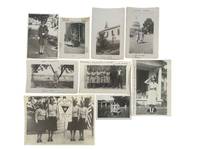
1943220591943. Women's Army Corps service photographs dated 1943 to 1944 document the participation of enlisted women in U.S. Army support operations during World War II with particular attention to transportation training environments and stateside military life. The images identify individual service members including Hilda Goble described in captions as an "ambulance driver during War II" and Abbie E. Bachelder situating named women within the broader expansion of female labor following the establishment of the Women's Army Corps in 1942. These photographs support research into women's military service wartime labor structures and the integration of women into logistical and medical support roles essential to the functioning of the U.S. Army during the war.<br /> <br /> Archive consists of 9 original silver gelatin photographs most approximately 3 x 5 inches several with scalloped or deckled edges and period ink captions identifying subjects and dates. Two portraits show Hilda Goble in full uniform standing before a porch and saluting each inscribed "Hilda Goble Ambulance driver during War II" documenting her role in transporting injured personnel within military systems. A group photograph captioned "Ambulance Driver Team War II Hilda Goble" depicts seven uniformed women indicating coordinated service within ambulance units. Additional images include a portrait labeled "Abbie E Bachelder / June - 1944" showing a uniformed WAC posed before a landscape of barracks buildings and another dated 1943 identifying Bachelder outside a wooden structure. A photograph captioned "Oct 29 - 1944 / Reims" shows two women identified as Roberta and Abbie posed on the grounds of the U.S. Capitol indicating travel or official assignment within government contexts. Other photographs depict WAC personnel standing near a military chapel and within training or hospital environments while one image titled "Marine Corps Wives of America - Hdqtrs Chap 1" shows four women beneath an organizational banner documenting affiliated civic or support networks connected to military service.<br /> <br /> These images documents the Women's Army Corps expantion to meet wartime labor demands assigning women to clerical transportation medical and logistical roles across domestic and overseas installations. The presence of ambulance drivers within the archive demonstrates the direct involvement of women in medical transport and support infrastructure while scenes at the U.S. Capitol and organized groups indicate both official recognition and the development of social and institutional networks among servicewomen. Light edge wear and minor creasing with one photograph showing tape residue; images otherwise clear with captions legible; overall very good condition. This archive provides a concentrated visual record of named WAC personnel and their roles within the operational and social framework of the U.S. Army during World War II. unknown
" . this highly acclaimed sourcebook examines the public and private lives and legal status of Greek and Roman women. The texts represent women of all social classes, from public figures remembered for their deeds (or misdeeds), to priestesses, poets, and intellectuals, to working women, such as musicians, wet nurses, and prostitutes, to homemakers. The editors have selected texts from hard-to-find sources, such as inscriptions, papyri, and medical treatises, many of which have not previously been translated into English. The res ulting compilation is both an invaluable aid to research and a clear guide through this complex subject.The third edition adds new texts to sections throughout the book,420p. illus bibliography. index Book
" ... this highly acclaimed sourcebook examines the public and private lives and legal status of Greek and Roman women. The texts represent women of all social classes, from public figures remembered for their deeds (or misdeeds), to priestesses, poets, and intellectuals, to working women, such as musicians, wet nurses, and prostitutes, to homemakers. The editors have selected texts from hard-to-find sources, such as inscriptions, papyri, and medical treatises, many of which have not previously been translated into English. The res ulting compilation is both an invaluable aid to research and a clear guide through this complex subject.387p. illus bibliography. index [a few underlinings] Book
Revised and enlarged edition of "Women in Greece and Rome" A Collection of translated documents illustrating the life of women in classical times.293p.bibliography, index. Book
15383China WOMEN October League Marxist-Leninist. Chicago: October League 1976. 16 pages. 5.5" x 8.5" illustrated with black and white photos of Women's Day marches the woman are all performing tasks at work on the image. Minor soiling good copy in stapled pictorial wraps. unknown books
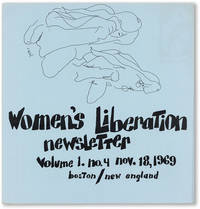
196946193Boston: New England Free Press 1969. First Edition. One-sheet newsletter offset printed on blue stock folded twice to create an eight-panel publication; measures 45.5cm x 43.25cm 17 15/16" x 17" when fully-opened. Hint of sunning to folds else very Near Fine. New England feminist publication printing lengthy statements from Lucia Montague and Diana Gerrity; the newsletter opens into an illustrated poster printing letters quotes poems women's lib news items and movement events. A list of suggested literature appears on rear wrapper. New England Free Press unknown books
1976153831976. China WOMEN October League Marxist-Leninist. Chicago: October League 1976. 16 pages. 5.5" x 8.5" illustrated with black and white photos of Women's Day marches the woman are all performing tasks at work on the image. The Liberation of Women in China. Printed by Highland Park: Internationals Socialists n.d. 49 pages. 5.5" x 8.5" inches. Original wrappers Pamphlet. Argues that the liberation of women in China had become subordinate to the needs of the state and industrialization. Highland Park: International Socialists n.d. circa 1970s. Original printed wrappers 49 pages. 5.5 × 8.5 inches. Tables footnotes.<br /> <br /> A scarce radical pamphlet issued by the International Socialists examining the gender politics of post-revolutionary China. The work critiques the Chinese Communist Party's claims to women's emancipation contending that the liberation of women had been made subordinate to the demands of state-building and industrial growth. In opposition to official party rhetoric the pamphlet situates women's issues within the broader political economy arguing that while the Communist revolution opened limited avenues for women's participation in the labor force and public life genuine equality was sacrificed to the state's overriding needs of production modernization and social control. Tables and statistical data are included to support its argument with footnotes directing readers to both Chinese sources and Western Marxist analysis. Pamphlets from the International Socialists are relatively uncommon especially those with sustained attention to global feminist and socialist struggles. This text is significant in documenting how New Left and Trotskyist organizations in the United States attempted to reframe Chinese Communism through a feminist lens situating women's emancipation not as a fulfilled revolutionary promise but as a deferred and compromised project. For institutional collections it offers an important perspective on the intersections of gender Marxism and internationalism in the mid-20th century while also reflecting the intellectual currents of American socialist critique. Mild wear to wrappers otherwise well-preserved. Overall Very Good. unknown
Sticker to spine and FEP, stamp to page block and inside back cover. Until recently the Sociology of Leisure was dominated by theoretical approaches which made women's experiences invisible. Drawing upon feminist perspectives this book re - conceptualises leisure in order to provide a more informed understanding of women's leisure. The authors argue that such an examination necessarily involves a study of women's daily lives which views leisure in relation to the structure of their lives as a whole. Drawing upon a major study of Sheffield women's leisure and other sources, the processes of negotiation and social control are cited as crucial in determing women's access to free time and the resources required to enjoy leisure. Ex - Library
1st edition. Period Cloth, 4to, ca. 160 pages. Published bimonthly (1930-32) or quarterly (1932-34) . SUBJECT(S) : Conservative Judaism -- Periodicals. Conservative Judaism. Women's League for Conservative Judaism -- Periodicals. United Synagogue of America. National Women's League -- Periodicals. M United Synagogue of America. Later merged with: United Synagogue review and Torchlight to form: Voices of Conservative/Masorti Judaism. OCLC hardcopy listings are unclear; at any rate, very few libraries seem to hold these early volumes in hard copy. Later binding, broken through at hinges, forms a kind of portfolio for the original issues, all with original wrappers. Very Good Condition thus. (women-5-3)
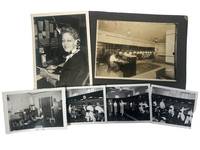
1900200911900. Telephone operator photo archive circa 1900 to 1958 documents women's labor within telephone exchange systems showing how urban communications depended on trained female operators seated at switchboards connecting calls handling information and maintaining the human infrastructure behind early and mid twentieth century telephone service. The material documents telephone communication labor through photographs of switchboard rooms operators wearing headsets plug boards supervisory presence and grouped clerical activity revealing how connection work operated in practice before automated dialing fully displaced manual exchange work. The archive supports research into women's wage labor communications history gendered office work New York telephone service and the disciplined workplace culture that positioned young women as the public voice and operational center of the telephone network.<br /> The archive consists of six black-and-white photographs including five silver gelatin photographs and one early albumen photograph with images measuring from approximately 3.5 x 4.25 inches to 7 x 9 inches. The date range appears to extend from the early twentieth century to 1958 based on the later dated images. Several photographs show women seated in tight rows facing large switchboards wearing heavy headsets with horn mouthpieces and working among dense arrangements of cords and plugs. The early albumen photograph shows a row of women facing the switchboards while a female supervisor watches over the room indicating both the gendered hierarchy and procedural discipline of the exchange floor. One image shows an operator turning toward the camera with a plug in hand smiling while gesturing toward the board. Four smaller photographs dated 1958 show teams of women moving between boards and a small group with paperwork behind the operating area; pencil inscriptions on the versos identify the location as New York.<br /> The photographs are valuable because they make visible the labor system behind telephone service: rows of operators standardized equipment supervisors paperwork and the coordinated manual routing of calls. They also record the gendered character of communications work in which women's voices posture speed and manner were made part of the service itself. Light handling wear minor edge wear and expected age toning; images remain crisp with equipment and personnel details clearly visible; overall very good. Strong women's labor and communications history archive documenting the human operation of telephone exchange systems across the first half of the twentieth century and into the postwar period. unknown
Blue-white octavo, 2-stapled binding, 30 pages ; 23 cm. Women -- Legal status, laws, etc.
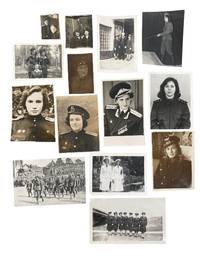
1941231851941. Women's HistoryMilitary Women's military service photo archive documenting the incorporation of women into military organizations in the United States Russia and Europe from the ear;y 40s through the end of World War II with especially strong evidence of uniformed training rank identity weapons instruction and military parades in the 1940s. The group shows women as enlisted or commissioned participants in military systems in portrait sittings unit groupings drill formal dress and liberation era parade culture. Several images center on Czechoslovak and Soviet aligned visual culture at the end of the war including a Prague parade photograph explicitly identifying women volunteers attached to the 1st Czechoslovak Army on 17 May 1945 placing female service on the public stage of postwar victory.<br /> Photo archive of 14 likely silver gelatin photographs ranging from 1.5 x 2 to 3 x 5.5 inches United States and Europe circa 1910s-1945. The archive includes formal studio portraits of individual women in military tunics with shoulder boards insignia peaked caps and medals; a close portrait of a decorated woman officer wearing a sash and multiple campaign medals; and a full length image of a young servicewoman holding a rifle on what appears to be a stage or drill platform. Group scenes include seven women in matching belted uniforms and caps posed outdoors near a long low building captioned 1944 three women in service dress photographed among trees and two women in white formal or naval style uniforms standing in a landscaped garden. A small early portrait shows a younger female figure in uniform beside an older woman extending the chronology back before the Second World War. The Prague parade image is the most textually grounded item: its printed Czech caption states that the military review of the 1st Czechoslovak Army was held in Old Town Square on 17 May 1945 in the presence of President Edvard Beneš and identifies the marching contingent as women volunteers assigned to that army. Recurring themes across the collection include rank display military insignia paired and group portraits emphasizing unit identity and the shift from informal military support to organized involvement and state recognition.<br /> Across the first half of the twentieth century women entered military institutions through auxiliary organizations medical and communications branches transport and administrative service anti aircraft and weapons training and in some national contexts direct incorporation into regular formations. This archive tracks that process through its own evidence: portraiture records accession into uniformed hierarchy group photographs show women organized in units the rifle image places female service within martial training rather than clerical abstraction and the Prague review demonstrates how women's wartime labor and service were folded into liberation politics and postwar state ceremony. The international span gives the group unusual strength for institutional collecting on women's military history because it places American and European service culture in one frame and shows the common mechanisms by which states made women visible disciplined and legible within military life between the two world wars and at the end of the second. Light to moderate wear scattered creasing edge wear handling marks and some fading or softness to several prints; overall good condition. This is a compact but pointed body of photographic evidence for how women were absorbed into military systems through uniform training ceremony and public recognition across the WWI-WWII era. unknown
0259026824.Gpaperback. Good. Access codes and supplements are not guaranteed with used items. May be an ex-library book. paperback
0483206253.Ghardcover. Good. Access codes and supplements are not guaranteed with used items. May be an ex-library book. hardcover
20012111902154610780Sagashinbunsha 2001. Soft Cover. Fine. The book is in fine condition. Sagashinbunsha paperback
1880194351880. Cowgirl imagery in late nineteenth and early twentieth century American visual culture documents the public fascination with women performers and riders associated with rodeo culture Wild West exhibitions and frontier mythology. Eighteen postcards dating from approximately the 1880s through the early 1920s depict cowgirls mounted on horseback performing actions associated with Western riding culture including firing revolvers and rifles galloping across open terrain and lassoing livestock. The images correspond to a period when female riders and sharpshooters gained national attention through rodeo competitions traveling Wild West shows and early popular media representations of the American frontier. Several postcards depict identifiable rodeo performers including Gene Fisher and Mildred Douglas whose participation reflects the visibility of women riders in Western entertainment and exhibition culture.<br /> <br /> Eighteen postcards dating from approximately the 1880s to about 1920 depicting cowgirls in action poses across Western landscapes. The archive includes both real photo postcards and printed postcards produced using color lithography and chromolithography several of which feature embossed design elements. Each postcard measures approximately 5.5 x 3.5 inches. The scenes portray women riders equipped with bandoliers pistols and rifles while mounted on horseback amid rugged Western environments populated by wild horses and cattle. One image shows a rider firing a revolver with visible muzzle flash as the horse rears back while another depicts a cowgirl swinging a lasso above her head. A real photo postcard shows rodeo rider Gene Fisher mounted on horseback and another image depicts female rodeo cowgirl Mildred Douglas riding a bucking steer. Several postcards contain handwritten messages referencing Western towns and travel including one reading "Dear Uncle Brainard is quite a town and plenty of saloons here."<br /> <br /> Visual representations of cowgirls became an established element of American frontier mythology during the late nineteenth and early twentieth centuries shaped by traveling Wild West shows rodeo exhibitions and early illustrated postcards circulated as souvenirs of Western identity. Performers such as female sharpshooters and rodeo riders appeared alongside male counterparts in popular entertainment challenging conventional gender expectations by presenting women as skilled riders marksmen and performers in public spectacles of frontier life. These postcards reflect the intersection of popular print culture and the romanticized imagery of the American West during the decades when rodeos and frontier reenactments were widely promoted as symbols of national heritage. Eighteen postcards measuring approximately 5.5 x 3.5 inches. Colors remain bright on the printed examples and the photographic postcards retain clear contrast. Minor handling wear typical of early twentieth century postcards. Overall condition very good. unknown
20012111902158501950Sagashinbunsha 2001. Soft Cover. Fine. Number of pages: 598p. Size: 27cm Sagashinbunsha paperback
0265604079.Ghardcover. Good. Access codes and supplements are not guaranteed with used items. May be an ex-library book. hardcover
0282950648.Gpaperback. Good. Access codes and supplements are not guaranteed with used items. May be an ex-library book. paperback
1963153231963. Tereshkova Valentina. Signed photograph commemorating the historic flight of the Soviet cosmonaut who became the first woman to travel into space during the Cold War competition between the United States and the Soviet Union. Valentina Tereshkova launched aboard Vostok 6 in June 1963 completing a three day mission in which she orbited the Earth forty eight times. Her flight followed closely after the first human spaceflight by Yuri Gagarin in 1961 and marked a major milestone both in the development of human space exploration and in the participation of women in aerospace history.<br /> <br /> Tereshkova Valentina. Signed Photograph. Color photograph measuring approximately 8 x 10 inches. The image is signed in blue ink at the lower right corner in cursive Cyrillic and includes the inscription "Vostok 6." The portrait presents Tereshkova as a cosmonaut of the Soviet space program and commemorates the mission that established her international reputation as the first woman to travel into space.<br /> <br /> Tereshkova's flight formed a central moment in the early years of the space race when both superpowers sought technological and symbolic achievements demonstrating the capabilities of their space programs. The Vostok 6 mission represented a milestone not only for Soviet aerospace engineering but also for the global recognition of women's participation in scientific and technological fields traditionally dominated by men. Tereshkova's accomplishment became an enduring symbol of women's achievements in space exploration and Cold War scientific competition. Tiny crease in the upper right corner; otherwise well preserved. Overall very good condition. unknown
197043333Santa Monica CA: Graphic Communications Consultants 1970. First Edition. Quarto 27.75cm.; original pictorial staplebound card wrappers; unpaged; illus. Fine. 1970-1 calendar curiously beginning in July 1970 rather than January and ending in June 1971 each day of the year providing a number of relevant anecdotes quotes and historical events marking the progress of women's liberation. Bibliography provided. Forms part of the Women's Heritage Series. Graphic Communications Consultants unknown books
1999Q-1579540554Rodale Press Inc 1999-01-01. Hardcover. New. New. In shrink wrap. Looks like an interesting title! Rodale Press, Inc hardcover
No marks or inscriptions. Slight creasing to covers, none to spine. A very clean very tight copy with bright unmarked boards and no bumping to corners. 112pp. A study of the sport of gymnastics and an approach to developing technique, discipline, courage and endurance the it aimed at women from the British Amateur Gymnastics Senior Coach.
16725Denmark Academy Catalog 1876-1877. Denmark Iowa. Pamphlet /Volume 8 of 17: Founded in 1843. Denmark Academy was coeducational from its inception. At first a small local school it reopened in in 1852 with a new building and began to attract students from further reaches. The first graduating class consisted of only 2 students both female. One was Emma Cooper who went on to serve as "Lady Principal." Very rare with no copies of this program in any institution or library as per OCLC Worldcat.<br/><br/>Women's colleges proliferated in the mid- to late- 19th century to fill the void created by their exclusion from most institutions of higher education. The prevailing notion that women were too delicate for a rigorous academic education was openly challenged when Elizabeth Cady Stanton spoke at the Seneca Falls Convention of 1848 "Man's intellectual superiority cannot be a question until woman has had a fair trial.When we shall have had our colleges our professions our trades for a century a comparison then may be justly instituted." Young women were quick to step up to the challenge; as quickly as female colleges opened they filled up. This document dates from 5 years before Seneca Falls. unknown books