REDOUTE, Pierre-JosephLivre Rare Book
692 508 résultats
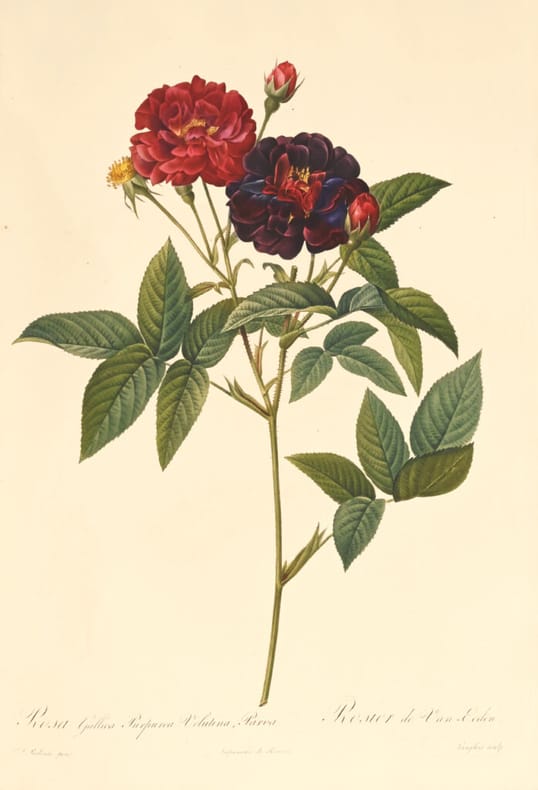
LCS-18447169 superbes roses dessinées par Redouté rehaussées avec un grand raffinement de coloris très délicats à l’époque. Paris, de l’imprimerie de Firmin Didot, Imprimeur du Roi, 1817-1824. 3 volumes in-folio de I/ 156 pp., 1 portrait hors-texte, 1 frontispice colorié, 56 estampes en couleurs hors-texte, (1) f. de table; II/ 122 pp., 59 estampes en couleurs hors-texte, (1) f. de table; III/ 125 pp., 54 estampes en couleurs hors-texte, (1) p. d’errata, (1) f., pale mouillure en fin du volume 3 n’affectant pas les estampes. Demi-maroquin rouge à coins, dos lisses ornés de filets dorés et roulette estampée à froid formant faux-nerfs, grands fleurons dorés à la rose. Reliure de l’époque ornée de roses. 368 x 270 mm.
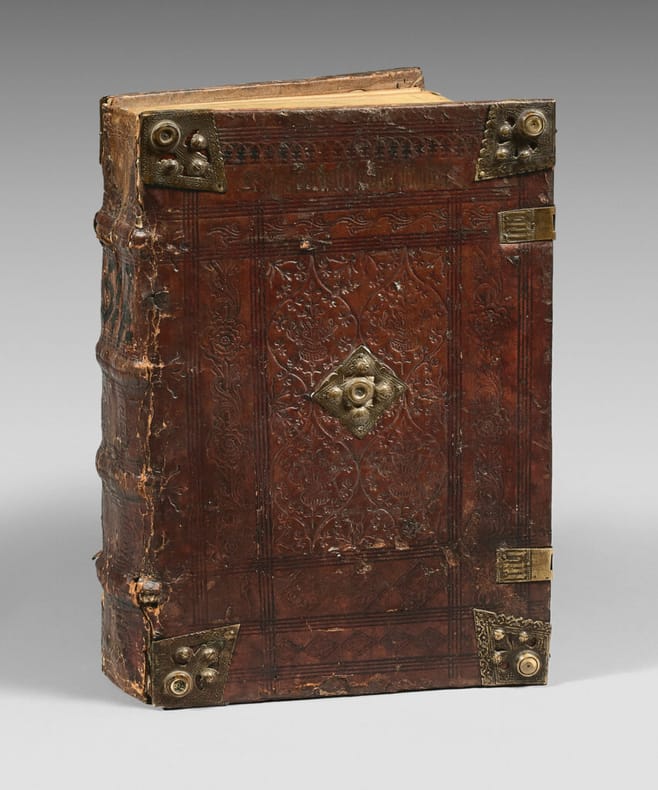
LCS-17768L’iconographe absolument superbe se compose de 96 grandes figures gravées sur bois, à pleine page spécialement dessinées pour le texte. Nuremberg, Anton Koberger, 8 novembre 1491. In-folio de (353) ff., signés a-z6 (a6 blc), ab-ad6, ae8, A-Z6, Aa-Gg6, Hh10 (Hh10 blc), pts. trous en marge des 4 premiers ff., gde. initiale enluminée au f. aiiii verso, ancien petit travail de vers dans la marge intérieure des cahiers x, y et ab sans atteinte à la gravure, infime mouillure angulaire aux ff. 310-311 et 340. Le dernier feuillet Hh10, blanc, n'a ici pas été conservé. Le texte, orné d'une grande initiale enluminée, a été rubriqué en rouge et bleu. Veau brun sur ais de bois, plats décorés d'un décor estampé à froid de motifs végétaux et animaliers dans des encadrements de filets, aux angles et au centre, cinq bouillons de cuivre, sur le premier plat, titre de l'ouvrage [Schatzbehalt D’Ewige Seligkeit] en lettres dorées usées, dos à nerfs orné d'un motif de roses à froid répété, tranches naturelles, traces de fermoirs ouvragés. Petits défauts à la reliure. Reliure de l'époque. 329 x 228 mm.
8vo. (16), 149 ff. (misnumbered as 159), (1) p., (23) ff., with woodcut diagram (f. 144), woodcut headpieces and initials. Bound in 19th c. polished tan calf, gilt spine, gilt borders to covers, gilt turn-ins, marbled pastedowns, red edges, silk ribbon bookmark, stamped by binder "Dupré" on front flyleaf. First edition of this important travelogue by the Venetian state jeweller and gem merchant Gasparo Balbi, detailing his nine-year voyage from Venice to the Far East between 1579 and 1588, and a work of special historical interest for its eyewitness information about the Arabian Peninsula in this early period. In this book, Balbi was "the first writer to record the place names between al-Qatif and Oman that are still in use today" (G. R. King, p. 74). His "interest in the area lay in the pearls that came from the oyster beds of which the most extensive are those in the waters around al-Bahrayn, those off the Qatar peninsula and especially those in the western waters of Abu Dhabi. Either taking his information first-hand from a local individual or using a navigator's list, Balbi recorded place-names along the coast of modern Qatar, the United Arab Emirates and the Sultanate of Oman" (G. King, p. 248). According to Slot, "practically none of the names of places on the coast between Qatar and Ras al Khaima occur in other sources before the end of the eighteenth century" (p. 36). The present work is also of the highest significance for including "the first European record of the Bani Yas tribe" (UAE Yearbook 2006, p. 20), the largest and most important tribe of the Arabian Peninsula, from which emerged both the Al Nahyan and the Al Maktoum dynasties, today's ruling families of Abu Dhabi and Dubai. - Balbi travelled extensively in the Arabian Peninsula in search of precious stones. He knew "the waters off the Abu Dhabi coast as the Sea of Qatar and mentions the following places now in UAE territory: Daas (Das), Emegorcenon (Qarnein), Anzevi (Azanah), Zerecho (Zirkuh), Delmephialmas (Dalma), Sirbeniast (Sir Bani Yas), Aldane (Dhanna), Cherizan (identified as Khor Qirqishan, just off Abu Dhabi island), Dibei (Dubai), Sarba (Sharjah), Agiman (Ajman), Emelgovien (Umm al-Quwain), Rasa-elchime (Ras al Khaimah), Sircorcor (Khor al-Khuwair), Debe (Dibba), Chorf (Khor Fakkan) and Chelb (Kalba)" (G. R. King, UAE: A New Perspective, 74). From Venice Balbi sailed for Aleppo, proceeding to Bir and from there overland to Baghdad, descending the Tigris to Basra, where he embarked for India. The "Viaggio dell'Indie Orientali" proved to be the most widely read source of information about India throughout the next century. In the tradition of mercantile guidebooks, such as the 14th century "Practica della mercatura" compiled by Pegolotti, this is one of the few secular travelogues to the Orient published in the 16th century. And in addition to providing the kind of practical information required by merchants trading in precious stones among other wares, Balbi, with a jeweler's eye for rarities, allows himself considerable license in recording his personal observations at exotic sights (e.g., the cave Temples of Elephanta and his enthusiasm for elephant tusks f. 100v) or in mentioning incidental occurrences along the way, such as his chance meeting in Goa with the famous embassy of Japanese legates on their way home. Balbi dates his stays to particular places in a precise manner, always gives a careful explanation of the local system of exchange (coins, weights, and measures), describes commercial routes in India in detail and even includes a monsoon calendar. Balbi also discusses Goa, Negapatam, and Pegu (Burma), the latter a source of great fascination owing to its sensational wealth and the section most frequently anthologized in travel collections. The "Viaggio dell'Indie Orientali" was reprinted in 1600 (also rare). The account was translated into Latin and equipped with illustrations in the 1606 'India' volume of the De Bry series, and a partial English translation (above all, the section on Pegu) subsequently appeared in Purchas. An Arabic translation was published in 2008, but a full English translation never appeared. - Minor rubbing and edge wear to spine and boards. Narrow upper margin, mend at f. 25, otherwise remarkably well preserved. BM-STC Italian 68. Howgego I, B7. Cordier Japonica 112. Brunet I, 618. Graesse I, 279. Kress Library of Economic Literature S 276. B. J. Slot, The Arabs of the Gulf, 1602-1784. G. King, "Delmephialmas and Sircorcor: Gasparo Balbi, Dalmâ, Julfâr and a Problem of Transliteration," Arabian Archeology and Epigraphy, vol. 17 (2006), pp. 248-252. UAE Yearbook 2006, p. 20. G. R. King, "The Coming of Islam and the Islamic Period in the UAE," in UAE: A New Perspective, I. Al-Abed & P. Hellyer (eds.), pp. 68-97. W. M. Floor, The Persian Gulf: A Political and Economic History of Five Port Cities, 1500-1730. Lach, Asia in the Making of Europe, I.1, 473-475. Penrose, Travel and Discovery, 198. Placido Zurla, Di Marco Polo e degli altri viaggiatori veneziani piu illustri, II, 258-265. J. Charpentier, "Cesare di Fedrici and Gasparo Balbi," Indian Antiquary LIII (1924), pp. 51-54.
8vo. IX, (1), 502, 32 pp. With half title, folding lithographed diagram and publisher's adverts at end dated June 1859. Original green cloth covers bound in as pastedowns, cloth spine mounted on first free endpaper at the end. Modern blue morocco, gilt, marbled flyleaves. Stored in custom-made slipcase. First edition, first issue, of "the most important single work in science" (Dibner), and "a turning point, not only in the history of science, but in the history of ideas in general" (DSB). "No work of science has ever been so fully vindicated by subsequent investigation, or has so profoundly altered humanity's view of itself and how the living world works" (Wilson). - This first impression of the first edition can be distinguished from later impressions of the work through the presence of the misprint "speceies" on p. 20, which was corrected in the second impression. This copy handsomely rebound but still retaining the cloth binding of Freeman's variant b. Of the first edition of 1250 copies, fifty-eight were distributed for review and presentation, this being one of them: the slip of paper "with Mr Darwin's compliments", uncommonly in Darwin's own hand, tipped in at beginning. Small closed tear in the folded table, very light soiling and foxing at the beginning, but a good, clean and uncut copy. - Provenance: small ink stamp of Francis Darwin Swift (1864-1944), grandson of Charles Darwin's uncle Francis Sacheverel Darwin, showing a leaf-bearing stag and the name "F. Swift" in blackletter. PMM 344. Dibner Heralds (1980) 199. Eimas Heirs 1724. Freeman 373. Garrison/Morton (1991) 220. Grolier, Science 23b. Norman 593. Sparrow, Milestones 49. Waller 10786.
Two sheets joined (470 x 740 mm to the neat line, full margins showing the plate mark, overall size 550 x 790 mm). An extraordinary example of "the first modern map of the Arabian peninsula" (Al-Ankary), by far the best copy we have ever handled: the first issue of the first edition, a strong impression on thick white paper with excellent contrast and exceptionally broad margins. "L'opera è dedicata al mecenate Johann Jakob Fugger ... a firma Giacomo di Castaldi Piamonetse Cosmographo in Venetia" (Bifolco I, 380 for the first state of three). - Still the most sought-after map of the region, Gastaldi's two page wall-map served as a model for all further mapping of the peninsula until the 19th century. Gastaldi is regarded as "the most important 16th century Italian cartographer. His maps are very rare, as they were issued separately to order and were not part of an atlas" (Al-Qasimi, 1st ed., p. 23). Gastaldi used various sources including Portolan charts of the region drawn by the 16th-century Portuguese explorers. Many details, such as the coastline of the Arabian Gulf, certain coastal towns, or the peninsula of Qatar, are mapped and named for the first time. It is the most valuable of the early maps of the region. "Although the shape of the peninsula is distorted by modern standards, the Qatar peninsula and Bahrain are both shown - details that are missing on some maps produced up to almost 300 years later" (Stuart McMinn Catalogue). - The map covers the modern geographical areas of Egypt, Ethiopia, Somalia, Saudi Arabia, Yemen, Oman, the United Arab Emirates, part of Iraq and Iran, Pakistan and the west coast of India. The travels of Marco Polo, published in Ramusio's "Navigationi et viaggi", heavily influenced Gastaldi's geography of this map, which is considered far superior to all previous maps of Asia. Gastaldi was "cosmographer to the Venetian Republic, then a powerhouse of commerce and trade. He sought the most up to date geographical information available, and became one of the greatest cartographers of the 16th century" (Burden). - Old foliation in brown ink to the upper right margin. Spotless and with temoins on the right outer edge. An exceptionally fine example. Bifolco, I, 380f. Tibbetts 28. Karrow 30/91. Nordenskiold II, 130, 61. Couto/Bacqué-Grammont/Taleghani, Atlas Historique du Golfe Persique (2006), p. 132, no. 29 and p. 152. Tooley, Maps in Italian Atlases of the 16th Century, 54. Sultan Bin Muhammad Al-Qasimi (2nd ed.), p. 26 with 2 figs. Tooley, Dictionary II, 143.
8vo. 2½ pp. on bifolium. Letter to a comrade who had contacted her with publishing questions, in part (translated): "This poem is hardly suitable for publication. I would advise - if your time allows for it - to read our classic writings: Lassalle, Engels and Marx; you would certainly find many ideas and viewpoints. Right now, your essay to me seems to be based on solely warm feelings instead of clear concepts. That may also derive from the poetic form (of the essay). Having said that, I would be very pleased if you continued to dedicate yourself with the same enthusiasm to our good cause of socialism […]". - In fine condition, with a fragile central mailing fold, mild soiling, and a few pencil notations. Accompanied by three unsigned postcard photos.
Double-page woodcut map, fine original hand-colour, with near-contemporary manuscript vignette illustrations of an Ababeel bird, Makkah and Kaaba in pen and wash heightened in gold. 414 x 572 mm. Framed (78 x 56 cm). The first-ever printed woodcut map of the Arabian peninsula, here in original hand colour and adorned with unique, hand-drawn illumination added by a contemporary artist. The map was published in the first atlas printed outside Italy; it was the first atlas to be illustrated with woodcut maps. Remarkably, the hand-drawn vignette illustrations include a depiction of the relief of Makkah, besieged by Abrahah, through the Ababeel birds, who pelted the attacking army of war elephants with burning stones from the pits of the fires of hell. The image shows a gigantic blue-and-gilt Ababeel bird above the city, engulfed in flames - not only one of the earliest depictions of Makkah but also an amazing example of cross-cultural exchange of narratives during the early Renaissance, proving a Western illustrator's familiarity with a Middle Eastern tradition famously referenced in the Qur'an (sura 105, known as al-Fil, The Elephant): "Wa 'arsala 'Aalayhim tayran 'Ababeel, Tarmeehim bihijaratin min sijjeel" ("And He sent against them birds in flocks, Striking them with stones of burning clay"). No other example with these illustrations of Makkah is known, nor are they contained in any printed edition of Ptolemy. Campbell, Earliest Printed Maps, p. 179-210. Schreiber 5032. Tibbetts 8 (p. 37). The Heritage Library, Islamic Treasures, s. v. "Maps". Cf. Heritage Library, Qatar, p. 8f (illustration). Carter, Robert A. Sea of Pearls, p. 21.
4to. 220 unnumbered pp. Title-page and title woodcut printed in red and black; full-page woodcut on reverse of title-page and 44 woodcuts in the text by Jörg Breu the elder. Bound with eight contemporary pamphlets. Contemporary blindstamped leather over wooden boards. All edges red. Remains of two clasps. Sixth or seventh, still early German edition of Ludovico di Varthema's famous travels to Arabia, Persia, and India: the highly important and adventurous narrative containing the first printed eyewitness account of any place in today's United Arab Emirates. On his return journey from Mecca (which he was the first Westerner to describe), Varthema visited Ras al-Khaimah ("Giulfar") and portrayed the city as "most excellent and abounding in everything", with "a good seaport", and whose inhabitants are "all Muslims". While Montalboddo's famous anthology of discoveries, printed in 1507, contained the first printed reference to the Arabian Gulf region, it was Varthema's work, published only three years later, that offered the first actual report from the region by a Western traveller who had visited the coast. All early editions of Varthema’s account are exceedingly rare (even the 2013 Hajj exhibition at the MIA, Doha, only featured the 1655 reprint; cf. below). - Varthema, a gentleman adventurer and soldier from Bologna, left Venice at the end of 1502. In 1503 he reached Alexandria and ascended the Nile to Cairo, continuing to Beirut, Tripoli, Aleppo and Damascus, where, adopting Islam and taking the name of Yunas, he joined a Mameluke escort of a Hajj caravan and began the pilgrimage to Mecca. Varthema was amazed by what he observed: "Truly I never saw so many people collected in one spot as during the twenty days I remained there", he begins, and arriving at the Great Mosque, continues, "it would not be possible to describe the sweetness and the fragrances which are smelt within this temple." Thanks to his knowledge of Arabic and Islam, Varthema was able to appreciate the local culture of the places he visited. Impressed and fascinated, he describes not only rites and rituals, but also social, geographical, and day-to-day details. "I determined, personally, and with my own eyes", he declares in the prefatory dedication, "to ascertain the situation of places, the qualities of peoples [...] of Egypt, Syria, Arabia Deserta and Felix, Persia, India, and Ethiopia, remembering well that the testimony of one eye-witness is worth more than ten hear-says." His good fortune did not continue unabated, however: after embarking at Jidda and sailing to Aden, he was denounced as a Christian spy and imprisoned. He secured his release and proceeded on an extensive tour of southwest Arabia. Stopping in Sanaa and Zebid as well as a number of smaller cities, he describes the people, the markets and trade, the kind of fruits and animals that are plentiful in the vicinity, and any historical or cultural information he deems noteworthy. Returning to Aden, and after a brief stop in Ethiopia, he set sail for India. In addition to visiting Persia, Varthema explored the coasts of Malabar and Coromandel, including a stay at Calicut at the beginning of 1505. He also purports to have made extensive travels around the Malay peninsula and the Moluccas. Returning to Calicut in August 1505, he took employment with the Portuguese at Cochin and, in 1508, made his way back to Europe via the Cape of Good Hope. - First published in 1510, Varthema's account became an immediate bestseller. In addition to his fascinating account of Egypt, Syria, the Arabian Peninsula, and the holy Muslim cities, "Varthema brought into European literature an appreciation of the areas east of India [...] which it had previously not received from the sea-travelers and which confirmed by firsthand observations many of the statements made earlier by Marco Polo and the writers of antiquity" (Lach, I. i. 166). "Varthema was a real traveller. His reports on the social and political conditions of the various lands he visited are reliable as being gathered from personal contact with places and peoples. His account of the overland trade is of great value in that we are made to see it before it had begun to give way to the all-seas route. He even heard of a southern continent and of a region of intense cold and very short days, being the first European probably after Marco Polo to bring back the rumor of Terra Australis" (Cox I, 260). - Bound at the end of the volume are eight rare contemporary pamphlets, including two concerned with the Ottoman wars, two others so rare that they are bibliographically unrecorded (a full list with references is available upon request). Binding is mildly rubbed and bumped; interior shows slight browning and fingerstaining with occasional edge damage. Pastedown has ownership and bookplate of the Bildhausen Cistercians, dissolved in 1803. VD 16, ZV 15159 (BSB copy lost). IA 113.553 (s. v. "Barthema", citing 212 pp. only: no more than six copies, all in Germany). Goedeke I, 379, 17, 7. Cf. Röhricht no. 574, p. 164; Cordier Indosinica I, 103; Röttinger 115 (all for Gülfferich's 1549 ed.). Cf. exhibition cat. "Hajj - The Journey Through Art" (Doha 2013), p. 90 (1655 Dutch ed. only). Blackmer 1719. Gay 140 (a 1556 Frankfurt ed). Cox I, 260. Macro 2239 (other eds.). Carter, Sea of Pearls, p. 68 (1520 ed.). Boies Penrose, p. 28-32. Not in Atabey, BM, or Adams.
Engraved and etched gilt brass with lettering in Arabic. Total height from ring to base 53 cms. Exceptionally large armillary sphere with rich calligraphical and ornamental decoration as an image of the universe. The celestial sphere is surrounded in the centre by rings with the signs of the zodiac (outside) and various planet symbols. The names of the zodiac signs and months are engraved in Arabic. Signed and dated by the artist, an "Alexander", in the year H 1125. A nearly identical object is kept at the Globe Museum of the Austrian National Library at Vienna (item GL. 214), there classified as "Persian/Arabic". While simple celestial globes are not uncommon in the trade, elaborate specimens of the present size (53 cms) are very rare. - Slightly soiled and corroded, but almost not rubbed.
Folio (235 x 328 mm). 2 parts in 1 vol. (6) pp., 1 blank leaf, 288 pp. (8), 474, (2) pp. With 2 different woodcut printer's devices on title-page and colophon, half-page woodcut on reverse of title-page (repeated on half-title of pt. 2), and numerous diagrams in the text. Contemporary full limp vellum binding with later ink spine label (wants ties). First edition of "the most important work of its kind in Arabic literature" (cf. Poggendorf), this copy inscribed by the German humanist Wilhelm Xylander (1532-76), sometime rector of Heidelberg University. - Ibn al-Haytham (965-c. 1040), known as Alhazen in the Western tradition, has been hailed as "the greatest Muslim physicist and one of the greatest students of optics of all times [...] The Latin translation [...] exerted a great influence upon Western science. It showed a great progress in experimental method. [Alhazen's book contains] research in catoptrics, [a] study of atmospheric refraction, [a] better description of the eye, and better understanding of vision [as well as an] attempt to explain binocular vision [and the] earliest use of the camera obscura" (Sarton). "This combined edition served as the standard reference work on optics well into the 17th century, influencing scientists such as Brahe, Kepler, Galileo, and Descartes" (Norman). - "The Arab physicist Alhazen preserved for us all that was known by the ancients in the field of optics and added some contributions of his own. His book remained a standard authority thru the 1600s. He understood that light emanated spherically from a point and greatly improved on Ptolemy's uncertain rule for refraction which, he showed, held true only for small angles. He covered many cases of reflection and refraction and his explanation of the structure and function of the eye was followed for 600 years" (Dibner). - The 'Liber de crepusculis', the work on dawn and twilight included in Risner's 'Opticae thesaurus' and attributed to Alhazen, is actually the work of his contemporary Abu 'Abdallah Muhammad ibn Mu'adh al-Jayyani (cf. Norman; DSB, p. 208). The optical study by the Polish scholar Witelo, likewise here included, is "a massive work that relies extensively on Alhazen [and] offers an analysis of reflection that was not surpassed until the 17th century" (Norman). - An old dampstain throughout, almost entirely confined to the outer and lower margins. Endpapers restored with old material. Upper corner of the title-page shows old blind-stamped rosette device and early calculations done in ink. 20th century bookplate to front pastedown. From the library of the French industrialist and patron Pierre Bergé (1930-2017); acquired from the sale of his estate. VD 16, H 693 (H 692, V 1761). Adams A 745. BM-STC 383. Dibner 138. Norman 1027. Honeyman I, 73. DSB VI, 205 & XIV, 461. GAL I, 470. Poggendorf I, 31. Duncan 113. Sarton I, 721. Carmody p. 140. Thorndike/Kibre 803, 1208. Vagnetti D62. BNHCat A 241. IA 103.705. Brunet I, 180. Arabick Roots Doha AR79. Collection Nachet (1929), 50 (this copy).
in-folio gr. (448x305 mm), ff. 326 (su 328, mancano 2 fogli bianchi in fine presenti il f. CCLXI bianco con la sola indicazione del numero di pagina in alto a destra, e il f. bianco n.n. corrispondente al 326); così disposti: ff. (20), CCLXVI, (5), CCLXVII-CCXCIX, (1). Sontuosa legatura del XVIII secolo in marocchino granata, ricca bordura ai piatti e dentelle interna, il tutto impresso in oro; al piatto anteriore armi reali di Francia sormontate da corona e circondate da rami d'alloro, al dorso gigli di Francia e ricchi fregi, (conservata entro elegante astuccio e scatola). Testo su due colonne in car. gotico, iniziali a pennello in inchiostro rosso e blu nella "Tabula operis", grande iniziale filigranata al foglio I. Prima edizione (una seconda, con il testo tedesco, uscì nell'Ottobre dello stesso anno) della celebre Cronaca di Norimberga, il più grande figurato del Quattrocento: la sua straordinaria illustrazione si compone di ben 1809 silografie di vari formati (molte a piena pagina ed alcune su doppio foglio, alcune ripetute) opera di Michael Wohlgemuth, il noto maestro di Dürer e di Wil. Pleydenwurff. Studi recenti confermano che il giovane Albrecht Dürer lavorò ad alcune delle illustrazioni dell'opera. Soggetti sono tratti dal Vecchio e Nuovo Testamento, dalla storia classica e medioevale, nonché, in gran numero, da vedute topografiche delle città europee (molte di fantasia e varie reali nel XV sec., stupende). Comprende pure due carte geografiche su doppio foglio: un planisfero tolemaico e un'Europa centrale. L'illustrazione parte dalle varie fasi della creazione dell'universo, alla costruzione dell'Arca di Noé, a quella della Torre di Babele, ritratti di profeti e personaggi storici, vedute di città, raffigurazioni di cataclismi divini o naturali, fenomeni vari e mostri, comete ed eclissi di sole e di luna, torture varie, l'Anticristo e la Danza della Morte. Il testo dello Schedel descrive, in ordine cronologico, la storia degli avvenimenti del mondo dalla creazione all'anno 1493, ivi compreso un discusso passaggio sulla scoperta dell'America al f. 290 v. Si tratta senza dubbio del più bel libro di ogni epoca. Esemplare di illustre provenienza: al contropiatto anteriore ex libris del Conte Sergei Grigor'evich Stroganov (1794-1882), membro di una delle storiche famiglie della Russia; si distinse per la diffusione della cultura ricoprendo importanti incarichi nell'Amministrazione di Mosca. Magnifico esemplare con ampi margini. (Un ininfluente forellino di tarlo nel margine inferiore bianco dei primi 60 fogli). Timbro della "Imperial Tomsk University Library" nel margine del primo f. e al verso del medesimo. (breeee/bbteee). HC 14508. Goff S-307. BMC II, 437. Fairfax Murray Collection, n. 394, pp.628-633. IGI 8828. Proctor 2084. Vaticana S-133..
4to (175 x 244 mm). Arabic manuscript on paper. 2 volumes. 117 pp. 68 pp. 27 lines to the page, written in dark brown ink on buff paper, catchwords in red, some diagrams, dated at the end of each book. Modern brown morocco bindings with fore-edge flap. Rare and early manuscript of Ibn Kammuna's principal work, this copy written less than fifty years after the commentary, which made its author famous, was completed in 1268. - Ibn Kammuna, who lived in Baghdad in the 13th century, is considered one of the most important Jewish philosophers after his Andalusian colleague Moses ibn Maimon (Maimonides, d. 1204) and is known to have corresponded with the illustrious polymath Nasir al-Din Tusi (d. 1274). Ibn Kammuna experienced the overthrow of Abbasid power by Mongol troops in 1258. Following this event, many faiths cohabited in Baghdad until the new power converted to Islam. It is at the heart of this multi-confessional society that Ibn Kammûna wrote most of his work. - The "Sharh al-Talwiyyat" constitutes one of the major contributions to the work of Sohrawardi (d. 1191), who had died in Aleppo less than eighty years before the commentary was written. Several texts suggest that Ibn Kammuna would have stayed in Aleppo, around 1250, to collect direct sources from Sohrawardi's students. Thus, Ibn Kammuna played a key role in the dissemination of the thought of Sohrawardi and the illuminative philosophy ("Ishrâq" in Arabic) that he initiated (cf. Henri Corbin, 1945). - Since Corbin's work, the "Sharh al-Talwiyyat" has been the subject of numerous studies seeking to establish a reference edition. Three relevant editions exist: those of S. Mûsawî (2003), H. Ziai and A. Alwishah (2002, dealing only with parts I and II), and of N. Habibi (2009). The three parts of this work are devoted respectively to logic, the natural sciences, and theology. According to the census established by John Lameer, there are only about fifty copies of "Sharh al-Talwihat" by Ibn Kammuna, taking into account the complete and incomplete copies. Our manuscript, dating from 716 H (1316 CE), is said to be the tenth oldest known copy of Ibn Kammuna's Commentary on the work of Suhrawardi. This set of two volumes comprises parts 2 and 3, while the volume on logic is not present. - Ibn Kammuna wrote extensively on theology, philosophy and psychology. His work is based on the knowledge of ancient Greek philosophers, on the study of the writings of Avicenna and Sohrawardi, as well as on the works of Judah Halevi and Maimonides. He is notably the author of "Tanqih al-abhath lil-milal al-thalath" (Critical Study on the Three Monotheistic Religions), and of "al-Jadid fi'l-hikma" (The New Wisdom), a discussion of the philosophy and science of the 13th century. His most significant contribution to the history of philosophy remains his present detailed commentary on Sohrawardi's "Al-Talwihat". Reza Pourjavadi & Sabine Schmidtke, A Jewish Philosopher of Baghdad. 'Izz al-Dawla Ibn Kammuna (d. 683/1284) and His Writings. Leiden and Boston, 2006 (= Islamic Philosophy, Theology and Science. Texts and Studies, vol. 65). Joep Lameer, "Ibn Kammuna's Commentary on Suhrawardi's Talwihat. Three Editions", Journal of Islamic Manuscripts 3 (2012), pp. 154-184.
4to (170 x 232 mm). 64 pp. With woodcut device on title-page. - (Bound with) II: [I'tiqad alamarah ...]. Brevis orthodoxae fidei professio, quae ex praescripto Sanctae Sedis Apostolicae ab Orientalibus ad Sacrosanctae Romanae Ecclesiae unitatem venientibus facienda proponitur. Ibid., 1595. (28) pp., 2 bl. ff. With 2 half-page woodcuts and woodcut device at the end. - (Bound with) III: Ibn Ajurrum, Muhammad ibn Muhammad al Sinhaji. [Kitab al-Ajurrumiyyah]. [Ibid., 1592]. (24) pp. Arabic text throughout, printed in red and black. - (Bound with) IV: Ibn al-Hajib, 'Uthman ibn-'Umar. [Kafiya li-Ibn al-Hajib]. [Ibid., 1592]. (96) pp. Arabic text throughout, printed in red and black. Contemporary full vellum with traces of a handwritten spine title. A fine sammelband containing no fewer than four extremely rare publications from the Medicea Oriental Press, the first printing press in Europe dedicated to printing Arabic typeface. It was founded in Rome in 1584 under the direction of Giabattista Raimondi (1536-1614) and the patronage of Pope Gregory XIII. For the Arabic types, Raimondi commissioned the famous typefounder Robert Granjon. Cutting the Arabic typefaces took a long time, and the first book to bear its imprint did not appear until 1591. Until 1610 Raimondi printed only eight works with Granjon's types. - Contains individually: - I. Alphabetum Arabicum (1592). A prospectus of the Medicea's Arabic typefaces - "a masterpiece of design which not only displays Granjon's beautiful types, but contains a careful Latin Essay on the Arabic writing system" (Lunde, Arabic and the art of printing, in "Aramco World" 1981). - II. Brevis orthodoxae fidei professio (1595). Maronite confession of faith, intended for Eastern Christians who claimed to be united with the Catholic Church. Arabic and Latin parallel text on opposite pages. The woodcuts in the text are after Antonio Tempesta (1555-1630). - III. Kitab al-Ajurrumiyyah (1592). Editio princeps of a short Arabic grammar by the 14th c. scholar Muhammad al-Sanhaji from Fez (Morocco). There are also copies with a Latin title and imprint, "Grammatica Arabica in compendium redacta, quae vocatur Giarrumia". - IV. Kafiya (1592). "Editio princeps of this popular short syntax of the Arabic language, written in the 13th century by the Arabian grammarian Uthman Ibn Umar, known as Ibn al-Hajib (1175-1249). Two centuries later an Oriental printed edition was published in Istanbul (1786), but in the meantime this edition, printed in Arabic (30 point) throughout, could well have passed for a manuscript" (Smitskamp). There are also copies with a Latin title and imprint, "Grammatica arabica dicta Caphiah, auctore filio Alhagiabi". - Binding a little stained; wants ties. Later pastedowns. Occasional slight toning and some minor marginal soiling. "Kafiya" shows some dampstaining to upper edge of a1 and a4, with light offsetting of red Arabic print in the lower margin of d1v. In general, excellent, wide-margined copies throughout. Provenance: Christiaan Druve (d. 1616), abbot of the Sint-Niklaas Abbey in Veurne, with his contemporary ownership entry "Christianus Druvaeus Abb. S. Nicol. Fur. Recogita" on the title-page of the Alphabetum. I. Edit 16, CNCE 1227. Schnurrer 41. Adams A 780. BM-STC Italian 36. OCLC 47816774. Lunde, Paul, "Arabic and the Art of Printing", in: Aramco World 32/2 (1981) (mit Abb.). J. Balagna, L'imprimerie arabe en occident (Paris 1984), p. 135. Cat. Le Livre et le Liban (mentioned p. 190; no copy in the catalogue). Not in Smitskamp (PO) or Fück. - II. Edit 16, CNCE 7571. Zenker 1571. Not in Adams. - III. Edit 16, CNCE 65819. Schnurrer 43. Adams M 1891. GAL S II, p. 332. - IV. Edit 16, CNCE 44392. Schnurrer 42 Adams U 102. GAL I, p. 303. Smitskamp (PO) 30.
Folio (ca. 31 x 42 cm). 2 vols. 379 ff. with 1 diagrammatic woodcut. 357 ff. Contemporary full calf over wooden boards on four raised double bands, blind- and giltstamped, one volume with 2 brass clasps (and remnants on the other volume). Two complete volumes, in their contemporary Renaissance bindings, of the four-volume Latin edition of Avicenna's magnum opus. Gerard de Cremona's widely received translation was here edited by Jacques Ponceau with the commentaries of Jacobus de Partibus and Johannes Lascaris. - The principal writing of Abu Ali al-Husain ibn Abdullah ibn Sina (ca. 980-1037), the "Qanun" is the most authoritative medical text in the Islamic world. Written in Arabic, it was widely translated throughout the Middle Ages and formed the basis of medical training in the West as late as the mid-17th century. Through this encyclopedic work, the author exerted "perhaps a wider influence in the eastern and western hemispheres than any other Islamic thinker" (PMM). "The 'Qanun' [...] contains some of the most illuminating thoughts pertaining to distinction of mediastinitis from pleurisy; contagious nature of phthisis; distribution of diseases by water and soil; careful description of skin troubles; of sexual diseases and perversions; of nervous ailments" (Sarton, Introduction to the History of Science). "[Avicenna's] Canon is one of the most famous medical texts ever written, a complete exposition of Galenism. Neuburger says: 'It stands for the epitome of all precedent development, the final codification of all Graeco-Arabic medicine'. It dominated the medical schools of Europe and Asia for five centuries" (Garrison/M. 43). - The present two volumes comprise the complete Third Book, fen 1-12 and 13-22, and thus cover the principal part of the Qanun: special pathology and therapy "a capite ad calces" (from head to toe), including ailments of the ear, nose, and throat, as well as obstetrics. Volumes 1 and 4 (not present here) comprised books I (452 ff.) and book IV, fen 1 (142 ff.); books II and V were not part of this edition. - Both volumes lack merely the final blank leaf, otherwise complete with ample margins showing occasional deckle edges. Some light browning, some waterstaining to edges (mainly towards end of vol. 2), otherwise very little staining; some worming mostly confined to blank margins. A few contemporary ms. annotations. Both volumes in their original, prettily blind- and gilt-tooled brown leather bindings over wooden boards. - Provenance: traces of removed bookplates on pastedowns. According to a pencil note on the inside front cover of the first volume, the set was removed from the Fritzlar Cathedral Library, parts of which were dispersed in 1724 and in 1803. Later sold at Venator (Cologne), sale 23/24 (1962), lot 15 (with illustration plate IV); old sales notice pasted to inside front cover of first volume. H 2214. GW 3127. Goff A-1428. BMC VIII, 302. Proctor 8616. BSB-Ink A 964. IGI 1125 u. Corr. Pell. 1668. Polain 444. Voull. Bln. 4708. Claudin IV, 88-93. Klebs 131.13. Panzer I, 553, 200. Not in Oates, Osler, Waller, or Wellcome.
Folio (365 x 545 mm). 14 (instead of 15) maps (lacking no. 11). Contemporary black half-leather binding over brown cloth. Kiepert's map of the western part of Asia Minor: the personal copy of Paul Gaudin, the archaeologist and engineer in charge of the completion of the Hejaz railway. - In the margins, the numbers of the adjacent maps are written in blue pencil. On maps VIII and IX the route of the railway line as well as the names and numbers of the stations between Alasehir/Philadelphia and Karahissâr/Afiûn were added by Gaudin in red ink. - Binding rubbed. Interior in good general condition despite some minor soiling, tears and pinholes. Also included are maps of Turkey, drawn on tracing paper, showing the route of the Smyrna-Panderma and Smyrna-Afion/Karahissar railway lines. - Provenance: from the library of the archaeologist, collector and railway engineer Paul Gaudin (1858-1921), in charge of the completion of the Hejaz railway in the first decade of the 20th century and later a major donor to the Louvre Museum. OCLC 32646128.
Folio (282 x 372 mm). 20 collotype prints mounted on 18 sheets loose in red gilt cloth portfolio as issued, complete with half-title, list of plates, title and preface. One of the earliest photographic documents of Mecca and the Hajj, preceded only by the photographs of Muhammed Sadiq Bey published in 1881 (Sotheby's, 4 June 1998: £1,250,000). Much rarer than the author's similarly titled "Bilder-Atlas zu Mekka", a portfolio of lithographs to accompany the "Mekka" books which Snouck had published after his return from the Arabian Peninsula. - "Following the publication of 'Bilder-Atlas zu Mekka', Hurgronje received a letter from his doctor in Makkah, whom he had taught the art of photography. The letter contained new photographs of the hajj which were of such great interest that he decided in 1889 to publish his 'Bilder aus Mekka' [...] The photographs provide an insight into the world of Makkah's inhabitants, pilgrims from all over the Islamic world, in addition to the sharif of Makkah, the Turkish governor, and various religious and secular figures" (Badr el-Hage, p. 46f.). - "In 1981 F. H. S. Allen and C. Gavin first identified the earliest Arabian photographer by deciphering his elaborately calligraphed signatures, which without exception had been erased from the plates reproduced by Snouck Hurgronje: 'Futugrafiyat al-Sayyid 'Abd al-Ghaffar, tabib Makka' (The Photography of the Sayyid Abd al-Ghaffar, physican of Mecca). This princely eye surgeon had been host to the young Snouck in Mecca immediately after the Dutchman's conversion to Islam. Snouck claimed to have taught his host how to use a camera and attributes to him (without ever mentioning his name) the pictures reproduced in 'Bilder aus Mekka'". - Light spotting, title and text leaves frayed at inner edge (not affecting text), occasional minor stains or wear to edges of mounts, covers rather marked and stained. Very rare: only two copies at auctions internationally during the past decades (the last, at Sotheby's in 2006, was incomplete, lacking all the text leaves). Macro 1233. Badr el-Hage. Saudi Arabia Caught in Time. Reading, 1997. F. E. Peters. The Muslim Pilgrimage to Mecca and the Holy Place. Princeton University Press 1996.
Octavo (185 x 130 mm). XLII ff. (A-E8, F2). Large woodcut on title with decorative woodcut border, putti above and below (Sander 7494 and pl. 93). Roman letter, numerous floriated white on black woodcut initials. Modern calf bound to style: covers with concentric frames in blind fillets, gilt fleurons at outer corners, central lozenge in gilt. Spine with five raised bands, lettered in gilt. Marbled endpapers. All edges gilt. Second original Italian edition, second issue of Ludovico di Varthema's famous travels to Arabia, Persia, and India: the highly important and adventurous narrative containing the first printed eyewitness account of any place in today's United Arab Emirates. On his return journey from Mecca (which he was the first Westerner to describe), Varthema visited Ras al-Khaimah ("Giulfar") and portrayed the city as "most excellent and abounding in everything", with "a good seaport", and whose inhabitants are "all Muslims". While Montalboddo's famous anthology of discoveries, printed in 1507, contained the first printed reference to the Arabian Gulf region, it was Varthema's work, published only three years later, that offered the first actual report from the region by a Western traveller who had visited the coast. All early editions of Varthema’s “Itinerario” are exceedingly rare (even the 2013 Hajj exhibition at the MIA, Doha, only featured the 1654 reprint; cf. below). - Varthema, a gentleman adventurer and soldier from Bologna, left Venice at the end of 1502. In 1503 he reached Alexandria and ascended the Nile to Cairo, continuing to Beirut, Tripoli, Aleppo and Damascus, where, adopting Islam and taking the name of Yunas, he joined a Mameluke escort of a Hajj caravan and began the pilgrimage to Mecca. Varthema was amazed by what he observed: "Truly I never saw so many people collected in one spot as during the twenty days I remained there", he begins, and arriving at the Great Mosque, continues, "it would not be possible to describe the sweetness and the fragrances which are smelt within this temple." Thanks to his knowledge of Arabic and Islam, Varthema was able to appreciate the local culture of the places he visited. Impressed and fascinated, he describes not only rites and rituals, but also social, geographical, and day-to-day details. "I determined, personally, and with my own eyes", he declares in the prefatory dedication, "to ascertain the situation of places, the qualities of peoples [...] of Egypt, Syria, Arabia Deserta and Felix, Persia, India, and Ethiopia, remembering well that the testimony of one eye-witness is worth more than ten hear-says." His good fortune did not continue unabated, however: after embarking at Jidda and sailing to Aden, he was denounced as a Christian spy and imprisoned. He secured his release and proceeded on an extensive tour of southwest Arabia. Stopping in Sanaa and Zebid as well as a number of smaller cities, he describes the people, the markets and trade, the kind of fruits and animals that are plentiful in the vicinity, and any historical or cultural information he deems noteworthy. Returning to Aden, and after a brief stop in Ethiopia, he set sail for India. In addition to visiting Persia, Varthema explored the coasts of Malabar and Coromandel, including a stay at Calicut at the beginning of 1505. He also purports to have made extensive travels around the Malay peninsula and the Moluccas. Returning to Calicut in August 1505, he took employment with the Portuguese at Cochin and, in 1508, made his way back to Europe via the Cape of Good Hope. - First published in 1510, Varthema's account became an immediate bestseller. In addition to his fascinating account of Egypt, Syria, the Arabian Peninsula, and the holy Muslim cities, "Varthema brought into European literature an appreciation of the areas east of India [...] which it had previously not received from the sea-travelers and which confirmed by firsthand observations many of the statements made earlier by Marco Polo and the writers of antiquity" (Lach, I. i. 166). "Varthema was a real traveller. His reports on the social and political conditions of the various lands he visited are reliable as being gathered from personal contact with places and peoples. His account of the overland trade is of great value in that we are made to see it before it had begun to give way to the all-seas route. He even heard of a southern continent and of a region of intense cold and very short days, being the first European probably after Marco Polo to bring back the rumor of Terra Australis" (Cox I, 260). - The fine title woodcut shows Varthema seated on a bench in front of a building, writing on a globe, behind him a set of dividers; in the background a landscape with a ship at sea and a castle. 18th-century collection shelfmark to title page. A very clean, appealingly-bound copy; a few minor traces of worming have been professionally repaired. Rare; only four copies in international auction records. OCLC lists five copies only (Yale, Trinity College Hartford, NYPL, BL, BnF). Cf. exhibition cat. "Hajj - The Journey Through Art" (Doha, 2013), p. 90 (1655 Dutch ed. only). BM-STC 73. Blackmer 1719. Gay 140. Röhricht 574. Cordier Indosinica I, 98. BM 2: 473 (96). Boies Penrose, pp. 28-32. OCLC 42438419. Cf. Macro, Bibliography of the Arabian Peninsula, 2239 (other editions only). Carter, Robert A. Sea of Pearls, p. 68 (1520 edition). Not in the Atabey collection. Not in Adams.
4to. (4 [instead of 10]), 464 [instead of 466] ff. (wants the first 6 ff. of prelims, final 2 ff. of text and the 6 ff. of "special advices" and index, all supplied in facsimile). With historiated woodcut initials. Splendid modern red morocco, both covers richly gilt, gilt fillets to raised bands. Stored in custom-made cloth clamshell box with gilt spine title. The first English edition of Ludovico di Varthema's famous travels to Arabia, Persia, and India: the highly important and adventurous narrative containing the first printed eyewitness account of any place in today's United Arab Emirates. On his return journey from Mecca (which he was the first Westerner to describe), Varthema visited Ras al-Khaimah ("Giulfar") and portrayed the city as "most excellent and abounding in everything", with "a good seaport", and whose inhabitants are "all Muslims". While Montalboddo's famous anthology of discoveries, printed in 1507, contained the first printed reference to the Arabian Gulf region, it was Varthema's work, published only three years later, that offered the first actual report from the region by a Western traveller who had visited the coast. All early editions of Varthema’s "Itinerario" are exceedingly rare (even the 2013 Hajj exhibition at the MIA, Doha, only featured the 1654 reprint; cf. below). - Varthema, a gentleman adventurer and soldier from Bologna, left Venice at the end of 1502. In 1503 he reached Alexandria and ascended the Nile to Cairo, continuing to Beirut, Tripoli, Aleppo and Damascus, where, adopting Islam and taking the name of Yunas, he joined a Mameluke escort of a Hajj caravan and began the pilgrimage to Mecca. Varthema was amazed by what he observed: "Truly I never saw so many people collected in one spot as during the twenty days I remained there", he begins, and arriving at the Great Mosque, continues, "it would not be possible to describe the sweetness and the fragrances which are smelt within this temple." Thanks to his knowledge of Arabic and Islam, Varthema was able to appreciate the local culture of the places he visited. Impressed and fascinated, he describes not only rites and rituals, but also social, geographical, and day-to-day details. "I determined, personally, and with my own eyes", he declares in the prefatory dedication, "to ascertain the situation of places, the qualities of peoples [...] of Egypt, Syria, Arabia Deserta and Felix, Persia, India, and Ethiopia, remembering well that the testimony of one eye-witness is worth more than ten hear-says." His good fortune did not continue unabated, however: after embarking at Jeddah and sailing to Aden, he was denounced as a Christian spy and imprisoned. He secured his release and proceeded on an extensive tour of southwest Arabia. Stopping in Sanaa and Zebid as well as a number of smaller cities, he describes the people, the markets and trade, the kind of fruits and animals that are plentiful in the vicinity, and any historical or cultural information deemed noteworthy. Returning to Aden, and after a brief stop in Ethiopia, he set sail for India. In addition to visiting Persia, Varthema explored the coasts of Malabar and Coromandel, including a stay at Calicut at the beginning of 1505. He also purports to have made extensive travels around the Malay peninsula and the Moluccas. Returning to Calicut in August 1505, he took employment with the Portuguese at Cochin and, in 1508, made his way back to Europe via the Cape of Good Hope. - First published in 1510, Varthema's account became an immediate bestseller. In addition to his fascinating account of Egypt, Syria, the Arabian Peninsula, and the holy Muslim cities, "Varthema brought into European literature an appreciation of the areas east of India [...] which it had previously not received from the sea-travelers and which confirmed by firsthand observations many of the statements made earlier by Marco Polo and the writers of antiquity" (Lach, I. i. 166). "Varthema was a real traveller. His reports on the social and political conditions of the various lands he visited are reliable as being gathered from personal contact with places and peoples. His account of the overland trade is of great value in that we are made to see it before it had begun to give way to the all-seas route. He even heard of a southern continent and of a region of intense cold and very short days, being the first European probably after Marco Polo to bring back the rumor of Terra Australis" (Cox I, 260). - Published as an extensive part of "The History of Travayle in the West and East Indies" - one of the first English versions of the significant collection edited by Pietro Martire d'Anghiera (Peter Martyr, 1457-1526). The first independently published English translation would not appear until 1863: Varthema's travelogue was included for the first time in the present translated edition of Martyr's "History". The translation, with some omissions, is that of Decades I-III of "De Orbe Novo" by Martyr, with additions from other sources, edited by Richard Eden and Richard Willes. Willes was a member of the Jesuits from 1565 to 1572 and was familiar with Maffei, the Jesuit chronicler whose account he drew on for this work. Under the benefaction of the Earl of Bedford, Willes expanded Eden's translation to include, apart from Varthema's travels, four Decades and an abridgement of Decades V-VIII; Frobisher's voyage for a Northwest Passage, Sebastian Cabot's voyages to the Arctic for the Moscovy Company, Cortez's conquest of Mexico, Pereira's description of China, 1565, Acosta and Maffei's notices of Japan, 1573, and the first two English voyages to West Africa. Also, this is the first account in English of Magellan's circumnavigation, as well as the first printed work to advocate a British colony in North America. - First 6 and final 8 ff. supplied in facsimile. Occasional faint contemp. marginalia. 19th c. calligraphic note, quoted from Brunet, on flyleaf. From the library of Sir Arthur Helps (1813-75), English writer, dean of the Privy Council, and Cambridge Apostle, with his armorial bookplate and autograph ownership. Howgego M65. Brunet I, 294. OCLC 5296745. LCCN 02-7743. European Americana 577/2. Church 119. Streeter Sale 24. Arents 23. Borba de Moraes, p. 33. Hill 533. BM-STC 649. Sabin 1562. Cordier, Japonica 71. Field 485. Cf. exhibition cat. “Hajj - The Journey Through Art” (Doha, 2013), p. 90 (1655 Dutch ed. only). Macro, Bibliography of the Arabian Peninsula, 2239f. (other editions only). Not in the Atabey or Blackmer collections.
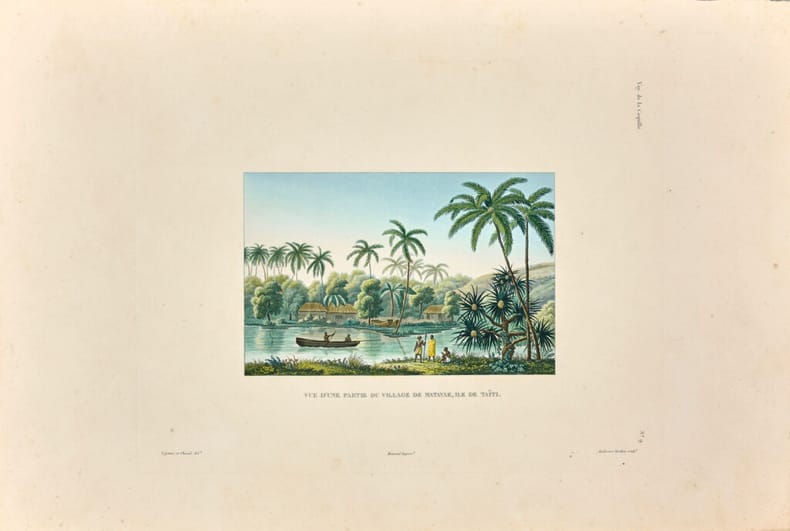
LCS-18061Précieux et rarissime ensemble complet des quatre atlas illustrant le récit d'un des plus célèbres voyages dans le Pacifique Paris, Bertrand, 1826-1827. L’exemplaire comporte l’ensemble complet des Atlas de ce voyage, à savoir : -Historique.. atlasin-folio comportant 60 planches en couleurs dans leurs 15 livraisons d’origine. -Zoologie.. atlasin-folio contenant 157 planches en couleurs dans leurs 27 livraisons d’origine. -Botanique.. atlas in-folio contenant 106 planches (25 en couleurs) dans leurs 15 livraisons d’origine. -Hydrographie.. atlas in-folio contenant 55 cartes et tableaux relié dans le cartonnage d’origine. Soit au total 57 livraisons conservées brochées telles que parues et un volume conservé dans son cartonnage d’origine. Très bon état de conservation des couvertures de livrasions. L’ensemble est conservé dans 5 boites protectrices en demi-maroquin bleu. 565 x 375 mm.
LCS-18225Edition originale française rarissime dédiée à Anne de Bretagne et premier tirage « De la louenge et vertu des nobles et clères dames » de Jean Boccace achevée d’imprimer le 28 avril 1493 par Antoine Vérard. A Paris, Antoine Vérard, 1493. In-folio de (144) ff. (a-n8, o-p6, q-r8, s-t6) à 34/35 lignes. Plein maroquin havane, plats orné d’un décor d’entrelacs mosaïqués noir encadré de filets doré, dos à nerfs orné de même, doublures et gardes de peau de vélin, tranches dorées. Reliure signée de Marius Michel. 273 x 192 mm.
Mostly 4to. 23 ff. 4 letters on halved sheets; mostly folded. Addendum. Highly interesting collection of personal letters from the last years of the King's life. In French, to Eléonore de Maupertuis, lady-in-waiting to Princess Anna Amalia of Prussia, Frederick's youngest sister. Eléonore was the daughter of the well-esteemed Prussian diplomat, scholar, and translator Kaspar Wilhelm von Borcke. In 1744 she had married the French mathematician and astronomer Pierre-Louis Moreau de Maupertuis, also a close confidant of Frederick's and head of the Prussian Academy of Science. After her husband's death in 1759 she concentrated on her office in the household of the Princess. - Since 1756 Anna Amalia of Prussia was Abbess of the Quedlinburg Convent but spent most of her time in Berlin. She is mainly remembered for her alleged affair with the Prussian officer and adventurer Frederick von der Trenck. While the historical truth of this anecdote cannot be proven, she was undoubtedly - and more importantly - one of the 18th century's few female composers of note. Her music collection ("Amalienbibliothek") contains many important prints and manuscripts, including the autograph of Johann Sebastian Bach's Brandenburg Concerts. She spent her last years in seclusion at Berlin, always remaining in close contact with her brother, who visited her regularly. She survived Frederick's death on 17 August 1786 by just a few months, passing away on 30 March 1787 (cf. MGG I, 486f. and T. Debuch, Anna Amalia von Preußen, Berlin 2001). - There are but few sources for the life of Anna Amalia, many of which are dubious (such as Trenck's autobiography) or focus on Frederick the Great (such as the diaries of Count Lehndorff). Thus, the King's present letters to Eléonore de Maupertuis constitute a unique source for the last years of the Princess. They reflect Frederick's concern for Amalia's health after she suffered a stroke in 1773 and underscore the close relationship between the siblings: "Ma cher Madame, J'ai non recours a Vous pour ne point fatiguér ma bonne Soeur, Com(m)e je suis obligé de ma rendre demain au Parc pour des affaires je me propose des profités en ces Voisinages pour rendre visite a ma bonne Soeur [...]" (Charlottenburg, 2 May 1783). - "Je Vous prie Ma chere Madame, de Conjurer ma Soeur en mon nom de Voulloir prendre quelque Medecine, pour Luy facillitér L'expectoration [...]" (n. d.). - "Voici ma bonne Madame deux Sortes de Tabac pour ma bonne Soeur [...]" (n. d.). - "Je vous prie Ma chere Madame, de m'envoyer Le Nom de Soupes que Ma Soeur mange avant dinér, et une Liste des plats qu'elle aime et qui convienent le mieux en Sa Santé [...]" (n. d.). - "Je vous suis bien obligé, des bonnes nouvelles que vous me donnez de la Santé de la Principe ma Soeur, par votre lettre endate d'hier [...]" (6 March 1785). - Almost all letters close with the words "Votre (tres humble) Serviteur Federic". Most of the present letters are a quarter or half page in length and undated; a few are dated only by day but not year ("ce 6 May", "ce 22", "ce 25 Juin", etc.). One bears a note by another hand on the reverse ("[...] Potzdam, 1777, Von I. M. d. König"). Only two are dated in full: "Charlottenburg ce 2 May 1783" and "a Potsdam le 16 de Mars 1785". This last letter is written by a scribe's hand, bearing only an autograph postscript and signature by the King. This is also the only letter formally addressed "à la Gouvernante de Maupertuis, neé de Borck, à Berlin". Content and form, however, prove that all letters are from the same time and to the same recipient. - All letters written in brown ink on fine, clean laid paper, most with posthorn watermark. Includes a browned folio sheet (watermark St. Wolfgang, pointing to Georg Friedrich Meyer's Röthenbach paper mill) with late 18th-c. caption: "Collection de Lettres de Fredéric le Grand Roi de Prusse, de Sa main propre; à feüe Madame de Maupartuis Gouvernante de feüe la Princesse Amélie Soeur de ce Roi". - An exceptionally well-preserved collection.
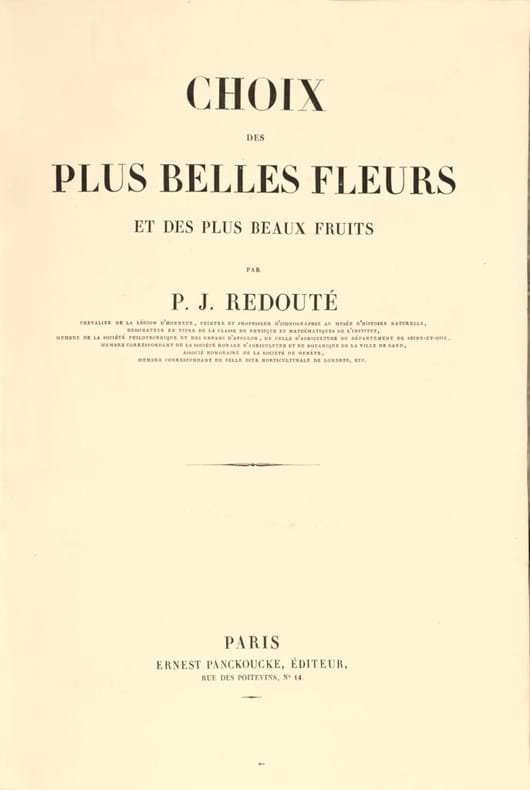
LCS-186396Exemplaire sur très grand papier vélin. Paris, Ernest Panckoucke, s.d. [1827-1833]. Grand in-4 de (2) ff., 144 planches, 17 pp. de tables. Demi-chagrin brun, dos à nerfs orné doré et à froid, témoins. Reliure de l'époque. 334 x 240 mm.
4to (165 x 227 mm). Arabic manuscript on paper. 44 pp. (22 ff.) with 5 full-page colour illustrations (one double-page-sized), all illustrated leaves consisting of two folios pasted together for reinforcement. 17 lines of text, per extensum, within green and double red rules, written in Maghribi style (with diacritic under the letter 'fa') in black, red and green ink; introductory first page written in a different hand in brown ink. 19th century Levantine binding in full red morocco with fore-edge flap, stamped in blind with rules, fleurons and ornamental oval medallions to both covers. Pioneering Abbasid-era study of horsemanship and horse care: the work's only known manuscript in Europe, constituting the long-lost first volume of the set now in the National Library of the Kingdom of Morocco. - Titled "Kitab al-Furusiyah" (the "Book of Riding" or "Book of Horses", often referred to as the "Book of Farriery") or, in full, "Kitab fi al-'inayahbi al-khayl wa-sa'ir dawab al-rukub" ("On the care of horses and all other riding animals"), this encyclopedia of horse care was completed ca. 1200 CE. Ahmad ibn al-Ahnaf is known also to have composed a "Kitab al-Baytara" (Book of Veterinary Science) - possibly simply the same work by a different title, although some Arabic sources mention the titles separately. Ahmad was one of the earliest authors to write on the care of horses and possibly the first ever to include illustrations. - The present manuscript comprises the beginning of the work from chapter 1 to the first half of chapter 4. The introduction announces a total of 30 chapters, but no complete copy is known: the most extensive manuscript extant has 29 chapters, while specimens with 26 chapters are more common. As the later chapters are very short, these first four chapters make up more than a quarter of the entire work. They discuss, individually: 1) the study of milk teeth and permanent teeth; 2) the physical appearance and general characteristics of the horse, donkey, and mule; 3) the functions of the external parts of the body; 4) equestrianism and the various ways of mounting a horse. - The present volume completes the incomplete three-volume set in Rabat's National Library of the Kingdom of Morocco, which begins with the fifth chapter and fully agrees with the present manuscript in script, page layout, spelling and size (MS 6126, described in the "Chevaux et cavaliers arabes" exhibition catalogue, see reference below). The illustrations in the manuscript in the Royal Library, showing the identical almond-shaped horse eyes and characteristically rounded hooves, are clearly by the same artist, as well. The Rabat MS is dated Dhu'l-Hijja 1126 H (December 1714 CE) and thus provides the date for the volume at hand, although the style of penmanship would easily agree with a 17th century dating. - Upper corners of the first two leaves professionally restored with very little text loss. Some fingerstains and dust-soiling throughout, more pronounced in first and last page, suggesting that the manuscript probably had no binding before the 19th century. Frequent edge tears, confined to margins. Pigments somewhat chipped in the final, double-page-spread illustration. Altogether a beautiful specimen of an Arabic manuscript on equestrianism, and like all such manuscripts of the greatest rarity. Cf. Digard, Chevaux et cavaliers arabes dans les arts d'Orient et d'Occident: exposition présentée à l'Institut du monde arabe (Paris, 2002), pp. 79, 83 & 126 (no. 68).
74 catalogued items, comprising 88 volumes of printed books. In Arabic, English, French, German, Italian, Latin, Swedish, and Syriac. A highly important ensemble of books on early Islamic medicine and science, assembled by one of the most renowned medical research institutes of its age, comprising not only rare historical and bibliographical studies, but also many first printed editions of crucial scientific texts in Arabic, frequently in the form of doctoral theses that remain almost impossible to find in libraries. Several titles, such as Steinschneider's "Introduction to the Arabic Literature of the Jews" (published in no more than 20 copies, "for private circulation" only), have not been seen on the market in decades, making the present offering a unique opportunity to acquire some of the most elusive relevant literature published in the late 19th and early 20th century. - Established in 1906, the Karl Sudhoff Institute in Leipzig was the first institute for the study of the history of medicine established worldwide. Its founder Karl Sudhoff (1853-1938) is regarded as one of the 20th century's foremost historians of medicine. A practicing physician for most of his life, Sudhoff published more than four hundred articles as well as many monographs, edited standard works and editions of original manuscripts. He was personally involved in building the institute's library and thus in assembling the present collection. - The 88 volumes offered here include numerous relevant issues of scholarly journals as well as journal articles. They often unite within a single volume several items published separately but forming a clear thematic unit, sometimes bringing together between two covers material that appeared at various times and in several places but was intended by the author to be considered as a whole. Deaccessioned from the Department of the History of Medicine of the University of Leipzig, most books bear the usual shelfmarks and stamps, but are otherwise in fine condition. - Catalogue available upon request.
Five oblong albums (445 x 315 mm), consecutively numbered with 847 vintage albumen prints (various formats, 115 x 85 to 280 x 205 mm) laid down and captioned on thick cream card. Contemporary red half sheepskin, title and year stamped in gilt lettering to front covers of each volume. Spine and edges ruled in gilt, silk-watered endpapers, album sheets edged in gilt. An exceptional trove of early exploration and travel photographs, documenting a two-year tour around the coast of Africa and Yemen, through the Gulf from Muscat to Bahrein, then on by the Arabian Sea to Karachi and finally back to Syria and Jerusalem. The collection is preserved in its original massive oblong albums with each of the partly large-format photographs meticulously captioned in the traveller's own hand. Numerous photographs of himself are included within the albums and witness the transformation of a well-groomed English gentleman at the beginning of the tour in East Africa, in early 1900 ("being carried to small boat at Majunga"), into a bearded explorer camping with the Bedouins in 1901(showing him in front of "My camp at El Bagdadi on the Euphrates"). - The unidentified traveller was hosted by local dignitaries and had an obvious special interest in architecture and archeological excavations. His photographs provide extraordinary insights into the social and cultural life of the British protectorates he visited. Indeed, his journey to the Gulf, documented here, pre-dates Hermann Burchardt's 1903/04 expedition, famed for providing the first visual records of many places in the region, and the numerous previously unrecorded photographs of Muscat, Bahrein and other places in the Gulf contained in the present albums are therefore a particularly important find. - Apart from the views of Muscat castle and port there are highly unusual snapshots of street life both outside and within Muscat's city walls, a stunning double portrait of "Men with Hawks belonging to the son of the Sheikh of Bahrein", a view of Bahrein harbour, captioned the "Head Quarters of Pearl Fishing", the Bahrein Post Office, the market in Bandar Abbas, the Quarantine Station at Basra, as well as photos of horse dealers, women selling salt or just date palms. The 1901 photograph of the Arch of Ctesiphon is captioned "Left wing fell in April 1887 the rest will probably soon follow", also recording height and length of the remaining structure, as well as the width of the entrance. A photo of the "British Residents Wife's Bay Arabian" documents the rare occasion of a "Ladies' nomination Race", also recording the names of the winners of this race held in Bagdad. "Dr. Robert Koldewey from the German expedition" is met and photographed in Babylon at the Temple of the Venus. Visits to several ships at sea are documented in photos of the vessels themselves, as well as by group portraits of their captains and crews on board. A remarkable photograph shows the warship Persepolis returning from its campaign under Daria Begi against the shores of the Trucial States. - Bindings a little rubbed, boards partly stained, some of the album leaves affected by minor waterstaining and some foxing. Photographs mostly unfaded with good, strong contrast and in excellent condition throughout. An extraordinary record and a unique collection.