1 575 résultats
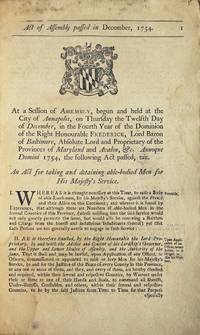
1755319725Annapolis: Jonas Green 1755. 2pp. Bound with: Acts of the province of Maryland made and passed at a session of Assembly begun and held at the city of Annapolis on Saturday the twenty-second day of February in the fourth year of the dominion of the Right Honourable Frederick Lord Baron of Baltimore absolute lord and proprietary of the provinces of Maryland and Avalon &c. Annoque Domini 1755. Published by authority. 8pp. Folio. Period wrappers restitched some losses to the blue sugar paper old repairs at head of each leaf with minor losses old dampstaining. 2pp. Bound with: Acts of the province of Maryland made and passed at a session of Assembly begun and held at the city of Annapolis on Saturday the twenty-second day of February in the fourth year of the dominion of the Right Honourable Frederick Lord Baron of Baltimore absolute lord and proprietary of the provinces of Maryland and Avalon &c. Annoque Domini 1755. Published by authority. 8pp. Folio. Recruiting for Braddock's Campaign. Passed in December 1754 "to raise a Body of able Land-men for his Majesty's Service against the French and their Allies on this Continent" this separately-printed session law essentially authorizes a draft system for forcing "all and every able-bodied Freeman who live idle and do not follow or exercise some lawful Calling" to be enlisted as soldiers. Given the timing it is believed that the troops being raised were intended for service on the Braddock expedition against Fort Duquesne.<br/><br/>Bound together with the above is a second session printing of Maryland laws including acts relating to the French and Indian War: "An Act to Prevent the People of this Province from Supplying the French or their Indian Allies with Ammunition Warlike Stores or Provisions of any Kind" and "An Act for Regulating the Rates of Carriage and Quartering Soldiers in Public Houses within this Province for His Majesty's Service." Also included are acts on currency courts and tobacco.<br/><br/>Both session printings are rare with ESTC recording only five copies in four institutions and eight copies in six institutions respectively. Bristol B1727 and Evans 7458; Wroth 179 and 180; ESTC W33246 and W7078 Jonas Green unknown books
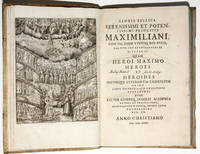
16235340Ingolstadii: Ex officina typographica G. Haenlini 1623. Hardcover. Near Fine. 4to 27 x 17.5 cm. 17 ff. 388 pp. recte 386 7 ff. with misnumbered pages at pp. 203-06 243-46 and 260-71 1 full-page engraving 20 x 15.5 the platemark. Bound in contemporary blind-stamped pigskin raised bands boards beveled somewhat scuffed clasps missing. Blue edges small hole repaired on half title and engraving ownership inscription of Andechs Abbey on title page minor browning in some quires. An excellent and unsophisticated copy. First edition of a rare volume of prose and verse glorifying the military exploits of the Prince-Elector Kurfürst of Bavaria Maximilian I 1572-1651 by members of the University of Ingolstadt as compiled by the Jesuit philosopher-theologian Georg Stengel 1584-1651. The Gloria Bellica is an important witness to the intertwining of princely power university politics and religious sectarianism at the onset of the Thirty Years War 1618-48. Published in the year of Maximilian's elevation to Prince-Elector 1623 the book seems to have been an attempt by faculty at Ingolstadt to secure his favor. The increasingly Jesuitical university would be frequently imperiled during the flux of the war and quickly identified Maximilian himself educated by Jesuits as an important military protector. Maximilian's central role in the German Catholic League had been essential in checking the power of the Protestant Union. The volume is especially notable for its full-page prefatory engraving executed by the Augsburg artist Daniel Manasser a highly detailed and elaborate allegory charting Maximilian's martial rise and the praise conferred on him from various secular and sacred sources. Merchants clerics Liberal Arts herself and a throng of lesser citizens crowd together to salute Maximilian as he rides upward on the back of Pegasus toward the Olympian gods reclining in the empyrean; the demigod Hercules mediates between heaven and earth while battling Nessus and the Lernaean Hydra. Flanking Maximilian's ascent are 8 groups from whom he receives "Gloria": his enemies his commanders and soldiers muses and scientists hometown Bavaria the Catholic League the Holy Roman Emperor Ferdinand I the pope and church and indeed Mary Christ and the saints. The text of the Gloria Bellica is arranged as a fuller version of this scheme with 20 chapters each detailing a source Maximilian's glory. OCLC identifies U.S. copies at Harvard Trinity CT Georgetown and Chicago. VD 17 23:231047E; De Backer/S. and VII 1550 32; Lentner 3774; Pfister I 4297; Mario Praz Studies in Seventeenth-Century Imagery Rome: Edizioni di Storia e Letteratura 1975 pp. 503-04. <br/> <br/> Ex officina typographica G. Haenlini hardcover books
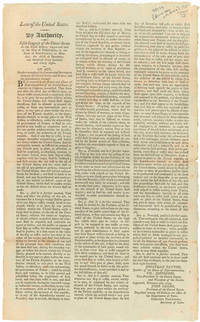
1799WRCAM48177Philadelphia 1799. Broadside 13 1/2 x 8 1/4 inches printed in three columns. Docketed in ink on verso. Three horizontal folds. Some light edge wear small separations at edges of folds not affecting text. Very good. Rare congressional act extending the suspension of trade with France during the so- called "Quasi-War" of the late 1790s and adding a provision allowing the U.S. Navy to inspect and seize American ships that are violating the embargo. This act was approved February 9 1799 and extends the provisions of the law first approved on June 13 1798. It is signed in type at the end by President Adams Vice President Jefferson and Speaker of the House Jonathan Dayton. The Quasi-War was an undeclared conflict between the United States and France during the Adams administration in the late 1790s manifested mostly in naval engagements between the two nations. The war was the outgrowth of deteriorating Franco-American relations which had been weakened earlier in the decade by the Genêt Affair and the XYZ Affair and it wreaked havoc on commerce between the two nations. One of the main weapons wielded by Adams was to ban American commerce from France and French dependencies accomplished by the congressional act of 1798 and extended by the present law. The law forbids American ships from trading with France or with French dependencies including in the West Indies and goes on to bar French commerce and French ships from American ports. Significantly this act goes beyond the provisions of the 1798 law by permitting United States Navy vessels to inspect and potentially seize American vessels that have traded with France or with French dependencies. <br> <br> This broadside format is unusual for the printing of a law and indicates that it was meant to be displayed in ports and customs officers for the attention of ships' masters who may have been unaware of the embargo law or willfully violating it. ESTC locates only three copies at Oxford the British National Archives and the American Antiquarian Society. Rare. EVANS 36522. ESTC W42364. OCLC 80514531. unknown books
186538207Washington D.C. 1865. Letterpress broadside. 24 x 8 1/2 inches. Expert restoration on verso. An unusual broadside Civil War peace proposal.<br/> <br/>A little-known but highly eccentric character Evans first made a name for himself in 1818 when he walked from New Hampshire to Detroit in the middle of winter no less backtracked to Pittsburgh and continued his walk all the way to New Orleans publishing a narrative of his pedestrian journey the following year. After a failed Congressional run in New Hampshire and a failed attempt to become secretary of the Senate he ended up practicing law in Washington. In the midst of the Civil War Evans published a series of broadside letters all known in but few examples and likely printed in small quantities. In one in which excoriated the south for their role in the war he explained that he issued his missives as broadsides since his letters had no chance of publication in the already crowded pages of the newspaper press. The present broadside by Evans suggests a 20-point proposal for peace between the North and South including the abolition of slavery the federal assumption of Confederate debt universal amnesty restoration of all confiscated property the annexation of Mexico the expulsion of the Russians from the Pacific Northwest the seizing of the Hudson's Bay and Arctic fur trade from the British inviting Canada to become part of the United States the unification of Central America and the building of a trans-Darien canal the nationalization of the mining industry universal temperance fair pay charity from the rich and more. The broadside letter concludes: "Unhappy -- deeply unhappy am I in what I am now going to say -- tears of pity grief and shame for the whole country coursing down my cheeks: -- I solemnly declare that I have no doubt and never had that the longer the South holds out the nearer she will be so absolute annihilation ." We locate only four examples extant Boston Aethenaeum American Antiquarian Society Harvard and Minnesota Historical Society. unknown books
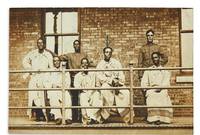
15978BUFFALO SOLDIER Pair of Real Photo postcards of 24th U.S. Infantry musicians in camp. Photographs 3-1/2" x 5-1/2" inches Pine Camp Fort Drum NY c. 1910. Infantryman Joseph Lee identifies himself in these photos. He was part of the 24th during their Houston Mutiny in which many members of the regiment were court martialed after famously coming to the defense of a black woman harassed by local police. <br/><br/>Photos depict members of an original Buffalo Soldier regiment dating from its time at Pine Camp NY later Fort Drum. One captioned in negative "The Famous 24th Inft. Band Pine Camp" shows ~30 uniformed soldiers with instruments. The other uncaptioned showing 7 soldiers; most in white robes with "USA" on the collar perhaps a regimental choir. Both were sent by Joseph Lee 1879- ~1940 Arkansas native enlisted as a musician in the 24th 1903-1919. Both inscribed and addressed one stamped neither postmarked; minimal wear. Lee has apparently self-identified with an arrow in each. This regiment was involved in the dramatic Houston Mutiny of 1917 beginning when a soldier was arrested for aiding a black woman. In the end 19 soldiers were executed and nearly 50 received life sentences but Lee remained with the regiment until his honorable discharge. unknown books
1648304145np 1648. Sole edition. 4 ll. Collation: A4. 4to. Green half morocco by Riviere spine gilt some spotting. Sole edition. 4 ll. Collation: A4. 4to. "And would you know what here is meant / By Monster 'Tis our Parliament."<br/>ESTC lists seven other copies of this scathing anti-Cromwellian work though no other parts are traced. Wing S 2321; ESTC R204781. Provenance: Samuel Christie-Miller 1873 purchase note on flyleaf with cost of binding; Britwell Court Sotheby's 4 April 1924 lot 814; Fairfax of Cameron bookplate; Robert S. Pirie bookplate unknown books
186421371<p><i>Report of the Select Committee Relative to the Soldier's National Cemetery Together with the Accompanying Documents as Reported to the House of Representatives of the Commonwealth of Pennsylvania March 31 1864.</i></p> <b>ABRAHAM LINCOLN.</b>Book. Includes a foldout map of the planned cemetery and a copy of Lincoln's dedication. Published in Harrisburg 1864. Fair condition. <br /> hardcover books
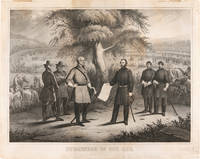
WRCAM55725Philadelphia: John Smith 1865. Lithograph 21 1/4 x 26 1/2 inches. Margins with surface rubbing and soiling. Four-inch closed tear in upper margin descending into the image two-and-one-half- inch closed tear in lower margin ascending into the image no paper loss in either case. Backed by later paper mending tears and a few small chips in edges of sheet. Very nice tone to the image. Good overall. Apparently a rare unrecorded proof of this lithograph commemorating the meeting between Ulysses S. Grant and Robert E. Lee at Appomattox Courthouse on April 9 1865 at which Lee surrendered the Army of Northern Virginia and the Civil War essentially came to an end. This print is not only important as a proof giving evidence of how the image was reworked for final publication but also as part of a series of prints commemorating Lee's surrender that did so much to bolster the image of Grant as the "savior of the Union." "No single event of Ulysses S. Grant's life inspired more prints than the surrender he accepted at Appomattox." - Neely & Holzer. <br> <br> The present image bears the title SURRENDER OF GEN. LEE only with no publication copyright or artist information. In the image Grant and Lee meet in the open air before a large tree not indoors as was actually the case. Grant standing to the right holds the surrender terms in his right hand extended toward Lee. Lee one gloved hand on his hip and the other on the hilt of his sword stares steadily at Grant but makes no move toward the paper. Grant and Lee are each accompanied by a pair of aides who gaze at each other suspiciously. In the receding background thousands of troops are shown formed in long curving lines while a handful of officers ride horses. In the version of this print as finally published by John Smith of Philadelphia the positions of Grant Lee and their aides have been reversed and Lee extends his hand toward Grant ready to accept the terms of surrender. The configuration of the armies in the background has been modified and a prominent scar has been added to the trunk of the tree between the two leaders. In both this proof and the final version of the print Grant's uniform has been improved from what he actually wore - he still does not match the splendor of Lee but he is not shown wearing the uniform of a private with the straps of a Lieutenant General. "Here" as Neely & Holzer observe "the lithographer's notions of creating a picture for posterity do battle with widely reported truth." The title of the final version was modified to THE SURRENDER OF GENERAL LEE AND HIS ENTIRE ARMY TO LIEUT. GENERAL GRANT APRIL 9th 1865 Library of Congress control number 2015647830. NEELY & HOLZER UNION IMAGE pp.169 & 174. John Smith unknown books
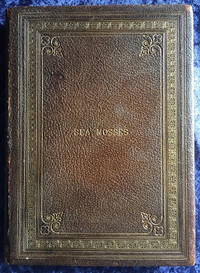
186424170<p><i>"call us not weeds we are flowers of the Sea."</i></p> <b>CIVIL WAR. ANNA BIGELOW.</b>Autograph Manuscript Signed unique calligraphy book with illustrations pressed sea weeds and hand lettered four lines of verse titled 'Sea Weeds.' New York N.Y 1864. 7½ x 10½ on 60-plus pages with 31 moss examples interleaved.<p>Album donated to benefit Union soldiers presented at the New York Metropolitan Fair held on March 28 1864 to raise funds to aid sick and wounded Union soldiers. The Metropolitan Fair was organized to benefit the Sanitary Commission a private relief agency authorized by federal legislation in 1861. The Commission raised an estimated $25 million in revenue more than $386 million today and enlisted thousands of volunteers. A New York Times article on Jan. 1 1864 provided a preview: "Every branch of agriculture trade industry and art will be invited to contribute its choicest and costliest products for exhibition and sale. Musical and dramatic artists will be invited to aid the common cause with their talent and genius. All the material resources of the great City of New-York and of the region directly tributary to it are to be invoked."</p><p>The great success of an earlier Chicago fair inspired many women in the North to become involved. The Metropolitan Fair included everything from "Architectural Ornaments" to "Wines & Liquors" to "Wholesale Millinery Goods." Commemorative and ceremonial objects were often specially designed for the Sanitary fairs. Anna Bigelow's album of sea mosses may have been displayed in the "Arrangements and Decoration" section.</p><p>When Northerners attended fairs donated money or goods or volunteered their time they were aiding the soldiers on the front lines. Autographs of leading Americans were often sold; Lincoln even donated an autograph manuscript of the Gettysburg Address to the New York Fair where it sold for $1000. For Chicago's Great Northwestern Fair Lincoln donated his original signed draft of the Emancipation Proclamation with an accompanying letter stating his "desire to retain the paper but if it shall contribute to the relief or comfort of the soldiers that will be better."</p><p>The elaborately hand lettered and decorated title page of this album bears a small signature "Ellsworth" and "819 Broadway." Henry W. Ellsworth is listed in New York's Manual of the Board of Education as a penmanship instructor at School No. 47 on Twelfth Street between Broadway and University Place p. 295. There is also an inscription "Drawn by E. W. Gandy 1864" at the top of the front free endpaper.</p><p><b>Condition</b></p><p>All edges gilt. Elaborately gilt stamped brown morocco gift binding with white silk linings with gilt title "Sea Mosses" at front board and "Album" at spine. A bit chipped top of spine. Internally a bit marked at the silk linings. The plates in very good condition with the each sea moss plate a delicate floral arrangement. Front cover detached. Some soiling and foxing.</p> hardcover books
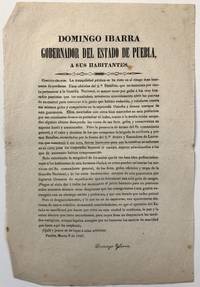
18471729Puebla 1847. Very good. Broadside 12.5 x 8.5 inches. Minor foxing and toning. An unrecorded broadside that prints the thanks and admonitions of the Governor of Puebla Domingo Ibarra following an attempted insurrection there in late February and March 1847 during the Mexican-American War. The uprising was a part of the so-called Polkos Rebellion that followed popular outrage at a January law that allowed the federal government to seize church property in order to pay for the war effort. In Puebla the revolt involved elements of the city's military garrison but was successfully put down by the rest of the guard. Ibarra begins by lamenting the sedition and thanking the loyal portion of the garrison:<br/><br/>"La tranquilidad publica se ha visto en el riesgo mas inminente de perderse. Unos oficiales del 2o Batallon que no merecian por cierto pertenecer á la Guardia Nacional ni menos tener por gefes a los muy honrados patriotas que los mandaban intentaron atrevidamente abrir las puertas de su cuartel para convocar á la gente que habian seducido y rebelarse contra sus mismos gefes y compañeros en la espresada Guardia y demas cuerpos de esta guarnicion. Solo calculando la magnitud de los males que de tan loca idea podian sobrevenir á los habitantes de esta hermosa ciudad es como puden estimarse los servicios del Sr. comandante general de los Sres. gefes oficiales y tropa de la Guardia Nacional y de los otros benémeritos cuerpos de esta guarnicion que lograron librarnos de aquellos sin que derramase una sola gota de sangre."<br/><br/>And he continues by warning the citizens of Puebla against continued foolishness in the face of the enemy and also by asserting his resolve to resist further insurrection:<br/><br/>¡Plegue al cielo dar à todos los mexicanos el juicio bastante para no provocar sobre nostros mismos otras desgracias que las consiguientes à una guerra extrangera con un enemigo astuto y ponderoso y que nos invade por todas partes! Pero si desgaciadamente y lo que no es de esperarse aun aparecieren sìntomas de nueva rebelion descansad conciudadanos en que el ejecutivo del Estado se sacrificará por hacer que reine en esta ciudad la confianza la paz y la union sincera que tanto necesitamos."<br/><br/>A strong statement by a clearly relieved Mexican state official. We locate no copies in OCLC or available sales records. unknown books
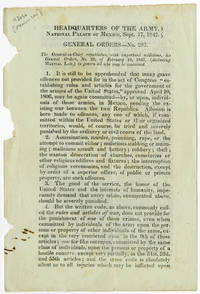
1847WRCAM42040Mexico City 1847. 4pp. printed on a. single folded sheet. Old vertical crease. Three tears along the central fold resulting in loss of paper but no text. Very good. A rare copy of an important order issued by Gen. Winfield Scott just days after his victory at the Battle of Chapultepec and his taking of Mexico City. Chapultepec was the final victory in Scott's march to the Mexican capital following victories at Cerro Gordo Contreras Churubusco and Molino del Rey. Largely outnumbered against Santa Anna's forces Scott produced a series of stunning victories leading to his capture of Mexico City and the issuance of this broadside which seeks to establish order by proclaiming martial law in the capital. <br> <br> A preamble to the General Orders announces that this is a restatement "with important additions" of Scott's order of Feb. 19 1847 issued from Tampico which also declared martial law. In the present order meant to maintain order in the newly conquered city Scott lays out the prohibitions for a wide variety of acts including assassination murder poisoning rape assault robbery theft the desecration of churches and cemeteries and more. Significantly he announces that such rules will apply equally to Americans as to Mexicans. He points out that these laws are important not only to guide his army but "for the protection of the unoffending inhabitants and their property about the theatres of military operations against injuries on the part of the army contrary to the laws of war." Scott further extends martial law to any part of Mexico under the control of U.S. forces. Lastly he announces that the American army will safeguard all of the churches monasteries convents inhabitants and property in Mexico City and announces a "contribution" of $150000 to be imposed on the capital to pay for these services payable in four equal installments. <br> <br> The order is signed in manuscript at the end by Winfield Scott's Assistant Adjutant General H.L. Scott. Garrett locates the copy at the University of Texas at Arlington and OCLC adds copies at the California State Library Sutro copy and the University of North Carolina. GARRETT p.390. OCLC 52501908. unknown books
184724284Mexico City 1847. 4pp. printed on a single folded sheet. Old vertical crease. Three tears along the central fold resulting in loss of paper but no text. Important order establishing martial law in Mexico City.<br/> <br/>A rare copy of an important order issued by General Winfield Scott just days after his victory at the Battle of Chapultepec and his taking of Mexico City. Chapultepec was the final victory in Scott's march to the Mexican capital following victories at Cerro Gordo Contreras Churubusco and Molino del Rey. Largely outnumbered against Santa Anna's forces Scott produced a series of stunning victories leading to the capture of Mexico City and the issuance of this broadside which seeks to establish order by proclaiming martial law. A preamble to the General Orders announces that this is a restatement "with important additions" of Scott's order of February 19 1847 issued from Tampico which also declared martial law. In the present order meant to maintain order in the newly-conquered city Scott lays out the prohibitions for a wide variety of acts including assassination murder poisoning rape assault robbery theft the desecration of churches and cemeteries and more. Significantly he announces that such rules will apply equally to Americans as to Mexicans. He points out that these laws are important not only to guide his army but "for the protection of the unoffending inhabitants and their property about the theatres of military operations against injuries on the part of the army contrary to the laws of war." Scott further extends martial law to any part of Mexico under the control of U.S.forces. Lastly Scott announces that the American army will safeguard all of the churches monasteries convents inhabitants and property in Mexico City and announces a "contribution" of $150000 to be imposed on the capital to pay for these services payable in four equal installments. The order is signed in manuscript at the end by Winfield Scott's Assistant Adjutant General H.L. Scott. Garrett locates a copy at the University of Texas at Arlington and OCLC adds copies at the California State Library Sutro copy and the University of North Carolina.<br/> <br/>Garrett p.390; OCLC 52501908. unknown books
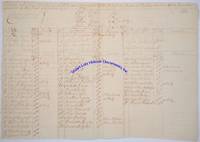
4943MASSACHUSETTS MUSTER ROLL. DS. 2pg. 15 ½†x 10 ½â€. January 1778. No place near Boston. A “Muster Roll of Capt. Ford Company of Militia now in Service of the United States for the Purpose of Guarding the Troops of the Convention Commanded by Col. Eleazer Brooks Taken to Jany 1778â€. The roll of American officers and soldiers lists one captain three lieutenants four sergeants four corporals two drummers and fifty privates. After the British defeat at Saratoga in the fall of 1777 the British prisoners of war were marched to the Boston area; they were later marched to Richmond Virginia. It is signed on the back by Captain Ford Secretary Reed and a Justice of the Peace. Eleazer Brooks 1727-1806 was a farmer and an official in Lincoln Massachusetts. He served as a colonel in the militia and marched on Dorchester Heights. He was later promoted to brigadier general and he represented Lincoln at the Massachusetts ratification of the Articles of Confederation in 1778. The document has the usual aging and wear and dark legible ink. A most unusual Revolutionary War manuscript. unknown books
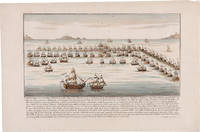
1782WRCAM56168Augsburg 1782. Handcolored engraving 11 1/2 x 17 3/4 inches. Some light soiling and tanning. Near fine. Matted. An attractive and well-preserved contemporary print by German engraver Johann Martin Will with delicate hand-coloring depicting the British and French fleets in combat formation during the Battle of the Saintes also known as the Battle of Dominica/Bataille de la Dominique. Britain's victory over the French navy in April 1782 effectively ended French control of the Caribbean. The engraving depicts over eighty ships which are keyed for identification in captions in German below the image. The upper middle ground depicts Rodney's flag ship "Formidable" and two supporting vessels attacking and breaking the French line. Among the many other ships identified are the flagship of the French admiral Comte de Grasse's "Ville de Paris" here identified as "Stadt Paris" as well as Sir Francis Samuel Drake's division Admiral Samuel Hood's division and the Prince George which according to this account broke its main mast while breaking the line. Also depicted is the French fleet's attempt to reestablish the line in which they have little luck as ships were already starting to flee. <br> <br> The battle was named after the Saintes a group of islands between Guadeloupe and Dominica in the West Indies. The year before the French fleet under de Grasse had decisively defeated the British fleet in the Battle of the Chesapeake and then blockaded the coast until Cornwallis surrendered at Yorktown helping to secure American victory in the Revolution. This time the British fleet soundly defeated the French capturing the flagship and de Grasse the first French admiral in history to be captured by an enemy and inflicting significant causalities. This emboldened the British in the ongoing negotiations with the Americans and French as well as in ongoing conflicts with Spain. The French-American alliance effectively dissolved and Britain reaffirmed its claims on the Newfoundland fisheries and Canada. Further the French and Spanish abandoned their planned invasion of Jamaica focusing instead on protecting their existing holdings. <br> <br> Johann Martin Will 1727-1806 was a prominent engraver and publisher in Augsburg who specialized in producing images for the British and American markets. A most uncommon image of an important naval battle in the West Indies. unknown books
16409World War II Original war time U.S. War and Navy Departments first editionsPocket Guide books for 18 countries. These guidebooks were prepared by the U.S. War and Navy Departments to educate American soldiers stationed overseas during the conflict. It includes points on culture language including slang local history and the military justification for American presence in the area; in this sense these pocket books are a unique distillation of American wartime policy composed by the highest decision-makers in government for the soldiers actually setting foot on foreign soil. These guides provide a concise yet rich example of wartime indoctrination and the resulting cultural associations and relationships formed within the average American by the war.<br/><br/> All 18 guide books are war dated and they include: Alaska 1943; Australia 1944; Egypt 1943; France 1944; Paris and Cities of Northern France 1944; Cities of Southern France 1944; Great Britain 1944; India 1944; Iran 1943; Iraq 1943; Italian Cities 1944; New Caledonia 1944; New Guinea and the Solomons 1944; New Zealand 1943; Northern Ireland 1942; Panama 1943; Syria 1942; West Africa 1943. Washington DC: War and Navy Departments 1942-1944. Stapled bindings. 5.25" x 4.25" inches. All first editions. Written often in a casual approachable way From the Pocket Guide to Iraq: "Herr Hitler knows he's licked if the peoples united against him stand their ground" these guides repeatedly drill in the strategic necessity for Americans to create diplomatic relations wherever they are stationed. For example from the Pocket Guide to New Zealand: "Always remember that it is to our enemies' advantage to sow seeds of discord between us and our allies and it is to our advantage to understand them and to make them our friends." They also illustrate explicit policy motivations as with the Pocket Guide to Iran: "As an American soldier assigned to duty in Iran once called Persia you are undertaking the most important job of your life. There is no other war theater where military success by the United States and her fighting allies will contribute more to final victory over the axis. You've heard a lot of talk in this war about life lines - the sea lanes and land routes by which military supplies flow into the combat zones to be turned against the enemy. Iran is much more that a life line. It is a major source of the power that keeps the United Nations' military machine turning over -- oil. Because of its prime strategic value Iran in the only country in the world where the armies of three of the United Nations -- Great Britain Russia and the United States -- are operating in daily touch with each other . You as an American have a responsibility that goes beyond the ordinary military duties required of you. Your country has a reputation throughout the world for decency and unselfishness in its dealings with other nations. That reputation is a major asset for us in this global war. By your actions you can uphold it or destroy it." Includes period maps of the respective regions as well as cartoon illustrations to accompany the instructional text. Scattered soiling and wear. Altogether very good. unknown books
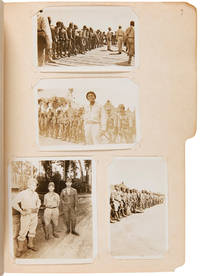
1945WRCAM55788Morotai Bougainville Green Island and other locations in the South Pacific 1945. Three clasp-bound collections of manila folders containing 113 mostly vernacular photographs occasionally captioned in pencil two divisional newsletters copies of Japanese surrender documents and numerous news clippings and assorted ephemera related to the soldier's war experiences. Minor dust-soiling to folders some toning to contents. Overall very good. An informative collection of photographs documents and clippings related to the World War II experiences of the African-American 93rd Infantry Division in the South Pacific. The 93rd Infantry Division was a segregated "colored" unit formed first during World War I and reactivated for service in 1944. The unit was shipped to the Pacific Theater where they served primarily in construction and defensive infrastructure operations. The 93rd occupied Morotai in the Dutch East Indies from April to October 1945 where they witnessed the surrender of the Second Japanese Army. <br> <br> The material in the present collection is organized in three compilations of clasp- bound manila folders with the contents of each compilation annotated in pencil on the front cover. The chief feature of the collection are the 113 photographs arranged thematically throughout the first two folders. <br> <br> Folder One contains photographs and documents pertaining to the Japanese surrender to the division's commander Major General Johnson. There are also photographs showing various Japanese troops surrendering to Australian officers including one of a Japanese officer surrendering to Gen. Thomas Blamey at Australian field headquarters in Morotai. A few photographs emanate from a Japanese hospital ship "taken over by our Div." showing "a few in the hospital." One photograph features an African-American soldier perhaps the compiler of this collection smiling in front of a line of surrendering Japanese soldiers. In the first folder there are also two copies of divisional newsletters: one from the 13th Jungle Air Force; and another titled IGUANA which was the daily newsletter for the 93rd Infantry we could locate no copies of IGUANA in OCLC. Rounding out the first folder are copies of an address on Japanese surrender delivered by Gen. Sir Thomas Blamey to Lieutenant-General Teshima Commander of the Second Japanese Army "On the occasion of the signing of their Surrender Morotai 9th September 1945" and a lithographic copy of the "Instrument of Surrender" between the two combatants. <br> <br> The front cover of Folder Two is titled in pencil "Places and People in the Netherland East Indies and Green Is. in the Northern Solomons and Bougainville." This folder contains images of Australian soldiers in Morotai; numerous pictures of indigenous Morotain people including men women and children; the entrance to the Morotai War Cemetery; photos of the 13th Australian Air Force; overhead images of an active volcano in Bougainville; pictures of Bob Hope Carol Landis a popular Hollywood actress who performed extensively for troops during the war and others on a U.S.O. mission at Bougainville; images of various aircraft including B-29 nose art and Japanese planes; a few pictures of dead Japanese soldiers in Morotai captioned "Good Japs"; photographs featuring the invasion of Morotai; and other images of the South Pacific islands where the compiler was stationed. <br> <br> Folder Three is labeled "Places I've Seen" and is composed of beer labels the compiler collected during his service along with numerous newspaper and magazine clippings memorializing his unit's service. The clippings indicate the compiler also served at Leyte in addition to Morotai Bougainville and Green Island in the Dutch East Indies. <br> <br> An interesting collection of firsthand photographs of an African-American unit's service in the South Pacific during the Second World War. unknown books
194520240The Hague ca. 1945. Hardcover. Near fine. Two oblong 8vo. albums. First album: 11.5" by 9" approx. String-tied faux-alligator boards. 43 gelatin-silver prints majority 3.75" by 2.5" but many 5.5" by 3.25" mounted to stiff gray leaves with cobweb-patterned tissue guards on each and handwritten captions in Dutch. Apparently complete. Near fine with several photos mildly yellowed but majority bright and sharp. <br /> <br />Second album: 13'' by 9'' approx. String-tied grey textured paper boards. 91 gelatin-silver prints of various sizes from 3.75'' by 2.5'' to 5.5'' by 3.25'' most of the latter size on stiff blue paper with tissue guards and handwritten captions in Dutch. Also contains an anti-Hitler card affixed to the front paste-down several cards with art and verse and two sepia-toned photographs on the final page. Two 5'' scuff marks to front board album corners and edges worn and bumped otherwise near fine with bright and sharp photographs. <br/><br/>A pair of carefully assembled albums possibly compiled for official use. The majority of the photos in both albums record the aftermath of a botched Allied bombardment in the Hague on March 3 1945; the attack claimed the lives of 511 civilians and left over 20000 people homeless. Targeted at a German missile base in the occupied Netherlands bombs deployed by the Royal Air Force landed instead in the adjacent Bezuidenhout neighborhood in the Hague destroying thousands of homes business and public buildings. The photos show several bombed-out churches and many apartment buildings with street names captioned underneath. Near the end of the first album three images show the burning of the Schevenigen Pier near the Hague which the compiler blames on the Germans but whose exact cause has never been established. The album forms a direct account of wartime destruction in the Netherlands. <br /> <br />The second album much more extensive includes some of the same material along with many other photographs. Affixed to the front paste-down is a black-bordered satirical memorial card for Hitler reading in Dutch "He came.but not to England / He saw.Moscow / He lost.the war." Beginning with two views of The Hague one in 1930 and one apparently mid-bombardment labeled March 3 1945 it also includes numerous scenes of destroyed buildings and monuments identified by street name. Some of these overlap with images from the first album; many do not. In addition to those showing the aftermath of the bombing several photos show intact monuments and buildings from neighboring cities like Middelburg possibly as a point of comparison with the ones destroyed. A few pages show photographs of various Bailey bridges at unspecified locations and other wartime construction. The final page of uncaptioned photos includes a shot of a pro-Hitler slogan painted in Dutch on a bridge underpass and a photo of several posters including a Dutch advertisement for "De Eeuwige Jood" The Eternal Jew a German propaganda film. A final leaf follows with two pro-R.A.F. cards with verses and drawings and three souvenir cards of Queen Wilhelmina Princess Juliana and her children Beatrix and Irene. The final page has two sepia-toned photos of a parade presumably celebrating the war's end. An important act of witnessing from an unfortunate event. hardcover books
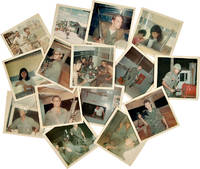
1972WRCAM55575Various places in Vietnam 1972. 145 photographs all but thirteen in color most approximately 3 1/2 x 3 1/2 inches. Majority of photographs mounted on black paper stock with non-archival adhesive tape some photos retain remnants of tape at corners. Some images a bit faded but generally in very good condition. A tremendous collection of photographs depicting the personal life and military service of an unidentified African-American soldier with the last name "Williams" serving in Vietnam during the war and with numerous family photographs at home. The majority of the photographs are undated but those that are dated place the collection roughly between 1968 and 1972. Other identifying characteristics in the photographs indicate that the soldier was likely part of the United States Air Force 93rd Security Police Squadron which provided security and air base defense during the Vietnam War. There is a photograph of Williams leaning against the sign for the 93rd SPS dormitory. <br> <br> Notable in the sixty or more photographs from the soldier's time in Vietnam are images from an unidentified American Air Force base depicting soldiers in the barracks a mess hall and fraternization among soldiers; additional photographs show a heavily-armed Williams manning a bunker holding an EBONY magazine posing with a South Vietnamese soldier in an urban setting and staring strikingly at the camera wearing machine gun ammunition and a hand grenade. A series of thirteen images were taken at "Le Van Loc" a popular Vietnamese night club located on the Tan Son Nhut Air Base near Saigon indicating Williams may have been stationed at or near that base. Personal photographs show individuals of varying ages presumably family members who appear alone or in groups and at times are photographed with Williams. Several of these photographs feature children presumably Williams' at home and at an Elmhurst School function. Williams seems to have been especially proud of his motorcycle as it features in a few shots. <br> <br> A collection of both service and family photographs capturing a young African- American serviceman during the Vietnam War. unknown books
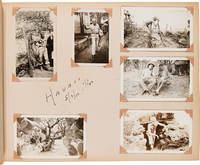
1945WRCAM55773Philippines New Caledonia Guadalcanal New Zealand Hawaii 1945. 213 photographs from 2 3/4 x 2 1/4 to 6 1/2 x 8 1/2 inches corner-mounted; plus twenty-two pieces of ephemera mounted or laid in including two mimeographed pamphlets. Oblong quarto album. Red silk boards blue silk ties with stylized Japanese figure on center of front board. Some fraying to edges and corners some loss to silk on rear board minor soiling. Photographs in excellent condition overall. Very good. A dramatic photograph album from Harvey D. Burgstresser's 1912-83 service in the U.S. Army artillery during World War II. Although most photos are not labeled individually they are labeled by group and track Burgstresser's travels through various combat stations during the war in the Pacific. The first photo labeled "Fayetteville NC" shows Burgstresser on left in uniform with another solider walking along a city street. The first section follows and is labeled "Hawaii 5/7/42-11/1/42" and consists mostly of photographs of soldiers at-ease playing with radio equipment and goofing around likely as they wait for deployment to the front. The next section "Guadalcanal 11/15/42-12/1/43" is short but more somber including photo prints of indigenous people of the island the corpse of a soldier and a photo of a sign posted on a roadside reading: "Kill the Bastards! Down this road marched one of the regiments of the United States Army Knights Serving the Queen of Battles Twenty of their wounded in litters were bayoneted shot and clubbed by the yellow bellies. Kill the Bastards!" <br> <br> Next is a section entitled "Auckland New Zealand 12/1/43-3/1/44" a small and peaceful section featuring photos of couples a few female friends and shots of Burgstresser's battery and company in formation 90th Field Artillery Battalion 25th Infantry Division. From there he was off to "New Caledonia 3/1/44-12/15/44" with a joint force of ANZAC soldiers. Most of these shots are also at- ease and around camp several featuring a truck marked "NZ Mail." From here he moves to "Luzon P.I. 1/9/45 to 10/2/45" the final section and the place where things get a bit more serious; this is also the largest section in the album. Several images show soldiers setting up artillery stations laying wire and organizing ammunition. One image in this section is labeled "V-J Day" and this is the only mention Burgstresser makes about the progress of the war. There are scenes of buildings damaged from war along with a few scenes of combat and more of the aftermath of combat including downed planes and destroyed tanks and several quite explicit images of corpses. In the midst of this are images of Filipino women and men in traditional attire and likely some from New Caledonia and Guadalcanal as well including several shots of topless Filipino women likely not taken by Burgstresser. <br> <br> Various pieces of ephemera are in the album including a twenty-eight-page mimeographed pamphlet entitled WELCOME 25th. INF. DIV. with sections corresponding closely to Burgstresser's arrangement of this album; and a six-page mimeographed pamphlet entitled THE SEA BREEZE "Souvenir Edition" October 23 1945 issued to those aboard the troop ship USAT "Cape Meares." Also included is Burgstresser's military "Motor Vehicle Operator's Permit" authorizing him to drive automobiles large trucks and a "Vehicle wheeled combat;" an invitation to ceremonies honoring General Douglas MacArthur's return to the U.S.; Burgstresser's "Good Conduct Pass" for Auckland; a few newspaper clippings; and pieces of Japanese currency including two pieces of Japanese government- issued "fiat pesos" which the Japanese issued during their occupation of the Philippines. <br> <br> According to his obituary PHILADELPHIA DAILY NEWS April 25 1983 Burgstresser had graduated from Bucknell University; after the war he went into the insulation business and was eventually president of the Philadelphia Asbestos Corporation. His album ably captures both the camaraderie and the horror of the war in the Pacific. hardcover books
1518100733<p> Small broadside about 6 x 8 1/2 printed on one side about ten partial lines of text including title Proclamation!. Minor toning slight creasing a little uneven small margin on the left side a couple of minor nicks; overall very good. While Kentucky may have been neutral at the start of the war after the Confederates invaded the state they turned toward the Union. This small broadside reminds people they needed to register with the "home guard." It also reminds people that failure to register will result in being disarmed. This order was passed under the threat of an impending invasion of Kentucky by General Braxton Bragg's Army of Tennessee. The broadside is signed in print by Major P. G. Bracht. </p> Observer and Reporter Power Press Print books
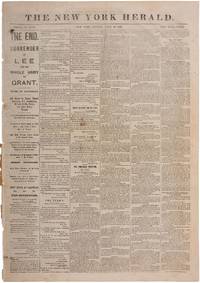
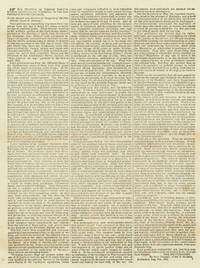
186537333New York 1865. Elephant folio 15-1/2" x 22." 8pp each page in six columns. Several pages of advertisements. The rest devoted to the details of the surrender. A large map on page 8 displays the final troop movements and Appomattox Court House. Disbound some spine separations Very Good.<br/> <br/> The surrender having occurred on April 9 the previous day this is one of the earliest accounts of the capitulation at Appomattox Court House. The first page prints the dramatic headlines in the left column; the balance of the front page pages four five and page 8 print related reports. Most of page 8 prints a large detailed map headed "THE SURRENDER OF LEE. Scenes of Grant's Operations Against Lee in Virginia; of Sherman's Operations Against Johnston in North Carolina." Interesting advertisements for a variety of goods and services are also printed as well as information about President Lincoln's discussions on the restoration of Virginia to the Union. unknown books
1862217811862. No binding. Fine. Broadside. ""The Petition of Certain Non-Conscripts Respectfully Presented to the Confederate States Congress."" Richmond August 8 1862. Signed in print ""The Petitioners By their Counsel John H. Gilmer."" 1 p. 7 7/8 x 10 3/8 in. Petitioning against General Order No. 46 of the Confederate War Department which rescinded the part of the Confederate Conscription Act of April 16 1862 that mandated the discharge of all voluntary enlistees under age 18 or over age 35 in July 1862. ""These were the terms of the law. They were plain unequivocal and mandatory. Common sense - universal public opinion . understood accepted and adopted the law . Shall an army order revoke a solemn act of Congress . Have we a constitutional Government with specific powers granted . or have we an unlimited Government dependent only on Executive will or ministerial caprice Are the People free or is the Executive supreme"" Historical BackgroundPresident Davis Secretary of War George Randolph and the Confederate Congress instituted the first conscription act in American history in April 1862 after early defeats in Tennessee and North Carolina in anticipation of the expiration of one-year enlistments signed at the war's outset. The Conscription Act would cause all males ages 18 to 35 to be drafted into service unless exempted. Those already enlisted would be held to a three year commitment from their date of entry into the service. Conscription raised difficulties for Southern politicians who had argued for most of their careers against the broad construction of federal powers in the United States Constitution. Some believed it violated the cardinal principle of states' rights others such as Georgia Governor Joseph Brown protested its tendency toward centralization and despotism. Common folks complained about the fact that planters who owned 20 or more slaves were exempt as were many overseers and tradesmen and those who could afford to buy ""substitutes.""According to historian James McPherson conscription was ""the most unpopular act of the Confederate government. Yeoman farmers who could not buy their way out of the army voted with their feet and escaped to the woods or swamps. . Armed bands of draft-dodgers and deserters ruled whole counties.""ReferencesParrish & Willingham 5422 locating 5 copies.McPherson James. Battle Cry of Freedom New York 1988 p. 432. unknown books
186324584<p>"<i>We the members of the Loyal League do hereby pledge ourselves by words and acts whenever practicable to use our influence in support of the Government in all its measures for the suppression of the present unholy rebellion; and we will use our influence to discountenance and oppose all efforts in opposition to the Government and the Union.</i>"</p> <b>CIVIL WAR--RHODE ISLAND.</b>Pledge and original membership roll of the Loyal League of Providence Manuscript Document Signed with 161 signatures ca. January 1863 Providence RI. 2 pp. 7¾ x 22¼ in.<p><b><br /></b></p><p><b>Historical Background</b></p><p>Loyal Leagues also often known as Union Leagues were men's clubs established during the Civil War. They usually consisted of the professional merchant and artisan classes in northern cities. The first such club formed in Philadelphia in 1862.</p><p>Many of the signers of this membership roll were born between 1844 and 1850 and many were probably students at Providence High School. In 1861 students from the high school organized into a militia company called the "Ellsworth Phalanx" in honor of the New York Zouave commander Elmer Ellsworth killed in May 1861 in Alexandria Virginia. They drilled and paraded in Providence throughout the winter and into the spring of 1862.</p><p>After Confederate General Stonewall Jackson routed Union General Nathaniel Banks' forces at Winchester Virginia and pushed them back across the Potomac River in May 1862 urgent calls went out for troops to defend Washington D.C. In response Governor William Sprague of Rhode Island ordered the organization of the 10th Rhode Island for three months' service. Company B was recruited almost entirely from the ranks of the High School and University companies and commanded by Captain Elisha Dyer former governor of the state. At least one of the signers here William H. Hawkes served in Company B in 1862 and another Harry A. Richardson had served in Company K of the 9th Rhode Island in the summer of 1862.</p><p>The likely author of the pledge and first signer on the right column was Granville Budlong 1844-1909. The first signer in the left column was Lewis G. Janes 1844-1901 son of prominent abolitionist Alphonso Janes. Other signers included Arthur Lincoln son of a professor at Brown University; and William E. Cushing 1844-1880 who became an architect and designed the city's baseball stadium in 1878. At least two signers Frederick Metcalf and Eugene F. Granger were killed later in the war while serving in the military. Metcalf was only seventeen when he died of disease in South Carolina in 1864 after a year in the service. Granger the son of a Baptist minister joined a New Hampshire regiment and died in a Confederate prison in North Carolina. His younger brother Edward V. Granger also signed this roll. Other signers were the sons of merchants railroad agents carpenters tin platers and masons in Providence. Several went on to graduate from Brown University in the late 1860s and early 1870s.</p><p>On March 19 1863 the <i>New York Times</i> reported that in Providence Rhode Island</p><p>"Only two weeks remain before the election. The Republicans and those loyal men of other parties who have united with them are diligently at work in canvassing the State. They are marking those "peace" men who … are expressing sympathy with the rebellion. The Democrats are really very unfortunate. They can't find one of their own party who wants office. They have been trying a month to get a Governor but no Democrat will accept their nomination…. When bad men combine good men must unite. So the loyal men of all parties are coming together in solemn league to support the Government and to give all their energies to the vigorous prosecution of the war. The "League" in this city is composed of some two thousand loyal names. It is fast increasing in numbers and is extending its spirit and influence throughout the loyal portions of the State."</p><p><b>Condition</b></p><p>Originally two joined leaves. The topmost portion of the sheet lost allowing the title "Pledge" to just be made out. Conservation repairs of fold separations. Strong signatures in various color inks continuing and with docketing on verso.</p> books
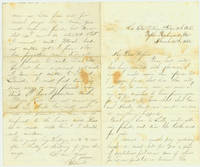
1865223991865. No binding. Fine. Six letters to his wife Libby approx. 15 pp. in all. ""There will be an awful hot time if our Brigade is engaged. I dont think anything can restrain the men if they once get started. I am in hopes to come out alive but no one can tell but the Almighty"" The white officer of the USCT Captain Richard Andrews wrote to his wife about the sieges of Petersburg and Richmond and the impending Appomattox campaign. Union forces including African American soldiers captured Richmond on April 3rd and Lee would be forced to surrender at Appomattox just over two weeks after Andrews wrote. In other letters he details his health concerns his transfers after the war's end and possibilities of land ownership. His final letter details an anticipated transfer to the Freedmen's Bureau in Galveston Texas.RICHARD ANDREWS. Autograph Letter Signed ""Richard"" to his wife Libby before Richmond Va. March 25th 1865 4 7/8 x 8 1/8 in. 4 pp. #22399.01"".I received a month's pay yesterday bought a sword belt for 7.00 a pair of pantaloons for $12.00 pair of gloves for $2.00 paid $25.00 towards the present to Genl. Draper.As soon as I sell my horse I will send you more if I had sold her three days ago I could have got over $100.00 for her but now she is very lame so much so that no one can use her. I fear I shall have to dispose of her at a loss. We shall move in a very short time.Things are coming to a crisis. Lee will have to skedaddle or there will be a terific fight. Our brigade is practicing charging every day. There will be an awful hot time if our Brigade is engaged. I dont think anything can restrain the men if they once get started. I am in hopes to come out alive but no one can tell but the Almighty. My health is pretty fair now and I trust I may not even get wounded for I am anxious to gain strength this summer.""Historical BackgroundFrom Salem Massachusetts Lieutenant Richard F. Andrews fought in the Battle of Chaffin's Farm September 29-30 1864. Just two months earlier he was so sick that he was excused from duty but he volunteered for service and helped lead the 36th Regiment of U.S. Colored Troops to victory. The performance of the USCT at Chaffin's Farm New Market Heights put an end to any doubts of their bravery or fitness for service. There Andrews was shot in the leg and for his bravery he was promoted to Captain.The 36th Regiment of USCT was organized in February 1864 out of the 2nd North Carolina Colored Infantry. In addition to Chaffin's Farm it saw service toward the end of the Siege of Petersburg the single greatest concentration of African American troops during the war at Richmond and its occupation and in the Appomattox Campaign.The United States Colored Troops USCT were regiments of the United States Army during the American Civil War composed of African American soldiers. First recruited in 1863 by the end of the Civil War the men of the 175 regiments of the USCT constituted approximately 10% of the Union Army. The United States War Department issued General Order Number 143 on May 22 1863 establishing a ""Bureau of Colored Troops"" to facilitate the recruitment of African-American soldiers to fight for the Union Army. Regiments including infantry cavalry engineers light artillery and heavy artillery units were recruited from all states of the Union and became known as the United States Colored Troops USCT. USCT regiments were led by white officers and rank advancement was limited for black soldiers. Approximately 175 regiments composed of more than 178000 free blacks and freedmen served during the last two years of the war. Their service bolstered the Union war effort at a critical time. RICHARD ANDREWS. Autograph Letter Signed ""Richard"" to his wife Libby near City Point Va. May 9th 1865 7 ¾ x 9 ¾ in. 4 pp. #22399.02"".I had quite a nap-fell asleep just after dinner and snoozed away for over two hours something unusual for. See website for full description unknown books
18620000618<p>Charlestown Virginia: Head Quarters Banks' Division Charlestown March 5 1862. First edition. Folio 13.5" x 10" letterpress broadside printed on thin paper in black ink. Accompanied by a manuscript version of the text single sheet 2 pages which includes corrections as reflected in the published version almost certainly contemporary. Corona & Shetler/ West Virginia Imprints 805 citing this copy. </p><p>Broadside with old folds edge wear tears & a couple of old tissue repairs on the verso. Manuscript folded & foxed.<br /></p><p>General Nathaniel P. Banks via Assistant Adjutant General & Major of Volunteers R. Morris Copeland condemns the actions of troops for "<b><i>depredations on property disturbance of peaceful families and the most reprehensible infringement upon the rights of citizens"</i></b> and warns of the consequences:<br /></p><p><b><i>"To countenance excuse or tolerate such crimes is to impair and destroy the discipline of the army and injure the holy cause that we have left our homes to sustain. The citizens who are wronged suffer least from the injuries inflicted upon them. The curse returns upon the army which thus abuses its power and for that reason as well as others they must be suppressed. Men who commit such flagrant acts will meet the punishment such acts deserve and for the worst the punishment is DEATH." </i></b><br /></p><p>Major Robert Morris Copeland was dishonorably discharged from the army later in 1862.<br /></p><br /> Head Quarters, Banks’ Division, Charlestown books