1 575 résultats
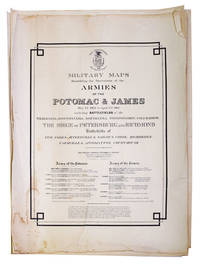
1869267611Washington D.C.: War Department Office of the Chief of Engineers Lithographed by Julius Bien New York 1869. First Edition. Prepared under the direction of Bvt. Brig. Gen. N. Michler Major of Engineers and Bvt. Lieut. Col. P.S. Michie Capt. of Engineers. 16 maps on 17 sheets. All but one double-page. Folio 23-5/8 x 18-1/2 inches. Unbound sheets. Light stains at top edges of several maps title with tape repair. First Edition. Prepared under the direction of Bvt. Brig. Gen. N. Michler Major of Engineers and Bvt. Lieut. Col. P.S. Michie Capt. of Engineers. 16 maps on 17 sheets. All but one double-page. Folio 23-5/8 x 18-1/2 inches. The topographic maps comprise:<br/>1A. Gettsburg to Appomattox Court House northern<br/>1B Gettysburg to Appomattox Court House southern <br/>2. Fredericksburg<br/>3. Chancellorville <br/>4. The Wilderness<br/>5. Spottsylvania<br/>6. North Anna single page<br/>7. Totopotomoy <br/>8. Cold Harbor<br/>9. Richmond<br/>10. Bermuda Hundred <br/>11. Petersburg and Five Forks <br/>12. Jetersville and Sailor's Creek<br/>13. High Bridge<br/>14. Appomattox Court House<br/>15. Antietam<br/>16. Harper's Ferry. Phillips Atlases 3688 listing only 15 maps; Civil War Maps 518; Stephenson and McKee "Virginia in Maps" p. 194: "Topographers had already surveyed more than 1300 miles and issued more than 1200 maps prior to the army's passage over the Rapidan River on the night of 3-4 May 1864 the beginning of U.S. Grant's major offensive in Virginia that led from the Battle of the Wilderness on 5 and 6 May to the ten-month siege of Petersburg beginning in mid-June and finally to R.E. Lee's surrender at Appomattox on 9 April 1865. Bvt. Brig.-Gen. Nathaniel Michler's men made more than 1600 photographic sketches between the time of the river crossing and 30 July 1864. The vast number of surveys that Michler directed led to the publication of this atlas. War Department, Office of the Chief of Engineers [Lithographed by Julius Bien, New York] unknown books
175738668Newtown NJ 1757. 1p. Signed by Henry Simson Joseph Byram John Anderson Thomas Woolverton and Joseph Parry. The French and Indian War on the New Jersey "Front Tears."<br/> <br/>In the wake of Braddock's defeat with tensions with the Delaware Valley Indian tribes rising and with a perceived threat that the tribes of the Delaware Valley would invade into New Jersey at the end of November 1755 Governor Belcher detached hundreds of West New Jersey troops to the New Jersey/Pennsylvania border and into Pennsylvania many under the command of Colonel Abraham van Campen. The present document concerns the death of a resident of Sussex County who evidently travelled with Van Campen and Colonel Jacob Ford to the "front tears" to "parley or hold a treaty with the Indians there" but "hath never returned & by report was near about that time killed." The document advocates for his bereaved wife and suggests that his eldest son be appointed heir and estate administrator. Another copy of this document addressed to "Your Honour" appears in the Documents Relating to the Colonial History of the State of New Jersey first series vol. xxxii p. 326. unknown books
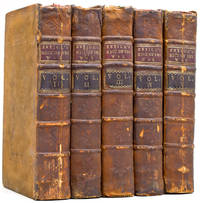
1766237662London: Edward and Charles Dilly 1766. Third edition revised and corrected of vols.I-III; second edition of vols. IV & V. With 41 portraits and 8 folding maps. iv 495; 464; 480; 470 26 Index pp. 5 vols. 8vo. Bound in contemporary panelled reversed calf boards tooled in blind leather title labels. Extremities worn joints rubbed front hinge of volume I detached and front endpaper laid in. Very good. Text clean. Bookplate. Third edition revised and corrected of vols.I-III; second edition of vols. IV & V. With 41 portraits and 8 folding maps. iv 495; 464; 480; 470 26 Index pp. 5 vols. 8vo. History of the French and Indian War drawn largely from primary source material and with much pertaining to the war in North America and the West Indies. Entick 1703-1773 was a prominent lexicographer and historian. Howes E165a; Sabin 22667 Edward and Charles Dilly unknown books
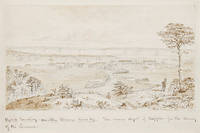
1863WRCAM56150Aquia Landing Va 1863. One pen and ink drawing 7 x 10 1/2 inches sight and one pencil sketch 6 3/4 x 9 3/4 inches sight each in recent matching frames 11 1/2 x 15 inches; plus 2pp. letter on folded folio sheet. Slight soiling and smudging to sketches. Short tape repairs to two closed tears at top margin of letter minor separation at fold text not affected. Very good overall. Two drawings by an unnamed artist submitted as potential accompaniments for articles in HARPER'S WEEKLY which was well-known for the copious Civil War illustrations that supplemented its text. Such illustrations were usually either drawn by reporters or artists sent into the theater by HARPER'S or less often by soldiers in the field. These two works were done by a Union Army Division Post Master and are accompanied by a letter from his commanding officer submitting them for publication. <br> <br> The first work done in pen and ink on paper is entitled "Aquia Landing on the Potomac River Va. The main depot of Supplies for the Army of the Potomac" and depicts a river scene with steamers and sailing vessels along with a pier in the middle distance with a supply train approaching in the foreground which is observed by two soldiers. In the foreground are delicately drawn trees and shrubs; in the background one can see more ships and the other side of the river possibly Simms Point. In early March 1862 the Confederates abandoned Aquia Landing a strategically important post on the Potomac River and Union forces quickly seized the point. The Union Army used the wharves and storage building at Aquia Landing until June 7 1863 when the army headed north for the Battle of Gettysburg and again used the facilities in 1864 during the Overland Campaign. <br> <br> The second work is a pencil sketch titled "Army Bakery in charge of Capt. James Gillette Commissary of Subsistence to Genl. Geary's Division." One medium-sized and two small cabins are at the left side of the image with barrels and a large cauldron nearby; presumably this is where the bakers prepared bread and other items for baking. On the right side of the image is a large wooden lean-to sheltering at least nine ovens. Two bakers are carrying trays of bread and one stands near an open oven with a large peel. To the right of the lean-to is a tent partially open and filled with loaves of bread with three more bakers loading in loaves. In the background are bare trees suggesting this scene is set in winter. <br> <br> The accompanying letter on "Office of the Commissary of Subsistence" letterhead is from Capt. James Gillette to John Bonner then editor of HARPER'S WEEKLY. Gillette writes that he encloses three sketches of which two are included here: "These sketches were made under my own supervision by our division post master are as accurate in detail as any I have seen." Gillette then describes additional material he has enclosed and notes "Some time since a few sketches of scenes in Richmond furnished by my experience found place in your weekly eliciting from you the request that I should occasionally forward to your address such representations of military scenes as might be of interest. Hence these enclosures which in truthfulness cannot be excelled." <br> <br> James Gillette 1838-81 enlisted as a private and rose quickly through the ranks. By this time he was Captain and Assistant Commissary of Subsistence for the 2nd Division XII Corps under Gen. John W. Geary. For his meritorious service he was breveted lieutenant colonel U.S. Volunteers and for gallantry at the battle of Chancellorsville he was breveted major in the regular Army. John Bonner 1829-99 was one of the best known newspaper writers in America at this time. He started as a writer at the NEW YORK HERALD and then moved on to be an editor at HARPER'S. After the Civil War he made a small fortune on Wall Street and then lost it in a most dramatic fashion. He drifted west working for the LEADVILLE CHRONICLE and LEADVILLE NEWS in Colorado and the SAN FRANCISCO CHRONICLE and SAN FRANCISCO CALL among other Bay Area newspapers. <br> <br> An attractive pair of original Civil War drawings from a Union soldier in Virginia in the middle year of the war accompanied by the letter from the Army Commissary officer submitting them for publication to HARPER'S WEEKLY. unknown books
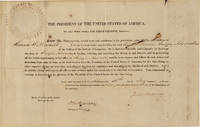
1813WRCAM54812Washington D.C. 1813. 1p. partially-printed document completed in manuscript. Paper seal of the United States affixed to upper left corner. Old folds. Light tanning mild surface wear a few ink blotches one small area of ink burn not affecting text. Overall very good. Matted framed and glazed. A War of 1812-era presidential appointment signed in ink by President James Madison and by Secretary of War John Armstrong. Here Madison appoints Maryland attorney James Sewall Morsell to the position of Judge Advocate of the Militia of the District of Columbia. In addition Morsell has fully endorsed and docketed the document on the verso pledging to "carefully & diligently perform the duties of a Judge Advocate.to the best of my Skill & Judgement and that I will support the Constitution of the United States." Morsell would serve as a Judge Advocate for almost two years. From January 15 1815 until March 3 1863 he would serve as a circuit court judge in the District of Columbia. Earlier in his career and during his years in private practice Morsell represented numerous African-American families who petitioned for freedom in the nation's capital. Judge Morsell passed away in Maryland in 1870. unknown books
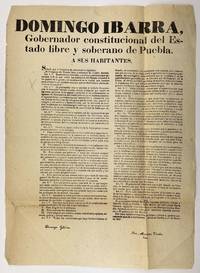
18471731Puebla 1847. Good plus. Broadside approximately 17 x 12.25 inches. Previously folded near lower and right edges to fit in a folio volume with several small stab holes at left edge where previously bound. Some separation from left edge along lower fold line and small area of loss at fold point not affecting text. Light tanning and faint foxing. A rare broadside that promulgates a March 16 1847 decree of the Puebla state government that sought to raise emergency funds for the army facing the American invasion at Veracruz during the Mexican-American War. This decree printed and published in Puebla the following day under the authority of its governor Domingo Ibarra orders the formation of a group to be called the "Patriotic Board of Aid" in order to assure the participation of its citizens. The first article of the decree announcing the establishment of the junta reads as follows:<br /><br />"Entretanto se decretan y realizan contribuciones generales á fin de que todos los habitantes del Estado cooperen á los goastos de la guerra se establecerá en la capital una reunion para proporcionar prontos recursos que se denominará 'Junta patriotica de auxilios.'"<br /><br />The subsequent sixteen articles define the constitution authority and goals of the group. The second article for example stipulates the specific legislative judicial religious and municipal bodies that will nominate two members each to the junta. The fourth article outlines the responsibilities of the board -- to acquire a loan of up to 100000 pesos using the state income as collateral; to seek cash and military supplies via donation loan or purchase; to administer the delivery of goods and money to the army at Veracruz; and to issue state treasury bonds to lenders. The group according to the last article has eight days to amass a much as possible before reporting their results to the state.<br /><br />At this point in the war not only was the entire country under enormous pressure from the landing of Winfield Scott's army but Puebla was also suffering from the significant unrest of the Polkos Revolt which had led to an unsuccessful insurrection aided by a portion of the military garrison in the city just a week prior to the publication of this decree. Indeed the need to ensure the participation of all citizens in the costs of the war is mentioned and emphasized at several points in the decree. The larger size of this broadside underscores the importance of the message and its distribution as well. <br /><br />A fascinating and rare document of emergency efforts at the state level to support the war effort against the United States. We locate only one copy of this rare broadside at Yale. books
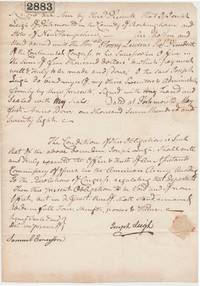
3201DS. 1pg. 7 ¼†x 10 ¼â€. May 1 1778. Portsmouth New Hampshire. A document signed “Joseph Leigh†and co-signed “Samuel Emersonâ€. The important document states “Know all Men by these Presents that I Joseph Leigh of Portsmouth in the County of Rockingham and State of New Hampshire are holden and stand bound unto the Honble Henry Laurens Esq. President of the Continental Congress or his Successor in Office in the Sum of Five Thousand Dollars to which payment well & truly be made and done I the said Joseph Leigh do bind myself my Heirs Executors & Administrators firmly by these presents. Signed with my hand and sealed with my seals: Dated at Portsmouth May first Anno Dom: one Thousand Seven Hundred and Seventy Eight. The Condition of this obligation is such that the above bounden Joseph Leigh shall well & truly execute the Office & Trust of an Assistant Commissary Officer in the American Army According to the Resolutions of Congress regulating that Department then this present obligation to be void and of none effect but in default thereof shall stand remain & abide in full force strength power & virtue.†A few weeks later the New Hampshire Committee of Safety wrote to Leigh stating that “You are hereby appointed Commissary to proceed immediately to that post of the Continental Army where the regiments from this state are stationed - to take charge of & Issue such stores as may be sent there from this state - and you are to observe such orders and instructions as you may from time to time receive from the General Assembly of this state or in the recess thereof from their Committee of Safety - or at any time from the board of war for this State in regard to any matters or things deliver to your care & charge - and you are to render a particular account of your Conduct in and about yr premises and make remittances for the stores delivered to your charge as aforesaid agreeable to the instructions from time to time sent you as aforesaid - and you are to be allowed and paid for your time & expense while in said service such wages as the issuing Commissarys for the other New England States have & receive for similar services.†There is a paper seal to the right of the Leigh autograph and a small label on the top margin. An unusual Revolutionary War financial document. unknown books
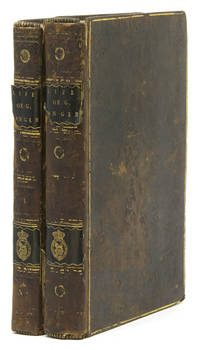
1801302703London: J. Debrett 1801. Complete with half-titles and one illustration to text. 339; 475 4 ads pp. 2 vols. 8vo. Contemporary calf black morocco labels to spine gilt slightly shelf-worn extremities a little rubbed presentation inscription to title-page. Complete with half-titles and one illustration to text. 339; 475 4 ads pp. 2 vols. 8vo. AUTHOR'S PRESENTATION COPY. Presentation copy signed "From the Author" on the title-page. This copy formerly belonged to Sir George Chetwynd; it has both his bookplate and discreet embossed library stamps from Grendon Hall where his collection was housed. A manuscript note to the front free endpaper states that this copy also belonged to the Duke of York.<br/><br/>Having served as aide-de-camp to Clinton during the Charleston campaign he was wounded at Charlotte in 1782 Hanger was appointed Major of Tarleton's Dragoons. With further connections to Carleton Gen. Dickenson and Major Andre among others he was well placed to produce one of the best accounts of the Revolutionary War in the South. <br/><br/>Sabin notes the "curious prophecy" to be found in the second volume: "one of these days the Northern and Southern powers will fight as vigorously against each other as they both have united to do against the British" Howes H-158; Sabin 30227 J. Debrett unknown books
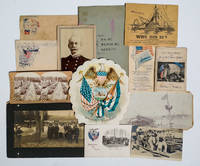
21688On February 15 1898 a mysterious explosion destroyed the battleship USS Maine while it was anchored in Havana Harbor killing 260 men and helping to propel the United States into war with Spain. Although the cause of the explosion was unclear American newspapers were quick to allege that the ship had been brought down by a Spanish bomb. Led by William Randolph Hearst in the New York Journal and Joseph Pulitzer in the New York World the press demanded action. Hearst's headline "Remember the Maine!" became a rallying cry that helped turn American public opinion strongly in favor of war with Spain. By April President McKinley had given into to additional pressure from hawkish senators and his own vice-president Theodore Roosevelt and war was declared. Although brief the Spanish-American War had important consequences. It ended Spain's colonial empire in the Western Hemisphere and secured the position of the United States as a Pacific power. "U.S. victory in the war produced a peace treaty that compelled the Spanish to relinquish claims on Cuba and to cede sovereignty over Guam Puerto Rico and the Philippines to the United States. The United States also annexed the independent state of Hawaii during the conflict. Thus the war enabled the United States to establish its predominance in the Caribbean region and to pursue its strategic and economic interests in Asia" Office of the Historian U.S. State Department.<br/><br/>This collection consists of approximately 120 items including original photographs printed and real photo postcards stereoviews commemorative programs patriotic covers postal stamps calling cards song sheets lithographs and other ephemera showing the Maine as she appeared before the disaster the wreckage and salvage efforts the funeral service and burials of the victims first at Cristobal Colon Cemetery in Havana later at Arlington National Cemetery and some of the myriad ways in which the Maine was memorialized and mythologized in American popular culture. Original photographs and real photo postcards capture the ship and crew prior to the disaster crowds of sailors lined up to pay their respects to the victims the coffins being transported the cemetery dotted with freshly dug graves elaborate floral wreaths and memorials and salvage efforts in the immediate aftermath of the disaster and in 1911 when the ship was raised before being towed out to sea to its final resting place at the bottom of the ocean. The wide reach of the patriotic feelings aroused by the disaster can be seen in two cabinet cards of young children wearing U.S.S. Maine hats as well as on items that have no military or national connection e.g. a high school commencement program a blotter advertising corsets yet bear images of the Maine or the "Remember the Maine" slogan. On envelopes and stationery we see images of Uncle Sam punching a Spainiard an eagle dubbed "the New Bird in Havana Harbor" and troops walking toward a ship under the heading "On to Cuba." A mendicant uses the Maine as his theme on a card handed out to solicit alms; a song by a writer of sensational crime broadsides is reported to have been "composed and written during the indecision of the U.S. Government" and urges "Let's show all foreign powers Aye the haughty sons of Spain they will brook no insult like the Sinking of the Maine." A particularly unusual item is an envelope illustrated with an image of the remains of the ship captioned "WHO DID IT" containing illustrated sheets of tissue with instructions to blow them up via a small "fuse" on the back. In all an illuminating collection that helps demonstrate the impact of both the incident and how it captured the popular imagination -- such that many Americans still recognize the "Remeber the Maine!" rallying cry today even if they no longer know what it represents. unknown books
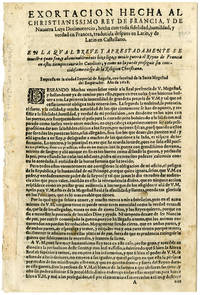
1626WRCAM39190Impressa en la ciudad Imperial de Augusta i.e. Trier: con facultad de la Sacra Magestad del Emperador 1626. 16pp. Small folio. Dbd. Contemporary manuscript docketing on p.16 and contemporary ink underscoring on p.7. Some loss repaired in silk from chipping at gutter and from worming in several leaves the latter affecting some text but not exceeding 1 x 1 inch in area. Closed tears in final leaf repaired with very early paper on verso. Light staining and foxing. Overall very good. The original Spanish translation of an important invective against Louis XIII during the first phase of France's involvement in the Thirty Years' War. At the time of this publication in 1626 France had actively begun to support the Protestant side in the conflict concerned with the political threat of the Hapsburg states that surrounded it on three sides in Spain and Spanish-controlled Flanders to the south and north and the Holy Roman Empire in Germany to the East. In 1624 Cardinal Richelieu was appointed to the Royal Council of Louis XIII and immediately began to institute a vigorous anti-Hapsburg policy. The following year France joined England in subsidizing the efforts of Christian IV of Denmark to defend Lower Saxony against the Holy Roman Empire beginning an involvement in the war that would eventually lead to its own military participation against its fellow Catholic powers. <br> <br> The present document is a long and detailed warning to Louis XIII against pursuing a course of actions that would pit France against the rest of the Catholic world. According to the document itself the text was first composed in French and subsequently translated into Latin and thence into Castilian Spanish. It immediately occasioned a number of responses and refutations and its anonymous authorship soon became the subject of a 200-year-long debate. In his exhaustive and authoritative bibliography on the Jesuits BIBLIOTHÈQUE DE LA COMPAGNIE DE JÉSUS Augustin de Backer seems to have put the question of authorship to rest attributing it to the German Jesuit Jacob Keller. Keller 1568-1631 was a German scholar and controversialist widely regarded as a genius and best known for a counter- Calvinist tract on Tyrannicide and a celebrated defense of the Papacy in a debate with Lutheran theologian Jacob Heilbrunner. Backer lists both the French and Latin versions of the EXHORTATION. and refers to a German translation but he omits any mention of the present Spanish version. He also describes the document as having been printed in Italy which may result from confusion regarding the city name of Augusta. While Augusta Syracuse was under anti- French Spanish control in 1626 and may thus be a candidate for the printing location all other signs and context point to Trier "Augusta Treverorum" in Latin including the publisher's imprint which calls Augusta an "imperial city" and declares permission for publication from the Holy Roman Emperor. <br> <br> An extremely interesting and rare document anticipating the violent wars between France and the rest of Catholic Europe of the following decade and offering a view of the French-Hapsburg rivalry from the Austro- German Hapsburg perspective and translated for the Spanish Hapsburg audience. One copy is held at the Casa de la Cultura Ecuatoriana BenjamÃÂn Carrión in Quito; OCLC lists one additional copy at the New York Public Library. Backer BIBLIOTHÈQUE DE LA COMPAGNIE DE JÉSUS NOUVELLE ÉDITION PAR CARLOS SOMMERVOGEL Louvain 1960 Vol. IV Cols. 992-3. "Jacob Keller" THE CATHOLIC ENCYCLOPEDIA http://www.newadvent.org/cathen/08613c.htm. con facultad de la Sacra Magestad del Emperador unknown books
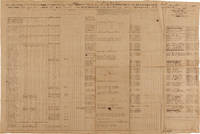
1863WRCAM54505Richmond 1863. Printed form approximately 24 x 36 inches completed in manuscript. Folded. Light wear and a few small separations along folds. Slightly wrinkled at right edge. Moderate tanning scattered foxing. Still very good. A rare example of a Civil War muster roll for a Confederate unit. This roll is for for Company E of the 2nd Battalion Georgia Sharpshooters commanded by Maj. J.J. Cox as they mustered on Feb. 28 1863 near Chattanooga shortly after the battle of Fort Donelson. Although it was a Georgia Battalion the vast majority of men in Company E were from Montgomery Alabama. As a part of Gen. J.K. Jackson's Brigade in the Army of Tennessee the unit fought at Murfreesboro Chickamauga and Missionary Ridge and later as a part of Gen. Gist's Brigade participated in the battle for Atlanta and Hood's Tennessee operations. The roll lists all officers and enlisted men records two deaths in the company a number of absentees through sickness and desertion and even notes two instances of substitution. Civil War soldier substitutions were a controversial tactic in which men of means bought their way out of service. A fine copy of a scarce Confederate military document. unknown books
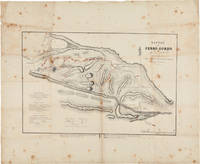
1847WRCAM43715Washington D.C. 1847. Engraved map 12 1/2 x 18 1/2 inches with hand- coloring on a 19 1/2 x 23 3/4 inch sheet. Old folds. Small splits at four cross-folds. Foxing. Good. A scarce and detailed map of the Battle of Cerro Gordo one of the important battles of the Mexican-American War. General Winfield Scott's victory at Cerro Gordo over a much larger force commanded by Santa Anna allowed the Americans to move closer to Mexico City. The map shows the location of the Mexican battery at the pass as well as an additional Mexican battery of seventeen guns. Most dynamically it shows the location of several American forces including those commanded by Shields Riley Twiggs Worth and Pillow as well as the location of the American dragoons and light artillery. A printed note below the map records that Scott commanded some 8325 men while Santa Anna had twice that under his command. A further note records a total of sixty-three Americans killed and 367 wounded. The Mexican forces took some 1000 in killed and wounded. The map was drawn by George B. McClellan then a captain under Winfield Scott and a participant in the battle some fifteen years before he achieved notoriety as a commander in the Civil War and as the Democratic nominee for president in 1864. unknown books
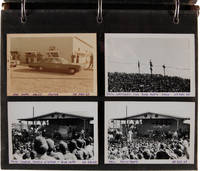
1970WRCAM55101Biên Hòa Nha Trang Long Binh and other locations in Vietnam plus Luzon Philippines and Osan South Korea 1970. 469 black-and-white or color photographs measuring between 3 1/2 x 3 1/2 inches and 8 x 10 inches either mounted or laid-in to acetate sleeves almost all annotated in ink on the bottom margin or on the verso. Contemporary three-ring thick quarto-size binder black cloth over boards. Joints partially split some abrading and dust- soiling to covers. Slight fading to some of the color photos. Overall very good. An exceptional vernacular photograph album by a talented but unknown amateur photographer recording a wide variety of experiences on American Air Force bases in South Vietnam and Asia during peak years of the Vietnam War. <br> <br> The photographer was likely a member of the motor pool or a mechanic as the shots seem to center around truck airplane and helicopter maintenance. Most of the photographs capture scenes on or around the various bases with shots both inside and outside of barracks airplanes including several shots of a U2 spy plane bombed-out equipment and numerous photos of the people and structures in the "Vietnamese Area." A few images capture distant shots of the aftermath of a "rocket attack" on December 12 1969; shortly thereafter the photographer and his friends celebrate Christmas. Some of the more interesting photographs during the photographer's time in Vietnam include "VC Prisoners" "Group of Zips" "Papa-San Working His Rice Paddie" "Vietnamese Guard Tower" "Church on the West Side of Biên Hòa" "Refueling at Phan Rang Run" "Bring the Wounded Out" and several pictures labeled "Buddha Hill" likely the Long Son Pagoda in Nha Trang. Notably and for no obvious reason in two separate images the photographer snaps a picture in a magazine of the famous photograph of ThÃÂch Quang Duc the monk who burned himself alive at a busy intersection in Saigon in 1963. Several times the photographer takes a picture of another picture an interesting practice in the context of so many original photographs. <br> <br> A handful of images of the photographer himself can be seen in the album. In a couple of shots he is posed with his pet lizard. Later he and his fellow soldiers adopt a pet monkey who features in several photographs. There are also a healthy amount of aerial images featuring the South Vietnamese landscape notably rice fields villages rivers "bomb craters" and cities among other locations. Also the photographer identifies dozens of fellow soldiers by name throughout the album in both single portraits and in group photos. <br> <br> The album contains numerous shots both black-and-white and in color taken from the crowd and later on the runway during a December 28 1969 U.S.O. show at Long Binh with several images each of Bob Hope Neil Armstrong Connie Stevens Suzanne Charny Teresa Graves Les Brown the Golddiggers and others. One photograph of Neil Armstrong is captioned "Biggest Hit of the Show." This is understandable given the fact that Armstrong landed on the moon just five months before this U.S.O. show. There is also an 8 x 10 photograph of Connie Stevens inscribed to "Ron" either the photographer's first name or an autographed picture he received from a friend. After the U.S.O. show the photographer snaps several closer shots of Bob Hope Connie Stevens and others climbing into cars to leave. <br> <br> In April or May 1970 the photographer was shipped out to Osan Air Base in South Korea. Along the way he spends a couple of days at Clark Air Base in Luzon in the Philippines where he snaps a few shots of the base. By early May he has arrived at the Osan Air Base near Songtan Station in the city of Pyeongtaek South Korea just south of Seoul. He seems to be happy with his appointment at Osan; he captions one photograph "Home Sweet Home" and a few shots of the countryside as "Paradise." Here he also photographs Korean farmers their families villages a marketplace a church a school and other landmarks. The final two images dated in August 1970 show the photographer on an airboat on an unidentified Korean river. <br> <br> Personal photographic records by soldiers in Vietnam are growing ever more scarce in the market. This collection is one of the best we've encountered and most certainly informs the overall record of the war during perhaps its lowest point of public support. hardcover books
1966148795N.p.: N.p. 1966. Collection of 20 vintage borderless photographs from the 1966 film 18 reference photographs and 2 fashion photographs of Rosaleen Murray and Ann Norman. Mimeo snipes on the verso of three of the photographs. <br/><br/>Inspired by the 1959 short story "Las Babas del Diablo" by Julio Cortazar.<br/><br/>Michelangelo Antonioni's first English-language film marking the beginning of the final phase of his work co-produced by companies in Italy the United States and the United Kingdom and featuring an international cast. The director's brash use of color set design non-standard editing techniques and typical emphasis of atmosphere over plot would carry over into the two major films that followed "Zabriskie Point" 1970 and "The Passenger" 1975. <br/><br/>In his 2009 essay on the film Danny Lyon notes "It is apt that through his established style Antonioni made a movie that is perhaps closest to communicating the myth of the swinging Sixties scene but also the confusion of the time. . Britain's new and very chaotic cultural revolution was perhaps most effectively captured by an Italian."<br/><br/>Winner of the Palme d'Or. Nominated for two Academy Awards for Best Director and Best Screenplay.<br/><br/>8 x 10 inches. Lightest edgewear else Near Fine. <br/><br/>Complete collation details available on request.<br/><br/>Criterion Collection 865. Ebert I. Grant UK/Italy. N.p. unknown books
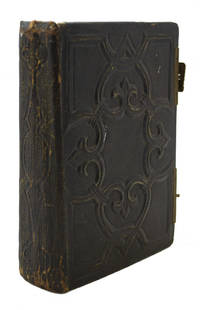
186168366Carte-de-Visite Album of 30 Union Civil War Generals Including Ulysses S. Grant CIVIL WAR. GRANT Ulysses S. Carte-de-Visite Album of 30 Union Civil War Generals. United States: Mathew Brady et al. n.d.c.a. 1861-1865. Small octavo album containing 30 individual carte-de-visites of Union generals in the Civil War. 5 3/4 x 4 1/2 inches; 140 x 110 mm. Each mounted within a decorative stiff card frame with gilt border. With 15 leaves and each leaf has a slot for two photographs. Most photos with a publisherÃs imprint on the back and the name of the general also penciled on the back. Album is contemporary embossed Morocco with two brass clasps. One clasp is broken. Gilt dentelles. Some pages have been reattached at margin but all are present. Some chipping and wear to head and tale of the spine but overall very good. A very nice assemblage of vintage photographs of officers from the Union. The carte-de-visites are as follows with a note on their publisher and condition if other than very good: 1. Winfield Scott D. Appleton. 2. George McClellan Charles Taber 3. Ambrose Burnside Appleton. 4. Michael Corcoran E. Anthony. 5. Silas Casey Charles D. Fredricks. 6. Nathaniel Banks Appleton. Slightly faded. 7. Ulysses S. Grant E. Anthony. 8. Henry Halleck Appleton. 9. Ethan A. Hitchcock Appleton. 10. Nathaniel Lyon Appleton. 11. John Pope E. Anthony from Brady's National Portrait Gallery. 12. Franz Siegel Appleton Faded. 13. Robert Anderson Appleton. Bottom of mount chipped. 14. John Wool Appleton. 15. William Sprague Charles D. Fredricks. 16. Group photo of 12 generals Unknown maker. Faded. 17. Max Weber Appleton. 18. Frederick W. Lander Appleton. Lightly faded. 19. Jesse L. Reno Unknown maker. 20. James Shields Appleton. 21. Unknown sitter Beers & Mansfield written on back. 22. Winfield Scott Hancock E. Anthony for Matthew Brady. 23. Thomas Francis Meagher Appleton Bottom of mount chipped. 24. Henry Washington Benham E. Anthony for Matthew Brady. 25. George Meade E & H.T. Anthony for Matthew Brady. 26. Egbert Ludovicus Viele Appleton. 27. Adam J. Slemmer Appleton. 28. Daniel Butterfield E. Anthony for Matthew Brady. 29.Charles D. Jameson E. Anthony for Matthew Brady.Red mark at bottom of photo on mount. 30. Edwin Vose Sumner Charles D. Fredricks. HBS 68366. $2000 Mathew Brady, et al. unknown books
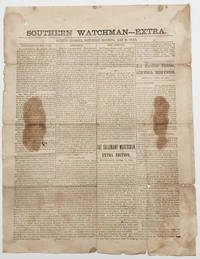
1865WRCAM53477Athens Ga 1865. Broadside 15 1/2 x 11 3/4 inches. Minor edge wear some toning and spotting two small dark stains old folds. Overall good condition. An interesting broadside newspaper extra concerning the Union occupation of Athens Georgia at the end of the Civil War. The paper was printed nearly a month after the Army of Northern Virginia surrendered and ten days or so after Gen. Joseph Johnston surrendered to Sherman the Confederate forces active in the Carolinas Georgia and Florida. The first two columns include passages on "Teachings of the War" "Armistice" and "Good Advice." Each of these articles struggle to find meaning in the end of the recent conflagration providing an important glimpse into the minds of the Southern sympathizers. The third column begins: <br> <br> "New Arrival! The Federal forces under command of Brig. Genl. Palmer entered our place on the 4th inst. The conduct of the troops since their occupation of the town has been good and reflects great credit upon Genl. Palmer as a strict disciplinarian. We hope that our citizens will endeavor by kind and courteous treatment toward the soldiery to encourage a continuance of the protection which they seem willing to afford." <br> <br> The editors of the SOUTHERN WATCHMAN argue for peaceful acceptance of the Reconstructionist Union forces and mince no words in their harangue on other Southern newspapers calling for the continuation of the War: <br> <br> "Below we give extracts from the SALISBURY WATCHMAN and CAROLINA SPARTAN - two papers that have from the beginning of the war advocated the policy of fighting on until the last man and dollar were exhausted and by their vile traitorous and insidious words exerted a strong influence over the minds of the South and thousands of widows and orphans who are now suffering every privation and horror connected with the war can attribute them to the false and unscrupulous arguments set forth and spread out in these papers. It is an easy thing and one that requires but little valor or manly spirit to cry out 'War to the last!' when comfortably ensconced at home surrounded by every luxury and comfort that civil life affords and where no Yankee bullets can reach. Such has been the position of those who govern the Southern press who keeping their devoted carcasses at a respectable distance in the rear still cry out for more lives to sacrifice and more money to squander to enable them to secure a foundation for their weak and rotten Confederacy to stand upon." <br> <br> The paper then quotes a long passage from each of these other newspapers. The editors of the SALISBURY WATCHMAN call for armed resistance before reporting that they themselves are preparing to "leave you for some spot on earth where Yankees cannot come." The CAROLINA SPARTAN incites the people to lay their lives "on the altar of Southern independence" before insisting in the last sentence that "we advise our friends to refrain from hostilities." <br> <br> A rare broadside relating to the delicate psychological condition and tenuous state of feelings among groups of Southerners who have been forced to realize that the fight for the Confederacy is over and they have lost. unknown books
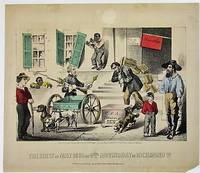
186534176New York: Published by H. & W. Voight. Lith. by Kimmel & Forster 254 & 256 Canal St. 1865. Broadside illustration 9" x 10-3/8". Brightly colored mildly toned. Small spot at top blank margin. Upper margin of blank verso shows remnants from former taping. Lower blank forecorner chipped. Very Good. <br/><br/> "From building inscribed 'To let Apply Lincoln & Co.' Southerners at whom Negro thumbs his nose are moving 'C.S.A. Treasury' etc." Weitenkampf. Anticipating the end of the Civil War in Richmond the cartoon depicts Robert E. Lee collecting swords for placement in a cart drawn by two skeletal dogs Treasury Secretary Trenholm hauling away worthless Confederate bonds and a "Sheriff Sale" sign on the building. Bystanders look on. A dog urinates on a box entitled "C.S.A. Treasury. Waster Paper." <br/> Despite the title's date the cartoon was probably issued before May 1 that date being the artist's prediction of the time of the Confederacy's collapse. The reference to Lincoln & Co. suggests the President was still alive. <br/>Weitenkampf 148 recording a 1905 reproduction only. Not in Reilly. OCLC 191119865 4- AAS Clements U VA Williams as of October 2019. Also located at the Library of Congress Boston Public Library Lincoln Financial Foundation Collection. Published by H. & W. Voight. Lith. by Kimmel & Forster, 254 & 256 Canal St. unknown books
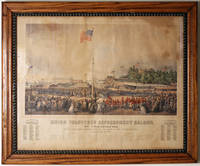
186122953<p>Showing Union troops arriving in Philadelphia from New Jersey via ferry and marching in formation towards the Union Volunteer Refreshment Saloon cheered on by Philadelphians. Text at the bottom lists members of the committee and men willing to accept donations for the saloon. This image became a choice souvenir for soldiers passing through Philadelphia.</p> <b>CIVIL WAR.</b>Print. <i>Union Volunteers Refreshment Saloon of Philadelphia</i>. James Queen delineator and lithographer. Philadelphia: Thomas Sinclair 1861. In period frame 35 x 29 in. <p><b>Historical Background</b></p><p>The Union Volunteer Refreshment Saloon was organized in South Philadelphia in 1861 by grocer Barzilla S. Brown. He began informally distributing food to Union troops traveling through Philadelphia an important rail and steamer hub. The relief effort became official on May 27 1861. The saloon provided soldiers with food drink stamps and paper and offered traveling troops a place to rest. This initial effort differed in some ways from the later Sanitary Fairs that contributed to the care of sick and wounded soldiers. At this point the civilian members were catering to the needs of healthy new recruits.</p><p>In September the Refreshment Saloon added a hospital to aid sick and wounded troops. The saloon supported itself through donations of food clothing cash and later through admission cost to view the Confederate navy vessel <i>Ram</i> which was captured in 1863. After providing social and medical services for four years the saloon closed in late 1865.</p><p><b>James Fuller Queen</b> 1820-1886 apprenticed to learn lithographic draftsmanship. He drew a large variety of lithographs for large printing houses of Wagner & McGuigan Thomas Sinclair and P. S. Duval. He drew views of buildings cities scenic attractions newsworthy events portraits sheet music covers diplomas illustrations for magazines and other images. He also became an outstanding chromolithographer. His view of the "Union Volunteer Refreshment Saloon" is one of Queen's most complex works and perhaps the one for which he is best known. He later drew the United States Sanitary Commission Fair in Philadelphia.</p><p><b>Thomas S. Sinclair</b> c. 1805-1881 was born in the Orkney Islands of Scotland and studied lithography in Edinburgh and other cities. He started his own printing firm in Philadelphia in 1838. He was among the first in Philadelphia to experiment with color lithography. From 1854 to 1859 his brother joined him in the firm of Thomas Sinclair & Co. Later his son worked with him in Thomas Sinclair & Son. He published three different hand-colored lithographs by Queen of Brown's Refreshment Saloon and its friendly rival William M. Cooper's Cooper Shop Volunteer Refreshment Saloon in 1861.</p> Thomas Sinclair books
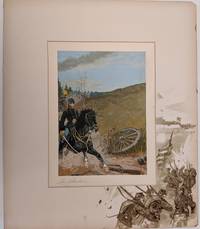
1887692New York: Koch Sons & Co. 1887. Folio. 480 x 405 mm. 19 x 16 inches. Printed index of plates followed by 12 chromolithographic images after original drawings by L. K. Harlow. Each image is mounted to a cardboard mat 11 of which have lithographic vignettes in the lower corner of the mat. Each image is preceded by a tissue with the title of plate printed; some of the tissues are creased and chipped at the out edges. Each plate is signed by Harlow in pencil and a few are signed in the plate; the images are clean and bright but the mats show some toning and a few have minor chips to the edges.  The folio plates are housed in a folding portfolio the spine and flaps are worn and probably should be discarded. Deluxe Edition numbered "79". Sold by Subscription Only. Scarce portfolio of Civil War paintings by the noted Boston artist Louis Kinney Harlow.  Harlow was noted for his water color illustrations that were used to illustrate scores of books and which keep the printer Louis Prang very busy in the 1880's and 1890's. Fielding writes "In 1880 he opened his studio in Boston. Since that time he has been much sought after by publishers of fine books his illustrations having color brilliancy." The plates in this portfolio depict aspects of army life and battle scenes including Grant at Vicksburg Sherman on his march and Sheridan at the Battle of Cedar Creek Each is finely designed and colored and each is signed in pencil in the lower margin. The color plates were printed by Koch and Sons and demonstrate the technical skills of the printer and his attention to detail and color registration. Copies of this portfolio were scarce in the trade. NUC lists only the Boston Public Copy and OCLC adds seven others all in American libraries. Mantle Fielding Dictionary of American Painters p. 158. . Koch, Sons, & Co. unknown books
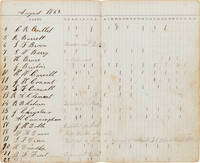
1862WRCAM55597Various locations mostly Louisiana 1862. 120pp. Contemporary sheep later leatherette backstrip title stamped in dark brown on front board reading "GUARD BOOK D. CO. 12TH. REG. MAINE." Some edge wear mild chipping and light scuffing to boards. Front hinge detached spine cracked. Occasional thumb-soiling to text. Still very good. A manuscript record book documenting an entire year of guard duty worked by various members of Company D 12th Maine Infantry Regiment Volunteers during the early part of the Civil War. The majority of time recorded in this book emanates from Louisiana while the 12th Maine Regiment was attached to Butler's Expeditionary Corps from January to March 1862. On their way to Louisiana the regiment travelled on the Steamship Constitution to Ship Island Mississippi serving there until May 4 1862. The Regiment then traveled to New Orleans for guard duty at the U.S. Mint until October 1862. While in New Orleans the Regiment took part in the expedition to Pass Manchaca from June 16 to 20 and the expedition to Ponchatoula from September 13 to 18. In October the Regiment moved slightly north to Camp Parapet in Shrewsbury Louisiana and served there until November 19 1862; the record book ends here. <br> <br> Each two-page opening of the ledger is pre- printed with a large column on the left for names and thirty-one numbered smaller columns for marking days served on guard duty. Most days have just one or two tick marks for any particular soldier indicating just one or two men were on active patrol mostly privates but also sergeants corporals musicians wagoners and others. The number of guard shifts worked by the regiment increased dramatically in May 1862 when they arrived at the U.S. Mint in New Orleans before falling off again the next month presumably after some relief arrived. In addition to guard duty service notations indicate reasons for absences such as "died at" "sick" "in confinement" "permanent detail" "enlisted for cook" "light duty" "in the woods" and "hospital." Notations from February 1862 indicate that James H. Andrews died onboard the Constitution on February 14 and two other soldiers caught sickness at Fortress Monroe. Another entry shows that S.G. Tracy "Died at Ship Island 12 of April 1862." Later in July Capt. H.W. Dunn is detailed for daily duty at the "Reding Press" in New Orleans. In August G.F. Drown is "Detailed as Nurse in General Hospital St. James Hotel N.O." <br> <br> Material from the Trans-Mississippi West is rare this early in the Civil War and also usually not as thorough as the present record book documents an entire year of service. A unique record of Civil War service for a peripatetic Maine volunteer infantry regiment serving in the Bayou State. hardcover books
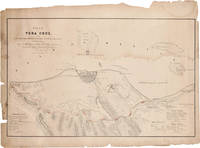
1847WRCAM48455Washington D.C. 1847. Engraved map 16 x 25 1/4 inches with hand- coloring on a 19 1/2 x 27 inch sheet. Worn around the edges with chips and loss not affecting the map imagery itself. Two closed tears in the left edge do intrude into the map. Paper tanned upper portion stained. About good. A scarce and detailed map of the Siege of Vera Cruz a turning point in the Mexican- American War. Winfield Scott with ten thousand American troops and a siege train landed on the beach near Vera Cruz on March 9 1847. The American forces outnumbered the Mexican defenders of the city by a two-to-one margin and the American guns were especially devastating. The city's castle was undamaged but the terrified citizenry implored Gen. Juan Morales to capitulate which was done at the end of March. The map notes American casualties as twelve killed and sixty-one wounded the actual numbers were slightly higher; the casualty rate among Mexican soldiers and civilians outnumbered that of the Americans. Vera Cruz would become an important port base for the American forces. This map shows the coastline from the road to Jalapa to the landing point of the American troops. The city and its main defenses are shown in detail and the headquarters of American commanders Scott Worth Patterson and Twigg are also shown. The Line of Investment is colored in red as is the location of the American hospital. Text on the map describes the make-up of the divisions led by Patterson Worth and Twigg. This map was drawn by George B. McClellan then a captain under Winfield Scott and a participant in the battle some fifteen years before he achieved notoriety as a commander in the Civil War and as the Democratic nominee for president in 1864. OCLC records some sixteen institutional copies but in our experience this map is scarce in the market. unknown books
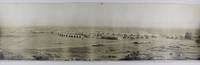
19171993Chicago: Mayhart Studio 1917. Very good. Large panoramic photograph 8 x 90.5 inches. Rolled. Light wear at edges with a couple of small chips and very short closed tears along top edge. minor dust soiling and toning. A fabulous and extremely long panoramic photograph measuring approximately 7.5 feet in length that depicts Camp Bowie in Fort Worth during October 1917. At this time the camp was still under construction but also housed an entire infantry division in training for World War I. Ongoing construction efforts are clearly evident as piles of lumber in various states of organization occupy the field in the center foreground. Already completed barracks and other out buildings occupy the right of the image and thousands of army tents sweep into the background of the center and left portions of the image. A group of standard houses likely for officers and their families is located at the lower left of the image. The photographers Mayhart Studio of Chicago were responsible for a number of military and patriotic views during the United States' involvement in the Great War including the well-known "Living Flag" image of thousands of servicemen composing an American flag.<br/><br/>"Construction of Camp Bowie began on July 18 1917. The camp in the Arlington Heights neighborhood about three miles west of downtown Fort Worth was established by the United States War Department to give training to the Thirty-sixth Infantry Division. Local officials expected financial gain and urged that the camp be located at Fort Worth. Including the adjacent rifle range and trench system the site encompassed 2186 acres. Camp Bowie's greatest average monthly strength was recorded in October 1917 as 30901. For about five months after the departure of the Thirty-sixth for France in July 1918 the camp functioned as an infantry replacement and training facility with monthly population ranging from 4164 to 10527. Shortly after the Armistice on November 11 1918 Camp Bowie was designated a demobilization center. By May 31 1919 it had discharged 31584 men. The heaviest traffic occurred in June when it processed thousands of combat veterans of the Thirty-sixth and Ninetieth Texas-Oklahoma divisions. The demobilization having been concluded Camp Bowie was closed on August 15 1919" -- Handbook of Texas Online.<br/><br/>A quite remarkable photographic document of this short-lived World War I-era army camp in Fort Worth whose grounds and surrounding neighborhood are now touted by the municipal tourism office as "the city's premier commerce corridor." We locate no other examples of this excellent and large panorama. Mayhart Studio unknown books
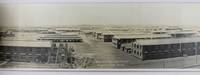
19171992San Antonio 1917. Very good. Large panoramic photograph 8 x 92 inches. Rolled. Minor wear at edges with one very short closed tear at top edge. Light blemish in negative at center of image. Light dust soiling and toning. An outstanding and extremely long panoramic photograph measuring well over 7.5 feet in length that depicts Camp Travis in San Antonio following its recent opening. Although the camp was open and housing an entire division-in-training at the time of this image the camp was still under construction as evidenced by the organized piles of lumber at the far right of the image and the incomplete barracks building in the center foreground. The panorama nevertheless gives a sense of the scope and size of the training camp with barracks and outbuildings stretching almost as far as the eye can see in the center and left sections of the photograph. Structures are more sparse in the right-hand side of the image both because they as yet unbuilt and because some of the training fields were located in this part of the camp. The photographers Mayhart Studio of Chicago were responsible for a number of military and patriotic views during the United States' involvement in the Great War including the well-known "Living Flag" image of thousands of servicemen composing an American flag. <br/><br/>"On July 15 1917 after its selection as the training site for the Ninetieth Texas-Oklahoma Division of the army Camp Wilson was renamed Camp Travis in honor of Alamo hero William B. Travis. The camp was ready for occupancy on August 25 1917. Additional land was subsequently acquired for vital training facilities and numerous structures were erected by the soldier welfare agencies. Camp Travis comprised 18290 acres of which 5730 were on the main campsite adjoining Fort Sam Houston. The Ninetieth Division was organized at Camp Travis in September and October of 1917. During the summer of 1918 Camp Travis served as an induction and replacement center with an average strength in July of about 34000 White and Black troops. On December 3 Camp Travis was named as a demobilization center. The facility was also designated a local recruiting station and a regional recruit depot in March 1919. Some 62500 troops were discharged at Camp Travis in about eight months. The camp then became the home station of the Second Division. Its service as a separate entity was terminated however upon its absorption by Fort Sam Houston in 1922" -- Handbook of Texas Online.<br/><br/>A quite fascinating view of this enormous World War I-era training camp in San Antonio now a part of the even larger Fort Sam Houston military base on the east side of the city. We locate no other copies of this large and remarkable panorama. unknown books
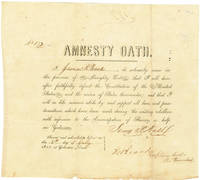
1865WRCAM55643Galveston 1865. Partially-printed document 8 1/4 x 9 1/2 inches completed in manuscript. Three vertical folds. Minor toning foxing soiling and edge wear. Very good. A rare Civil War amnesty oath attested to and signed by James P. Nash in Galveston on July 8 1865. The partially-printed document is signed by him twice and also dated and signed by the Captain and Provost Marshal Harry Beard. The oath reads in full: <br> <br> "Amnesty Oath. I JAMES P. NASH do solemnly swear in the presence of Almighty God that I will hereafter faithfully defend the Constitution of the United States and the union of States there=under; and that I will in like manner abide by and support all laws and proclamations which have been made during the existing rebellion with reference to the Emancipation of Slavery; so help me God. JAMES P. NASH. Sworn and subscribed to before me this 8th day of JULY 1865 at Galveston Texas. H. BEARD Captain and Provost Marshal." The signer of the Amnesty Oath James P. Nash was likely the same James P. Nash who was an early educator and professor in Galveston. <br> <br> This 1865 amnesty oath appears to exist in two states: one blank below the line "1865 at Galveston Texas" and one with a dotted line added above the printed words "Captain and Provost Marshal." The present example is the former and likely first state of the document before the dotted line and "Captain and Provost Marshal" were added later. <br> <br> Amnesty oaths are scarce in the market; this one is especially interesting for its association with an early Galveston educator. unknown books
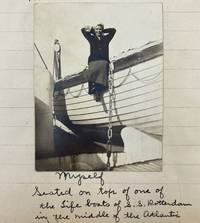
19141820Various places in Germany mostly Darmstadt as well as England Holland the Atlantic Ocean New York and Allentown 1914. Good plus. 144pp. with ten original photographs and printed document mounted at rear. Quarto commercial journal. Black cloth boards edges dyed red. Spine perished boards attached with amateur tape repairs. Text block solid. Minor offsetting from photographs; a bit of soiling to first leaf; light even tanning. Accomplished for the most part in highly legible hand; approximately 17500 words in total. A remarkable manuscript travel journal that documents the European trip of a 22-year-old Pennsylvania woman its interruption by the outbreak of World War I her subsequent stranding in Germany and her trials in securing passage back to the United States. Anna F. Weil b. about 1892 the daughter of an Allentown grocer John Weil departed New York on June 29 1914 aboard the S.S. Rotterdam a 3400 passenger luxury cruise liner operated by the Holland America Line. She arrived in Rotterdam Germany on July 9th and proceeded to connect with family and sightsee in Germany and the Netherlands with plans to proceed to Switzerland and Germany which were cut short by the declaration of war between Germany and England:<br/><br/>"Wed. July 29. To-day war was declared I have many postal cards written to send to American but was told not to send them as they would not reach their destination so all communication with outside countries is cut off. The harbor is closed and no ships can leave or enter German ports. The English cut the German cable a few days ago before war was declared so now we can't even send a telegram from Germany." p.68<br/><br/>At first the war is present in daily life but still seems some distance from it:<br/><br/>"On Sunday Aug. 23. I saw the first wounded French soldiers saw a wagon full but there were well treated by the Germans and the people expressed pity for them as they were a sad looking party. We were at Frankenstein's Castle a ruin on the mountain which can be seen way in the distance from Darmstadt. It was a very nice ramble through the woods and part of the castle is used as a restaurant where we had some thing to eat and drink before resuming our ramble in and about the castle. When at the top of the town it was nice to look over the tops of the trees over the fields and see the villages and the city away off in the distance." <br/><br/>The reality of the situation however quickly becomes more evident and more pressing:<br/><br/>"Aug. 28. Friday. Received a letter from Angeline dated July the 23d. also one from Frank dated August the 4th. Saw hundreds and hundreds of horses which are taken and sent to battle with the men. Saw many companies leaving it was a beautiful sight to see them march as one man. As they passed through the streets the women came and greeted them and gave them flowers. Horses wagons men every thing was covered with the acorn leaves the German emblem of victory and as the women gave the flowers they were placed among the acorn leaves and so they left their homes families and country with flowers and song and their flags waving high above them. It was a beautiful and inspiring sight to see them go but to think of their return made one's heart grow sad. One company that I saw Company 115 had but 30 men left after the battle the rest were dead or wounded."<br/><br/>Throughout the account her German heritage shapes a favorable view of the Germans in the war:<br/><br/>"In Belgium the Germans were very much ill treated they had to flee the country in 1 hours notice and leave every thing back Elizabeth Buehler and her brother as well as other Germans who were living in Belgium in the city of Antwerp had to flee for their lives and all their belongings were taken from them they arrived in Darmstadt with nothing but what they had on their bodies. When the war first broke out the Russians who were in Germany threw bombs and tried various ways of doing mischief. So all were given a chance to leave and got to their own country. Those who refused and did any mischief were taken into custody and placed under guard until the war is over. Those who did any wrong were sentenced to death were shot. This was at least more human that the way some of the Belgians and Russians treated and mutilated the Germans when they had done no wrong and deserved no punishment. War is war and there are rules which we cannot change and are considered honest in warfare but I don't think it right to torture or mutilate a wounded soldier whether friend or foe."<br/><br/>She remained with family at an estate on Dieburger Strasse in Darmstadt Germany until she was able to secure an emergency passport from the American Consul in Frankfurt on September 15th. The return passage was fraught as Holland America misplaced her reservation the ship was delayed and she was forced to find temporary lodgings in Rotterdam when she arrived on October 1st:<br/><br/>"When we got there the proprietor said all was taken this made the porter cross and he said he would find some kind of place for us but we were not going to take any kind of a make shift so we turned and hurried back to the station the porter took hold of my arm and tried to detain us but I broke loose and Mrs. Kramer and I ran as fast as could when we reached the station we were just in time to catch the other four who were driving away in carriages. The eldest one saw us running and stopped the team and waited for us. We got in and such a time till we found lodgings. Every thing was taken which was due to so many Americans and fleeing Belgians. We succeeded in finding a place at 2.30 am where all six of us stayed. Then there was trouble with the driver and one of the Americans went out and called a police-man and settled the trouble and we retired at 3am."<br/><br/>She eventually landed back in The States after a return trip that saw rough seas and an intense scrutiny of passengers upon landing in New York:<br/><br/>"At Staten Island the doctor came to our ship with a yacht flying the yellow flag. Here we stopped for some time the mail ship came and all mail bags were given over to this ship. Then another yacht crowded with American custom officers arrived on the scene and boarded our ship. Then we all had a hurried lunch as there was no time for supper. All had to go on deck until the dining room was in readiness for the officers. It was dark by this time and the ship under way again. When all was ready we had to stand in line with our yellow tickets. Only a few at a time were allowed to enter the dining-room. When once inside we had to look about for the table bearing the number of our ticket. Here we were interviewed by the officer at that table. Some people had a great deal of trouble and were sent from one table to another. Others were refused admission into the United Sates and some had to go to Ellis Island."<br/><br/>The rear pages of the journal are illustrated by 10 mounted original photographs of her initial journey family some sightseeing and her return passage; also tipped in are her emergency passport and a typed letter from the American consul. Overall the journal is a detailed and eventful original woman's travel manuscript as well as a rich primary record of an American civilian caught in Europe during the outbreak of the Great War. A partial transcription with additional excerpts is available upon request. unknown books