1 575 résultats
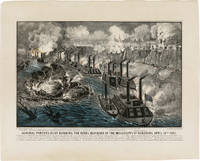
1863WRCAM56146New York: Currier & Ives 1863. Handcolored lithograph 12 x 15 inches. Tiny chip in upper left corner well away from the image. A clean near fine copy. A colorful and dramatic depiction of Admiral David Dixon Porter's Mississippi River Squadron running the Confederate blockade at Vicksburg during the siege of the city by Union forces in 1863 an important strategic victory in taking control of the river. Captions identify Porter's flagship the U.S.S. Benton in the right foreground leading the Lafayette and General Price which are followed by the Louisville Mound City Pittsburg Carondelet Silver Wave Forest Queen Henry Clay and Tuscumbia. A barrage of cannons fire from both the squadron and the Confederate batteries on the embankments overlooking the river. Union cannonballs are hitting both the batteries and the buildings on the bluffs of Vicksburg further in the background. Clouds of smoke billow from the ships the burning buildings and one of the floats of flammable material set out by the Confederates. <br> <br> Initially Grant had asked only for a few gunboats to shield his troops but Porter persuaded him to use more than half of the Squadron. Six nights later April 22 they made a similar run past the batteries to give Grant the transports he needed for crossing the river. Grant first tried to attack the Rebels through Grand Gulf south of Vicksburg and had Porter's gunboats eliminate the two forts there so his troops could cross. Despite intense shelling the upper fort held; Grant called off the assault and moved downstream to Bruinsburg where he crossed unopposed. Afterwards Porter's ships remained in place securing the Mississippi and Yazoo Rivers and guaranteeing the success of the siege. Grant was effusive in his praise Porter's actions and for his contribution to the victory Porter's appointment as acting rear admiral was made permanent. <br> <br> The additional printed caption describes the event thusly: "At half past ten P.M. the boats left their moorings & steamed down the river the Benton Admiral Porter taking the lead - as they approached the point opposite the town a terrible concentrated fire of the centre upper and lower batteries both water and bluff was directed upon the channel which here ran within one hundred yards of the shore. At the same moment innumerable floats of turpentine and other combustible materials were set ablaze. In the face of all this fire the boats made their way with but little loss except the transport Henry Clay which was set on fire & sunk." <br> <br> The Union victory at Vicksburg was the second major blow to the Confederacy in the spring and summer of 1863. On July 3 Lee's invasion of the North foundered at Gettysburg and on July 4 the U.S. flag rose over Vicksburg. This print is surprisingly uncommon in the market. CURRIER & IVES: CATALOGUE RAISONNÉ 0058. PETERS CURRIER & IVES 1180. Currier & Ives unknown books
40474This Union officer served on the staff of Brigadier General James Shields whose troops faced Stonewall Jackson's Confederate troops in the Shenandoah Valley in June 1862 and later commanded the Second Louisiana Regiment Cavalry; he was a good friend of famed Irish soldier Miles W. Keogh 1840-76 killed in the Battle of the Little Bighorn who served under him in the Papal Army during the Italian rebellion in 1860 and who fought with him in the Battle of Port Republic; he's reported to have become enamored with famed Southern spy "Belle" Boyd" at one point and to have unwittingly revealed military secrets to her. Outstanding pencilled ANS 2pp recto and verso heavy stock 4" X 2½" card "Conrad's Bridge" Virginia n.d. ca. early June 1862. Addressed to "General" probably James Shields. Very good. Lightly age toned. In this remarkable small report Keily reports in a small tight but fairly legible hand to his commander that "Col. Carroll moves his comm'd. at p.m. and will push on as rapidly as possible some cannonading heard this morning in the direction of Harrisonburg I would respectfully submit that if the Infantry did not move rapidly enough to carry out your views at Wainesborough before Jacksons arrival there a reconnaisance composed of cavalry conducted cautiously might attain the object with a good Guide which we have procured I would be glad to undertake it -- respectfully" and signs off adding his rank "Capt. A.D.C" beneath. A rather light challenging to transcribe postscript reads "P.S. Just received information from a reliable source that Jackson has --- --- --- Train on the --- Pt. Republic Road." It's difficult to precisely date Keily's note but General Shields did write General McDowell on June 4 1862 that "Colonel Carroll. after a forced night's march reached Conrad's Bridge this morning at 5 o'clock which bridge he found burned" -- which likely dates Keily's letter from this date or shortly after. Whether Shields took Keily up on his offer to lead a cavalry reconnaissance is unclear. Shields 1810-79 is perhaps best remembered as the Illinois politician who almost fought a duel with Abraham Lincoln in 1842; he's also the only person in American history to serve as U.S. senator from three different states Illinois Minnesota and Missouri; as a brigadier general of volunteers in the Civil War his lackluster performance as commander of the 2nd Division of the V Corps in the Army of the Potomac during the crucial Valley Campaign caused him to resign his commission. On June 9th the Battle of Port Republic took place a costly Confederate victory in which Jackson's 6000 troops faced off 3500 Union troops losing just over 800 men to the Union's loss of just over 1000 men -- a battle at which Keily himself was severely wounded in the face while leading a charge of Ohio cavalry up a hill into a barrage of Confederate artillery fire. The following year after painful recuperation Keily ended up on the staff of General Charles P. Stone in New Orleans recruiting cavalry troops in that occupied state. Late in the war he was court-martialed for "conduct unbecoming an officer" but the charges were shown false and by the end of the war he was brevetted a brigadier general. Keily died from yellow fever in Louisiana at age 38 shortly after the war's end making his autograph material quite scarce -- and a choice war-date item such as this most desirable. This remarkable war-date communication sheds interesting light on Shields as commander during the disastrous Valley Campaign. unknown books
1925536421925. Folio. Eight pages approximately 2750 words; accompanied by another autograph letter from Russell to Trowbridge 14 March 1925; 4to four pages approximately 750 words with more information on the political situation in Missouri on the eve of war and an autograph transcription by Russell of the long poem "The Battle of Wilson's Creek August 10 1861" folio two pages with his own commentary on the poem. Folded. Insect damage to the poem and first leaf of the longer letter resulting in the loss of a number of letters but quite legible throughout. 813. Russell a native of St. Louis enlisted under Lincoln's first call for troops and served in a Missouri regiment through the summer of 1864. Following an outline of sectional struggle from 1820 and early events of the war given in the first half of the longer letter Russell describes the events of the Wilson's Creek Campaign and then his own eyewitness to history: "The Kansas boys like ourselves were resting when all at once the rebels crept up the hill to the top of the crest opened a tremendous fire right into the Iowa boys and our regiment but we went at them anyway and a hand to hand struggle began . My Captain Cary Gratz was killed . I was wounded four times and the Kansas boys were holding their own. Capt. Lyon had been hit twice once a scratch along the forehead and a light superficial wound in the knee. I was carried down the hill and placed on the hill side opposite the line of battle the valley being merely a hollow. I had a good view of the fight as it went on. My first attention was attracted to my right as I lay there and watched Capt. Lyon trying to rally the Iowa boys who were in a panic their Colonel had been killed and although the Kansas boys had saved them Capt. Lyon was rallying them into formation to use as they were then near the front. All at once I saw him rear off that dople sic gray horse and fall to the ground. Maj. Schofield also ran to his side a messenger sent for our surgeon Dr. Comyns . Capt. Lyon was carried down the hill he was shot nearly half way up from the hollow to the battle lines. The bullet had struck him squarely in the breast and had gone through his hear and he had lost the pleasure of seeing the victory his indomitable courage had won."_The Confederates commanded by Gen. Sterling Price made another assault following the death of Lyon but Samuel Sturgis rallied the Union troops and the Federal lines held. Sturgis then left the field toward Springfield and the Confederates did not pursue him. "The campaign marked the beginning of the war in Missouri and the trans-Mississippi. Afterward the Federal army withdrew to rolla Missouri leaving the Southerners in possession of most of the southwestern region of the state" "Encyclopedia of the Confederacy"._Lyon 1818-1861 a Connecticut native graduated from West Point in 1841 served in the Mexican War and on the western frontier most of the time to the eve of Civil War in "Bleeding Kansas" becoming involved in the political issue of slavery in the territories. Appointed brigadier general in May 1861 to command the Union forces in St. Louis he also led discussions with Confederate sympathizers on Missouri's position in the union; when compromise failed he launched his first military campaign which culminated in his death at Wilson's Creek. "The entire north mourned his death and he immediately became a national hero and martyr . his brilliant work had done much to hold Missouri for the Union" DAB. <br/><br/> unknown books
1846WRCAM46339Monterey 1846. Broadside 12 1/4 x 8 1/2 inches. Old fold lines. Minor wear. Near fine. In a cloth clamshell case. American forces under the overall command of Gen. Zachary Taylor fought for control of the important city of Monterrey Mexico during September 22-28 1846 in one of the most important battles of the Mexican- American War. The Mexican forces under Gen. Ampudia trapped in the city plaza and bombarded with artillery decided to negotiate and Taylor agreed to a controversial armistice lasting eight weeks. The occupation of the city was disrupted by the behavior of the American troops especially the Texans who were as a result sent back north. On October 5 a Mexican lancer was shot by an American soldier - without provocation - while riding through the streets. Taylor was forced to ask for instructions on how to try the man only to find that no American laws applied and that he could only discharge the man and send him home. With the present decree the U.S. Army tried to establish some legal principles for ruling the city in this period. All rights enjoyed by citizens under Mexican law are to be retained including commercial laws for dealing with foreign merchants excepting supplies purchased for the use of the army; additionally no payments can benefit the government of Mexico and every supplier of the army must be registered. hardcover books
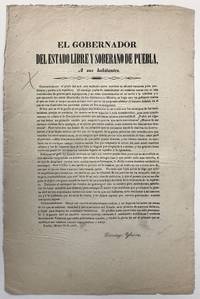
18471730Puebla 1847. Very good. Broadside 12.75 x 8.5 inches. Minor soiling and wear. A rare broadside that prints the thanks and admonitions of the Governor of Puebla Domingo Ibarra following an attempted insurrection there in late February and March 1847 during the Mexican-American War. The uprising was a part of the so-called Polkos Rebellion that followed popular outrage at a January law that allowed the federal government to seize church property in order to pay for the war effort. In Puebla the revolt involved elements of the city's military garrison but was successfully put down by the rest of the guard. In this address Ibarra seeks to inspire unity amongst the citizenry and to warn them of the imminent danger of the American army having just landed at Veracruz. The broadside begins:<br/><br/>"Conciudadanos: el génio del mal está soplando nosotros su aliento venenoso para perdernos y perder á la república. El enemigo acaba de desembarcar en nuestras costas con un tren considerable de guerra para sojuzgarnos y en estas circunstancias se os invita á la rebelion y á que apoyando las miras liberticidad de los disidentes de México se haga caer un gobierno contra el que se tiene el mayor encono porque es el que se ha propuesto afirmar el sistema federal en el que se ven frustrados los perversos planes de los monarquistas. Si hoy que se vé la patria en un peligro tan imminente no se contienen los enemigos de las instituciones porque su ambicion de mando se hace superior à toda consideracion ¿qué será cuando estemos en calma si la Providencia permite que salvemos nuestra nacionalidad"<br/><br/>The landing of Scott at Veracruz was probably the primary encouragement for negotiations between rebel factions and the federal government. Ibarra concludes:<br/><br/>"Obrad con vuesta acostumbrada cordura y asà dejareis burladas las miras de los que os seducen. Atendad à que la salvacion del Estado es el primero de nuestros deberes y dejad para despues las cuestiones domésticas. El pérfido norte-americano nos está provocando á las guerra casi en nuestras mismas puertas: corramos á combartirlo: auxiliémos à nuestros hermanos de Veracruz que están pidiéndonos socorro y tendrà la gloria de ser el primero que sacrifique con vosotros vuetro conciudidano y amigo."<br/><br/>A stirring address and rare. We locate only one copy at Yale. unknown books
1898WRCAM54953Puerto Principe Cuba 1898. Broadside 16 1/4 x 12 1/4 inches. Toned old folds and creases minor edge chipping short closed tear slight fold separations. Very good. A very rare possibly unique surviving example of a Cuban broadside dating from the month after the conclusion of the Spanish- American War. The war ceased with a truce between the United States and Spain on August 12 1898; the official end of the war came a few months later on December 10 when the two parties signed the historic Treaty of Paris. Here on September 10 in the interim between truce and treaty the outgoing Spanish colonial governor of the south- central Cuban city of Puerto Principe present-day Camagüey Emilio March y Garcia calls for reinforcement of the truce agreement that would ensure free and open commercial trade in the region in the face of continuing interference by Cuban insurgents. March y Garcia claims that the Cuban revolutionaries are illegally detaining people interrupting the cattle trade trampling property rights carrying arms in flagrant disregard for the law and more. The ARIZONA REPUBLICAN published an English translation of this proclamation in its September 26 1898 issue. The translation reads: <br> <br> "I hereby inform the commanders of insurgent bands who are pillaging in the neighborhood of this city; who not observing the agreement between the Spanish and American governments with regard to the freedom of commercial relations are illegally detaining the country people; who are obliging the land owners to procure special passes and permits in order to put in order their plantations and will not allow them either to sell their cattle under the absurd pretext that the estates are the property of the nominal Cuban state and that its government alone can distribute and sell them and turn their products to what uses it sees fit thus trampling under foot the rights of property whereas on the part of this government the most absolute liberty in making contracts has been allowed and will be allowed in the future thus demonstrating the respect it has for the rights of all persons within its jurisdiction. I must call to notice with real sorrow that if these towns are suffering almost the horrors of starvation it is the result of the measures adopted by the chiefs of the insurgent bands who are impeding free traffic by forbidding the entry of all kinds of provisions especially cattle into the towns. In view of what I have already explained I consider it necessary to publish the following warnings: Article 1. I repeat my order of August 23 last permitting free entry and exit to all towns of this province subject to my authority and the most absolute freedom of trade between all the inhabitants of the province. Article 2. The prohibition to enter towns with arms remains in force and whoever is found with arms in his possession will be punished in accordance with the laws." <br> <br> Don Emilio Augusto March y Garcia Mesa was a career Spanish military commander who spent at least three stretches of time in Cuba the last as military governor of Puerto Principe during the Spanish defeat in the Spanish- American War. He also served as the colonial governor of Puerto Rico and general captain of Arago the Balearic Islands and the Canary Islands. <br> <br> The present broadside is exceedingly rare and quite possibly unique with no copies listed in OCLC and no records at auction. unknown books
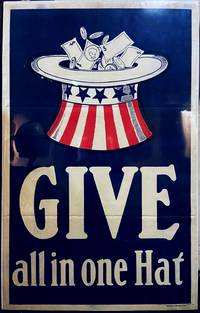
295876New York: Sweeney Litho Co. Lithographed canvas banner. 46" x 29"<br/><br/> This large World War I-era poster was sponsored by the United War Work Campaign. Established in 1918 by Woodrow Wilson the campaign brought together seven organizations--the YMCA the YWCA the American Library Association the War Camp Community Service the Knights of Columbus the Jewish Welfare Board and the Salvation Army--to form a group fundraising effort with the hope of raising over $170 million for the war. The canvas banner depicts a red and white striped top hat on a blue background. The hat is full of dollar bills and coins symbolizing the collective fund that had been created and encouraging citizens to donate. The poster is in very good condition. Folds as issued. The vintage colors are rich and emblematic of the era.<br/><br/> Sweeney Litho Co unknown books
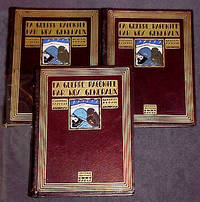
19215823Paris. Librarie Schwartz 1921. Sumptuously bound in the High Art Deco style in full burgundy period morocco. Elaborate gilt-ruling to spine and covers with gilt titles. Silk moire endsheets. Each volume presents a gorgeous and unusual multi-chromatic raised enamel onlay of a beleagured French soldier to front covers. Folios. Profusely illustrated in Art Deco style with plates panoramas fold-out colour maps photographs sepias etc. by Charles Foqueray Lucien Jonas et al. A huge and graphically stunning history of the Great War encased in a fabulous Deco binding without peer. A magnificent and rare item. Some minor wear to extremities a bit of chipping to spine gutters minor water staining to lower edges not affecting internal text or illustrations. A Very Good eye-boggling set. Librarie Schwartz unknown books
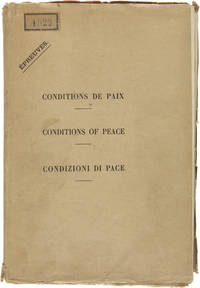
1919WRCAM35473N.p. but likely Paris 1919. Four versions of the text separately paginated and grouped together printed in English French and Italian two versions. Folio. Gathered signatures loosely inserted into printed wrappers as issued the four sections laid into a general printed wrapper. Moderate edge wear. Near fine. Germany's great ally in World War I was the Austro-Hungarian empire which in 1919 was broken apart and made into the separate states of Austria and Hungary birthing as well several other nations in Eastern Europe. The new state of Austria signed the Treaty of Saint Germain making peace with the victorious Allies on September 10 1919. Present here are preliminary printings in English French and Italian actually two Italian versions of that treaty indicated as such by the printed words "proof" "epreuves" and "bozza" on the respective treaties. The articles three versions of the treaty are not numbered sequentially but rather are numbered discreetly within parts and the pagination is not continuous between the parts. The second Italian version present here however does number the articles a total of 371 and the pages a total of 177 continuously though there is no printed date for the signing of the treaty indicating that it is also a preliminary proof printing though made later than the other three. Several of the most important parts of the treaty - those dealing with financial reparations for example - are blank here indicating that these proof versions were printed before those matters were completely settled. <br> <br> The conclusion of the Great War split apart the Austro-Hungarian Empire. In the Treaty of Saint-Germain the newly-created state of Austria recognized the independence of Hungary Czechoslovakia Poland and Yugoslavia and also had to cede much land to Italy and Bukovina to Romania. Austria also had to agree never to compromise its independence and was therefore forbidden from entering into any alliance with Germany. Austria was also forced to admit its complicity with Germany in waging the war and was saddled with reparations payments. Austria's army was limited to 30000 and other articles of the treaty addressed political and economic issues. The text of the treaty also contained the League of Nations Covenant and therefore was never ratified by the United States Senate. <br> <br> A very rare and interesting version of an important treaty ending the First World War here in a very small printing likely made only for participants in the peace conference. unknown books
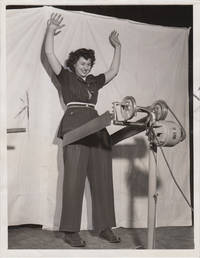
1942CAT0191Cleveland 1942. Silver prints most 6 ½ by 9 with various editorial marks and identifiers to versos. A collection of women's fitness press photographs taken around Cleveland in 1942 from the archives of the Cleveland News. Excellent. A collection of twenty-two photographs documenting women's fitness programs in Cleveland in 1942. The programs and corresponding articles in the Cleveland News appear to be the work of Eleanor Dearnley physical education teacher at Flora Stone Mather College. Other photographs show women's fitness activities at the Lakewood Community Center also in Cleveland. There are several examples of similar local efforts in support of the national "Keep Fit for Victory" Campaign. <br /> <br /> The photographs show women in a range of activities - basketball stretching calisthenics volleyball etc. Some of the photographs are graphically hand-painted by the editorial staff. Most pictures have corresponding articles pasted onto versos. The images are generally quite playful in nature - perhaps because it was early in the war or because the pictures were intended as morale boosters. A generally quite well-preserved group in excellent condition except for the above-mentioned editorial marks. unknown books
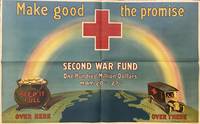
1918295121New York: American Red Cross 1918. Original poster mounted on linen. Color lithograph. 34 3/4" x 55 3/4"<br/><br/> This vibrant WWI poster was part of the American Red Cross' fundraising campaign for the 'Second War Fund' with the goal of raising $100 million in a single week in May. Beautiful colors good condition with repair to center and repairs around margins. Poster features an outline map of North America and Europe with a pot of gold in America that reads 'Keep It Full' and a rainbow stretching from the pot to a Red Cross aid truck in Europe.<br/><br/> American Red Cross unknown books
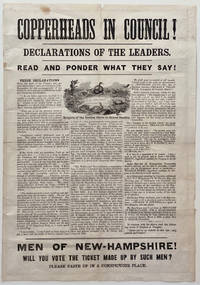
1863List1004New Hampshire: Printer Unknown 1863. First Edition. Printed broadside 16 ½ x 11 ½ inches archivally mounted and matted. A very good copy with some light toning small closed tear at upper margin light foxing at upper margin very tiny spot of loss to illustration at fold. Franklin Pierce remained politically active upon his return to New Hampshire following his presidency advocating for the Democratic cause and generally opposing the Civil War and Lincoln's policies. This scarce pro-Union anti-slavery broadside printed for the 1863 New Hampshire elections which happened March 12 takes aim at Pierce and his fellow Democrats repeating the unfounded claim first made in 1862 by William Seward that Pierce belonged to the secret Knights of the Golden Circle the secret society formed with the goal of forming a new territory out of the CSA Mexico Central America and the Caribbean. There was never evidence that Pierce had any involvement in the KGC though the society had members in southern parts of some Union states such as Indiana Ohio Illinois and Missouri.<br /> <br /> The broadside printed for the March 12 elections quotes heavily from Pierce as well as the other Democrat candidates and party officials who were either running for office in New Hampshire or involved in politics a group which included Ira Eastman John Goerge Josiah Minot Thomas Treadwell Daniel Marcy William Burns and George Stevens. The broadside includes an engraving of coiled snakes each with these politicians named and the caption "et id omne genus." Eastman the Democratic candidate for governor won the popular vote but lacked the constitutional majority necessary for election. Marcy was successful in his bid for the First District. "Men of New Hampshire!" the broadside asks: "Will you Vote the Ticket Made up by Such Men" with the final line imploring to "Please paste up in a Conspicuous Place." <br /> <br /> Overall an uncommon survival from the 1863 elections. A very good copy with some light toning small closed tear at upper magin light foxing at upper margin very tiny spot of loss to illustration at fold. Quite scarce with OCLC locating two copies only at the Huntington Library and the New York Historical Society. Printer Unknown unknown books
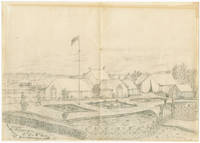
1864WRCAM56141Petersburg Va 1864. Pencil sketch 10 x 14 1/4 inches. One vertical and two horizontal folds. Residue from previous mounting and old repair to verso minute separation at two cross- folds. Lightly tanned. Very good. A large and well-executed pencil sketch of a field hospital toward the end of the Civil War. The artist only identified him- or herself as "W.M.C." in the lower left corner along with the caption: "Field Hospital of the 3rd Div. 6th Corps near Petersburg Va. Pencil Sketch made 1864." In the foreground are the well-tended grounds of the hospital including a flagpole flying the hospital "H" flag with the Greek cross insignia of the VI Corps all surrounded by a wooden fence and trimmed hedge. A complex of semi-permanent tents dominates the majority of the image with two men in uniform in conversation to the left of the tents. In the background are two covered ambulance wagons decorated with medical crosses; trees and small houses are visible further in the background. <br> <br> The VI Army Corps was created in 1862 and assigned to the Army of the Potomac although in 1864 it was temporarily assigned to the Army of the Shenandoah under the command of Maj. Gen. James B. Ricketts. Although the VI Corps faced heavy fighting throughout the Civil War 1864 was particularly violent - this field hospital was undoubtedly packed throughout the year. In the wake of the Battles of the Wilderness and Spotsylvania during the Overland Campaign to the close fighting near Mule Shoe also known as the "Bloody Angle" the assault at Cold Harbor and the Shenandoah Valley campaigns the VI Corps saw nearly two-thirds of its 24000 soldiers killed or wounded. In December 1864 the VI Corps returned to the Army of the Potomac and in April 1865 played an important role in the final assault on the fortifications of Petersburg. unknown books
190237237v. p. 1902. Maroon half-leather binding with black cloth boards. General wear with spotting to boards which are bowed. A VG copy. 201 numbered pages of lined paper. 9-7/8" x 7-5/8" <br/><br/>The 'Kilpatrick' began life as the SS Michigan beginning service in September 1891 as a cargo vessel with limited passenger accomodation. In 1898 she was sold to the US government to act as a military transport during the war. She was capable of hauling 840 men and 800 horses. While not an active participant in the Spanish American war she did subsequent duty in transport service to the PI as this log documents. Capt Rogers begins his entries Saturday Dec. 31st 1898 noting relief of Cap. Jeffreys taking command of U.S.A.F. Michigan departing for Havana at 9 pm. The final entry is Sept. 2nd 02 noting position/course details of a "Manila to Frisco" run. This log a first-hand account of the ship's life recording location etc. Details of the Captain's or crew's life are for the most part absent. That being said it is a unique historical document that provides daily facts of the ship it's activities & its location. hardcover books
2018719752018. International Law Studies. United States Naval College. Vols. 1-94 1901-2018 lacking vol. 57 in 94 books with Index volume covering vols. 1-30. Together 94 books. Washington: Government Printing Office. Reprint Buffalo NY: W.S. Hein. Blue buckram hardcover with gilt spine lettering. Ex-library with property stamps and shelf location labels at foot of spines else very good. Reprint price USD 7200. Special $1295. Published irregularly. 1964-65 never published. Provides scholarly discussions on problems such as neutrality armed merchant vessels and treaties. Title Varies: 1901-1902 as International Law Situations; 1903 as International Law Discussions 1904 as International Law Situations; 1905-1906 as International Law Topics and Discussions; 1907-1908 as International Law Situations; 1909 as International Law Topics; 1910-1912 as International Law Situations; 1913-1914 as International Law Topics and Discussions; 1915-1916 as International Law Topics; 1917-1921 as International Law Documents; 1922-1923 as International Law Decisions and Notes; 1924-1925 as International Law Documents; 1926-1939 as International Law Situations; 1940-1953 as International Law Documents; 1954-2018 as International Law Studies. unknown books
1739606731739. Relates to Events in the Americas Anglo-Spanish War. Cotejo de la Conducta de S.M. Con la de el Rey Britanico Assi en la Acaecido Antes de la Convencion de 14. de Enero de Este Anno de 1739 Como en lo Obrado Despues Hasta la Publicacion de Represalias y Declaracion de Guerra: Con Licencia en Madrid. His Catholick Majesty's Conduct Compared With That of His Britannick Majesty As Well With Regard To What Happened Before the Convention of the 14th of January of This Year 1739 As to What Has Been Done Since Untill the Publication of Reprisals and Declaration of War: Printed by Authority at Madrid by Antonio Marin. London: Printed for T. Cooper 1739. 63 pp. Spanish text with English translation on facing leaves. Octavo 8" x 5". Later quarter morocco over textured paper boards gilt title to spine. Some rubbing to joints corners lightly bumped hinges just starting at ends. Discoloration to free endpapers light toning to text somewhat heavier in a few places. Early owner signature Eyre to head of title page interior otherwise clean. $1250. Only edition. A legalistic analysis of Spanish claims advanced during the Anglo-Spanish War 1739-1748. Also known as the War of Jenkins' Ear after the conflict's flashpoint it related to Great Britain's exclusive right granted by the Treaty of Utrecht at the end of the War of the Spanish Succession 1713 to ply the slave trade and sell other goods in Spain's American colonies. This war was eventually subsumed into the War of the Austrian Succession 1742-1748. The signature in this copy may be that of Sir James Eyre 1734-1799 the notable judge later chief justice of the Court of Common Pleas. Sabin A Dictionary of Books Relating to America 17026. unknown books
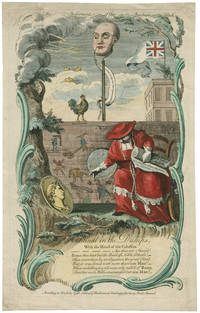
1740WRCAM43159London 1740. Engraving with hand-coloring 14 x 8 3/4 inches. Minor soiling. Color quite bright and fresh. Very good. A satire against French Cardinal Fleury Chief Minister to Louis XV published during the frenzy of celebrations over Admiral Vernon's victory over the Spanish at the Battle of Porto Bello - an enthusiasm which the Cardinal apparently did not share. Fleury was an ally of Robert Walpole whose power was in decline and had reluctantly agreed to hostilities with Spain. Fleury is seen here seated reaching out toward a medallion of Admiral Vernon and holding a scroll which reads "His iron will get ye better of my gold" and "G-d he'll take all our acquisitions in America." On the wall behind him are several small crude illustrations one of which appears to be a portly Walpole hanging from a gallows above the slogan "No matter if he is longer than ye gallows." A head sits atop a pole perhaps alluding to the fact that many people would be pleased to see Walpole's head positioned thus. Engraved by George Bickham. Only one copy located in OCLC at Northwestern University. BRITISH LIBRARY CATALOG 2454. OCLC 43946235. unknown books
47928Oblong 4to. 1 page seal intact; docketed on verso. Burke and Huger each had prominent associations with the South Carolina branch of the Society of Cincinnati Huger serving as first vice-president and Burke publishing a widely circulated pamphlet warning that the organization would widen the division between "the patricians and the rabble." Folded; some browning but very good. <br/><br/> unknown books
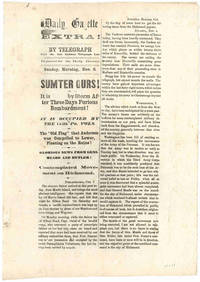
1863WRCAM45995N.p. but possibly Williamsport Pa 1863. Broadside 10 1/4 x 7 1/2 inches. Minor wear and soiling. One small tear in left margin. Very good plus. A vivid Civil War broadside showing the immediacy of the news from the front as well as how garbled or false information was disseminated. The headlines further trumpet: "It is occupied by the 144th Pa. Vols. - The 'Old Flag' that Anderson was compelled to lower floating on the ruins! - Glorious news from Gens. Meade and Butler! - Contemplated movement on Richmond." Despite resumption of a terrific bombardment of Fort Sumter on October 26 the fort did not fall to Federal forces. Thousands of rounds were dropped on the fort but it stayed in Confederate hands another sixteen months until evacuated on February 13 1865. It certainly was not occupied by the 144th Pennsylvania Volunteers and Major Anderson's "Old Flag" did not fly over the fort until two hours before the death of Abraham Lincoln on April 15 1865. The whole second column of text concerns events in the Western Theater Georgia Tennessee and Alabama and the progress of the Army of the Potomac in Virginia: <br> <br> ".General Meade was on the march for the city of Richmond under circumstances which rendered it almost certain that he would capture it. The report of the evacuation of Richmond.is of course all bosh.The details of the great movement now being executed I am not allowed to telegraph you.the objective point of the combined command is the city of Richmond." unknown books
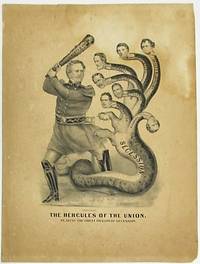
186134445New York: Currier & Ives 1861. Lithograph 13-1/2" x 18". Paper browned but images clear. Short closed tear at top blank margin minor chipping to two corners. Very Good.<br/><br/> "A tribute to commander of the Union forces Gen. Winfield Scott shown as the mythical Hercules slaying the many-headed dragon or hydra here symbolizing the secession of the Confederate states. At left stands Scott wielding a great club 'Liberty and Union' about to strike the beast. The hydra has seven heads each representing a prominent Southern leader. The neck of each Southerner depicted is labeled with a vice or crime associated with him" Reilly. The Southerners are Toombs Stephens Davis Beauregard Twiggs Pickens and Floyd labeled variously as Hatred and Blasphemy Lying Piracy Perjury Treason Extortion Robbery. According to Weitenkampf a variant omits the name of Scott in the title.<br/>Reilly 1861-35. Weitenkampf 131 7 locations. OCLC 191119921 3- AAS Peabody Essex Boston Athenaeum as of December 2017. Currier & Ives? unknown books
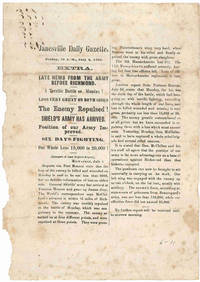
1862WRCAM45999Janesville Wi. 1862. Broadside 8 1/2 x 6 inches. Light wear and foxing. Very good. An unrecorded Civil War broadside publicizing a dispatch from Union Gen. George B. McClellan following The Seven Days' Battles which occurred between June 26 and July 2 1862. In the course of that week Union and Confederate forces fought a series of battles in five different locales. At the end of these engagements the Confederates withdrew to Richmond. This EXTRA provides information about losses and casualties and states: "Gen. McClellan and his big staff all agree that the position of our army is far more advantageous as a base of operations against Richmond than that hitherto occupied." Although most of the battles in the Seven Days can be considered Union victories the overall outcome of the campaign was still not particularly successful for the Union due to McClellan's weaknesses as a commander in the field. Afterwards the Union's Peninsular Campaign was abandoned and the majority of McClellan's men were transferred to John Pope's army in Northern Virginia. unknown books
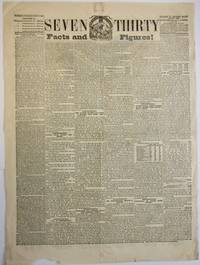
186537449Philadelphia 1865. Elephant folio broadsheet printed in six columns on recto and on verso. 15-3/4" x 21-1/4." Engraving of Screaming Eagle with shield bearing scroll inscribed "Your Sons and your Money on your Country's Altar!" Blank lower margin chip. Very Good.<br/><br/> The words to twenty-one patriotic songs are printed on the recto beginning with "Hail Columbia" followed by "Yankee Doodle" "The Star Spangled Banner" "John Brown's Soul" "Johnny is Gone for a Soldier" and ending with "The Volunteer's Wife to her Husband." The Library Company's entry calls this item "Rare" although OCLC records other institutional holdings.<br/> The verso is titled "SEVEN THIRTY Facts and Figures!" It discusses the Nation's ability to pay the war debt. "The United States Can Carry a Bigger War Debt Than England." It accuses "a formidable body of men hostile to the Government and favorable to the Rebellion" of predicting "the ruin of the country by the weight of the debt." Patriots will purchase the Seven Thirty bonds but "Buying Gold Makes One a Rebel."<br/>Library Company of Philadelphia Record Number 000116607. unknown books
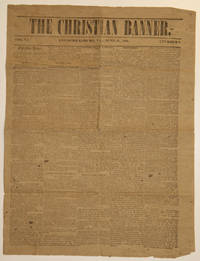
186221798<p><i>"The colored population of Fredericksburg are strolling about town and seem to be perfectly happy our country is ruined and slaughtered worse than beeves all on account of the negroes! Can it be possible that man will sacrifice their country for the negro…"</i></p><p>A fine war-date newspaper published in Fredericksburg Virginia. Articles on the front page describe the destruction of President Jefferson Davis's Mississippi plantation the Battle of Memphis military actions near Richmond and an account of operations near Charleston South Carolina. Several other articles deal with the subject of slavery.</p> <b>CIVIL WAR – CONFEDERACY.</b>Newspaper. June 11 1862. <i>The Christian Banner</i> Fredericksburg Va. J.W. Hunnicutt Vol. 1 Number 6. 4 pp. large folio.<p><b>Excerpts</b></p><p>"<i>We learn that the vandals have come off their boats and battered down and utterly destroyed the residence of Jeff. Davis and also that of Joe Davis. Their acts of destruction and vandalism in that neighborhood were complete leaving nothing behind but a bleak and desolate track behind them</i>."</p><p>"<i>African Slavery. The fact can be no longer disguised; let this war result as it may African Slavery in Virginia is already virtually swept from her territory. If she would lay down her arms and return to the Union her citizens might receive some remuneration for their servants from Government</i>"</p><p>"<i>Submission … This is submission with a tyrant's rod and a vengeance. And all who were opposed to secession have been forced to </i>submit<i> because a Military despotism has been hanging over them ever since. and this is freedom—Independence!"</i></p><p>"<i>The word submission has produced a greater terror over the Southern people than any word in the world. Submission! Submission to what Submission to Old Abe Lincoln Submission to Black Republican rule what power had he Lincoln none whatever! If all the States had remained quietly and peacefully in the Union. Lincoln could not have inaugurated a civil war upon the South</i>"</p> books
1756WRCAM35228London: Printed for S. Bladon 1756. 68pp. Dbd. Very good. "Remonstrance addressed to London merchants against imprisoning of British traders on the Ohio" - Howes. We believe this to be the first edition first issue differentiated by having the price "one-shilling" printed on the bottom of the titlepage. The second issue is from the same setting of type but with "Second edition" on the titlepage. Bladon also published a forty-two-page edition priced six-pence. Such compact cheaper editions are almost invariably later ones. HOWES C668 "aa." SABIN 15207. KRESS 5501. THOMSON 265. Printed for S. Bladon unknown books
1814251150Washington: A. and G. Way 1814. First. hardcover. very good. of the Invasion of the City of Washington by the British Forces in the Month of August 1814. November 29 1814. Folding table. 52pp. 8vo modern 3/4 black morocco. Washington: A. and G. Way 1814. First Edition. Very good<br/><br/> Report of the United States House of Representatives Committee ".to inquire into the causes of the success of the enemy in his recent enterprises against this metropolis and the neighboring town of Alexandria; and into the manner in which the public buildings and property were destroyed and the amount thereof." Preface. Shaw and Shoemaker 33404.<br/><br/> A. and G. Way unknown books