1 575 résultats
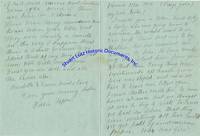
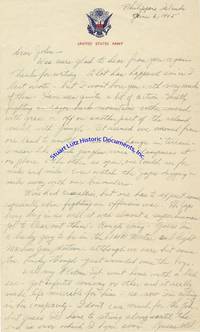
4410WORLD WAR II IN THE PHILIPPINES. ALS. 3pg. 6†x 10 ½â€. June 6 1945. Philippine Islands. An autograph letter signed “Claude†an American GI stationed in the Philippines. He wrote on “United States Army†stationery to his friend John about fighting the Japanese: “Dear John Was sure glad to hear from you again Thanks for writing. A lot has happened since I last wrote - but I won't bore you with very much of them - Have seen quite a bit of action. Mostly fighting n razor back mountains either covered with grass or off on another part of the island covered with jungle - It seemed we moved from one land to another - such a change in terrain - I mean like thick jungles vines & dampness at one place & the other so open one could see for miles and miles - even watch the japs digging in miles away with our binoculars. We’ve had casualties but one has to expect some especially when fighting an offensive war - The japs being dug in so well it was almost a superhumanjob to clear out them - Rough going - guess I'm a lucky guy to be in the 60MM Mortar and light Machine Gun platoon - although we were hit some too. Lucky though just wounded were the boys. Well my Platoon Sgt. Went home with a bad ear - got infected someway or other and it really made life miserable for him - so now I'm acting in his compacity - I don't care much for the job but guess I'll have to string along until the end is over which I hope soon. Guess old Nick here was lucky - Had a few close one's too close for comfort. just hope my luck holds on. Guess as far as the point system goes - I'll be in the Army quite awhile yet. Only can figure out 69 points - Quite a jump to dig up 16 more And I've been in this Army 38 months already - Seems like half my life - When I get home I won't know how to act like a civilian - ha - I know one thing I'll have to learn to control my Army slang or else - I'm writing this in our rest area - although we aren't resting as yet - A lot of hard work to build it up & get it in shape first - Haven’t been her long - but it's a nice area - About like Fort Lewis. Pine trees - cold at night need three blankets still my pups get cold and now that the rainy season has set in it reminds me of Fort Lewis more so as we had so much rain there. Have one camp on a golf course - Been quite some time since I played golf - last tie in the Hawaiian Is. on the isle of Moloka! - More or less pasture. I'd send you a v-mail but as far as I know yet they go straight home with out being photographed and I don't think you'd want that kind. So am using the borderless airmail variety - No two cent overprints have showed up in this area as but if they do I'll remember you - Some of my other friends were asking about them too. Mr. Weltack has been sending me a first day cover now and then and I really appreciate it - as I have no way or time to bother with them. Hope I can continue after the war as I really get a kick out of FD. 's F.Fs F.AM's & all the other better covers. I belonged to the AAMS at one time and have been thinking about joining the MACC in the future. Its been a long time since I saw a good game of baseball- Was in 1939 I guess - In Chicago at the Cub park - The Cubs were playing the Giants at the time. My dad & cousin are great Cub fans but me I like to see a good game - The best men win - I used to play a little too. You know how young guys are - getting up a team & trying to lick the neighboring town teams a log of good clean fun. Well John write when you have time. I enjoy hearing from you. Best of Wishes Sincerely Claudeâ€. The letter is in fine condition. unknown books
4314WORLD WAR I. ALS. 3pgs. November 13 1914. Vienna. An autograph letter signed “Libbie Tappan†by an American living in Vienna at the start of World War One. Tappan writes home to her sister in America concerning wartime conditions in Vienna. She mentions lies of the media and the fear that her letter will be censored: “My Dear Sister: I wrote you a letter sent 21 by a lady who was going home to America. She would amil it in New York. Irene sent one to her Mother she has received an answer to hers. SO I am wondering why I don’t hear from you At that time every thing was excitement. All mails from here was stopped and now we have to leave our letters open. Irene’s Mother wrote her to come home at once but we thought it was to big a risk to run. We had no idea that they were writing all lies until we got hold of an American paper. War was first declared here on account of the to be next king and his wife were killed by the Serbians. There is such a lot to tell but for fear it will never reach you I will only say the German Kaiser is not to blame. The Germans and Austrian Hungarians have never lost a battle we are not starving and there is no…here. All places of amusement were closed trotting was stopped the first of August. Things are beginning to brighten a bit now but there will be no racing until next year. Every available place is filled with wounded soldiers and we don’t see much else but soldiers although there has never been a battle here in Vienna. I am so sorry about Marvin. It seems too bad he had to be taken. I hope you let Eugene and the rest of the folks know about us. We are still in no danger as long as we stay here. I am so sorry I cannot send you some money but it is impossible now. But just as soon as it can be sent will send. Remember me to all the ladies There was a call for linen for the wounded. Irene did two pounds out of my old linen. I thought of you all how busy you would be if you was here there was a ship load of red cross nurses and doctors come over some of them are here in Vienna. There were many Americans went home when your letter went. They were nearly a month on the way. I suppose it cost them a small fortune to go I don’t think of any thing else just now. Will write soon again. Trust you are well and all the ladies also. Berdette & Irene sends love Ever your loving sister Libbie Tappanâ€. An interesting first-hand account. It is in very good condition and the original envelope is enclosed. unknown books
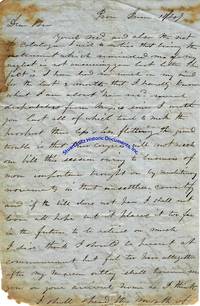
4298MEXICAN WAR. ALS. 2pgs. June 18 1849. place illegible An autograph letter signed by an American soldier on duty during the Mexican-American War. Writing to his brother in college he hopes that the war will end soon enough for him to make it through alive. “… my neglect in not answering your last letter the fact is I have had so much on my mind for the last 2 months that I hardly know what I am about have recd several dispatches from Mexico since I wrote you last all of which tend to make the prospect than less & less flattering the grand trouble is that their congress will not reach our bill this session owing to business of more information brought on by revolutionary movements in that unsettled country and if the bill does not pass I shall not lose all hope but it places too far in the future to be relied on much I did think I should be present at commencement but feel too hour altogether after my Mexican entity shall however see you on your arrival home as I think I shall spend the month of July at home shall probably go down about the 10th & think it probably stop some time. I have not heard from home in a long time they were all well when last they wrote presume that to be the case now we as a city remain without the cholera at present though there have been or 3 cases which have terminated fatally what do you intend going after you graduate I believe I shall go home to farming or to California I don’t know which my time is up here the first of next month and the two opposition lines that are about going into opperation sic here will effectually kill the time so not I am out of business although the first of July you must have your eyes & ears open & not throw away money upon cut honors as it is termed for it is all a humbly yours signature illegible. Some powerful sentiments. The letter is in fair condition with large areas of toning deep folds and a small tear in the lower left-hand corner. unknown books
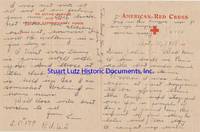
3650ALS. 4pgs. 4 ¼†x 5 ½â€. Paris. October 11 1918. An autograph letter signed “Jim†by an American soldier in Paris near the end of World War I. He was recovering from minor wounds and a surgery at an American Red Cross hospital in Paris. The letter is on “American Red Cross†stationery. “Dear John: -- Well here I am back in Paris again but under much different circumstances. When I was here before I just happened to be going there the town was stopped over for a couple of days I joined my regiment a few days late and the day I caught up with a jab of anti-tetanus serum my wounds being slight and permitting travel I was sent along to this place which is an American Hospital for officers with American Red Cross nurses and every one here gets the best of care When I landed here they took x-ray pictures of my wounds and next came the operation they gave me ether or gas I know not which and way I went to sleep on the table about 2.45 P.M. and remembered nothing until a nurse spoke in my ear about 5.00 P.M. saying how do you feel now This letter contains nothing but truth so don’t worry. We went into the fight and let me tell you it was some hot place for a few days must say this upon war-fare with with the…and his men guard M.S. auction is not stuff I as…was very lucky and came out of it with two small wounds one on my right leg about which your pocket bottom of would come and the other on the top of my right foot this left me so that I was unable to walk so I was given first aid and sent bank in an ambulance to a hospital where the gave me I was not sick at all and I am feeling fine now they have not taken the stitches out yet however I will be walking in a few days. I trust every thing is going well with you and those at the club my mail is holding so I am somewhat…on some news. Will close with best wishes to all from Jim S.P. #179 R.d.U.S. Please excuse writing it as I am sitting up in bed. Jâ€. The letter is in fine condition. unknown books
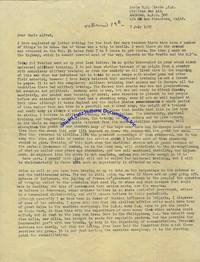
4293WORLD WAR II LETTER. TLS. 2pg. 8 ½†x 11â€. July 7 1945. No place likely the Philippines. A typed letter signed by Boris Clarke during the closing days of World War II. He wrote to his uncle Alfred Lane of Cambridge Massachusetts who was a Harvard professor. Clarke wrote “I have neglected my letter writing for the last few days because there have been a number of things to be done. One of these was a trip to Manila. I went there on the second and returned on the 4th. It takes from 7 to 8 hours a day to get there. The time I make on the highway which is cement covered most of the way depends on the traffic and the M.P.s. Today Col Patrick sent me up your last letter. I am quite interested in your stand about universal military training. I do not know whether because of my origin from a country with compulsory military training or from the anxiety we all lived thru in the beginning of this war when our inductees had to train in some camps with wooden guns and other field materiel however I have always believed that universal training is not a threat to peace. It is not the compulsory military training that causes war in Europe. All the countries there had military training. The forces that create war are not preparedness but economic and political. Germany went to war but was not ready to attack Russia immediately she needed some boosting of moral sic some victories to present to her people before she attacked a country that had a standing army even if not so well equipped at that time. Although it takes England and the United States a short period of time before they can throw in a powerful and trained army the weight of a trained and ready army is always a sobering factor to those that decide that this is the time to strike. I believe in military training as a discipline. The comradeship physical training and toughening discipline the training to take orders and to give orders on the whole an experience quite different from the normal civilian experience will strengthen the youth of our country. Many of the boys over here and in Europe could not live thru the shock that army life imposed on them. The change was too great for some. When they returned to civilian life the greatest percentage of them recovered. But in the army they were not able to render the service which I believe most of them sincerely wanted to give. Training of this sort when the emotional strain not so great because of the certain imminence of combat as is the case now will contribute to the strengthening of what we called some years ago character and now call emotional stability and adjustment. An argument like the above is not complete unless you believe enough in it to take part. I myself most likely will not be called for universal training but I will be wholeheartedly in favor if such an opportunity is afforded my son…The war is still going on even if there are no guns going off. Spheres of influence the juggling of phrases as ‘government chosen by the people’ the question of bringing relief to the countries that need it by whom and what pressure that would have in deciding the type of government that nation wants are the weapons. We believe in democracy other nations believe in a state controlled government others in a benevolent dictatorship and still others believe in their pocketbook. Although generally I have been in favor of Russia’s influence in Bulgaria I disprove of some of her methods. I agree with you that USA civilian affairs units would have been of great value in the immediate emergency. The U.S. army C.A. aims to get the people on their feet but it cost in the long run less. Here in the Philippines C.A. has rebuild many rice mills saw mills has brought in seeds for vegetable gardens and has provided the Commonwealth government with new trucks to help in the organizing of transportation. These services are costly but they are lasting. They have laid the foundation from which these services can grow. It is not just meeting the immediate emergency it is the starting point for rehabilitation. Thru Patrick you have already received the news that I am on my way home…McArthur has declared the Philippines secure. The Commonwealth Govt is taking over the civil affairs…At first contact with the people here we are too apt to judge them by our own standards and think that they are lazy. That is not the case. They have adopted their life to the environment if we were to go on the way we do in the States we would burn out very fast. The older in residence and wiser of the white people here have adopted the afternoon siesta…it tends to make my nights sleepless…â€. The letter has mailing folds and the original envelope and is in fine condition. unknown books
175623894London: Printed for M. Cooper at the Globe 1756. Small octavo. 7 1/4 x 4 1/2 inches. 100pp. Blindstamp to title and G4 library ink stamp to the verso of the title and p. 48. 20th-century half calf over marbled paper-covered boards rubbed marks from old library label on upper cover.<br/> <br/>The first edition of a scarce but important critical commentary on the British government's handling of the French and Indian war.<br/> <br/>This work relates "to the inefficient conduct of the ministry in the disputes with France especially in America on the Ohio and elsewhere under Washington Braddock etc. For this and later publications Shebbeare was fined and put in the pillory. A change of government brought him a change of sentiment and a pension" Sabin.<br/> <br/>Howes S366; Sabin 80038; ESTC T75830. Printed for M. Cooper, at the Globe unknown books
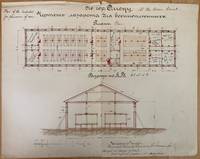
1916List1025Siberia Petrograd et al. 1916. First Edition. Various documents and letters most legal format roughly 200 pages in total with three publications and several newspapers on the subject and thirteen hand drawn architectural plans for a new camp at Omsk measuring between 25 x 17 and 13 x 8 inches. During World War One a staggering number of prisoners - roughly 2.4 of the five million in total who were sent to the Eastern Front - ended up as prisoners of war in Russia. Of that number roughly two million were from Austria-Hungary. Though often neglected by historians due to the attention given to the Russian Civil War and the atrocities of World War Two the subject has drawn increased historical interest with the historian Gerald H. Davis and others calling attention to its importance in the 1980s. Davis and others have written on the relationship between the large prisoner population and the dissolution of their nations as well as the abhorrent conditions many were forced to endure partially due to hierarchical structure of treatment due to differing attitudes by their Russian hosts toward different nations and ethnicities and partially due to the lack of appropriate infrastructure and resources to support such a large prisoner population. <br /> <br /> Offered here are the papers of Herbert H.D. Pierce the Special Aide to Embassador George T. Marye in Petrograd containing a substantial amount of firsthand accounts of prison conditions from the early years of the war as well as a striking series of manuscript architectural plans for a new prison camp that was built in Omsk. Pierce a diplomat who was most famously involved with a case involving seal fishing in the Berings Strait was appointed as a Special Aide out of his retirement and served until his death in 1916. It is possible that he was assigned the task of dealing with the prisoner of war situation as nearly all of his papers that we recovered from his estate from this period deal with the subject. Pierce was involved specifically with the disbursal of relief funds received from the German and Austro-Hungarian governments that were to be disbursed to their citizens. <br /> <br /> The highlight of the collection is a series of hand drawn architectural plans for a series of POW camp structures in Omsk bearing the signature of a N. Alexandrow architect. It is unclear what Pierce's exact relationship was to this project. The plans are translated into English in ink. Of particular interest are the separate officers' barracks plans as one of the violations of POW laws in Russia was the varying levels of treatment given to different prisoners in particular in their recognition of German and Austro-Hungarian ranking officers. There were twenty-eight prison camps in Omsk this one is not identified specifically. The Siberian camps often held up to 35000 prisoners this one shows plans for 10000. There were 128 camps in the Moscow region where camps typically housed 2000-5000 prisoners. The conditions of the camps were generally abysmal with camp capacities routinely exceeded by roughly 50-100%. Frequent disease outbreaks killed thousands of prisoners during the conflict in Omsk Novo-Nikolaevsk Sretensk and Totskoe specifically. <br /> <br /> The group includes letters written to Marye describing conditions in the camps as well as reports of the Americans' own observations in Siberia Moscow and elsewhere. Most are in English though several original documents in German are included. Also included are Pierce's working copies of the Second Hague Convention guidelines of 1907 Order 697 of the War Department that established the regulations regarding prisoners of war in 1914 and a copy of the agreement made between Germany and Russia in August of 1914 which allowed for all women and all men over 45 years and younger than 17 to leave the country unheeded. Some of the letters document violations of this agreement for example a fifty-five year old Austrian man writing to the embassy stating that he had been detained. The authorship of some of the reports is often unclear - one report is credited to "A Russian Lady" another from Krasnaya-Ratchka near Khabaraovsk is an uncredited 18 page description of prisoner conditions. One uncredited report nineteen pages long on the conditions of prisoners in the Moscow Circuit may have been written by Pierce himself and is addressed to Marye. Another 44 page report on Siberian prison conditions is uncredited and likely produced by the embassy itself. A portion - perhaps 25% or so - of the reports are incomplete or unclear in origin though there is much to glean from them regardless. <br /> <br /> Also included are three printed publications. The first is entitled Rapport du Conseiller Prive E.G. Chinkevitch Membre du Comte special de secours aux prisonniers de guerre sur la visite des camps des prissoniers Austro-Hongrois dans l'arrondissement militair d'Omsk printed in 1915. OCLC locates a single copy in France. The report outlines the observed conditions and includes twenty-six photographs of prisoners. The second is a forty-three page report addressed to James Gerard the American ambassador in Berlin by an unidentified author which outlines the prisoner of war conditions in England written in February of 1915. The third is a scarce map of Russian prisoner of war camps printed by L. Friederichsen in Hamburg in 1915 entitled Karte vom Europäischen und Asiatischen Russland mit Angabe der hauptsächlichsten Orte in denen sich Kriegsgefangene und zurückgehaltene Zivilpersonen befinden sowie mit Bestimmungen über den Postverkehr nach diesen Orten. The map shows locations of prison camps throughout the Russian Empire and also shows the mail routes. It is in fine condition overall and we locate six copies in OCLC. <br /> <br /> Overall a scarce survival of primary source material on a somewhat overlooked but important period in Russian history with relevance to diplomatic historians as well worthy of further study. <br /> <br /> Works cited: <br /> <br /> Grekov N. V.: Germanskie i avstriiskie plennye v Sibiri 1914-1917 German and Austrian prisoners in Siberia 1914-1917 in: Vibe P. P. ed.: Nemtsy. Rossiia. Sibir' Germans. Russia. Siberia Omsk 1997 p. 159.<br /> <br /> Nachtigal Reinhard: Seuchen unter militärischer Aufsicht in Rußland. Das Lager Tockoe als Beispiel für die Behandlung der Kriegsgefangenen 1915/16 in: Jahrbücher für Geschichte Osteuropas 48/3 2000 pp. 367-368; Brändström Kriegsgefangenen 1922 pp. 41-48.<br /> <br /> Nachtigal Reinhard; Radauer Lena: Prisoners of War Russian Empire. In: 1914-1918 Online. https://encyclopedia.1914-1918-online.net/article/prisoners_of_war_russian_empire Accessed 5/21. unknown books
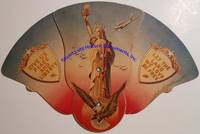
4686WORLD WAR II PATRIOTIC FAN. Fan. No date early 1940s. Madison Wisconsin. A World War II patriotic fan showing the Statue of Library overlooking a ferocious eagle. There is a solo fighter plane and a squadron of planes near the statue. The left panel states “Give us peace and liberty†and the other “Let the land we love be freeâ€. There is light waterstaining to the side of the right panel and it opens easily. It was printed by the Joyce Funeral Home of Madison Wisconsin and this is published on the back. unknown books
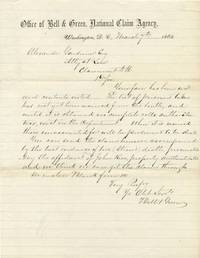
2224L. 1pg. 7 ½†x 9 ¾â€. March 7 1862. Washington D.C. A letter from the Bell and Green National Claim Office about missing Civil War soldiers. The company wrote on their letterhead to Alexander Gardiner of Claremont New Hampshire: “…The list of prisoners taken has not yet been received from the South and until it is obtained no complete rolls authoritative exist in the Department. When it is received those unaccounted for will be presumed to be dead. You can send the claim however accompanied by the best evidence of his Straw’s death procurable say the affidavit of John Rice properly authenticated and we think we can get the claim through.†The letter is in fine condition. It appears that the recipient of the letter Alexander Gardiner was killed a few months later at Winchester. The condition is very fine with the usual mailing folds. unknown books
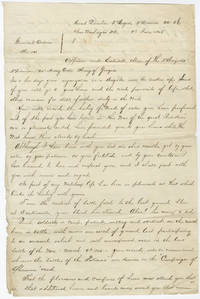
186523320<p>Brigadier General William Cogswell offers a dramatic farewell message to the troops under his command in the Army of Georgia. A Salem Massachusetts lawyer Cogswell turned his law office into a recruiting station after learning the 6th Massachusetts had been attacked in Baltimore. He was first in last out in his Civil War service: In 24 hours he raised the first full company of the war Company C 2nd Massachusetts Volunteers and his brigade fought in the final battle of the war in Bentonville North Carolina. Despite his relative obscurity Cogswell's eloquence rivals the great farewell messages in military history.</p> <b>WILLIAM COGSWELL. CIVIL WAR.</b>Manuscript Document Signed. General Orders No. 14. Farewell to the Army of Georgia Near Washington D.C. June 9 1865. 1 p. 7¾ x 12 in.<p><b>Complete Transcript</b></p><p><i> Head Quarters 3rd Brigade 3d Div. 20th Army Corps </i></p><p><i> Near Washington D.C. 9th June 1865</i></p><p><i>General Orders</i></p><p><i>No. 14</i></p><p><i>Officers and Enlisted Men of the 3rd Brigade 3rd Division 20th Army Corps Army of Georgia.</i></p><p><i>In a few days your organization will be broken up. Some of you will go to your homes and the civil pursuit of life while others remain for still further duty in the West. </i></p><p><i>Your noble record the history of the deeds of valor you have performed and of the part you have taken in this "War of the great Rebellion" now so gloriously ended have preceded you to your homes while the West knows them already by heart. </i></p><p><i>Although I have been with you but six short months yet by your valor by your patience by your fortitude and by your courtesies I have learned to love and respect you and I shall part with you with sorrow and regret. </i></p><p><i>No part of my military life has been so pleasant as that which links its history with yours. </i></p><p><i>From the earliest of battle fields to the last grand blow at Bentonville N.C. your blood has stained Alas! too many a sod. </i></p><p><i>Quick soldierly in camp patient willing and obedient on the march brave in battle with never an inch of ground lost participating to an unusual extent and with unsurpassed valor in the last battle of the War – March 19 1865 – your record will be remembered wherever the "battles of the Potomac" are known or the "Campaign of Sherman" read. </i></p><p><i>That the pleasures and comforts of home may attend you that go that additional honor and laurels may await you that remain that an Almighty and good God may forever lead you in ways of pleasantness and paths of peace that industry and virtue may crown you with their rewards that all that good brave men deserve may be yours that those who remain may shortly be sent to home and friends and that the blessings of a kind heaven may always be with you wherever you go is the last best wish of your Brigade Commander.</i></p><p><i> Wm Cogswell</i></p><p><i> Bvt. Brig Gen Commanding</i></p><p><b>Historical Background</b></p><p><b>William Cogswell</b> 1838-1895 was the son of the founder of the Massachusetts Republican party. He left Dartmouth College and spent two years on a square-rigger sailing around the world. When he returned he attended Harvard Law School and became a lawyer in Salem Massachusetts. When word reached Salem that the 6th Massachusetts had been attacked in Baltimore on April 19 1861 Cogswell turned his law office into a recruiting station and raised Company C of the 2nd Massachusetts Volunteer Infantry in 24 hours. He went on to become its commander.</p><p>Though the regiment suffered heavy losses Cogswell's company distinguished themselves well at the Battle of Antietam. Cogswell was promoted from company to regimental commander. During the Battle of Chancellorsville Cogswell was seriously wounded which resulted in his missing the Battle of Gettysburg where the 2nd Massachusetts lost another commander resulting in Cogswell's promotion to colonel. Cogswell was brevetted brigadier general on December 15 1864 and took command of the 3rd brigade 3rd division of the 20th Corps a part of the Army of Georgia that participated in Sherman's Savannah Campaign better known as the March to the Sea.</p><p><b>Condition</b></p><p>Very good. Lower half of left margin somewhat tattered affecting only one word go edge wear at upper right half some toning. Superb for display.</p> books
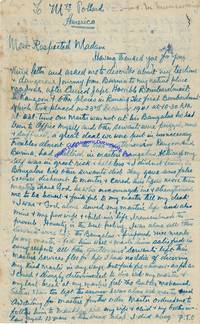
5112WORLD WAR II IN INDIA. AL. 4pgs. N.d. 1941-2 N.p. An unsigned handwritten letter to Mrs. Pollard in America from an Indian servant who survived a 1941 Japanese attack in Burma during World War II. He details his family’s flight from Burma back to their native Madras India. “Most Respected Madam Having thanked you for your kind letter and asked me to describe about my tedious & dangerous journey from Burma to my native place Madras after cursed Japs. Horrible Bombardment in Rangoon & other places in Burma. The first Bombardment which took placed on 23rd December 1941 at 10:30 A.M. at mail time…I did not leave the Bungalow like other servants did they gave some false excuses dishonest to master & cared their lifes more than master’s. Thank God he who encouraged me & strengthened me to be honest & faithful to my master till my death…merciful master paid my wages in addition to any pay master paid Rs 100 hundred for my way expenses & ordered me to go to Calcutta by walk…We had none there to comfort us & encourage us & give help to us but God alone was with us…The place was in a Horrible state any people too missing cursed my worst life cried loudly & bitterly & searching my wife & the child. Thank God I found them after a great & unbearable troubles search although …successful in my undertakings after seeing my poor people & was rejoiced & thanked God for his unfailing mercy…I entrusted my family to the hands of God Almighty we walked & crossed jungles & mountains all rocky paths sharp stones our feet became sore & swollen all jungle very thick forest wild beast one side & other side robbers & thieves…we reached the city of Calcutta may God bless these two kind nations with long lifes & prosperity we never dreamt even that we arrive Calcutta with life our sorrows & calamities is inexpressible…â€. A dramatic and harrowing story. The letter is in good condition and written in blue ink. unknown books
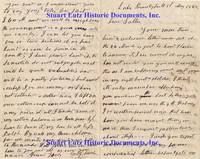
5312CONFEDERATE LETTER. ALS. 4pgs. May 15 1862. Lake Beautyfull. An autograph letter signed “Georg Curle†by an inhabitant of the Confederate south. The writer empowers the recipient to negotiate a marriage contract on his behalf. He also mentions the Civil War obliquely calling the Union “the Lincolnists†as well as his economic struggles: “…But you say you had commenced a negotiation with Cos M. P and did not know what to say to her I had in one of my former letter you with all power to act for me and close the contract with her and had supposed you so understood it be such have been watching with much interest to here sic the result so I hope you will not feel at a loss to know how to act but close the matter as if I were present say to Cos MP to be ready I expect to be in about the first of July all she has to say is to say yes and we will go before the parson and have the not sic tied at once. Know all men by these presents that I Goerg Curle do hereby constitute Sally Sallie G Shelton my Legal representative to negotiate and close a marriage contract between Miss MP and myself any and every promise on act of said SGS as…this subject will be as binding as if I were present myself. Given under my hand and seale sic this 13 day May 1862 Georg Curle…I can let you have one or two sections of as find land as can be found in the South; I have plenty land if the Lincolnists do not subjugate us it will be quite valuable; but must confess Ive no money as I have not collected a dollar since I left Va our cotton crop cannot be sold at any price at all…George Curleâ€. The letter is in fine condition with just a hint of toning. unknown books
1739WRCAM47525London: T. Cooper 1739. 228pp. Lacks half title. Modern tan half morocco and cloth spine gilt. Minor soiling and wear. Very good plus. Letter concerning the secession on March 9 1739 of the "Patriots" from the House of Commons over the negotiations preceding the War of Jenkins' Ear. The Patriots were Tories and disaffected Whigs who opposed Sir Robert Walpole the first Prime Minister. Walpole argued for peace and moderation in dealing with Spain and he was supported by a scant majority. This letter presents the informed view of a member of Parliament displaying the furor in England for the protection of their American trade and decrying the factitious nature of English politics. The secession proved advantageous for Walpole because it allowed him to push through several bills relating to the free exportation of sugar and molasses from the West Indian Colonies. ESTC T138894. GOLDSMITHS 7730. EUROPEAN AMERICANA 739/154. SABIN 34807. T. Cooper hardcover books
1860CAT0150New York 1860. An unusual image of a Zouave soldier in an outdoor setting holding a horse. During the Civil War roughly 95 Zouave regiments formed adopting the names uni-forms and sometimes fighting styles of the North African Zouave brigades. The bulk - about 70 of the regiments - fought for the Union cause. We were unable to determine anything else about this soldier though the image was found in a New York estate. New York was home to two of the most famous Zouave brigades the 5th New York Volunteer Infantry and the 11th New York Volunteer In-fantry. A nearly fine image with a slight crease housed in a full case. unknown books
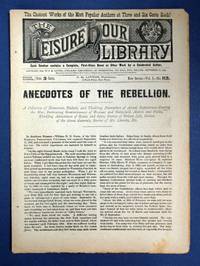
188638609New York: F. M. Lupton 1886. Early printing with the rear wrapper advert listing through No. 123 in the series. OCLC records two holding institutions: Yale & the Huntington. Printed self wrappers sewn. Age toning to paper. Two stab holes in margin along spine. A VG copy of this rare title. 16 pp text double column. Ornamental masthead. Folio. 11-5/8" x 8-3/8" <br/><br/> F. M. Lupton unknown books
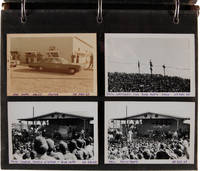
1970WRCAM55101Biên Hòa Nha Trang Long Binh and other locations in Vietnam plus Luzon Philippines and Osan South Korea 1970. 469 black-and-white or color photographs measuring between 3 1/2 x 3 1/2 inches and 8 x 10 inches either mounted or laid-in to acetate sleeves almost all annotated in ink on the bottom margin or on the verso. Contemporary three-ring thick quarto-size binder black cloth over boards. Joints partially split some abrading and dust- soiling to covers. Slight fading to some of the color photos. Overall very good. An exceptional vernacular photograph album by a talented but unknown amateur photographer recording a wide variety of experiences on American Air Force bases in South Vietnam and Asia during peak years of the Vietnam War. <br> <br> The photographer was likely a member of the motor pool or a mechanic as the shots seem to center around truck airplane and helicopter maintenance. Most of the photographs capture scenes on or around the various bases with shots both inside and outside of barracks airplanes including several shots of a U2 spy plane bombed-out equipment and numerous photos of the people and structures in the "Vietnamese Area." A few images capture distant shots of the aftermath of a "rocket attack" on December 12 1969; shortly thereafter the photographer and his friends celebrate Christmas. Some of the more interesting photographs during the photographer's time in Vietnam include "VC Prisoners" "Group of Zips" "Papa-San Working His Rice Paddie" "Vietnamese Guard Tower" "Church on the West Side of Biên Hòa" "Refueling at Phan Rang Run" "Bring the Wounded Out" and several pictures labeled "Buddha Hill" likely the Long Son Pagoda in Nha Trang. Notably and for no obvious reason in two separate images the photographer snaps a picture in a magazine of the famous photograph of ThÃÂch Quang Duc the monk who burned himself alive at a busy intersection in Saigon in 1963. Several times the photographer takes a picture of another picture an interesting practice in the context of so many original photographs. <br> <br> A handful of images of the photographer himself can be seen in the album. In a couple of shots he is posed with his pet lizard. Later he and his fellow soldiers adopt a pet monkey who features in several photographs. There are also a healthy amount of aerial images featuring the South Vietnamese landscape notably rice fields villages rivers "bomb craters" and cities among other locations. Also the photographer identifies dozens of fellow soldiers by name throughout the album in both single portraits and in group photos. <br> <br> The album contains numerous shots both black-and-white and in color taken from the crowd and later on the runway during a December 28 1969 U.S.O. show at Long Binh with several images each of Bob Hope Neil Armstrong Connie Stevens Suzanne Charny Teresa Graves Les Brown the Golddiggers and others. One photograph of Neil Armstrong is captioned "Biggest Hit of the Show." This is understandable given the fact that Armstrong landed on the moon just five months before this U.S.O. show. There is also an 8 x 10 photograph of Connie Stevens inscribed to "Ron" either the photographer's first name or an autographed picture he received from a friend. After the U.S.O. show the photographer snaps several closer shots of Bob Hope Connie Stevens and others climbing into cars to leave. <br> <br> In April or May 1970 the photographer was shipped out to Osan Air Base in South Korea. Along the way he spends a couple of days at Clark Air Base in Luzon in the Philippines where he snaps a few shots of the base. By early May he has arrived at the Osan Air Base near Songtan Station in the city of Pyeongtaek South Korea just south of Seoul. He seems to be happy with his appointment at Osan; he captions one photograph "Home Sweet Home" and a few shots of the countryside as "Paradise." Here he also photographs Korean farmers their families villages a marketplace a church a school and other landmarks. The final two images dated in August 1970 show the photographer on an airboat on an unidentified Korean river. <br> <br> Personal photographic records by soldiers in Vietnam are growing ever more scarce in the market. This collection is one of the best we've encountered and most certainly informs the overall record of the war during perhaps its lowest point of public support. hardcover books
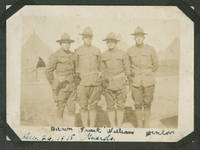
1918WRCAM54314Indiana and Camp McClellan Al 1918. Contemporary black cloth photograph album with over 100 mounted silver-gelatin photographs. Minor shelf wear. A few loose photographs. Very good. An interesting vernacular photograph album of a young American's life in the early 20th century. The compiler of the album served with the 36th Artillery Regiment and trained at Camp McClellan in Alabama of which there are almost fifty photographs present here. Additionally most of the photographs are annotated in ink identifying the soldiers in the photographs the settings and locations and the activities in the pictures. The photographs include tanks a gas mask a brownie gun and three shots of an African- American soldier or staffer. Numerous images capture the training in progress with the soldiers "out on a hike" while they "prepare for action guns set ready for loading" and more. One image depicts a simple Alabama farm and is captioned in manuscript "Alabama scene." <br> <br> The remainder of the album is devoted to the young man's life in Indiana with numerous shots of farm life and prairie land and including a trip to a cabin in Morgan County. These shots are not annotated but provide an important peek into rural life in the Midwest during the early 20th century. hardcover books
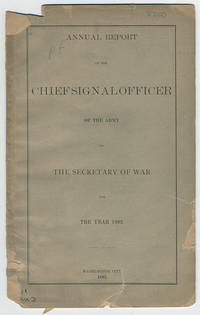
188310306Washington City 1883. 8vo. 24 pp. <br><br>Includes the progress made by the Signal Service in its metereological and scientific work. Stitched; in original printed wrappers. Browned and brittle with chipping and closed tears resulting in loss of no text but of a little of printed border of front wrapper. A few heavily pencilled marks or inked notations. unknown books
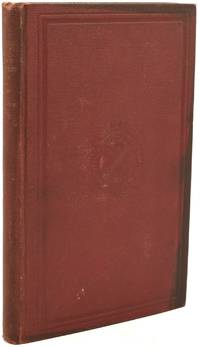
1899289701Washington: Government Printing Office 1899. Hard Cover. Very Good binding. The report of the Chief of Ordnance for the U.S. War Department for the year 1898. With thirteen folding charts of diagrams for the guns used by the army at the time and three additional folding charts and a plate in the appendix. Mild staining to the boards. Red textured cloth with gilt lettering and embossed designs. OCLC notes no institutional holdings of this report by the Chief of Ordnance. Very Good binding. Government Printing Office unknown books
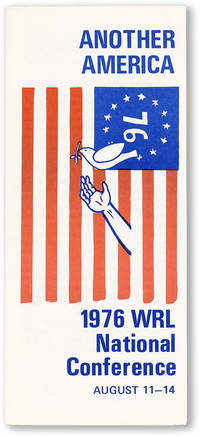
197646168New York: War Resisters League 1976. Tri-fold leaflet ca 8" x 4". Fine. Includes description of the League and conference program; blank portions for conference registration unused. The 1976 WRL Conference was held in Downington PA. War Resisters League unknown books
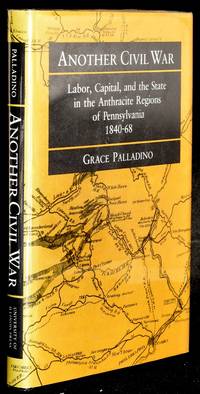
1990191933Urbana; Chicago: University of Illinois Press 1990. Hard Cover. Near Fine binding/Near Fine dust jacket. Contents clean and tight; DJ protected with Mylar Cover. Near Fine binding / Near Fine dust jacket. University of Illinois Press unknown books
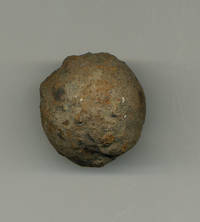
11115Civil War bullet "Minie Ball". Bullet that was actually fired in the battle of Antietam and was recovered form that battlefield. It is typical of the bullets of the Civil War .31 caliber and many have been fired by either a Confederate or a Union soldier. Sealed and in excellent condition. unknown books
1929WRCLIT77152New York & London: Wiley / Chapman & Hall 1929. xii4341pp. Large octavo. Cloth. Photographs drawings folding chart. Cloth a bit sunned otherwise very good. First edition. The author was a ranking officer in the Army Air Corps and Aerial Surveyor for the Byrd Expedition. Includes a chapter on Oblique Aerial Surveys by A.M. Narraway. Wiley / Chapman & Hall hardcover books
41587Oblong double-folio 13 x 17 inches seal affixed; docketed on verso. Several small breaks at corner folds corner torn away just touching the docketing. A very good copy. In this document Jonathan Tucker was appointed second lieutenant of a company in the 5th Regiment of Militia in Worcester County. In the following month Lincoln was named Major General of all the Massachusetts state militia; he was given command of the southern department in 1778 and after his capture and exchange was with Washington at Yorktown where he was chosen to receive Cornwallis's sword. Other members of the council who signed this document include Perez Morton James Otis Benjamin Greenleaf Caleb Cushing John Winthrop Joseph Gerrish John Whetcomb Elias Taylor Michael Farley Joseph Palmer Moses Gill Samuel Holton B. White Charles Chauncey and John Taylor. <br/><br/> unknown books
1862155041862. 37th Cong. 2d Sess. Ho. of Reps. Mis. Doc. No.67. 1862. 2pp. disbound. Very Good. unknown books