CIVIL WARABAA
1 575 résultats
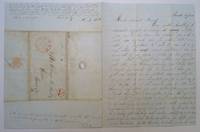
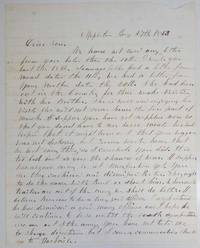
1863286999Appleton WI 1863. unbound. very good. Fine content A.L.S. 4to. 2 pages Appleton WI January 27 1863 providing news of troop movements and the firing and replacement of several Generals in part: ".I suppose Rosecrans Army is at Murfreesboro yet. You see they cashiered and dismissed Porter. They ought to do the same with Buell or shoot him. When such traitors are out of the Army we shall do better. I believe Rosecrans to be a true good officer. I understand he has dismissed a many good officers and I hope he will continue to do so until the last sympathizers are out of the Army. It is reported that Burnside has resigned and Hooker has taken his place. Hooker is not ably as good an officer as Burnside but it seems bad to be changing Commanders so much. Matters do not look encouraging yet I believe we shall succeed by and by." Condition: weak folds with minor fraying at the top margin that affects parts of two letters. Overall very good.<br/><br/> unknown books
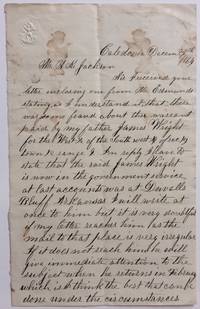
18642828001864. unbound. very good. Autograph Letter Signed. 8vo. 2 pages Caledonia Wisconsin December 24th 1864 to A.B. Jackson Registrar at Menasha in part: "I received your letter enclosing one from Mr. Edwards stating as I understood it that there was some fraud about the warrant paid by my father James Wright for the West ½ of the South West Lot of Sec. 14. In reply I have to state that the said James Wright is now in the Government Service at last accounts was at Duvall's Bluff Arkansas. I will write at once to him but it is very doubtful if my letter reaches him as the mail to that place is very irregular. If it does not reach him he will give immediate attention to the subject when he returns in February - which is I think the best that can be done under the circumstances." Three tiny stain marks at the top otherwise in very good condition.<br/><br/> A Wisconsin Military Officer is suspected of Fraud in regards to his Land Grant Application.<br/><br/> unknown books
500989of A.H. Perry to W.P. Burrall Esq. on Hartford and New Haven Railroad Office letterhead Springfield MA February 22 1864. Small 4to 1 page. Signed by Authors. F. Soft cover. paperback books
500990text of a telegram on printed form of the American Telegraph Company from Captain William M. McKim to agent George P. Greer of the Hartford and New Haven Railroad Boston ca. 1864. 8vo 1 page with additional Autograph Letter Signed of S.R. Conner on verso for certification. Signed by Authors. F. Soft cover. paperback books
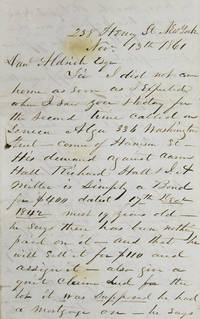
186114981258 Henry Street New York 1861. 4 pages. 1 vols. 8vo. Some spotting and light soiling else in good condition. 4 pages. 1 vols. 8vo. Bishop writes Aldrich regarding a legal case concerning a lien on some property in the post script he writes "The news from the South today is cheering-important & fully confirmed. Our troops have taken Port Royal 2 or 3 forts & made a good landing on South Carolina soil & with reinforcements supposed to be on the way will probably take Charleston. In Kentucky Gen. Nelson has obtained a most important victory--400 killed & 1000 prisoners among them 2 generals. unknown books
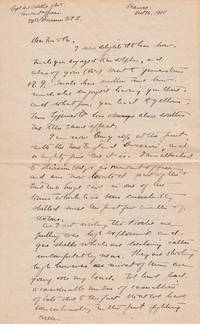
1918308587France 1918. 2-1/2 pages pen and ink on paper with original envelope. Old folds else fine. 2-1/2 pages pen and ink on paper with original envelope. AN OFFICER IN THE REMOUNT SERVICE. An animated letter home from an officer serving in a little-known but vital branch of the service during the First World War. Reading in part:<br/><br/>"I am now living up at the front with the New England division and a mighty fine one it is. I am attached to Division headquarters as remount officer and am now located part of the time in a huge cave in one of the towns which has been considerably shelled since the first few troubles of the war. As I sit writing the Boche are hurling over high explosives and gas shells which are rather uncomfortably near. They are shooting high however most of the time and going over our heads. We have had a considerable number of casualties of late due to the fact that we have been continually in the front fighting area. The animal situation has become so desperate due to the tremendous losses and lack of supply that a number of divisions have become immobile and this one along with still others threatens to become so. That's why I have been sent here and I am doing everything in my power to save up what animals we have by being continually out among them instructing officers and men in proper care and feeding most of the losses have been due to neglect preventing over loading; and making such suggestions to the General as I see fit. It is interesting but difficult work."<br/><br/>Born in Brookline Massachusetts into a prominent and notable American family Brigadier General Nicholas Biddle 1893-1977 was a career officer in the United States Army National Guard who saw action in the Mexican Border 1916 World Wars I and II and was a recipient of the Legion of Merit. Biddle was the son of Edward Biddle 1851-1933 and Lillian Howard Lee Biddle 1862-1946 and great grandson of banker Nicholas Biddle. Biddle married Sarah Lippincott 1894-1962 granddaughter on her father's side of the founder of the J. B. Lippincott Company and granddaughter on her mother's side of Joseph Wharton founder of the Wharton School of the University of Pennsylvania. They had one son John Scott Biddle 1925-2008 who was best know as a foremost yachting cinematographer. <br/><br/>Known as the "Yankee Division" the 26th Infantry was formed from the Massachusetts National Guard in July 1917. The division was sent to Europe in WWI as part of the American Expeditionary Forces and saw extensive fighting in France. The Remount Service was part of the Quarter Master Corps and worked with the Veterinary Corps to handle the thousands of animals that still played a major role in WWI. As the division's "Remount Officer" Nicholas Biddle would have been in charge of supervising the care and handling of the unit's horses and mules. unknown books
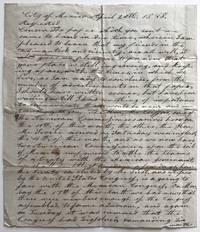
18481325Mexico City 1848. Good. 2pp. plus docketing on a quarto bifolium. Previously folded. Some separation along fold lines. Four-inch tear from opening repaired with tape. Light tanning and a couple of fox marks. In a neat legible script. Writing on April 20 1848 to his cousin Edward Moulton in Willimantic Connecticut from occupied Mexico City Sergeant William Dorrance of the 7th U.S. Infantry gives an update on the progress of the treaty to end the Mexican-American War and impatiently awaits the conclusion of peace terms: "The Hon. Mr. Clifford one of the American Commissioners arrived here on the 11th of this month the other the Hon. Mr. Levien arrived on Saturday evening last the 16th of this month and as we now have two American commissioners upon the soil of Mexico empowered to settle the terms of a treaty with the Mexican government we shall doubtless know in a few days how the treaty concluded by Mr. Trist and ratified by the United States Congress is going to fare with the Mexican congress. On Monday the 17th of this month we had news that there were members enough of the Congress assembled to forme a quorum and again on Tuesday it was rumored that the Congress had dissolved demanding six months to determine upon the ratification or rejection of the present treaty. At all events we shall soon know and if we are not to have peace soon it is my opinion that we shall have to march to St. Louis Potosi and give them a drubbing. The question of Peace or War rests now entirely with Mexico." The Treaty of Guadalupe Hidalgo was in fact ratified by the Mexican legislature on May 19 1848 one month after this letter was composed. Contemporary news from Mexico of advancements in the negotiations to bring about an official end to the war. unknown books
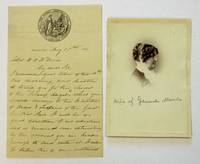
186436745Philadelphia 1864. Great Central Fair letterhead sheet folded to 5" X 8". 4 pp manuscript on rectos only. Letterhead depicts the Fair's Seal with a vignette of a Goddess-like figure handing a chalice to two soldiers one of whom appears wounded; surrounded by the words "The Great Central Fair for the U.S. Sanitary Commission." Mount remnants on final blank page one small tape repair Very Good.<br/> OFFERED WITH SALT PRINT PHOTOGRAPH BUST PORTRAIT OF MARGARETTA MEADE. 5-1/2" x 4" mounted on plain paper. Very Good. <br/><br/> Margaretta Sargent Meade 1814-1886 the wife of General George Meade did her part for the War effort at the United States Sanitary Commission. She labored long and hard to make its upcoming Fair a success. <br/> Colonel William Watts Hart Davis 1820-1910 to whom the Letter is addressed was stationed at James Island in South Carolina home of the famous Swamp Angel Battery which had bombarded Charleston in 1863. The Battery was immortalized in a poem by Herman Melville. Davis served with the 25th and 104th Pennsylvania regiments during the War and was breveted a Brigadier General March 13 1865 for his "gallant and meritorious service during operations against Charleston South Carolina." He was a lawyer; professor and superintendent of the Virginia Military Scientific and Literary Academy in Portsmouth; a Mexican War veteran; a government official in the Territory of New Mexico; and wrote several books. Jordan Colonial and Revolutionary Families of Pennsylvania Genealogical Publishing Company p 380; "Davis W. W. H. William Watts Hart 1820-1910" website of Social Networks and Archival Context. unknown books
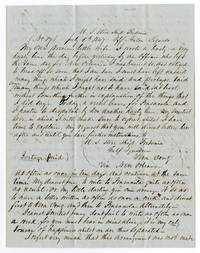
1847WRCAM42138U.S. Store Ship Fredonia off Anton Lizardo 1847. 4pp. Quarto on a folded folio sheet. Old fold lines. Central fold running the horizontal length of the sheet reinforced with tape. Minor soiling else fine. A very affectionate letter from a sailor to his wife back home full of pining declarations of love and devotion. The sailor Gregory notes that he is safe and likely to stay that way as they are at a good anchorage and the coast has been entirely secured. He indicates that she should direct her letters both to Vera Cruz and Pensacola and that either way they will surely find him with the Gulf Squadron. He also mentions a possible posting to the Naval Observatory which would bring him home to his dearest Jenny. <br> <br> "The frigates 'Potomac' & 'Raritan' have both sailed for home some days ago but we had no opportunity of writing by them as the former sailed from Sacrificios & the latter from Tobasco. You will doubtless have heard long ere you receive this all about the taking of Tobasco. The whole coast is now in our possession and there remains not the slightest chance of any more fighting for the squadron. I must not omit to mention my sweet little wife the Gibbon Edwards Kennard & myself have received an answer from Mr. Maury respecting our application for the Observatory. He says he is very anxious to have us all back again and that he would that day 22d of April go to see the Honl. Secretary and try to get us ordered; but he said he had but faint hopes of success for it was known at the same time at the Dept. that we were very short of officers in this squadron." unknown books
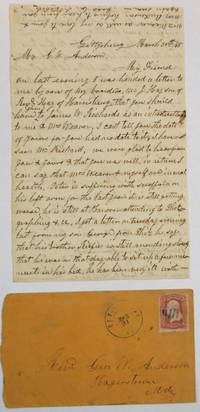
373992pp plus postal envelope with cancel and 3 cent stamp. Very Good.<br/><br/> Weaver advises that his son "George is enjoying good health since he has returned from Dixie he was conscripted the third time since the rebellion but has succeeded by being detailed to attend to some other duties but the last time he was compeled to go into camp and from there to the front in Virginia & in place of going to camp he forged himself a detail that he was ordered from Montgomery to go into Miss. to gather up material to make paper he left Selma Alabama Nov 2 /64 & arrived home safe with many hair's breath escape of being taken prisoner on the 1st Dec /64. He is now in Phila in a wholesale notions store. unknown books
183544071London 1835. Good. Separated at folds edge worn and torn a few chips one affecting a few words at the end of about a dozen lines of text light soiling. 6 pp. with integral address. Folio. 10.5 x 16.5 inches. Manuscript with numerous corrections and additions concerning the failure of the British military in the War of 1812. In late 1835 then Colonel William Francis Patrick Napier 1785-1860 member of the British Army and a military historian gave speech at Bath which the Sunday Times reported claiming he had criticized the British soldiers in the War of 1812 as failing because they "stood as patriots and freemen on less firm and less elevated ground than the Americans themselves" which John Mitchell notes at the very beginning of this article published in the January 1836 issue of "United Service Journal and Naval and Military Service Magazine" pp. 84-92. Defending the soldiers Mitchell goes on to launch an attack on Napier's speech and the British command and their tactics. "The failure of the British troops at New Orleans was as complete as possible; but patriotism or want of patriotism had nothing to do with the business. The military policy of England guided by men ignorant alike of the strength and the weakness of armies swayed besides by the influence of philanthropic and economical patriots whose evil counsel fell like a death-bearing pestilence on the ranks of the army-shone out in all its poor and paltry littleness: in the constant striving to save farthings millions of treasure were wasted and thousands of gallant lives were remorselessly sacrificed. The valour everywhere exhibited by the troops the zeal ability high spirit and devotedness displayed by so many matchless officers the number of gallant blows struck and noble feats of arms performed- were not it must be allowed sufficient to counterbalance the folly ignorance and presumption that marked the official management of that most miserable war. But I repeat the fault was not with the troops" The failure is not just at New Orleans. "The British failed at Sacket's Harbour Platsburgh and New Orleans; to which for argument sake we will add Baltimore. At Sacket's Harbour and Platsburgh the British forces retired from phantom hosts and imaginary foes. At Baltimore something of the same kind happened." After a detailed analysis of the military's failures he ends his unrelenting attack: "But the soldiers of a great nation must know that they are equal to any contest. An American war like every war in which brave men are to be encountered has its difficulties; and it is only by looking those difficulties fairly in the face that they can be overcome. Had we listened to the liberal and patriotic despondency which so long represented us incapable of contending against the French we should at this moment have been crouching beneath the lash of Napoleon or his successor on the throne of the Grand Empire." Needless to say many jumped to the defense of Napier who wrote in his letter to the editor that the Sunday Times report of his speech was pure fiction and that he never criticized the troops; in fact he states he never mentioned the war at all. John Mitchell 1785-1859 was an army officer and writer who served in the West Indies in the Peninsular War and on diplomatic missions for Wellington. He wrote much on the defects of the British army tactics and a number of volumes including "The Fall of Napoleon" and "Biographies of Eminent Soldiers." Postmarked London December 22 1835. Addressed to Major Thomas Henry Shadwell Clerke who was editor of "The United Service Journal and Naval and Military Service Magazine." unknown books
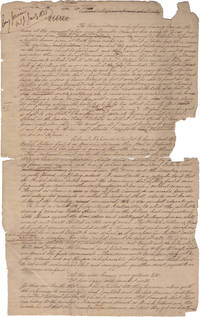
186436746Virginia 1864. Folio 8" x 12". Three loose leaves making 6 pp completely in ink manuscript. Occasional short separations at folds light age toning and soiling some edge wear with slight loss of text. Overall Good. <br/><br/> The 1st New York Infantry Regiment was mustered for two years of service in April 1861. After serving at Big Bethel Fair Oaks Malvern Hill Fredericksburg and Chancellorsville they were duly mustered out in May 1863. This history by 2nd Lieutenant John S. Brush details the organization of the company and its movements. The Company arrived at Big Bethel on the morning of June 10th 1861 formed a line of battle remained under the enemy's fire for nearly two hours before being ordered to retreat. They moved on to Newport News where the Rebel Iron Clad Merrimac shelled the garrison for two hours before retiring; no casualties were reported. Onward to join the Army of the Potomac and to the White House plantation on the Pamunkey River on June 4 1862. Then to Savage Station then joining the battle at Peach Orchard where Privates Carlisle Ferris Patrick Culhane & Edward Corcoran were killed and Privates William Rodgers Frank Cox & Thos. Hillman were wounded. Later at Glendale "Captain John H. Carter was dangerously wounded while gallantly rallying his men to the contest" and was taken prisoner while Sergeant Joseph E. Fallon "seeing the colors falling into the hands of the rebels rushed forward under a heavy fire from the enemy and secured two of them." Other battles and casualties are mentioned followed by a list of soldiers who were killed transferred discharged deserted etc. With a Recapitulation signed and dated by John S. Brush at Potomac Creek Virginia 4 April 1863.<br/> John S. Brush born c. 1840 was mustered into the New York Infantry in 1861 a 1st Corporal and was mustered out a 2d Lieutenant. Brush had an interesting life following the war. 1880 Federal census records list him as a resident of Sing Sing Prison. Unfortunately this Civil War veteran went into the forgery business. By 1903 he had spent more than 20 years in Illinois and New York State prisons because of his "expertness in 'free hand' imitation of signatures and handwriting" versus the more common tracing method making him "one of the most dangerous professional forgers operating in this country." He was so good that those he had imitated at times would identify his forgeries as their own signatures. In 1903 Brush pleaded guilty yet again to forgery and was sentenced to another five years imprisonment at Dannemora prison. By the 1910 U.S. Federal Census he was living at the National Soldiers' Home in Tennessee. PROCEEDINGS OF THE TWENTY-NINTH ANNUAL CONVENTION OF THE AMERICAN BANKERS' ASSOCIATION. . . 1903. pp. 127-129. unknown books
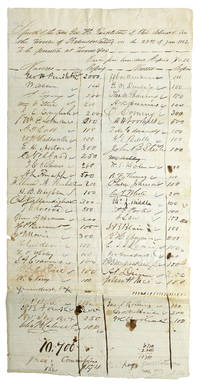
1862251158Washington D.C. 1862. 1 p. pen and ink on paper docketed on verso. Folio. Old folds else very good. 1 p. pen and ink on paper docketed on verso. Folio. Copperheads and Unconditional Unionists. This compelling historical manuscript was penned during the contentious and hostile political environment that was pervasive during the Lincoln Administration. The subscription is for a speech by Pendleton arguing the constitutionality of the proposed "Legal Tender Act" authorizing the government to issue paper money popularly known as "greenbacks" that were not backed by an equal value in gold or silver to help finance the war. Despite intense opposition the act was passed in February 1862 and laid the foundation for a permanent paper currency. <br/><br/>Notable signatures on the subscription of which 10700 copies were ordered at 50 cents apiece Pendleton ordered 2000 include rabid "Copperhead" and hated Southern sympathizer Clement Vallandigham who was famously tried and convicted of treason in 1863 and subsequently banished to the Confederacy; Kentuckian John Crittenden author of the unsuccessful "Crittenden Compromise" of 1860; and the speech's author George Pendleton leader of the peace wing of the Democratic Party who ran for Vice President on the failed McClellan-Pendleton ticket that ran against Lincoln during the presidential election of 1864. <br/><br/>The manuscript is signed by Republicans Democrats and members of the Unconditional Unionist Party and includes: William H. Wadsworth Kellian Van Rensalear Whaley George W. Dunlap Daniel Wolsey Voorhees William Alexander Richardson Anthony Lausett Knapp William Joshua Allen Albert Gallatin Porter John Benedict Steele Erastus Corning I Theodore Medad Pomeroy Robert Bruce Van Valkenburgh Chilton Allen White Albert Gallatin Riddle William Eckart Lehman Charles John Biddle Sydenham Elnathan Ancona William Gay Brown Sr. Jacob Beeson Blair Joseph Eggleston Segar James Sidney Rollins Thomas Lawson Price William Steele Holman William Gaston Steele James Edward English George Thomas Cobb Elijah Hise Norton Chauncey Vibbard Henry Grider James Addison Cravens Nehemiah Perry Warren Perry Noble Philip Johnson John Law and others. unknown books
40474This Union officer served on the staff of Brigadier General James Shields whose troops faced Stonewall Jackson's Confederate troops in the Shenandoah Valley in June 1862 and later commanded the Second Louisiana Regiment Cavalry; he was a good friend of famed Irish soldier Miles W. Keogh 1840-76 killed in the Battle of the Little Bighorn who served under him in the Papal Army during the Italian rebellion in 1860 and who fought with him in the Battle of Port Republic; he's reported to have become enamored with famed Southern spy "Belle" Boyd" at one point and to have unwittingly revealed military secrets to her. Outstanding pencilled ANS 2pp recto and verso heavy stock 4" X 2½" card "Conrad's Bridge" Virginia n.d. ca. early June 1862. Addressed to "General" probably James Shields. Very good. Lightly age toned. In this remarkable small report Keily reports in a small tight but fairly legible hand to his commander that "Col. Carroll moves his comm'd. at p.m. and will push on as rapidly as possible some cannonading heard this morning in the direction of Harrisonburg I would respectfully submit that if the Infantry did not move rapidly enough to carry out your views at Wainesborough before Jacksons arrival there a reconnaisance composed of cavalry conducted cautiously might attain the object with a good Guide which we have procured I would be glad to undertake it -- respectfully" and signs off adding his rank "Capt. A.D.C" beneath. A rather light challenging to transcribe postscript reads "P.S. Just received information from a reliable source that Jackson has --- --- --- Train on the --- Pt. Republic Road." It's difficult to precisely date Keily's note but General Shields did write General McDowell on June 4 1862 that "Colonel Carroll. after a forced night's march reached Conrad's Bridge this morning at 5 o'clock which bridge he found burned" -- which likely dates Keily's letter from this date or shortly after. Whether Shields took Keily up on his offer to lead a cavalry reconnaissance is unclear. Shields 1810-79 is perhaps best remembered as the Illinois politician who almost fought a duel with Abraham Lincoln in 1842; he's also the only person in American history to serve as U.S. senator from three different states Illinois Minnesota and Missouri; as a brigadier general of volunteers in the Civil War his lackluster performance as commander of the 2nd Division of the V Corps in the Army of the Potomac during the crucial Valley Campaign caused him to resign his commission. On June 9th the Battle of Port Republic took place a costly Confederate victory in which Jackson's 6000 troops faced off 3500 Union troops losing just over 800 men to the Union's loss of just over 1000 men -- a battle at which Keily himself was severely wounded in the face while leading a charge of Ohio cavalry up a hill into a barrage of Confederate artillery fire. The following year after painful recuperation Keily ended up on the staff of General Charles P. Stone in New Orleans recruiting cavalry troops in that occupied state. Late in the war he was court-martialed for "conduct unbecoming an officer" but the charges were shown false and by the end of the war he was brevetted a brigadier general. Keily died from yellow fever in Louisiana at age 38 shortly after the war's end making his autograph material quite scarce -- and a choice war-date item such as this most desirable. This remarkable war-date communication sheds interesting light on Shields as commander during the disastrous Valley Campaign. unknown books
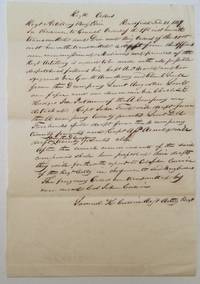
1839224440Readfield 1839. unbound. 1 page 11 x 7.75 inches Readfield February 22 1839. Outstanding and historically important autographed document regarding a dispute between Maine and New Brunswick signed "Samuel K. Currier" Adjutant Regiment Artillery 1st Brigade - 2nd Division. In part: "In obedience to General Orders of the 19th instituted and herewith transmitted.of the 21st.a draft of the Regiment Artillery is ordered to be made with all possible dispatch as follows.vis.Capt. A. P. Arnolds and two sergeants; George W. Armstrong from the D Company; Lieutenant Augustan Lords - one fifer and one drummer; Ira Portman of the A Company is detached. Capt. John Ford will draft from the A Company twenty privates.Lieutenant Fairbanks will draft from the Company B twenty privates. After the several commandants of the said companies shall have perfected their drafts they will forthwith report to Col. John Courier of the Regt. & Artily. in obedience to said Brigade Orders. The foregoing Orders are transmitted by command." Military documents pertaining to General Orders No. 7 are extremely rare and this example is in fine condition.<br/><br/> The Aroostock War was a boundary dispute between the state of Maine and the Canadian province of New Brunswick in 1838-1839. High tensions and heated rhetoric led both sides to raise troops arm them and march them along the disputed border. At one point reports of British bringing up their Regular Army troops from the West Indies reports of the Mohawk Nation offering their services to Quebec and reports of New Brunswick forces gathering on the Saint John River resulted in the Issuance of General Order No. 7 on February 19 1839 calling for a general draft of Maine Militia. In essence Maine had become the only state to have ever declared war on another country. The grievance was ultimately settled through the Webster-Ashburton Treaty of 1842 establishing a definitive boundary between the countries giving most of the disputed area to Maine.<br/><br/> unknown books
1864283340Springfield 1864. unbound. very good. Interesting Home-Front A.L.S. 4to. 2 pages Springfield Illinois September 7th 1864 concerning happenings in and around Wisconsin. In part: "I am glad to hear of your recovery from your wounds. Where did your father leave you when he went to Nashville after you Mr. Hill says he left you part way home. I was in hopes that you would come down and see me before you went into the Army again but you did not say anything again about it in your letter. Andrew - you sent me your picture before you went to the War and I gave it to Harry's girls when I was out there.and Libby gave me another one when I was at your place. Charley Gilbert's corpse was brought home Saturday I believe from Memphis.he was in the 40th Regiment. His family did not know he was dead until his corpse arrived home. He died with Dysentery. PS - Tell your Mother that butter is 35 to 40 cents here. Condition: Visual folds as expected from the passing of the letter from one relative to another - otherwise in very good condition.<br/><br/> unknown books
1846245837Nunda NY 1846. unbound. 4 pages front and back each measuring 9.75 x 7.75 inches Nunda NY September 11 no year circa 1846. The writer of this letter refers to the events leading up to the Mexican War which was precipitated by actions of President Polk in part: "George M. Dallas played Judas; and James K. Polk is a mere tool in the hands of John C. Calhoun & Company. I do not pity the Pennsylvanians so much they were told better by such men as Webster and others. The United States reach no farther north than Mason's and Dixon's line if we might judge by the legislation of James K. Polk. He is valorous against an important foe but as obsequious as a spaniel when 'Queen Victoria' speaks. The Mexican War is a second edition of the slave hunt in Florida refers to the 1st Seminole War which was actually directed in part against runaway slaves. $100000000 will hardly suffice to defray the expense of the War of Conquest." Two-inch tear along one of the folds; several small holes throughout the text. Good condition.<br/><br/> unknown books
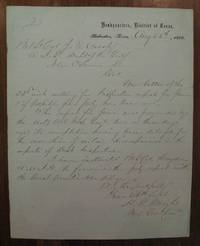
1866215411Galveston 1866. unbound. very good. Autographed letter signed "H.G. Wright" by the Major-General of the Union Army sent from his headquarter in Texas to a colleague in New Orleans regarding an update on an Inspection report. 1 page on lined Headquarters District of Texas letterhead. 4to. Galveston Aug. 25 1866.<br/><br/> ".The report for June was forwarded.two or three days ago; its completion having been delayed for the correction of certain discrepancies in the reports of Dist. Inspectors."<br/><br/> unknown books
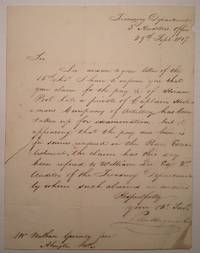
18172309011817. unbound. 1 page 10 x 7.75 inches Auditor's Office Treasury Department September 29 1817. Written to a petitioner who has filed a claim for a deceased soldier's back pay in part: " I have to inform you that your claim for the pay of Hiram Pool late a private of Capt. Heslemans Company of Artillery has been taken up for examination but it appears that the pay due him is for services rendered during the Peace Establishment." Two-inch closed tear on the left side small chip near the upper right and staining on the lower right; good condition.<br/><br/> In this particular case Private Pool was killed after the signing of the Treaty of Ghent Dec. 24 1814. The government therefore is attempting to imply that he lost his life during the Peace Establishment and the petitioner is entitled to far less monies than if a determination were made that he died during the war.<br/><br/> unknown books
002289Washington Government Ptg Office 1941. In wrappers. Minor soiling. Photographs charts and diagrams throughout. Washington Government Ptg Office 1941. unknown books
002287Washington Government Ptg Office 1941. In wrappers. Minor soiling. Photographs charts and diagrams throughout. Washington Government Ptg Office 1941. unknown books
001551Washington D.C. Government Ptg Office 1941. Brown wrappers. Minor soiling. Profusely illustrated with diagrams and figures. Washington, D.C. Government Ptg Office (1941). unknown books
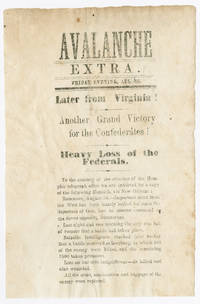
1861WRCAM54583Memphis Tn 1861. Broadside 6 1/2 x 4 1/4 inches. Mild toning and edge wear minor expert tape reinforcements on verso. Very good. A very rare broadside extra of the MEMPHIS AVALANCHE containing a telegraph dispatch from Richmond via New Orleans announcing a Confederate victory in the Western Virginia Campaign. The text of the handbill reads: <br> <br> "Important news from the West has been hourly looked for since the departure of Gen. Lee to assume command of the forces opposing Rosencranz. Last night and this morning the city was full of rumors that a battle had taken place. Reliable intelligence reached here to-day that a battle occurred at Leesburg in which 300 of the enemy were killed and the remaining 1500 taken prisoner. Loss on our side insignificant - six killed and nine wounded. All the arms ammunition and baggage of the enemy were captured." <br> <br> The news of the battle at Leesburg was erroneous. False reporting of battles never actually fought was a more common occurrence than one might think during the Civil War. This example stands naturally as one of the earliest examples of this type. <br> <br> We know of only one other copy of this very rare handbill a much inferior copy sold at Swann in 2013 for $375. Unrecorded otherwise with no copies in OCLC and in none of the standard Confederate reference works. unknown books
19452194619France Editions 1945. Stapled Binding. Good. Wrappers rubbed. 1945 Stapled Binding. 16 pp. French-language work with photographs silhouette illustrations and technical information on British aircraft during WWII. France Editions unknown books
184733896Puebla Mexico 1847. First Edition. 1p. quarto broadside 31 x 21.5 cm. Two corners slightly chipped. Not in usual Mexican War sources. Orders the second battalion of the National Guard to turn out to receive orders at 2pm on Sunday. Also states that Puebla is threatened by the approach of American Troops and that it is necessary to organize resistance. "al enemigo de bnuestra independencia" who intends to go all the way to Mexico City. Santa Anna would lose the Battle of Cerro Gordo two days later and Puebla would be surrendered peacefully about a month later unknown books