1 575 résultats
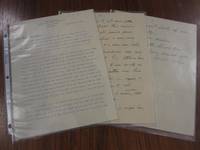
1903232609Cleveland 1903. unbound. Typed letter to his daughters with a two-page handwritten continuation and signature. The letter concerns the rents his family has been charging tenants in part: ".I am sorry we have to reduce rents but the only way to get along in this world is to adjust ourselves to the conditions as they are forced upon us. If a merchant holds up to high prices when everybody around him is making low prices he will soon be left without a business and he will probably never get it back because the impression that he is a high-priced man will get into the peoples' minds and even if he reduced them afterwards he could not remove the impression." Three pages total 11 x 8.25 inches with a handwritten envelope The McClean Arms and Ordnance Co. Cleveland December 22 1903. Very good condition.<br/><br/> unknown books
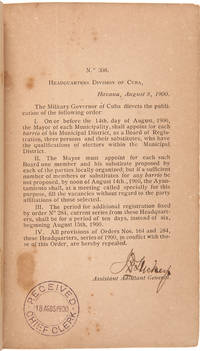
1900WRCAM51843Havana 1900. Approximately 520; 600pp. including several folding charts. Over 200 separate imprints. Original half leather and brown cloth boards spine gilt. Corners and edges worn spine rubbed boards scuffed. Initial leaves of first volume torn away but present. Several other leaves chipped and torn throughout. With many official signatures and docketing stamps. Good. Two volumes of orders promulgated in 1889 and 1900 by the American military government of Cuba after the cessation of hostilities in the Spanish-American War. Under the terms of the Teller Amendment to the Congressional Joint Resolution for war with Spain in 1898 the United States denied the intention of using the conflict as a pretext for the annexation of Cuba and promised to leave the island following the termination of the war. The American military therefore oversaw the creation of the new independent Cuban government before departing in 1902. The documents contained in this collection consist of over two hundred orders in both English and Spanish from the Headquarters Division of Cuba that helped to shape the emerging civilian government. They include instructions for the running of elections the organization of the courts and school system the appointments for various government offices provisions for tax regulations and many other critical issues facing Cuba at its independence. The directives cover two periods from January to July in 1899 and from July to September in 1901. Many of the orders are signed in manuscript by the assistants to the military governor for the island Gen. Leonard Wood including assistant adjutant generals J.B. Hickey and L.W.V. Kennon and Brig. Gen. Chief of Staff Adna R. Chaffee. An interesting documentation of the first American occupation of Cuba. hardcover books
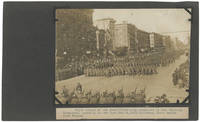
1919CAT0119New York: Underwood and Underwood 1919. First Edition. Gelatin silver prints 7 ¾ x 5 ½ inches each on 11 ½ x 7 inch black paper mounts captioned with affixed text. Very Good. Two WWI-era press photographs related to the Negro 15th Infantry Division of the New York National Guard a.k.a. the 369th US Infantry Regiment and their white commander Colonel William Hayward. One photograph shows the division on parade in New York following their return from combat duty in France in 1919 the other is a well-known image of Hayward who organized the all-black unit and served as its leader. Fighting for a record-breaking 191 consecutive days alongside French troops in the trenches the regiment became known as the "Harlem Hellfighters." <br /> <br /> The opportunity for African-Americans to serve in WWI arose from the Selective Service Act of 1917 which drafted all men between the ages of twenty-one and thirty. Special segregated training camps were established and units were formed. The US National Archives states that 200000 African-Americans served in Europe during WWI but only 42000 saw combat. When the 15th Infantry arrived in France in 1918 Hayward was committed to the idea that his unit would fight on the front lines. After General Pershing refused to integrate them with the full US army Hayward pushed for another assignment under French command. Unlike many other segregated divisions in WWI the 15th aka 369th was eventually sent to the trenches. Its members' distinguished service brought honor and fame. Before leaving the US in 1917 the regiment had not been allowed to participate in the New York National Guard's farewell parade. When they returned victorious Hayward ensured they were publicly honored. <br /> <br /> Both with various press stamps to versos. Small closed tear of about a half inch to upper edge of parade picture good overall. Hayward portrait with some rippling at edges very good overall. Underwood and Underwood unknown books
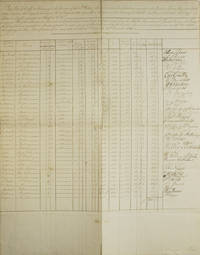
1783303187Minorca 1783. Two single sheets. Folio. Very good copies a little toned old folds. Two single sheets. Folio. Signed in full by every officer. The first is titled: "No. 26 Pay List for additional Subsistence etc to the officers in st. Philips Castle from 25 Dec. 1781 to 23 Feb. 1782." The second has written on the verso: " No. 136 Pay List to make up Subs. to Brevet Officer etc equal to the Rank where in they respectively serve in The Garrison of Fort St. Philips during the Siege Decemb. 24 1781 - Dollars 4350-50." These two officer pay lists are signed by each of the 36 and 44 listed officers. They're a wonderful souvenir of the siege and with a sample of every officer's signature a valuable source for further research. <br/><br/>The five month Siege of Minorca August 19 1781 - February 5 1782 was a vital victory over England in the European theatre of the Revolutionary War. Throughout most of the eighteenth century English possession of the island was of real strategic importance from its deep-water harbor the Royal Navy could launch attacks against the Mediterranean fleets of Spain France and Italy. unknown books
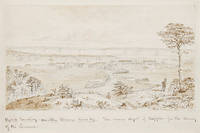
1863WRCAM56150Aquia Landing Va 1863. One pen and ink drawing 7 x 10 1/2 inches sight and one pencil sketch 6 3/4 x 9 3/4 inches sight each in recent matching frames 11 1/2 x 15 inches; plus 2pp. letter on folded folio sheet. Slight soiling and smudging to sketches. Short tape repairs to two closed tears at top margin of letter minor separation at fold text not affected. Very good overall. Two drawings by an unnamed artist submitted as potential accompaniments for articles in HARPER'S WEEKLY which was well-known for the copious Civil War illustrations that supplemented its text. Such illustrations were usually either drawn by reporters or artists sent into the theater by HARPER'S or less often by soldiers in the field. These two works were done by a Union Army Division Post Master and are accompanied by a letter from his commanding officer submitting them for publication. <br> <br> The first work done in pen and ink on paper is entitled "Aquia Landing on the Potomac River Va. The main depot of Supplies for the Army of the Potomac" and depicts a river scene with steamers and sailing vessels along with a pier in the middle distance with a supply train approaching in the foreground which is observed by two soldiers. In the foreground are delicately drawn trees and shrubs; in the background one can see more ships and the other side of the river possibly Simms Point. In early March 1862 the Confederates abandoned Aquia Landing a strategically important post on the Potomac River and Union forces quickly seized the point. The Union Army used the wharves and storage building at Aquia Landing until June 7 1863 when the army headed north for the Battle of Gettysburg and again used the facilities in 1864 during the Overland Campaign. <br> <br> The second work is a pencil sketch titled "Army Bakery in charge of Capt. James Gillette Commissary of Subsistence to Genl. Geary's Division." One medium-sized and two small cabins are at the left side of the image with barrels and a large cauldron nearby; presumably this is where the bakers prepared bread and other items for baking. On the right side of the image is a large wooden lean-to sheltering at least nine ovens. Two bakers are carrying trays of bread and one stands near an open oven with a large peel. To the right of the lean-to is a tent partially open and filled with loaves of bread with three more bakers loading in loaves. In the background are bare trees suggesting this scene is set in winter. <br> <br> The accompanying letter on "Office of the Commissary of Subsistence" letterhead is from Capt. James Gillette to John Bonner then editor of HARPER'S WEEKLY. Gillette writes that he encloses three sketches of which two are included here: "These sketches were made under my own supervision by our division post master are as accurate in detail as any I have seen." Gillette then describes additional material he has enclosed and notes "Some time since a few sketches of scenes in Richmond furnished by my experience found place in your weekly eliciting from you the request that I should occasionally forward to your address such representations of military scenes as might be of interest. Hence these enclosures which in truthfulness cannot be excelled." <br> <br> James Gillette 1838-81 enlisted as a private and rose quickly through the ranks. By this time he was Captain and Assistant Commissary of Subsistence for the 2nd Division XII Corps under Gen. John W. Geary. For his meritorious service he was breveted lieutenant colonel U.S. Volunteers and for gallantry at the battle of Chancellorsville he was breveted major in the regular Army. John Bonner 1829-99 was one of the best known newspaper writers in America at this time. He started as a writer at the NEW YORK HERALD and then moved on to be an editor at HARPER'S. After the Civil War he made a small fortune on Wall Street and then lost it in a most dramatic fashion. He drifted west working for the LEADVILLE CHRONICLE and LEADVILLE NEWS in Colorado and the SAN FRANCISCO CHRONICLE and SAN FRANCISCO CALL among other Bay Area newspapers. <br> <br> An attractive pair of original Civil War drawings from a Union soldier in Virginia in the middle year of the war accompanied by the letter from the Army Commissary officer submitting them for publication to HARPER'S WEEKLY. unknown books
1862101900Three leaves two 8 x10 sheets and one 5x10 text on all sides and comes with typed transcripts. Normal aging and browning and a few tears at folds. The letters were written by George Roden who was born in 1841 from Newark New Jersey who was the son of English immigrants and served in the 2nd New Jersey Infantry regiment. He was a corporal at the time these letters were written. The letters talk about the desolation of the Virginia countryside. "Not a fence or a decent house is to be seen for miles… the black remains of Camp fires with the filth of the many camps of both armies are seen on most every farm. I tell you Va. is suffering for her folly." The letters are from Alexandria and Stafford Court House Virginia. See guide to Roden family papers at the William L. Clements Library. books
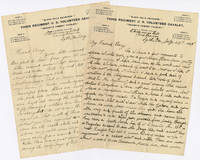
1898WRCAM46791Chickamauga Park Ga 1898. 5pp. Quarto written on "Black Hills Squadron" stationery. Old fold lines. Minor wear. Very good plus. A pair of letters written by Leighton H. Baxter to a friend back home. In his first letter he states that he is "not an enlisted soldier but has a regulation suit.a horse to ride and am fixed up very nicely. He works for the commander of the squadron Major Leigh H. French presumably as a teenage civilian clerk. His duties include "a good deal of writing to do telegrams to send take notes of cases tried in the regiment and a great many other minor duties." He sleeps in the same tent as the Major and takes his meals with the officers. He is well fed but is very glad not to be a private as they "fare badly." It is however "a regular circus to see the boys ride and shoot they beat Buffalo Bill all to pieces." Baxter reports that there are some 40000 to 50000 troops at Camp Thomas with more due to arrive. Some have already departed for "Porto Rico" and he expects his squadron to be going there at any time. In his second letter he notes that the men in his regiment are all "crack shots and fine riders" and all from around Deadwood and the Black Hills. He has been drilling with the men and has learned to handle a sword fairly well. He also mentions practicing "rough riding.such as leaping from a horse while he is running then back again picking up a hat while at full speed etc." <br> <br> The Third U.S. Volunteer Cavalry was mustered into service in May 1898 and commanded by Melvin Grigsby attorney general for the state of South Dakota. The unit was known both as the "Black Hills Squadron" and as "Grigsby's Cowboy Cavalry." Its commander Maj. Leigh H. French was trained as a medical doctor and surgeon and had a practice in Washington D.C. when the war broke out. One of his captains Seth Bullock was the first sheriff of Deadwood. The squadron never saw active duty outside the continental United States spending most of its brief career at Camp Thomas in Georgia. In the crowded camp in the heat of a southern summer typhus measles and other illnesses were rampant and Grigsby's Cavalry lost twenty-seven men to disease. unknown books
189733203Washington D.C.: National Tribune 1897. 320pp. Lacks wrappers text brittle. Fair to Good. National Tribune unknown books
606681not signed from the 1956 film "War and Peace." 1. 1/2 length pose of Audrey Hepburn in a loving embrace with Mel Ferrer. 2. Full length pose of a sick man being attended by Mel Ferrer and one other doctor. Note three priests in the background Photographs are on single weight stock; 10" x 8"; very good minor signs of handling; 1956. No Binding. Very Good. paperback books
607182not signed from the 1956 film "War and Peace." 1. 1/2 length pose of Audrey Hepburn in a loving embrace with Mel Ferrer riding inside a sleigh with an unidentified actress. 2. Full length pose of a sick man being attended by Mel Ferrer and one other doctor. Note three priests in the background Photographs are on single weight stock; 10" x 8"; very good minor signs of handling; 1956. No Binding. Very Good. paperback books
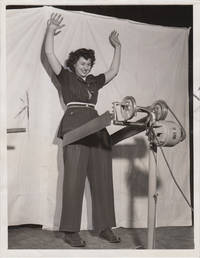
1942CAT0191Cleveland 1942. Silver prints most 6 ½ by 9 with various editorial marks and identifiers to versos. A collection of women's fitness press photographs taken around Cleveland in 1942 from the archives of the Cleveland News. Excellent. A collection of twenty-two photographs documenting women's fitness programs in Cleveland in 1942. The programs and corresponding articles in the Cleveland News appear to be the work of Eleanor Dearnley physical education teacher at Flora Stone Mather College. Other photographs show women's fitness activities at the Lakewood Community Center also in Cleveland. There are several examples of similar local efforts in support of the national "Keep Fit for Victory" Campaign. <br /> <br /> The photographs show women in a range of activities - basketball stretching calisthenics volleyball etc. Some of the photographs are graphically hand-painted by the editorial staff. Most pictures have corresponding articles pasted onto versos. The images are generally quite playful in nature - perhaps because it was early in the war or because the pictures were intended as morale boosters. A generally quite well-preserved group in excellent condition except for the above-mentioned editorial marks. unknown books
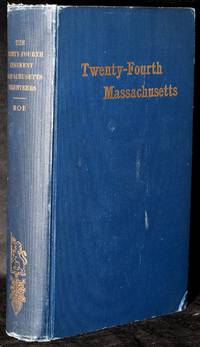
1907275301Worcester Mass: Twenty-Fourth Veteran Association 1907. First Edition. Hard Cover. Very Good binding. One of a number of regimental histories by Roe he produced half a dozen of them Bud Robertson doesn't discredit this history but does consider it derivative: "For this work Roe leaned heavily on the writings of Cols. Thomas G. Stevenson and Francis Osborn; other memoirs were also employed in describing the regiment's several campaigns along the South Atlantic coast" Nevins I 153. This copy has had a discreet repair to the textblock evident at page 400. Otherwise a clean and tight copy in the publisher's blue cloth from the library of Bud Robertson with his bookplate on the pastedown. Nevins I 153. Very Good binding. Twenty-Fourth Veteran Association unknown books
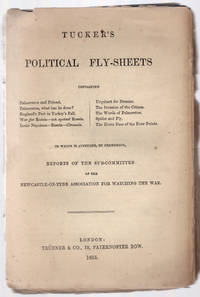
18558000London: Trübner & Co. 1855. 8 vols. 12mo. Intro. Vol.: iiixv 1 pp. No. I: 16 pp. No. II: 16 pp. No. III: 15 1 pp. No. IV: 15 1 pp. No. VIII: 16 pp. No. IX: 32 pp. Vol. II no. I: 16 pp. <br><br>Present here are eight pamphlets: The introductory pamphlet; vol. I nos. I "Palmerston and Poland" II "Palmerston what has he done" III "England's Part in Turkey's Fall" IV "War for Russianot against Russia" VIII "The Words for Palmerston" IX "Spider and Fly"; and vol. II no. I "The new hope for Poland". WorldCat lists 3 library holdings. In self-wrappers. Pages mostly unopened. Some edge chipping to introductory volume no. IX and vol. II no. 1. A few marginal tears. First page of each volume rubber-stamped with a five-digit number. Age-toning mild soiling to outer pages. Trübner & Co. unknown books
1862WRCAM52914New York 1862. xxii385pp. Early 20th-century buckram gilt leather spine spine labels. Cloth somewhat dust soiled spine labels slightly chipped. Paper shelf label on spine institutional blind and ink stamps on titlepage. Light tanning. Good plus. Rare report on the trial of the prisoners taken from the Confederate privateer Savannah. The schooner Savannah having been fitted as a privateer sailed from Charleston on June 2 1861 for the purpose of intercepting United States commercial ships. On the following day after capturing the brig Joseph the Savannah was herself captured by the brig-of-war Perry and her crew taken prisoner. The arduous deliberations of the trail ended in gridlock as the jury could not agree on a verdict. The appendix contains various proclamations by President Lincoln including one declaring a naval blockade of the South. hardcover books
1982160074NY MCGRAW-HILL BOOK COMPANY 1982 1982. DUST JACKET UNCLIPPED BOOK CLUB EDITION VERY GOOD. Hardcover. NY, MCGRAW-HILL BOOK COMPANY, 1982 hardcover books
181536137Portland Maine: Argus Office 1815. Letterpress broadside approximately 15 1/2 x 10 inches. Wide margins with deckle edges. Rare Maine broadside announcing the signing of the Treaty of Ghent which ended the War of 1812.<br/> <br/>This broadside announcement begins with a statement by the publishers of the Argus newspaper office in Portland: "At eleven o'clock last evening an express arrived in this town in Thirteen Hours from Boston with the following letter and Handbill to Capt. William Webb &c. containing the joyful tidings of Peace. By the favor of an esteemed friend we are enabled thus early to lay them before the Public." This is followed by a letter from Thomas Motley in Boston forwarding the hand bill from the Boston Centinel quoting New York publisher Jonathan Goodhue's 11 February announcement of the arrival of H.M.S. Favorite in New York with American commissioner Carroll aboard with a signed treaty in hand. Maine sat on the front lines of the War of 1812 making this news of the Treaty of great significance. By the fall of 1814 the British had invaded and occupied eastern Maine and formally brought all of the District east of the Penobscot River back into the British Empire. Much to the ire of Maine's citizens Massachusetts did nothing to defend its eastern District which in turn led directly to Maine's seeking separation and statehood following the war. Although the Treaty of Ghent ended the War of 1812 in December 1814 Moose Island remained under British control since the issue of ownership of the islands in Passamaquoddy Bay was in dispute until settled in June 1818. A rare Maine broadside: OCLC locates only the Indiana University copy; American Imprints locating only the Massachusetts Historical Society copy.<br/> <br/>Shaw & Shoemaker 36115; Williamson 9913. Argus Office unknown books
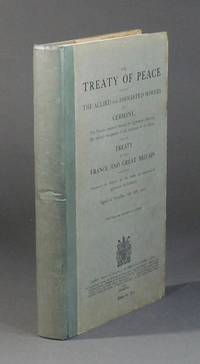
191958595London: His Majesty's Stationery Office 1919. Folio 428pp. bilingual text in French and English; 16 pages on glossy paper with seals and signatures; 5 large multiple folded maps loosely inserted into a pocket at inner rear panel: 'Allemagne Est' / 'Allemagne Ouest' / 'Saar Basin' / 'Danzig' / 'Schleswig'. A fine bright copy in original cloth-backed printed boards slight darkening along the fore-edge and the price cancelled to read 6 s. There was also an issue in printed wrappers. <br/><br/> His Majesty's Stationery Office hardcover books
WRCAM35472London: His Majesty's Stationery Office 1920. iv86pp. Folio. Original printed front wrapper rear wrapper lacking. Wrapper chipped at edges. Closed tear in titlepage repaired with tape closed tear in final two leaves with no loss. Good. Lacks the folding map. Though they fought together in common cause the defeated nations of World War I signed separate treaties with the victorious Allies the Treaty of Versailles with Germany being only the most famous of five treaties ending the Great War. This is the official British printing of the Treaty of Neuilly-sur-Seine made between the Allied and Associated Powers and defeated Bulgaria and signed more than a year after the Armistice of November 1918. The first part prints the Covenant of the League of Nations. The second part sets the new national boundaries under which Bulgaria had to give land to Yugoslavia and western Thrace to Greece. Under the section on reparations Bulgaria had to recognize her complicity with Germany in waging the war the infamous "war guilt clause" and also had to agree to pay penalties in the amount of 2250000000 francs. Other clauses address political military the Bulgarian army was limited to twenty thousand men economic and labor issues. Though the United States was a signatory to the Treaty of Neuilly-sur-Seine the Senate refused to ratify it. This treaty is an important part of the settlements ending the First World War little known and scarce on the market. His Majesty's Stationery Office unknown books
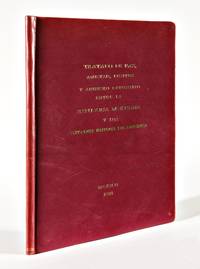
1848319879Mexico: Imprenta de I. Cumplido 1848. 55pp. printed on facing pages in parallel Spanish and English. Original printed green wrappers bound into modern red limp polished Mexican calf gilt. Light toning occasional minimal foxing small tear in upper outer corner of page 19/20 affecting just six words. Overall very good. 55pp. printed on facing pages in parallel Spanish and English. Official Mexican Printing of the Treaty of Guadalupe Hidalgo. The official Mexican printing of the final text of the landmark Treaty of Guadalupe Hidalgo ending the Mexican War and delivering to the United States its current territory in the Southwest. This printing closely follows the Queretaro edition produced just a few months earlier but contains added protocols excluded from that earlier printing. The full text appears here in both English and Spanish on facing pages. Pages 46-49 contain the text of amendments made to the treaty by the United States Senate followed by a statement of Pena y Pena dated May 30 1848 accepting the modifications and concluded by a Protocol dated May 26 attempting to put the best light on the treaty from the Mexican point of view. The Treaty of Guadalupe Hidalgo which ended the war between the United States and Mexico resulted in the formal cession of the entire Southwest and California to the United States. Agreements were reached for the withdrawal of American troops from Mexico the payment of Mexican claims and the formal cession of territory the U.S. had already occupied all of the land. The theoretical boundaries were set out and arrangements for boundary commissioners were made. By this treaty the United States obtained an addition of land equalled in size only by the Louisiana and Alaska purchases. <br/><br/>A fundamental piece of Western Americana here in the official Mexican edition of the complete treaty and scarce on the market. Streeter Sale 282; Palau 339389; Garrett p.91l; Cowan p.252; Howes M565"aa"; Eberstadt 162:847; Malloy p.1107; Reese Best of the West 104 Imprenta de I. Cumplido unknown books
18991278759Washington: Government Printing Office 1899. First. Thin octavo; G-/no-DJ paperback; fading red spine no text; covers have moderate fading and edgewear with chipping and tearing cracking along spine binding visible underneath name of previous owner written along top of front cover in pencil front cover is detached from binding and hangs off at upper portion rest attached by rear cover; textblock has moderate age-toning text clean and unmarked; 71pp<br /> <br /> <p>Shelved in Netdesk office Ephemera Box H. 1278759. Shelved Rockville Bookstore. Government Printing Office unknown books
3033Washington: Government Printing Office 1899. . 8vo buff wrappers front printed and nearly detached Washington: Government Printing Office, 1899. unknown books
1894CAT000122Paris: Garneir Frères 1894. First Edition. Hardcover Original Cloth. Good. undated ca. 1894. Original red cloth faded and moisture damaged. Clean internally slight age toning but otherwise unmarked. 196pp and 16 chromolithograph plates picturing over 100 delights. Not in Cagle Vicaire. Size: 8vo. Quantity Available: 1. Shipped Weight: Under 1 kilo. Inventory No: CAT000122. Garneir Frères hardcover books
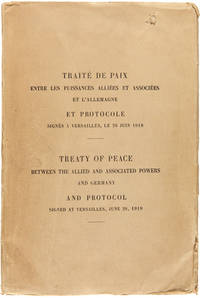
1919WRCAM49707Paris 1919. xv14284pp. printed in French and English on facing pages plus four large folding maps. Folio. Original printed wrappers. Minor edge wear small nick on front cover. Very good. Untrimmed and unopened. In a cardboard chemise and slipcase. Official French printing of the Treaty of Versailles a document of monumental importance in American and world history. The treaty made with Germany at the end of the First World War concluded a war of unrivalled devastation while sowing the seeds for the Second World War just twenty years on the horizon. The United States guided by Woodrow Wilson's vision played a central role in the crafting of the treaty. The U.S. Senate refused to ratify the treaty however based on the objection of several senators to the Covenant of the League of Nations which was included as Part I of the settlement thereby largely removing American influence and involvement from the international scene in the inter-war period. <br> <br> The Treaty of Versailles was a wide-ranging and ambitious document which sought not only to address the immediate postwar settlement but to punish Germany for its actions in starting and prosecuting the war attempted to remake the map of Europe and created a supra-national political organization the League of Nations. The Covenant of the League of Nations comprises the first part of the treaty. The next most famous part is that dealing with reparations which includes Article 231 the infamous "war guilt clause." By this article Germany accepted the responsibility of her and her allies "for causing all the loss and damage to which the Allied and Associated Governments and their nationals have been subjected as a consequence of the war imposed upon them by the aggression of Germany and her allies." The intent of the article was to affix legal and financial responsibility on Germany but it took on moral implications and was used by Hitler during his rise as an example of Allied perniciousness. Germany had to agree to pay reparations to the allies in the sum of 20000000000 gold marks the amount to be modified by a reparations commission in 1921. Germany also had to recognize the independence of Austria and agree not to compromise that independence in the future. Germany's borders were redrawn with Alsace- Lorraine being given to France West Prussia to Poland and other lands such as Danzig and the Saar Basin stripped away. She lost her overseas possessions the Rhineland was occupied and the German army was limited to one hundred thousand men and largely disarmed. Other provisions address issues of tariffs ports labor aerial navigation prisoners of war and more. <br> <br> As has been noted the many punitive measures of the Treaty of Versailles did much to fan the seeds of discontent in post-war Germany and to facilitate the rise of Hitler who publicly flaunted the provisions of the treaty throughout the 1930s. The refusal of the United States to ratify the treaty and participate in the League of Nations was a crucial part in the chain of events that led to the Second World War. A most important document here in an official French printing with the Protocol as a separate signature at the end. unknown books
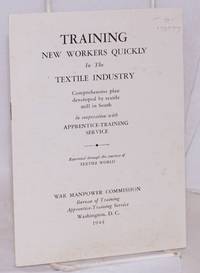
194442577Washington: War Manpower Commission Bureau of Training Apprentice-Training Service 1944. 13p. wraps. War Manpower Commission, Bureau of Training, Apprentice-Training Service unknown books
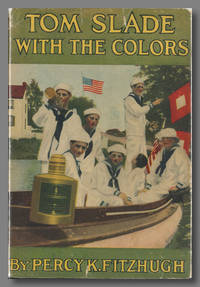
1925WRCLIT78625New York: Grosset & Dunlap 1925. Gilt lettered drab green cloth pictorial endsheets. Frontis and plates by Thomas Clarity. Edges a trace foxed 1925 ownership signatures spine slightly cocked otherwise a very good copy in modesty soiled and used dust jacket with small chip at crown of lower joint. A reprint of this popular boy's book with later titles in the advert for the series in the terminal catalogue. Slade's Boy Scout training enables him to be of service to the cause of supporting the Allies leading to his eventual enlistment. As the jacket flap asserts: "You can well imagine that war-time brings Tom some experiences that any loyal American boy would enjoy going through ." Grosset & Dunlap hardcover books