US Army U SBiblio.com
9 442 résultats
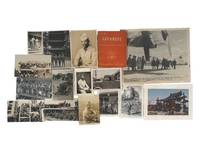
1943215491943. Photo archive documents the experiences of African American and white soldiers during and after World War II with a particular focus on the postwar occupation of Japan and the Philippines. African American and white United States Army soldiers in occupied Japan and the Philippines appear throughout this World War II and immediate postwar photograph archive of 16 original photographs documenting the military presence established in Asia following Japan's surrender in 1945. United States occupation forces entered Japan under the authority of the Allied command led by Douglas MacArthur overseeing demilitarization economic stabilization and reconstruction of Japanese infrastructure. The photographs document American servicemen returning from deployment in the Pacific and participating in the early occupation environment including logistical operations military transport and everyday life among U.S. troops stationed abroad. Several images specifically depict African American soldiers providing visual evidence of Black military service during a transitional moment when the U.S. armed forces remained segregated yet were increasingly dependent on specialized technical personnel and logistical units supporting large occupation forces across Asia.<br /> <br /> Archive of 16 items consisting of 15 black and white silver gelatin photographs and one language manual documenting American military personnel in Japan the Philippines and the United States during and immediately after World War II. Photographs range in size from approximately 3.5 x 2 inches to 10 x 8 inches and include formal portraits group images of soldiers disembarking from a military transport ship in San Francisco after returning from Asia scenes of military activity in Japan and documentation of damaged wartime infrastructure. One portrait shows an African American soldier in full uniform wearing a shoulder patch for the Japan Logistical Command a unit responsible for supply distribution transportation networks and infrastructure support for American occupation forces in Japan. Another photograph depicts an African American soldier with technician rank insignia on his sleeve chevron indicating a specialized technical role within the Army's wartime ranking system. Informal photographs provide glimpses of daily life including a soldier seated in a rickshaw with an inscription on the reverse reading "This is what is used for a taxi over here it's called a RICKSHAW. The guy in the seat is sometimes called a sgt. when they can think of nothing worse Ha Ha." Another image captures soldiers gathered outside a military barracks while a photograph captioned "Shadow of C-54 falls upon Sons of the Rising Sun on arrival at Ie Shima 20 August 1945 enroute to Manila" records the arrival of a U.S. transport aircraft shortly after the end of the Pacific war.<br /> <br /> Japanese: A Guide to the Spoken Language. Washington: War Department 1943. Issued to American military personnel preparing for operations in the Pacific the manual reflects the practical linguistic training provided to soldiers expected to interact with Japanese civilians and local labor forces during military operations and the occupation period. The guide includes phonetic instruction and dialogues designed for rapid language acquisition. One instructional passage advises soldiers: "To learn to imitate the sounds of Japanese you should listen to the records at least six or seven times. The English will be given first followed by the Japanese. Then repeat the Japanese out loud and say it good and loud. Remember! Repeat every Japanese phrase right after you hear it." Illustrated dialogue exercises show soldiers asking for directions in Japanese while another voice interjects "Hey! Anybody here speak any English" The photographs and language manual together illustrate everyday realities of U.S. military life in Asia during the transition from wartime operations to occupation governance following Japan's surrender. Photographs exhibit minor edge wear and light creasing consistent with period handling. The language guide shows moderate handling wear with slight staining and creased pages but remains fully legible. Overall condition very good. unknown
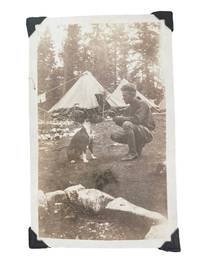
1918232501918. World War I Fort Bliss soldier training and camp life photo album from El Paso ca. 1918 recording the rapid wartime expansion of a border post into a large World War I training environment through tent rows drill formations truck convoys gas-mask instruction and group portraits of enlisted men in uniform. The album grounds that setting in specific internal evidence including the handwritten caption "Thanksgiving Ft. Bliss Texas 1918" beneath a group portrait the tent sign "Ambulance Company No. 10 / Men Wanted" and a large camp scene captioned "Ready for Business / W.H. Horse Co / El Paso Tex." Additional photographs follow soldiers through inspection lines recreational and theatrical moments camp interiors and exteriors and transport scenes giving the album a broad documentary range centered on military routine rather than formal ceremony alone.<br /> World War I era training album at Fort Bliss El Paso Texas. Circa 1917-1918. Photograph album containing 49 original black-and-white photographs mounted on black cardstock photographs ranging approximately from 2 x 3 inches to 3.5 x 5 inches. Images include extensive camp views including long rows of tents men standing in formation a soldier posed before camp quarters and a large gathering identified in manuscript as "Ready for Business." One image shows a woman in military-style uniform saluting the camera possibly a YWCA servicewoman. A substantial section documents motor transport and field organization through ambulance and truck lines crowded vehicle scenes and the recruiting sign for Ambulance Company No. 10 but these sit within a wider record of ordinary post life that includes mess and tent arrangements wooded camp settings dogs and mascots informal portraits a gas-mask training portrait stage performance views beneath an American flag rail lines and trestles mountain roads canyon routes and several personal portraits among them a woman in military dress and another street portrait with a uniformed soldier. The sequence suggests a soldier-assembled working album built from service experience at Fort Bliss and nearby western travel rather than a commercially produced souvenir.<br /> The album places Fort Bliss within the wartime transformation of the U.S. Army on the Mexican border and in the Southwest when posts such as El Paso functioned as training transport and staging environments for newly mobilized troops. Its strongest documentary value lies in the accumulation of ordinary but specific military details: tent architecture vehicle organization gas defense drill troop formations mess arrangements rail infrastructure and the handwritten Thanksgiving 1918 notation that fixes part of the sequence to the closing months of the war. Black paper album with spiral binding; photographs corner-mounted throughout; several prints with creases abrasions or edge losses but images in overall very good condition; album itself sound and complete. Overall very good condition. A photographic record of Fort Bliss that preserves how soldiers organized camp life training movement and leisure in El Paso during the World War I years. unknown
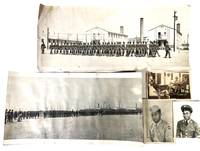
1941193561941. Partially identified Black Airmen photographs and Tuskegee Airmen signatures. African American airmen associated with the United States Army Air Forces during the World War II era document the struggle the struggle of entry into military aviation during a period when the armed forces remained racially segregated. This archive contains sixteen items including photographs of Black airmen in uniform and autographs of Tuskegee Airmen the pioneering African American pilots and support personnel trained beginning in 1941 after federal pressure forced the Army Air Corps to open limited aviation training opportunities to Black candidates.<br /> <br /> Five original photographs of African American airmen in Army Air Forces or early U.S. Air Force uniforms and nine signed note cards bearing the signatures of Tuskegee Airmen veterans. The archive also includes a contemporary pamphlet and photograph of a monument commemorating the Tuskegee Airmen. Signatures appear on white unlined cards measuring approximately 5 x 3 inches and include Claude Platt of the 301st Fighter Squadron and an Army primary flight instructor Charles A. Lane Jr. of the 99th Fighter Squadron Charles McGee of the 302nd Fighter Squadron Luther E. McIlwain Eldridge Williams of the 332nd Fighter Wing Leroy Bowman of the 301st Fighter Squadron Edward E. Tillman of the 477th Bombardment Group Utota Knox of the 302nd Fighter Squadron and Curtis C. Robinson of the 99th Fighter Squadron. The five photographs include two panoramic images measuring approximately 8 x 15 inches and 8 x 17.5 inches and three smaller photographs measuring roughly 3 x 5 inches. <br /> <br /> One panorama shows a large formation of troops assembled in ranks with a band and flag bearers present with African American personnel grouped separately from white soldiers and women within the formation. A second panorama shows approximately four dozen Black airmen marching in formation near a military installation. The smaller photographs depict African American airmen wearing service uniforms with airman caps and winged shoulder insignia; one image bears the inscription "To Mother - From Son in the service" while another real photo postcard shows a Black airman posing with a Black woman seated in a prop carriage behind a decorative mule annotated with "me" above the woman and the initials "T.B." above the man. <br /> <br /> The Tuskegee Airmen program began in 1941 when the U.S. Army Air Corps initiated training for African American pilots at Tuskegee Army Air Field in Alabama following federal directives requiring the military to allow limited Black participation in aviation roles. Units such as the 99th Fighter Squadron and the 332nd Fighter Group became the most visible African American flying units during World War II flying escort and combat missions in the European theater while operating within a segregated military structure. Their service challenged long standing claims that African Americans were unsuited for combat aviation and became a major milestone in the broader campaign for racial equality in the armed forces. The experience of these aviators and the public recognition of their accomplishments contributed to growing pressure for the desegregation of the military culminating in President Harry S. Truman's 1948 order ending official racial segregation in the armed forces. Five photographs ranging from approximately 3 x 5 inches to panoramic formats up to about 8 x 17.5 inches accompany nine signed note cards. One panoramic photograph shows slight water staining and a fold at the left corner; the remaining photographs and signatures remain well preserved. Overall condition very good. The material preserves visual documentation of African American participation in military aviation alongside signatures of several Tuskegee Airmen who served in fighter and bomber units during the war. unknown
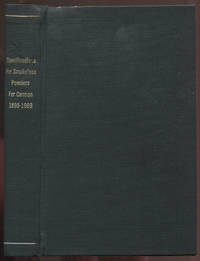
1909553425Washington D.C.: Ordnance Department U.S. Army 1909. Hardcover. Very Good. First editions. Small octavo. 18 volumes totaling approximately 230pp. 10 volumes contain a chart one fold-out and three contain fold-out graphs. Bound with wrappers into black clothcovered boards with spine gilt and page edges sprinkled red. Several volumes with ownership stamps or signatures or inked or stamped notes on the cover. A clean sammelband save for a large dampstain on the front endpapers causing light rippling on the first 30 pages or so and unobtrusive occasional staining at the very top of the gutter one fold-out graph with about ¼ missing and occasional small chips or tears on the wrappers; altogether very good.<br /> <br /> A bound series of Army-issued instructional pamphlets dating from 1898 to 1909 which were distributed to manufacturers of smokeless powders guncotton Ballistite Cordite etc. to instruct them on the specifications required by the U.S. Army. The pamphlets range in length anywhere from six to 30 pages. The earliest pamphlet stands out as it is comprised primarily of mimeographed pages from specifications written for three earlier contracts one from 1895 and two from 1897 and is the only volume in the collection constructed in this manner. We suspect that before these specifications were made more generalized in these frequently updated pamphlets they were written out contract by contract. Three of the pamphlets contain the owner signature of Odus Creamer Horney on the front wrapper. Horney was in charge of the building and launching of the Army's first smokeless powder factory starting in 1907 while in command of the Picatinny Arsenal in New Jersey.<br /> <br /> The collection contains two titles that eventually combine into one. Specifications for Smokeless Powders for Cannon later titled Specifications Governing the Manufacture of Smokeless Powder for Cannon and Standard Methods of Chemical Tests of Nitrocellulose and of Smokeless Powder for Cannon eventually combine into Official Methods for Examination of Nitrocellulose and of Smokeless Powder for Cannon and Specifications Governing Manufacture of the Same for about a year before the title was changed to No. 405 Instructions to Bidders and Specifications Governing the Manufacture Test and Inspection of Nitrocellulose and of Smokeless Powder for Cannon. A complete list of each title and a brief description is available upon request.<br /> <br /> As a collection this chronicles the evolution of the criteria required by the US Army for the manufacture of smokeless powders when that technology was still quite new in terms of use. OCLC locates four individual pamphlets but we could not find a similar example of this expansive collection. Ordnance Department, U.S. Army hardcover
1867005330Salem OH: Hudson & Son Printers 1867. Book. Very good condition. Paperback. First Edition. Octavo 8vo. ii printed wrapper with verso blank 12 pages of text followed by ii blank rear wrapper. Moderate soiling and age-toning to wraps with a few small tears to edges and a few tiny stains on front wrapper. This publication canonizes the First National Encampment of the Grand Army of the Republic. Includes a Preamble and 23 Articles and Resolutions. General John M. Palmer Major B. F. Stephenson surgeon of the Fourteenth Illinois regiment and General S. A. Hurlbut were present and appear to have been involved in the formation of the national rules. Rare imprint. No institutional holdings according to WorldCat/OCLC. The American Antiquarian Society Library holds a similarly titled GAR publication regarding a meeting held a month later December 21 1866 pertaining only to the Department of the Massachusetts. First edition. Hudson & Son, Printers Paperback
191095145Calcutta: Superintendent Government Printing India 1910. First Edition. Leather bound. Near Fine. Leatherbound volume. First edition from 1910 has been rebound in greenish-black Morocco leather with title and regiments listed in gilt on front. Spine has five raised bands with gilt decoration on each band. All edges gilt. Marbled endpapers. Condition of binding is near fine--there are a few small nicks at edges and a spot of wear to cardboard at the corners. Interior pages are clean and fresh with the occasional light spotting. A brief narrative history of the regiment is followed by lists: of colonels commandants native commandants and Risaldar Majors; of regimental lists; of war services of officers all followed by an Appendix and and Index and all preceded by an explanation of abbreviations. Laid in is a photo of the regiment in 1909 cut out from another volume. The book is not available on any of the listing sites and World Cat lists only two copies: one in New York and one in Australia. The book is available on Google Books; Small 4to. 172 pp. From the estate of Donald G. Skinner Canadian military collector extraordinaire. <br/><br/> Superintendent Government Printing, India hardcover
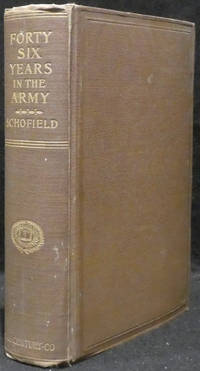
189720240031<p>Forty-Six Years in the Army by Lieutenant-General John M. Schofield. Published by The Century Co. New York 1897. Sm4to. xvi 577pps. Very good first edition book. Inscribed by the author on the FFEP. Narrow-ribbed brown cloth covered boards with blind-stamped borders around edges of front and back panels; gilt-stamped lettering and graphics on spine. Upper page edges are gilt. External lower edges are untrimmed side edges are rough trimmed. and both are age- and likely soil-darkened. Several scuffs on panels and spine diagonal scrape at upper right corner of back panel. Edges at head and tail of board spine have crimps and horizontal creases rubbed but not fraying. Fore-edge corner tips are scuffed very small rub-through on the lower right front tip. Back inside gutter has crack of 2 3/16". Gutter is cracked at pp. xii-xiii pp. 16-17 and pp. 288-289. Pencilled margin mark on page 13. Faint damp stains along the upper margin edges off and on through-out the book heaviest varies from approx. 1/8"-1/2" adjacent to the gutter by 2 1/2." The slightly duller areas of the upper edge photo is an indication of the pages impacted. Text pages are age-toned. Light intermittent foxing. Spine block is loose from the boards but held in place by the endpapers. Also includes a 4-page advertisement pamphlet. Photos are intended as part of the descriptions. Please use close-up options for best inspection. Additional photos available at your request.</p><p>From: Kansas City Public Library Civil War on the Western Border:</p><p>John M. Schofield served as the senior Union Army officer in Missouri during part of the war as both commander of the Army of the Frontier and the Department of Missouri. In 1864 he joined William T. Sherman's forces in Georgia and led one of the three federal armies in the Atlanta Campaign and subsequent "March to the Sea." Detached to protect the federal position in Tennessee he successfully fought John Bell Hood's remnants at the Battles of Franklin and Nashville.</p> The Century Co. hardcover
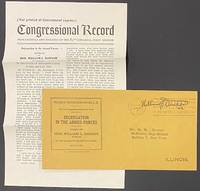
1951186401951. Dawson William L. African American congressman from Chicago and World War I veteran of the segregated 366th Infantry Regiment House of Representatives speech delivered April 13 1951 addressing segregation in the United States armed forces during the early years of the Cold War. Dawson served in Congress for nearly three decades and became the first African American to chair a congressional committee. His speech was delivered during a critical period in the history of American civil rights and military policy following President Harry Truman's 1948 Executive Order 9981 directing the desegregation of the armed forces. Debates in Congress during the early 1950s addressed the pace and implementation of integration and Dawson used the floor of the House to argue that racial segregation contradicted the principles for which American soldiers fought.<br /> <br /> Dawson William L. "Segregation in the Armed Forces." Speech of Hon. William L. Dawson of Illinois in the House of Representatives April 13 1951. Congressional Record 82nd Congress First Session. Single printed sheet measuring approximately 6 x 9 inches preserved with original mailing envelope. The printed text reproduces Dawson's remarks opposing segregation within the military establishment. In the speech Dawson declared: "If there is one place in America where there should not be segregation that place is in the armed services among those who fight for this country." He continued with a broader appeal to constitutional ideals and national unity: "I would give up this life of mine to preserve this country and every American in it white or black. Deny to me today if you will all that American citizenship stands for I will still fight to preserve our Nation knowing that someday under the Constitution of the United States all of these restrictions will be removed and that we will move forward before the world as one people American people joined in a democracy which shall set the pattern for all the world."<br /> <br /> Dawson's remarks formed part of the ongoing political struggle over civil rights and military policy during the early Cold War. The Korean War had begun the previous year and questions about equality within the armed forces remained under active debate as the military implemented Truman's desegregation order. Dawson's own wartime service in a segregated unit during World War I informed his critique of racial discrimination within the military establishment. As a senior African American political leader in Congress his advocacy contributed to broader legislative and political pressure supporting the continued dismantling of segregation in the armed forces. Minor wear consistent with age; overall condition very good. unknown
19561585031st Edition 2nd Printing. 1956. 1950s Chinese Nuclear Science Poster set incomplete 15 posters of 30 in colour. Each poster is numbered and depicts a detailed image for example a variety of types of nuclear weapons and defence construction with explanative notes. <br> <br>This broken set comprises poster numbers 6 8 9 10 11 12 13 14 15 21 22 23 24 25 and 26 of the 30 issued in this set. The posters in this group vary from being in reasonable secondhand condition to poor condition. Each shows signs of wear creasing closed tears and some with loss mainly on edges and corners. Most posters are torn with considerable loss at one corner and in two cases this has caused loss to the image. Many have been mended with tape on the reverse along some edges there is some marking mainly on reverse though in one case on the poster itself. On the reverse of poster 23 there is an amateur painting and some painted text. Text in Chinese. The poster sizes vary ranging approximately from approximately 55 x 77 to and 77 x 53cm. An interesting collection of posters which clearly shows that China was as deeply concerned about nuclear war during the Cold War as it's neighbours Russia and the United States across the Pacific. <br> <br>Poster no. 6 shows details of the lethality and destruction factors of the atomic explosion including shock weaves radiation and radioactive contamination. <br> <br>Poster no. 8 shows the materials to be used to build nuclear protection trenches as well as the construction methods. <br> <br>Poster no. 9 displays the images of the type of bomb shelter known "below chest-level bulletproof shelter" giving its floor plans with information on an estimated time to build and materials to use. <br> <br>Poster no. 10 shows images of the type of bomb shelter known "light bomb shelter" and a floor plan with information about its accommodation capacity 8-10 people estimated time to build 15 days and materials to use. Also it suggests every infantry platoon should install one of these shelters. <br> <br>Poster no. 11 shows images of the type of bomb shelter known "heavy bomb shelter" and a floor plan with information about an estimate time to build 35 days and materials to use. The heavy bomb shelter is used as a command office when needed. <br> <br>Poster no. 12 includes 9 images showing different nuclear protection bunkers built for various weapons and equipment such as 57 x 85cm cannon 122 x 152cm howitzer rocket artillery tank self-propelled artillery trucks and communication equipment. The poster also shows floor plans for each type of the bunkers an estimate time to build and materials to use. <br> <br>Poster no. 13 includes 8 images showing different nuclear protection field war warehouses to store materials and equipment such as ammunition mines explosives fuel barrels PT-10 and PT-25 fuel tanks and army provisions. The poster also shows floor plans with information about an estimate time to build and material to use. <br> <br>Poster no. 14 includes two images showing special squads for detecting radition levels on the upper section of the poster together with action plans below the images. A legend on the lower section shows correspondent names for the coloured routes. Detailed plans designed for searching nuclear contamination source and safe routes to take within the contamination zone. The routes are shown and numbered. Each squad consists of one squad leader. <br> <br>Poster no. 15 features an image of the special squad for detecting radiation level and very detailed information on their responsibility and action plans. An inset includes three images showing how to extract contaminated soil and a legend showing correspondent names for the coloured routes lower right section. <br> <br>Poster no. 21 includes 9 images showing different ways to remove radiative contamination on the roads and on battle field. Two blue charts in the middle section one chart showing different types of vehicles to remove contamination on the roads the other various warning signs according to radiation levels. <br> <br>Poster no. 22 shows images of different types of water supply wells cistern etc. and ways to protect the water supply from radioactive contamination. An image featured in the centre shows the layout of a water plant and how it processes contaminated water. The instruction above the image suggests that processed water shall be consumed only when no clean water is available. Four images with detailed instruction lower section show various water purifying methods distilling filtering and ion exchanging <br> <br>Poster no. 23 displays images of soldiers disinfecting radiation contaminated food with package or without and containers for food storage. <br> <br>Poster no. 24 features a Soviet Union made AN-1-A radiac set left section and two images right section of soldier measuring radiation level and soldier carrying the set. <br> <br>Poster no. 25 shows a circuit diagram of the AN-1-A radiac set with a legend showing different coloured current circuits. <br> <br>Poster no. 26 features another Soviet Union made AN-11-A radiac set. The parts of the set are highlighted upper section. Front view and back view of the set are shown lower section. A small image of the set in use upper right section. . unknown
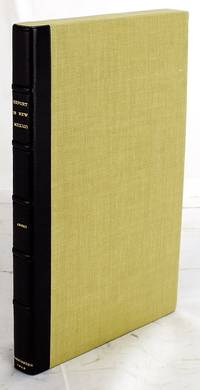
18481805130019Washington D.C: U.S. Government Printing Office Depart of War 1848. First Edition. Hardcover. Good. 1st edition Senate issue. Housed in a custom made morocco leather backed slipcase. Bound by Jacques Desmonts James Macdonald Norwalk Conn. 24.5 cm. Bound in original printed wrappers. Wraps are worn and nearly detached. Loss to bottom corner of front and rear wrap. Contemporary signature on front wraps. 132 pages: 24 plates folded map; 24 cm. Large folding lithographic "Map of the Territory of New Mexico." Pages are clean and unmarked. Includes plates of Santa Fe Fort Marcy San Felipe and Native Americans. Howes A-11; Sabin 57; Wagner-Camp 143; Streeter I.168; Graff 5 Rittenhouse 2. One of the earliest U.S. government sponsored explorations of the Southwest. James Abert left Ft. Leavenworth in Kansas along the Santa Fe trail in order to map the newly won territory. He made his way via Bent's Fort and returned to back His map was the most detailed up to that point. Abert had served in Gen. Stephen W. Kearny's Army of the West in the Mexican American War and had been part of Fremont's earlier California expedition. 30th Cong. 1st sess. Senate. Ex. doc. no. 23. U.S. Government Printing Office, Depart of War hardcover
18414444951<p>printed for the author by F. B. Penniman hinges cracked and weak but still holding title page coming loose black cloth worn remnants of spine label light foxing pages 145-148 missing from pagination no actual missing pages unmarked rare.</p> self-published hardcover
1943277008Kamnik district Slovenia: Tehnika RK VI 1943. 30pp. 8vo mimeographed text with images original tan wrappers with mimeographed cover.<br/> <br/> This rare surviving pamphlet from World War II was produced by the Yugoslav Partisans the most accomplished armed resistance movement against the Axis occupation of Europe. Starting out as a guerilla group the Partisans soon created a complete underground society based on Communist principles including schools government and medical institutions financial systems and publishing presses. This pamphlet produced by one such press likely hidden in the mountains or forests of Slovenia addresses an emergent need in such a new clandestine society: that for maps. It proceeds in logical order: geographical vocabulary instructions for making field maps and later more sophisticated and symbolic drafting techniques. Within this technical know-how it also communicates tactical military advice that the Partisan guerillas employed in their battles with Axis armies. This tactical quality of the publication is most in evidence in the pamphlets many striking diagrams which demonstrate the importance of visual knowledge in situations of survival.<BR> <BR> This pamphlet was one of many Partisan publications designed to educate protect and encourage members of the movement. It is particularly fascinating for its simple means of production since the secrecy of Partisan operations limited them to mechanical methods such as mimeographs--in witness here--as well as heliotypes linocuts and typewriting. Given its fragility the pamphlet is in excellent condition with clean text. Slight stains and some very small tears in margins. As one of the few Partisan publications on cartography this pamphlet is a rare and fascinating record of the World War II resistance.<br/> <br/> Tehnika RK VI unknown
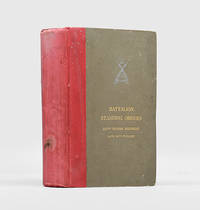
1931183065Allahabad: The Pioneer Press 1931. First edition one of 125 copies only. The orders for this unit first raised during the Indian Rebellion and subsequently seeing extensive service worldwide lay down regulations across a wide range of subjects. It was signed by Captain Mark Bwye of the 10th Battalion 15th Punjab Regiment a sister unit. We have traced no copies in institutions or in commerce. During the Indian Rebellion of 1857 Captain H. T. Bartlett raised the 18th Regiment of Punjab Infantry at Peshawar. Under Lord Kitchener's reforms in 1903 it was reconstituted as the 26th Punjabis then in 1922 it was merged with four other units to form the 15th Punjab Regiment. This was made up of five battalions of which the 2nd Battalion was the former 26th Punjabis. Over the course of its history from 1857 they fought in the Second Afghan War Third Anglo-Burmese War both world wars and the Indo-Pakistan War of 1965. In 1931 they were stationed in Mingaladon Burma and commanded by Lieutenant Colonel O. D. Bennett. Octavo. Battalion badge in silver to p. 292 diagram and tables some folding in text; interleaved with blanks for notes as issued. Original red half cloth grey green cloth boards lettered in gilt and decorated with battalion crest in silver. Marginal pencil notes to appendix. Binding variably soiled spine sunned stained and rumpled tips a little worn: a very good copy. hardcover
NC02AA-00581The Infantry Journal. Collectible - Good. Washington: The Infantry Journal Inc. 1943. 3rd edition. 24mo. 360pp. Illus. maps. Good book. Owner's name on front cover. mortars ordnance handbooks and manuals Inquire if you need further information. The Infantry Journal unknown
1970158580北京.Beijing.: No publication details. circa1970. Coloured Chinese Air Defence poster incomplete set consisting of 9 posters each poster is numbered. The set includes poster numbers 4 8 10 11 12 13 14 15 and 16. These posters are in secondhand condition. The posters show some creasing with a number of small tears particularly at margins some mending on reverse with tape. Two posters are considerably torn at margin affecting the image slightly in one case. There is some browning and staining and there is considerable annotation on the reverse of poster number 8. Text in Chinese. Sheets measure appoximately 53.9 x 77.9cm. Poster no. 4 depicts 9 images of different types of simple air defence shelters trenches caves etc. Brief descriptions of each type of shelter are provided below the images. Three images in the lower section suggest that when selecting the site for air defence shelters one should not build too close to buildings flammables and electric wire. <br> <br>Poster no. 8 includes 9 images showing the alternative shelters when air raids happen and no nearby air defence shelter available. Alteratives suggested include basements beneath a bridge the corner of a wall and under solid staircases as good alternative shelters. <br> <br>Poster no. 10 shows 3 methods to use to fire at enemy aeroplanes each with detailed instructions. The speed and size of the aeroplane and shooting angles and distance are all taken into consideration. A chart in the centre gives the calculations required to be prepared in advance to successfully shoot down an aeroplane. The calculations require taking into account the plane's size and distance. <br> <br>Poster no. 11 includes 3 images to demonstrate methods to fire at enemy paratroopers with detailed instructions. A chart in the centre gives the calculations for advance preparation taking into account the person's height and distance from the invading paratroopers. <br> <br>Poster no. 12 depicts 5 images showing various anti-aircraft firing positions. They are: a position where a single person lifts and stabilises the rifle while the other person aims; position aided by fortification; position aided by tree branches; position aided by walls; and kneeling position. <br> <br>Poster no. 13 is illustrated with 5 images showing two squads rifle shooting squad and machine gun shooting squad who are in charge of the anti-aircraft placement and three main targeted aircrafts bomber military cargo aircraft and helicopter to shoot. <br> <br>Poster no. 14 shows 10 images of self-rescue and first aid for other people after air raids with detailed instructions. Self-rescue actions featured are emergency bleeding control and fire evacuation; first aid treatment introduced are treatment for bone rapture CPR and transport the wounded. <br> <br>Poster no. 15 depicts 5 images demonstrating methods to extinguish fire bombs. Methods include: burying or covering the burning objects with sand and soil; covering the burning objects with soaking wet quilts or sack bag; throwing the burning objects into water containers with iron shovel; and using a fire extinguisher extinguishing powder or carbon nitride. <br> <br>Poster no. 16 includes 6 images showing plans and actions of rescue urgent repair and maintance of law and order with detailed instructions. It suggests: to report to the relevant government agency and evacuate nearby civilians when unexploded bombs are discovered; during air strikes lay down perimeters around shops to prevent from looting; to restore transportation by clearing roads immediately after air raids; to urgently repair damaged electric wires and water pipes; it gives the major patrol sites as the factory shops warehouses dams bridges and power station and urges the viewer to arrest suspects if necessary; to put out fire immediately and to make sure the safety of the civilians is paramount. <br> <br>中國人民解放軍總參謀部動員部Mobilization Division of People's Liberation Army General Staff Department was first formed in 1954 and later joined with 中国人民解放军总参谋部军务部 Military Division of People's Liberation Army General Staff Department to form a joint division in 1969. The Division returned to its original name in 1975. . No publication details. unknown
20032080502106402119Fuyoshobo 2003. Soft Cover. Fine. The book is in fine condition. Fuyoshobo paperback
1685AQ22730London: Printed by the Assigns of John Bill deceas'd: And by Henry Hills and Thomas Newcomb 1685. 271pp 1. ESTC R7189 Wing A105. Bound with: Rules and articles For the better Government of His Majesties Land-Forces In Pay during this present rebellion. London. Printed by Printed by the Assigns of John Bill deceas'd: And by Henry Hills and Thomas Newcomb. 1685 36pp. ESTC R28828 Wing R2239. 8vo. Contemporary gilt-tooled speckled calf later rebacked preserving contemporary backstrip. Rubbed head-cap perished. Early manuscript shelf-marks to FEP early inscription of Hugh Scott to title page of first mentioned work dampstaining primarily confined to margins of first work more extensive in second. A scarce late seventeenth-century martial manual on the English army line infantry formations. First printed in 1676 the work is primarily devoted to the correct battlefield positioning of pikes and muskets; detailed instruction is provided for the efficient command of personnel in order to maximise damage inflicted and minimise friendly losses. The information is presented in an efficient and remarkably accessible manner the directions for the 'exercise of the musquet' for example are arranged as a list of succinct stages easily comprehended: 'Handle you Charger / Open it with your Teeth / Charge with Powder.' Successive editions each a revision on the last accommodated advances in military technology such as the introduction of flintlock firing mechanisms and the wide-spread employment of the bayonet. This copy is paired with a reissue of the regulations for the conduct of the infantry occasioned by the onset of the Monmouth Rebellion during which the ranks of the English Army swelled in response to the threat of the deposition of James II. . Printed by the Assigns of John Bill deceas'd: And by Henry Hills, and Thomas Newcomb unknown
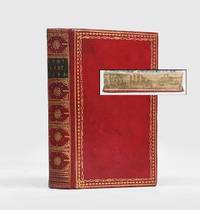
1799183026London: War-Office 1st March 1799. Late 18th-century edition in an attractive binding. Army lists were published annually by the War Office between 1754 and 1879 giving the names of officers and their dates of commission. The fore-edge painting executed at a later date shows Broadway and New York City Hall based on an etching by Carl Fredrik Akrell after a drawing by Baron Axel Leonard Klinckowström. Provenance: Alexander Adair d.1834 with his armorial bookplate. Adair was the great grandson of Sir Robert Adair of Ballymena and inherited the family estate at Flixton Hall in 1783. In 1805 he raised and commanded the 9th Troop of Suffolk Yeomanry. One "Mr Adair" army agent at Pall Mall is listed on Page 73. The same page features numerous ink corrections to the list. Octavo 226 x 140 mm pp. ii 655 5. Tables in text. Contemporary red straight-grain morocco green spine label smooth spine compartments decorated with gilt sunburst device boards tooled with gilt borders board edges milled in gilt turn-ins tooled in gilt marbled endpapers edges gilt near-contemporary fore-edge painting of Broadway in 1824. Spine rumpled boards slightly marked contents clean: a very good copy. ESTC T170321. hardcover
18600021783Washington D.C. USA: George W. Bowman. Bound in sumptuous full leather binding with five raised bands to spine and gilt decorations and titles this dated 1860 hardcover First Edition is VG. Late of Royal United Services Library but having several tiny impressed stamps to indicate the association. 287pp186 full-page many folding including maps and battle plans. 20th century binding with unmarked cream endpapers. One corner of frontis plate is neatly snipped 1cm x 0.5cm. Several folding plates are slightly misfolded but without loss. Weight of book is 3.5Kg. Condition generally VG . Very Good. Full Leather Hardcover. First Edition. 1860. George W. Bowman hardcover
1913381597Washington: Government Printing Office 1913. Hardcover. Very Good. First edition. Three volumes. House Documents No. 1346 and No. 1346 part 2 62d Congress 3d Session 1912-1913 and House Reports No. 92 and No. 92 part 2 63d Congress 1st Session 1913. Complete as issued in one cloth bound volume and one cloth box; and one cloth bound volume. Octavos. Bound volume: 172pp. folding maps; box: 16 folding maps and 3 folding diagrams; bound volume: 19 6pp. 1 folding map and 1 folding chart. Moderate soiling to the cloth boards a very good set. An extensive topographical survey of the Alaska Territory conduced by Major Jay J. Morrow of the US Army Corps of Engineers. A scarce complete set of the two-volume House Document with the folding maps in fine condition and the additional one-volume House Report bound with 48 other reports. Government Printing Office hardcover
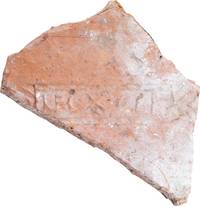
1106Carnuntum c62AD-200AD. Fragment of a reddish clay brick with the stamp of Legio X Gemina Pia Fidelis “"LEG X C PF" the 10th Roman legion of 5280 men split into 10 cohorts. Mortar layer on the back otherwise a very good and well preserved stamp. Ex collection Piscator 1959. Cf. on this piece Brandl op. cit. no. 187-190. 6 1/2" x 4" x 1 1/4" Legio X Gemina was formed from the disbanded Legio X the first Roman legion levied personally by Julius Caesar in 58 BCE. It distinguished itself as one of the four legions used by Caesar in his invasion of Gaul fought for Octavian and Antony against Brutus and Cassius in the Battle of Philippi in 42 BCE and followed Antony in his campaigns against Parthia and Armenia 36-34 BCE. The legion surrendered to Octavian after the Battle of Actium in 31 BCE losing its prestigious name Equestris as punishment and receiving veterans from other legions which earned it the cognomen "Gemina" twin. After service in the Cantabrian Wars and brief deployments to various frontier posts the legion was sent to Carnuntum a fortress on the Danube between current day Vienna and Bratislava in about 61 CE where it remained vigilant against Germanic threats. Following participation in Trajan's Second Dacian War the legion moved twice more first to Aquincum Budapest in 103 CE then finally to Vindobona Vienna in 114 CE where they remained stationed defending the Danube frontier until the 5th century though vexillationes were periodically sent for campaigns in Judaea Mauritania and Parthia.<br /> <br /> Red clay bricks like these were a common building material in Roman architecture from about the time of Augustus and making bricks was among the chores for Roman soldiers during their down time. unknown
191912692Washington DC: Presumed United States Government Printing Office 1919. Presumed First Edition First printing. Hardcover. Good. C.C.P. 400. Volume I: viii 713 3 pages. Figures 1 fold-out. Tables. Appendices. Index. Boards quite weak and partially restrengthened with glue. Pencil name inside front board Cover/spine is scuffed and has worn edges. Grayish binding. Volume II: viii 342 2 pages. Figures including several fold-outs. Tabular information. Index. No board weakness noted. Red binding. This is a mixed set due to different color of binding. In a 1918 journal article the functions of the Committee on Classification of Personnel in the Army were enumerated as: 1 classifying personnel according to their military qualifications 2 establishing the Trade-Tests division 3 enlisting the occupational needs of units in a division 4 extending the personnel work to staff corps troops 5 establishing the Central Personnel Bureau 6 appointing a committee on education and special training 7 organizing the War Service Exchange 8 rating the officers and candidates for commissions in the Officers Training Camps 10 cooperating with the Provost Marshall General 11 reducing the army paper work 12 enlisting the intelligence ratings of army men and 13 selecting aviators and navy men. The Committee on Classification of Personnel in the Army subsequently became The Classification Division Adjutant-Generals Department. The personnel system of the United States Army developed during 1917 and 1918 was an answer to the demand for a method of increasing the speed and efficiency of mobilization by utilizing to the best advantage the training experience and other qualifications which recruits brought with them from civil life. The system was planned and introduced largely through the efforts of the Committee on Classification of Personnel in the Army a civilian body working under the jurisdiction of the Adjutant General of the Army. The history of this movement is dole in Volume I. Volume II contains "The Personnel Manual". It gives detailed instructions for the actual operation of the personnel system as finally evolved and used during the latter part of 1918. This manual is the product of the experience of a year and is issued in complete form as a series of helpful suggestions so that the Army may profit by them in peace as well as in any future emergency. Presumed United States Government Printing Office hardcover
1796173179London: War Office 1796. Hardcover. Good cover edges bumped cover soiled interior tight. Red leather boards with gilt lettering on spine 98 pp 29 leaves of plates 27 folded. Printed for the War Office. The 18th century was a wealth of knowledge exploration and rapidly growing technology and expanding record-keeping made possible by advances in the printing press. War Office hardcover
196483699Washington DC: Department of the Army Headquarters 1964. Presumed First Edition First printing. Three hole punched with metal fasteners. Fair. Format is approximately 9 inches by 11 inches. 6 pages plus many tabs with one or more pages per tabbed section. Rare surviving original copy. Ink notation on front cover. Pages 1/2 is ahead of page 'i' The contents include: Introduction including Instructions for the use of the nuclear play calculator Strike Assessment Procedures including sections for cannons free rockets missiles air delivered weapons atomic demolition munitions and new weapons; Damage Determination ReferencesSample Problem Strike Assessment and Nuclear Play Calculator Aids in envelope. The Aids are present. This manual includes tabbed sections on Cannons Rockets Missiles Air-delivered weapons Atomic Demolition Munitions and then by yield from 0.5 KT through 5 MT. The Tab for I KT is mislabeled 1 MT. This manual provides guidance on procedures and techniques for nuclear play during tactical exercises. This manual provides the necessary aids for the Aggressor to determine the damage to United States and Allied forces from nuclear strikes. The weapons systems in this manual are based on material contained in the Handbook on Aggressor Military Forces FM 30-102. Aids envelop includes 8 plastic sheets of horizontal dispersion templates for cannons free rockets and Guided missiles and air delivered weapons and Damage circle templates for 1:50000 and 1:25000. The nuclear play calculator is a device for applying performance probabilities to nuclear delivery systems. The horizontal dispersion template is an aid used to determine the actual ground zero of a nuclear weapon. The damage circle template is an aid used in conjunction with the damage letters to evaluate the damage to personnel and equipment. The target element table describes target categories and the damage to be expected within each letter damage circle. The Damage circle radii tables are a series of tables showing the damage radii based on the height of burst and the weapon yield. This manual reflects the state-of-the-art the state of knowledge the state of training and the state-of-tactical nuclear weapons employment during the height of the cold war after the Cuban Missile Crisis and before the focus of the Army shifted to ground combat in Vietnam. Department of the Army, Headquarters unknown
19962081502111905359Danketsu 1996. Soft Cover. Fine. The book is in fine condition. Danketsu paperback