9 442 résultats
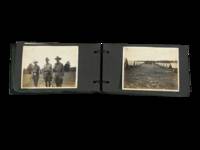
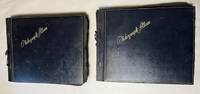
195635221Europe: n/a 1956. Photograph Album. Fair. Two oblong thick string tied photograph albums. Dark covers. Approx. 14" x 11". Both volumes have 50 black sheets of paper completely filled on both sides with numerous personal photographs souvenir photographs post cards ephemera and hand written narratives and notes in white pen. Both bindings are fragile with several loose pages in both volumes. Some of the pictures and cards are loose and laid inside the volumes. The black sheets are chipped on the edges with small pieces flaking off. Albums in fair condition only. <br /> <br /> Each volume has a one page hand written explanation note by Carl Wahle on service issued paper with color "Vienna" seal illustration and color flag illustrations of America United Kingdom. Russia and France top of the page. "7690 HQ. & SVC. CO. APO 777 US Army NY. NY." is printed in black at the center top edge of the paper. The title is taken from one of the first written title headings in volume 1. A very unique and detailed collection of photographs and ephemera detailing the personal life and service of Carl Wahle in Europe during the mid 1950's when the United States was at "Cold War" with Russia. Private First Class Wahle served with the Allied forces that controlled Vienna after World War II. There are many pictures of Carl inside the albums. He witnessed the historic departure of Allied forces from Vienna in July 1955 after the Austrian State Treaty was signed May 15 1955. Several up close pictures taken of the Russian French and British Armies during the this peace keeping mission are included. <br /> <br /> The first album contents include:<br /> <br /> Introductory note page to Volume 1 written by Carl<br /> colored embroidered shoulder patches pasted down on the inside of the front cover<br /> 186 personal and bought photographs of European places Military marches service people etc. <br /> 18 color photographs of Russian & American Changeover Ceremony Sept 1953 <br /> 23 photographs from November and December 1954 of service activities places misc.<br /> a note card by Carl to his folks dated December 19 1953<br /> a drawn white outlined map titled "My Trip to Berchtesgaden Germany Dec. '53 <br /> 4 souvenir cards <br /> 5 souvenir and 2 personal pictures of "Berchtes Jaden Salt Mines"<br /> 61 mostly souvenir photos of the Bavarian Alps Hitler's Eagle Nest and Berchtas Gaden Germany in Winter 1953; <br /> 9 mostly personal photographs taken in Paris with two photographs presumably of Carl<br /> a drawn map outlined in white titled "Trip to Paris Frankfurt Bad Ischle. - Dec. '53<br /> 2 pages of hand written narrative of Paris France Christmas 1953 including 2 maps and a small picture of the Eiffel tower pasted down<br /> color program from the Paris nightclub "Bal Du Moulin Rouge<br /> 18 pictures of Paris<br /> 1 page narrative of Bad Ischl Austria December 1953 with 6 pictures<br /> 21 more pictures Paris and Austria with a picture portrait of Carl subtitled "Student 137 March 1953; <br /> pasted down Certificate - "Tactical Command USFA NCO ACADEMY Honor Graduate signed by L. J. Chase Major Infantry and C. E. Hoy Brigadier General with Carl's note - "Graduated fourth in my class of 135 students"<br /> 25 pictures of NCO Academy<br /> 6 photographs of the 4th Recon Review April 1954; <br /> 24 training and bivouac area photographs <br /> 13 photographs of "Stiftskaserne May 1954 Honor Guard farewell ceremony for Commanding General of Vienna Command Brigadier General Fits" <br /> white drawn outlined map titled "Trip to Bavaria Ger. Switzerland Italy Monaco France & Austria. - June 54"<br /> approximately 193 photographs post cards views and ephemera of an extended trip in Europe. Carl writes several notes about this trip including "the marvelous journey I undertook accompanied by Miss Irene Nikenoay Mr. and Mrs. Kellman aunt & uncle through Austria Germany Switzerland Italy Monaco and France June 1954. There is a pasted down paper of travel orders and with 14 customs stamps. <br /> <br /> The second album includes<br /> <br /> Introductory note by Carl stating "This is Volumn Volume II of my overseas photographs and should not be examined until first reading Volume I. Please turn pages very very slowly and with extreme caution. I request this due to the fact I have written with white ink on every page and also because of the large amount of photographs therein. Thank you Carl."<br /> 6 photographs "Command Inspection by Brigadier Gen. Nutter<br /> 20 scenes within the Stiftskaserne<br /> 51 pictures of service in Europe including views of the former Nazi World War II headquarters Russian military zones and photographs of politicians Senator Estes and Congressman Daniel Reed<br /> 44 pictures of "Soviet - American change over ceremony Vienna dated 1 Sept 1951 should be later than 1951<br /> 26 photographs of Carl's parents arrival and travel in Vienna<br /> one page with one nice color illustrated note card pasted down<br /> 8 pictures "British - American change over Ceremony Heroes Square 1 Nov 1954" <br /> 19 service photographs taken October 1954 <br /> large photograph of the "Flak tower Stiftskaserne" made by the Nazis<br /> 86 views and cards from a trip made in October 1954 to Frankfurt London Rotterdam Brussels Luxembourg and Stuttgart<br /> 3 pictures of a newly wedded couple unnamed<br /> 61 more pictures of the October 1954 trip<br /> a small color embroidered note card dated May 15th with a note written inside "Belvedere Palace. this baroque structure which was constructed in the 18th century for Prince Eugene was the scene for the signing of the Austrian State Treaty. On this day a new era began for Austria."<br /> large photograph of the "Austrian Landscape" <br /> 56 pictures and views of places in Vienna a British Inspection at Schonbrunn Barracks Vienna Radio Station "International weapons match" a picnic an Austrian dance boxing match change over ceremonies involving American-British French-British American-Russian<br /> a nice holiday greeting card printed in German from Irene Nikenday<br /> 16 pictures cards ephemera from Austria<br /> 4 pictures Russian-American Changeover<br /> 4 pictures General Nutter farewell ceremony<br /> 5 misc pictures armed forces day inspection in 2 American Generals a miniature photograph of Carl "X-9" a wedding picture<br /> 41 pictures of French American Russian military units drill teams marches etc. dated 28 July 1955 "was the date the Austrian State Treaty came indo foree. and another note "Austria is Free! 28 July 1955 The Austrian State Treaty is now in force."<br /> a large mounted picture with the sun shining through a tree forest titled "Morning"<br /> a very large color picture of 3 cows<br /> 44 more pictures and cards of various unnamed places to complete the end of Volume 2. From the United States Department of State:<br /> <br /> Austrian State Treaty 1955<br /> On May 15 1955 representatives of the governments of the Soviet Union Great Britain the United States and France signed a treaty that granted Austria independence and arranged for the withdrawal of all occupation forces. These governments signed the agreement with the understanding that the newly independent state of Austria would declare its neutrality creating a buffer zone between the East and the West. The Austrian State Treaty was the only treaty signed by both the Soviet Union and United States in the decade after the 1947 Paris Peace Treaties and it marked the only Cold War era withdrawal by the Soviet Union from a territory it occupied.<br /> The Austrian situation was unique in postwar Europe. In 1938 it had been the only nation to be annexed in its entirety by Nazi Germany a fact that raised consistent questions during the war about the extent to which the country was a victim of Nazi aggression or whether it had been a collaborator. At the Potsdam Conference in 1945 the Allies agreed that they would jointly occupy Austria in the postwar period dividing the country and its capital Vienna into four zones as they planned to do with Germany and Berlin. The Soviets also demanded reparations from Austria a request that was dropped due to the country's non belligerent status but the United States did agree that the Soviet Union would be entitled to any German assets in the Soviet occupation zone. In contrast to Germany the Austrian government continued to exist in the postwar period and govern although the Four Powers could veto any new legislation if they unanimously agreed to do so. This arrangement was maintained until the withdrawal of the occupying powers upon the completion of the Austrian State Treaty.<br /> The breakdown of the wartime "Grand Alliance" and the emergence of the Cold War led to the Austrian occupation lasting far longer than anyone anticipated. Negotiations over the final status of Austria began in 1947 when half of fifty-nine proposed articles for a treaty were agreed upon. At the first meeting the foreign ministers agreed to name the agreement under negotiation the Austrian State Treaty not the Austrian Peace Treaty to acknowledge that Austria's involvement in the war had not been voluntary and that the treaty was therefore not to end a war but to reestablish an independent state. The principle sticking point during the 1947 negotiations was the issue of German assets: how they were defined and just how much compensation the Soviet Union was entitled to take. The Soviet occupation forces had seized control of factories railroads as well as oil and shipping concerns all of which had been under Nazi control at one point or another and only offered to sell them back to the struggling Austrian provisional government at exorbitant prices. As a solution to this situation France suggested a revenue-sharing plan in which some profits from the formerly German-held industries would be sold back to Austrians and some would operate independently with the Austrian State and occupying powers sharing their revenue but then the Soviet Union refused the treaty claiming some Austrian territories on behalf of the government of Yugoslavia. The parties finally reached an agreement in 1949 in which the West would offer economic concessions to the Soviet Union in exchange for the Soviet relinquishment of Yugoslav claims. Just when a deal appeared imminent the Soviet Union again opted not to sign; in fact at several points throughout the process the Soviet Union delayed completion of the treaty while it reconsidered what benefits it hoped to gain from the agreement.<br /> Between 1950 and 1953 tense Cold War relations and the existence of a hot war in Korea also contributed to stalling the talks on the Austrian situation. Then after the death of former premier Joseph Stalin in 1953 his successors in the Soviet Union launched a "peace offensive" to try to decrease international tensions. Although there were some concrete indications of the new policy such as relaxed controls in East Berlin and the newfound willingness of the Chinese to discuss Korean War POW exchanges after Chinese leaders visited Moscow U.S. President Dwight D. Eisenhower stated that he would only agree to holding a summit meeting with the Soviet Union if there were several clear indications that Soviet actions would match its rhetoric of peace. One of the examples he named was the completion of the Austrian State Treaty. Even before negotiations on the treaty restarted there were indications that Soviet policy toward Austria was liberalizing as it loosened restrictions on the press and travel in and out of its sector and also worked to establish formal diplomatic relations with the Austrian Government.<br /> With the German assets question all but settled in the last set of draft treaties the question holding up the negotiations at this stage was the issue of Austrian neutrality. The Austrian Foreign Minister went through the neutral government of India to inform the Soviet Union that if a treaty was signed independent Austria would also remain neutral staying out of NATO or other defensive arrangements. Eisenhower was against neutrality on principle and he was both angered by this maneuver and hopeful that Austrian neutrality could still be prevented. One particular danger was that West Germans anxious for their nation's own reunification would follow the Austrian example and offer their neutrality in an effort to expedite unification. German neutrality would have greater implications for American security plans in Europe than Austrian neutrality would. In late 1954 the West German Government and the Western powers at last reached an agreement under which Germans would rearm under the NATO command reassuring the United States.<br /> Finally in April of 1955 and after substantial debate on both sides representatives of the Austrian Government traveled to Moscow and returned just four days later with a complete treaty that outlined compensation to the Soviet Union for German assets and the nature of Austrian neutrality. U.S. officials demanded two changes in the treaty regarding the upper limit placed on Austrian armed forces and the removal of a clause on voluntary repatriation of displaced persons that they feared could be used by the Soviet Union to force anticommunist refugees to return to East Bloc countries. The Soviets conceded on both points. The overall terms of the treaty were less favorable to the Soviet Union than previous proposals but the timing was right for the USSR to initiate its withdrawal from Austria. On May 15 representatives from Britain France the United States and the Soviet Union signed the Austrian State Treaty ending seventeen years of occupation by foreign troops. As promised the newly-independent nation declared and maintained its neutrality for the remainder of the Cold War. n/a unknown
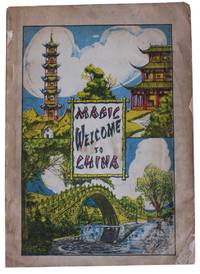
19476092Nanking China: Engineer Section Army Advisory Group 1947. Good. 9½" x 6¾". Illustrated thin card wrappers. Pp. 5 88 1. Good: lacking the map; wrappers heavily soiled and worn with some loss to edges and spine; internally very good with light toning at extremities.<br /> <br /> This is a heavily illustrated guidebook to China produced for the wives and families of American soldiers. The first section provided a "Greeting" and backdrop of information:<br /> <br /> "This small booklet is intended to give you an insight into China from the point of view of an American Army or Navy family. Your husband may be stationed in Shanghai Nanking Hankow Hangchow Tsingtao or Peiping. We have tried to tell you a little about each of these places: where you will live what kind of a home you may expect to find awaiting you and what there is to do and see."<br /> <br /> At the time of publication the United States Army Advisory Group was stationed in Nanking the Nationalist capital. Americans stayed on in China post-World War II through 1949 after Congress passed the Economic Cooperation Act of 1948 to administer the European Recovery Program. We know this program better as the Marshall Plan; the same legislation included $460 million in military and economic aid to China.<br /> <br /> The bulk of the book was dedicated to Shanghai as the authors expected that "you will all want to go there from your home station to shop in its fabulous stores and to enjoy a little of its cosmopolitan atmosphere." Readers were assured that once they "forget the filth in the streets the crowds and all of the peculiarities which will at first probably surprise and shock you Shanghai will grow on you - that is its biggest asset."<br /> <br /> Several pages provided information on Shanghai including tips on shopping hotels theaters and restaurants and "a doctor's advice for your health." A section on places of worship interestingly included Jewish temples and there's also a brief history of the city. The book also devoted five- to ten-page sections respectively on the cities of Nanking Peiping Hankow Hangchow Chengtu and Tsingtao.<br /> <br /> The book boasts a beautifully colored front wrapper along with 58 illustrations and 38 photographic images. The illustrations were by Gyula Singer a Jewish artist who according to an oral history escaped the Nazi occupation of Austria by moving to Shanghai. He later relocated to New York where he ran a commercial design business with a specialty in theater backdrops.<br /> <br /> OCLC shows five copies over two entries. Engineer Section, Army Advisory Group unknown
1862160225-MG61Philadelphia: George W. Childs 1862. very good hardcover. 1862 hinges tight no marks some foxing endpapers very nice copy. Hard Cover. Very Good/No Dust Cover. George W. Childs Hardcover
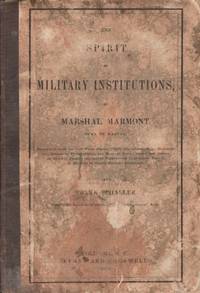
186432582Columbia: Evans and Cogswell 1864. Stiff wraps. Good. 12mo. 278 pages. Stiff paper boards with title on the front cover. Black cloth spine. Covers are worn and discolored. It appears the covers are facsimiles. Light to moderate foxing to the contents. Pencil inscription on the right front flyleaf reads "Col. Samuel W Milton from the publishers." <br /> <br /> The author wrote this book during his recovery from wounds in battle. He dedicates this work to Jefferson Davis. Jefferson Davis thanks the author and calls him "a master of the art of war" on page 12. Confederate imprint.<br /> <br /> Parrish & Willingham 4953; Confederate Hundred 60; Sabin 44651. The previous owner served as an Assistant Adjutant General under Samuel Cooper from 1863 to the end of the war. From Find A grave dot com taken from the Biography of Eminent Men of the Carolinas: <br /> <br /> Samuel Wickiff how it is spelled in the obit Melton was born in Yorkville S. C. February 7 183 hard to read. Receiving his early education in Yorkville he graduated from the South Carolina college in the class of 1852. He edited the Chester Standard published in Chester in 1852 and 1854. Then he returned to Yorkville and established the Yorkville Examiner on January 1 1855 running it until 1858 when he sold out to Lewis M. Grist. In the meantime in 1857 he was admitted to the bar and commenced the practice of law with his brother C. D. Melton at Chester continuing until the war broke out. He enlisted in the Confederate army in 1861 on the staff of Gen. M L. Bonham as aid-de-camp accompanying him to Virginia remaining with him until after the first battle of Bull Run. Subsequently he went on the staff of Maj. Gen. Gustavius W. Smith commanding the Second corps he having the rank of major. He remained with Gen. Smith until February 1863 and was then assigned to duty in the office of the adjutant and inspector general of the Confederate army at Richmond where he remained until the close of the war. He was in the first battle of Bull Run in the Peninsular campaign in the battles around Richmond at Seven Pines the campaign in 1863 in North Carolina and temporarily on the staff of Gen. Beauregard at the battle of Drury's Bluff. The chief duties however from early in 1862 to the close of the war were in the adjutant general's office in Richmond. Evans and Cogswell unknown
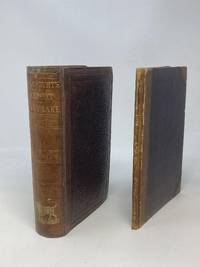
186720057Washington: Government Printing Office 1867. FIRST EDITIONS. First work with 178 figures; second with 5 photographic plates; third with 1 plate and errata slip. 5 heliotype plates and 1 engraved plate. Contemporary half morocco over boards worn on edges all edges marbled; a portion of pages 323/324 of first section torn away affecting text though a photocopy is included otherwise interior excellent. First editions of these three catalogues. The catalogue of the surgical section was edited by Alfred Woodhull 1837-1921. J.J. Woodward 1833-1884 edited the medical section and Edward Curtis 1838-1912 edited the microscopical section. Thousands of specimens are described nearly all the aftermath of the Civil War. Mostly human specimens the name and rank of the donor is noted as well as a brief summary of the context in which the injury or illness leading to death or amputation occurred. The catalogues also include comprehensive collections of surgical instruments medical artifacts including prosthetics and battlefield medical supplies and historical documents related to military medicine.<br /> <br /> The surgical section contains descriptions of over 4700 specimens “varying from cranium to tumors graphically detailing the wounds suffered by thousands of soldiers during the Civil War. The attending physician’s name is listed with each case. Many of these descriptions are specifically related to injuries which are further enumerated in the Medical and Surgical History of the War of the Rebellion†Rutkow. That catalogue is also significant because it is “the first publication that actually gives an idea as to the number and type of photographs taken by or for army physicians†during the war Burns. The third part contains a plate depicting an “Apparatus for Microphotography†and five plates depicting photographs of tissue specimens taken with this apparatus. The editors of the second and third parts Edward Curtis and Joseph Woodward performed the autopsy on Abraham Lincoln. Curtis was an early pioneer of photomicrography. <br /> <br /> The Army Medical Museum was founded in 1862 by U.S. Army Surgeon General William A. Hammond as a center for the collection of specimens for research in military medicine and surgery. Hammond directed medical officers in the field to collect "specimens of morbid anatomy.together with projectiles and foreign bodies removed" and to forward them to the newly founded museum for study. During and after the war Museum staff took pictures of wounded soldiers showing the effects of gunshot wounds as well as results of amputations and other surgical procedures. The information collected was compiled into six volumes of The Medical and Surgical History of the War of the Rebellion published between 1870 and 1883.<br /> <br /> Burns Early Medical Photography in America 1839-1883 New York 1983; Rutkow. The History of Surgery in the United States 1775-1900 San Francisco 1988. Government Printing Office unknown
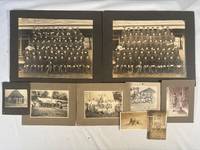
1909224671909. Soldier Harold Howard's person documentaation of service in the 11th U.S. Cavalry during the period of American military occupation and intervention in Cuba following the Spanish American War. These photographs place an enlisted cavalryman within the broader framework of U.S. expansionist policy in the Caribbean under the Platt Amendment when American troops were repeatedly deployed to Cuba to oversee political stability infrastructure and economic interests. The archive includes identified images of Sgt. Harold Howard and captures both formal military organization and informal daily life offering a ground-level record of U.S. cavalry presence during a period of continued occupation and reintervention including the second U.S. occupation of Cuba from 1912 to 1913.<br /> <br /> Archive of nine vintage silver gelatin photographs ranging approximately from 3.5 x 5 inches to 10 x 13 inches many mounted to original photographer boards and some annotated in ink or pencil. Two large-format formal group portraits depict Troop K 11th U.S. Cavalry at Fort Oglethorpe Georgia 1913 showing soldiers in full dress uniform arranged in tiered formation with visible regimental flag marked "11" and "K" with Howard identified in one image. Smaller photographs include a group portrait of U.S. cavalrymen in Pinar del Río Cuba dated 1908 showing soldiers in campaign dress posed near a stable as well as candid camp scenes featuring cooking areas barracks life and assembled troops. Two photo postcards function as personal correspondence with handwritten messages from Howard dated April 1 and September 9 1913 addressed to Mrs. A. L. Howard in Maine referencing weather conditions and upcoming exhibition drills providing direct evidence of mobility and routine within cavalry service. Additional images include a cabinet card of two uniformed soldiers and a scene depicting Black Cuban civilians posed near a thatched structure situating U.S. military presence within local social environments.<br /> <br /> Taken together the archive documents the lived experience of a U.S. cavalryman operating within the infrastructure of American imperial policy in the Caribbean linking domestic military bases such as Fort Oglethorpe with overseas deployment in Cuba. The photographs record both the formal visual culture of the U.S. Army and the everyday conditions of enlisted service while the inclusion of Cuban subjects and locations underscores the entanglement of military occupation with local populations. General edge wear throughout with occasional pinholes adhesive remnants and minor chipping to mounts; some toning to boards. Photographs remain clear and stable with annotations legible. Overall very good condition. unknown
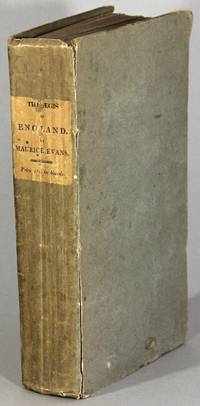
181766691London: printed for the author. Sold by Longman and Co. Baldwin and Co.; Law and Whittaker; Black Parbury and Allen; Egerton; Westley and Parrish; and all other booksellers 1817. First edition 8vo pp. xxx 2 608; uncut and largely unopened; original drab paper-covered boards printed paper label on spine; label slightly chipped affecting 2 letters corners bumped front joint starting; all else very good and sound. Includes sections on Waterloo The Reduction of Algiers The Battle of Albuera Operations in the Eastern Seas Java The Capture of Martinique Corunna Capture Off Santo Domingo Egypt Mahratta War etc. Includes a lengthy list of subscribers including the Dukes of Kent Cumberland and Cambridge the Duke of Wellington Sir Stamford Raffles and many other naval and military figures. printed for the author. Sold by Longman and Co. Baldwin and Co.; Law and Whittaker; Black, Parbury, and Allen; Egerton; Westley unknown
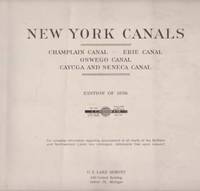
195617143Detroit: U. S. Lake Survey. 1956. Flexible covers. Very Good. Boards creased and darkened and with light rubbing to extremities. ; 8vo; Sheet 1700-1848 pages . U. S. Lake Survey unknown
19872080502106509643Aoshio-sha 1987. Soft Cover. Fine. Number of books: 4 Aoshio-sha paperback
185387405Washington DC: Robert Armstrong Public Printer 1853. Hardcover. Good. Quarto. 9 in. x 6 in. pp. 495. Maroon stamped cloth boards ruled in blind. Gilt lettering to spine as well as graphic in gilt of a buffalo. Bumped corners Stained endpapers with some penciled writing. Frontis lithograph. All plates as called for though several out of order. 58 lithographed illustrations. NOTE: Several plates are latter-day facsimiles to replace the few previously missing plates. Moderate foxing light spotting throughout and af few light pencil trials.<br /> <br /> Two Maps both originals accompanying Stansbury's report were originally issued as folded in a separate hardcover binding but for protection and close study the folding maps have been removed and safely stored in a clear archival display sleeve. Maps will be mailed under separate cover in a mail-tube. Maps are in generally good condition with some staining to folds archival tape professionally applied to several folds and a few short closed tears to edges; quarter size open tear to center of second map.<br /> <br /> The first map is entitled "Map of a Reconnaissance between Fort Leavenworth on the Missouri River and the Great Salt Lake in the Territory of Utah made in 1849 and 1850 under the orders of Col. J.J. Abert Chief of the Topographical Bureau by Capt. Howard Stansbury of the Corps of Topographical Engineers aided by Lieut. J.W. Gunnison Corpos Topographical Engineers and Albert Carrington. The adjacent country laid down from the latest and most authentic data. Drawn by Lieut. Gunnison and Charles Preuss." Wheat Mapping the Transmississippi West. <br /> <br /> The second accompanying map is titled "Map of the Great Salt Lake and Adjacent Country in the Territory of Utah Surveyed in 1849 and 1850.by Capt. Howard Stansbury of the Corps of Topographical Engineers and Albert Carrington. Drawn by Lieut. Gunnison and Charles Preuss." "Captain Howard Stansbury in 1849 had taken a topographical party west to make a thorough examination of the Great Salt Lake country and the routes from it.He was accompanied by Lieutenant John Williams Gunnison and they set out together from Fort Leavenworth on May 31 1849 traveling near the tail-end of the California emigration. Both officers kept journals of the march on which Stansbury also subsequently submitted an official report. Robert Armstrong, Public Printer hardcover
193523217Madrid: Ministerio de la Guerra Tomo 1º y Ministerio del Ejército Tomos 2º y 3º.- 1935-1941.- 3 Vols. 296; 295; 162 pp.: profusión de láminas fotográficas en negro y al final del tomo 3º tres mapas plegados del Rif el Sahara Español y Guinea; 4º 274 x 197 cm.; el tomo 1º en excelente papel ahuesado los otros dos en papel reciclado de inferior calidad por problemas de la posguerra; Media Piel azul lomo liso dorado.- Completísimo estudio histórico sobre las posesiones africanas de España. El tomo 1º se publico en tiempos de la 2ª República interrumpiéndose la publicación durante la Guerra Civil tras la cual se concluyó la obra con los tomos 2º y 3º. EXCELENTE ESTADO. MARRUECOS Y SAHARA ESPAÑOL Libro en español Ministerio de la Guerra hardcover
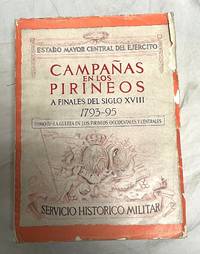
194959709Madrid: Servicio Histórico Militar 1949-1959. 4 Tomos en 5 Vols. 27x195 láminas de mapas algunos desplegables. Rústica con sobrecubiertas algo ajadas interior en buen estado. Esta obra constituye uno de los estudios más completos y rigurosos sobre la participación del Ejército español en la llamada Guerra de la Convención o Guerra del Rosellón conflicto que enfrentó a España con la Francia revolucionaria durante los últimos años del Antiguo Régimen. Se trata de una obra oficial de carácter técnico e institucional elaborada a partir de documentación original conservada en archivos militares: órdenes de operaciones partes oficiales correspondencia de mandos estados de fuerza planos y memorias contemporáneas a los hechos. Servicio Histórico Militar paperback
188401119474Grand Army Scout and Soldiers' Mail 1884. Weekly tabloid newspaper for Union veterans all 1884 issues Vol. III No. 4 Jan. 5 1884 through Vol. IV No. 3 Dec. 27 1884 bound in deep blue cloth-covered boards. Papers have their original folds and the occasional repaired edge tear but overall condition is very good. Hard Cover. Very Good/No Jacket. Folio. Grand Army Scout and Soldiers' Mail Hardcover
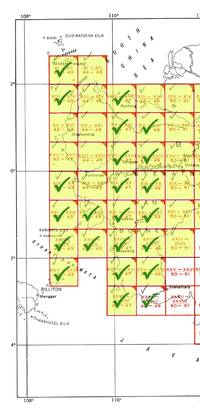
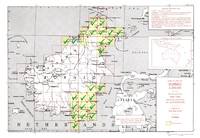
194470378Washington DC: Army Map Service 1944. First edition 23 color broadside maps each about 22 x 20 in.; 1:200000 scale covering the western section of the series from XI-XII 42-43 to XXVII-XXVIII 48-49 lacking XI-XII 44-45 XIII-XIV 44-45 XIII-XIV 50-51 XV-XVI 42-43 XV-XVI 44-45 XVII-XVIII 42-43 XVII-XVIII 44-45 and XIV-XX 44-45. Geographical region covered is the west coast From Kuching to Soekamara and some outlying islands. Each map is numbered in marker on the bottom left margin otherwise clean and near fine. The Army Map Service was the primary map producing body of the US Military through WWII. Service cartographers many of them women recruited after Pearl Harbor produced 40000 maps covering 400000 miles between 1941 and 1945. LoC Their work formed the basis of silk escape maps provided to soldiers. Army Map Service unknown
194570379Washington DC: Army Map Service 1945. 23 broadside color maps; each about 22.25 x 20 in. 1:250.000 scale covering two separate regions: North Borneo including part of Brunei and Southeast Borneo from Samarinda to Kualakapuas and inland to Boentok. All maps in fine condition. Maps included are: NB-49 X; NB-50 I J O P Q R S V W; NA-50-D; SA-50-C D G H I M N O S T U; SB-50-A. The Army Map Service was the primary map producing body of the US Military through WWII. Service cartographers many of them women recruited after Pearl Harbor produced 40000 maps covering 400000 miles between 1941 and 1945. LoC Their work formed the basis of silk escape maps provided to soldiers. Army Map Service unknown
20022081502111905866Beijing Earthquake Publishing House 2002. Soft Cover. Fine. Number of pages: 1125p Size: B5 Hardcover Number of books: 4 Beijing Earthquake Publishing House paperback
1943438<p><strong>Details</strong>:<br />color lithograph with manuscript pilot notations in pencil<br />Folded double sided chart reverse World Pilotage Chart Location Index and Key<br />condition: professionally conserved good condition original folds working aeronautical charts<br />dimensions: various<br /><br /><br /><strong>Description</strong>: <strong>List of Titles with dimensions:</strong> <strong>1. <em>Marrakech Morocco to Alger Algeria No. 64 </em></strong>dimensions: 14 10/16" x 57 ½"<br />2.<strong> <em>Haut Plateau Algeria Africa No.421</em></strong> dimensions: 21 7/8" x 28 ¾" <br />3<em>.</em><strong><u><em> Alger Algeria to Tripoli Libya No. 65</em> </u></strong><u>dimensions: 14 ½" x 57 ½" </u><br />4.<strong> <em>Tunis Tunisia to Bengasi Libya SFC 314</em> </strong>dimensions: 19 ¾" x 57 ½" <br />5.<strong> Bengasi Libya to Cairo Egypt FC 67 </strong>dimensions 21 7/8 x 28 3/4"<br />6.<strong> Karachi to New Delhi - Agra India 136 </strong>dimensions 14 1/2" x 58"<br />7.<strong> Thar Desert India 550 </strong>dimensions 22" x 29"<br />8.<strong> Jumna River India 552 </strong>dimensions 22 3/8" x 29 3/4"<br />9.<strong>Aravalli Range India 551 </strong>dimensions 22 3/8" x 29 9/16"<br />10. <strong>Tokara Group 491 Japan </strong>dimensions 22" x 28.75" <br /><br /><br /></p> U.S. Army Map Service
1916229001916. World War I mobilization photo album group of 65 photographs dating circa 1916-1918 documenting the training and daily life of U.S. soldiers during the pre-deployment period. The material captures the organization and routines of stateside military encampments as the United States prepared for overseas engagement providing visual evidence of training exercises camp infrastructure and soldier life. These images record both formal military activity and informal moments illustrating how enlisted men adapted to regimented environments while maintaining social bonds during the transition from civilian life to military service.<br /> <br /> Sixty-five black-and-white silver gelatin photographs each approximately 3 x 4 inches mounted in a ring-bound black leather album measuring about 3.5 x 6 inches. The images depict rows of conical canvas tents arranged in orderly lines soldiers standing in formation and groups engaged in drilling and instruction. Additional scenes show men performing camp labor including driving tent stakes transporting supplies cooking and resting on cots within tent interiors. Several photographs capture a regimental band assembled with visible instruments while others present candid moments of leisure and interaction. A pair of images shows two soldiers in improvised costume dress suggesting informal humor within camp life. The latter portion of the album shifts to civilian contexts with men in suits posed outdoors social gatherings in grassy settings and group portraits including women in light-colored dresses indicating family or community connections during leave periods.<br /> <br /> Produced during the United States' mobilization for World War I these photographs document the transformation of civilian individuals into military personnel within temporary training environments. The archive shows both the structured discipline of camp organization and the persistence of personal identity and social relationships. The inclusion of both military and civilian scenes provides a continuous narrative of service and home life supporting research into military training social history and vernacular photography of the World War I era. Scattered toning minor rubbing to album leaves and occasional corner lifting; binding secure with moderate cover wear; overall very good condition. A cohesive visual record of U.S. soldier experience during wartime mobilization. unknown
194186279Aberdeen Proving Ground MD: The Ordnance School 1941. Presumed First Edition First printing thus. Four-hole punched and held together with two two pronged clips. Good. Format is approximately 8 inches by 13 inches four-hole punched with two two pronged clips holding the text together. 3iii-vii 250 pages. Three pages of errata sheets. 18 appendices. 50 Figures. Printed single-sided only. Cover worn torn and soiled with some page wear and soiling noted. Pencil marks and notations on cover and some pages. The major portion of this text appears to be an early version of Field Manual No. 9-10 The Ordnance Company -Medium Maintenance; The Ordnance Battalion--Maintenance. It was apparently expected to be issued in July 1941 the the date of issue is blank. FM 9-10 Ordnance Field Manual Ordnance Field Maintenance was published on April 20 1942. There are substantial differences between this text and what was officially published as FM 9-10. This publication was intended solely for use as an Ordnance School text for instruction purposes only. It was not intended for general distribution to agencies or personnel outside the Ordnance training Center at Aberdeen Proving ground Md. It is reasonable to conclude that this instructional text was also a draft text for what would eventually become FM 9-10 and that the experience gained in its use at The Ordnance School contributed to the development of material changes. As such then this early version not labeled as a draft provides a significant and perhaps unique insight into the development of Ordnance doctrine training and practice at the Company and Battalion level at the time when the United States entered the Second World War. One page on Machine Gun Repairs to the M9197A1 laid in. The purpose of this manual was to present a coordinated and complete picture of the problem of ordnance field maintenance together with a logical solution of that problem. While this manual will be found to be helpful as a reference for operation of the maintenance organizations in garrison it was intended primarily as a guide for use in field operations. There are included in the various parts of this manual a discussion of a typical ordnance field shop and a method of conducting operations; a discussion of details pertaining to a typical maintenance company; and discussions of particular problems in ordnance field maintenance as they are encountered and solved. Except where obviously necessary in the interests of uniformity throughout all ordnance service it is not intended that this manual shall impose unnecessary restrictions on the imagination and initiative of ordnance personnel responsible for the operation of the units covered by this manual. On the contrary it is intended that the thoughts and imagination of such personnel will be stimulated to evolve more satisfactory solutions to the problems of ordnance field service. The organization of ordnance maintenance in the field army is based on the principle of progressive increases in available maintenance facilities from front to rear. The equipment and personnel assigned to each echelon are designed to carry the normal load of that echelon plus a certain peak load of the subordinate echelons. In Part I. The Ordnance Company - Medium Maintenance there are Chapters on General; Organization and Equipment; Operations; Duties of Individuals; and Administrative Details. Part II. The Ordnance Battalion Maintenance has Chapters on General and Operations. A list of appendices follow and are in turn followed by the list of Figures. There are specific discussions of ordnance weapons and vehicles and materiel. There is significant discussion of the inspection of ordnance materiel especially ammunition. The Ordnance School unknown
194337635Camp Edwards MA: Engineer Amphibian Command 1943. fair. 221 wraps illus. diagrams bibliography covers worn scuffed and soiled ink marks on covers. Foreword by Brigadier General Daniel Noce Commanding. This is an extremely rare surviving piece of Army Amphibious Operations training development during WWII. Engineer Amphibian Command paperback
1915AQ27136Ranikhet: Abdulla Khan photographer 1915. 24 black and white photographs mounted on twelve leaves. Sewn as issued in original publisher's printed red wrappers. Rubbed and creased a trifle bowed. An unrecorded publication comprised of 24 evocative photographs primarily group shots of members of the 1/4th Battalion Duke of Cornwall's Light Infantry whilst stationed at Bareilly Uttar Pradesh during the first year of the Great War. 1/4th Battalion formed in Truro made up part of the Devon and Cornwall Brigade in Wessex Division. They sailed for India late 1914 and landed in Bombay on 10th November 1914 and remained there until 1916 where they moved to Aden 1916-1917 and then finished out the war in Egypt 1917-1918. . Oblong 8vo. [Abdulla Khan, photographer] unknown
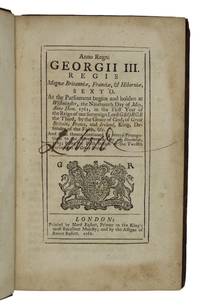
1766AQ28034London: Printed by Mark Baskett 1766. 2 5-206pp 2. Imprint from general title page. Contemporary blind-ruled calf contrasting red morocco lettering-piece. Rubbed corners exposed upper board detached lower joint split some loss to head of spine. Early ownership inscription to general title page very occasional light spotting. An apparently unrecorded edition of the public general act renewing the terms of the previous Mutiny Act as well as the articles relating to the quartering of British Army troops in foreign territories notably the raising of troops in America: 'The officers and Soldiers of any Troops which are or shall be raised in America being mustered and in Pay shall at all Times and in all Places when joined or acting in Conjuction with Our British Forces be governed by these Rules or Articles of War and shall be subject to be tried by Courts-martial in like Manner with the Officers and Soldiers of Our British Troops'. Not in ESTC. 8vo. Printed by Mark Baskett unknown
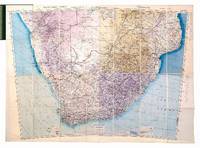
54220Dec. 1943. Large coloured map extending from Cape Town to Rhodesia. 100 x 135 cm. backed on linen dissected into 28 panels bcked on linen and folding into original geen cloth covers George Philip & Son Ltd label to upper cover. Dec. 1943. hardcover
1754AQ22977London: Printed for Paul Vaillant 1754. xv 1 423pp 1. With seven engraved folding plates and eight folding tables. Contemporary sprinkled calf tan morocco lettering-piece. A trifle rubbed and marked upper joint starting. Book-label of Sir John Dashwood King to FEP. Internally clean and crisp. The first edition in English of the Kingdom of Prussia's infantry guide: Reglement vor die königl. preussische Infanterie the first published work of army officer and much-admired military tactician Sir William Fawcett 1727- 1804. In 1781 having served with distinction in several campaigns in Germany Fawcett was appointed adjutant-general on the British establishment promoted to the rank of lieutenant-general and charged with reviewing the severely disrupted and outmoded drill system. He was well-suited to the task being widely considered to possess one of the finest strategic minds of his day and well versed in contemporary martial literature having translated inter alia Reveries or Memoirs upon the Art of War London 1757 Regulations for the Prussian Cavalry London 1759 and Regulations for the Exercise of Riflemen and Light Infantry London 1798. ESTC T115267. First. edition in English. 8vo. Printed for Paul Vaillant unknown
23215Ceylon Sir Lanka One item on paper watermarked 1827 the other items undated. Sibbald was in Ceylon between 1818 and 1833. There is no indication that any of these four items have been published. One: 'The Origin of the Kandelay Tank'. 8pp. foolscap 8vo. On two bifoliums of paper with Gater watermark dated 1827. In good condition on aged paper. Begins: 'In the Eastern country there was a King of the race of Sun called Annasockkaynathan oriental characters here the name of whose wife was Manonmasunthary oriental characters here who was delivered of a wonderful child who was born with teeth and dressed him togehter with breasts full grown at which the King was astonished and sent to the wise men enquiring of the miraculous birth of the child'. Two: 'Story of Manderapaudey'. 6pp. foolscap 8vo. In poor condition heavily worn with loss of text. Begins: 'In a City called Vecroomakasum there lived a Bramany who had an only daughter who was a beautiful and accomplished young woman; her Father intended to bestow her hand on a young man who was in every manner able to support her and who was well informed and had Received a proper education'. Three: 'The History of Santiraksen'. 22pp. foolscap 8vo. In fair condition on aged and worn paper. Begins: 'A certain king who reigned over a realm called Kalatasem was long since without having an Issue and in Consequence his wife brought forth a child the prognosticators have prognosticated that child has been unfortunate to the Parent and admonished the king to transport the same otherwise the Parent and all other relations will die in a six months'. Four: Headed: 'the craft first of making two intimates to alienate'. 16pp. foolscap 8vo. Ends abruptly on p.16 with catch word and clearly the first part only. Written in a closer hand than the other items presumably at a later date. Begins: 'In a city called <Makilarupean> was a merchant man Named Vartaman who has thought to peregrinate and merchandize so he has loaded his merchandizing upon a cart and coupled to it two oxen'. From the Papers of William Sibbald perhaps the translator. [Ceylon [Sir Lanka]?] One item on paper watermarked 1827, the other items undated. unknown