TERNISIEN D'HAUDRICOURT.Livre Rare Book
30 332 résultats
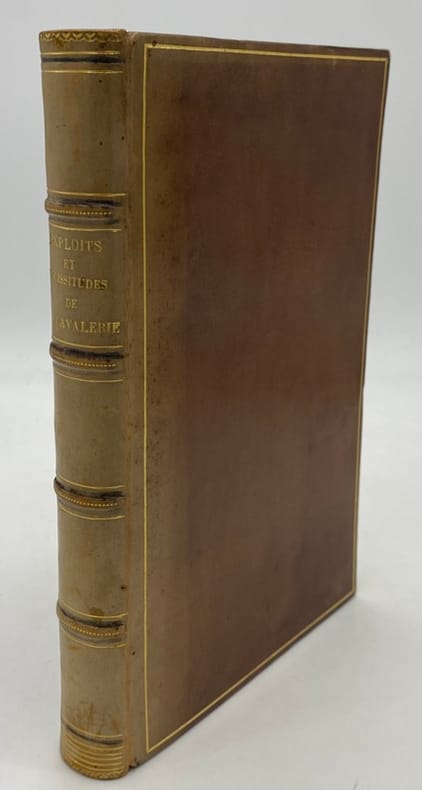
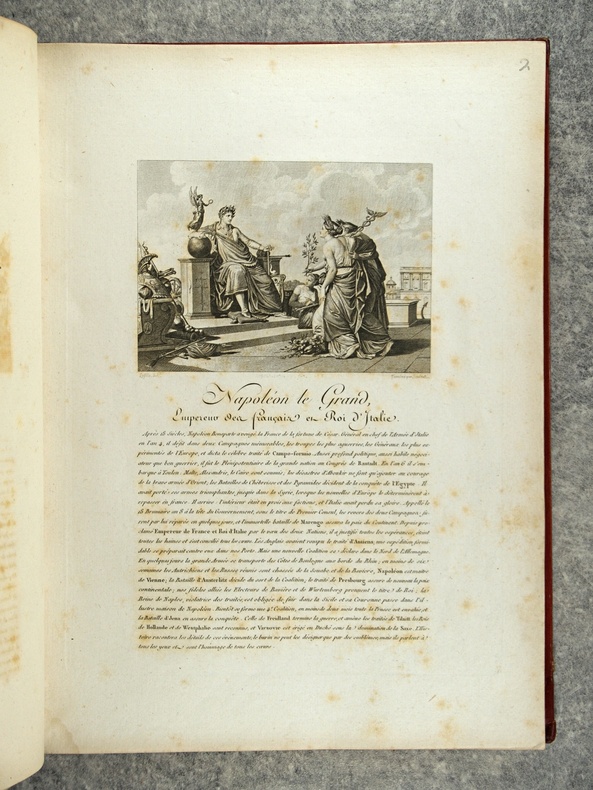
18252563A PARIS. CHEZ DECROUAN, GRAVEUR. SANS DATE (1825). 3 VOLUMES PETIT IN-FOLIO (26,5 X 34,5 X 10 CENTIMETRES ENVIRON) RELIURE D'EPOQUE 1/2 CHAGRIN ROUGE MAROQUINE, PLATS RECOUVERTS DE PAPIER MAROQUINE ROUGE ENCADRE D'UNE DENTELLE DOREE, DOS LISSE ORNE DE FILETS, FLEURONS A LA LEGION D'HONNEUR MODELE RESTAURATION AUX 3 FLEURS DE LYS ET ARABESQUES DORES, TITRE ET TRANCHES DORES. CHAQUE VOLUME COMPORTE UN TITRE IMPRIME SUIVI D'UN TITRE GRAVE. ILLUSTRE DE 3 TITRES GRAVES ET DE 207 PLANCHES GRAVEES A MI-PAGES (71 + 70 + 66), SOUS SERPENTE, EN TAILLE-DOUCE OU A L'EAU-FORTE, PAR SWEBACH, MARTINET, COUCHE, LAFFITTE, BLANCHARD, CHARON, LEROUGE, ETC. CES GRAVURES REPRESENTENT LES PERSONNAGES ET LES ACTIONS LES PLUS FAMEUSES DES ARMEES FRANCAISES DE LA REVOLUTION ET DE L'EMPIRE, MAIS AUSSI DE L'ANCIEN REGIME ET DE LA RESTAURATION, ET SONT ACCOMPAGNEES D'UN TEXTE EXPLICATIF, EGALEMENT GRAVE. QUELQUES DEFAUTS EXTERIEURS (COIFFES, MORS, CHARNIERES), SINON BON EXEMPLAIRE.
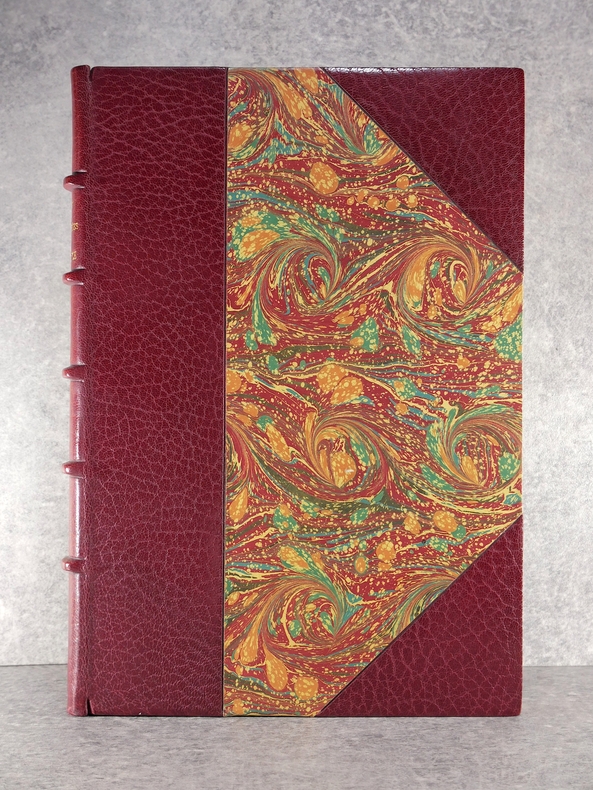
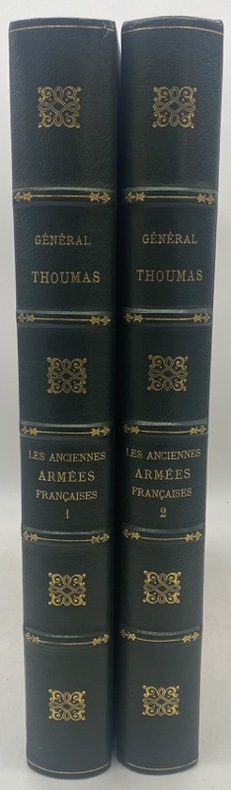
229865Paris, E. Plon, Nourrit, 1893 - 1895 5 vol. in-8, demi-chagrin cerise à coins, dos à nerfs fleuronnés, têtes dorées (Rivière & son for the Army and Navy). Quelques rousseurs.
150049185Paris: Paulin / Lheureux 1845-1862. zus. ca. 15000 S. einige Stahlstichporträts + Ansichten. HLdr. *ohne den Atlas-Band* schöne Reihe, in braunem Halbd-Leder* ExLibris*.
237391Paris, Magimel, an IX (1801) in-8, 269 pp., demi-maroquin bleu nuit, dos à nerfs, armes en pied, tête dorée (reliure de la fi du XIXe siècle).
105899Paris, Corréard, 1848-1849 2 tomes en un vol. in-8, XII-241 pp. et VII-[1]-226 pp., veau glacé parme, dos orné à nerfs soulignés de pointillés et de filets dorés, filet doré d'encadrement sur les plats, coupes guillochées à la hauteur des coins, roulette intérieure, tranches peignées (Tripier-Bradel).
19073603PARIS. J. LEROY, EDITEUR. 1907. IN-4 (22,5 X 31 X 3,5 CENTIMETRES ENVIRON) DE (8) + XIV + 154 ET (1) PAGES, RELIURE D’EPOQUE 1/2 MAROQUIN PARME A COINS, DOS A CINQ FORTS NERFS, TITRE ET TETE DORES, COUVERTURE ET DOS CONSERVES (G. HUSER, RELIEUR). ILLUSTRE DE NOMBREUSES FIGURES EN NOIR ET EN COULEURS ET DE 20 PLANCHES HORS TEXTE, DONT 14 EN COULEURS, CERTAINES REPLIEES. EDITION ORIGINALE, TIRAGE LIMITE A 525 EXEMPLAIRES NUMEROTES. UN DES 25 DU TIRAGE DE TETE SUR PAPIER IMPERIAL DU JAPON, CELUI-CI PORTANT LE NUMERO 13. TRES BEL EXEMPLAIRE.
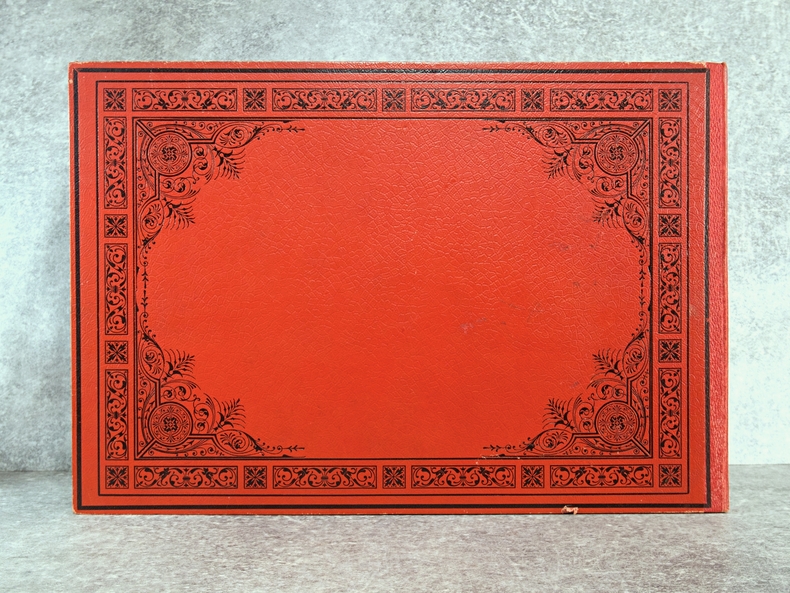
1860916PARIS. HENRI PLON, EDITEUR. LEMERCIER. SANS DATE (VERS 1860). IN-FOLIO OBLONG (30 X 43,5 X 1 CENTIMETRES ENVIRON), RELIURE DE L’EDITEUR A LA BRADEL PLEINE PERCALINE ROUGE ENCADREE D’UN DECOR EN NOIR AVEC TITRE DORE AU CENTRE DU PLAT SUPERIEUR. ILLUSTRE DE 20 SUPERBES PLANCHES GRAVEES SUR ACIER PAR ROUARGUE, LALAISSE, DUROND ET TRES FINEMENT REHAUSSEES A L’AQUARELLES D’APRES LES DESSINS DE THEODORE YUNG. CONTIENT: SIEGE DE TOULON (1793), BATAILLE DE SAINTE EUPHEMIE (1806), PRISE DE GAETE (1806), COMBAT DE SOMO-SIERRA (1808), BATAILLE DE LA COROGNE (1809), PRISE D’OPORTO (1809), SIEGE DE SARAGOSSE (1808 & 1809), BATAILLE DE TALAVERA (1809), BATAILLE D’OCANA (1809), PASSAGE DE LA SIERRA MORENA (1810), FUENTES D’ORONO (1811), AFFAIRE DE BRIENNE (1814), COMBAT DE CHAMPAUBERT (1814), BATAILLE DE MONTMIRAIL (1814), BATAILLE DE MONTEREAU (1814), BATAILLE DE CRAONNE (1814), COMBAT D’ARCIS-SUR-AUBE (1814), BATAILLE DE PARIS (1814), BATAILLE DE LIGNY (1815), BATAILLE DE WATELOO (1815). RELIE D’ORIGINE SANS LA LISTE DES PLANCHES. PREMIER TIRAGE. RELIE D’ORIGINE SANS LES FEUILLETS DE TITRE ET DE TABLE (JOINTS EN PHOTOCOPIE). PETITS DEFAUTS EXTERIEURS SANS AUCUNE GRAVITE, QUELQUES ROUSSEURS CLAIRES, SINON BEL EXEMPLAIRE.
188401119474Grand Army Scout and Soldiers' Mail 1884. Weekly tabloid newspaper for Union veterans all 1884 issues Vol. III No. 4 Jan. 5 1884 through Vol. IV No. 3 Dec. 27 1884 bound in deep blue cloth-covered boards. Papers have their original folds and the occasional repaired edge tear but overall condition is very good. Hard Cover. Very Good/No Jacket. Folio. Grand Army Scout and Soldiers' Mail Hardcover
200816208EPINAL, C. FROEREISEN, libraire editeur, 1882 ; in-4, 121-18-20 planches, cartonnage de l'éditeur. Demi-cuir (reliure moderne).
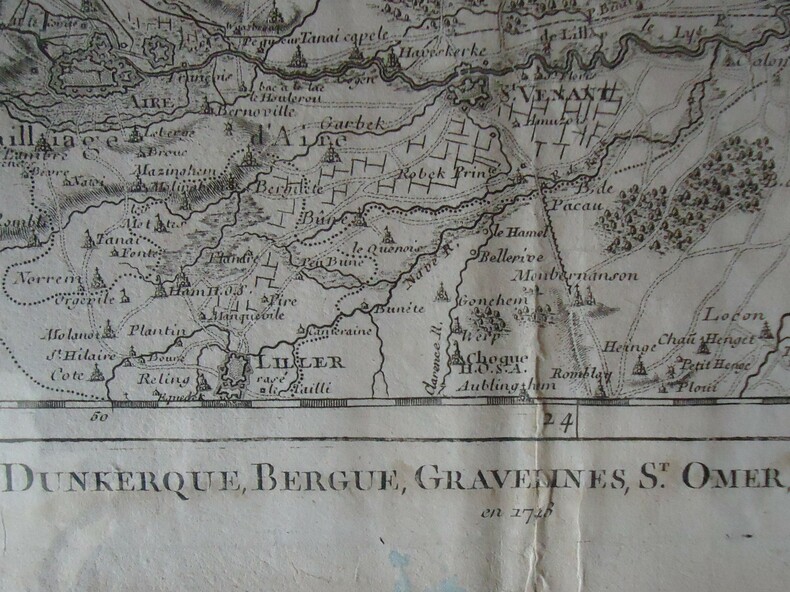
SPN-1053Paris, Etienne-Louis Crépy, 1743-1744. 6 cartes géographiques des Flandres (1743 et 1744) : - carte particulière des environs de Malines, Anvers, Lier, Herentals, Aerschot, etc. (1743) / 75 x 55 cm - carte particulière des environs de Dunkerque, Bergue, Gravelines, St Omer, Aire, Lille, Menin, Ypres, Dixmude, etc. (1743) / 74,5 x 55 cm - carte particulière des environs de Bruxelles, Louvain, Diest, Tirlemont, Leau, Vilvorden, Nivele, Halle, etc. (1743) / 74 x 55,5 cm - carte particulière des environs de Courtray, Oudelarde, Mons, Tournay, Ath, Ninove, Alost, Orchies, etc. (1743) / 74,5 x 55 cm - carte des environs de Betune, Douay, Arras, Bappaumes, Dourlens, Hedin, Lecluse, St Pol et autres. (1743) / 74 x 55 cm - carte des environs de Liège, Mastrick, Limbourg, Aix la Chapelle, Huy, Fauquemont, Dalem, etc. (1744) / 74,5 x 55 cm Échelle de deux lieues et demi Commune de France [= 12 cm] et de deux lieues de Brabant [= 9,5 cm]. Cartes dressées sur les Mémoires du libraire-imprimeur bruxellois Eugène-Henry Fricx (1644-1730, actif de 1670 à sa mort, imprimant les affiches de la ville, des livres d'histoire, des plans de villes, des cartes militaires et géographiques). [BEG, quelques taches bleues sporadiques, légères rousseurs et petits accrocs en bords]
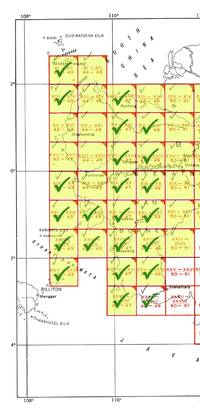
194470378Washington DC: Army Map Service 1944. First edition 23 color broadside maps each about 22 x 20 in.; 1:200000 scale covering the western section of the series from XI-XII 42-43 to XXVII-XXVIII 48-49 lacking XI-XII 44-45 XIII-XIV 44-45 XIII-XIV 50-51 XV-XVI 42-43 XV-XVI 44-45 XVII-XVIII 42-43 XVII-XVIII 44-45 and XIV-XX 44-45. Geographical region covered is the west coast From Kuching to Soekamara and some outlying islands. Each map is numbered in marker on the bottom left margin otherwise clean and near fine. The Army Map Service was the primary map producing body of the US Military through WWII. Service cartographers many of them women recruited after Pearl Harbor produced 40000 maps covering 400000 miles between 1941 and 1945. LoC Their work formed the basis of silk escape maps provided to soldiers. Army Map Service unknown
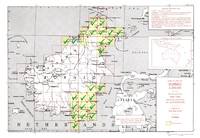
194570379Washington DC: Army Map Service 1945. 23 broadside color maps; each about 22.25 x 20 in. 1:250.000 scale covering two separate regions: North Borneo including part of Brunei and Southeast Borneo from Samarinda to Kualakapuas and inland to Boentok. All maps in fine condition. Maps included are: NB-49 X; NB-50 I J O P Q R S V W; NA-50-D; SA-50-C D G H I M N O S T U; SB-50-A. The Army Map Service was the primary map producing body of the US Military through WWII. Service cartographers many of them women recruited after Pearl Harbor produced 40000 maps covering 400000 miles between 1941 and 1945. LoC Their work formed the basis of silk escape maps provided to soldiers. Army Map Service unknown
20022081502111905866Beijing Earthquake Publishing House 2002. Soft Cover. Fine. Number of pages: 1125p Size: B5 Hardcover Number of books: 4 Beijing Earthquake Publishing House paperback
1912233398Berlin, Deutsches Verlagshaus Bong & Co., 1909 - 1912.
186715-0-360Weimar, Bernhard Friedrich Voigt, 1867. 8° (ca. 21,5 cm x 14 cm), mit 27 lithographischen Tafeln X, 70 S., Hlbleder d. Z. mit Rückenschild
2191Paris, Laumette, 1890 2 vol. gr. in-4, XII-426 pp., 17 pl. h. t., nbs ill. in-t., demi-chagrin vert, dos à nerfs orné (rel. de l'époque). Quelques rousseurs.
1943438<p><strong>Details</strong>:<br />color lithograph with manuscript pilot notations in pencil<br />Folded double sided chart reverse World Pilotage Chart Location Index and Key<br />condition: professionally conserved good condition original folds working aeronautical charts<br />dimensions: various<br /><br /><br /><strong>Description</strong>: <strong>List of Titles with dimensions:</strong> <strong>1. <em>Marrakech Morocco to Alger Algeria No. 64 </em></strong>dimensions: 14 10/16" x 57 ½"<br />2.<strong> <em>Haut Plateau Algeria Africa No.421</em></strong> dimensions: 21 7/8" x 28 ¾" <br />3<em>.</em><strong><u><em> Alger Algeria to Tripoli Libya No. 65</em> </u></strong><u>dimensions: 14 ½" x 57 ½" </u><br />4.<strong> <em>Tunis Tunisia to Bengasi Libya SFC 314</em> </strong>dimensions: 19 ¾" x 57 ½" <br />5.<strong> Bengasi Libya to Cairo Egypt FC 67 </strong>dimensions 21 7/8 x 28 3/4"<br />6.<strong> Karachi to New Delhi - Agra India 136 </strong>dimensions 14 1/2" x 58"<br />7.<strong> Thar Desert India 550 </strong>dimensions 22" x 29"<br />8.<strong> Jumna River India 552 </strong>dimensions 22 3/8" x 29 3/4"<br />9.<strong>Aravalli Range India 551 </strong>dimensions 22 3/8" x 29 9/16"<br />10. <strong>Tokara Group 491 Japan </strong>dimensions 22" x 28.75" <br /><br /><br /></p> U.S. Army Map Service
Very Good Turkish, Ottoman (1500-1928) Original manuscript autograph document signed by Mehmed Said Pasha sent to Trabzon Vilayat, Ordu Kaza, Hasbamane Nahiya local manager, faziletlu 'Mehmed Ali Sevki Beyefendi'. 33,5x20 cm. Folded. 1 p. In Ottoman script. Mehmed Said Pasha was an Ottoman monarchist, senator, statesman and editor of the Turkish newspaper Jerid-i-Havadis. He supported the CUP, the political party which came to power after the Ottoman coup d'état of 1913. His origin comes from 'Sebazâde family' from Ankara. He became first secretary to Sultan Abdul Hamid II shortly after the Sultan's accession, and is said to have contributed to the realizations of his majesty's design of concentrating power in his own hands; later he became successively minister of the interior and then governor of Bursa, reaching the high post of grand vizier in 1879. He was grand vizier seven more times under Abdul Hamid II, and once under his successor, Mehmed V. He was known for his opposition to the extension of foreign influence in Turkey. n 1896, he took refuge at the British embassy in Constantinople, and, though then assured of his personal liberty and safety, remained practically a prisoner in his own house. He came into temporary prominence again during the revolution of 1908. On 22 July he succeeded Mehmed Ferid Pasha as grand vizier, but on the 6 August was replaced by the more liberal Kâmil Pasha, at the insistence of the Young Turks. Also during 1908, Mehmed Said Pasha bought the famed Istanbul arcade in the Beyoglu (Pera) district, today known as Çiçek Pasaji ("Flower Passage"). The modern name became common in the 1940s; during Mehmed Said Pasha's ownership in the 1900s and 1910s, the arcade was known as Sait Pasa Pasaji ("Said Pasha Passage"). During the Italian crisis in 1911-12, he was again called to the premiership. He was again removed from power by the Savior Officers (who backed the Freedom and Accord Party (Liberal Union) against the Committee of Union and Progress) and replaced by a new cabinet supported by the Officers and the Freedom and Accord Party. The CUP would return to power, however, the next year after the Ottoman coup d'état of 1913. (Source: Wikipedia). Seven lines on special paper with watermark 'Joynson Superfine'. Letter of request to provide teaching for some students in the region.
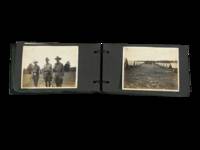
1916229001916. World War I mobilization photo album group of 65 photographs dating circa 1916-1918 documenting the training and daily life of U.S. soldiers during the pre-deployment period. The material captures the organization and routines of stateside military encampments as the United States prepared for overseas engagement providing visual evidence of training exercises camp infrastructure and soldier life. These images record both formal military activity and informal moments illustrating how enlisted men adapted to regimented environments while maintaining social bonds during the transition from civilian life to military service.<br /> <br /> Sixty-five black-and-white silver gelatin photographs each approximately 3 x 4 inches mounted in a ring-bound black leather album measuring about 3.5 x 6 inches. The images depict rows of conical canvas tents arranged in orderly lines soldiers standing in formation and groups engaged in drilling and instruction. Additional scenes show men performing camp labor including driving tent stakes transporting supplies cooking and resting on cots within tent interiors. Several photographs capture a regimental band assembled with visible instruments while others present candid moments of leisure and interaction. A pair of images shows two soldiers in improvised costume dress suggesting informal humor within camp life. The latter portion of the album shifts to civilian contexts with men in suits posed outdoors social gatherings in grassy settings and group portraits including women in light-colored dresses indicating family or community connections during leave periods.<br /> <br /> Produced during the United States' mobilization for World War I these photographs document the transformation of civilian individuals into military personnel within temporary training environments. The archive shows both the structured discipline of camp organization and the persistence of personal identity and social relationships. The inclusion of both military and civilian scenes provides a continuous narrative of service and home life supporting research into military training social history and vernacular photography of the World War I era. Scattered toning minor rubbing to album leaves and occasional corner lifting; binding secure with moderate cover wear; overall very good condition. A cohesive visual record of U.S. soldier experience during wartime mobilization. unknown
194186279Aberdeen Proving Ground MD: The Ordnance School 1941. Presumed First Edition First printing thus. Four-hole punched and held together with two two pronged clips. Good. Format is approximately 8 inches by 13 inches four-hole punched with two two pronged clips holding the text together. 3iii-vii 250 pages. Three pages of errata sheets. 18 appendices. 50 Figures. Printed single-sided only. Cover worn torn and soiled with some page wear and soiling noted. Pencil marks and notations on cover and some pages. The major portion of this text appears to be an early version of Field Manual No. 9-10 The Ordnance Company -Medium Maintenance; The Ordnance Battalion--Maintenance. It was apparently expected to be issued in July 1941 the the date of issue is blank. FM 9-10 Ordnance Field Manual Ordnance Field Maintenance was published on April 20 1942. There are substantial differences between this text and what was officially published as FM 9-10. This publication was intended solely for use as an Ordnance School text for instruction purposes only. It was not intended for general distribution to agencies or personnel outside the Ordnance training Center at Aberdeen Proving ground Md. It is reasonable to conclude that this instructional text was also a draft text for what would eventually become FM 9-10 and that the experience gained in its use at The Ordnance School contributed to the development of material changes. As such then this early version not labeled as a draft provides a significant and perhaps unique insight into the development of Ordnance doctrine training and practice at the Company and Battalion level at the time when the United States entered the Second World War. One page on Machine Gun Repairs to the M9197A1 laid in. The purpose of this manual was to present a coordinated and complete picture of the problem of ordnance field maintenance together with a logical solution of that problem. While this manual will be found to be helpful as a reference for operation of the maintenance organizations in garrison it was intended primarily as a guide for use in field operations. There are included in the various parts of this manual a discussion of a typical ordnance field shop and a method of conducting operations; a discussion of details pertaining to a typical maintenance company; and discussions of particular problems in ordnance field maintenance as they are encountered and solved. Except where obviously necessary in the interests of uniformity throughout all ordnance service it is not intended that this manual shall impose unnecessary restrictions on the imagination and initiative of ordnance personnel responsible for the operation of the units covered by this manual. On the contrary it is intended that the thoughts and imagination of such personnel will be stimulated to evolve more satisfactory solutions to the problems of ordnance field service. The organization of ordnance maintenance in the field army is based on the principle of progressive increases in available maintenance facilities from front to rear. The equipment and personnel assigned to each echelon are designed to carry the normal load of that echelon plus a certain peak load of the subordinate echelons. In Part I. The Ordnance Company - Medium Maintenance there are Chapters on General; Organization and Equipment; Operations; Duties of Individuals; and Administrative Details. Part II. The Ordnance Battalion Maintenance has Chapters on General and Operations. A list of appendices follow and are in turn followed by the list of Figures. There are specific discussions of ordnance weapons and vehicles and materiel. There is significant discussion of the inspection of ordnance materiel especially ammunition. The Ordnance School unknown
194337635Camp Edwards MA: Engineer Amphibian Command 1943. fair. 221 wraps illus. diagrams bibliography covers worn scuffed and soiled ink marks on covers. Foreword by Brigadier General Daniel Noce Commanding. This is an extremely rare surviving piece of Army Amphibious Operations training development during WWII. Engineer Amphibian Command paperback
1915AQ27136Ranikhet: Abdulla Khan photographer 1915. 24 black and white photographs mounted on twelve leaves. Sewn as issued in original publisher's printed red wrappers. Rubbed and creased a trifle bowed. An unrecorded publication comprised of 24 evocative photographs primarily group shots of members of the 1/4th Battalion Duke of Cornwall's Light Infantry whilst stationed at Bareilly Uttar Pradesh during the first year of the Great War. 1/4th Battalion formed in Truro made up part of the Devon and Cornwall Brigade in Wessex Division. They sailed for India late 1914 and landed in Bombay on 10th November 1914 and remained there until 1916 where they moved to Aden 1916-1917 and then finished out the war in Egypt 1917-1918. . Oblong 8vo. [Abdulla Khan, photographer] unknown
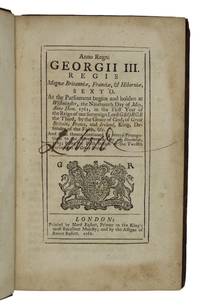
1766AQ28034London: Printed by Mark Baskett 1766. 2 5-206pp 2. Imprint from general title page. Contemporary blind-ruled calf contrasting red morocco lettering-piece. Rubbed corners exposed upper board detached lower joint split some loss to head of spine. Early ownership inscription to general title page very occasional light spotting. An apparently unrecorded edition of the public general act renewing the terms of the previous Mutiny Act as well as the articles relating to the quartering of British Army troops in foreign territories notably the raising of troops in America: 'The officers and Soldiers of any Troops which are or shall be raised in America being mustered and in Pay shall at all Times and in all Places when joined or acting in Conjuction with Our British Forces be governed by these Rules or Articles of War and shall be subject to be tried by Courts-martial in like Manner with the Officers and Soldiers of Our British Troops'. Not in ESTC. 8vo. Printed by Mark Baskett unknown
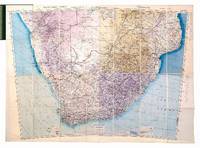
54220Dec. 1943. Large coloured map extending from Cape Town to Rhodesia. 100 x 135 cm. backed on linen dissected into 28 panels bcked on linen and folding into original geen cloth covers George Philip & Son Ltd label to upper cover. Dec. 1943. hardcover
1754AQ22977London: Printed for Paul Vaillant 1754. xv 1 423pp 1. With seven engraved folding plates and eight folding tables. Contemporary sprinkled calf tan morocco lettering-piece. A trifle rubbed and marked upper joint starting. Book-label of Sir John Dashwood King to FEP. Internally clean and crisp. The first edition in English of the Kingdom of Prussia's infantry guide: Reglement vor die königl. preussische Infanterie the first published work of army officer and much-admired military tactician Sir William Fawcett 1727- 1804. In 1781 having served with distinction in several campaigns in Germany Fawcett was appointed adjutant-general on the British establishment promoted to the rank of lieutenant-general and charged with reviewing the severely disrupted and outmoded drill system. He was well-suited to the task being widely considered to possess one of the finest strategic minds of his day and well versed in contemporary martial literature having translated inter alia Reveries or Memoirs upon the Art of War London 1757 Regulations for the Prussian Cavalry London 1759 and Regulations for the Exercise of Riflemen and Light Infantry London 1798. ESTC T115267. First. edition in English. 8vo. Printed for Paul Vaillant unknown