Anonym ( Donneau de Vizé)Antiquariat.de

30 331 résultats
1692029745Michel Brunet, Paris 1692. Halbleinen Sehr gut
feb118764Used. For more details please contact me unknown
18238-0-504Leipzig, Industrie-Comptoir, 1823-128. Kl.8°, mit 23 (von 24) lithografierten Frontispizen und ca. 1900 S. in gesamt 24 Heften (alles erschinene), dekorative, Pp d. Z. mit schöner Rückenvergoldung
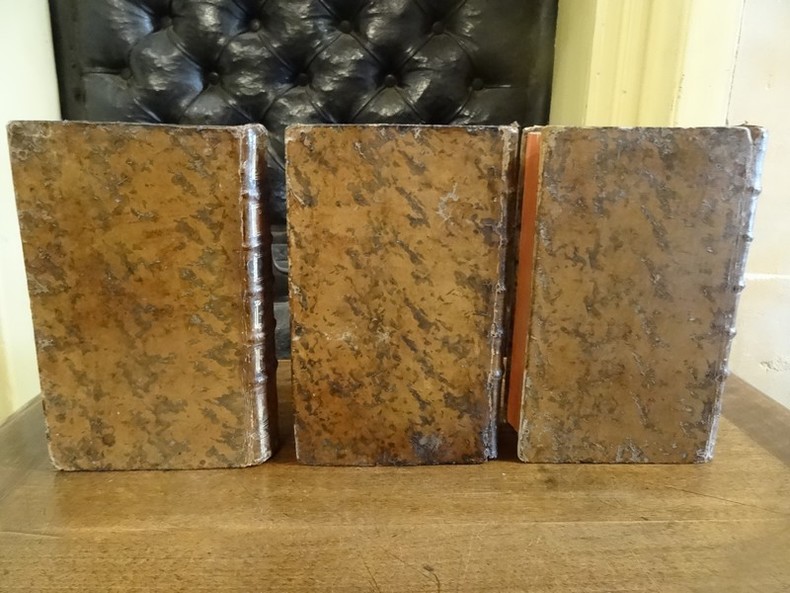
1771DEZ-3261Paris, Vincent, 1771. 3 volumes petits in-8, plein veau époque, dos à nerfs de fleurons, de filets et de roulettes dorés, titres dorés, toutes tranches rouges, XXXII, 670 pp; titre, 702 pp; titre, 472 pp et 352 pp, 1 f non chiffré (tome III en 2 parties). Ouvrage illustré d'un plan dépliant de la bataille de Fontenoy. Cet exemplaire contient 2 ex-libris manuscrit. Le premier figurant sur chaque page de titre: Comte de Boubers avec ses armes. Le second: Marie Darras Camon. Coupes usées, coins frottés, coiffes frottées et avec manques pour certaines, quelques frottements et épidermures, inversement de feuillets au tome II.
1758027265Pierre Gosse, à La Haye (den Haag) 1758. Halbleder Ordentlich
2003263365Moskau, Oruzhie i Tekhnologii, 2003.
91916aafImagerie d’Epinal - Pellerin & Cie, imp.-édit (Déposé), 1874, 197x60 cm, planche en très grand format (assemblage de 3 feuilles), gravée sur bois imprimée en noir sur papier et coloriée au pochoir, une feuille, roulée, bon état.
91918aafImagerie d’Epinal - Pellerin & Cie, imp.-édit (Déposé), s.d. vers 1870, 197x60 cm, planche en très grand format (assemblage de 3 feuilles), gravée sur bois imprimée en noir sur papier et coloriée au pochoir, une feuille, roulée, bon état.
91920aafImagerie d’Epinal - Pellerin & Cie, imp.-édit (Déposé), 1874, 197x60 cm, planche en très grand format (assemblage de 3 feuilles), gravée sur bois imprimée en noir sur papier et coloriée au pochoir, une feuille, roulée, bon état.
91921aafImagerie d’Epinal - Pellerin & Cie, imps.-édits (Déposé), s.d. vers 1870, 197x60 cm, planche en très grand format (assemblage de 3 feuilles), gravée sur bois imprimée en noir sur papier et coloriée au pochoir, une feuille, roulée, bon état.
192930333-zb3m65Berlin-Charlottenburg: Verlag der Weltbühne 1929. Seiten 395-428 und 1 Blatt Anzeigen. Orig. Broschur (der vordere Umschlagdeckel mit einer kleinen Fehlstelle an der rechten unteren Ecke, der Umschlag leicht angestaubt, ein Blatt mit einem kleinen Einriß, papierbedingt gebräunt, sonst ungewöhnlich gutes und sauberes Exemplar). Gr.-8°. broschiert/ Taschenbuch
8vo., First Edition, with portrait frontispiece, 10 plates on 7 and 2 full-page maps in the text; handsomely bound in full dark green crushed morocco, sides with gilt frame border, back with raised bands, second and fourth compartments lettered and ruled in gilt, all other compartments tooled in gilt, gilt top, hand-made endpapers, ribbon marker, front panel and backstrip of dustwrapper mounted on new and separate leaves at front, custom-made slip-case, a most attractive copy ideal as a gift or for presentation. With striking dustwrapper portrait by C.H. Birtwhistle. The first dedicated biography, it was a huge success and has been many times reprinted and reissued. Enser, p. 374.
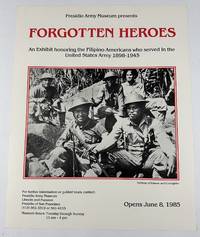
19855617San Francisco: Presidio Army Museum 1985. Three photographically-illustrated posters printed in red and black each 20 x 16 inches. Very minor edge wear and toning. Near fine. A visually appealing trio of posters celebrating the military service of Filipino Americans during World War II created for an exhibition at the Presidio Army Museum in San Francisco in the summer of 1985. The exhibition was titled "Forgotten Heroes: An Exhibit Honoring the Filipino Americans Who Served in the United States Army 1898-1945." Each poster pictures a different unit of Filipino U.S. Army soldiers with experience in the Second World War as follows: a group of infantry soldiers identified as part of the "Defense of Bataan and Corregidor;" eight members of Company E of the 57th U.S. Infantry Filipino Scouts; and the four soldiers comprising the Color Guard of the 1st Filipino U.S. Infantry Regiment in 1942. The first two posters cary the same title "Forgotten Heroes" while the latter poster is titled "'Bahala Na!' 'Come What May!' The Story of the 1st and 2nd Filipino Infantry Regiments in the United States Army" perhaps a smaller display within the larger exhibition. No copies in OCLC though we doubt the posters are unique perhaps residing in larger collections of Filipino American material. Presidio Army Museum unknown
1945215781945. AArchive of 64 original black-and-white photographs documenting American military operations and engineering activities in the Aleutian Islands during World War II. Photographs measure approximately 4.5" x 3.5" and provide an extensive visual record of one of the most remote and environmentally challenging theaters of the war. The images chronicle the daily work of U.S. Army personnel and Army Engineers stationed across the Aleutian chain where military forces confronted not only the threat of enemy action but also some of the harshest conditions faced by American troops anywhere during the conflict. Soldiers appear throughout the archive wearing cold-weather gear field jackets heavy boots and M1 steel helmets while working patrolling and constructing infrastructure amid windswept volcanic landscapes.<br /> <br /> A significant portion of the collection documents the enormous logistical effort required to sustain military operations in the islands. Engineers are shown surveying terrain operating equipment cutting and processing timber and building facilities essential to maintaining isolated military outposts. Several striking photographs depict large timber-log chutes descending steep hillsides toward the shoreline apparently designed to move heavy equipment and supplies through terrain where conventional transportation proved difficult. Other images record lumber operations construction projects and the continual adaptation of military infrastructure to the rugged environment. The archive also contains numerous panoramic views of the Aleutian landscape itself. Snow-covered mountains barren volcanic ridges isolated coastlines glacial valleys and treeless tundra dominate many photographs illustrating why the campaign became as much a battle against geography and weather as against enemy forces. The Aleutian chain stretching deep into the North Pacific and containing dozens of active and dormant volcanoes represented one of the most isolated regions under American military control during the war.<br /> <br /> Naval and maritime operations are likewise represented. Several photographs show transport and supply vessels anchored offshore or approaching remote coastal installations highlighting the dependence of Aleutian bases upon sea-borne logistics. Military camps consisting of Quonset huts and tent encampments appear throughout the collection while one particularly notable image captures an aircraft flying above a military installation underscoring the importance of aerial reconnaissance and patrol operations in protecting the northern approaches to Alaska. Although often overshadowed by campaigns in Europe and the Central Pacific the Aleutian campaign held considerable strategic importance. Following the Japanese occupation of Attu and Kiska in 1942 American forces undertook a costly effort to secure the islands and maintain control of the northern Pacific. These photographs document the infrastructure manpower and determination required to operate in a theater where extreme weather isolation and difficult terrain shaped every aspect of military life. A substantial and visually compelling archive documenting the engineering logistical and environmental realities of America's northernmost front during World War II. Photographs remain in very good condition with minor surface wear and occasional light creasing. unknown
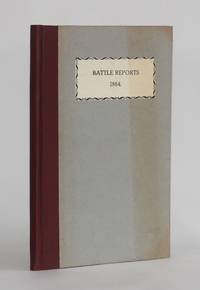
18646016Richmond: R. M. Smith Public Printer 1864. Hard Cover. Very Good binding. Octavo. 98 pp. Confederate imprint. Bound in later cloth-backed boards with printed paper label on the front cover. Lacking wrappers if so issued. Cover and contents toned; title page is missing the bottom corner affecting only the margin. Uncommon. Dornbusch outlines the contents: "Enemy attack on Fort McAllister Feb. 1 1863; reports engagements at Fayette Court House Cotton Hill Gauley Charleston and pursuit of the enemy to the Ohio; General Bragg's reports of the battles of Richmond Munfordsville & Perryville; report of Rhode's brigade at Seven Pines; capture of the gunboat J.P. Smith at Stone river" Dornbusch III 1429. Howes O-31; Parrish & Willingham 2348. R. M. Smith, Public Printer unknown
1908OVU8089Eckert Litho. Good with no dust jacket. 1908. Hardcover. 3/4 leather with black covers portfolio with black ribbons for tying three sides. Front cover is loose was hinged along side edge and has a red leather label with gilt lettering. Covers have some scuffing and leather spine has some wear and missing pieces at the ends. Title page has some markings from the flaps and some foxing. There are 127 total color plates originally had 144 numbered plates but 18 were removed for being obsolete and there is a Plate 93-A. Some plates have some small spots or slight foxing. Color images are in very good condition. Book is in good condition. 4.2 lb.; Oblong Small 4to 9" - 11" tall . Eckert Litho hardcover
191769073Washignton DC: Government Printing Office 1917. War Department Document No. 562. Hardcover. Good. Signed by previous owner. Cover has some wear and soiling. 2 volume set. Includes: illustrations diagrams. Volume I iii 1 803 p. Volume II 594. Change 1 and Change 2 laid in. This two volume set represents the state of the art state of knowledge and state of practice at the time of the entry of the United States into the First World War. From Wikipedia: "The United States Army Quartermaster Corps is a Sustainment formerly combat service support CSS branch of the United States Army. It is also one of three U.S. Army logistics branches the others being the Transportation Corps and the Ordnance Corps. The Quartermaster Corps is the U.S. Army's oldest logistics branch established 16 June 1775. On that date the Second Continental Congress passed a resolution providing for "one Quartermaster General of the grand army and a deputy under him for the separate army". From 1775 to 1912 this organization was known as the Quartermaster Department. In 1912 Congress consolidated the former Subsistence Pay and Quartermaster Departments to create the Quartermaster Corps. Quartermaster units and soldiers have served in every U.S. military operation from the Revolutionary War to current operations in Iraq Operation Iraqi Freedom and Afghanistan Operation Enduring Freedom." Government Printing Office hardcover
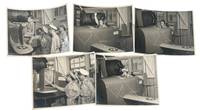
1942235381942. World War II U.S. Army Air Forces Link Trainer training photo archive of five large format silver gelatin prints circa 1942 to 1945 documenting simulator instruction during the wartime expansion of American military flight training using the first effective training device. The men wear Army Air Forces uniforms aviation badges officer caps and the winged star shoulder sleeve insignia commonly called the Hap Arnold emblem an insignia approved in 1942 for AAF personnel. The photographs place the pilot inside a ground based cockpit trainer while instructors and fellow cadets observe a visual record of how instrument procedure radio communication and cockpit discipline were taught before airborne practice. Invented by Edwin Albert Link in 1929 the Link Trainer was the world's first widely successful and effective mechanical flight simulator. Affectionately dubbed the "Blue Box" it revolutionized aviation by allowing pilots to safely train for blind instrument-only flying and poor weather conditions without leaving the ground.<br /> <br /> Photo archive of 5 silver gelatin photographs 8 x 10 inches United States circa 1942 to 1945. The photographs show Army Air Forces cadets and officers in a training room with a large cockpit simulator built with stub wings a tail round U.S. star insignia hinged canopy panels external bracing and a cockpit just large enough for one seated trainee. Several images show a trainee wearing headphones and working inside the enclosed trainer; another shows a man raising the canopy while holding a hand microphone; another shows three uniformed men observing a cadet seated at the controls. One image shows a pilot being congratulated or greeted at the simulator door by three officers with a placard on the fuselage reading "International flight." Visible uniform details include the AAF shoulder patch on a cadet's sleeve pilot or aircrew wings over shirt pockets aviation branch collar devices and officer cap insignia linking the group to the Army Air Forces rather than the postwar U.S. Air Force.<br /> <br /> The Link Trainer became one of the defining instruments of World War II flight instruction because it moved dangerous lessons in blind flying night navigation instrument reading and radio procedure into a controlled classroom setting. The U.S. Army Air Corps had adopted the device before the war and wartime mobilization turned simulator instruction into a standard component of pilot preparation as the Army Air Forces trained pilots at unprecedented scale for bomber fighter transport and liaison service. These photographs are strongest where they show the training process itself: the student isolated inside the cockpit the instructor watching from outside the headset and microphone linking simulated flight to communication procedure and the fuselage marked for an "International flight" exercise. Light curling and occasional creasing; some handling marks in the margins. Overall good condition. A focused visual record of World War II Army Air Forces simulator training and the classroom machinery that converted cadets into wartime pilots. unknown
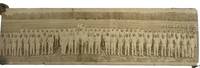
1942185261942. Panoramic photograph 1940s depicting an African American Quartermaster Corps unit during World War II with direct relevance to the study of segregated military organization logistical operations and the role of Black service troops in the war effort. The image shows three rows of Black soldiers in uniform assembled on a field with five white officers positioned in front reflecting the racial hierarchy characteristic of the U.S. Army during the period. A soldier at center holds a unit flag bearing an eagle insignia and the number "663" identifying the formation as part of a Quartermaster unit responsible for supply provisioning and support functions. During World War II the majority of African American soldiers were assigned to service branches rather than combat divisions and Quartermaster units played a central role in sustaining operations across multiple theaters. The photograph documents both the scale of military organization and the structural limitations placed on Black troops within the wartime army.<br /> <br /> Panoramic sepia photograph measuring approximately 8 x 16 inches showing the assembled unit in formation on a grassy field with additional soldiers visible in the background engaged in training or awaiting assembly. The composition emphasizes uniformed ranks command structure and the presence of the unit flag providing visual identification and context for the group.<br /> <br /> Photograph with creasing pinholes and tears consistent with handling; image remains clear; overall fair condition. A large-format visual record of African American service personnel in a logistical unit central to the operation of the U.S. Army during World War II. unknown
Madrid, Imprenta de I. Sancha, 1827, 21 x 14,5 cm., plena pasta española, XI + 192 págs. + 6 láminas grabadas por José Rico, una de ellas plegada + (Escuela particular de los regimientos de caballería:) XL págs. (Buen ejemplar, con amplios y limpios márgenes).
Madrid, Joachín Sánchez, 1739, 15 x 10,5 cm., pergamino, 12 h. + 124 págs. (Leve mancha en las últimas hojs. Es obra rara, el catálogo Colectivo solo recoge el ejemplar de la Real Academia de la Historia).
Very Good Turkish, Ottoman (1500-1928) Original autograph letter handwritten signed by Mahmud Sevket. (33x21 cm). In Ottoman script. 1 p. Case and its response by Mahmud Sevket when he was the governor of Kosovo. Document has 17 lines including the case of 'comitadjis' in Gjilan region of Kosovo. Report says that several comitadjis have been arrested and for them the court was expected to issue a death sentence. In his response, Mahmud Sevket Pasha has ordered that the death penalty should be converted to life rowing (hard labour). Mahmud Sevket's text: "Mabeyn-i Humayun Cenâb-i mülûkâne-i bas kitâbet celilesinden (?) celileden teblîg buyurulan telgrafane-i âlîsi sureti bilâde nakl-i (?) müebbeden kürek cezasi ile mahkûm edilerek idamlari cihetine gidilmemenin azâ-yi muhakemeye ettirilmeyeek ve muamelât-i muhakeme-i te'dib etmekte olan memuriye mucibiince dahi anlasilamayacak surette muhakeme-i fevkalâde re'isine bizzat sifâhen teblîg buyurulmus ve isbu muharebenin nezd-i âlîsinde hifz-i (?) müsarinileyhin emriyle müstesnâdir. Yevm-i muhakeme gayr-i mâlûm ise de bunun yarisinin bile icrâ olunmasi mahtumun bulunduguna göre teblîgâtin ihtiyâten teblîgi (?) baskaca beyân olunur efendim. Kosova Vâlisi Birinci Ferik Mahmud Sevket.".
1886142431886 un volume, reliure bradel (années 50) pleine toile crème in-quarto (bradel cloth-bound), dos long (spine without raised band) - titre frappé or (gilt title), pièce de titre sur fond bordeaux avec filet or (label of title with gilt line), marque-page en tissu (bookmark in tissue), tête lisse, gouttière et tranche de queue non rognées (top edge smooth - fore-edge and edge of bottom no smooth), grand papier, couverture illustrée en couleur par Paul Jazet conservée (cover of the preserved paperback edition), tirage de l'Edition de luxe Edité à 75 exemplaires sur beau papier (limited edition), un des 50 Exemplaire sur Hollande numérotés, 26 à 75 (N°33) aprés 25 exemplaires sur Japon Impérial, (limited edition ), orné d'un frontispice et de 52 compositions hors-texte (full page engraving) en noir en phototypie sous serpentes légendées par Paul Jazet, 304 pages, 1886 Paris Ch. Delagrave Editeur,
191526402Villebon-sur-Yvette 1915 -in-4 plein-veau 1 album, reliure plein veau havane marbré in-quarto à l'italienne (28,5 x 19 cm), dos 4 nerfs (spine with raised bands) muet (spine - no title), décoration "or" et à froid (gilt and blind stamping decoration), filet perlé "or" en place des nerfs avec un filet à froid et un filet "or" de part et d'autre des nerfs, double filet "or" en tête et en pied, premier plat décoré "or" , titre frappé "or" dans un encadrement d'un filet "or", 4ème plat décoré "or" , d'un filet "or" en encadrement, dentelle "fleuron or" sur les chasses (lace-like gilt decoration on the turn-ins), toutes tranches découpées "à la ficelle", album de 25 photographies albuminées en noir et montées sur onglets de cuir marron du CHATEAU DE VILLEBON-SUR-YVETTE : MAISON DE CONVALESCENCE MISE A LA DISPOSITION DE M. LE MINISTRE DE LA GUERRE (ALEXANDRE MILLERAND) PAR LE DOCTEUR CHARLES BONNET - MAI 1915 (AUJOURD'HUI CENTRE DE RETRAITES DES PÈRES LAZARISTES), 1915 sans nom de photographe,
1757013595PARIS CHEZ JOMBERT 1757 Un volume in-4 de XXXII + 656 pages , dans uned reliure d'époque plein veau marbré , dos à 5 nerfs , caissons richement ornés , pièce de titre , tranches marbrées , nouvelle édition corrigée & considérablement augmentée , bien COMPLET DES 34 PLANCHES DEPLIANTES , quelques taches sans aucune gravité , bon exemplaire . Bon Couverture rigide