8 059 résultats
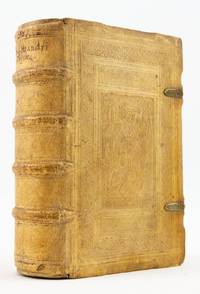
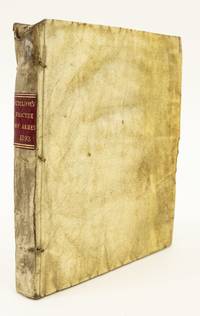
1593ST15853London: Deputies of Christopher Barker 1593. FIRST EDITION. 185 x 140 mm. 7 1/4 x 5 1/2". 12 p.l. 328 327-342 pp. <br/> Contemporary limp vellum yapp edges flat spine with later red morocco label. Inside front cover with ink owner's inscription of George Wilson dated November 1 1854; front flyleaf with engraved armorial bookplate of Thomas Francis Fremantle; early pen trials to title page old mathematical calculations on rear endpaper. Cockle 57; STC 23468; ESTC S117986; Heuser Beatrice "Strategy Before Clausewitz: Linking Warfare and Statecraft 1400-1830" 2017 chapter 5: "A National Security Strategy for England: Matthew Sutcliffe the Earl of Essex and the Cadiz Expedition of 1596." ◆Vellum a bit soiled half-inch chip to head of spine two-inch crack to fore edge of front cover title page with small ink stain and light soiling other trivial imperfections in the text but still an excellent copy clean and fresh internally and in a sound binding.<br/> <br/> This rare treatise addressing all aspects of war has been cited by military historian Beatrice Heuser as perhaps a unique example of a case "in which a civilian an 'armchair strategist' published a book containing a comprehensive concept for how to conduct a war with a specific enemy that was applied in practice." According to Heuser Sutcliffe penned "a national security strategy for England" and one that Robert Devereux Earl of Essex to whom the work is dedicated put into practice in the country's ongoing conflicts with Spain leading to the operation that resulted in the successful capture of Cadiz in 1596. Sutcliffe had met Essex at Trinity College Cambridge where he had likely served as one of the young earl's tutors. DNB observes that Sutcliffe who studied law before becoming a doctor of divinity applied his legal training to this work in which he examines not only fortifications aggressive and defensive tactics and the practical considerations of recruiting paying feeding and housing armed forces but also discusses laws and regulations governing the military. Cockle notes that the work "was well known both at home and abroad" and that it "urged the importance of military studies." Following this consequential work Sutcliffe restricted his writings to theological subjects and enjoyed a 40-year career as dean of Exeter Cathedral. This work is rare in the marketplace: ABPC and RBH find just three other copies at auction in the past 40 years. Deputies of Christopher Barker unknown
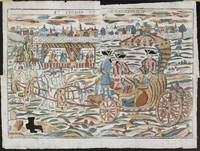
178009496Orléans: P.-F. Perdoux 1780. Beneath the title band lies the walled city of Soissons fronted by a broad field. In the center left shoemakers and cobblers serve customers and make and repair shoes in the shelter of a temporary stall. An elaborate outsized carriage dominates the scene. On the left an angel leads the team of six white horses toward the town gate. In the carriage a well dressed coachmen drives the beasts which are caparisoned with the tools of the shoemaker's and cobbler's trades. With a Cross of the Holy Spirit pinned to each of their chests Saints Crispin and Crispinian richly garbed sit behind unruffled in their journey. The carriage door is emblazoned with shoemakers' and cobblers' tools. In the lower left of the scene more tools overflow a wooden box and just to the right a pair of high boots and a half-dozen lasts lie scattered on the ground. Famous throughout northern Europe in the Middle Ages Crispin and Crispinian are known today from the king's great speech before the Battle of Agincourt in Shakespeare's Henry the Fifth act IV scene 3. Probably produced for their feast day - 25 October - to be hung in merchants' stalls and shops and fixed to tavern walls this wonderfully exuberant monumental print celebrates THE PATRON SAINTS OF SHOEMAKERS AND COBBLERS and of Soissons where they made shoes at night having preached all day. These sheets were sold to the tradesmen across France who were protected by the saints and broadly to the inhabitants of Soissons. Orléans was the most important center for the production and distribution of popular imagery in 18th-century France and Perdoux a dominant force not only in cheap prints but in decorated papers many used for book wrappers. It is unlikely that another example of this four-sheet print survives and certainly not in such superb condition four neat blank marginal repairs on the verso one just into the image. [P.-F.] Perdoux unknown
187341043Paris: Rothschild 1873. Large folio. 17 1/8 x 12 5/8 inches. Two volumes comprising 200 collotypes printed by G. Arosa et Cie. each approx. 9¼ x 7¼ in. or the reverse printed titles with publishers' and printers' credits on mounts with letterpress titles and text. Contemporary half black morocco<br/> <br/> One of the first books illustrated with collotypes rather than photolithography or photogravure.<br/> <br/> The present work stands out as one of the few publications that unequivocally attribute the collotype plates to the exceptionally rare Motay and Maréchal process. Cyprien Tessié du Motay and Charles-Raphaël Maréchal pioneers in the field are widely recognized as the trailblazers behind the practical implementation of the collotype process in 1865. By adopting what was then a new process De Gayffier's project holds a unique position as one of the early examples of works featuring illustrations created through the innovative collotype process setting it apart from the prevalent techniques of photolithography and photogravure of the time. The Motay and Maréchal process played a pivotal role in advancing the art of photography. The process involved the meticulous transfer of an image onto a sensitized lithographic stone using a multi-step process that allowed for the creation of detailed and high-quality prints. Collotype's distinct characteristic was its exceptional ability to reproduce fine tonal gradations and intricate details making it particularly well-suited for capturing the nuances of forest foliage as is evident in the beautifully detailed plates in this work. De Gayffier's project is also notable for its pioneering approach to documenting true forest foliage a departure from the more conventional choice at the time of documenting large parks. This endeavor represented a significant shift in the subject matter of early photography focusing on the richness of natural environments and their botanical diversity. Léon de Gayffier who was appointed by the Minister of Agriculture for the specific purpose of undertaking "special photographic operations" in 1867. Complete copy of this rare work. The Musée français de la Photographie has an album of only 54 plates.<br/> <br/> Voignier Répertoire des Photographes de France au Dix-Neuvième Siècle p.113; Eder Josef M and Edward Epstean translator History of Photography by Josef Maria Eder. p. 617; Hanson David Checklist of photomechanical processes and printing 1825-1910 p. 133. Rothschild unknown
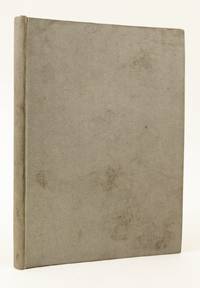
1597ST15850London: Printed by the Widow Orwin for Thomas Man 1597. FIRST EDITION. PRESENTATION COPY. 187 x 130 mm. 7 3/8 x 5 1/8". 5 p.l. 93 pp. <br/> 20th century gray paper boards. Printer's device on title page. Title page inscribed "Gyven to name inked through but perhaps "Thomas Langham" by the aucthor Jo. Norden"; tail margin of title inscribed "Constantin Adyn his booke"; 19th century ink signature of Benjamin Hynam on recto and verso of title. Front pastedown with early 20th century bookseller's description pasted on. STC 18614; ESTC S113322. ◆Boards a bit soiled but otherwise unworn minor dust-soiling or browning to head margins one quire a little browned occasional trivial smudges or tiny rust spots but an excellent copy generally clean and fresh.<br/> <br/> Written during a fallow period in the author's regular career as a cartographer this work emphasizing the importance of service to God for all leaders and common soldiers in the sovereign's army was inscribed by the author to a friend or patron. One of several works Norden dedicated to the earl of Essex it got our author into professional difficulties when Essex's enemy Robert Cecil rose to power and was in a position to impede Norden's career as a mapmaker. Norden quickly tried to push responsibility onto a "false Norden" from Kent he was from Somerset but biographer Frank Kitchen has established that the shared "interests backgrounds written expression everyday circumstances and style" indicate there was but one author. Though best known for his surveys and maps--including the first county maps of England to include roads--the pious Norden ca. 1547-1625 also produced numerous works of devotion and prayer among them the enormously popular "A Pensive Mans Practice" which went to 40 editions in his lifetime. While his sincere religious sentiments are not to be doubted it must be acknowledged that Norden was most moved to write these manuals when he was between surveying jobs and short of money. Aimed at soldiers of every rank the present work urges the "necessity of the fear and service of God" and "the use of all divine virtues both in commanding and obeying practicing and proceeding in the most honorable affairs of war." Norden also encourages civilians to support and respect the military and to pray for men-at-arms. This is an especially rare work: OCLC and ESTC find five copies in U.S. libraries and except for the two copies in the Cottesloe Library there seems to have been only one other--defective--copy at auction listed by RBH and ABPC. The present item is even more desirable as an extremely uncommon presentation copy signed by a 16th century English author. The Constantin Adyn who owned our copy is likely the early seventeenth-century schoolmaster otherwise known as Constantine or Constantinus Adyn fl. 1605-25 whose school was situated in Brighton according to Church of England records. The latest owner is likely the Anglo-Russian writer bibliophile and watchmaker Benjamin Hynam 1769-1859 a prominent figure in the distinguished Hynam family imperial watchmakers to Russian royalty. In the late eighteenth century the Hynams maintained a presence in both St Petersburg and London. Printed by the Widow Orwin for Thomas Man unknown
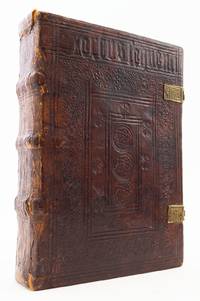
1504ST18751Basel: Michael Furter 1504. 220 x 138 mm. 8 x 5 1/2". CXXII 10 LXX 1 leaves. <br/> EXCELLENT CONTEMPORARY BLIND-TOOLED CALF covers panelled in blind title stamped in gothic letters at head of upper cover central panel with vertical row of three large rosettes EBDB tool s013635 this enclosed by a frame with eight carnation stamps EBDB tool s013643 then by a roll-tooled frame filled with circles containing flowers fruit and stars EBDB tool r000675; Kyriss 84 Roll 6 lower cover similarly framed but with central panel divided by diagonal blind rules into four compartments each containing a large rosette raised bands spine panels with one or two floral medallion stamps upper cover with original brass catches stamped "IVIII" newer clasps and leather straps probably newer pastedowns fore edge with the number "75" in ink subtle repairs to head and tail of spine as well as lower corner on back cover. Title and opening page with decorative woodcut initials main title and sectional title each with woodcut vignette and full-page woodcut on verso. VD16 T-653; VD16 H-6510; Adams L-1124 L-1123. For the binding: Kyriss 84 Tafel 171 Rolle 6; EinbandDatenbank EBDB tools s013635 and r000675 workshop w002075. An ink stain touching text on one leaf and slightly affecting four adjacent leaves but the vast majority of the contents clean fresh and in fine condition. Quarter-inch crack at top of each joint with leather across the spine consequently becoming a small flap light signs of wear to leather hinges mostly open--but the binding entirely sound with almost no wear at all to the joints. An extremely attractive volume THE REMARKABLY WELL-PRESERVED BINDING FEATURING FINE DEEP IMPRESSIONS OF ITS STAMPS.<br/> <br/> This is a rare early compilation of Medieval liturgical chants in an appealing binding by an Augsburg workshop. Kyriss dubbed this bindery Hirsch-Rolle I for its distinctive deer i.e. "hirsch" roll tool and noted it was active 1483-1532. EBDB the bindings database of the Berlin State Library has identified 26 bindings in German libraries from this workshop. The wide attractive floral roll here is most unusual among the binding's wide array of design elements from flowers and plants to stars all contained in tightly packed circles that bring bubbles to mind. Our two texts contain "sequences"--words sung between the Gradual and the Gospel on festival occasions--written by among others Gregory the Great the fourth century bishops Hilarius of Poitiers and Ambrose of Milan and fifth century Latin Christian poet Coelius Sedulius. They were printed by Michael Furter d. ca. 1516-17 who operated a press in Basel from 1489 into the second decade of the 16th century. He was especially known for the decorative nature of his volumes. Haebler's "Typenrepertorium" counted 12 sets of embellished woodcut initials Furter employed; examples from two of these sets may be seen here on the title page of the first work and at the opening of the text in both. The woodcut illustrations here are also notable. The title woodcut Schramm XXII 1263 on the first work is a depiction of the Magi presenting gifts to the Christ Child and his mother done early in the career of Albrecht Dürer 1471-1528. It was one of the "Basel Prayer Book Woodcuts" 25 illustrations likely meant for a "Hortulus Animae" Johann Bergmann von Olpe intended to print in 1494 but never issued. A large striking woodcut depicting the Christ Child at the center of a sunburst surrounded by medallions with the devices of the four Evangelists appears on the verso of the title in the first work and on the title page of the second. On the verso of the second title page is a woodcut of the Crucifixion from the "Postilla" by Guillelmus Parisiensis Basel 1491 Schramm XXII 336. This is an especially affecting and detailed scene: Mary Magdalene clings to the foot of the cross while Jesus looks serenely down at the Virgin Mary who is collapsing in the arms of another woman as several soldiers jeer. On either side of Christ the souls of the thieves crucified with him are being taken one--who had asked to be remembered when Jesus came into his Kingdom--by angels the other by demons. A banner marked with the SPQR of the Roman Empire flutters in the background. All in all this is a very pleasing exemplar of post-incunabular book-making. Michael Furter unknown
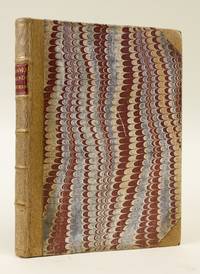
1578ST15632London: Printed by John Kingston for Andrew Maunsell 1578. First Edition in English. 189 x 134 mm. 7 3/8 x 5 1/4". 4 87 1 leaves with foliation errors but complete.Translated from the Latin by Thomas Twyne. <br/> Retrospective half pigskin over marbled boards raised bands red morocco label. Title with woodcut ornament head- and tailpieces many decorative initials. Printed in black letter. Front pastedown with Macclesfield bookplate for the South library; title with inscription in ink "Dulcius ex ipso fonte bibuntur aquae" "Sweetly the waters have been drunk from the fountain itself" and with the initials "D. Fl." see below; a couple of contemporary annotations in ink one slightly shaved; numerous marginal readers' marks in ink and pencil. STC 6231; ESTC S105155. Paper a shade or two less than bright title somewhat soiled a dark stain affecting the upper corner of ff. 24-28 touching text but all is legible; still an overall very good clean copy in a pleasing new binding.<br/> <br/> This is the first appearance in English of Daneau's 1576 "Physica Christiana" the foundational work of "Mosaic physics" which attempted to reconcile the account of creation in Genesis with scientific knowledge of the natural world in order to create a "Christian natural philosophy." Though obviously theological in origin "Christian Physics" is nevertheless substantially a work of natural history generally adopting the Aristotelian worldview then prevalent. The first of two parts is a disquisition on creation a long Socratic dialogue on the meaning of the opening chapters of Genesis. The second part which occupies a good deal more than two-thirds of the volume is a broader treatise on nature including discussion of such things as light and shadow meteors the rainbow thunder precious stones glass gold various trees stars and planets fish birds elephants foxes and many more topics. A Calvinist theologian forced into itinerancy because of his incautiously expressed opinions Daneau 1530-95 produced a considerable number of books mostly commentaries on the Bible and controversial works written against Lutherans and Catholics alike. Our copy has a couple of curious contemporary marginal annotations. On the verso of fo. 2 at the beginning of the second chapter someone noted "Five / speciall / copies of na- / turall phi- / losophye." And at the head of fo. 39 mis-numbered 40 recto is the inscription "Sr. Walter Rawley Laureatus poeta May 4 anno reg. Eliz. 39 anno dom. 1598." There is nothing in Raleigh's biography that can account for his being mentioned as poet laureate in 1598; in that period he was occupied in naval pursuits against the Spanish armada. It has been suggested that our copy was once owned by scholar and translator Andrew Hartwell 1553-1606 a bibliophile who sometimes used the Latin motto which appears on the title page here and who marked passages in his books with the floret-like squiggle seen here on ff. 3-12. At the same time the "D. Fl." inscription on the title page resembles the ownership mark used by the celebrated 17th century bibliophile antiquary politician and magistrate Sir Daniel Fleming 1633-1701. Later the book was securely located in the great library of the earls of Macclesfield which was sold in 12 sales at Sotheby's from 16 March 2004 to 2 October 2008 for some £22 million at the time approximately $40 million. The library was dispersed when the 9th Earl Macclesfield Richard Timothy George Mansfield Parker b. 1943 who was described by the "Independent" as leading an "unconventional lifestyle" was forced to leave his 14th century Shirburn Castle after a protracted family dispute. Called by the paper "a sleeping beauty" his crenellated home had a moat a drawbridge and at the time of the Earl's departure a repair bill of approximately £2.6 million. Despite the building's dilapidation the books in the very large library were distinguished for being uniformly well preserved were almost always in their original bindings and were a sensation at auction for more than four years. The present work is rare: ABPC and RBH locate just one other copy at auction in the past 40 years. [Printed by John Kingston] for Andrew Maunsell unknown
1710ST19567-052Cantabrigiae Cambridge: Cornelius Crownfield 1710. THE DEDICATION COPY ONE OF 150 ON LARGE PAPER per Mackenzie. 248 x 192 mm. 9 3/4 x 7 1/2". 4 p.l. xxiv 532 2 318 283-304 pp. 84 leaves.Edited by Rev. Joseph Wasse. <br/> FINE CONTEMPORARY RED MOROCCO GILT covers panelled with gilt fillets accented with fleuron acorn and scallop tools raised bands spine compartments densely gilt with similar tools red morocco label marbled endpapers all edges gilt probably with some very facile repairs to top and bottom of joints and spine. Front pastedown with the armorial bookplate of the dedicatee Henry Grey Duke of Kent dated 1713 and with the armorial ex-libris of Robert Offley Ashburton Crewe-Milnes Marquess of Crewe; front free endpaper with engraved armorial bookplate of Thomas Philip Earl de Grey see below for all. Dibdin II 385; Mackenzie "The Cambridge University Press 1696-1712" I 273-76. ◆Front joint with thin crack at head and tail covers with darkish splotches obvious but somehow not overly offending with antique morocco like this other very minor signs of use but the binding still extremely pleasing as a grand specimen for an important dedicatee. A MOST ATTRACTIVE COPY INTERNALLY especially clean and fresh with only negligible imperfections.<br/> <br/> This is the stately dedication copy of Wasse's monumental edition of Sallust in its original handsome unrestored binding. Described by Dibdin as "an excellent edition . . . the merits of which have long been acknowledged by the literary world" our version was prepared by Wasse after consulting nearly 80 manuscripts including "some very ancient editions." A huge undertaking it spent five years in the press. Oxford Antiquary Thomas Hearne mentioned it in his "Remarks" amazed that "Mr. Wasse . . . has so swell'd his Salust sic . . . with Notes" that "his Index will be upwards of 20 sheets"; in fact the Index consumes 84 leaves 21 quires. The text of the present volume contains the only two extant historical works of Sallust 86-34 B.C. which are his history of the conspiracy of Catiline against the senate in the year Cicero was consul and his history of the Roman war against the Numidian Algerian chieftain Jugurtha brought to its conclusion by the great soldier and populist politician Marius. As a stylist Sallust has enjoyed great fame for his artistic and epigrammatic speeches with their vividly delineated characters. A fellow of Queen's College Cambridge Joseph Wasse 1672-1738 served as chaplain to the Marquess later Duke of Kent Henry Grey 1671-1740 to whom he dedicated this work. The handsome binding is of very high quality and is decorated in the Cambridge style by an unknown binder of that city. Grey was a courtier who held a number of prominent positions: under Queen Anne he served as Lord Chamberlain of the Household and Knight of the Garter and as one of the Lords Justices Regents of the Realm upon her death; under George I he was Lord of the Bedchamber Lord Steward of the Household and Lord Keeper of the Privy Seal. Our volume was passed down in his family through the line of his granddaughter Jemima Campbell Marchioness Grey to Thomas Philip de Grey 2nd Earl de Grey 1781-1859 an amateur architect who rebuilt the family seat Wrest Park in Bedfordshire. He became the first president of the Royal Institute of British Architects. It was later in the 24000-volume library of the politician Robert Crewe-Milnes 1858-1945 Marquess of Crewe. Cornelius Crownfield unknown
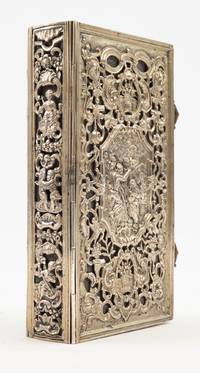
1885ST20549cOxford: Printed at the University Press for Peacock Mansfield and Britton London ca. 1885. 146 x 80 mm. 5 3/4 x 3 1/8". 536 pp. <br/> IN A LOVELY 18TH CENTURY SILVER BINDING over contemporary brown morocco DONE IN THE FRENCH RÉGENCE STYLE combining piercing with repoussé ornamentation the covers with central cartouche depicting a scene from the life of Christ in repoussé that on the front cover showing the Baptism of Christ with two hallmarks at the upper left an "A" and a rooster that on the lower cover showing the Ascension this surrounded by a pierced frame of rocaille drawer handles vases of flowers swans a leafy fronds spine pierced with rocaille and flowers separating three allegorical putti ornaments representing Faith Hope and Charity two openwork rocaille clasps. Endpapers rather worn at fore edge isolated very faint foxing otherwise A FINE COPY the text clean and fresh and THE SILVER BINDING SPARKLING AND UNMARRED.<br/> <br/> This glittering binding is a lovely example of 18th century silverwork in nearly flawless condition. While we have been unable to identify the maker the binding is probably French. A silver binding on a 1686 copy of a Rotterdam "Speculum Poenitentiae" catalogued by Antiquariat Roo is identical to ours in size and design except for the content in the large central frames and is identified by them as French. They find a master's mark of "T. G" beneath the front scene not present on our binding. In any case the delicate symmetrical ornamentation featured on our binding is typical of French Régence decorative arts with scrolls studded with naturalistic embellishments that reward close inspection. Many charming details are hidden within the sea of volutes such as the swans stealing treats from overflowing baskets of fruit. The central scenes from the life of Christ come to life through meticulous execution as our silversmith has taken great care with the details: water trickles from John the Baptist's outstretched arm and voluminous curls of cloud frame Christ's Ascension. The later Book of Common Prayer the binding now contains is a testament to the binding's enduring appeal as a precious devotional object. Printed at the University Press for Peacock, Mansfield, and Britton, London unknown
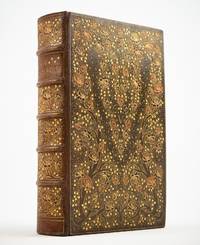
1885ST20626-1London: Printed at the Chiswick Press for Elliot Stock 1885. FIRST EDITION. 181 x 111 mm. 7 1/8 x 4 3/8". xxvi ii 274 i.e. 276 including text leaf marked as pp. 223-224 2 pp. <br/> ANIMATED CONTEMPORARY OLIVE BROWN MOROCCO ELABORATELY GILT AND INLAID covers with two climbing roses with 70 gilt and inlaid blossoms of wine red or salmon pink morocco and dozens of tiny heart-shaped leaves rising from the lower corners and winding up the sides before curving toward the center of the board in a heart shape the branches on a pointillé ground accented with tiny droplets upper cover with monogram of Eleanor Vere Boyle raised bands spine panels with rose branch featuring three inlaid blooms on a pointillé ground gilt lettering wide turn-ins with gilt rose sprays at corners yellow watered silk endleaves top edge gilt. With original front wrapper bound in at rear. Front joint replaced with great skill. With floral vignettes on title and half title decorative headpieces and initials and 11 full-page wood engravings by Boyle EXTRA-ILLUSTRATED with 28 engravings by Eisen Mariller Gravelot and many others. Spine lightly sunned to a hazel brown some extra-illustrations a little foxed occasional light to moderate offsetting from plates but the contents in excellent condition clean and bright throughout and the binding with only the most negligible signs of wear.<br/> <br/> The subject here is roses--on the extremely charming and exuberant binding in the text and in the illustrations. They were the favorite flower of author and illustrator Eleanor Vere Boyle 1825-1916 who planted them on a large scale in her garden at Huntercombe Manor. The popular illustrator of 14 children's books Boyle used most of her income to support charitable works in the parish where her husband was vicar. In her 50s she turned from illustrating to writing focusing primarily on nature and gardens as her subjects. Here she has collected English poems as well as translations in English of excerpts from poems in Greek Latin Persian Italian and French all of them celebrating the rose. Her illustrations show either close-ups of a flower or an adorable cupid accompanied by the flower of Venus. The press work in the present volume is first rate as one expects from the Chiswick Press and the binding is a riot of floral glimmering. Although the binding is unsigned the animated unconventional design is reminiscent of the work of the Guild of Women Binders while the execution is of exceptional quality equal to the productions by leading London workshops like Riviere and Zaehnsdorf. [Printed at the Chiswick Press for] Elliot Stock unknown
1744D4448France 1744. Hardcover. Very Good. Manuscript book on paper in French. c.1744. 8vo 166 x 106mm. 8 355pp. written in brown ink in a clear humanist script with some calligraphic aspects between framed pages in a single column of approximately 28 lines headings in Roman majuscules. With 89 full-page diagrams and technical illustrations of sundial construction and usage and other supporting images three are on plates and two of which are folding at rear. Contemporary mottled calf spine gilt in compartments labeled Gnomonique on gilt red morocco lettering piece marbled endpapers & edges; edges uniformly toned occasional stains; expertly rebacked preserving the original spine somewhat worn. Full contents listed on first 6 pages for this expertly executed and comprehensive compendium on the sundial. The objective of this manual is to enable the 18th century audience to understand the operating principle of sundials by describing the construction and manipulation of different forms of sundials including the planet-sundial moon-clock celestial houses-clock polar-clock ancient Babylonian and Jewish clocks as well as the construction of quadrants and astronomical tables. The suns position in the sky has always been an obvious means to keep track of time. The use of shadows of sticks cast by the sun were a natural means of indicating the time of day by the direction of the shadow and the time of year by its length. Although town squares began constructing clocks beginning somewhere in the 14th century sundials remained in the picture well into the 18th century. Mechanical clocks were expensive and could be found only in the most noble of homes. They were also more of a curiosity at first; most people still used their sundials or just estimated the time of day by the height of the sun in the sky. In 1777 when the French General Lafayette wanted to express his admiration for his ally and friend General George Washington during the American Revolution he chose a silver Explorer sundial as his gift. But by the close of the 18th century clocks and watches began to supersede sundials. They had one huge advantage- they worked all day long and were not dependent on weather. However they were also notoriously unreliable- telling time only approximately within an hour and needing to be reset frequently of course with the help of a sundial. Although the work of this study is anonymous an ownership entry at the foot of the title helps to date the work: Hic est Thorridon Rectoris Laurentii Moussault 1744. This wide-ranging study of the sundial appears at a time when the mechanical clock was on its way into popular fashion. A unique scholarly work that may well be one of the last close studies of such an ancient and important time-telling tool. <br/><br/> hardcover
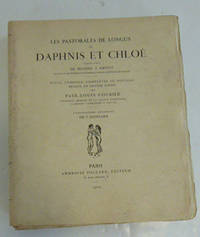
51-6792Paris: Ambroise Vollard 31 octobre 1902. 4to. 24.5 x 30cm. 10. 294 4pp.Original wraps in a contemporary half calf chemise with marbled boards in a matching slipcase repaired. One of 250 numbered copies.Francis Bouvet The Complete Graphic Work no. 75; Luc Monod Manuel. no. 7262; François Chapon Le Peintre et le livre pp. 67-68 -- The Artist & the Book 28 -- Rauch 22; OCLC Number / Unique Identifier:54167315.One of the most famous modern illustrated books – copy on hollande paper. Seduced by his first collaboration with Pierre Bonnard on Parallel by Verlaine 1900 Ambroise Vollard commissioned a second one from him these Pastorales. Where Parallel with its daring layout and the choice of printing the lithographs in pink had been disconcerting the layout of this second book is more classical the illustration being clearly separated from the text. However at the time of its publication it remained "shunned by bibliophiles who for a long time refused to see it as an appropriate illustration technique for luxury books because it was considered too commercial even vulgar" Limited edition. Vollard Petiet et l'estampe de maîtres pp. 44-45. .This judgment has largely been revised by their successors and the work is today considered one of the greatest successes of the illustrated book. Carteret Illustrés IV p. 242: a beautiful work highly sought after and highly rated. One of the greatest stars of modern books. ; « Like Bonnard’s earlier lithographs for Parallèlement and Manet’s for Le Corbeau these subtle plates had little appeal in 1902 for a public that preferred the sharply defined realism of the professional engraver.The book is today considered one of the finest of its periodâ€. The Artist and the Book n°28 ; Mahé II col. 695 ; Mornand Vingt-deux artistes du livre pp. 45-46 “Daphnis et Chloé fut pour Bonnard l’occasion de montrer toute la souplesse de son talent non seulement par la pureté du style bien antique des personnages mais par le caractère des paysages essentiellement grecsâ€. Paris: Ambroise Vollard, 31 octobre 1902. paperback
05-06351968. Gouache painting on board. 1.5 x 17 inches. BellevueAnnotated titled and dated on the mount by the artist in pencil. Literature: Millard Sheets. One-Man Renaissance by Janice Lovoos and Edmund Penney p. 148. Authenticated by the artist's son Tony Sheets on the verso. "Hilton’s Rainbow Murals Perhaps second only to Diamond Head as a Waikiki landmark the rainbow murals adorning the mauka mountain and makai ocean ends of the Village’s Rainbow Tower are the world’s tallest ceramic murals. Designed by renowned artist Millard Sheets the colorful ceramic tiles climb the entire height of the 31-story tower. By design the murals welcome all visitors to Oahu regardless of their hotel choice; the focal point for the murals is 2.5 miles away which on the ocean side coincides with the air corridor in and out of Honolulu International Airport. An inscription in Hawaiian on the mural reads: “Ho’ola’a ia I na kanaka me o ka uhane o Hawaii†“dedicated to the people and spirit of Hawaiiâ€. During 2004 the murals will receive a facelift of sorts – more than 100 tiles that have cracked broken or become badly weathered by the elements over the past 35 years will be replaced with exact recreations that will be impossible to discern from Sheets’ original masterpieces." 1968. unknown
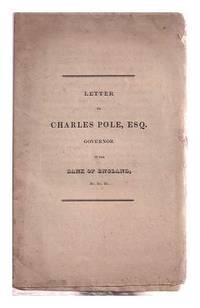
1820342776Publisher; Unknown 1820. First edition. Softcover. Specimen color/red plates 1 5 & 10 pound notes printed on single and double sides loosely inserted. Good copy; edges slightly nicked and dust-dulled as with age. An unread example with unopened pages. Remains particularly well-preserved overall; bright and clean. Additional scans and bibliographic detail on request. Date of publication is suggested. Physical description; 14 pp. Dis-bound as issued. Subjects; Bank of England.1800-1850. Bank notes - original currency samples -Great Britain. Banks and banking Central Great Britain. Currency - counterfeit and fraudulent - currency - forgery - nineteenth century. Currency printing - authentic registers. Pole served as Bank governor from 1820-1822 only. Publisher; Unknown paperback
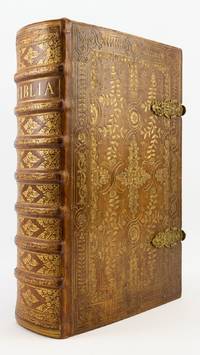
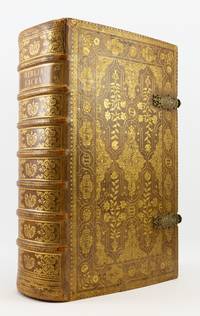
1752ST19424Stockholm: Tryckt af Henrick Christoph Merckell 1724-28; Peter Jöranson Nyström 1752. 422 x 275 mm. 16 5/8 x 11". 30 p.l. 1 leaf section title 234 2 section title 235-604 2 section title 605-908 2 section title 909-1387 1 pp.; 4 p.l. 300 4 301-666 pp. <br/> STATELY CONTEMPORARY CALF INTRICATELY GILT IN THE FANFARE STYLE over bevelled wooden boards covers with strapwork frame containing lilies and floral garlands central panel with strapwork rows of floral crosses the spaces between with floral sprays emerging from urns very expertly rebacked preserving original backstrip raised bands spine compartments with flowers-and-pomegranate centerpieces floral cornerpieces gilt lettering two decorative brass clasps catch plates and original straps turn-ins with lattices and floral ornaments marbled endpapers edges gilt and delicately gauffered. Five section titles with engraved vignettes. With ink presentation inscription celebrating the baptism of Claës Georg Listromer on 20th November 1604 and expressing the hope the Book will bring him wisdom as he grows signed by Claës Lindman dated 17th September 1605. A 20th century Swedish inscription below tracing the book's descent through generations of the Listromer family into the 1920s. Darlow and Moule 8821 8826. Slight variations in color of the leather Ffff8 with lower corner torn away not affecting engraving occasional faint offsetting but AN EXTREMELY CLEAN FRESH COPY in a binding bright with gilt.<br/> <br/> This impressively bound Swedish Bible was a baptism gift that clearly would have outweighed its recipient as Swedish law at the time required an infant be baptized within the first eight days of life. Although hardly practical for personal devotion and study the majestic tome was a treasured heirloom passed down in the same family for 200 years. The beautiful fanfare style seen here emerged in France in the 16th century but remained very popular in Northern Europe into the 18th century particularly for large "lectern" Bibles like the present item. The text here is an extensively annotated edition of the 1618 Gustave II Adolf Bible prepared by a father and son both named Johannes Gezelius who served successively as Bishop of Åbo. The New Testament was first printed in that city in 1711-13 the Old Testament in Stockholm in 1724-28. In our copy the New Testament is a 1752 reprinting. Tryckt af Henrick Christoph Merckell, 1724-28; Peter Jöranson Nyström unknown
1585ST20050Leipzig: Georgius Desner 1585. FIRST EDITION. 170 x 110 mm. 6 3/4 x 4 1/4". 28 p.l. 494 pp. 1 leaf blank; 3 p.l. 463 pp. <br/> FINE CONTEMPORARY BLIND-STAMPED PIGSKIN over bevelled wooden boards covers framed by decorative lattice roll upper cover with central panel depicting Judith a sword in her right hand the head of Holofernes in her left signed "M R" above the caption; lower cover with a panel showing Jael in the act of killing Sisera her left hand holding a chisel to his temple her right hand holding a hammer raised to strike a blow the plate signed "M R" at the end of the caption raised bands ink titling at head of spine and on fore edge edges stained red two original brass clasps. Title page with 17th century ownership inscription of Georg Laurence Seydenbecher; verso of title with round blue ink armorial stamp; occasional neat ink marginalia in an early hand. VD16 N 413; USTC 684027. For the binding: Haebler I 381-82. ◆Text slightly and uniformly toned because of paper quality half a dozen quires a bit more browned isolated small ink stains or foxing pigskin with minor soiling to edges just a hint of wear to lower corners but A FINE COPY the contents thoroughly fresh and the unsophisticated binding with beautifully distinct stamps.<br/> <br/> This is a very rarely seen copy of an outline of the essentials elements for a humanist education written by a noted German pedagogue and offered here in a wonderful blind-stamped binding featuring two fierce biblical heroines. Symbols of courage embraced by the Reformation Jael and Judith appeared on front and back covers of a number of 16th century bindings and both are shown here in elegant Renaissance garb clutching the weapons they used against enemies of Israel. Jael offered the Canaanite general Sisera refuge in her tent following a battle and having lulled him to sleep with warm milk is shown on the rear cover here in the act of striking a stake through his temple. Beneath the image is the text "Sic pereant omnes inimici tui Domine" "So perish all of your enemies Lord" Judges 5:31. Judith pretended to seduce the Assyrian Holofernes then got him drunk and cut his head off; here on our front cover she triumphantly displays his head brandishing his sword. Below her is a verse from Psalms: "Voluntatem timentium es faciet dominus" "He will do the will of them that fear him" Psalm 144. We did not find these plates in EBDB or any of the usual reference works but they are likely the work of bookbinder Matthias Radmann who became a master binder in Leipzig in 1546 and who signed his work "M R" often at the end of a caption as on the Jael plate. A student of Melanchthon Michael Neander 1525-95 became director of the college of Ilefeld where he developed an influential curriculum with a heavy emphasis on Latin and Greek classics rhetoric philosophy history theology physical science and geography; the school attracted students from all over Europe. In our volume he collects excerpts of important authors on these and associated subjects beginning with the Greek Fathers on theology and continuing through philosophy mathematics medicine chemistry history natural sciences geography rhetoric poetry and grammar. Our 1585 edition seems to be the sole printing and is very rare. Bindings of this sort are almost never found now so clean and with their elaborate blind decoration so extraordinarily sharp. Georgius Desner unknown
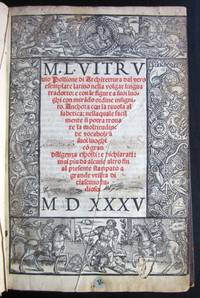
1535SAV123Venice: Nicolo de Aristotele detto Zoppino 1535. Hardcover. Very Good. Folio 295 x 190mm. 12 I-CX 110ff. Signatures: AA6-BB6; A8-N8; O6. Title printed in red and black with woodcut block border depicting strewn armor and dueling knights with wreathed portrait of Cicero at top and plaques with monogram initials of Roman Emperors Fabius Maximus Julius Caesar and Alexander Magnus. 136 woodcut in-text illustrations depicting lives of primitive humans the famous Vitruvian Man on p. XXII constellations rules for perspective and other mathematical figures and diagrams of architecture. Woodcut historiated chapter initials throughout of repeating portraits. Translated by Benedetto Giovio 1471-1545. Edited by Francesco Lutio Durantino. 19th-century calf with decorative stamps spine stamped in gilt TRAT DE ARCH endpapers renewed; loose in binding some margins trimmed close some light worming at least six early cancelled inscriptions on title leaf CX with significant excision otherwise an crisp and clean text block with wonderful woodcut impressions. 19th-century inscription on fly-leaf Famoza Archi-tectura. Another 19th-century inscription on front flyleaf Presented to the Mercantile Library Association of New York by Philip A Reach .Consul/ Lisbon Jan. 7 1848. Sold in 1958 on removal of Architecture Books from the Library pencil note. Rare illustrated Durantino edition of Vitruvius printed in Venice by Zoppino in 1535. This Vitruvius work was first printed in 1521 for Como. As it gained notoriety another edition in the vernacular Italian was prepared by Giovanni Antonio and Pietro de Nicolino da Sabbio in 1524. It incorporated woodcuts from a 1511 Latin edition produced by Giovanni Giocondo in Venice Tacuino. This Zoppino printing had a newly redesigned title-leaf with an elaborate woodcut border of chivalric battle scenes between Augustus Caesar Julius Caesar and Alexander the Great. The 136 in-text woodcuts are an all too interesting miscellany of late-medieval life nature and architecture and are characteristic of Vitruvian ideals in regards to proportion ornament language space place and beauty. The famous figure of Symmetria Vitruvian Man is present on p. XXII. Both the 1524 and 1535 editions were widely read by an Italian public. Vitruvian principles deeply influenced early Renaissance artists thinkers and architects who believed they were rediscovering an ancient discipline which would be the foundation of their culture. <br/><br/>Rare illustrated Durantino edition of Vitruvius printed in Venice by Zoppino in 1535. This Vitruvius work was first printed in 1521 for Como. As it gained notoriety another edition in the vernacular Italian was prepared by Giovanni Antonio and Pietro de Nicolino da Sabbio in 1524. It incorporated woodcuts from a 1511 Latin edition produced by Giovanni Giocondo in Venice Tacuino. This Zoppino printing had a newly redesigned title-leaf with an elaborate woodcut border of chivalric battle scenes between Augustus Caesar Julius Caesar and Alexander the Great. The 136 in-text woodcuts are an all too interesting miscellany of late-medieval life nature and architecture and are characteristic of Vitruvian ideals in regards to proportion ornament language space place and beauty. The famous figure of Symmetria Vitruvian Man is present on p. XXII. Both the 1524 and 1535 editions were widely read by an Italian public. Vitruvian principles deeply influenced early Renaissance artists thinkers and architects who believed they were rediscovering an ancient discipline which would be the foundation of their culture. Nicolo de Aristotele detto Zoppino hardcover
184441372Milsom Street Bath and 26 Haymarket London: Edmund Francis English Jr. and Thomas McLean. Lithographed and printed at 79 St. Martin's Lane and by Moyes and Barclay Castle Street Leicester Square London 1844. Folio. 24 1/4 x 16 1/2 inches. First Edition. 8 1-10. 18 pp. 12 leaves of plates. Title with hand-colored vignette mounted on card lithographed dedication to Princess Emilia of Baden and the Marchionesses Douglas and Clydesdale List of Subjects and List of Vignettes on Letterpress List of Subscribers "To the Reader" by English Lithograph letter from Beckford to English that is not mentioned in Abbey 6 tinted lithograph "Illustrations of Lansdown Tower Bath" with text on each room of the tower and Beckford's obituary and woodcut epitaph errata note 13 tinted and hand-colored lithograph plates mounted on 12 card leaves with pencilled titles underneath plates. Dark red straight-grained half morocco over publisher's brown moiré cloth title stamped and lettered in gilt on front and on spine with bookplate on pastedown<br/> <br/> Grand first edition folio volume of a fantastical folly with 13 hand-colored lithographs of Beckford's unimpeachable decor.<br/> <br/> Shortly after the eccentric novelist collector bibliophile and plantation-owner William Beckford died in May of 1844 the book Views of Lansdown Tower was published revealing Beckford's extraordinary retreat its luxurious interiors and the exquisite art collection he had assembled inside this fantastical architectural folly just outside Bath in Somerset England. Views was initiated by Willes Maddox under the patronage of Beckford who is found in the book's subscribers list. Beckford had moved to Bath from his estate Fonthill Abbey in Wiltshire in 1822 and remained there until his death. In 1826 Beckford employed a young architect named Henry Goodridge 1797-1864 to build the tower and its adjoining library about a mile away from Beckford's residence in Crescent. Beckford's Tower known initially as Lansdown Tower was built in Italianate neo-classical style on Lansdown Hill. The Tower and its attached railings are now designated as a Grade I listed historic building by the UK. It is the only standing example of Beckford's architecture. Though he did not live there Beckford used the tower as a showcase for his collection of art and fine books and its crowning cupola as a belvedere for taking in picturesque vistas of the surrounding landscape. The book reproduces drawings by Maddox in lithographs by C. J. Richardson. Maddox later gained a reputation for painting the portraits of eminent Turks and took up an invitation from the Sultan to work in Istanbul. Four of the book's 13 plates illustrate some of Beckford's objets d'art including ceramics ivories and metalware alongside his immaculate parlor furniture. The colored plates in order: I. Ornamental Title with View of Tower. II. Exterior of LansdownTower. III. The Vestibule. IV. The Scarlet Drawing Room. V. The Staircase. VI. View of the Belvedere. VII. Objects of Vertu No.1 in Mr. Beckford's Collection. VIII. The Sanctuary. IX. The Crimson Drawing Room. X. Black Cabinet in Crimson Drawing Room. XI. Objects of Vertu No.2 in Mr. Beckford's Collection. XII. The Library. XIII. Objects of Vertu No.3 in Mr. Beckford's Collection. XIV. Ornamental Furniture in Mr. Beckford's Collection. And the Vignettes in Letterpress: XV. Embattled Gateway in Garden. XVI. Italian Cottage. XVII. The Grotto. XVIII. View in Garden where the Sarcophagus stood before removed. XIX. The Tomb of Mr. Beckford. XX. The Tomb of Mr. Beckford's favourite Dog.<br/> <br/> Abbey Scenery 420. Bobins II 682. SP Lohia 626. Edmund Francis English Jr. and Thomas McLean. Lithographed and printed at 79 St. Martin's Lane, and by Moyes and Barclay, Castle unknown
1768ST19422Nuremberg: Johann Andrea Endterischen 1768. 460 x 295 mm. 18 1/4 x 11 1/2". 17 p.l. 11 48 2 2 3-8 3 9-190 2 191-740 pp.; 512 pp.; 2 2 3-190 2 191-480 18 pp. Three parts bound in one volume. <br/> STRIKING CONTEMPORARY SMOOTH CALF LAVISHLY GILT in the entrelac style covers with frame and compartments formed by gilt-ruled strapwork and filled with floral designs and lace-like ornaments of massed volutes and small tools raised bands spine compartments with central bouquet of pomegranate and flowers with massed floral tools on either side gilt lettering brass clasps featuring images of King David and St. Paul gilt-tooled turn-ins marbled endpapers all edges gilt and gauffered with pomegranates and flowers older repair to front joint alongside top compartment. Extra engraved title page woodcut headpieces and historiated initials 47 engraved plates comprised of: copperplate portraits of Luther and 11 Electors; 11 section titles each with 11 vignettes; nine full-page engraved depictions of Moses the Prophets and the Evangelists; seven full-page plates engraved with 12 vignettes six double-page maps and two double-page engravings. Front pastedown with ornate heart-shaped bookplate of Adam Melchior Dæumer dated 1784. ◆Two-inch crack to head of rear joint a bit of rubbing to joints and extremities a handful of quite minor dark spots to boards isolated trivial smudges or stains internally other insignificant imperfections but still a fine specimen--THE CONTENTS EXCEPTIONALLY CLEAN BRIGHT AND FRESH and the remarkable binding entirely solid and bright with gilt.<br/> <br/> This is an especially pleasing copy of the last and most extensive edition of the very popular and sumptuously illustrated Weimar Electors' Bible offered here in an impressive contemporary binding. Known as the "Kurfürstenbibel" because of its portraits of the Electoral Princes called "Kurfürsten" in German it was originally prepared for Ernst I Duke of Saxe-Gotha and Altenburg as a celebration of Martin Luther's Bible translation. Editions were issued by the Endters one of the prominent German printing families beginning in 1641. In addition to portraits of Luther and the Protestant princes of Germany the present edition contains the maps views and illustrated half-titles by Jacob van Sandrart and others first used in the edition of 1686. Our copy contains four maps and views not found in other copies of this edition showing the eastern Mediterranean and Palestine as well as both a map and a view of Jerusalem. The size of our volume puts a great strain on the binding which has nevertheless stood the test of time remarkably well. The overall decoration is exuberant the delicate gauffering lovely and the original straps remarkably well preserved. Johann Andrea Endterischen unknown
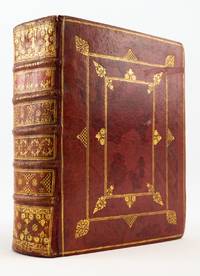
1552ST12878Parisiis: Apud Ioannem de Roigny 1552. 325 x 210 mm. 12 3/4 x 8 1/4". 1 p.l. title 776 pp. 20 leaves last blank. Collates as in Adams and Schweiger. <br/> Attractive contemporary calf over thick pasteboards covers with painted black and gilt rule frame center of both boards with large elaborate rectangular strapwork ornament in black and gilt flat spine divided into panels by gilt rules and cresting roll three spine panels with black and gilt ornament similar to those on the covers one panel with gilt titling inside an escutcheon all edges gilt the joints edges and portions of the spine at top and bottom very expertly renewed. Numerous fine "criblé" and other decorative initials and 145 WOODCUT SCENES measuring approximately 2 x 3" some of the cuts repeated. Front pastedown with "HB" book label of Heribert Boeder; title page with ink inscription of Johann Adolph Freitag dated 1653 and with library stamp of the College of Notre Dame Villefranche sur Saone. Adams E-1033; Dibdin II 470; Hoffman II 68-69; Mortimer 512; Schweiger II 1060. ◆Spine slightly faded and discolored in spots color of the cover leather a bit uneven two pages with ink stain touching but not obscuring a word of text isolated rust spots but a very pleasing copy the text unusually fresh clean and bright and the carefully restored binding completely solid and certainly pleasing.<br/> <br/> This is a large-format illustrated printing of the "Comedies" bound in a more restrained version of the painted entrelac bindings in vogue in 16th century a binding tall and dignified enough to suit its contents. Dibdin describes this as "a most excellent edition" that contains "almost all the valuable treatises upon the author up to the period of its publication" and notes that "it is of rare occurrence." There were two issues of this 1552 edition; our colophon dated to 17 Calendas Decembris Anno 1551 indicates that we have the first. Terence's six extant plays the ancestors of drawing room and modern situation comedies feature crusty fathers rebellious sons and impertinent slaves whose machinations solve the playwright's intricate complications of plot. The plays were popular throughout the Middle Ages and the Renaissance and still retain their appeal. The text of the plays in large and attractive italic type is surrounded here by the commentary in smaller italic of Donatus fourth century A.D. and others. Each scene is preceded by a woodcut depicting the actors on a curtained stage. While very simple in composition these are animated and frequently amusing. According to Mortimer our text and scholarly apparatus are mostly reprinted from Girolamo Scoto's Venice edition of 1545 and the scene cuts "are extremely close copies of the Italian blocks used by Scoto.". Apud Ioannem de Roigny unknown
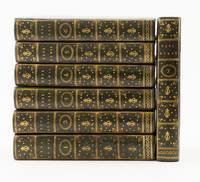
1775ST17825Paris: Joseph-Gérard Barbou rue Mathurins 1775. 163 x 96 mm. 6 3/8 x 3 3/4". Seven volumes. Edited by J. N. Lallemand; preface by Jean Baptiste Louis Crévier. <br/> EXTREMELY ATTRACTIVE CONTEMPORARY GREEN ARMORIAL MOROCCO perhaps by Derome covers with triple gilt rule border central gilt coat of arms of the Blanche family featuring a seated fox with one paw raised above it a row of three five-pointed stars smooth spine divided into compartments containing a gilt lyre surrounded by stars and dots floral sprigs at corners volume number within a laurel wreath gilt lettering marbled endpapers all edges gilt. With printer's two-swans device on title pages volume I with frontispiece portrait engraved by L. J. Cathelin after J. C. Philips. With pencilled note on front flyleaf attributing the binding to Derome. Brunet III 1108 "Edition estimée"; Dibdin II 171. For the binding: Olivier Pl. 2279. ◆Spines slightly and uniformly sunned very light shelf wear to bindings occasional faint foxing in volume IV but A SUPERB SET almost entirely absent of any signs of use.<br/> <br/> This is a fine-paper copy in a binding both charming and handsome of what Dibdin deems "a truly beautiful and accurate edition" of Livy's Roman history. Brunet called it an "esteemed edition" and notes that fine paper copies like the present set sold for twice what regular copies cost. First printed by Sweynheym and Pannartz in 1469 the "Histories" of Titius Livius Patavani 59 B.C. - 17 A.D. follow the rise of Rome from the founding of the city through its triumphs in the Punic Wars and up through the reign of the author's contemporary emperor Augustus. His account is notable for its emphasis on the glorious triumphs and accounts of heroism of the Romans stemming in his eyes from their virtue; his history is intended not just to inform but also to elevate the reader. The present edition according to Dibdin builds on the fine editions edited by Crevier and Drakenborch incorporating their useful notes and additions. It was beautifully printed by Joseph-Gérard Barbou 1723-90 scion of a family that had begun printing in Lyon in 1529 moving to Paris in 1540. Joseph apparently specialized in Latin classics producing editions of Cicero Lucretius Pliny Caesar and Martial among others. The fine binding here does not have Derome's ticket but is well executed enough to make the attribution written in at front plausible. There were no fewer than 18 members of the Derome family not to mention workshop associates who made their livings as binders in Paris from the middle of the 17th century until the first quarter of the 19th. Our binding is tasteful--perfect for a scholarly edition of a classic--and conceivably the work of one of the Deromes or of an extremely competent associate. Olivier attributes our armorial stamp to the 18th century Blanche family of Burgundy and he finds it on a copy of Barbou's 1771 Sallust in the library of Madame la Comtesse de Cossé. The "country house" condition of the present set suggests an aristocratic owner more concerned with owning fine books than with reading them. [Joseph-Gérard] Barbou, rue Mathurins unknown
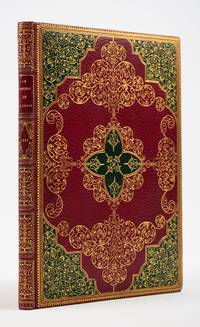
1651ST20278Paris: Chez F. Mazot 1651. 172 x 118 mm. 6 3/4 x 4 3/4". 3 34 leaves 35-39 1 pp. 2 leaves. <br/> LOVELY CRIMSON CRUSHED MOROCCO GILT AND ONLAID BY CAPÉ stamp-signed on front turn-in covers with onlaid green morocco cornerpieces and central quatrefoil all filled and surrounded by delicate pointillé tooling in floral and paisley designs raised bands spine compartments tooled in pointillé gilt lettering richly gilt turn-ins marbled endpapers all edges gilt. In a felt-lined morocco-lipped marbled paper slipcase. ENGRAVED THROUGHOUT WITH 38 FULL-PAGE ILLUSTRATIONS consisting of one portrait two allegorical religious scenes including title and 35 illustrations of the Holy Eucharist 40 pages of engraved text 37 of these with text flanked by full-length figures of saints accompanied by other religious symbols at head and foot of page two framed with vignettes of angels or the Madonna one page with text only. Front pastedown with "A W F" book label of bookseller Adrian Fluhmann. Duportal "Étude sur les livres à figures" pp. 244-45; Brunet V 624; Graesse VI 4; Leaves perhaps very lightly washed and pressed but an extremely fresh clean copy IN A SPARKLING BINDING.<br/> <br/> Covered by a luxurious binding by Capé this is a particularly attractive copy of a sumptuously illustrated prayer book composed entirely of engraved plates. According to Duportal it is "One of three important publications whose engravings reveal the trend characteristic of religious illustrations in France between 1601 and 1660." The work opens with a dedication to Charles d'Aubespine Marquis de Châteauneuf 1580-1653 with a full-page portrait by Guillame de Gheyn b. 1610. The bulk of the book is made up of two groups of plates. Those in the first group appearing primarily on the rectos contain prayers in Latin and French flanked by pairs of saints; gaps in the prayers are filled by naturalistic flowers insects and birds. Many of these plates also include a scene or two in miniature depicting the life of one or both of the saints or a vignette of angels. While just two of these engravings are signed "J. Collin" they all appear to be in the same hand which demonstrates an impressive level of finesse and delicacy depicting graceful figures with sure light lines. Duportal notes that this artist had a "talent charmant" and that well-executed dry-points of this type are quite rare in French books of the period. The second group of engravings appear strictly on the versos and depict the performance of a part of the Mass beneath a cloud in which appears a relevant scene from the life of Christ. They are all unsigned and clearly by a different hand with more rustic features--possibly "copies of originals published abroad" according to Duportal. The book concludes with two leaves of text framed by gamboling putti and the Virgin. Copies of this work can be found with varying numbers of leaves and engravings apparently the result of multiple reprintings with added material produced between 1651-53 but the present item can be distinguished as an early if not the very first edition as it does not contain "Privilege du Roy" dated 1652 or 1653. Furthermore our copy also contains the earliest state of the plates without the "I N R I" initials on the cross found on the title page and with the earlier state of the verso engravings before they were substantially reworked. Our edition seems to be quite rare with OCLC finding just one other copy with the same sequence of contents at the Bibliothèque Sainte-Genevieve. The stunning binding by Capé looks just as fresh and lustrous as the day it left its workshop. One of the most distinguished binders in France in the middle years of the 19th century Capé d. 1867 was especially well known for the delicacy of his work--which can be appreciated to full effect in the present example. He was the binder to the Empress Eugénie and Béraldi calls him "the Bozérian of the second Empire." This is precisely the kind of book our former owner the discriminating connoisseur-bookseller Fluhmann would have owned. Chez F. Mazot unknown
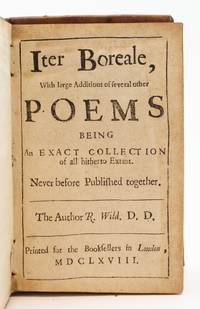
1668ST19030London: Printed for the Booksellers in London 1668. First Complete Edition Fourth Edition overall. 145 x 90 mm. 5 3/4 x 3 1/2". 1 p.l. blank 3-122 pp. 3 leaves table and final blank. <br/> Contemporary sheep covers ruled in blind smooth spine early paper label with gilt titling. Front blank with the ink ownership inscription of John Drinkwater; inside lower board with the book label of Michael Curtis Phillips. Hayward "English Poetry" 121 this copy; Grolier Club "Wither to Prior" 976; Wing W2136; ESTC R7135. ◆Covers with light scuffing bottom leather thong of two broken but the text block quite secure at the top pastedowns lifted but the insubstantial binding still in remarkably good original condition; internally A VERY FINE COPY especially clean fresh and bright.<br/> <br/> From the library of Richard Jennings noted for the outstanding condition of his books this is an especially fresh and extraordinarily well-preserved copy of poems by a Puritan divine known for his surprisingly biting wit. Dryden dubbed Robert Wild 1609-79 "the Wither of the City" after hearing the Financial District's workers' enthusiastic reception of the title poem here which celebrates General Monck's successful campaign to restore Charles II to the throne: "I have seen them reading it in the midst of 'Change so vehemently that they lost their bargains by their candles' ends." Our collection contains several of Wild's most notable works including "The Recantation of a Penitent Proteus" satirizing Puritan clergy who had conformed to the Anglican Church; "The Loyal Nonconformist" professing his loyalty to the monarchy but maintaining his Puritan religious views; and "The Fair Quarrel" an attack on the 1665 Five Mile Act designed to drive nonconformist ministers out of their parishes. Wild was something of a paradox: he could preach a hellfire Puritan sermon but also write verse sufficiently scandalous to be mistakenly attributed to the notorious libertine John Wilmot Earl of Rochester. Our volume was loaned by Richard Jennings for the celebrated 1947 London Exhibition of First and Early Editions of English Poetry catalogued by John Hayward. It would not be reasonable to expect to find a finer unrestored contemporaneous copy of this imprint. Printed for the Booksellers in London unknown
1784055973Konstantiniyye Constantinople: Müteferrika's Basmahâne Dâru't-Tibâati'l-Ma'mûre Râsid ve Vâsif Efendiler Matbaasi. AH 1198 = 1784 CE. 1784. 1st Edition . Leather. Very Good. Folio - over 12 - 15" tall. Bound in original full brown calf with flap miklep by Muteferrika Printing House. Folio. 32 x 22 cm. In Ottoman Turkish Old Turkish with Arabic letters. 2 6 238 leaves. The text is framed with a text block measuring 25.5 x 14.5 cm. Each page contains 33 lines. Printed on a special European watermarked paper acquired during the Ibrahim Müteferrika era. As traditionally done in Islamic bookmaking the title of the book is handwritten along the lower edge. Two leaves containing pp. 90-94 likely completed from another copy with trimmed margins loosely inserted. Occasional foxing on some pages otherwise a fine and well-preserved copy. Exceedingly rare first and only edition of the 19th incunabulum published by the pioneer of book printing in the Islamic world and founder of the first Turkish press Ibrahim Müteferrika 1672-1745 under the direction of his first heirs after his death. In this rare work -the first book published by Rasid and Vâsif Efendis the initial successors of Müteferrika- the events between 1730 and 1744 are chronicled a period during which Ottoman-Habsburg relations were defined by major military conflicts and shifting diplomatic alliances culminating in the Austro-Turkish War 1737-1739 and the Treaty of Belgrade. Following the Treaty of Passarowitz in 1718 the Habsburg Monarchy had expanded its territories into the Balkans acquiring regions such as the Banat of Temesvár northern Serbia including Belgrade and parts of northern Bosnia. However the Ottoman Empire sought to reclaim these territories. The opportunity arose during the Russo-Turkish War 1735-1739 when Austria allied with Russia against the Ottomans leading to the Austro-Turkish War of 1737-1739. The wars concluded with the Treaty of Belgrade 18 September 1739 the Battle of Grocka 21-22 July 1739 the Siege and Capture of Belgrade July -18 September 1739. The first war was a decisive Ottoman victory over the Habsburg forces near Belgrade. The defeat had a substantial psychological impact on the Habsburg court and led to a re-evaluation of their military strategy. Following the victory at Grocka Ottoman forces besieged and recaptured Belgrade a strategic city previously under Habsburg control. These events between 1730 and 1744 significantly impacted the balance of power in Eastern Europe and shaped the subsequent interactions between the Ottoman Empire and the Habsburg Monarchy. "Ibrahim Müteferrika 1674-1745 was an Ottoman müteferrika court official printer publisher author and translator of Hungarian origin. He was the first person in the Ottoman Empire to establish a printing press and publish books in Turkish. In 1720 when Nevsehirli Damat Ibrahim Pasha sent Yirmisekiz Mehmed Çelebi as ambassador to Paris Mehmed Çelebi took his son Mehmed Said Efendi along with him. While Yirmisekiz Mehmed Çelebi's embassy report sefâretnâme provided important information about France his son did not remain idle and contributed to the transfer of many innovations to the Ottoman Empire. During his stay in Paris Mehmed Said Efendi visited a printing press and decided to pursue similar efforts upon returning to Istanbul. After his return he met Ibrahim Müteferrika and together they began working to establish a printing press. Their idea was supported by Grand Vizier Nevsehirli Damat Ibrahim Pasha. Permission to open the press was granted on the condition that only non-religious works would be printed. They obtained a fatwa legal opinion from the Seyhülislam Abdullah Efendi allowing the printing of secular books and an imperial edict ferman of approval from Sultan Ahmed III. On December 16 1727 the foundation was laid for the first printing house named Dârü't-Tibâati'l-Âmire. Machines and Latin-alphabet type were imported from abroad. The source of the Arabic script types is unclear though there is evidence that Müteferrika produced them himself. <br/> <br/> Müteferrika's Basmahâne, Dâru't-Tibâati'l-Ma'mûre (Râsid ve Vâsif Efendiler Matbaasi., AH 1198 = [1784 CE]. hardcover
1951665Los Angeles: Twentieth Century Fox Film Corp 1951. 38 x 24 1/2 inches. Very good condition. Movie poster of the Ben Hogan Story called Follow the Sun. Very rare. See pics. Twentieth Century Fox Film Corp unknown
116521Lyon Iean Royaulx 1620. 4to. 16 960 273 76 pp. A small tear on page 181 in the second part. Printed within double frame title in black and red. Illustrated with several small wood cuts in text. Very fine contemporary red morocco fan binding richly gilt spine with four gilt frames with fleurons in the middle boards with gilt “à la eventail†decor with cornerpieces in the shapes of quarter circles around a central â€wheel†within triple gilt frames board edges and all edges gilt. From the library of Victor von Stedingk with his bookplate and signature and some ink annotation on fly-laf a pasted auction entry after Henrik Sederholm 1943 and with the library stamp from Erik Wirén “Bibl. Wiréniana SolÃ¥kraensis†on the title page. USTC 6902799 6 copies. This edition not in Darlow Moule but compare nr. 3743. Very fine contemporary fan-binding often also called â€wheel binding†or â€Ã€ la eventailâ€.This bible is a later reprint of the so called Louvain Bible selon l'edition Latine which was first published in Lyon in 1547. It is a revised translation to French made by members of the theological faculty in Lyon and then promulgated by the Catholics in France as based on the true and complete Latin translation by Saint Jerome in opposition to other huguenotte protestant translations. Several editions were published. hardcover