8 059 résultats
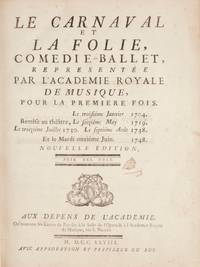
39101Quarto. Full mid-tan mottled calf with coat of arms gilt to both boards raised bands on spine in decorative compartments gilt marbled endpapers. With occasional decorative woodcut initials and head- and tailpieces throughout.<br /> <br /> 1. DESTOUCHES Andre Cardinal 1672-1749<br /> Le Carnaval et La Folie Comedie-Ballet representée par l'Academie Royale de Musique pour le premiere fois. Le troisième Janvier 1704. Remise au théâtre Le seizième May 1719. Le treizième Juillet 1730. Le septième Août 1738. Et le Mardi onziéme Juin. 1748. Nouvelle Édition Prix XXX. Sols. Paris: Aux Depens de l'Academie. On trouvera les Livres de Paroles à la Salle de l'Opera & à l'Academie Royale de Musique rue S. Nicaise. . Avec Approbation et Privilege du Roy. . De l'Imprimerie de la Veuve Delormel & Fils 1748. 1f. recto title verso "Les Paroles de Monsieur de la Motte. La Musique de Monsieur Destouches." 1f. cast list 5-51 i approbation and imprint. With manuscript paraph to title. <br /> <br /> Named cast includes:<br /> - "Acteurs Chantans dans les Choeurs" for the Côté du Roi performance Mlles. Dun Toulou Delorge Larcher Cazeau Rosalie Le Tourneur Duperey and Grimiaux and Messrs. Lefebre Le Page C Laubertie Fel Bourque Duchênet Rochette and Gratin; and for the Côté de la Reine performance Mlles. Cartou Masson Gondré Rôllet Delâtre Lablotiere Daliere Victoire Hery and Folliot and Messrs. S. Martin Le Mesle Bellanger Levasseur Belot Chapotin Favier and Le Roy<br /> - "Acteurs du Prologue" Mlle. Romainvile; Messrs. Person Le Page and de la Tour<br /> - Dancers Mlle. Puvigné in Hebé; Mlles. Lyonnois Courcelle and Thieri in Les Graces; Messrs. Devisse Caillez Laval Feuillade and Mion; Mlles. Dazenoncourt Briseval Minot and Puvigné in "Jeux & Plaisirs." <br /> <br /> A pupil of Campra Destouches achieved considerable success as a composer of stage music. His Isse was greatly admired by King Louis XIV. "Le carnaval et la folie is one of the first examples of a lyric comedy in France." James R. Anthony in Grove Music Online<br /> <br /> 2. CAMPRA André 1660-1744 Monteclair Bourgeois and Rameau<br /> Fragmens de Differens Ballets Représentés par l'Academie Royale de Musique Le Mardi 10 Séptembre 1748. Prix XXX. Sols. Paris: Aux Depens de l'Academie. On trouvera les Livres de Paroles à la Salle de l'Opera & à l'Academie Royale de Musique rue S. Nicaise. . Avec Approbation et Privilege du Roy. . De l'Imprimerie de la Veuve Delormel & Fils 1748. In a prologue and 3 acts.<br /> <br /> - 1f. recto title verso "Les Paroles de M. Danchet. La Musique de M. Campra." 3-4 cast list 5-8 "Prologue des Amours de Venus"<br /> <br /> Named cast includes:<br /> - "Acteurs Chantans dans les Choeurs" for the Côté du Roi performance Mlles. du Toulou Delorge Larcher Cazeau Rosalie Folliot Le Tourneur and Grimiau and Messieurs Lefebvre Le Page C. Laubertie Fel Bourque Duchênet Rochette and Gratin; and for the Côté de la Reine performance Mlles. Cartou Masson Gondré Rôllet Delâtre Lablotiere Daliere Chesdville Hery and Duperey and Messieurs S. Martin Le Mesle Bellanger Levasseur Belog Chapotin Favier and Le Roy <br /> - "Acteurs du Prologue" Mlle. Romainville Jacquet and Met<br /> - Dancers Mlles. Imblot Sauvage Parquet Amedée Carville Devaux Bellot L. and Bellot C; Mrs. Le Febvre Laurent Laval Caillé Feuillade and Bourgeois; Messieurs Le Lievre and Devisse. <br /> <br /> Campra was a leading figure in French theatrical and sacred music in the early 18th century.<br /> <br /> With:<br /> MONTECLAIR Michel Pignolet 1667-1737<br /> 1 Les Soirées de l'Eté tirées du ballet Des Festes de l'Eté: Le Paroles d de M. Pellegrin. La Musique de M. Monteclair. 2 cast list 3-22 pp. <br /> <br /> Named cast includes:<br /> - Actors Mlles. Coupée and Chevalier and Messieurs Person de la Tour and Le Page<br /> - Dancers Mlles. Camargo Lyonois Thierry Dazenoncourt Sauvage Beaufort and Briseval; Mrs. Dupré Dumay Matignon Hamoche and Caillé; Monsieurs Tessier and Levoir<br /> <br /> "Although not prolific Montéclair wrote in most of the genres cultivated during the early 18th century in France excepting only the keyboard. He was one of the most versatile of the generation between Lully's death 1687 and Rameau's advent as a stage composer 1733; composers of this 'préramiste' period are often described as 'imitators of Lully' but Montéclair and Campra are among those who influenced Rameau's dramatic music. In his stage works Montéclair was particularly sensitive to the dramatic function of orchestral colour. His operatic scores are much clearer than those of his contemporaries in giving directions for specific instruments like the off-stage horns 'played very softly to simulate the hunt in the distance' in the second entrée of Les festes de l'été Montéclair added that 'if no cors de chasse are available oboes and violins may play the following and remain in the orchestra'. In the same work a 'Prélude à trois basses' introduces the first scene of the third entrée where the main roles are sung by basses; the prelude to the second scene whose main roles are sung by sopranos is scored for violins and violas without continuo. The parts enter in reverse order and the melodic material is derived from the earlier prelude ex.1. Les festes de l'été and Jephté both contain an a cappella chorus and the former has a large-scale double chorus - an operatic counterpart to the choruses in Lalande's grands motets." James R. Anthony in Grove Music Online<br /> <br /> With: <br /> BOURGEOIS Thomas Louis 1676-1750 or 1751<br /> 1 L'Estime tiré Des Amours Déguisés. Les Paroles de Monsieur Fuzelier. La Musique de Monsieur Bourgeois. 2 cast list 3-14 pp.<br /> <br /> Named cast includes:<br /> - Actors Mlles. Fel Jacquet and Gondré; Messieurs de Chassé Poirier and Person<br /> - Dancers Mlles. Dallemand Thieri St. Germain Minot Sauvage Briseval and Himblot; Mrs. Dupré Lany Devisse Lyonnois Dumat Matignon Hamoche Laval and Feuillade; Mr. Doumoulin.<br /> <br /> A French composer and singer best known for his contributions to the 18th century French cantata Bourgeois also wrote ballets and divertissements.<br /> <br /> With: <br /> RAMEAU Jean-Philippe 1683-1754<br /> 1 Pigmalion Acte de Ballet. La Musique de Monsieur Rameau 2 cast list 3-10 1f. approbation and privilege<br /> <br /> "Rameau was one of the greatest figures in French musical history a theorist of European stature and France's leading 18th-century composer. He made important contributions to the cantata the motet and more especially keyboard music and many of his dramatic compositions stand alongside those of Lully and Gluck as the pinnacles of pre-Revolutionary French opera." Graham Sadler and Thomas Christensen in Grove Music Online<br /> <br /> 3. RAMEAU<br /> Les Festes de l'Himen et de L'Amour; ou Les Dieux d'Egypte Ballet Héroïque Donné à Versailles le quinze Mars 1747. Et Représenté pour la premiere fois par L'Academie Royale de Musique le Mardi 5 November 1748. Prix XXX. Sols. Paris: Aux Depens de l'Academie. On trouvera les Livres de Paroles à la Salle de l'Opera & à l'Academie Royale de Musique rue S. Nicaise. . Avec Approbation et Privilege du Roy. . De l'Imprimerie de la Veuve Delormel & Fils 1748. 1f. recto title verso blank 3 half-title with "La Poëme est de M. de Cahusac. La Musique de M. Rameau. La Danse de M. Laval Compositeur des Ballets du Roi." 4 cast list 5 synopsis 6 cast list 7-58 1f. privilege. With manuscript paraph to title. <br /> <br /> Named cast for the Prologue includes:<br /> - "Acteurs Chantans dans les Choeurs" for the Côté du Roi performance Melles. Dun Tulou Delorge Larcher Cazeau Rosalie Le Tourneur Dupereyand Grimiaux and Messieurs Lefebvre Le Page C. Laubertie Fel Bourque Duchênet Rochette and Gratin; and for the Côte de la Reine performance Mlles. Cartou Masson Gondré Rôllet Delâtre Lablotiere Daliere Victoire Hery Folliot and Messieurs S. Martin Le Mesle Bellanger Levasseur Belot Chapotin Favier and Le Roy.<br /> - "Acteurs du Prologue" Mlles. Coupée and Romainveille; Mr. Poirier<br /> - Dancers Mlles. Carville Courcelle and St. Germain in Les Graces; Mlles. Puvignée Dazenoncourt Himblot and Briseval and Mrs. Laval Laurent le Lievre and Bourgeois in Jeux et Plaisirs; Mlles. Minot Beaufort Thierry and Sauvage in Vertus. <br /> <br /> Named cast for the Premiere Entrée includes: <br /> - "Acteurs Chantans" Mlles. Chevalier and Gondré; Monsieur Jeliote<br /> - Dancers Mlles. Puvignée Derseuille Chevrier Masson Hutte St- Germain Courcelle Thiery Minot Dallemand Belnot C. Parquet Devaus Amedée Camargo Dazenoncourt Beaufort Belnot L. and Belnot C.; Mrs. Dupré F. Barrois Hamoche Mion Matignon Dumay Laval Dupré Feuillade Caillé le Liévre and Laurent; Messieurs Lany and Dumoulin<br /> <br /> Named cast for the Seconde Entrée includes:<br /> - "Acteurs Chantans" Mlle. Romainville; Messieurs le Page De la Tour and Albert<br /> - Dancers Mlles. Lyonnois Amedée Devaux Sauvage L. Belnot and C. Belnot; Mrs. Laval Matignon Dumay le Lievre Hamoche Feuillade Lyonnois Mion Laurent and Bourgeois; Messieurs Lyonnois and Dupré <br /> <br /> Named cast for the Troisieme Entrée includes:<br /> - "Acteurs Chantans" Mlles. Fel Coupée and d'Aliére; Messieurs Jeliote Person Poirier and Lamarre<br /> - Dancers Mlles. Camargo Dallemand Puvignée Lyonois St. Germain Courcelles Thiery Puvignée Desnoncourt and Minot; Mrs. Lany Dumoulin Tessier Laval Hamoche Caillez Feuillade Dumay and Dupré; Monsieur Device<br /> <br /> First Edition. Sonneck p. 500 editions of 1765 and 1778 only. <br /> <br /> 4. RAMEAU<br /> Platée Ballet Bouffon representé par L'Academie Royale de Musique pour le Carnaval De mil sept cent quarente!neuf. Le Mardi quatre Fevrier de la même année. Prix XXX Sols. Paris: Aux Depens de l'Academie. On trouvera les Livres de Paroles à la Salle de l'Opera & à l'Academie Royale de Musique rue S. Nicaise. . Avec Approbation et Privilege du Roy. . De l'Imprimerie de la Veuve Delormel & Fils 1749. 1 title 2 "Les Paroles de Monsieur Autreau. La Musique de Monsieur Rameau." 3-4 cast list 5-55. 1f. approbation and privilege. With manuscript paraph to title.<br /> <br /> Named cast include:<br /> - "Acteurs Chantans dans les Choeurs" for the Côte du Roi performance Mlles. dun Tulou Delorge Larcher Cazeau Rosalie Le Tourneur Deperey and Grimiaux and Messieurs Lefebvre le Page C. Laubertie Fel Bourque Duchênet Rochette and Gratin; and for the Côté de la Reine performance Mlles. Cartou Masson Rôllet Lablotiere Daliere Victoire Hery Folliot s. Martin Le Mesle Bellanger Levasseur Bellot Chapotin Favier and Le Roy<br /> - "Acteurs du Prologue" Mlles. Cartou Chesdeville Coupée and Rozalie; Messrs. Poirier Person De Lamare<br /> - Dancers Mlles L. Belnot C. Belnot Desiré Lyonnois Briseval Dazenoncourt Imblot Parquet and Amedée; Mrs. Laval Caillé Monservin Le Lievre Laurent Hamoche Bourgeois and Milon; Monsieur Lany<br /> - "Acteurs du Ballet" Mlles. Jacquet Fel and Coupée; Messrs. De la Tour Le Page Person Poirier and DeLamare<br /> - Dancers Mlles. Lany Courcelle St-Germain Thiery Minot Beaufort Sauvage Dallemand Carville Devaux L. Belnot C. Belnot Lyonnois Dallemand Desiré Dazenoncourt and Briseval; Mrs. Dumay Dupré Matignon Feuillade le Lievre Laval Hamoche Bourgeois Laurent and Mion; Me. Dourdet; Messrs. Lyonois Dupré Monservain Tessier Dumoulin Devise and Lany<br /> <br /> First Edition of the second version.<br /> <br /> 5. SALOMON Joseph-François 1649-1732<br /> Medée et Jason Tragedie Representée par L'Academie Royale de Musique pour la premiere fpois. Le vingt-quatrième jour d'avril 1713. Reprise le premier de May 1727. Et le vingt-deux Novembre 1736. Remise au Théâtre le Jeudi 20 Février 1749. Prix XXX Sols. Paris: Aux Depens de l'Academie. On trouvera les Livres de Paroles à la Salle de l'Opera & à l'Academie Royale de Musique rue S. Nicaise. . Avec Approbation et Privilege du Roy. . De l'Imprimerie de la Veuve Delormel & Fils 1749. 1 title 2 "Les Paroles de Monsieur Pellegrein. La Musique de Monsieur Salomon." 3-4 cast list 5-64 i approbation and privilege. With manuscript paraph to title. <br /> <br /> Not in Sonneck.<br /> <br /> A French composer and organist "Salomon's operas Medée et Jason and Théonoé are in the tradition of Lully and Campra." Guy Bourligueux in Grove Music Online<br /> <br /> Binding somewhat worn rubbed and bumped; minor loss to head and tail of spine; slightly shaken; hinges partially split. Minor internal wear; edges slightly browned; occasional foxing; two leaves loose. Very good crisp wide-margined copies overall. unknown
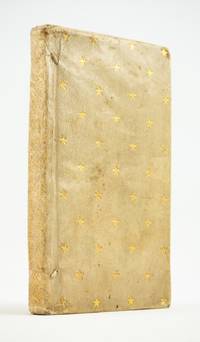
1689ST20606Bordeaux: Pierre Abegou Jean Martel 1689. 156 x 89 mm. 6 1/8 x 3 1/2". 14 p.l. 95 1 80 pp. With a life of the author. <br/> APPROPRIATELY CELESTIAL CONTEMPORARY VELLUM SPRINKLED WITH GILT STARS on covers flat spine densely tooled with repeating Gascon-style fleurette. Two section titles with an excellent woodcut depicting Nostradamus surrounded by the instruments of his trade woodcut tailpieces of stars and moon. Front pastedown with pencilled name and annotations of Nostradamus scholar Daniel Ruzo de los Heros. USTC 6163254. Minor soiling and three small brown stains to covers first quire and last two quires a bit browned due to paper quality one leaf with horizontal crease partially obscuring a line of text though still legible other isolated imperfections but an excellent copy nevertheless the text clean and fresh and the curious binding shining with gilt and showing almost no wear.<br/> <br/> In a particularly charming star-studded binding this is an excellent copy of Nostradamus' famous prophecies which has been part of two major Nostradamus collections. The famous astrologer and physician Michel de Nostre-Dame known as Nostradamus 1503-66 caused a sensation with the publication of his "Centuries" in 1555 a collection of predictions written in nearly impenetrable quatrains that has enjoyed a certain measure of popularity ever since. Published in Bordeaux in 1698 our edition contains the 942 surviving predictions together with a brief biography of Nostradamus. Our copy is distinguished by a strikingly appropriate contemporary "reliure parlante"--a binding designed to mirror the contents of the book it covers; in this case the field of shimmering gilt stars perfectly suits the subject of reading the heavens and wonderfully complements the celestial woodcuts in the book. This copy has been part of two notable libraries of Nostradamus material. Former owner Daniel Ruzo de los Heros 1900-91 was a Peruvian scholar and eccentric whose wide-ranging career included serving as district mayor of Miraflores in Lima publishing numerous works on the possible man-made nature of the geologic formations in Marcahuasi and most relevant here collecting a wealth of Nostradamus material. His 1970 work "El Testamento Autentico de Nostradamus" includes his theories on Nostradamus' prophecies along with a bibliography of published editions of Nostradamus' works including many from his own library; the present copy is not included suggesting it was a later addition to Ruzo's collection. The extensive pencil notations on the front pastedown include Ruzo's cryptographical interpretations of Nostradamus' verses--including an anagram of "Nostradamus" as "Mandat Russo" roughly translated from the Spanish as a "command made by Russo" which Ruzo has further marked with his own name to ensure no one could miss the joke. The present copy subsequently passed into the library of Elmar R. Gruber b. 1955 psychologist researcher and noted collector of mediumistic art. His esoteric research led to an interest in Nostradamus and he built a significant collection of Nostradamus material culminating in his 2003 publication "Nostradamus: Sein Leben sein Werk und die wahre Bedeutung seiner Prophezeiungen.". Pierre Abegou, Jean Martel unknown
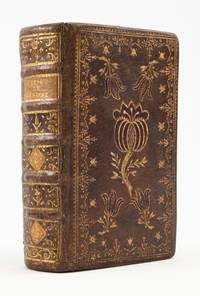
1743ST20461-4Paris: Chez Grange 1743. 136 x 85 mm. 5 5/8 x 3 1/4". 6 p.l. 592 8 pp. <br/> VERY PRETTY CONTEMPORARY PARISIAN BROWN MOROCCO GILT AND INLAID BY THE "ATELIER À LA TULIPE" covers with floral frame accented with heart tool pierced by two arrows a large pomegranate of gilt-tooled inlaid dark red morocco at center four inlaid red morocco tulips at each corner raised bands spine compartments with small gilt botanical tool at center two of these on inlaid tan morocco lozenges tan morocco label marbled endpapers all edges gilt. Text in French and Latin in parallel columns. Front pastedown with ex-libris of Jean Fürstenberg; verso of front free endpaper with early ink inscription: "Bibl. Schol." With a handwritten note once tipped onto the final page of daily prayers with handwritten Latin prayers in a contemporary hand. For the binding: Foot "Henry Davis Gift" III 179 Davis 561; Michon "Les Reliures Mosaiquées du XVIIIe siècle" pp. 51-2 and no. 223. Corners a little rubbed front free endpaper creased one leaf with old thin marginal glue stain from once tipped-in manuscript prayers that are now laid in one lower corner torn away costing a few letters at the ends of seven lines on each side other minor defects from devoted use but an excellent specimen nevertheless the text generally clean and with nothing approaching a major defect and the unsophisticated binding very well preserved.<br/> <br/> This prayer book in French and Latin comes in a charming binding by a workshop Michon dubbed "Atelier à la tulipe" after the distinctive three-petalled flower that appears on the covers here. Foot records a 1752 edition of "Heures Nouvelles" in a binding nearly identical to ours: a large central pomegranate on the covers with a tulip in each corner a delicate gilt frame and a spine in six compartments with a gilt flower or fruit at center in two cases as here on inlaid citron morocco. According to Michon the "tulipe" workshop active from 1740 to 1785 was closer in style to Derome than to Padeloup though it had its own distinctive style one which emphasized harmonious mosaic designs. The pomegranate that dominates the boards is a Catholic symbol of the Passion of Christ and is often featured in Renaissance paintings of the Madonna and Child. This symbolism was no doubt meaningful to the early owner given the signs here of devoted use: in addition to text neatly marked with "" signs at the places where one should make the sign of the cross this person also tipped in a leaf with seven neatly written short prayers in Latin for protection and purification to be said while one is washing getting dressed and preparing for the day ahead. Even dedicated use could not dim the beauty of our binding which attracted the eye of collector and connoisseur Jean or Hans Fürstenberg 1890-1982 a discriminating bibliophile of refined taste who assembled one of the great collections of the 20th century especially rich in fine and historic bookbindings and noted for its outstanding condition. Although not common bindings from this atelier nevertheless appear at auction from time to time invariably in small format like the present book and generally commanding significant sums of money as a typical example and good comparable a 1761 "Heures Royales" of precisely the same size and basic decoration as ours sold in 2017 at Alde for €2375. Chez Grange unknown
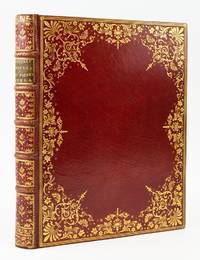
1772ST18628bBirminghamiae: Typis Joannis Baskerville 1772. First Baskerville Edition. 310 x 260 mm. 11 7/8 x 9 3/4". 1 p.l. 200 221-372 pp. but complete. <br/> SUPERB CONTEMPORARY RED MOROCCO LAVISHLY GILT IN THE STYLE OF DEROME covers with wide dentelle frame composed of botanical elements and many small tools raised bands spines gilt in compartments with central floral sprig surrounded by acorns flowers stars and dots volute cornerpieces green morocco labels gilt turn-ins marbled endpapers all edges gilt. Front pastedowns with engraved bookplate of P. Dupont and with morocco heraldic book label. Gaskell 44. ◆A breath of rubbing to extremities title page a little browned final page a bit foxed other trivial imperfections but AN EXCEPTIONALLY FINE COPY internally clean smooth and bright and in a sparkling binding.<br/> <br/> This is the impressive quarto edition of a trio of great Roman love poets in a premier binding befitting the elegant printing. In a sheet dated 1760 which Baskerville issued appended to a specimen of his folio Bible the printer discusses his proposed "Baskerville Classics": "Many gentlemen" he says "have wished to see a sett of the Classicks . . . in the Manner Letter and Paper of the 'Virgil' already published" and he vows to print the same with the poetical classics first. The present items are from what turned out to be seven Baskerville quarto printings of the classics mostly done late in the printer's career but according to Reed bearing "the marks of unabated genius." These volumes says Reed would "suffice had Baskerville printed nothing else to distinguish him as the first typographer of his time." In the present works the stately typography the luxurious paper textured but feeling rather like vellum and the spacious design combine to give the reader a particularly gratifying feeling of strength and serenity. The extraordinarily smooth surface of our leaves provides a tactile experience not available from any other 18th century printer Bodoni included. The beautiful binding here is unsigned but is clearly the product of a first-rate workshop; while it is not uncommon to see a volume from the Baskerville quartos in a decorative contemporary binding the present one would have a place in the front row of any assemblage. Typis Joannis Baskerville unknown
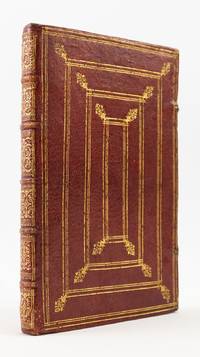
1651ST19567-214Paris: Chez F. Mazot 1651. 172 x 110 mm. 6 3/4 x 4 1/4". 3 34 leaves 35-39 1 pp. 12 leaves. <br/> Fine old contemporary red morocco covers panelled with gilt fillets with flowering urn cornerpieces raised bands the spine densely gilt in compartments with scrolls and dots two clasps marbled endpapers all edges gilt. ENGRAVED THROUGHOUT WITH 38 FULL-PAGE ILLUSTRATIONS consisting of one portrait two allegorical religious scenes including title and 35 illustrations of the Holy Eucharist plus 44 PAGES OF ENGRAVED TEXT 37 of these with text flanked by full-length figures of saints accompanied by other religious symbols at head and foot of page six framed with vignettes of angels the Madonna or scenes from the life of David one page with text only. Contemporary ink inscription to the lower margin of the title page reading "In Archui. vitr." Endleaf with engraved armorial bookplate of Viscount Strathallan; front pastedown with the bookplate of John Evelyn. Duportal pp. 244-45; Brunet V 624; Graesse VI 4. Trivial rubbing to the extremities leather straps slightly worn but holding strong but A SUPERB COPY exceptionally clean fresh and bright internally and in its solid and unsophisticated and still very pleasing binding.<br/> <br/> This is a particularly attractive copy of a sumptuously illustrated prayer book in its especially appealing original 17th century binding. According to Duportal it is "One of three important publications whose engravings reveal the trend characteristic of religious illustrations in France between 1601 and 1660." The work opens with a dedication to Charles d'Aubespine Marquis de Châteauneuf 1580-1653 with a full-page portrait by Guillame de Gheyn b. 1610. Then the bulk of the book is made up of two groups of plates. Those in the first group appear primarily on the rectos and contain prayers in Latin and French flanked by pairs of saints; gaps in the prayers are filled by naturalistic flowers insects and birds. Many of these plates also include a scene or two in miniature depicting the life of the saints or a vignette of angels. Just two of these engravings are signed "J. Collin" but they all appear to be in the same hand and demonstrate an impressive level of finesse and delicacy with emotive graceful saints depicted with sure light lines. Duportal notes that our artist had a "talent charmant" and that well-executed dry-points of this type are quite rare in French books of the period. The second group of engravings appear on the versos and depict the performance of a part of the Mass beneath a cloud in which appears a relevant scene from the life of Christ. They are all unsigned and clearly by a different hand with more rustic features--possibly "copies of originals published abroad" according to Duportal. The book concludes with text framed by gamboling putti and scenes from the life of Christ and facing full-page bust portraits followed by the Penitential Psalms each with elaborate illustrated frames depicting scenes from the life of David. Copies of this work can be found with varying numbers of leaves and engravings but the present item seems to be an early edition as it contains the earlier state of the engravings on the versos before they were substantially reworked and it does not contain the "Privilege du Roy" with the date 1652 or 1653. Our copy comes from the books assembled by the famous diarist John Evelyn 1620-1706 a library that Quaritch's dictionary of English book collectors calls "a noble collection." De Ricci says that the finest books from the library bear Evelyn's monogram as ours does and this bookplate brings with it the expectation of remarkably fine contemporary condition. This copy also has the bookplate of Viscount Strathallan possibly William Drummond 1810-86 Conservative MP and the second to hold the family title following the reversal of the attainder put in place after his family's participation in the Jacobite uprising. Chez F. Mazot unknown
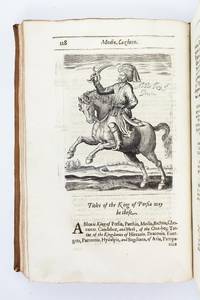
1634ST20186London: printed by William Stansby and Jacob Bloome 1634. FIRST EDITION. 290 x 195 mm. 11 1/2 x 7 3/4". 6 p.l. 225 15 pp. <br/> Contemporary sprinkled calf raised bands traces of old paper label to spine pastedowns lifted to reveal leather bands and manuscript document fragments used as sewing guards all edges sprinkled red expert repair to rear joint. With additional engraved title page featuring two figures of Persian dignitaries and three small travel vignettes signed at foot by William Marshall and 36 engravings in the text the majority vignettes but one full-page and nine more than half a page tall. Front endpaper with ink armorial stamp of Sir Walter John Trevelyan 8th Baronet of Nettlecombe and High Sheriff of Cornwall. Price inked in a contemporary hand to the front endpaper. Sabin 31471; STC 13190.3; ESTC S92948. Front board a bit splayed covers with three old dampstains and a few scars and tiny wormholes but a very pleasing original binding with almost no wear to the joints. A very few marginal smudges made during printing other quite trivial imperfections but AN ESPECIALLY FRESH BRIGHT AND CLEAN COPY INTERNALLY with rich impressions of the engravings.<br/> <br/> This is a contemporary copy in remarkably fresh internal condition of an important and entertaining account of the travels of a 17th century Englishman in exotic Asian and African territories particularly Persia. It is significant both for the ways it is accurate and for the ways it is fictitious. Sir Thomas Herbert 1606-82 left for Persia on a diplomatic mission to Shah Abbas in 1626 as part of the entourage of Sir Dodmore Cotton. The mission was not successful: Cotton and the mission's other leader Sir Robert Shirley both died in 1628 leaving their retinue at loose ends with the increasingly unimpressed Shah. Herbert made a slow return to England traveling through a large portion of Asia and Africa and even sailing up the coast of North America. He finally returned to England in 1630; four years later he published this account of his adventures. The text describes meetings with people of many cultures as well as encounters with exotic animals including the dodo flamingoes and flying fish. Herbert's accounts are of great importance for their details of early Asian travel by Westerners. At the same time the author was unable to resist the urge to embellish a good story and according to DNB gave implicitly first-person accounts of places he had not in fact visited. One such detour into the fanciful comes in the chapter involving the author's apparent visit to America. In it Herbert discusses the belief that the mythical Welsh king Madoc ap Owen-Gwyned had settled in North America in the 9th century for which he provides linguistic evidence that Sabin calls "entirely fanciful." DNB tells us that "this segment was apparently included to please the earl of Pembroke's own Welsh nationalist fancies. It also continued to help fuel various theories about Madoc's colonies and Welsh Indians in North America until the early years of the nineteenth century." Herbert's tale is profusely illustrated by William Marshall fl. 1617-49 with engravings that are sometimes more imaginative than accurate see for example the depiction of the shark on page 6 or the penguin on page 13. Despite these rather amusing inaccuracies the illustrations are lively and detailed providing a sense of the awe the early readers must have felt when imagining foreign places. Our copy in a period binding with part of a manuscript ledger used in the binding process visible is from the library of Walter John 1866-1933 8th baronet Trevelyan who as his inkstamp suggests served as High Sheriff of Cornwall from 1906-07. printed by William Stansby, and Jacob Bloome unknown
185042495Italy 1850. Gouache over faint etched line black gouache border. Period gilt and faux bois frame. A splendid panoramic view of Lake Como.<br/> <br/> Catering to the foreigners flocking to the region on The Grand Tour this hand-painted print beautifully depicts the famed picturesque lake with rich bands of blue highlighting the water and sky with the surrounding hills and mountains dotted with luxurious villas. The view looks north up the lake towards Switzerland from above Bellagio which occupies the point at which the lake divides in two. unknown
185042496Italy 1850. Watercolour over faint etched line black gouache border. Period gilt and faux bois frames. A splendid panoramic view of Lake Maggiore.<br/> <br/> Catering to the foreigners flocking to the region on The Grand Tour this hand-painted print beautifully depicts the famed picturesque lake with rich bands of blue highlighting the water and sky with the surrounding hills and mountains dotted with luxurious villas. In this view of Lake Maggiore we see from a very high vantage point the Borromean Islands: Isola Bella Isola Madre and Isola dei Pescatori with their extraordinary gardens. unknown
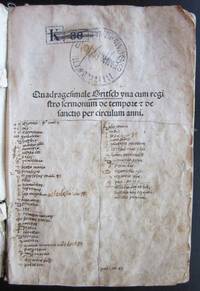
1495SAV133Venice: Lazarus de Suardis 1495. Paperback. Very Good . Venice: Lazarus de Suardis 21 March 1495. 8vo 173 x 116 mm. 284 leaves. Collation: 1-84 a-H in 34 gatherings of 4. Woodblock monogram printers device on colophon leaf. 48 lines double column Gothic type with printed guide letters. Stamp of the St. Charles Borromeo Seminary Library deaccessioned and two library shelfmarks pasted in Q83 and K30. Contemporary limp vellum; lightly soiled with some dampstains backstrip partly perished with partial ms. title and light edgewear; lower outer corner of l5 and D2 torn affecting a few words but in remarkable shape given its extensive use; cloth folding case. Title extensively inscribed in Latin with two columns of a subject index for sermons. The annotator was interested in indexing themes like heaven paradisus and hell infernus or Virgin Mary and Evangelists and easily being able to locate sermons for certain medieval virtues and vices or sins like luxury patience love anger and justice. Early biographical inscriptions on rear blank date to probably to the mid-sixteenth century and venetis gives this book a probable Venice home at one point. There are further scattered annotations notes and references to the index which reflect on sermons of interest. This book likely once belonged to preaching Franciscan monk from northern Italy. This monastic association is further evident with an ownership inscription in the lower margin of a1 Iste Liber est fratus dominici. Preaching was most closely associated with the Franciscans who also traveled extensively to reach audiences. The compact octavo format and lightweight wrappers of this volume would have made transportability much easier. Incunable edition of Johannes Gritschs register of medieval sermons called the Quadragesimale with an interesting period index of subjects probably added by a Franciscan scribe. Johannes Gritsch of Basel himself a Franciscan monk delivered his sermons in German and translated them in simple Latin ready for translation and adaptation to the vernacular. He used scriptural passages supporting texts from classics and fables and exemplary stories to prove moral grounds. Two main themes have been recognized to dominate the medieval sermon: the awareness of death and the need for contrition. Preachers would have relentlessly implored their audience to come to repentance. Brother Dominic the early modern friar who heavily used this book was no exception. He leaves evidence of his moral preaching interests throughout the book. The preliminary subject index is an invaluable glimpse into a composing preachers mindset at the dawn of the sixteenth century. This is the twenty-first edition of Gritschs Quadrigesimale which included fifty numbered sermons and additional sermons for specific church feasts; the first appeared in 1468 and a succession of printings appeared well into the sixteenth century. In fact a Lyons edition of the "Quadragesimale" was produced just one month later after this one in 1495 by Joannes Treschel. Printed sermon compilations were especially popular in monastic communities where volumes of model sermons would have enjoyed wide circulation. ISTC ig00506000. <br/><br/>Incunable edition of Johannes Gritschs register of medieval sermons called the Quadragesimale with an interesting period index of subjects probably added by a Franciscan scribe. Johannes Gritsch of Basel himself a Franciscan monk delivered his sermons in German and translated them in simple Latin ready for translation and adaptation to the vernacular. He used scriptural passages supporting texts from classics and fables and exemplary stories to prove moral grounds. Two main themes have been recognized to dominate the medieval sermon: the awareness of death and the need for contrition. Preachers would have relentlessly implored their audience to come to repentance. Brother Dominic the early modern friar who heavily used this book was no exception. He leaves evidence of his moral preaching interests throughout the book. The preliminary subject index is an invaluable glimpse into a composing preachers mindset at the dawn of the sixteenth century. This is the twenty-first edition of Gritschs Quadrigesimale which included fifty numbered sermons and additional sermons for specific church feasts; the first appeared in 1468 and a succession of printings appeared well into the sixteenth century. In fact a Lyons edition of the "Quadragesimale" was produced just one month later after this one in 1495 by Joannes Treschel. Printed sermon compilations were especially popular in monastic communities where volumes of model sermons would have enjoyed wide circulation. ISTC ig00506000. Lazarus de Suardis paperback
17969581Britain: Unpublished 1796. Fine late 18th century English manuscript atlas beautifully drawn almost certainly by a child and offering 68 full-page maps 32 in outline and a further 36 with keyed explanatory apparatus. The manuscript's creator probably in or around London details a colonial-era map of North America California as peninsular entitled 'Ten Northern American Colonies' going no further south than Virginia as well as providing maps of the 'East Indies and China' and a further 'Epitome of the new World' - north and south America as well as maps of England and Europe. We have not identified which printed map of the American colonies 'M.L.S.' was working from. This manuscript atlas is a particularly good example of its kind. The only English county to have its own full map is Middlesex - hence the suggestion of a London origin to the manuscript. The presence of maps of legal circuits in England may suggest a lawyerly family background. Map drawing for children in the 18th century was part of a polite education - the kind undertaken by the Bertram children in Jane Austen's Mansfield Park - and in Britain functioned as a way of understanding imperial expansion and contraction if it were to be acknowledged in the years after 1776. These maps could demonstrate and develop as here the child's skilled draughtsmanship in the copying process which would have drawn upon printed examples available to the child or their tutor. And when completed the atlas could be retained to demonstrate the child's educational achievement - certainly the family involved in the production of this atlas approved of the outcome as they commissioned its attractive tree-calf binding after the manuscript was completed. DESCRIPTION: Attractively bound quarto size manuscript 19x24cm in tree calf spine relaid gilt sun emblems to the backstrip and 'Maps' on a black label. Marbled endpapers; paper with 'GR' watermark and horizontal chainlnes. Written on the the second flyleaf the initials 'MLS'. Manuscript title: 'A System of Geography Consisting of Thirty-Five Maps 1796' no printed analogue to this located. A 'Contents' page follows the title offering a diagram of 'Circles' followed by the 35 maps that cover Europe the Americas North America and South America Ireland Scotland 6 maps of the legal circuits in England the 'War on the Rhine' concluding with 'East Indies and China' West Indies and 'Epitome of the Old World' 'of the New World' 'of England'. Maps drawn in ink on the rectos and explanatory details opposite. Maps 1-32 are each presented twice. The first version presents the topographical outline only; the second also has the apparatus and key. The three epitome maps 33-35 are presented once only with full apparatus. An additional map on watermarked paper from 1800 and also initialled 'M.L.S.' is also laid in. The manuscript runs to pp 144 plus a single leaf laid in & terminal blanks. Please contact Christian White Rare Books Ltd for more information or images of this item 1796 Unpublished unknown
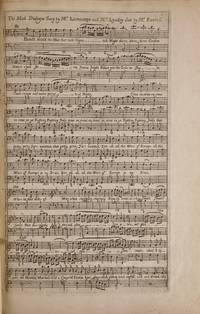
41185Folio. Contemporary dark brown leather-backed blue/gray boards. Titled "A collection of Songs by several eminent Masters" in contemporary manuscript on recto of first page of music. Engraved throughout.<br /> <br /> Provenance<br /> With "Lucy Gregory July the 6th 1756" and "Prince Gregory" in contemporary manuscript to front pastedown. Manuscript titling and annotation "Ex dono Revd. Dr. Dawson For use of Musical Society Windsor Castle to be returned to Dr. Dawson When ye club ceases viz when it is reduced to three persons" to blank recto of first song along with title and index to blank verso of final song.<br /> <br /> Contains 33 songs including works by Barrett Blow Eccles Galliard Handel 8 Leveridge Orlandini Pepusch Daniel Purcell Henry Purcell 2 Weldon and others. Scored mainly for voice most for one voice and few for two and figured basso continuo with single-line flute arrangements for some songs.<br /> <br /> 1. Handel. "A Favorite song in the Opera of Theseus" "See see your faithfull lover pineing". London ca. 1720. i blank 2 i blank pp. BUC p. 1001.<br /> <br /> 2. Purcell H. "Sing all ye muses. A song set by Mr. Henr. Purcell The Words by Mr Durfey." London ca. 1700. From Part I of The Comical History of Don Quixote. 4 pp. BUC p. 861 another edition. Scored for two voices and figured basso continuo.<br /> <br /> 3. Handel. "Mi brilla in English and Italian" "Be Kind and Love" / "Mi brilla nel seno". London ca. 1720. i blank 2 i blank pp. HWV 10 Silla.BUC p. 93. <br /> <br /> 4. Purcell H. "The Mad Dialogue Sung by Mr. Leveridge and Mrs. Lynsey" "Behold the man with gigantick might". From The Richmond Heiress. London ca. 1700. 3 i blank pp. BUC p. 862.<br /> <br /> 5. Handel. "Vieni torna in English & Italian" "Turn o turn thee dearest Creature / Vieni torna Idolo mio". London ca. 1715. i blank 2 i blank pp. HWV 9 Teseo. BUC p. 1041.<br /> <br /> 6. Handel. "A Favourite Song by an Eminent Master Within the Compass of the Flute" Recitativo: "Lo here my Love" / Aria: "Love in her eyes sits playing". London ca. 1725. i blank 2 i blank pp. BUC p. 624.<br /> <br /> 7. Handel. "A Song with a Symphony for an Octave Flute & Violins" Recitativo: "Ye verdant Plains" / Aria: "Hush ye pretty warbling Quire". London ca. 1722. i 3 paginated 4-6 i blank pp. HWV 49 Acis and Galatea. BUC p. 432 date incorrect; JISC two copies at Oxford and the British Library. In score for piccolo violin voice and unfigured basso continuo. <br /> <br /> 8. Handel. "A song by an Eminent Master" "Would you gain the tender Creature". London ca. 1750. HWV 49 Acis and Galatea. BUC pp. 432 1091.<br /> <br /> 9. Eccles. "Air in the Opera Semele. The words by Mr Congreve" "Come Zephrys". London ca. 1730. i blank 2 i blank pp. BUC p. 309. <br /> <br /> 10. Orlandini. "A favourite Song in the Opera of Arsaces Sung by Sigr. Senesino" "Se sol la mia morte" / "Cœlestial Corinna". London ca. 1721. i blank 2 i blank pp. BUC p. 56. "Lucy Gregory" in contemporary manuscript to upper outer corner of final blank page. <br /> <br /> 11. Anon. "The Ladys Repulse or Favourite Minuet in Hercules" a pasticcio. London ca. 1715. 2 pp. BUC p. 478. <br /> <br /> 12. Barrett. "A Song sett by Mr. Iohn Barrett Sung by Mrs. Lindsey" "Mistake not Nymph". London ca. 1705. 1f. recto music verso blank pp. BUC p. 86.<br /> <br /> 13. Barrett. "Liberia A Song Set to Musick" "Liberia's all my Thought". London ca. 1715. 1f. recto music verso blank pp. BUC p. 86.<br /> <br /> 14. Purcell D. "Lovely Charmer. A song in the Island Princess." London ca. 1700. 1f. recto music verso blank pp. BUC p. 856.<br /> <br /> 15. Leveridge. "A Favorite Song in the new Opera The words by Mr. Leveridge." London ca. 1720. 1f. recto music verso blank pp. BUC p. 339.<br /> <br /> 16. Anon. "Tom a Bedlam" "Forth from my dark and Dismall cell". London ca. 1720. 1f. recto music verso blank pp. BUC p. 345. <br /> <br /> 17. Leveridge. "A Scotch Song Sung by Mr. Leveridge the words by Mr Durfey" "Farewell my Bonny". London ca. 1710. 1f. recto music paginated "10" verso blank pp. BUC p. 325.<br /> <br /> 18. Blow. "Go Perjur'd Man. A Song for two Voices." London ca. 1710. 1f. recto music verso blank pp. BUC p. 115.<br /> <br /> 19. Anon. "A song by a Gentleman" "How charming". London ca. 1730. 1f. recto music verso blank pp. BUC p. 370.<br /> <br /> 20. Weldon. "Orpheus Song to the Waves Sett by Mr. Iohn Weldon Sung by Mrs. Linsey." "Stop O ye Waves". London ca. 1710. 1f. recto song verso version for flute pp. BUC p. 1065.<br /> <br /> 21. Anon. "A Song by a Great Master" "Beauteous Idol charming Creature". London ca. 1720. 1f. recto music verso blank pp. BUC p. 93. <br /> <br /> 22. Turner. "A Song On Mira's Singing and Beauty" "Singing charms The Bless'd above". London ca. 1710. 1f. recto music verso blank pp. BUC p. 1024.<br /> <br /> 23. M. F. "A song in the Italian style by F M" "Ah Crudel prenesto". London ca. 1720. 1f. recto music verso blank pp. BUC p. 638. A humorous song satirizing Italian opera with text in nonsense-Italian.<br /> <br /> 24. Galliard. "Sung by Mr. Pack in The Opera of Circe" "Fairest if thou can'st be King". London ca. 1720. 1f. recto music verso blank pp. BUC p. 358.<br /> <br /> 25. Vanbrughe. "Apollo to Daphne by Mr. Vanbrughe" "My Dearest Daphne". London ca. 1735. Not in BUC but may be from Vanbrughe's collection Mirth & Harmony; see BUC p. 1034.<br /> <br /> 26. Anon. "The Address with The Lady's Answer" "Ah lovely Nymph". London ca. 1725. 1f. recto music paginated "7" verso blank pp. BUC p. 11. <br /> <br /> 27. Handel. "A Song the words by Mr. Kirkland set to a Trumpet Minuet of Mr. Hendell's" "Phillis the Lovely". London ca. 1725. 1f. recto music verso blank pp. HWV 349 Watermusic. BUC p. 781. <br /> <br /> 28. Young and Leveridge. "The Reproach" "Send back my long stray'd Eyes" and "Mr. Leveridge's Tune." London ca. 1720. 1f. recto music verso blank. BUC p. 1098. The instrumental tune appears to be unrelated to the song; here may however be some association as the song incorporates imagery related to the eyes and the tune's name not given here is "Black-eyed Susan." <br /> <br /> 29. Anon. "A Song after the Italian Manner by an Eminent Master" "Lovely cruel charming fair". London ca. 1715. 1f. recto music verso blank pp. BUC p. 632 another edition. <br /> <br /> 30. Handel. "Di godere in English & Italian by Mr. Hendell" "Di godere" / "Oh my dearest". London ca. 1720. 1f. recto music verso blank. HWV 228. Not in BUC; possibly related to an edition in Foundling Museum. JISC "This song appeared in two editions in 1719: the first was in The Yearly Subscriptions a volume of twenty songs advertised on 5 December the second in the Monthly Mask of Vocal Music issued on 24 December".<br /> <br /> 31. Pepusch. "A Song in the Mask of Martillo" "Tender Hearts to ev'ry Passion". London ca. 1716. 1f. recto music verso blank pp. BUC p. 722. <br /> <br /> 32. Carey. "The Midsummer Wish Taken from the Journal" "Waft me some soft and cooling Breeze". London ca. 1725. 1f. recto music verso blank pp. BUC p. 165. <br /> <br /> 33. Leveridge. "A Song in the Beau Demolish'd Sung by Mr. Leveridge" "Whilst I'm carrouzing". London ca. 1730. 1f. recto music verso index in contemporary manuscript pp. BUC p. 615. <br /> <br /> Binding worn rubbed and bumped; spine partially lacking; lower board nearly detached. Minor dampstaining and worming; occasional small stains. John Barrett ca. 1674-ca. 1745 was an English composer and organist pupil of John Blow. "Like many of his contemporaries such as Jeremiah Clarke John Eccles and Daniel Purcell Barrett composed mainly for the theatre and his many songs mostly of the double-barrelled art song variety are both tuneful and attractive." Christopher Powell revised by H. Diack Johnstone in Grove Music Online<br /> <br /> John Blow 1649-1708 was an English composer organist and teacher. "By his mid-20s he had become the foremost musician in England and in later years he was the elder statesman of the Restoration school whose chief luminary was Henry Purcell." Bruce Wood in Grove Music Online <br /> <br /> John Eccles ca. 1668-1735 was an English composer. "Eccles's greatest talent is revealed in his many songs. Remarkable for their beautifully contoured melodies and impeccable prosody they quickly capture the mood and subtleties of the poetry and are eminently singable. His large works are notable for their dramatic pacing and their carefully planned tonal architecture. In the latter respect he surpassed even Purcell and was far in advance of his day. Eccles brought the Restoration tradition to its close. After Purcell's death in 1695 he was undoubtedly the greatest of the Restoration theatre composers." Stoddard Lincoln in Grove Music Online<br /> <br /> John Ernest Galliard ca. 1687-1749 German composer and oboist "certainly played a significant role in London's musical life in the first half of the 18th century." Roger Fiske revised by Richard G. King in Grove Music Online<br /> <br /> George Frideric Handel 1685-1759 English composer of German birth was "one of the greatest composers of his age." Anthony Hicks in Grove Music Online<br /> <br /> Richard Leveridge 1670-1758 English bass and composer was "a leading singer on the London stage and a popular composer of songs." Olive Baldwin revised by Thelma Wilson in Grove Music Online. <br /> <br /> Giuseppe Maria Orlandini 1676-1760 was an Italian composer. "The large number and wide spread of performances of his operas confirm the opinions of Burney La Borde Martini and Quadrio that Orlandini was highly celebrated as a composer of dramatic music. He was best known for his comic intermezzos in which genre his importance almost certainly outweighs that of Pergolesi. Indeed Orlandini's Bacocco e Serpilla under various titles and with added music by various composers appears to have been the most frequently performed piece of musical drama in the entire 18th century." John Walter Hill and Francesco Giuntini in Grove Music Online<br /> <br /> Johann Christoph Pepusch 1667-1752 a German-born composer and theorist active in England is best known for his arrangement of music for The Beggar's Opera to John Gay's libretto; he composed works in all genres including vocal music.<br /> <br /> Daniel Purcell ca. 1664-1717 brother or cousin of Henry Purcell was an English composer and organist. "Although he was a victim of invidious comparison with Henry Daniel was a talented composer whose style while perhaps too ornate is never dull or incompetent." Mark Humphreys revised by Robert Thompson in Grove Music Online<br /> <br /> Henry Purcell 1659-1695 composer and organist "was one of the most important 17th century composers and one of the greatest of all English composers." Peter Holman and Robert Thompson in Grove Music Online<br /> <br /> John Weldon 1676-1736 an English organist and composer "of considerable talent" was a pupil of Henry Purcell. Margaret Laurie revised by Stephen Bullamore in Grove Music Online. unknown
175751848Amsterdam Petrus Schenk 1757-74. Large folio. 55 x 345 cm. A large uncut copy in contemp. marbled boards spine gone and later backed with buckram original corners in leather a bit bumped. Stamps on foot of first title-page. Halftitel title-pages in red/black with engraved vignettes. 22 engraved leafs with dedications 14;28 pp. and 25 24 large double-page or triple-page folded engraved plates 6 additional plates only sometimes present. With a total of 55 plates. On thick heavy paper wide-margined and internally fine and clean. <br/><br/><em>Second edition. "Tileman van der Horst and Jan Schenk produced the Theatrum Machinarium Univesale one of the most celebrated works on the construction of all those elements so necessary to keeping life dry in Amsterdam the place of the book’s publication. It was perhaps the most important work then produced on dikes sluices dams weirs canals and swing-bridges the very elements of existence in Holland. Jan Schenck was the engraver of this work which may also be the most accurate and the most sumptuously illustrated book of its type in Holland in the 18th century - the technical aspects of the rendering was just superb." - Brunet V1082 - Graesse VII 258. </em> hardcover
a796334to. 54 leaves cloth cover fully decorated with metallic thread in ornate embossed decoration with sequins sewn in and much fancy knotting of gold and silver threads on what appears to be silk cloth. Book is entirely hand written and hand illustrated with full page watercolor frontis of Chalice; title page "In Depositione SS. Sacramenti" no place no date given. 54 leaves of handprinted text in black and red a few internal pages are blank with grey line border on every page. Contents are hymns and prayers: Hymnus Pangelingua Oratio de Sacramento Preces post Psal. Miserere Oratio pro Imperatore Oratio pro infirmo Oratio pro Serenitate et de S. Vitale Preces in Gratiarum Actionibus In Solemnitate SS Reliquianum and so on. One color illustration in text one page written on different paper and tipped in. Internally VG neat and clean; cover is faded and somewhat worn cloth but not book itself is split at hinge. Cover is Fair intact. Nice example of relatively rare mid-17th century book binding. . hardcover
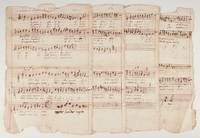
39441Folio ca. 335 x 235 mm. 8 pp. in total with each of the four parts notated in ink on both sides of a single leaf. Text in Latin.<br /> <br /> Includes settings of "In lumen tu splendor" "Ibant Maji quam indesant" "Hic nempe mundi gaudia" and "Qui pius puidens." <br /> <br /> With several corrections; a short passage added to the end of the first page of the Canto part in another hand.<br /> <br /> Somewhat worn; slightly browned; creased at central folds with several small holes; frayed at edges with small chips; some show-through; portions of both upper and lower blank margins lacking affecting titling but not notation. We have not located any other sources of the present works either manuscript or printed. unknown
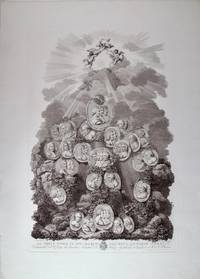
180740691Firenze: La Societa Rainaldi 1807. Each print features small circular engraved portraits and includes mythological elements at the upper portion amongst clouds and rays of sunlight with a background of a rocky outcrop including elements including vegetation and a running stream. The scenes evoke the celestial qualities of music and a reverence for the musicians depicted. <br /> <br /> On good quality laid paper sheet size 695 x 505 mm; plate impression 650 x 365 mm.<br /> <br /> Plate 1<br /> With printed dedication "Al Nobil uomo il Sig: March: Cav: Gius: Antonio Corsi Comandante del R. Corpo dei Cacciatori di Firenze e Gentlehome di Camera di S. M. il Re d'Etruria." <br /> <br /> Subjects include:<br /> Abel d'Arezzo Bach Bertoni Caffaro Campioni Cimarosa Clari Corelli Durante Fux Galilei Galuppi Gluck Handel Jomelli Ligneville Manna Leo Marcello Martini Miers Morales Palestrina Pena Perez Pergolesi Piccinni Poli Porpora Rameau Redi Rousseau Sacchini Sala San Martino Scarlatti Schuster Stefani Traetta Valotti and Zarlino.<br /> <br /> Plate 2<br /> With printed dedication "Al Nobil Uomo il Sig: Giovanni di Poggio Baldovinetti Patrizo Fiorentino. La Societa Rainaldi D.D.D." <br /> <br /> Subjects include:<br /> Albinoni Anfossi Arrighi Asoli Basili Bianchi Borghi Bornei Brunetti Buonvicini Caruso Cherubini Cicchi Colla ERgizio Domenico Gizzi Gazzaniga Gretry Guglielmi Hasse Haydn Lully Manfredini Mariani Mayer Méhul Mozart Paër Paisiello Paolucci Pleyel Porta Prati Puccini Righini Sabbatini Salieri Saratelli Sarti Schüster Tarchi Tozzi Trillo Vinci and Zingarelli.<br /> <br /> Plate 3<br /> With printed dedication "Al nobil uomo il sig: Conte Priore Ant: Colombani Verzeri Amatore delle Belle Arti e Professore dilettante della Musica."<br /> <br /> Subjects include:<br /> Capuzzi Cervetto Chabrand Clememnti Cramer Sr. Cramer Jr. Creuzer Kreutzer Dragonetti Dussek Ferrari Galeotti Geminiani Giardini Janevitz Janovich Krunpholtz Krumpholtz Mad. Krumpholtz La Motte Locatelli Lully Manfredi Mastrino Nardini Piantanida Pugnani Rodhe Roda Rolla Salomon Somis Steibelt Tartini Veracini and Viotti <br /> <br /> Several small marginal tears professionally repaired. Light horizontal crease to each plate hardly visible. <br /> <br /> A highly attractive set of important figures in the musical pantheon. Arrigoni & Bertarelli 2053 2097 and 3264. Rare. La Societa Rainaldi unknown
1683ST20461-2Paris: Pierre le Petit 1683. 203 x 127 mm. 8 x 5". 4 p.l. first blank xxxii 629 3 pp. <br/> REGAL CONTEMPORARY RED MOROCCO GILT covers with French fillet border central field semé with alternating fleur-de-lys and Louis XIV's stylized "L" topped with a crown raised bands spine compartments with crowned "L" at center oblique fleur-de-lys at corners marbled endpapers olive green morocco label all edges gilt. Printer's device on title page and four engraved plates depicting the Entry into Jerusalem the Crucifixion the Descent into Hell and the Resurrection. Front pastedown with morocco bookplate of Hans Fürstenberg; verso of front free endpaper with book label of the Fondation Fürstenberg. USTC 6098649. For the binding: Olivier Pl. 2493 Fer no. 8. Top inner corner of covers a shade darker but apparently not from moisture boards tending to splay slightly corners a bit bumped endpapers with offsetting from binder's glue but the binding lustrous with very little wear to the joints and generally pleasing. About a quarter of the leaves with small faint dampstain at upper gutter intermittent minor browning and foxing more pronounced on a couple of quires other unserious signs of devout use but the text with nothing approaching a fatal defect.<br/> <br/> Bound for a distinguished library--and perhaps for a member of the French royal household--and with an illustrious modern provenance this is a pleasing copy of a 17th century Parisian edition of the Office of Holy Week. The attractive engravings that accompany these paschal hours demonstrate the lush graceful style that distinguished the fine late baroque printmakers. The scenes of the Crucifixion and Resurrection were engraved by Jean Morin ca. 1605-50 whose innovation of combining engraving and etching on the same plate ushered in a new popular style of printmaking and the depiction of the Entry into Jerusalem by Flemish artist Peter Paul Bouche fl. ca. 1685-1702 is especially pleasing. But the story of this volume is its period binding. The owner who commissioned the binding may well have been a member of the noted Lamoignon family whose celebrated library was built over several generations but particularly by Chrétien-François de Lamoignon I 1644-1709 a cultivated man of letters and friend to writers such as Boileau and Racine. The "L" surmounted by a crown appears typically on the family bindings though normally accompanied by the same cypher stamped in the margin of the third leaf of text a stamp that is not present here. The impressive library was sold to bookseller Thomas Payne and auctioned off in 1791-92. Equally or really unequally the repeating motif of Louis XIV's crowned "L" monogram could well indicate that this was the property of royalty. We have not been able to identify its specific owner but this style of semis was not uncommon for royal bindings; the Russian National Library has two late 17th century examples with Louis XIV's own arms over an identical ground. According to Olivier the semis repetition alternating the monarch's initial with a fleur-de-lys or with a specific royal's cipher became popular during the reign of Louis XIII and continued under his successors; "the result for royal bindings is a sort of uniformity in the ornamentation which seems to reflect in the field of art the unification and centralization of France." Our binding's crisp precise tooling has survived beautifully despite apparent dedicated devotional use by its early owner. Our copy is further distinguished by coming from the collection of Hans or Jean Fürstenberg 1890-1982 a bibliophile of refined discrimination who assembled one of the great collections of the 20th century and whose books were noted for their outstanding condition. He put together one of the finest collections of 18th century French books ever assembled and his library contained a discriminating selection of bindings from other periods such as the present example. Pierre le Petit unknown
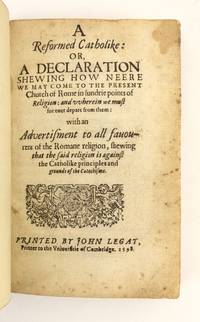
1598ST16441Cambridge: John Legat 1598. Second Printing. 153 x 98 mm. 6 x 3 7/8". 4 p.l. 375 1 pp. <br/> Modern sprinkled calf blind-ruled covers raised bands flanked by double gilt rules brown morocco label remnants of paper library shelf label at tail of spine. Printer's device on title page. Front pastedown with bookplate of the Fox Pointe Collection; rear pastedown with deaccession stamp of Bradford City Libraries. STC 19736; ESTC 19736. ◆Spine just faintly sunned leaves lightly browned due to paper quality and trimmed a bit close at head grazing headline on a couple of leaves isolated marginal stains or tiny rust spots but an excellent copy fresh and clean in a sympathetic binding with few signs of wear.<br/> <br/> This was an important work in establishing distinctions in liturgy and doctrine between the Catholic Church and the Church of England written by a moderate puritan whom DNB considers "perhaps the most significant English theologian of his age." Perkins 1558-1602 was one of the most popular voices of his time speaking from a Calvinist puritan point of view; while he could be virulently anti-Catholic he did not believe in repudiating the English church only in reforming it. According to DNB "The genius of Perkins's work did not lie in its originality—his theology represents a conventional recital of Calvinist scholasticism in virtually every respect. His gift lay rather in bringing to a broad audience a variety of theological and moral issues popularizing essentially technical discussions and therefore as Fuller observed humbling 'the towering speculations of philosophers into practice and morality.'" The present work spread his polemical influence beyond England to the Continent; even the Catholic bishop William Bishop admitted he had "not seene any book of like quality published by a Protestant to contain either more matter or delivered in better method." Both the 1597 first edition and our 1598 second printing are rare: no other copies of either edition are recorded at auction by RBH or ABPC in the past 50 years. John Legat unknown
1800409761800. Depicting couples from various regions with accoutrements as named in each lower margin unsigned. Image size: 10 1/2 x 8 3/4 inches. Sheet size: 13 3/8 x 10 3/8 inches The group consists: 1. Di Pesco Costanza Contado di Molise 2. Paese di Sessano Provincia Contado di Molise 3. Massagronica Provincia si Chiete Abruzzo Citra 4. Passe di Monte Aldiero Provincia d'Aquila. This group of watercolours showcases couples from various mountainous villages in the Abruzzo and Molise regions of Italy. Dressed in traditional garb each couple's attire highlights the distinct differences in the dress across this region to the east of Rome as well and the delicately ornate clothing of the time complete with bright colours intricate patterns and fascinating accessories. Each couple is beautifully captured in gauche executed with delicate brushwork and vivid colours that bring the characters to life capturing the essence of each couple's culture and lifestyle. The drawings offer a glimpse into Italy's rich and diverse heritage presenting a window into the customs and traditions of its people through their traditional clothing and accessories. unknown
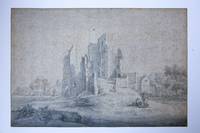
65233View on the ruins of the ""Huis ter Kleef"" a castle near Haarlem.Shepherds with dogs in front of the ruins. Birds flying in the sky above the ruins. Dated and signed below 1649 Maas or Maes. The date seems original but the signature doesn't. In a sale catalog from 2010 lot. 587 it is considered as a drawing by a young Nicholaes Maes 1634-1693 who in 1650s was beginning with his apprenticeship at Rembrandt's.On the bottom right corner are traces of what seems to be a collector's mark stamped in black ink fashioned as a ramping animal a lion in profile turned towards the left. not in Lugt.See R. van 't Zelfde 'Josua Breckerveld 1644-1700' Delineavit et Sculpsit 23 juli 2001 p. 11-17 illustrated. Drawing on paper in pen with brown ink washed in grey with some highlights in white. Total: 270 x 404 mm. Pasted down on cardboard an operation that is contributing to the spreading of foxing especially on the top region. The drawing was probably divided into two pieces from a notebook and recomposed by pasting it down on a wide cardboard. On the back another date was added in pen and brown ink ""1885."" and might refer to the pasting down the kind of cardboard would be consistent with that period. Other more recent numbers on the backing in pencil. Possibly the drawing was pasted down due to a minor defect of the paper located on the shirt of the sitting shepherd. The hole has been repaired from the backing and the lacuna was filled in with pencil. This area extends for less than 5 mm. unknown
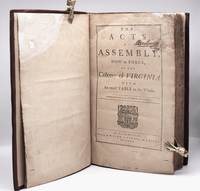
1769W2619Williamsburg Virginia: Printed by W. Rind A. Purdie and J. Dixon 1769. 4 577 1 pages. First and only printing of this important colonial Williamsburg imprint. Late in 1767 the General Assembly authorized a third "revisal" of Virginia laws which meant a compilation of all acts passed since the 1752 "revisal" together with all laws passed prior to 1752 that were still in effect. Ordinarily the contract for printing the book would have been awarded to the official public printer William Rind but Rind's financial straits caused the General Assembly to award the contract to Rind's financially stable competitors the Williamsburg printing company of Alexander Purdie and John Dixon . Perhaps to spare Rind public embarrassment it was decided to advertise the project as a joint venture; thus the names of Rind Purdie and Dixon are listed as printers on the title page. ASSOCIATION COPY: On the title page is the 1784 signature of Alexander Breckinridge 1752-1801 a Virginia surveyor veteran of the Revolution and participant of the 1787 convention on Kentucky statehood. On a blank page in the rear of the book is a form for a legal deed that is written in Breckinridge's hand. In the twentieth century book was sympathetically rebound in full leather with remnants of original leather and original leather title patch laid down. Professional rice paper repairs to margins of many pages; the repairs affect very little text. First Edition Thus. Hardcover. Very Good-. Folio - over 12" - 15" tall. Book. Printed by W. Rind, A. Purdie, and J. Dixon Hardcover
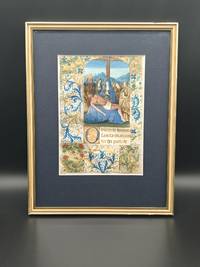
1359Very Good. Leaf from Book of Hours near Ghent-Bruges Belgium late 15th century. 180 x 130 mm Single leaf on parchment. Three lines of text of the Obsecro te Marian prayer in Latin executed in Gothic textualis. Single three-line initial in blue on red-gold field with shell gold ornamentation overlaid. Border separated into six sections: top section in strewn border style with blue flowers and pink roses on gold background; middle two sections with blue and gold acanthus leaves and blue flowers; bottom left section with red roses or strawberry flowers on gold background; bottom centre section with blue and gold acanthus leaves; bottom right section with blue and white iris. Blue flowers indicating production location close to Brugges. Central scene shows the Pieta with Mary clothed in royal blue and highlighted in shell gold holding Christ after the crucifixion surrounded by four other women with nimbs one of whom holds a book and one man in a 16th century hat. Artist has used forgrounding effect with city on a hill in the background. Leaf is framed in late 20th century frame misattributed on back as "Book of Hours English -1390". Mounting unknown but unlikely to be fully mounted. Verso not visible. hardcover
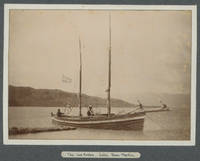
1890List01108Mostly Patagonia 1890. Printing-out paper prints the images measuring 3 1/4x4 1/2 to 4 1/4x6 inches and the reverse each with a caption written on a label affixed to the mount below the prints. 4to blue pictorial cloth. 1890s. In this bound photo album forty-six photographs document a group traveling from pastoral locations in northern Argentina to breathtaking views at the southern tip of the continent. The photographs were taken by an accomplished photographer and handwritten captions in English provide brief descriptions of the locations and people documented. Apparently a member of an exploration commission the photographer and his team travel first from Bahia Brazil to Buenos Aires and La Pláta then on to the southern tip of the continent and back up the continent through remote lakes and mountains on both sides of the Chilean/Argentinian border.<br /> <br /> While the photographer’s name and nationality are not clear from the album there are two photographs with a Sr. Moreno who is likely the Argentinian explorer Francisco ‘Perito’ Moreno. The photographs of “Sr. Moreno†bear a clear resemblance to photographs of Francisco Moreno and they are taken in La Plata which is where Moreno was the first director of the natural history museum Museo de La Plata. On the album page following the one with photographs of Sr. Moreno there are photographs of the Museo de La Plata building and grounds. Museo de La Plata was established in 1884 and Moreno’s personal collection of 15000 pieces formed the core of the original collections Farro. In order to fill the exhibit rooms he sought more materials and carried out collecting campaigns in Patagonia. At times he hired naturalists to travel into remote parts of Patagonia to gather samples of flora fauna geology and artifacts of indigenous people’s culture Farro. Museo de la Plata was exhibiting anthropological remains and indigenous material culture at the same time that Argentina was expanding into indigenous territory Farro. In this way Museo de la Plata was not just a natural history museum it was also a force of colonialism. <br /> <br /> Not only was Argentina in the process of colonizing Patagonia but also it sought to claim and maintain territory in relation to Chile. A sixty year boundary controversy between Argentina and Chile resulted in the Treaty of 1881 in which the two countries agreed for the first time on the boundaries in Patagonia Perry. Even after 1881 vague language in the treaty that the boundary be “the most lofty peaks that divide the waters†extended the dispute until 1902 Perry. Because Patagonia had not been colonized extensively scientific exploration of the region was tied with nation-building and establishing these borders. In 1896 the Argentinean government appointed Moreno as the Expert Representative in the border dispute with Chile. He led commissions of naturalists and surveying engineers through the disputed border regions along the Andes Mountains Museo de La Plata n.d. Moreno’s work had parallels in Chile’s attempts to establish borders too: “Through the work of these explorers the state was able to.draw up laws and decrees regarding environmental destruction and more effectively defend its position in the limits conflict with Argentina†Etchegaray 2018. <br /> <br /> We do not know whether the exploration commission in this photo album was affiliated with Moreno the collections of Museo de la Plata or the boundary controversy. However given the route to the tip of the continent and the back up along the newly established border it seems possible that this commission could have played some role – whether directly or indirectly – in the process of exploration and nation building occurring at that time. <br /> <br /> References<br /> <br /> Etchegaray J. L. 2018. Cataloging the nation: Explorations and the incorporation of North Patagonia into the Chilean National Ordering 1856-1902 Thesis San Francisco State University. In AS36 2018 HIST .E83. http://dspace.calstate.edu/handle/10211.3/213510<br /> <br /> Farro Máximo E. n.d. The Business of Museums: Towards a History of Collections in La Plata’s Museum 1888-1906 – World Archaeological Congress. Retrieved June 15 2021 from https://worldarch.org/world-archaeological-bulletin/the-business-of-museums-towards-a-history-of-collections-in-la-platas-museum-1888-1906/<br /> <br /> Ryan C. 2011. Indigenous possessions: Anthropology museums and nation-making in Argentina 1862–1943 Ph.D. The University of Wisconsin - Madison. Retrieved June 15 2021 from http://www.proquest.com/pqdtglobal/docview/885379045/abstract/E55A419FE8D54C0DPQ/1<br /> <br /> Museo de La Plata. n.d. Retrieved July 2 2021 from https://www.museo.fcnym.unlp.edu.ar/museo. unknown
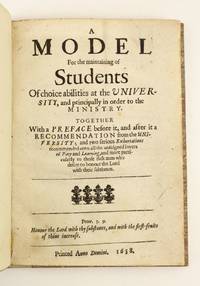
1658ST16442s.l.: s.n. Printed Anno Domini 1658. FIRST EDITION. 190 x 135 mm. 7 1/2 x 5 3/8". 3 p.l. 14 pp. complete. <br/> 20th century vellum-backed marbled boards flat spine with vertical titling. Front pastedown with bookplate of the Fox Pointe Collection. Wing P-2842B; ESTC R207754. ◆Text lightly washed and pressed but still crisp faint foxing to lower edge of title page otherwise a fine fresh copy in an unworn binding.<br/> <br/> Written by an opinionated English cleric this is an extraordinarily rare pamphlet proposing an unusual fund to support young 17th century scholars. According to DNB the scheme outlined in the present work was meant "to support the university studies of young men of promise seeking entry into the ministry." The plan "was approved by John Worthington and Anthony Tuckney and had the support also of John Arrowsmith DD Ralph Cudworth William Dillingham DD and Benjamin Whichcote. The fund raised about £900 and it appears that William Sherlock afterwards dean of St Paul's received assistance from this fund during his studies at Peterhouse Cambridge until 1660 when he graduated BA. Those entrusted with administering the fund sent Poole regular reports on students interviewed and the ratings they had received in philosophy logic and languages. The scheme was abandoned at the Restoration." Poole 1624 - 79 was the author of a number of controversialist pamphlets on subjects ranging from Unitarianism to preaching by lay persons before undertaking his major work: a synthesis of critical biblical commentaries "Synopsis criticorum aliorumque sacrae scripturae interpretum." This is one of his scarcest writings: ESTC lists seven copies two in North America while ABPC and RBH record just two copies at auction. s.n. Printed Anno Domini unknown
1606SE262<p>4o 220x159 mm. Collation: 4 A-H4. 8 64 pp. On the title-page woodcut coat of arms of the dedicatee Francesco Borghese as Captain General of the Saint Roman Church surmounted by a coronet. Woodcut decorated initials and tailpieces. Contemporary gilt-tooled vellum. Covers within a double fillet with Borghese's coat arms at the centre. Small heraldic dragons at each inner corner. Holes for ties at the foredges. Smooth spine decorated with alternating heraldic dragons and eagles. Minor losses small marginal stain to the lower cover. A very good copy in its original binding. Some light scattered foxing and staining.<br />Provenance: Francesco Borghese 1556-1620 brother of Pope Paul V and Captain General of the Saint Roman Church armorial binding.<br /><br />First edition of this important work likely Palazzolo's presentation copy to the dedicatee of the work itself Francesco Borghese whose coat of arms is stamped on its fine binding.<br />Francesco Borghese Duke of Rignano was the younger brother of Camillo who had been elected Pope as Paul V on 16 May 1605. Since his ascent to St Peter's throne the pope had vigorously fought for the development and reinforcement of the Papal Army and named his brother Generale di Santa Romana Chiesa i.e. Captain General of the Saint Roman Church. In this context the Milanese nobleman Cesare Palazzolo – Generale collaterale i.e. the general inspector for the papal armed forces – was commissioned with the redaction of the present work which contains not only the outlines of the reform but above all its theoretical justification. The work traces the spiritual basis of the disciplined soldier and re-defines military duties in terms of Christian piety. The soldiers of the Pope should be not only well organized and courageous but also disciplined and devoted. The pattern of conduct proposed by Palazzolo is thus dual natured both military and religious. <br />As noted Palazzolo dedicates his book to Francesco Borghese whose coat of arms as Captain General of the Saint Roman Church stands out on the title-page. <br />The handsome gilt-tooled vellum binding was executed – as the gold-tooling clearly attests – in the most renowned and sought-after workshop then active in Rome that run by the Soresini binders who worked for the papal court as well as other high-profile clients from the 1590s to ca. 1630. Credit for this particular binding may belong to Baldassare Soresini who was so active for the Borghese family that he was known as the 'Borghese Binder'. The choice of such a refined atelier could therefore reveal Palazzolo's intention of offering this copy to an outstanding recipient as indeed Francesco Borghese was.</p><p>STC 17th century Italian 642; G. Vianini Tolomei "I ferri e le botteghe dei legatori" Legatura romana barocca. 1565-1700 pp. 31-2 and pls. i-ii; G. Brunelli Soldati del papa. Politica militare e nobiltà nello Stato della Chiesa 1560-1644 Rome 2003 ad indicem; Idem "Cultura politica e mentalità burocratica nei carteggi dell'organizzazione militare pontificia 1560-1800" A. Jamme – O. Poncet eds. Offices écrits et papauté xiiie- xviie siècles Rome 2007 pp. 301-310.</p> Luigi Zannetti
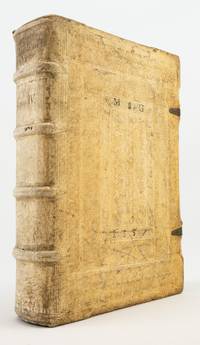
1556ST20472Basel: Hieronymus Froben 1556. First Edition of this Latin Translation. 343 x 235 mm. 13 1/2 x 9 1/4". 4 p.l. 730 142 2 blank pp. 12 leaves. Translated from the Greek by Petrus Nannius and Wolfgang Musculus. <br/> Contemporary blind-stamped pigskin over bevelled wooden boards by Balthasar Wernher of Lauingen covers framed by palmette rolls and a roll signed with the initials B. W. that features half-figures of Christ as Salvator Mundi St. Paul St. John the Baptist and King David central panel of upper cover with vertical palmette rolls the blank frame around it with the letters "M G" above the panel separated by turnip tool the date 1557 below the panel central panel on the lower cover with the same tooling but surrounded by a frame with a roll of medallions of the Reformers raised bands ink lettering to a couple of panels two original brass catches and catchplates one catchplate defective. Printer's woodcut device to title page and final page numerous decorative woodcut initials. Title page with three early ink owner inscriptions; occasional early ink marginalia and underlining. VD16 A 3980; Adams A-2083; Hoffmann I 415. For the binding: Haebler I 475 3; EBDB roll r003786 and workshop w004477. Binding somewhat soiled and chafed pigskin at one corner rubbed away one-inch circular hole on back board a contemporary issue with tooling impressed on the wood beneath isolated minor marginal stains or mild foxing other trivial imperfections but an extremely pleasing copy very fresh internally with excellent margins in a completely satisfying unrestored contemporary binding.<br/> <br/> This collected edition of the writings of the Church Father and leading advocate of the doctrine of the Trinity comes in a lovely binding by a known German workshop. The Einbanddatenbank "Bookbinding Database" or EBDB of the German Research Foundation attributes the Salvator Mundi/St. Paul/King David/John the Baptist roll to Lauingen binder Balthazar Wernher ca. 1525-74/75 whose initials appear in the panel featuring Christ. His workshop was active ca. 1555-75; the date on our binding indicates it was produced near the beginning of his career. One of the four great Eastern Doctors of the Church and the Patriarch of Alexandria St. Athanasius ca. 297 - 373 led the fight against the Arian doctrine which held that Christ was a creation of God the Father rather than consubstantial with Him. Athansius’ writings on the Incarnation and the Trinity which make up most of the text here were enormously influential. According to Catholic historian Cornelius Clifford "Athanasius was the greatest champion of Catholic belief on the subject of the Incarnation that the Church has ever known and in his lifetime earned the characteristic title of 'Father of Orthodoxy' by which he has been distinguished ever since." The English theologian and Cardinal John Henry Newman declared Athanasius a "principal instrument after the Apostles by which the sacred truths of Christianity have been conveyed and secured to the world." This translation of his writings was one of the final works by the Dutch humanist Petrus Nannius Pieter Nannick 1496-1557 a contemporary of Erasmus. The printer here was Hieronymus Froben who took over the family business from his father Johann Froben 1460-1527 a central figure in the printing history of the 15th and early 16th centuries who played a key role both in the intellectual ferment of the northern Renaissance and the theological turmoil of the Reformation. Our substantial large folio binding with its thick boards and four sets of muscular double bands provides an appropriate reflection of the weightiness of the works it contains. [Hieronymus] Froben unknown