8 059 résultats
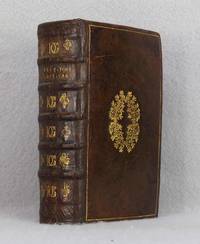
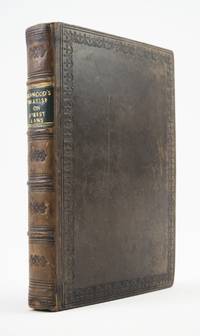
2689Oxford: Printed by Thomas Baskett Printer to the University 1753. Hardcover. Good. Octavo. No pagination. Final leaf: Bb3. Contemporary red morocco repaired. With 47 engraved plates most likely by Frederick Hendrick van Hove. ESTC T182569. ESTC records a copy in Scotland three at Oxford some in private collections one in Australia but none in the US. Tear in title-page not affecting text. Bound with: The Whole Book of Psalms Collected into English Metre. London: Printed by C. and J. Ackers for the Company of Stationers 1753. <br/> <br/> Oxford: Printed by Thomas Baskett, Printer to the University, 1753. hardcover
1598ST20689London: Printed by Thomas Wight and Bonham Norton 1598. FIRST PUBLISHED EDITION and First Edition under this Title. 192 x 139 mm. 7 5/8 x 5 1/2". 8 p.l. 154 162-65 159-67 1 blank 6 leaves. Errors in pagination but text complete. <br/> Late 19th century dark brown calf covers tooled in blind with plain rules and fleur-de-lys roll raised bands spine panels with small blind-stamped ornament black morocco label marbled endpapers neat repairs to ends of both joints. Front pastedown with engraved armorial bookplate of Godfrey Wentworth Woolley Park. Beale T-413; Mellon/Podeschi 15; Schwerdt II 7; STC 17291; ESTC S111993.<br /> Extremities slightly rubbed boards a little chafed in spots text lightly pressed but not washed a bit of browning to edges and occasional minor marginal foxing or traces of corner creases but quite an excellent copy the text clean and still fresh throughout and the perfectly suitable binding with no significant wear.<br/> <br/> This is a pleasing country gentleman's copy of the first published treatise on the laws governing English forests. Our author the fittingly named woodsman John Manwood d. 1610 served as gamekeeper of Waltham Forest as well as a justice of the New Forest. DNB tells us that he was possibly a barrister at Lincoln's Inn which would explain his interest in and knowledge of the law. Manwood tells us in the dedicatory epistle that he composed the present work in response to the precarious state of forest preservation stating that "so many do daily so contemptuously commit such heynous spoiles and trespasses" against the country's woodlands but "verie little or nothing as yet is extant concerning the Lawes of the Forrest" to help manage such behaviors. Our copy comes from the first published edition following only the 1592 pamphlet entitled "A Brefe Collection of the Lawes of the Forest" issued for private circulation and now extraordinarily rare. According to DNB the present treatise is "the only substantial work on the subject ever to reach the press" making it an enduringly useful source for those interested in the topics contained which include laws about hunting and perambulation in forests. It remained the standard work on the subject until the 19th century and Schwerdt writes that it has been "invaluable to students and lovers of ancient sport." Our copy is from the library of Yorkshire landowner Godfrey Wentworth 1773-1834 who served as High Sheriff of Yorkshire from 1796-97 and in the House of Commons from 1806-08. He probably had no need for a later printing of the work. Printed by Thomas Wight and Bonham Norton unknown
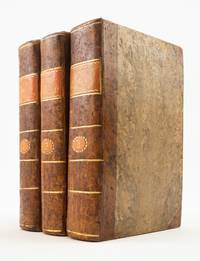
1717ST20754Lyon: Chez Anisson et Posuel 1717. Second Edition. 197 x 125 mm. 7 3/4 x 5". Three volumes. <br/> Pleasing contemporary half calf over paper boards painted to resemble tree calf smooth spines with gilt rules and two citron morocco labels. Attractive woodcut head- and tailpieces throughout WITH 153 ENGRAVED PLATES depicting the scenery flora fauna dress and architecture of locations described. Contemporary ink ownership inscription of De St. George on title page. Brunet V 903; Graesse VII 180. Corners slightly bumped and rubbed joints with just a hint of flaking but the period bindings solid and still extremely attractive survivals. Internally with a handful of quires faintly browned other trivial defects BUT AN UNUSUALLY WELL-PRESERVED SET inside and out.<br/> <br/> This lively narrative of travel at the turn of the 18th century includes a wealth of illustrations and a pleasing period bindings. A professor at the Jardin des Plantes in Paris Joseph Pitton de Tournefort 1656-1708 developed a system of botanical classification that became the standard method until it was superseded by Linnaeus in 1753. He made numerous collecting trips throughout his career; the present work is the record of his most significant voyage through Greece Turkey and along the Black Sea to Armenia and Georgia. The expedition which took place between 1700-02 had been proposed by the Comte du Pontchartrain then Secretary of State in 1699 as both a botanical and commercial endeavor. Tournefort's observations include a wealth of botanical detail but are also a rich source of information about the landscapes and peoples he encountered. He was accompanied on this voyage by German botanist Andreas Gundelsheimer and by the painter Claude Aubriet ca. 1665-1742 who had collaborated with Tournefort on his previous work "Eléments de Botanique." The work of Aubriet a botanical illustrator at the Jardin des Plantes was long appreciated by botanists and laypeople alike for its beauty and accuracy. The detailed depictions of plants here are accompanied by illustrated maps and engravings depicting zoological specimens archaeological sites and the costumes and cultures of the areas visited. The account was published posthumously in 1717 first in Paris and then shortly afterward in the present Lyon edition. The bindings here were never meant to be showy but they have come down to us in a remarkable state of preservation given their pedestrian construction and expected use. Chez Anisson et Posuel unknown
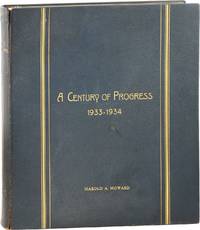
88343Chicago: 1934. Folio ca. 35 x 29.5 cm. Album in full morocco with gilt titles and rules binding signed "Arthur Hertzberg & Craftsmen"; silk moiré endpapers; calligraphic presentation leaf and 51 hinged leaves of large-format pencil-captioned silver-gelatin prints each ca. 28cm x 20 cm 11" x 8" or the reverse. This copy presented to Harold A. Howard 1868-1936 prominent Chicago real-estate tycoon and society figure. Photographer identified at base of spine. Slight wear including a ca. 3" separation at front joint near crown; a few leaves with faint marginal soil or foxing away from printed area; complete and Very Good.<br /> <br /> One of presumably very few presentation albums presented by the Century of Progress Exposition to prominent backers and members of Chicago's elite. The photographs all produced by the Exposition's official photographer the Kaufman & Fabry Company are of the highest quality exceptional for capturing the high modernism of the period and indeed of the event itself which is still considered a pivotal moment in the popularization of the modernist aesthetic in the United States as well as the introduction of the "Art Deco" style. Significantly the plan and most of the Exposition's infrastructure were designed by the young architects Louis Skidmore and Nathaniel Owings who a few years later would go on to found the epoch-defining firm Skidmore Owings & Merrill whose high-rise office towers came to personify the skylines of many of America's major cities Chicago's in particular. Though no limitation is stated for this album given the expense of production we would surmise that no more than a few dozen would have been produced. OCLC notes ten copies in American institutions each with presentations to a different recipient; a few others traced at auction and in commerce. unknown
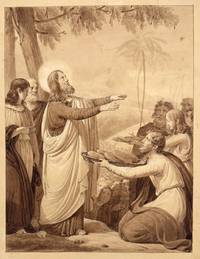
2260Ink and wash in black sepia and grayish brown ink with white heightening on wove paper 12 1/4 x 9 3/4 inches 311 x 248 mm the full sheet. In very good condition with some minor areas of light discoloration in the margins. Pencil inscription in French on the verso. unknown
1907012194Cleveland OH: The Burrows Brothers Company 1907. 616pp/frontis/illus/maps. #30 of 150 copies.In near fine clean slipcase. Beautifully printed on extra large laid paper bound in a richly tooled half leather binder. An exceedingly rare volume. Includes: illustrations diagrams maps. During the American Revolutionary War a contingent of Delaware Christian Indians led by John Heckwelder an assistant to Moravian missionary David Zeisberger founded the last of five missions to occupy the Tuscarawas Valley between May 3 1772 and September 8 1781. Heckewelder spent forty years as a missionary among the Indians in the Ohio Valley. He was praised for his understanding of the Indian language and customs but is also known for his account of the massacre of the Christian Indians at Gnadenhutten by troops lead by Col. David Williamson in 1782. Light nicks on spine. Clean no marks. Beautiful copy. 1st Printing. Half-Leather. Near Fine/No Jacket - Issued. Folio - over 12" - 15" tall. Limited Numbered Copy. The Burrows Brothers Company Hardcover
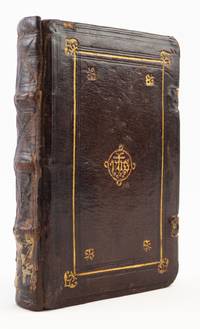
1538ST19567-018Venetiis Venice: in officina heredum Luceantonii Junte hiers of Lucantonio Giunta 1538. 149 x 104 mm. 5 7/8 x 4". 8 143 of 144 leaves lacking leaf p6. <br/> Contemporary Venetian morocco rebacked preserving original blind-ruled spine and corners rounded off and renewed covers each with blind-ruled borders and a gilt- and blind-ruled panel with gilt fleurons in each inner and outer corner central gilt IHS monogram raised bands brass clasps renewed all edges gilt and gauffered lacking final endleaf. Printer's device on title numerous historiated woodcut initials first page of text with woodcut border two full-page woodcut illustrations. Printed in red and black. Essling 181; Sander 5970 under "autres éditions"; EDIT 16 CNCE 11880. Original spine somewhat crackled bottom compartment with slight surface loss perhaps from removal of a label covers with several but insignificant small dings very minor dampstain at extreme top edge of a few leaves other trivial imperfections but a clean fresh and bright copy in an attractive early binding.<br/> <br/> Offered in what is probably its original binding this is a very rare edition of a Psalter done by one of the leading Venetian printing families of the 15th and 16th centuries. A major figure in the Italian book trade Lucantonio Giunta 1457-1538 began his career as a bookseller in Venice in 1477 and became a printer there in 1489. Together with family members and carefully arranged partnerships Giunta expanded his printing empire into numerous cities in Europe including Lyon Lisbon Antwerp Frankfurt and Salamanca. The present book was printed just after the death of Lucantonio whose heirs would continue to run the family business which grew prosperous in part because of its specialty in producing liturgical works such as this. The contents here are routine but the well-preserved decorative period binding makes the volume definitely worth having. in officina heredum Luceantonii Junte [hiers of Lucantonio Giunta] unknown
1774ST12037<p>Vicenza: per Gio. Battista Vendramini Mosca 1774. FIRST EDITION. 305 x 216 mm. 12 x 8 1/2". lxxvi pp.</p><p>Original paste paper boards covered in red and green block-printed patterned paper. In a modern red cloth folding box. Frontispiece engraving of the arms of bride and groom engraved allegorical vignettes on title page and at end woodcut head- and tailpieces and foliated initials all done with considerable charm. Spine and head edge just slightly faded a couple of very small snags in backstrip one page with mild thumbing but A SUPERB COPY EXCEPTIONALLY CLEAN FRESH AND BRIGHT both the text and original printed paper wrappers in an almost unbelievable state of preservation.<br /><br />This is a remarkably well-preserved Italian "wedding book" a souvenir produced for friends and guests of a noble bride and groom. It contains a collection of romantic poems by 28 different authors along with engravings of the newlyweds' arms. This kind of book was popular in Italy particularly in the north during the second half of the 18th and early part of the 19th centuries. Such occasional works were produced by printers in the major cities like Venice Vicenza Padua Trento and Milan for assorted noble patrons. Copies of these fête books are to be found today in Italian and Swiss libraries but only two copies of any such volumes are held in North America one by the New York Public Library and one by the Getty. KVK locates four copies of our work one of them damaged in three Italian libraries. The groom here Count Lodovico Tiene or Thiene was a scion of one of Vicenza's most important families. His ancestor also named Lodovico built the Palazzo Thiene that was memorably remodelled by Vicenza's most famous son Andrea Palladio. Our volume was obviously a treasured keepsake that was carefully stored away from light and dust and it looks amazingly like it must have on the day of the happy nuptials.</p> per Gio. Battista Vendramini Mosca
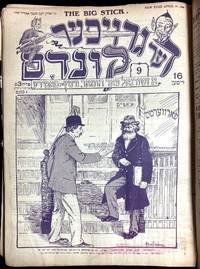
190942930New York: Ferlag "Kibets 1909. 1st Edition. Original publisher’s binding Folio newspaper. Complete first volume Starting with Vol I Nr 1 of “Der Kibitser†Dec. 15 1908 renamed and renumbered first as Vol I Nr 1 Jan 22 1909 of “Der Groyser Kibetser The big kibetzer†with the following issue of Feb 5 numbered as "3" to correctly follow from the first issue and then with Vol I Nr 6 March 19 1909 onward as “Der Groyser Kundes The Big Stick†or “The Big Prankster.†Incidentally the other set of this volume we examined also did not have a Nr 2 so we are confident this is complete as issued. <br> One centerfold cartoon by Zuni Maud see image features "Der Kaptialistisher Tayfel"--the Capitalist Devil–holding back a "mother" by the hair to stop her from interfering as "baby's milk-bottle" is drained off by the "milk-trust" cat. <br> The caption reads "The Capitalist Devil: - to the mother: Never mind madam all in English in Hebrew letters you go to the factory the milk-trust will take good care of your baby."<br> This cartoon-laden periodical was a New York City Yiddish language satirical bi- weekly which ran from 1908 until 1927.<br> The humor paper was issued biweekly this volume for its first 20 months and then weekly after that. OCLC also references another Vol I Nr 1 from April 15 1908 a special S´imhes` Toyreh Simchas Torah issue but this may have been a one-off. <br> Founded by the humorist Yosef Tunkel or Der Tunkeler his pen name meaning 'The Dark One' the paper was taken on by Jacob Marinoff when Tunkel left to work for an established paper in Warsaw. The paper consciously set itself up in opposition to the serious Yiddish-language press of the time such as the socialist Forverts.Naturally more traditional religious Judaism did not escape its satire: The later 1915 "Christmas" edition included a parodic conversation between Jesus and the prophet Elijah. <br> Despite its irreverent attitude to everything it also published poetry by Di Yunge "The Young Ones" poets such as Moyshe-Leyb Halpern and Zuni Maud. At its height it had a circulation of 35000 but folded in 1927 due to flagging sales. Der Groyer Kunds is highlighted in this recent talk by Yiddish comics scholar Eddie Portnoy on the reactions in the Yiddish press to restrictions on Jewish immigration to the US: https://www.yiddishbookcenter.org/collections/archival-recordings/recorded- programs/ybcr-nybc-ybcr-1048/door-slams-shut-reactions-yiddish-press-immigr ation .<br> SUBJECTS: Yiddish wit and humor -- Periodicals. OCLC: 28297536. Most holdings appear to be fragmentary and do not include these issues. Issue 18 with torn cover. In final issue the bottom margin suffers some loss to the final leaves none to the dramatic front cover though. Damaged boards are loose and most issues are coming loose though the quality paper used has remaind strong and bright much better than standard newsprint would have. Important graphic Yiddish humor from the great migration period. Dramatic and displayable! BK5 YID-43-9A-LEX. [New York]: Ferlag "Kibets unknown
1801055966Istanbul: Darü't-Tibaatü'l-Âmîre Mühendishâne Istanbul AH 1216 1801 CE. 1801. 1st Edition . Leather. Very Good. 8vo - over 7¾ - 9¾" tall. Contemporary brown half calf both boards marbled. Demy 8vo. 21 x 14 cm. In Ottoman script Old Turkish with Arabic letters. 33 1 blank p. Many marginal notes underlined words by red ink stains between pp. 15-18 stained margins two ownership period seals some notes and calculations on the front pastedown and the boards. Hand-coloured and decorated headpiece. Otherwise a good copy. Exceedingly rare first edition of this foundational textbook traditionally attributed to Mahmud el-Rûmî hence known as the 'Mahmudiye' which served for centuries as the primary resource for teaching Arabic to children in Ottoman madrasahs and was reprinted in numerous subsequent editions. Between 1801 and 1900 the book was published 30 times after this first edition. First composed in the 16th century and widely used in Ottoman madrasahs it was the principal introductory text for children beginning their study of Arabic. Its pedagogical structure and clarity made it a standard in elementary religious and linguistic education for centuries. The book offers a concise and accessible introduction to Arabic grammar and morphology especially tailored for young learners. It includes basic Arabic vocabulary introduction to Arabic letters and pronunciation noun and verb conjugations with emphasis on common forms simple sentence structures essential grammatical rules and inflection patterns i'râb. Written in rhymed prose or verse the text was designed to be easily memorized. It laid the groundwork for more advanced studies in the Arabic language Quranic recitation and Islamic sciences in the Ottoman madrasahs. Professor Müderris Abdurrahman Efendi was the first director of the "Engineering School Printing House" Mühendishâne Matbaasi established in 1797 in Üsküdar Istanbul. A professor of algebra and geometry Abdurrahman Efendi had studied fortification techniques for ten years under French experts before the founding of the Mühendishâne-i Berrî-i Hümâyûn also known as Mühendishâne-i Cedide in 1793 during the Nizam-i Cedid reform period. While managing the printing house he also taught engineering courses at the newly founded school. Commonly known among the public as the "Üsküdar Printing House" the Mühendishâne Matbaasi under his direction published several important works including the famous Cedîd Atlas. Despite this the press was regarded as a public-interest institution and lacked sufficient capital which hindered its development. Due to the lack of progress Abdurrahman Efendi stepped down on December 2 1807 and was succeeded by Seyyid Hüseyin Beyefendi former deputy chief clerk of the registry Defteremini. The Mühendishâne Printing House 1797 was founded under the chairmanship of Mühendishane teacher Abdurrahman Efendi with the printing sets inherited from Ibrahim Müteferrika who published the first Turkish book in the Ottoman Empire. Until 1824 66 works were printed including the important publications of the period such as Bashoca Hüseyin Rifki Tamani's Usûl-i Hendese 1797-98 Atlas-i Kebîr Tercümesi 1803 author: William Faden translated into Turkish by Resmî Mustafa Aga and Mahmut Raif Efendi's Cedveli-Tableau des nouveaux reglemens de I'Empire Ottoman 1798 printed in French in the Ottoman Empire. The printing house which was inactive for almost 45 years between 1826 and 1870 started operating again especially in 1878 and 38 works were printed here until 1906. Source: ITÜ online. Beydilli 15. Özege 18418. Türkmen 29.; Yazmadan Basmaya: Mühendishâne 11.; As of May 2025 we can't trace any copies in OCLC. <br/> <br/> Darü't-Tibaatü'l-Âmîre [Mühendishâne], Istanbul, AH 1216 [1801 CE]. hardcover
18306526London 1830. Aquatints coloured by hand. A fine complete series of four anonymous prints of hunting scenes possibly after the Alkens.<br/> <br/> The style and naming of these prints suggests an Alken origin for the series. Siltzer records a number of series by the Alken family in which the first plate is titled "Unkennelling." This title appears to be unique to them and supports the supposition that the present series are after the Alkens. Henry Thomas Alken was born into what became an artistic dynasty. He studied under the miniature painter J. T. Barber and exhibited his first picture a miniature portrait at the Royal Academy when he was sixteen. From about 1816 onwards he "produced an unending stream of paintings drawings and engravings of every type of field and other sporting activity. He is best remembered for his hunting prints many of which he engraved himself until the late 1830s.To many sporting art is "Alken" and to describe his work or ability is quite unnecessary." Charles Lane British Racing Prints pp. 75-76<br/> <br/> Cf. Siltzer pp.57-76. unknown
1913055436Dersaadet-Konstantiniyye: Kader Matbaasi. AH 1331 1913. 1st Edition . Soft cover. Very Good. 8vo - over 7¾ - 9¾" tall. Original wrappers. Light stains on the front cover. Otherwise a good copy. Cr. 8vo. 20 x 11 cm. In Ottoman script Old Turkish with Arabic letters. 48 p. First printed edition of this earliest travel account of China in the Islamic world and description of the early 16th century China and the Ming Dynasty by Nakkâs the leader of the delegation sent by Mirza Shahruh son of Tamerlane. This book is known also "Hitaynama" i.e. The book of China which was translated by Çelebizâde and published by Ali Emirî. Hitay or Hitai is the name given to northern China by the Uyghurs Mongols and some peoples in Medieval Europe. This area contains northern China Beijing and certain regions of Manchuria between the Great Wall of China and the Yellow River Huang He. Ming dynasty and Tamerlane relations were always tense. After Tamerlane's death at last his Chinese campaign his son Mirza Shahruh sent a delegation to the Chinese emperor which included Nakkâs. His book written in Persian was completed in 1422. In his book he described their three year-voyage which started from Herat to Pekin. There is valuable information in this travel book on many topics such as the size of the Chinese court of the Ming dynasty in Han-Balik-Pekin the multitude of the emperor's servants the emperor's wooden seating ceremonies banquets for the ambassadors the characteristics of the rooms they stayed in the emperor's religion and the way of worship etc. At the beginning of the 15th century the book was presented to Sultan Suleiman the Magnificent and Sultan Selim. Source: Osmanlida seyahatname yazarligi ve Ümit Burnu seyahatnamesi: Kantas Mehmet Ziya. Özege 31. <br/> <br/> Kader Matbaasi., [AH 1331] paperback
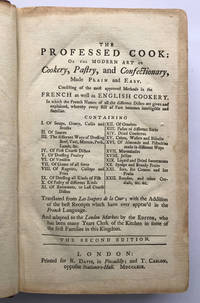
17693726<p>First published as Soupers de la cour in 1755 Menon's work first appeared in English in 1767 in a translation by Bernard Clermont under the title The Art of Modern Cookery Displayed Consisting of the most approved methods of cookery &c. London printed for the translator 1767. This is its first appearance under the new title which was to be retained for the third edition of 1776 in which the translator's name appears on the title-page. With a six-page 'Translator's Apology' in addition to the 'Author's Advertisement'. In his fascinating apology Clermont reveals many of the concerns of the eighteenth century chef while pointing to some of the key differences between English and French cuisine. He also writes about the challenges of translation: 'This Book was published in four small Volumes. I thought it too full of Words and of Repetitions and that the Sense of the Author could be explained without all the volubility of the French Language which I have as much as I was capable supplied with the Expressiveness of the English' p. vi.<br /><br />'Menon's book covers menus hors d'oeuvres entrées and some deserts. An entire chapter is devoted to sherbets or ices and ice cream. Like Marin that other great contemporary of Menon's both placed emphasis on their sauces. Menon's recipes were surprisingly varied coming not only from France but Italy Germany Ceylon and Flanders and used in everything from hors d'oeuvres to deserts' Harrison Une Affaire du Gout 1983.<em><br /></em><br /><em><br /></em><em>8vo 210 x 125 mm pp. xvi xxiv 286; 2 blank ii 289-588 some light browning in text in contemporary calf single filet gilt to covers plain spine with raised bands ruled in gilt spine worn with vertical cracking restoration to spine and corners rather a workaday bit of repair work tending to solidity rather than beauty with the early ownership inscription of M. Findlater on the front endpaper.</em><br /><br />See Harrison <em>Une Affaire du Gout A Selection of Cookbooks</em> 1475-1873 91.<br /><br />ESTC t90913 at BL and Harvard only.</p> R. Davis and T. Caslon
1849055266Istanbul Constantinople: Darü't-Tibaatü'l-Âmîre. AH 1265 1849. 1st Edition . Hardcover. Very Good. 8vo - over 7¾ - 9¾" tall. Contemporary cloth marbled boards. Slight chippings on the panels' extremities fading on board and slightly stained front pastedown overall a very good copy. Demy 8vo. 21 x 15 cm. In Ottoman script Old Turkish with Arabic script. 101 p. Framed text. First printed edition of this extremely rare description and account of Jerusalem narrated through the earliest Islamic Jewish and Christian legends and sources by a 17th-century Islamic scholar. As stated in the preface of the book the author came to Jerusalem in 1635 AH 1051 and wrote this book based on his own observations in first-hand style for three years gathered from the scholars and saints from the oldest Arabic sources written in the Jerusalem where he came as a "contiguous" Tr. mücâvî and an observer. This early Islamic work offers an invaluable insight into the early Jewish culture of the region in and around Jerusalem the Christian culture and the arrival of Islam in the region the Islamic history of the city architecture scholars the legends formed around and the history of religions here the prophets and most importantly the social structure of the region is compiled from unnamed sources. Several manuscripts of the work are also available in important libraries such as Vatican Cairo Kastamonu and Konya. Demirci. Not in Özege.; Eight copies in the US libraries in OCLC in University of Michigan Concordia Theological Seminary Virginia Tech Butler University Libraries Concordia College Library Morningside University Dallas Theological Seminary and Library of Congress Karl Süssheim Collection 756161183 933219362. <br/> <br/> Darü't-Tibaatü'l-Âmîre., [AH 1265] hardcover
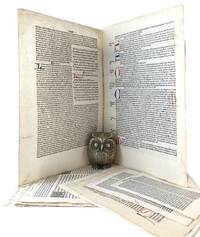
1476179736N: N 1476. kerning21 1476 J. de Colonia & J. Mathen. Antoninus. Summa Confessionum. Printed in double columns with red initial letters. 21 cm. x 15.3 cm. 2 1478 J. de Colonia & J. Manthen. Lactantius. Opera Roman letter. 29.3 cm. x 20 cm. 3 1481 Michael Manzolus. Horatius Flaccus. Opera. Roman letter. Commentary round the text. 30 cm. x 21 cm. 4 1489 B. de Zanis. Pliny. Historia Naturalis. Roman letter double columns. 31 cm. x 25 cm. 5 1489-1491 Peregrinus de Pasqualibus. Mesue. Opera. Double columns with coloured initial letters. 30 cm. x 21.3 cm. 6 1491 D. Bertochus. Augustinus. Opuscula Plurima. Printed in double columns. 22.3 cm. x 16.5 cm. 7 1491 Guilelmus Anima Mia Tridinensis. Valerius Maximi Factorum ac Dictorum. 64 lines of commentary surrounding the text. Fine capital letters. 29.7 cm. x 20.5 cm. 8 1491 Peregrinus de Pasqualibus Bononiensis. Augustinus. De Academicis. Printed in double columns. 22.3 cm. x 16.5 cm. 9 1492 B. de Choris. de Cremona. Seneca. Opera Philosophica. Roman letter. 30.3 cm. x 21 cm. 10 1493 J. Tacuinus Tridinensis. Silius Italicus. Punica. Double columns initial letters in red. 29.3 cm. x 20.7 cm. 11 1493 Damianus de Mediolano. Suetonius. Vitae Caesarum. Roman letter with commentary round the text. 28.2 cm. x 19.3 cm. 12 1493 Simon Bevilaqua. Tibullus. Elegiae. Roman letter commentary round text coloured initial letters. 32 cm. x 21.4 cm. 13 1493 J. Rubeus Vercellensis. Justinus. Epitome. Roman letters coloured initials. 31.2 cm. x 21.5 cm. 14 1493/1494 Simon Bevilaqua. Lucanus. Pharsalia. Roman letter with commentary round text. 30.2 cm. x 21.4 cm. 15 1495 Simon Bevilaqua. Opuscula. Printed in double columns. 14.7 cm. x 10.3 cm. 16 1496 G. Arrivabenus for B. Rusina & B. Fontana. Caracciolus. Sermones. Double columns gothic letter. 18.4 cm. x 12.5 cm. 17 1497 J. & G. de Gregoriis de Forlivio. Hieronymus. Commentaria in Bibliam. Roman and gothic letter. 32.3 cm. x 21.7 cm. 1476-1487. Together. N unknown
1772ST17890aBirminghamiae: Typis Johannis Baskerville 1772. 300 x 240 mm. 11 3/4 x 9 1/4". 1 p.l. 364 pp. <br/> ELEGANT CONTEMPORARY RED MOROCCO GILT covers with French fillet border and intricate frame of volutes and floral tools raised bands spine compartments with central lozenge radiating lancets from each corner surrounded with small flowers and leaves oblique leafy branch at each corner gilt lettering turn-ins with floral roll marbled endpapers all edges gilt. Front pastedown with armorial bookplate of V. H. Wilmot Esq.; front free endpaper with armorial Glenconner bookplate. Gaskell 46. Lower corner of front board with scarcely noticeable small patch of lost patina and gilt from insect activity just a hint of wear to joints and extremities but still A VERY FINE CONTEMPORARY COPY virtually perfect internally--very clean and fresh with generous margins and in a refined binding with no significant signs of use.<br/> <br/> This is typographically a lovely printing as well as a distinguished edition of Terence in a very handsome contemporary binding. The second century B.C. playwright Terence is believed to have been a native of North Africa enslaved during the Punic Wars. Brought to Rome and given his freedom he joined the cultivated circle of Scipio the Younger. His six extant plays the ancestors of drawing room and modern situation comedies feature crusty fathers rebellious sons and smart aleck slaves whose machinations solve the playwright's intricate complications of plot. The plays were popular throughout the Middle Ages and the Renaissance and still retain their appeal. Dibdin notes that this edition is "printed in the usually beautiful style of the impressions of ancient classical authors" issued by Baskerville. That series known as the Baskerville Quarto Latin Classics began with the first book to be issued by his press: the renowned Virgil praised by Renouard Gaskell Dibdin and other critics for its beauty. In a sheet dated 1760 which Baskerville issued appended to a specimen of his folio Bible the printer discusses his proposed "Baskerville Classics": "Many gentlemen" he says "have wished to see a sett of the Classicks . . . in the Manner Letter and Paper of the 'Virgil' already published" and he vows to print the same with the poetical classics first. These volumes says Reed would "suffice had Baskerville printed nothing else to distinguish him as the first typographer of his time." The beautiful typography the luxurious paper looking and feeling much like vellum and the spacious design combine to give the reader a particularly gratifying feeling of strength and serenity. The stately binding though similar to the French style of the period was likely done in England for 18th century owner V. H. Wilmot. Our copy was later in the collection of Edward Priaulx Tennant 1st Baron Glenconner 1859-1920. Typis Johannis Baskerville unknown
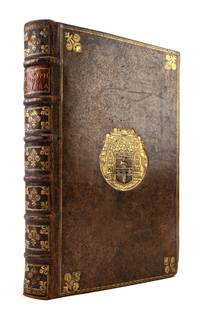
1583ST15026Paris: Arnold Sittart 1584; Heidelberg: Peter Santandrea 1583. 178 x 111 mm. 7 x 4 3/8". 14 p.l. cccix pp. 13 leaves last blank; lxxv 10 ccxvi 22 pp.; 2 leaves 84 pp.; 1 1-196 18 pp.; 62 pp. Two works in several parts bound in one volume. With annotations and commentary by Antonio Augustin Joseph Scaliger and Fulvio Orsini. <br/> Pleasing contemporary calf covers with central gilt wreath of olive branches raised bands spine panels gilt with cipher "D C G" at center flanked by a palmette and a vegetal trefoil gilt titling bottom panel with "OD" and "I8" on either side of the cipher. Printers' devices on the title pages decorative woodcut initials and headpieces. Front pastedown with what appear to be early library shelf markings; one page with neat early marginalia. Adams V-590 and F-390. Covers slightly marked spine with a bit of superficial crackling and with one short crack in the middle of bottom panel the text with faint browning and isolated minor soiling a few leaves with long shallow creases not affecting legibility otherwise in excellent condition the binding solid and without significant wear and the leaves generally clean fresh and smooth.<br/> <br/> This glossary of recondite Latin words and phrases was no doubt bound for a contemporary bibliophile with an extensive library. The "OD" and "I8" at the bottom of the spine appear to be the indication of a shelf location--not something frequently encountered on spines of this period. This designation and the location notation on the front pastedown that clearly relates to it "Arm. 0. Tab 4. Loc. 18" suggest a library of some complexity and an educated owner who believed in careful organization. While we have not been able to identify "D C G" she would seem also to have been a person of taste and good sense. The binding is attractively decorated while still being practical for scholarly use. The work itself has gone through a number of changes of fortune. The story begins when Verrius who lived in the time of Augustus compiled a valuable work full of information on everything from grammar to mythology. Unfortunately his text has been largely lost; the authentic fragments fill only the first few leaves of our volume. His work was epitomized by Festus a ca. third century scholar but Festus was not a very good epitomizer and to make matters worse all of his entries have been lost up to the letter "M." Luckily an epitome of the epitome from "A" to "Z" had been made by Paul the Deacon in the eighth century. Valuing the handbook for its information on the writing of correct Latin Renaissance scholars went to work on this puzzle in the 15th century and a first version of Paul was published by Zarotus in Milan in 1471. Later scholars published Festus and the great French classicist Joseph Scaliger 1540-1609 was largely responsible for bringing definitive order out of chaos. His scholarly edition reconstructs the work of Festus as far as one can filling in the gaps caused by missing pages in the manuscript with conjectures and rectified material from Paul. Peter Santandrea unknown
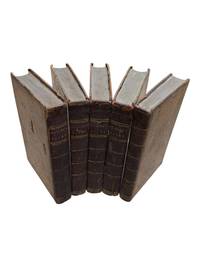
17789147London: Printed for T. Payne at the Mews-Gate 1778. First Tyrwhitt edition. 5 volumes 8vos 310 318 320 336 and 290pp. Contemporary tree calf red spine labels with gilt lettering. Spines dry toned and with a few cracks and chipping at caps. Joints rubbed upper joint in vol 1 cracked but holding. Few contemporary shelving numbers on front pastedowns contemporary inscription to verso of title in vol 1 "Calf leat. Mr. Hodgson." Overall a very good sound set. <br /> <br /> Beautiful 18th century Chaucer which was hailed at the time as the best-edited English classic that had appeared. Tyrwhitt consulted dozens of manuscript versions of Chaucer to put this together in 4 volumes and added a glossary as the 5th volume 3 years later. This set in an untouched period tree calf binding and scarce thus. . Printed for T. Payne at the Mews-Gate unknown
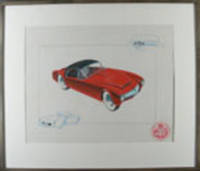
195318800Boston 1953. Tempera on paper. Initialled "R.S.W." Mounted circular label lower right. Handsome 1950s sports car design.<br/> <br/> All of our present information about this drawing comes from a label on the back of the piece which indicates that it comes from the archives of the A.J. White Motor Vehicle Research Company - designers of exotic cars in the Boston MA area. We have not discovered any further information about the A. J. White Research Company thus far nor about the artist R.S.W. of this particular drawing. There does not appear to be any connection to the great White truck manufacturer. The drawing itself is especially nice its cool red sportscar positioned diagonally between two details in blue in a way that makes it appear anxious to move. unknown
1793W1578Dublin Ireland: P. Wogan P. Byrne J. Moore and W. Jones 1793. Frontispiece vi 2 303 pages. The first printing of the Dublin edition preceded in the same year only by the 2-volume first London edition--both preceding the first U. S. edition published in 1794. The Dublin edition is significant not only for its apparent scarcity but also for the frontispiece an unusual mezzotint portrait of a younger Benjamin Franklin that appears in no other edition and has seldom if ever been reproduced. The clean and tight book has been sympathetically rebacked retaining the original red leather title patch. All edges of the textblock were stained a pale green perhaps when the rebacking was done--the staining intrudes 1/16" onto the top and bottom margins of the frontispiece.Very light and faint foxing throughout; occasional smudges in the margins. Two large but light waterstains to the frontispiece but only minor and relatively unobtrusive intrusion into the image. Missing the front free endpaper. The book's condition is much nicer than it sounds; certainly an acceptable copy for the serious collector. First Dublin Edition. Hardcover. Collectible-Very Good. Small 8vo - over 7¾" - 9¾" Tall. Leather. P. Wogan, P. Byrne, J. Moore, and W. Jones Hardcover
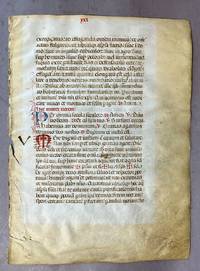
007112Upper Rhine region probably Alemannic Germany or northern Switzerland 1000. No Binding. Good. Single parchment leaf recto and verso 245 x 182 mm written in a fine mature Caroline minuscule in dark brown ink 29 lines per page single column. Rubrics in red; simple pen-flourished initials in red and blue marking textual divisions. Pricklings and ruling faintly visible. The text comprises the Exorcism and Blessing of Water Exorcismus aquae with extended invocations against unclean spirits and prayers for purification healing and protection. These texts form part of the Roman ritual tradition as transmitted in Germanic regions during the 10th century and are characteristic of Rituals or Sacramentaries rather than Missals or biblical codices. The hand is confident and regular with well-proportioned Caroline letterforms and consistent word separation. Decoration is restrained and functional reflecting a working liturgical manuscript produced for clerical rather than a luxury commission. Palaeographical and textual features point to production in the Alemannic sphere of the Upper Rhine an area renowned for conservative preservation of Carolingian liturgical practice. In good bur well-used medieval condition. The parchment is supple but heavily toned at margins with cockling and surface wear consistent with prolonged liturgical handling. There are tears at binding edge with evidence of modern tape repair. Occasional later marginal notations present. Ink and decoration remain clear and legible. Early litugical manuscripts of this early date are increasingly scarce on the market. Leaves containing exorcistic and ritual texts are especially sought after for their historical and theological interest offering insights into early medieval concepts of sanctification healing and spiritual protection. Ships unmatted and unframed <br/> <br/> unknown
1581ST20964Geneva: Excudebat Henrius Stephanus 1581. Second Estienne Edition. 320 x 212 mm. 12 1/2 x 8 1/2". 6 p.l. 584 76 pp.Edited and with annotations by Henri Estienne. <br/> FINE 17TH CENTURY SPRINKLED CALF PRIZE BINDING covers gilt with French fillet border oblique fleur-de-lys at corners SUPRA LIBROS OF CARDINAL MAZARIN AT CENTER raised bands spine compartments with fleurs-de lys at center and corners edges gilt over marbling old repair to head of spine. Printer's device Schreiber 18 on title. WITH 1692 COLLÈGE MAZARIN PRIZE PRESENTATION to Laurence Thibault for Greek oratory signed by the head of College P. J. Le Chapelier with seal of the college attached tipped onto title page. Main text in Greek dedication to James VI of Scotland and Estienne's annotations in Latin. Renouard 149.6; Hoffmann III 577; Dibdin II 567; USTC 450908. Lower corner of back board somewhat bumped leather slightly marked other very modest exterior wear but the stately binding in nearly fine condition. First five quires with two tiny wormholes to tail margin final signature with a little creasing other insignifcant imperfections but AN ESPECIALLY FRESH CLEAN AND BRIGHT COPY INTERNALLY the leaves crackling when you turn them.<br/> <br/> This copy of what Renouard calls the "far superior" Estienne Xenophon is offered in a very attractive binding that was used as a prize for a student at the Collège Mazarin near the close of the 17th century. Best known to his contemporaries as an historian and general as well as an opponent of Athenian democracy Xenophon ca. 430-354 B.C. was a student of Socrates and aside from Plato's his works contain the only surviving examples of Socratic dialogues. Although born in Athens Xenophon greatly admired Sparta and its political structure and he eventually went to war for Sparta against the Athenians this earned him land in Sparta but unsurprising exile from Athens. Xenophon's philosophical writings found popularity in the Renaissance and some scholars have suggested that Machiavelli was particularly influenced by Xenophon's more "practical" i.e. ruthless approach to politics. The present 1581 printing is among the most highly regarded Renaissance editions of Xenophon's works. The printer and scholar Henri Estienne II 1528-98 was a brilliant classicist best known for producing "Thesaurus Graecae Linguae" 1572 a standard reference for 300 years. He produced his first Xenophon in 1561 but fully revised the text for the present edition. Dibdin tells us that "the edition of 1581 has more intrinsic value than the preceding one" and Renouard notes that it is "not as pretty as the 1561 edition but far superior." Our copy fittingly was presented as a prize for Greek oratory to a student at the Collège Mazarin founded by a bequest from the former first minister of France Jules Cardinal Mazarin 1602-61. Mazarin was not just a prince of the Church and an advisor to the Sun King but one of the greatest bibliophiles of his day with a library of 40000 volumes that became the foundation of the Bibliothèque Mazarine. Our book is bound in a style appropriate to that famed collection with Mazarin's personal supralibros at the center of each board. The partly printed award certificate bound in at the front indicates that Laurence Thibault had won second prize for Greek oration in the college's "solemn games" honoring the royal recognition of the college. It is signed by the head of the college Pierre-Jean Le Chapelier de Mauron who held a doctorate from the Sorbonne and simultaneously served as abbot of the Abbey of Ste Marie-de-Boquen in Brittany. Excudebat Henrius Stephanus unknown
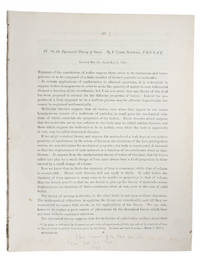
186743456London Taylor and Francis 1867. 4to. No wrappers as extracted from "Philosophical Transactions" Vol. 157 - Part I. Titlepage to volume 155 and pp. 49-88. Titlepage with minor light browning at corners. Internally clean. A small stamp on verso of titlepage. <br/><br/><em>First appearance of this seminal paper in its full version from "Transactions" representing the announcement of Maxwell's final "Theory of Gases" and introduces the "Maxwell Distribution" in its final form a statistical means of describing aspects of the kinetic theory of gases a theory together with his electromagnetic theory are considered to be SOME OF THE GREATEST ADVANCES IN PHYSICS OF ALL TIMES. Everett considers this paper 1868 to be Maxwell's greatest single paper. Maxwell's discoveries laid the foundations of special relativity and quantum mechanics.One of Maxwell's major investigations was on the kinetic theory of gases. Originating with Daniel Bernoulli this theory was advanced by the successive labours of John Herapath John James Waterston James Joule and particularly Rudolf Clausius to such an extent as to put its general accuracy beyond a doubt; but it received enormous development from Maxwell who in this field appeared as an experimenter on the laws of gaseous friction as well as a mathematician.In 1866 he formulated statistically independently of Ludwig Boltzmann the Maxwell-Boltzmann kinetic theory of gases. His formula called the Maxwell distribution gives the fraction of gas molecules moving at a specified velocity at any given temperature. In the kinetic theory temperatures and heat involve only molecular movement. This approach generalized the previously established laws of thermodynamics and explained existing observations and experiments in a better way than had been achieved previously. Maxwell's work on thermodynamics led him to devise the Gedankenexperiment thought experiment that came to be known as Maxwell's demon. </em> unknown
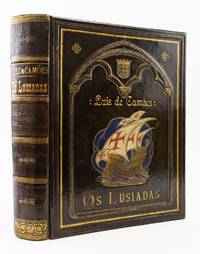
1880ST17890eLeipzig: Typographia Giesecke & Devrient for Emilio Biel Portugal 1880. 400 x 305 mm. 15 3/4 x 12". 2 p.l. LVI 375 1 XCII pp. <br/> IMPOSING CONTEMPORARY BLACK CALF upper cover with sunken central panel framed by gilt and blind rules raised gothic window frame with gilt tooling large ship embossed and painted at center gilt lettering above and below lower cover gilt-stamped "Companhia Portugueza Editora / Porto" raised bands spine panels with blind-stamped floral frames gilt lettering patterned endpapers apparently later hinges all edges gilt and elaborately gauffered. In a later green felt-lined cloth slipcase. Illustrated half title engraved portrait frontispiece dedication and portrait of the dedicatee engraved decorative half frames at beginning of each Canto and tailpiece at the end 10 section titles printed in colors and 19 plates all with original tissue guards. Front pastedown with modern color-printed bookplate dated 1980. ◆Spine slightly sunned leather with a few minor scrapes scratches and other small signs of wear plates variously foxed because of paper used usually mildly or moderately though occasionally more noticeably; nevertheless a striking volume with its main attractions the front cover and shimmering gauffered edges retaining all of their appeal.<br/> <br/> This is an impressive commemorative edition of the masterpiece of the Portuguese language's greatest poet in a binding that celebrates that country's history of exploration. First published in 1572 the epic poem "Os Lusíadas" relates the adventures of Portuguese explorer Vasco da Gama ca. 1460s - 1524 the first European to reach India by sea. Sailing via the Cape of Good Hope in 1497 he established the first ocean route from Europe to India landing in Calicut in 1498. His navigation skills provided Portugal with more than bragging rights for accomplishing a feat attempted for decades at the cost of hundreds of sailors' lives: the Portuguese now had unprecedented access to the spices of the East and came to dominate that market. A master of verse whose skills have been compared to those of Shakespeare Milton and Dante Luís de Camões ca. 1524/25 - 1580 also had firsthand experience of the voyage: he travelled to India on the carrack São Bento in 1553. He composed parts of this work while dwelling in a cave in Macau and managed to save the manuscript when he was shipwrecked in the Mekong delta. After 17 years in the East Camões returned to Portugal and completed "Os Lusíadas." When it was published two years later he was rewarded with a royal pension. The binding here depicts a Portuguese caravel--the small very maneuverable ship Portugal's explorers used in the Age of Discovery--at full sail on choppy seas in a sunken space framed within a Moorish-style arch bearing the Portuguese Coat of Arms. Dedicated to Dom Pedro II Emperor of Brazil this luxurious production was issued to commemorate the 300th anniversary of Camões' death. Typographia Giesecke & Devrient [for] Emilio Biel, Portugal unknown
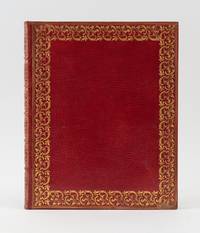
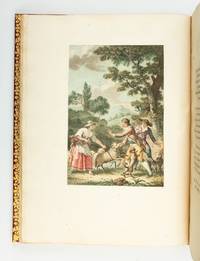
1793ST20474Paris: Defer de Maisonneuve 1793. First Edition with these Illustrations. 350 x 262 mm. 13 3/4 x 10 1/4". 125 pp. <br/> VERY PRETTY 19TH CENTURY CRIMSON MOROCCO ELEGANTLY GILT covers framed with floral tools raised bands spine panels filled with rows of flower-and-lozenge roll gilt lettering gilt turn-ins top edges gilt. FOUR FINE STIPPLE-ENGRAVED PLATES by Colibert and Cazenave after Monsiau PRINTED IN COLORS. A Large Paper Copy. Cohen-de Ricci 400; Furstenberg 122; Lewine p. 188; Maggs 1930 Catalogue of French Illustrated Books 84; Ray p. 145. Occasional minor foxing the margins of one plate foxed a bit more otherwise a fine copy clean and fresh internally with immense margins the plates with pleasing colors and the unworn binding bright with gilt.<br/> <br/> This is an especially tall copy of Florian's pastoral romance in imitation of Cervantes one of the grander French books to be printed in colors when the vogue for such productions took hold during the last years of the 18th century. Ours is one of six such books all printed after 1786 that Ray singles out for praise as "handsome and imposing volumes." A noted painter of both classical and modern subjects Monsiau 1754-1837 was also an illustrator whose "abundant and interesting work in this line" is underrated even though it has the merits of being simple natural lively and piquant. Ray Monsiau's obscurity says Ray may be owing to the fact that he most often worked as a secondary collaborator on major illustrated works; the present book is one of the few he did on his own and it is among his best. Publisher Defer de Maisonneuve did not originate the technique of stipple engraving on copper plates but he did perfect the process which allowed for gradual tonal changes in hues and intensities of color rather than the "stained glass" effect of separately printed patches of color. Given the turmoil of the period when this book was published it is quite likely that it did not have an especially decorative original binding and may have remained in publisher's boards as was often the case. Happily a later owner supplied a period-appropriate binding here that matches the opulence of the contents. While our copy has the engraver's name just visible beneath the plates perhaps disqualifying them as the "avant la lettre" versions used in the Large Paper Copies per Cohen-de Ricci the size of the margins here and the quality of the paper certainly argue for that designation. Defer de Maisonneuve unknown