English School, 19th centuryBiblio.com
48 790 résultats
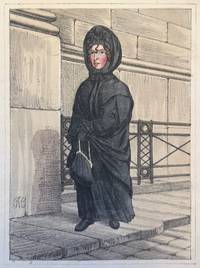
18201889London 1820. Lithograph with handcoloring in watercolor 9 x 6 1/2 inches 230 x 165 mm full margins. Light pencil inscriptions in the lower margins which are largely illegible. Light handling wear and some surface soiling otherwise in good condition with beautiful saturated watercolor work in the area of the subject's face. Whitehead's brother Philip was employed by the Bank of England from 1797 to 1810. During his employment at the Bank Philip Whitehead "adopted an extravagant lifestyle" and evidence came to light that he had defrauded Robarts & Co. by "forging an acceptance to a Bill." He was charged with forgery in 1811 and executed on 29 January 1812. The news of her brother's conviction was kept from his sister Sarah as long as possible. Learning of the execution Sarah Whitehead's mental health became unstable and she began to visit the Bank daily asking if Phillip was there. This continued until 1818 when the Directors offered Whitehead a financial grant on the condition that she stopped coming to the bank. Whitehead wore black crepe clothing which was a sign of mourning and as a result became known as the "Black Nun." To this day Whitehead's ghost reputedly haunts the Bank of England as well as the area on Threadneedle Street nearby. The myth of Whitehead's ghost appears in the poem New Year Letter by W. H. Auden. unknown
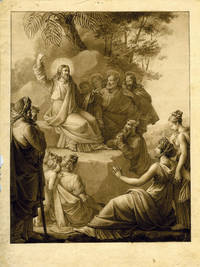
886Pen and ink with wash on watermarked J Whatman 1814 paper 11 x 8 1/4 280 x 210 mm. Scattered minor edge losses at the left sheet edge well outside of image area. Minor handling wear otherwise in very good condition. A truly masterful drawing by an unknown draughtsman. unknown
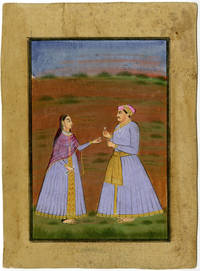
9191750. Gouache and ink with heightening in gold on handmade card stock 10 5/8 x 7 3/4 inches 270 x 197 mm the full sheet. Margins and verso are washed in tea with minor scattered surface soiling and some areas of light scattered discoloration. The top right and bottom left corners are very slightly dog-eared well outside of the image area. Colors remain fresh and well saturated. Mirza Nur-ud-Din Muhammad Salim 30 August 1569 - 28 October 1627 known by his imperial name Jahangir "Conqueror of the World' was the fourth Mughal Emperor who ruled from 1605 until his death in 1627. He was the third and only surviving son of Akbar and his chief empress Mariam-uz-Zamani born to them in the year 1569. He was named after the Indian Sufi saint Salim Chishti. <br /> - Singh Pashaura; Fenech Louis E. eds. 2014. The Oxford handbook of Sikh studies. Oxford University Press. p. 647. ISBN 978-0-19-969930-8. unknown
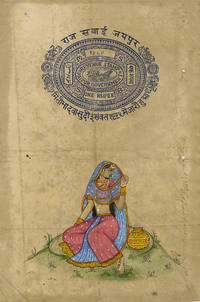
189513361895. Ink and gouache with gold heightening on fibrous brown laid paper with a Jaipur Court Fee tax stamp in purple ink 13 3/8 x 8 3/4 inches 340 x 222 mm. Toning handling creases and minor scattered surface soiling throughout. A typed and signed court order dated 1891 in reference to a landlord/tenant dispute appears on the verso as well as the purple blindstamp of the Treasury of Jaipur. There are scattered coeval Hindi inscriptions in ink on the recto. The following text appears typed on the verso:<br /> <br /> "Maloom order of 2nd July 1891 and 5 party No. b applied to the P.I.B. Department for redress.<br /> <br /> The P.W. Member opined that party No. b is entitled to live in the quarters which had been continually occupied by them and party No.a should not interfere with the other party in respect of the quarters which should be restored to the latter. <br /> <br /> Resolution No.34. <br /> <br /> Resolved that the proposal of the P.W.Member be accepted.<br /> <br /> TRUE COPY<br /> <br /> Registrar<br /> <br /> Mahakma Khas Jaipur."<br /> <br /> <br /> The first revenue stamps in India were issued in the mid-nineteenth century during the Raj and they are still being issued to this day. Apart from issues for the whole of India many princely states provinces and other states also had or still have their own revenue stamp issues. <br /> <br /> Before independence Indian revenue stamps were closely modeled on similar designs from Great Britain as is the case with this carriage motif stamp from Jaipur. The stamps were issued to denote various denominations including rupees and annas. An anna or Änna was a currency unit formerly used in British India equal to 1â„16 of a rupee. It was subdivided into four old Paisa or twelve pies thus there were 192 pies in a rupee. When the rupee was decimalized and subdivided into 100 new paise one anna was therefore equivalent to 6.25 paise. This particular stamp was used as evidence of court taxes remitted for property dealings. unknown
1st edition. Modern boards. 64mo (2x4, miniature), [26]+ 384 pages. In Latin. Engraved title page, illustrated, with portrait medallion: "vatis amatoris iulia sculpta manu." Author's portrait on leaf 10. Each work has divisional title page. Johannes Secundus (also Janus Secundus or Jean Second) (1511-1536), was a an erotic New Latin poet of Dutch nationality....Secundus was a prolific writer, and in his short life he produced several books of elegies on his lovers Julia and Neaera, epigrams, odes, verse epistles and epithalamia, as well as some prose writings (epistles and itineraria)....Secundus situates his poetry, stylistically as well as thematically, firmly with the Neo-Catullan tradition. Variations on the central theme include: imagery of natural fertility; the 'arithmetic' of kissing; kisses as nourishment or cure; kisses that wound or bring death; and the exchange of souls through kissing. Secundus also introduces elements of Neo-Platonism and Petrarchism into his poems (wikipedia). Subjects: Latin poetry, Medieval and modern -- Early works to 1800. Epigrams, Latin. OCLC: 781619207. Spelling and date error on spine. Includes second identical title page with inscription dated 1686. Pen marks on a few pages and period owners notation on rear blank end paper. Touch of edgewear to first title page and to background margin of portrait on leaf 10. Good+ Condition Overall. Nice copy. (AC-22-2)
Acquaforte su ferro, 1579 circa. Primo stato di due, avanti la numerazione. Pubblicata nel Catalogus gloriae mundi, di Barthélemy de Chasseneuz (ca. 1480-1541) – noto anche con la forma latinizzata del nome Bartholomaeus Cassaneus, edito Francoforte nel 1579 da Sigmund Feyerabend. La tavola raffigura un re seduto su un trono che tiene uno scettro sullo sfondo centrale, a sinistra uno scriba, ai lati della stanza i consiglieri del re, soldati in piedi in primo piano. Inserita in una cornice ovale, gli angoli riempiti con motivi ornamentali. Il Catalogus gloriae mundi, tipico prodotto dell’enciclopedismo rinascimentale, opera umanistica e giuridica, si incentrava sull’onore, problema per definizione interdisciplinare e di vastissimo successo nella pubblicistica cinquecentesca. Ma nel saggio di Chasseneuz il concetto di onore divenne addirittura la griglia di una vera e propria enciclopedia di tutto il creato. In dodici libri l’intera esperienza secolare e celeste si condensava compatta, ritrovando intorno all’onore il proprio archetipico motivo d’ordine: I. considerazioni generali sull’onore II. onori e ordini dell’uomo e della donna in generale III. onori e ordini degli spiriti celesti e infernali IV. onori e ordini degli ecclesiastici V. onori e ordini dei Principi VI. onori e ordini degli ufficiali del sacro palazzo VII. onori e ordini dei magistrati e di tutti gli ufficiali di giustizia VIII. onori e ordini dei nobili IX. onori e ordini dei militari X. onori e ordini delle scienze e dei letterati XI. onori e ordini dei plebei e degli artigiani XII. onori e ordini di pietre, vegetali, animali e di tutti i rimanenti esseri, celesti e terrestri. Di famiglia borghese, Bathélemy de Chasseneuz studiò diritto alle Università di Dole, Poitiers, Bologna, Torino e Pavia. Dopo l’occupazione del Ducato di Milano da parte di Carlo VIII vi svolse incarichi giudiziari, conseguì nel 1502 il dottorato in utroque ed accompagnò Charles d’Amboise nella sua spedizione contro Bologna. Esercitò poi l’avvocatura ad Autun, divenendo avvocato del Re e baglivo dell’abbazia di Saint Martin d’Autun. Consigliere nel parlamento di Digione dal 1525, nel parlamento di Parigi dal 1531, fu presidente in quello di Aix dal 1532. Morì nel 1541. Di lui rimangono a stampa una raccolta di pareri legali, i commentari sulle consuetudini del Ducato di Borgogna e, appunto, il Catalogo della gloria del mondo. La prima edizione dell’opera fu pubblicata nel 1529. Nel 1579 Sigmund Feyerabend, tipografo di Francoforte, decise di pubblicare una nuova edizione dell’opera, arricchita dalle illustrazioni realizzate ad hoc da Jost Amman allo scopo di rendere più facilmente comprensibili le teorie del giurista e valorizzare maggiormente l’opera. Magnifica prova, ricca di toni, impressa su carta vergata coeva, rifilata al rame, tracce di colla al verso, per il resto in ottimo stato di conservazione. Bibliografia The New Hollstein, Part VI.87.144.23.i, p. 87. Etching on iron, 1579, unlettered. First state, of two, before the numbering 6 added lower right in the plate. The plate depicts a king sitting on a throne holding a sceptre in centre background, on the left a scribe, on either side of the room the king's advisors, soldiers standing in the foreground. Set in an oval frame, the corners filled with strapwork ornaments. A fine impression, printed on contemporary laid paper, trimmed to the paltemark, very good condition. Printed in Catalogus Gloriae Mundi by Barthélemy de Chasseneuz, printed in 1579, Frankfurt - Sigmund Feyerabend. Barthélemy de Chasseneuz (1480–1541) was a lawyer, and he was neither a narrow-minded one nor a bad one – quite the opposite. He had attended French and Italian universities and had been the student of some of the most famous teachers of his time. The talented legal scholar had acquired experience at the court of the duke of Milan and even at the court of the Pope himself. And yet, he returned to his home country in 1506 where he took up high offices. As his contemporaries, Barthélemy de Chasseneuz was convinced that everything on earth had a precise order. He believed that any kind of dispute arose solely from the fact that humankind was unaware of the exact structure of this order. It was obvious that the King of France was of higher status than a juggler. But what about the King of France and the King of Aragon? Who of them was of higher status? Being a good lawyer, Chasseneuz sat down and studied the sources. He wrote more than 1,000 pages setting out which office held which rank based on all theological, philosophical and legal sources available to him – from the hierarchy of the Heavens to the social ranks of humankind and to animate and inanimate nature. In 1529, this book was published for the first time. Chasseneuz’ book was of huge importance to all those who had to deal with issues of ceremonial protocol. All princes and city councillors had enough money to afford an expensive book. That’s why, at some point during the 70s of the 16th century, Sigmund Feyerabend from Frankfurt decided to publish a new edition of Chasseneuz’ work. He did not simply reprint the first edition, instead, he hired the famous book illustrator Jost Amman to transform Barthélemy de Chasseneuz’ theoretical considerations into impressive – and easily understandable – copper engravings. Bibliografia The New Hollstein, Part VI.87.144.23.i, p. 87.
Acquaforte. Lastra mm 118x152, foglio 160x222 mm. Firma a matita a sinistra Luigi Bart. Titolo a matita in basso a sinistra non ben leggibile. Possiamo ipotizzare Invadenza. L’incisione non è catalogata in nessuno dei numerosi repertori sull’artista da noi consultati; è notorio che la catalogazione delle opere di Bartolini non è ancora completa. Bellissima prova, impressa su carta coeva, piccolo strappo perfettamente restaurato nella parte superiore, leggera abrasione al verso, per il resto in ottimo stato di conservazione. Luigi Bartolini è considerato uno dei maggiori incisori italiani del Novecento, insieme a Giorgio Morandi e Giuseppe Viviani. Oltre ad essere un prolifico incisore (al suo attivo oltre mille acqueforti), fu anche pittore e scrittore. Partecipò sia come pittore che come incisore a diverse edizioni della Biennale di Venezia dal 1928 al 1962. Presente a varie manifestazioni artistiche, sviluppò diverse maniere definite: ‘maniera bionda’, ‘lineare’ e ‘nera’. Ricordiamo soprattutto le acqueforti della serie Marche e della serie Sicilia. Iniziò la sua produzione grafica nel 1914 e il suo stile si rifà alla tradizione naturalistica dell’Ottocento. Molte sue incisioni si possono ricollegare ad alcune opere del Goya, di Telemaco Signorini e di Giovanni Fattori. Eccellente nella rappresentazione della natura morta e del paesaggio, spesso il Bartolini rappresentò dolcemente le cose e gli oggetti più umili, i soggetti di natura più dimessi. In essi ritroviamo il sentimento che diviene immagine e la forma che si sviluppa in espressione. Con Bartolini l’incisione torna ad essere un mezzo di espressione poetica libera dal simbolismo e dal vedutismo allora in voga presso le accademie. Nelle sue acqueforti prevale ora un tratteggio leggero (genere biondo), ora una ricerca del chiaroscuro alla Rembrandt (genere nero). Etching. Plate mm 118x152, sheet 160x222 mm. Signature in pencil on the left Luigi Bart. Title in pencil at lower left not well readable. We can assume Invadenza. This work is not catalogued in any of the several repertories we consulted about the artist; it is well known that the cataloguing of Bartolini's works is not yet complete. Beautiful proof, printed on contemporary paper, small tear perfectly restored in the upper part, light abrasion on the back, otherwise in excellent condition. Born in Cupramontana near Ancona, Luigi Bartolini was the twentieth century Italian etcher, who came closest to the stature of his great rival, Morandi. As a teenager, he saw the collection of etchings, including work by Callot, owned by the Corradi family in Iesi. From 1907 to 1910 Bartolini studied at the Istituto di Belle Arti in Siena, and started to etch c. 1909. He moved to Rome in 1910, where until 1912 he frequented the Accademia di Belle Arti, while also attending lectures on literature and the history of art, and courses on anatomy at the University in Rome. Bartolini studied the etchings of Goya and took lessons on drawing at the Accademia di Spagna. From there, he went to Florence in 1913, where he attended the Scuola del nudo. Bartolini continued his anatomical research, as well as studying architecture, making himself the most assiduous student of all Italian twentieth century printmakers. He also visited the Uffizi and Florentine print dealers to look at the etchings of Rembrandt and Fattori. Bartolini painted his first oils just before the outbreak of the First World War. Although he painted pictures throughout the rest of his career, and was awarded the Premio Marzotto for them in 1956, they have been far eclipsed in fame by his etchings and writings. During the First World War, Bartolini published his first collection of poetry. A very prolific and accomplished writer, in this field he is best known today as the author of the novel, 'Ladri di biciclette' (Bicycle thieves), of 1946, which was quickly turned into a celebrated film by Vittorio de Sica and Cesar Zavattini. After the First World War, Bartolini held a series of minor teaching posts in Macerata, Sassari, Avezzano, Pola, and Caltagirone, while he continued to etch, and started a long career as a polemical journalist and critic of art and architecture. From 1923 to 1929, he wrote for the Naples periodical, 'Cimento', but he also contributed to 'Il Selvaggio', 'Quadrivio', 'Italia letteraria', and 'L'Ambrosiana'. Bartolini's 1924 exhibition of etchings at the Casa d'Arte Bragaglia in Rome was a great success, and later that year he showed 70 etched landscapes of the Marches at the Casa Palazzo di Roma. The following year he visited Paris, where he paid particular attention to the paintings of Van Gogh. Bartolini's political convictions led him to being assaulted by Fascists and hospitalised in 1928. Two years later, he won a prize at the Venice Biennale, where he had exhibited a portfolio of etchings. In 1930, the Turin publisher, Buratti, began to issue a series of portfolios of etchings by contemporary Italian artists under the editorship of Cipriano Oppi, selecting Bartolini for the first album. The following year, Buratti published 'Le carte parlanti', a portfolio of 10 of Bartolini's etchings, which was published in an edition of 20. In 1932, Bartolini shared the first prize at the Prima mostra dell'incisione moderna at the Uffizi with Morandi and Boccioni. His close friend, the leading anti-Fascist art historian, Lionello Venturi, acted as his agent selling his etchings in Paris. Bartolini's correspondence with his compatriots in exile led to his imprisonment, from which he was released on Mussolini's personal intervention. He was then placed under political surveillance. From 1933 to 1938, Bartolini taught in Merano, where he painted and etched in the open air, finding subjects on the banks of the fast flowing Adige. Despite being under political su...
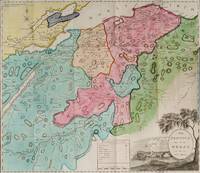
179829839AB1798. First Edition. Aberdeen Printed for Isaac Forsyth Bookseller Elgin 1798. Octavo 14 cm x 215 cm. Folded hand-coloured Frontispiece-Map by William Millar Frotispiece-Engraving of the "Elgin Cathedral" VIII 353 pages. Original Hardcover / Original 18th or early 19th century leather with original spinelabel. The large hand-coloured Map with a minor tear only. Corners slightly bumped. Spine slightly starting but overall in excellent condition with some minor signs of wear only. Interesting Provenance and signed manuscript dedication by the Cartographer and Mapmaker William Millar: From the library of Aberdeen Highlander Major Hugh Houstoun with a dedication: "April 27th 1798 - To Major Hugh Houstoun - from his Much obliged and Humble Servant William Millar". The fantastic Map in this publication was produced by William Millar who is identified inside the publication in the text of an Advertisement placed verso the titlepage and in which the Publisher Isaac Forsyth of Aberdeen gives thanks: ".For the very handsome manner in which the two first chapters were furnished by the Revd. Mr.Grant of Elgin and the other two by the Revd. Mr.Leslie of Darkland he offers this testimony of his grateful remembrance. Nor can he omit expressing his sense of obligation to Mr.William Millar Engineer of the Sutherland Coal Work for the Most accurate Map of the Province of Moray ever offered to public notice." The publication includes for example stories about the "First Inhabitants Celts Picts Scots Surnames in Moray Thanes Earls of Moray Family of Gordon Family of Grant Family of Shewglie Family of Innes Family of Brodie Family of Calder Family of Kilravock Family of Dunbars Family of Grangehill and Durn Family of Comyn of Altre Family of Fraser of Lovat Family of Mackintosh Family of Macpherson Family of Macdonalds of Glengary Family of Duff Earl of Fife Family of Gordonstown Family of Lethin Family of Findrassie Family of Murreffs of Duffus Population of Moray Antiquities of the Province with Roman Progress in Moray Vitrified Forts etc. etc. hardcover
197568712ABKöln., Elsass Express., 1975. 37,4 x 30,9 cm. [54] unpaginierte Blätter. OKarton mit schwarzweisser Originalradierung recto mit Plattenabdruck., 68712A Erste Auflage. Rücken materialbedingt wenig lesespurig, sonst sehr gutes Exemplar.
Bulino, 1593, monogrammata in lastra, nell’immagine in basso a destra “HG Jnve.” Numerata 5, in basso a sinistra. Stato unico. Eccellente esemplare, impresso su carta vergata coeva, rifilato ai margini, qualche spellatura al verso, in ottimo stato di conservazione.L’incisione appartiene a una serie di quattordici dedicata ai Vizi Capitali e alle Virtù. L’invidia è raffigurata dentro una nicchia, nelle sembianze di una vecchia megera nell’atto di mangiare un cuore, mentre nella mano sinistra tiene dei serpenti. Nei due alnoli superiori, i suoi attributi, il serpente e il caneSotto l’immagine, due versi in latino che definiscono il Vizio: “Invidia asperius nihil est, nec acerbius usquani/Tabificum pravis malum et exitiale venenum F.E[stius]”. Engraving, 1593, signed on plate, in the image lower right “HG Inve”, numbered 5 at lower left. Only state.Excellent example, printed on contemporary laid paper, trimmed at margins, some scratch on verso, in very good condition.In this print, which comes from a series of fourteen engravings, representing the Seven Capital Vices and Virtues, Envy is shown as an old hag eating a heart, inside a niche adorned with two shields that represent her two main attributes, the snake and the dog.Under the image, the following latin inscription: “Invidia asperius nihil est, nec acerbius usquani/Tabificum pravis malum et exitiale venenum F.E[stius]”. Hollstein 154
18274336Paris, Henri Feret, 1827 ; huit tomes, in-8 ; demi-veau glacé bronze, dos lisses ornés de palettes décoratives dorées et fleurs stylisées à froid, titre doré, tranches marbrées (reliure de l'époque) ; XV, 411 ; 483 ; 495 ; 488 ; 476 ; 544 ; 460 ; 464 pp. ; et portrait par Devéria, gravé par H.C. Muller. Contient une table des matières de l'Esprit des lois très détaillée.
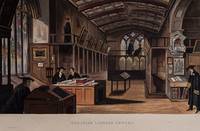
184329389AB1843. Oxford James Heywood 1843. Octavo. IV pages of Title and Contents plus 44 plates / This being coloured lithographs collation complete. Original Hardcover / Original cloth with gilt lettering to front board. The boards of this volume are cleanly detached spine is missing. Interior pages and illustrations all complete including endpapers with the personal Library Stamp of Hopkins: "T.H.T.Hopkins - Magd Coll. Oxford" on the endpaper and titlepage. Complete with all plates. Only very occasional minor signs of foxing. Extremely scarce and wonderful publication on the student-life in Oxford and Cambridge during the first half of the 19th century ! Wonderful provenance. Thomas Henry Toovey Hopkins 1831-1885 Thomas Henry Toovey Hopkins 18311885 matriculated from Trinity College in 1851 and received a Demyship at Magdalen College in 1853. He took his BA in 1856 and was elected to the fellowship in the same year. In 1858 Hopkins took his MA and was ordained Deacon. He served the college as a tutor in 185881 Bursar in 186265 1869 and 188185 Junior Dean of Arts in 1861 1867 and 1868 Vice President in 1870 and 1871 and Dean of Divinity in 187274 1877 and 1879. Hopkins was ordained a deacon in 1842 and priest in 1853. In addition to the positions Hopkins held at Magdalen he was also Curator of the University Chest in 188385 Curator of the Parks in 186285 and Delegate of the University Police in 187375. He resigned his position as Bursar at Magdalen in 1885 on account of his failing health and died at Sandown in the Isle of Wight in the same year at the age of 54. The College Barge was given in his memory; pictures in MC:F22/P1/1 shows that Hopkins was a very keen rower as an undergraduate. Source: Information from Magdalen College Oxford archives. OCLC 56007578 Illustrations include the following Aquatints in colour and lithographs in black and white: 1. Bodleian Library at Oxford Aquatint / 2. Sir Thomas Bodley / 3. Cambridge University Library Aquatint / 4. Student signing is name in the Matriculation Book before the Vice Chancellor at Oxford 1842 / 5. Oxford University Amusements - 1842 Fantastic Aquatint depicting a Biedermeier Scene of an english Student's Life / 6. Oxford University Students driving Tandem 1842 depicting also the Oxford & London Fly" / 7. Brasenose College Chapel Oxford Afternoon Service / 8. Annual Examination of Students in Trinity College Cambridge / 9. Father of a College Presenting a Supplicat for a Degree Cambridge / 10. Proctors Walking Oxford / 11. Vice-Chancellor conferring the B.A.Degree Oxford / 12. Act for B.C.L. Degree Cambridge / 13. Vice-Chancellor conferring the M.A.Degree Oxford / 14. Vice-Chancellor conferring the B.D. Degree Oxford / 15. Robert Egglesfield Founder of Queen's College Oxford / 16. William of Wykeham Founder of New College Oxford / 17. Margaret of Anjou Lancastrian Foundress of Queen's College Cambridge / 18. Elizabeth Woodville Yorkist Foundress of Queen's College Cambridge / 19. Corpus Christi College Oxford / 20. Richard Fox Founder of Corpus Christi College Oxford / 21. Merton College Oxford / 22. Tom Tower Christ Church Oxford / 23. Cardinal Wolsey / 24. Erasmus / 25. Edward VI. / 26. Sir John Cheke / 27. Queen Mary 1555-1558 / 28. Cardinal Pole / 29. William Cecil Lord Burleigh / 30. Robert Dudley Earl of Leicester / 31. Matthew Parker / 32. John Whitgift / 33. Sir Thomas Smyth / 34. Charles I. / 35. William Laud / 36. Earl of Manchester / 37. Oliver Cromwell / 38. Richard Cromwell / 39. John Locke / 40. Edward Copleston / 41. Oxford Convocation House / 42. Plan of Oxford Colleges / 43. Examination of Students in the University of Durham / 44. The Chancellor conferring a Degree in the University of London // hardcover
199169471ABZürich., Galerie Jamileh Weber., 1991. 133 x 115 cm. [1] unpaginiertes Blatt., 69471A Sehr gutes Exemplar.
1969857FBHannover., Kestner Gesellschaft., 1969. 61,5 x 61,5 cm. 1 Blatt Inhalt, 15 Grafiken. OKarton-Flügelmappe., 857F Ein Blatt mit sehr kleinem Einriss, Mappenkanten gering berieben, sonst sehr gutes Exemplar.
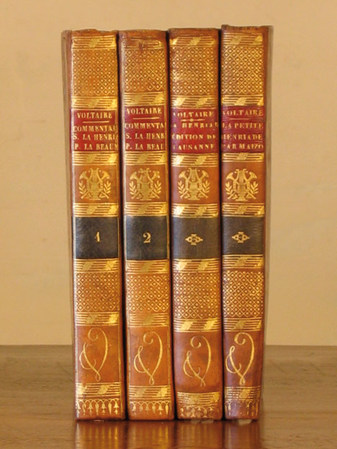
9274en reliure uniforme, concernant la Henriade ; in-8 (20,5 x 13 cm) ; plein veau havane raciné, dos à faux-nerfs de filets dorés, ornés et dorés, grand V (majuscule manuscrite) doré en pied, pièces de titre grenat et de tomaison ou décoratives vert-sapin ; à l'intérieur, les blocs imprimés sont de tailles différentes.1- La Henriade en dix chants, précédée, accompagnée et suivie de toutes les pièces relatives à ce poème et à la poésie épique en général. Nouvelle édition, revue, augmentée et exactement corrigée. Lausanne, François Grasset, 1771, petit in-8 (18,3 x 11,5 cm) ; XXXVI, 366 pp. ; (24) pp. de catalogue du libraire.2- Commentaires sur la Henriade, par Feu Mr de la Beaumelle ; revu et corrigé par Mr F... (Fréron). À Berlin et Paris, Le Jay, 1775 ; deux tomes in-8 (19,2 x 12,2 cm) ; XVI, 364 pp., élégant frontispice de Marillier gravé par Augustin de Saint-Aubin avec les portraits de Voltaire, La Beaumelle et Fréron en médaillon ; (4), 336 pp. (Bengesco, I-387). "C'est à propos de ce frontispice que Voltaire, composa, dit-on, le célèbre quatrain :Entre La Beaumelle et Fréron,Un graveur a placé VoltaireCe serait vraiment un CalvaireS'il n'y manquait le bon barron" (Cohen-Seymour de Ricci, 533-534).3- Maizony de Lauréal : La Petite Henriade ou l'enfance d'Henri IV, poème en trois chants avec des notes historiques et littéraires ; présenté à S.A.R. Mgr le duc de Bordeaux. Paris, Pillet Ainé, 1824 ; in-12 (15,2 x 9,4 cm) ; (4), VI, 284 pp., portrait en pied du duc de Bordeaux lithographié par C. Motte.
PLEASE NOTE: This is a heavily-worn former library copy with the usual markings. Dust jacket not included. Binding very tender - could let go at any moment, thus we offer this book AS IS. Now the good news: x, 709 pages. Index. Glossary. Profusely illustrated in black and white and color. "The subject, though approached from the viewpoint of forty years of Esquire Magazine fashion coverage, represents far more than that in its totality. The result, obviously, is to tell you more than you could conceivably care to find out, at least at one sitting, about any one of the many aspects of twentieth-century fashions for men." - Arnold Gingrich. This books is "also a social history, for the clothes men wear tell us not only a lot about the men who wear them but a lot too about the climate of the time in which they live: the social, economic and political conditions that influence the way a man dresses. This, then, is a lavishly illustrated encyclopedia that, in seminarrative style, covers in detail every item of apparel worn by the American man of this century while exploring the society of which his clothes are a reflection. Also considers luggage and leather goods, the styling and care of the hair, and toiletries. Each category of apparel is covered chronologically, decade by decade. Also takes readers behind the scenes, to the mills where the fabrics are made and to the plants where the clothes made from these fabrics are manufactured. Every step of every process is described in detail. Since this book deals with eight decades of fashion, it offers the reader a uniquely panoramic view of men's fashions in the twentieth century" - Introduction. Despite its major deficiencies, a worthy reference copy of this treasured fashion reference. Book
158852305[Köln, ca. 1588]. Bildmaß ca. 37 x 48 cm. Unter Passepartout im Rahmen mit breiten Holzleisten (Rahmenmaß: 63 x 74 cm).
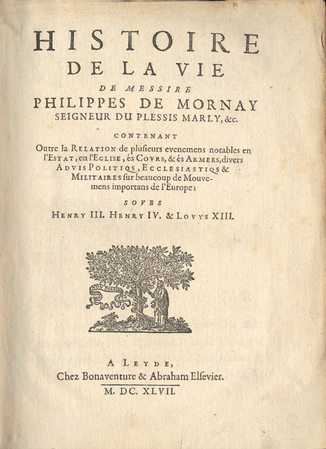
16476363Leyde, Bonaventure et Abraham Elsevier, 1647 ; marque "le solitaire" ; in-4 ; plein vélin ivoire rigide de l'époque, titre manuscrit au dos ; (12), 732, (6) pp.
1912170965Circa1912. 180 silver gelatin black & white photographs mounted in a half calf maroon cloth binding with gilt rules and lettered in gilt. New head & tail bands all edges gilt. Calf spine has been expertly rebacked inner hinges re-enforced endpapers and margins are foxed and cloth is slightly rubbed but generally very good and images generally clean. Each of the 180 images is approximately 10 x 7.4cm mounted on cards and inserted into the bordered pages. 48pp. Album measures 31 x 21.4cm A large album of photos of a trip to Japan around the end of the Meiji Era c. 1907. The traveller visited a number of temples parks and castles in western Japan including Nara Kobe and Okayama. There are fine black-and-white landscape shots among them images of a park with cranes in Okayama the famous Kintai Bridge in Iwakune and castle possibly Hiroshima castle. Several of the images show Japanese pilgrims beggars rickshaw pullers street sellers festivals and beach scenes. Many of the photos have been labelled on the back. In addition to the images of Japan the album contains photos which appear to have been taken on the journey to or from Japan to Europe by sea including shots of Shanghai Hong Kong Singapore Port Said and Genoa and a shot of Stromboli from the sea. The photographer seems to have been a boat enthusiast. There are a particularly large number of images of junks sampans yachts and other vessels. . hardcover
214226Japan. 10 manuscript sheets of varying size minor wear at edges some occasional browning but overall very good. This distinctive collection of ten handwritten documents spans a pivotal transitional period in Japanese history from the final years of the Edo period to the early Meiji era. The documents reflect a wide variety of official and diplomatic concerns such as coastal defence arrangements in response to the increasing arrival of foreign ships records concerning the surrender of regional lords following internal conflict the landing of a British diplomatic mission and a manuscript copy of an imperial letter involving the Shimazu clan of Satsuma and the influential court noble Iwakura Tomomi. <br><br>Among the more significant items is a document thought to detail the Dajōkan’s Great Council of State policies for handling foreign incursions including a list of regional officials operating under its authority. Other documents provide brief profiles of foreign diplomatic representatives in Japan and a chronological summary of treaty exchanges with the United States. <br><br><br>Names of major historical significance appear across the documents including Iwakura Tomomi 岩倉具視 Shimazu Jusan’I 島津従三位 Sanjō Saneyoshi 三条実美 and three notable British figures: Sir Harry Parkes William George Aston and Ernest Mason Satow. As a group these manuscripts offer valuable insight into the shifting political and diplomatic landscape of mid-19th-century Japan. . unknown
488-Eo.J. Aquarell über Bleistift, mit schwarzer Tuschlinie umrandet, auf cremefarbenem Velin mit Wasserzeichen: J Whatman Turkey Mill, links von der Mitte signiert und datiert ?EHArndt gez. 1836.?. 23,6:53,3 cm. - Leicht fleckig, kleinere Einrisse im linken Rand sorgfältig restauriert. Mit liebevoller zeichnerischer und perspektivischer Genauigkeit erfaßte der in Dresden lebende Architekt hier einen großen, in eine spätsommerliche Landschaft eingebetteten Gutshof.
FH-311o.J. Farbholzschnitt, 1932, auf cremefarbenem Japan, mit Bleistift signiert und datiert. Darstellungsgröße 25:27,7 cm, Blattgröße 31,3:34,8 cm. ? Mit sorgfältigen Restaurierungen auch innerhalb der Darstellung.- An diesem eindrucksvollen Blatt wird deutlich, dass Bartlomiejczyk sich stark am japanischen Farbholzschnitt orientierte.
FH-258o.J. Farbholzschnitt, um 1911, auf Japan-Bütten, mit Bleistift signiert und als ?Eigenhanddruck? bezeichnet. Darstellungsgröße 20,7:19,5 cm, Blattgröße 30,7:22,7 cm. - In den Rändern mit Farbspuren und um das sehr feine Japan-Bütten zu verstärken, hat der Künstler seinen Farbholzschnitt auf einen zweiten Bogen Japan-Bütten aufgelegt. Literatur: Andreas Albert, Siegfried Berndt. Ein Dresdner Meister des Farbholzschnitts. Künstler und Lehrer auf dem Weg zur Selbstfindung und Weltentdeckung. Husum, 2013, Abb. S. 24. - Auf dem Original-Passepartout falsch betitelt ?Auf der Rhede I?. [2 Warenabbildungen]
FH-256o.J. Farbholzschnitt, um 1911, auf Japan-Bütten mit Einschlüssen, mit Bleistift signiert und als ?Eigenhanddruck? bezeichnet. Darstellungsgröße 20,7:19,5 cm, Blattgröße 33,3:22/23 cm. - Ränder links und oben ungleichmäßig. Literatur: Andreas Albert, Siegfried Berndt. Ein Dresdner Meister des Farbholzschnitts. Künstler und Lehrer auf dem Weg zur Selbstfindung und Weltentdeckung. Husum, 2013, Abb. S. 24. - Auf dem Original-Passepartout falsch betitelt ?Auf der Rhede I?. [2 Warenabbildungen]
FH-294o.J. Farbholzschnitt, um 1910, auf Japan-Bütten, mit Bleistift signiert und als ?Eigenhanddruck? bezeichnet. Darstellungsgröße 24,8:15 cm, Blattgröße 27,5:16,7 cm.- Selten!