1 561 résultats
1371925Abidjan: Université d'Abidjan, 1986 in-8, 171 pages. Broché, très bon état. Sommaire: KOUAME (N.), La dynamique de l'habitat baoulé. - TOURE (M.), Croissance urbaine et développement économique et social en Afrique au sud du Sahara. - OUATTARA (S.), Une problématique sociologique du phénomène migratoire. - TOURE (I.), Le syndicalisme de participation à l'épreuve. - MEMEL FOTE (H.), Conficius et l'esclavage: une philosophie problématique. - TRAORE (A.), Des conséquences de la sous-représentation statistique des femmes sur le développement national.
8192Saint-Denis (Ile Bourbon), 1810. 10 pp. manuscrites.
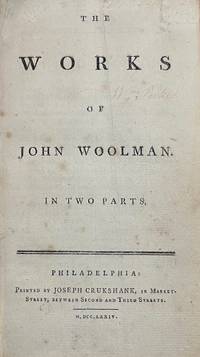
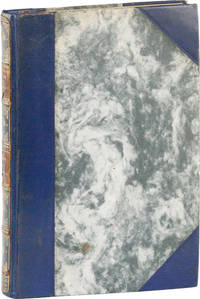
177434482Philadelphia: Joseph Crukshank 1774. First Edition. Three-quarter leather. Good. Octavo. 1 xiv 2 436 pages 1. Rebound in three quarter leather with tan cloth covered boards. Raised bands gilt decorations and title on the spine. Two title pages but continuos pagination. Inscription by the previous owner on the front blank end sheet. Front blank end sheet has some holes upper corner partly affecting the inscription. Moderate toning to the contents. Small worm hole lower back foredge not affecting the text. Pages 407-428 also has a small worm hole top edge not affecting the text. Chapter in part 2 pages 279-311 is titled "Considerations On the Keeping of Negroes."<br /> <br /> This first edition was published after the death of Woolman 1720-1772. Several later editions have been published. John Woolman was a Quaker minister and early abolitionist. He traveled to England in 1772 to promote the abolition of Slavery but died soon after arriving in England. He is buried in York. <br /> <br /> <br /> Howes W 669; Sabin 10524. Joseph Crukshank unknown
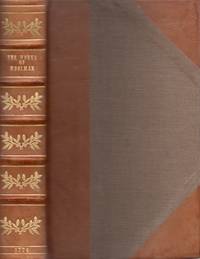
177435034Philadelphia: Joseph Crukshank 1774. First Edition. Leather bound. Fair. Octavo. 1 xiv 2 436 pages 1. Polished calf leather covers. Chipped title on the spine. Missing a section of leather bottom spine and another section is coming loose. Front cover is detached. Text lightly toned with scattered light brown stains. <br /> <br /> Two title pages with continuos pagination. Chapter in part 2 pages 279-311 is titled "Considerations On the Keeping of Negroes." This first edition was published after the death of Woolman 1720-1772. Several later editions have been published. John Woolman was a Quaker minister and early abolitionist. He traveled to England in 1772 to promote the abolition of Slavery but died soon after arriving in England. He is buried in York. <br /> <br /> Howes W 669; Sabin 10524. Joseph Crukshank unknown
238361Paris, L. Pelletier, an XII - 1804 in-8, [2] ff. n. ch., VIII pp., pp. 5-194, dérelié.
239790Paris, L. Pelletier, an XII - 1804 in-8, [2] ff. n. ch., VIII pp., pp. 5-194, demi-basane fauve à coins, dos lisse, tranches mouchetées de rouge (reliure à l'imitation).
177830042A Paris, chez Prault / Les Frère Jombert et Cellot / La Veuve Duchesne / Lesclapart, 1778. 2 ouvrages (le premier pourvu de son Supplément) reliés en un vol. au format in-8 (198 x 125 mm) de 1 f. bl., 1 frontispice gravé n.fol., viii - 216 pp. ; 73 pp. et 1 f. n.fol. ; 2 ff. n.fol., 104 pp. et 1 f. bl. Reliure de l'époque de pleine basane marbrée havane, plats jansénistes, dos lisse orné d'un double filet d'encadrement doré, triples filets dorés, important décor fleuronné doré, semis de petits fleurons et de cercles dorés, pièce de titre de maroquin vieux-rouge, titre doré, palette dorée en tête et queue, filet doré sur les coupes, tranches saumon.
188452888Boston: Printed by the Order of the City Council 1884. First Edition. Small quarto 26.5cm; marbled paper over navy blue calf spine in seven compartments with six raised bands leather labels titling and decorative elements stamped in gilt on spine; marbled endpapers; engraved portrait frontispiece1011-70 with an additional 31 leaves bound in. Armorial bookplate of Walter Merriam Pratt on front pastedown. Re-backed with the original spine laid down; light wear to upper and lower board edges with some touch-up to leather at crown and heel; Very Good. A grangerized copy containing 22 ANS and ALS ca.1-4pp one autograph sentiment a 4.25" x 6.5" cabinet card signed by Phillips and several clipped portraits of various sizes depicting Phillips his wife and his son in uniform. Most prominent among the letters are those written to G.W. Putnam 6 H.G. Denny 2 R.L. Winthrop 2 John Boyle O'Reilly 1 and an October 8 1853 ALS to abolitionist and social reformer Gerrit Smith in which he claims to have mislaid his letter but is available to come to Brooklyn either on 15 December or 5 January 1854 and that his fee would be fifty dollars. Handsome volume memorializing American abolitionist and orator Wendell Phillips 1811-1884 commissioned by the City of Boston in an edition of 5000 copies. Nearly half the text is comprised of the eulogy by George William Curtis and includes extensive remarks by city council members and aldermen a prayer by Rev. Minot J. Savage an address by the Mayor and a poem by Mrs. Mary E. Blake. A proud son of Boston Phillips abandoned a career in law after being converted to the cause of abolitionism by William Lloyd Garrison in 1836. He was a frequent speaker at meetings of the American Anti-Slavery Society active in the free-produce movement a member of the Boston Vigilance Committee and an early advocate of women's rights. Later in life he turned considerable effort towards gaining equal rights for Native Americans and together with Helen Hunt Jackson and Massachusetts Governor William Claflin helped found the Massachusetts Indian Commission. cf.BAL 4347. Printed by the Order of the City Council unknown
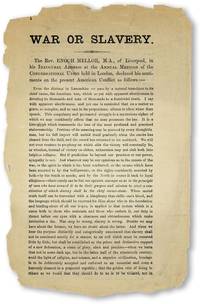
186346597Manchester: Union and Emancipation Society n.d. ca. 1863. First Edition. Original broadsheet handbill 22x13.5cm.; extremities chipped with shallow losses not approaching text the whole rather dust-soiled and unevenly toned else Good or better overall. Text reproduces an address delivered by the Rev. Enoch Mellor of Liverpool "in his INAUGURAL ADDRESS at the ANNUAL MEETING of the CONGREGATIONAL UNION held in London" in which he "declared his sentiments on the present American Conflict." Mellor 1823-1881 was the life-long minister of the non-conformist Square Congregational Church in Halifax West Yorkshire with the exception of a five-year period coinciding with this address when he succeeded the abolitionist Congregational minister Thomas Raffles 1788-1863. Mellor's argument begins with reference to the Lancashire Cotton Panic an economic depression caused by a dearth of baled cotton imports following the start of the American Civil War. Mellr goes on to say that "War /may/ be wrong slavery /is/ wrong" comparing its presence on the American continent with that of the propagation of polygamy "carefully and resolutely laid as a foundation-stone in the territory of Utah. Union and Emancipation Society unknown
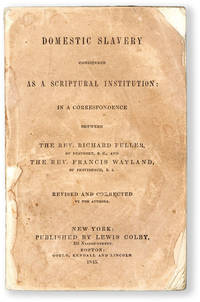
184554623New York: Lewis Colby 1845. First Edition. Wrappered Issue. 18mo. 15cm; original peach wrappers with titles printed in black on front cover; viii2541pp. Modest wear front wrapper split along lower half of front joint with shallow loss to right corners of same; old faint tide-mark along lower edge of textblock with creasing to upper and lower corners of first and last few pages; terminal blank present though lacking rear wrapper; Good. Uncommon wrappered issue of this significant debate between two 19th century Baptist leaders over the Bible's teachings on slavery which went through at least four subsequent editions between 1847-1860. "The chapters were originally letters published in a Baptist newspaper in Boston Massachusetts. Southern pastor Richard Fuller and Northern educator Francis Wayland were each able defenders of their respective positions. These men were also good friends who believed that a difference of opinion about slavery should not necessiatate a breaking of Christian fellowship. Unfortunately these two Baptist leaders proved naive in this regard. Just weeks after the publication of the correspondence in book form Fuller's Southern Baptist Convention broke away from the larger Baptist denomination and formed a new ecclesiastical body. A number of issues factored into the division though the slavery debate was what ultimately led to the creation of a separate Baptist denomination in the South" from the Mercer University Press edition 2008. SABIN 26170; LCP AFRO-AMERICANA 3944. Lewis Colby unknown
183384791Lexington KY: Abraham Skillman 1833. First Edition. First printing. 12mo 18.5cm; original brown cloth-covered boards; viii207pp. Respined to style with facsimile printed spine label; Bookplate of the Young Men's Christian Institute New Haven to front pastedown; bookseller's ticket Williams' Bookstore Under the Old South Meeting House Boston at base of front flyleaf; pencil signature faded and illegible to front endpaper. Complete sound and Good. <br /> <br /> One of a tiny number of pre-Civil War abolitionist texts to have been written by a Virginia author. Paxton 1784-1868 was a Presbyterian minister born in Rockbridge County Virginia and educated at Princeton Theological Seminary; it is likely his mentorship there under Charles Hodge helped develop Paxton's antislavery sentiments. In 1826 after publishing an essay asserting the institution of slavery to be incompatible with the teachings of the Bible Paxton was expelled from his pastorship of Cumberland Presbyterian Church near Farmville in south-central Virginia. The present text addressed to his former congregation recounts the events of his expulsion reprints the essay in question and adds a series of epistolary essays supporting his theological position in oppostion to slavery. <br /> <br /> The existence of any abolitionist sentiment during this period in Virginia's history is remarkable in itself. For a native-born minister to willfully preach the gospel of antislavery even the relatively conservative version of abolitionism professed by Paxton before a congregation whose sentiments on the subject would have been diametrically opposed - and which doubtless included a number of slaveholding families - must have amounted to apostasy in some congregants' eyes. By publishing the present work Paxton essentially doubled down on his unpopular beliefs making him in this cataloguer's eyes a rather remarkable figure. We find it surprising that so little biographical information exists regarding Paxton. His name barely appears in the scholarly literature on the period; perhaps because no mention of abolition is made in either the title nor the sub-title of his book the work is rarely discussed in articles on the antebellum southern antislavery movement. Though reasonably available institutionally Letters on Slavery is perenially scarce in commerce having appeared at auction only three times in the current century. This a quite decent copy in a discreetly restored binding. SABIN 59264. DUMOND Antislavery Bibliography p.89. LCP AFRO-AMERICANA 7501. Abraham Skillman unknown
186581012New York: American News Company 1865. First Edition. First printing. Octavo. Sewn printed wrappers; 76pp. Brief closed tear to title page margin; bit of wear at upper fore-corner of text block well away from text else a clean fresh copy in the original printed wraps; Very Good or better. Includes text of letters written to various colleagues in the antislavery ranks including Elizabeth Cady Stanton Charles Sumner and others. The first volume taking in the year 1863 was printed a year earlier. SABIN 82664. American News Company unknown
198115264Princeton: Princeton University Press 1981. First Edition. Octavo. Cloth boards; dustjacket; 262pp; Removed from a non-circulating private library with ink ownership markings to front flyleaf and accompanying black ink elisions from de-accession on front endpaper. Very mild rubbing to jacket; else clean and unmarked copy. Princeton University Press unknown
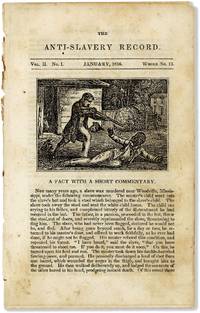
183682919New York: American Anti-Slavery Society 1836. 12mo 19cm. Stitched self-wrappers; pp.1-12. Removed; first and final leaves detached but present; light soil scattered faint foxing; tear to bottom inch of bound edge away from text; complete and Good. Woodcut decoration at head of text a strikingly violent image depicting the murder of a Black man by his enslaver in Woolville Mississippi.<br /> <br /> Single issue of this monthly abolitionist periodical that ran from 1835 to 1837 published by the American Anti-Slavery Society under the direction of Elizur Wright. It was "a small magazine with excellent woodcuts containing principally extracts from other publications" that was "distributed freely without charge" and "found its way into the schools and colleges everywhere" Dumond p.267. Wright stated that in September 1835 the Society published 25000 copies of the Record p.267. BLOCKSON 9174. LCP AFRO-AMERICANA 622. American Anti-Slavery Society unknown
186063532New York: Published and for sale at 5 Beekman Street 1860. First Edition. 12mo. 20th-c. binding of tan calf over paper-covered boards; marbled page edges; 951pp. About fine and complete; the pamphlet appears to have been offered without cover wrappers in any case not noted by Blanck.<br /> <br /> Uncommon first edition of this late tract by the important abolitionist and feminist Lydia Maria Child 1802-1880. Child's intention with this work was to make a direct case to southern slaveholders based not on any moral grounds but purely on business hoping that the Caribbean example would convince southerners that abolition could be achieved without wrecking their economy. "Child suggested to Samuel B. May the publisher .that the title page omit any mention of the American Anti-slavery Society giving only an address but no publisher. She even considered issuing the tract anyonymously but decided that her notoriety would probably help rather than hinder its circulation" see Karcher The First Woman in the Republic: a Cultural Biography of Lydia Maria Child. Durham 1994; p.428ff. Blanck notes two editions in 1860 as well as a reissue in 1862; this with verso of the final leaf unprinted is the first. Rarely encountered in commerce. BAL 3189. Published and for sale at 5 Beekman Street unknown
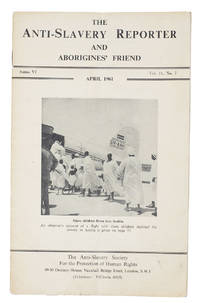
1961ABC_45244London: Anti-slavery and Aborigines Protection Society 1961. Original pictorial wrappers. Vol. 2 no. 7 April 1961. Pamphlet journal which includes obituaries articles reports news and reviews. Cover photo shows Nigerian children boarding a plane for Saudi Arabia where a story on page 73 states that they are to be sold as slaves to cover the costs of pilgrimage. A vertical crease some slight wear. Otherwise in good condition. Anti-slavery and Aborigines Protection Society, unknown
185723389.07<p><strong>Rare New York Senate Print of Proposed State Law to Combat the <em>Dred Scott</em> Decision</strong></p><p>"<em>Every slave … who shall come or be brought or be involuntarily in this state shall be free.</em>"</p><p>SLAVERY AND ABOLITION—NEW YORK STATE.</p><p>New York Senate. "An Act To secure Freedom to all persons within this State" Edward M. Madden April 9 1857 Passed the Assembly on April 17; failed in the Senate. Printed with numbered lines for the use of the Senate. 1 p. 6.5 x 11.5 in. </p><p><strong>Excerpts</strong></p><p>"<em>Neither descent near or remote from an African…nor color of skin shall disqualify any person for being or prevent any person from becoming a citizen of this state; nor deprive such person of the rights and privileges of a citizen thereof.</em>"</p><p>"<em>Every person who shall hold or attempt to hold in this state in slavery…under any pretence or for any time however short shall be deemed guilty of felony and on conviction thereof shall be confined in the state prison at hard labor for a term not less than two nor more than ten years.</em>"</p><p><strong>Historical Background</strong></p><p>In 1799 the New York legislature passed "An Act for the gradual abolition of slavery" that indentured and would eventually free slave children born after July 4 1799. In 1817 it passed a law freeing those slaves in 1827. But non-residents and part-time residents could still bring their slaves into the state temporarily.</p><p>On March 14 1857 New York Assemblyman Samuel A. Foot introduced resolutions declaring that the U.S. Supreme Court through its decision in <em>Dred Scott v. Sanford</em> "has in effect declared slavery to be national" and calling for the creation of a joint committee of three senators and five assemblymen to "consider and report what measures if any the Legislature of this State ought to adopt to protect the constitutional rights of her citizens." The resolution passed by a vote of 49-24 and the Senate concurred on April 2.</p><p>On April 9 Edward M. Madden introduced this bill in the Senate. Simultaneously Foot introduced this bill #24129 and three resolutions #23389.08 in the Assembly. Eight days later the Assembly with 81 Republicans 38 Democrats and 8 American Party members passed the bill 72 to 38. In the Senate with 17 Republicans 9 American Party members Know Nothings and 4 Democrats attempts to move the bill to the Committee of the Whole were evenly divided. Lacking the two-thirds majority required for this procedure the bill died.</p><p>Very similar language appeared in an 1859 bill which also failed; New York passed no new Personal Liberty Law during the decade before the Civil War.</p><p>The New York Senate had thirty-two members in 1857 so it is likely no more than fifty copies of this bill were printed for Senate consideration. We can find no evidence that any other copies have survived.</p><p><strong>Edward M. Madden</strong> 1818-1885 was born in Orange County New York and began work at a cotton factory at age nine. He worked as a merchant and then opened a saw factory in Middletown. He entered politics as a Democrat and was a delegate to the 1852 Democratic state convention. He joined the new Republican Party and served as a member of the New York Senate in 1856-1857 1872-1873 1875 and 1880-1881. He also served as a delegate to the 1864 and 1876 Republican National Conventions.</p>
1863101890Letterpress broadside 18 7/8" x 11 3/4" bold black type for highlighted words. Paper evenly toned some wrinkling considerable archival conservation and restoration with archival paper repair; despite the imperfections it is still a decent copy with a nice impression. This appears to fall into the political dirty tricks department in an election between John Brodhead and Henry Bumm for city treasurer in Philadelphia. The broadside is supposed to highlight a letter from John Brodhead to Jefferson Davis in 1860. It has strong racist overtones as Brodhead supposedly requests a position in Nicaragua so he can "help open it up to civilization and Niggers." He goes on to state he is "tired of being a white slave at the North and long for a home in the sunny South." These kinds of political tricks were not uncommon during the Civil War period perhaps that's still true today and the racist overtones would certainly not help one's chances in a Northern election.
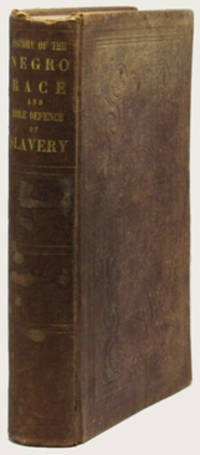
185234901Glasgow Kentucky: W.S. Brown 1852. Early edition being a reprint of the 1851 Louisville edition. Each page printed within a decorative chain-line frame the stereotyped title-page makes reference to engravings but none are called for in this edition. Tall 8vo in the publisher's original brown cloth the covers with decorative embossing retaining the emblem of the Louisville publishers in blind the spine lettered in gilt and with flat bands ruled in blind powder-blue endpapers. xiii 569 8 8 ads pp. A sound copy the text-block well preserved and complete a bit of expected age toning to the paper and light foxing here and there as usual the binding with some age-wear but still very sturdy strong and tight. ONE OF THE MOST NOTORIOUS PRO-SLAVERY BOOKS PUBLISHED IN THE UNITED STATES BEFORE THE CIVIL WAR. The author stylized himself as "the Rev. Josiah Priest" but was not ordained in any denomination.<br> The present Louisville text evolved from an earlier version titled "Slavery As It Relates to the Negro or African Race" published in 1843. It went through numerous editions and title changes during the 1840s and 1850s reflecting the growing sectional controversy over slavery. The popularity of the work exploded <br>in 1852 as it was viewed as a counter-argument to Stowe's pro-abolitionist epic UNCLE TOM'S CABIN.<br> The work's central claim is that slavery is fully sanctioned and approved of by the Bible. Among his arguments are: people of African descent were descendants of Ham and therefore subject to a divine curse; the racial differences were ordained by God; that slavery was beneficial or natural for Black people; and that abolitionism was a dangerous fanaticism threatening the social order and status quo.<br> Although repugnant to many modern readers the book is historically significant because it demonstrates how slavery's defenders tried to answer the growing abolitionist movement. The title also accurately states that the issue of slavery was going to divide the Republic thus predicting the Civil War. W.S. Brown hardcover
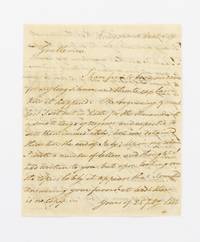
130002Very Good. Quarto 4 pages a bifolium comprising 3 pages of text with the last page used for address purposes. Creased where folded for posting; slight loss to the leading edge of the second leaf where torn open removing one word of text; overall in excellent condition. The letter dated 10 December 1791 and carried privately by ship from Kingston is addressed to 'Messrs Newton Gordon & Murdoch Merchants Madeira'. A number of lesser matters are touched upon but the letter deals primarily with the importation of wine: 'I cannot at present ascertain what quantity of wine I shall be able to dispose of next year as I have 20 pipes on hand and sales are slow from the great quantity at market; however you will please ship me twenty pipes of York market wine Barbadoes Gauge & 12 Iron hoops at first convenient opportunity'. As often with letters of any age the first paragraph contains an apology for the tardy response: 'I have first to beg your excuse for my silence and then to explain how it happen'd. The beginning of March last I set out in haste for the Havana with a small cargo of negroes and expected to sell them immediately but was detain'd there till the end of July'. unknown
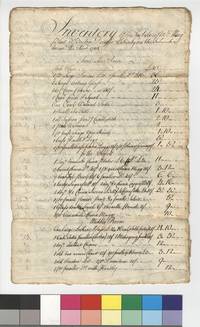
173860003<p>Mary Grosse Phillips Blair 1681-1738. Manuscript Document Estate Inventory Boston Mass. November 3 1738. 8 pp. folio. Mary Blair was widow of Capt. John Phillips and Capt. William Blair merchant. This inventory depicts a lavishly furnished mansion vast real estate holdings and a rich array of items in the shop -- suggesting that Mary Blair continued the mercantile trade after her husband's death in 1736. Also of note are enslaved persons Cato and Monday. Thomas Hancock was one of the administrators of the estate which was valued at over £28232. Another copy of the inventory exists in state records Suffolk County probate case 7223.</p><p>Fine condition.</p>
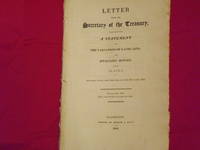
1816100537Pamphlet formate folio disbound first pamphlet 3 leaves printed on recto only second 7pp. third 6 pages and folding chart. Pamphlet extracted from larger volumne chipping along spine and edges not affecting text second papmple completely disbound paper browned and somewhat dry These pamphlets are rare and represent an important source of information on the numbers and values of slaves in early 19th century America. The first title presents the value assigned to slaves in 11 states including New York. The second lists the number and values of slaves in the various counties in the state of Maryland. The final pamphlet presents real estate values and values on dwellings including slaves in the counties of Pennsylvania. The information in these reports was compiled by Alexander James Dallas 1759-1817 who was the Secretary of the Treasury. Dallas born in Kingston Jamaica settled in Pennsylvania and practiced law there. Eventually he would become Secretary of the Treasury in 1814 when the nation was almost bankrupt. He managed to reorganize the department get the country out of debt created a surplus and even helped promote what would become the Second Bank of the United States. ANB. William A. Davis,
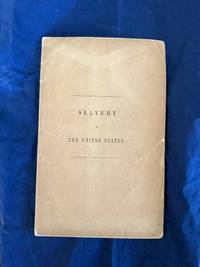
1851106835<p>Pamphlet 8vo wrappers 36 pp. Archival tape repair to back of front cover slight edgeware normal aging and browning; otherwise very good. Follows the general tone of a good deal of the abolitionist literature of the period. However while the author acknowledges the critical importance of slavery to America he suggests the issue needs to be debated with "calmness and candor" interestingly he indicates that the climate for these discussions appears to be improving.</p> Charles C. Little and James Brown,
185633708Philadelphia 1856. 24pp disbound three small binding holes in blank left margin. Two early signatures of Wm. Thompson Shafer on title page. Light spotting throughout. About Good. <br /> <br /> This scarce pamphlet says the "great issue" is whether "Slavery shall be allowed to overspread a territory of greater extent than that of the whole United States" and "whether the policy of our government is to continue to be that of Slavery Extension or Slavery Restriction." All the power of the presidency is "being used to force the withering and blighting scourge of Slavery upon the National domain." Pursuing this tyrannical course our government "shall lend its aid in striking a deathblow to the freedom of speech the liberty of the press and the security for life personal liberty possession and peace." <br /> LCP 4300. OCLC 22829199 4- LCP No. IL U Haverford Detroit Pub. Lib. as of April 2017. unknown
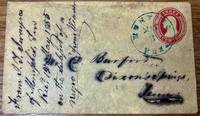
185536035Memphis: n.p. 1855. Paper. Fair. Paper envelope. Approximately 6" x 3". No letter with the envelope. A stamped three cent envelope with postal mark dated May 8 location not clear. Paper is toned with small thin tear located under the address from use of the pen. <br /> <br /> Written on the front side is "From J. T. Swayne of Memphis Ten Rec'd 12 May 1855 on the subject of a Negro from Weaver." This was addressed to Mr. C. Burford of Dixon's Springs Tennessee. J. T. Swayne was a former Mayor of Memphis during the reconstruction. There are references to the Burford family in Dixon Springs Smith County Tennessee online. n.p. unknown