1 561 résultats
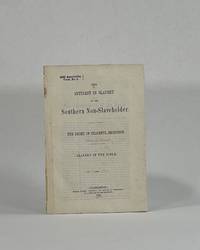
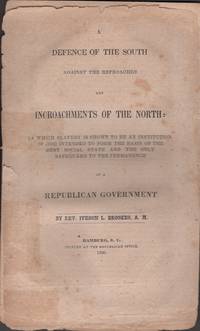
185036089Hamburg South Carolina: Printed at the Republican Office 1850. Wraps. Fair. Wraps. 48 pages. Covers are detached and stitching mostly removed leaving several loose pages. Small edge tears to a few pages. Toning to the contents. Pages 47 and 48 has an old tape repair with slight loss of print. This is pro Slavery and religious defense of the institution from a Southern Minister. Fair only. From the North Carolina Encyclopedia ncpedia dot org:<br /> <br /> "Iveson Lewis Brookes Baptist clergyman planter and Southern sectionalist was the eldest of five sons of Jonathan and Annie Lewis Brookes and was born in Rockingham County. His father was a veteran of the Revolution. His parents had only recently moved to North Carolina from Spotsylvania County Va. where many of his relatives continued to live; soon after his birth his parents moved permanently to Caswell County. Educated in a local academy during his early years in 1812 Brookes enlisted in the American army. After seeing only limited action during the War of 1812 he entered The University of North Carolina. He was graduated in 1819 after developing what proved to be a lifelong acquaintance with both James K. Polk and Thomas Hart Benton. In his commencement address entitled "Is the State of the World Better in the Present Age Than at Any Former Period" Brookes expressed an optimism and an enmity to slavery that were totally antithetical to his later positions. Undecided about his future he spent a year as a teacher in Greensboro"."Although he had opposed slavery as a student at The University of North Carolina Brookes became a staunch defender of slavery and a rabid southern sectionalist. During the Nullification controversy he was made a minuteman by Governor James Hamilton of South Carolina. In 1861 at the age of sixty-eight he offered himself for service in the Confederate Army. From the first appearance of abolitionism he feared for the future of southern society. From 1835 he wrote dozens of defenses of slavery most of them in the form of letters to northern antislavery periodicals. His most famous defenses were two pamphlets written during the crisis of 1850: A Defence of the South against the Reproaches and Incroachments of the North 1850 and A Defence of Southern Slavery against the Attacks of Henry Clay and Alexander Campbell 1851 the latter written at the behest of Governor James Henry Hammond of South Carolina. The productions of an enraged slaveholder revealing little of the optimistic and balanced thinking of his youthful years those two documents stood as the most characteristic statements of a die-hard southern sectionalist who had learned to love the life of a slaveholding planter. Printed at the Republican Office unknown
186261272New York: D. Appleton & Co 1862. Second Edition. Octavo 20.5cm. Green cloth titled in gilt on spine; yellow coated endpapers; 39018pp; 8 tinted lithographs. A firm copy rubbed at spine ends and bumped at corners mildly foxed: Very Good.<br /> <br /> Commander Andrew Hull Foote 1806-1963 served on the USS Perry from 1849 to 1851 suppressing the slave trade off the coast of Africa. In 1854 he published an abolitionist history of Africa describing African cultures American colonies and the slave trade. He was a noted commander for the Union Navy until his unexpected death of kidney disease in 1863. D. Appleton & Co unknown
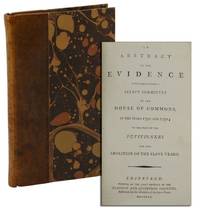
1791140945477Printed at the Joint Expence of the Glasgow and Edinburgh Societies instituted for the Abolition of the Slave Trade: Edinburgh 1791. First Edinburgh Edition. Very Good. Rare first Edinburgh edition published same year as the London edition of eye-witness testimony on the horrors of the British slave trade containing a very early engraving of the famous large folding plate of slaves packed into the hold of the slave-ship Brookes. The famous engraving is one of the most powerful and influential images in the history of social justice and the fight to abolish slavery. It served as a gruesome test of the Britain's "humane" Slave Trade Act of 1788 also known as Dolben's Act which limited the number of enslaved people that British slave ships could transport based on the ships' tons burthen. <p>Very Good. Small 8vo bound in somewhat recent quarter calf and marbled boards with light fading to the spine. Folding frontispiece map of the west coast of Africa in with 2 x 0.5" loss along one edge neatly restored. Large folding woodcut 16.25 x 15.5" of a slave ship based on the engraving W. Elford published in a pamphlet in London in 1789 is excellent and bright with several repairs made to the verso mending tears. The print now an iconic symbol of the Middle Passage was so visually arresting that William Wilbeforce created a scale model of the Brookes making it a central part of his presentation before the House of Commons. His abolition bill did not garner enough support to pass and it was not until 1807 that England succeeded in abolishing slavery. Edinburgh unknown
178640654Philadelphia: London printed: Philadelphia: re-printed by Joseph Crukshank 1786. 8vo. 8 1/2 x 5 inches. xix 2 22-155 pp. Publisher's advertisement at rear. Original blue paper wrappers<br/> <br/> Exceedingly rare first American edition of Clarkson's first work. A landmark work by the writer who helped abolish slavery in the British Empire.<br/> <br/> First American edition of Clarkson's rare first published work preceded by the same years first English edition his famous prize essay on the abolition of slavery igniting the campaign for one of the fundamental rights of man PMM 232. In 1770s England as "rebellious Americans were severing ties with their former British motherland a strenuous battle occurred that spawned the noble civil- and human-rights fight that eventually ended Britain's participation in the African slave trade." With this Essay on the Slavery and Commerce of the Human Species Thomas Clarkson "became the official whistle-blower of the horrors of transatlantic slavery the driving force behind the abolition of African slavery and the slave trade" Smith Thomas Clarkson 17. Clarkson's "famous prize essay was the prelude to parliamentary action" on the abolition of slavery. Clarkson together with William Wilberforce led the "campaign carried on by word of mouth and by means of the printing press for one of the fundamental rights of man" PMM 232. Clarkson had been completing his studies at Cambridge when he entered an essay competition and came across an "advertisement for Benezet's Historical Account of Guinea. He was profoundly struck by the title and 'hastened to London to buy it'. Overwhelmed by the horror and brutality of transatlantic slavery his goal of merely winning the prize for its own sake" shifted to creating a work of wider impact. On winning the 1785 Cambridge prize Clarkson translated the essay his Latin dissertation into English for publication. He documents the long history of slavery the devastating Middle Passage and the inhumanity of slavery in the colonies. Clarkson is renowned as "the man who spawned the British Abolitionist Movement and the first Briton to devote his entire adult life to ending African slavery… the moral conscience of American slavery proponents well into the 19th century" Smith 9-30 43. "He never ceased to work for anti-slavery lending his pen and his prestige particularly to the cause of abolition in the United States" DNB.<br/> <br/> Evans 19561; Library Company of Philadelphia. Afro-Americana 1553-1906 2nd ed. 2384; Kress B1028; ESTC W32021; PMM 232a; Sabin 13484. London, printed: Philadelphia: re-printed by Joseph Crukshank unknown
18609565Charleston: Steam-Power Presses of Evans & Cogswell 1860. Disbound. Very Good binding. Octavo. 30 2 blank pp. First edition. Removed from binding. Vertical crease from old fold; a few instances of pencil bracketing; De Bow's name is penciled in on the title page by a later hand. Generally a well preserved copy. <br /> <br /> One of a series of pamphlet issued by Charleston's "1860 Association" a group of wealthy slave-holders who moved to promote immediate secession. In this tract De Bow a Charlestonian by birth who was living and publishing pro-Southern essays in his New Orleans Commercial Review of the South and Southwest offers and economic argument about the "benefits" of slavery on the Southern worker's wages and working condition. De Bow's essay is followed by extracts from an article on the rights of secession as well as lengthy extracts from a sermon by Rev. Henry J. Van Dyke "The Character and Influence of Abolitionism" in which this Northern pastor argues that abolitionism has no Biblical foundation and that its principles are misrepresented for men's gain. Uncommon in commerce. Parrish & Willingham 5330; Confederate Hundred 28; Work p. 399; Afro-Americana 5157; Turnbull III p. 298. Steam-Power Presses of Evans & Cogswell unknown
188435270Chicago: Jansen McClug & Co 1884. First Edition. Wraps. Very good. Stitched wraps. Two copies. 8 pages. Original covers present and in very good condition. The Thirteenth Amenment passed the Congress in April 1864 officially ending Slavery. Jansen, McClug & Co unknown
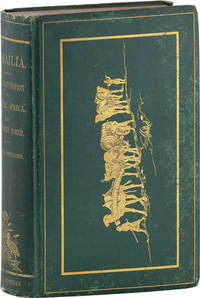
187561084New York: Harper and Brothers 1875. First American Edition. Octavo 24cm. Green cloth stamped in gilt; brown coated endpapers; 542pp; steel-engraved frontispiece 2 wood-enraved frontispieces 2 color maps 1 folding and 48 wood-engraved plates all with tissue guards. Inscribed "Charles V. Payne from his friend M. R. E. Christmas 1874" on front free endpaper; the same inscription is repeated with the date 1875 on a front flyleaf. A sound copy externally rubbed with superficial silverfishing to both boards internally clean with two central gatherings pulled but not fully detached short tear to folding map at gutter: just Very Good. <br /> <br /> Samuel Baker 1821-1893 was a noted British explorer of Africa. In 1860 he was appointed "governor-general of the equatorial Nile basin" by the Khedive Ismail of Egypt with duties including "annexing the equatorial Nile basin establishing Egyptian authority over the region south of Gondokoro suppressing the slave trade" and more ODNB. His success was mixed: he successfully annexed Gondokoro and did suppress the slave trade but failed to establish secure control of the region ODNB. This account published after his return to England details how he "raised and trained a fighting force.to crush" the slave trade Czech. CZECH p.11. Harper and Brothers unknown
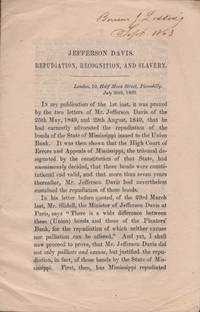
186335488London: R. J. Walker 1863. First Edition. Wraps. Fair. Wraps. 12 pages. Title on page 1. Tissue and glue patch repairs made to pages 11 and 12. Inscribed and signed top of page 1 by historian and author Benson J. Lossing. The author R. J. Walker was a Democrat Senator from Mississippi in the years 1835-45. He was a staunch pro-Union advocate during the Civil War. Fair condition due to the reapirs. R. J. Walker unknown
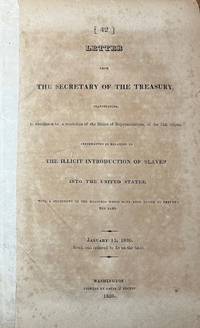
182035023Washington D.C.: Printed by Gales & Seaton 1820. First Edition. Wraps. Fair. Disbound wraps. Approx. 9" x 4". 12 pages. Toning to the paper. First 4 pages have a small edge chip not affecting the print. Wraps spine backed with later tissue paper. Pages 3-6 are loose. Scarce. 10 copies located in OCLC. The Act Prohibiting Importation of Slaves promoted by President Thomas Jefferson was passed in 1807 and took effect in 1808.<br /> <br /> From the 1820 letter submitted by the Treasury Department Spain and individuals were responsible for the illegal importation of Slaves into the United States. Secretary of Treasury William Crawford writes "From information recently received by this Department there is just reason to believe that Sir Gregor MacGregor has taken military possession of Amelia Island Florida in the name of the Spanish Patriots" Continued on the same page "In addition to the circumstances already communicated the disposition which has been manifested by the vessels of Spain engaged in the African Slave Trade to introduce illicitly into that section of the Union the persons who in the prosecution of their traffic have been subjected to their control seems to require the presence of a force sufficient to enforce the due execution of the laws against the introduction of slaves into the United States." The Treasury Department recommends "To guard against the unlawful introduction of slaves and to repress any attempt that may be made by the foreign belligerent force collected in that neighborhood to excite domestic insurrection among the blacks it appears to me to be absolutely necessary that a land and naval force be stationed at St. Mary's." <br /> <br /> Soon after this letter was published Florida was ceded to the United States by Spain in 1821. Florida was a territory until 1845. Printed by Gales & Seaton unknown
186234999Chicago: Steam Presses of F. Fulton & Co 1862. Second Edition. Wraps. Very good. Wraps. 95 pages. Folding frontispiece map. Tan colored stitched wraps with printed title on the front cover. Light toning to the front wrap. The Mason Dixon line history goes back to the 18th century involving property lines between Maryland Pennsylvania and Delaware familes. Pre Civil War the line was better known for the demarcation between free states and the Slave states from the South.<br /> <br /> A pre-Chicago fire imprint. Chicago Ante Fire imprints 641; Sabin 45089. Steam Presses of F. Fulton & Co unknown
186536786New York: American Anti-Slavery Society 1865. Newspaper. Good. Newspapers. Approximately 27" x 18.5". 4 pages each. Several folds. Some light creases and several closed edge tears to the papers not affecting the print. Previous owner name written in the upper right corners of the front page first three issues. Light toning and foxing to the papers.<br /> <br /> 5 issues:<br /> <br /> New York: Saturday November 3 1855. Vol. XVI. No. 24. Lead article "The Boston Mor"<br /> New York: Saturday December 29 1855. Vol. XVI. No. 32. Lead article "Mr. Channing on American Slavery."<br /> New York: Saturday January 11 1862. Vol. XXII. No. 35. Lead article "The Emancipated South Carolinians."<br /> New York: Saturday July 29 1865. Vol. XXVI. No. 12. Lead article "Pro-Slavery South Carolina Loyalty. A "Union" Speech from Provisional Governor Perry."<br /> New York: Saturday November 18 1865. Vol. XXVI. No. 28. Lead article "Pro-Slavery Negro Suffrage Extract from the Message of Gov. Marvin of Florida to the State Convention. American Anti-Slavery Society unknown
200529142London:: BBC Books 2005. First Printing of the First UK Edition. A Fine tight copy in a Fine dust jacket. If you were black in America at the start of the Revolutionary War whom would you want to win In response to a declaration by the last governor of Virginia that any rebel-owned slave who escaped and served the King would be emancipated tens of thousands of blacks voted with feet escaping to fight beside the British. Originally designed to break the plantations of the American South this military strategy instead unleashed one of the great exoduses in American history. Told in the voices of the slaves and the white abolitionists who aided them Simon Schama vividly details the odyssey of these escaped blacks shedding light on an extraordinary chapter in America’s birth. BBC Books, unknown
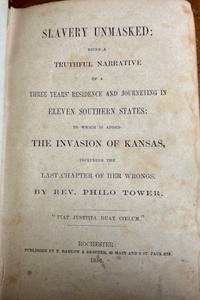
185633823Rochester: E. Darrow & Brother 1856. First Edition. Hardcover. Fair. 12mo. xvi pages 17-432 pages. Lacking the frontispiece. Brown cloth hardcover with faded title on the spine. Cloth binding has several faults including a pronounced lean heavy shelf and edge wear worn and exposed corners and worn and chipped edges of the spine. Light stains on the covers. Moderate toning and foxing to the contents. Text block lightly shaken with some pages in front starting to loosen. Fair condition only. Complete. E. Darrow & Brother hardcover
185031527Washington DC: Gideon and Co. Printers 1850. First Edition. Wraps. Good. Wraps. 14 pages 1 page blank. Title printed on page 1. Spine strengthened by archival tape. Page edges creased. Light toning to contents. Gideon and Co., Printers unknown
184834435Washington DC: Printed by J. & G. S. Gideon 1848. First Edition. Wraps. Fair. Wraps. Approximately 9.5" x 6". 16 pages. Untrimmed wraps folded with splits and loose pages at the folds. Contents clean. John Gorham Palfrey May 2 1796 – April 26 1881 was an American clergyman and historian who served as a U.S. Representative from Massachusetts. A Unitarian minister he played a leading role in the early history of Harvard Divinity School and he later became involved in politics as a State Representative and U.S. Congressman Wikipedia. Palfrey argued that the existence of slavery was a major political problem that threatened the stability and future of the Union. He believed that slavery was incompatible with the principles of liberty and equality upon which the nation was founded AI generated. Printed by J. & G. S. Gideon unknown
18589866Washington 1858. Unbound. near Very Good binding. Octavo. 16 pp. First edition. Unbound folded sheet forming 8 leaves. Old folds with some closed tears/silverfishing along a couple the creases; staining to the bottom margin of a a few leaves not touching text; otherwise generally a very good copy. <br /> <br /> Circumstances surrounding Kansas's Lecompton Constitution brought the tension surrounding the confluence of statehood and slavery to a new level. A pro-slavery document the Lecompton Constitution and subsequent votes on it were a fraught and dishonest affair complete with subterfuge false choices boycotted votes and more all in service of establishing a pro-slavery constitution in a state that's populace had a clear and before the end demonstrable antislavery majority. This report before the House by Georgia's Alexander Stephens soon to be Vice President of the Confederate State of America defends a December election that was widely boycotted by antislavery voters because the options presented to the electorate both allowed for slavery to persist in Kansas despite the misleading language of the referendum. By August of this same year 1858 a new vote would be held to keep or toss out the Lecompton Constitution. In a vote that demonstrated the antislavery sentiment of Kansas residents the Constitution would be thrown out by a 7 to 1 margin. Leaving space for a constitution to be drafted and ratified prohibiting slavery in Kansas. Krdlicka James F. Colonists Citizens Constitutions: Creating the American Republic. Sabin 91261. unknown
186539270Boston: Geo. C. Rand & Avery 1865. 8vo. 8 1/2 x 5 3/4 inches. 16pp. With the author's compliments. Disbound.<br/> <br/> First edition of this powerful and timely address delivered just three months after the end of the American Civil War.<br/> <br/> A respected classicist professor and public intellectual Alpheus Crosby offers a sober and principled argument concerning the reintegration of the Southern states into the Union. Rejecting both harsh retribution and passive leniency Crosby emphasizes the constitutional and moral responsibilities of the federal government in the aftermath of rebellion. Framed by the ideals of Phi Beta Kappa and the liberal education it promotes Crosby's speech calls for a just and sustainable reconstruction policy underscoring the need for national unity grounded in legal equity and civic virtue. A revealing document of Northern intellectual engagement with the dilemmas of Reconstruction at its inception.<br/> <br/> Sabin 17626. Geo. C. Rand & Avery unknown
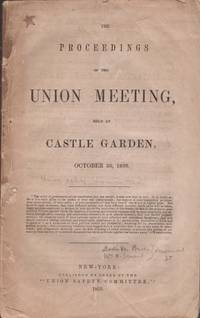
185034470New York: Joseph D. Bedford Printer 1850. Wraps. Fair. Wraps. Approximately 9" x 5.5". 62 pages. Rear cover blank and detached. Stitched contents with title on the outer wrap page 1. Paper is folded vertically. Stitching is mostly gone and the remaining stitching is frayed and loose. Light edge chips on the left edge front cover. Ink stamp upper left corner back cover "From Dusenbury & Odgen". Light toning and occasional stray pencil marks in the margins. Fair or better condition. <br /> <br /> The contents are in support of the Fugitive Slave Acts and the writer believes all Northern States should defend it even if they do not like it. The writer strongly criticizes Martin Van Buren and William Seward in the proceedings referring to them as traitors ".I refer to Martin Van Buren and William H. Seward. I know their history and their acts. I know that you would order that the name of traitor should be branded on their brows in characters so permanent as to be indelible except at the torch of the Creator on judgment day." <br /> <br /> A list of the Union Safety Committee printed on page 38. "Signatures Attached to the Call For the Union Meeting of the Citizens of New York found on page 39. Joseph D. Bedford, Printer unknown
185634998Philadelphia: Printed for the Author by C. Sherman and Son 1856. First Edition. Wraps. Very good. Original brown printed stitched wraps with title on front. 46 pages 1. Very light chipping to head and base of spine.<br /> <br /> Sabin 14916. Printed for the Author by C. Sherman and Son unknown
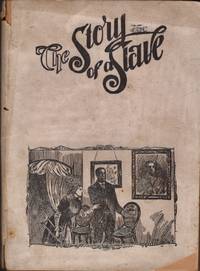
189435946Chicago: Published for the Trade 1894. Wraps. Fair. Stapled wraps. Approx. 7" x 5". 192 pages. Illustrated front cover with title. Original pink wraps have faded on the front cover. Front cover is chipped bottom right edge. Small chips to the spine and joints. Paper is brittle and browned. <br /> <br /> Anonymous author but credited to Charles Chandler a white author. This is a fictionalized story of Slavery of Paul the Slave and his young mistress. The author condemns Slavery in the preface. Published for the Trade unknown
1837101441Pamphlet small 8vo removed dbd 11 pp. Removed some minor foxing normal aging and browning; otherwise very good. This pamphlet was prepared for the New York chapter of the Religious Society of Friends Quakers for their annual meeting to oppose slavery. Not surprisingly this tract encourages people to help end "this stain upon our national character." While there are religious sentiments in this work much of the discussion relates to social injustice and morality. Mahlon Day (and New York Quakers),
183331599England: Elliott Cresson 1833. Bi-folded folio. 3 pp. 12 1/3 x 7 1/2 inches. Important autograph letter from Elliott Cresson one of the foremost proponents of the American Colonization Society and its colony in Liberia to Member of Parliament Benjamin Hawes presenting a resolution to found the British African Colonization Society. Discusses the famed abolitionist William Lloyd Garrison's opposition to the colonization movement.<br/> <br/> The letter begins with the two-page text of a resolution to establish the British African Colonization Society under the patronage of the Duke of Sussex: "That Colonies composed of fair settlers of African race established on judicious principles on the Coast of Africa appear calculated beyond any other plan to put an effectual stop to the slave trade . . . Resolved that a Society be formed to be called the British African Colonization Society and that its objects be to cooperate with the American Colonization Society and with the several missionaries and other religious and charitable societies in Great Britain and the United States of America in such measures as may promote the total abolition of the slave trade and the establishment of Christianity and Civilization among the Natives of Africa chiefly by the employment of Free Persons of African birth or descent . . ." In the letter which follows Cresson writes of William Lloyd Garrison's opposition to the colonization movement: "I send the list of officers as far as accepted several others have not yet answered but I trust we shall present a bold front. I have just heard thru his Chaplain from the Duke. Garrison has written to poison his mind and probably will annoy our meeting. I trust that as the notice has been so short our friends will bring many with them . . . My letter to the Times in answer to Garrison they have not yet noticed so that it will be put in the Globe whose Editor has offered it a place in his columns." Cresson a noted Philadelphia businessman and philanthropist was among the most ardent supporters of colonization the movement to relocate formerly enslaved people and free black Americans to colonies in Liberia. In 1832 he traveled to England to promote international support for the movement. The following year Cresson and the Philadelphia Young Men's Colonization Society a branch of the American Colonization Society founded Port Cresson in Liberia. However the colony was attacked in 1835 by Bassa tribesmen incited by Spanish slave traders and destroyed. Although initially in favor of colonization William Lloyd Garrison changed his mind and decried the efforts of the American Colonization Society as a perpetuation of slavery. For Garrison's 28 June 1833 letter to the Duke of Sussex referenced above see The Letters of William Lloyd Garrison I:107. Elliott Cresson unknown
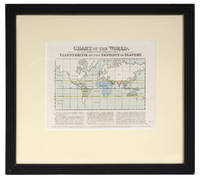
94420London Joseph Cross n.d. but c. 1825. . Hand coloured engraved map. The map shows the extent 30° north and south of the Equator in which sugar is grown. Australia is still shown as New Holland. 29.8 cm x 23.7 cm 11¾" x 9¼". Framed and glazed.<br /> Scarce colour-coded map concerning the sugar trade and its link to slavery.<br /><br />The section shaded yellow is the appropriate climate for the growing of sugar. The section shaded red is the area from which Britain may obtain sugar cheaply parts of South America and the West Indies under British rule. The blue section shows where Britain is unable to obtain sugar due to the devastating effects of the slave trade. The pink and green areas are those from which the sugar trade is limited by high duties and restrictions. The argument is that the duties and restrictions are there to protect the slave trade and ultimately damage the British economy.<br /><br />James Cropper was a successful and wealthy Quaker merchant philanthropist and disciple of Adam Smith. A major force in the anti-slavery movement he believed that eliminating tariff protections would lead to the end of slave labour in the West Indies. Cropper himself had interests in East Indian sugar and therefore stood to benefit from the reduction of tariffs which colored his role in the abolition movement. Nevertheless 'in Cropper's mind the intensity of Quaker Quietism had fused with the economic optimism of Adam Smith. Anti-slavery confirmed this union endowing laissez-faire with an immediate moral and spiritual purpose and enriching his faith in the inevitability of human progress' Davis James Cropper and the British Anti-Slavery Movement 1961.<br /> London, Joseph Cross, n.d. [but c. 1825]. unknown
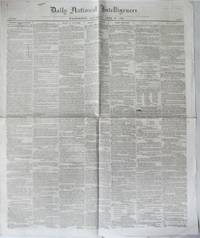
1859017039Washington DC: Gales and Seaton 1859. Tabloid. Good. Side folding large tabloid newspaper. A single issue of this long running newspaper published in Washington DC first published in 1800 and publishing until 1870 with an eventual bias toward conservative Whig policies. Besides the usual ads and political news this issue contains two "Was Committed" notices last page bottom right one pertaining to Mary Norris George Park and Sally King the other pertaining to Lewis West. All four were African-Americans with Mary Norris George Park and Lewis West being enslaved people from enslaver Robert E. Lee. According to the US National Park Service website devoted to Robert E. Lee's Arlington House Memorial Mary Norris George Parks and another man Wesley Norris believed they were free based on a provision in the will of George Washington Custis. Based on this knowledge the three emancipated themselves traveling to Pennsylvania. They were all captured in Maryland. According to contemporary newspaper accounts New York Tribune in June 1859 Lee had the re-captured African-Americans whipped. Wesley Norris himself wrote an article in the Anti-Slavery Standard in 1866 which provides his account of the whipping. Early historians and biographers dismissed both accounts considering them to be accounts used for anti-slavery propaganda. Lee himself was silent on the subject with many of his contemporaries and historians taking his silence as a denial. However modern research suggests the accounts of Wesley Norris and others were true dispelling the myth of Lee as benevolent enslaver perpetuated by earlier historians. The first notice states that Norris Park and West were committed to jail on May 26th and that "George and Mary say they belong to Col. Robert Lee of Fairfax County Virginia." The complexion and height of all three are given as well as descriptions of the clothing they wore. Sally King asserted that she was free living in Washington with a Mrs. D. Bread. According to the piece they all initially left Washington on May 22nd 1859. The second notice contains the same information as the first although it appears Lewis West was jailed on May 27th but also asserted he "belongs to Col. Robert Lee." Both notices request that the "owner or owners" come forward and pay all charges due. Also present is a notice of "young servants for sale" indicating the availability of several girls from ages 11 to 15 as well as young men from 21 to 25 years old. All were apparently located in Georgetown. The newspaper is in GOOD condition. Paper split chipped and deteriorating along the spine with very slight loss of letters to some of the "was committed" ads. Horizontal and vertical fold creases present. Moderate toning along the spine edge. Small hole worn through at the intersection of the fold creases. Some wrinkling and creasing to the paper. Several small tears along the extremities. Gales and Seaton unknown
1840100899Pamphlet leaflet 8vo 4 33-36 pp. Some aging and browning and a small stain at the bottom let margin; otherwise very good plus. Basically this short pamphlet provides "abridged selections" of various slave statutes from states around the country prior to the Civil War .The statutes consistently explain that a slave should be considered a thing not a person and of course has no right to own property. It also outlines various punishments such as 25 lashes for riding a horse without permission 21 lashes if more than six slaves meet together and death for striking a white person 3rd offense. The Anti-Slavery Bugle,