1 560 résultats
19535P., Plon (Collection "Le roman des grandes existences"), 1930, in 8° broché, 317 pages.
44899P., Plon (Collection "Le roman des grandes existences" n°17), 1928, in 12, plein cartonnage bordeaux de l'éditeur, 317 pages.
184841261848. Paris éditions Adolphe Delahays 1848 3e éd. traduite sur la 4e en anglais - Broché 12 cm x 19 cm 416 pages - Texte de Mistress Trollope - Quelques rousseurs sinon bon état
196315364Denver: Sage Books 1963. First Edition. Octavo. Cloth boards; dustjacket; 218pp. Removed from a non-circulating private library with ink ownership markings to front endpaper and accompanying black ink elisions from de-accession. Moderate dusting and rubbing to jacket; else clean crisp copy in very good jacket with unmarked text. Sage Books unknown books
1863139381863 Alger, Duclaux, 1863. In 8 broché,a grandes marges non rognées, couverture imprimée (dos fendu). 358 pp. avec une carte dépliante en frontispice et XXXII figures et cartes hors texte. Ghadamés, oasis du Sahara tripolitain, fut visité par de nombreux explorateurs européens. La mission française composée de Mircher, Vatonne et Polignac
1859PHO-1030Paris, Charles Douniol, 1859 , In-8° (13 x 21cm) Reliure d'époque demi-basane et coin; dos à nerfs avec titre doré. 1faux-titre, 1titre, XXI + 544p., 1f , illustré d’une 1 carte dépliante hors texte , cachet de prix école libre saint Michel , bon exemplaire
1987RO20032780INSTITUT DUMAY. 1987. In-4. Broché. Bon état, Couv. légèrement passée, Dos satisfaisant, Intérieur frais. 77pp. Nbreuses photog n&b dans le texte. Qq passages dans le texte surligné au marqueur. . . . Classification Dewey : 326-Esclavage
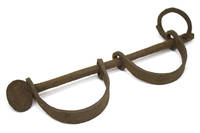
18003062751800. Wrought iron two semicircular wrist pieces approx. 4 inch in diameter attached to an 11-inch long bar. Oxidization consistent with age and material. Wrought iron two semicircular wrist pieces approx. 4 inch in diameter attached to an 11-inch long bar. A set of shackles of the type used in the Middle Passage slave route from Africa to the Americas in the 18th century. An illustration of this type of shackle appears on page 16 of Lydia Maria Child's Appeal in Behalf of that Class of Americans Called Africans Boston 1833 where she notes that these shackles were used to secure the ankles of adjacent slaves. "Yet even thus secured they do often jump into the sea and wave their hands in triumph at the approach of death unknown books
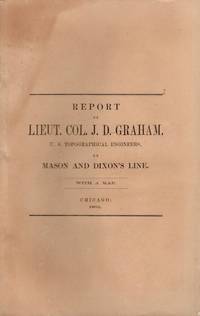
186234999Chicago: Steam Presses of F. Fulton & Co 1862. Second Edition. Wraps. Very good. Wraps. 95 pages. Folding frontispiece map. Tan colored stitched wraps with printed title on the front cover. Light toning to the front wrap. The Mason Dixon line history goes back to the 18th century involving property lines between Maryland Pennsylvania and Delaware familes. Pre Civil War the line was better known for the demarcation between free states and the Slave states from the South.<br /> <br /> A pre-Chicago fire imprint. Chicago Ante Fire imprints 641; Sabin 45089. Steam Presses of F. Fulton & Co unknown
186062260Atlanta: Printed at the Daily Locomotive Job Office 1860. 47 pp. 1 vols. 8vo. Original blue printed wrappers. Wrapper a bit chipped else Fine. 47 pp. 1 vols. 8vo. Printed at the Daily Locomotive Job Office unknown books
186062260Atlanta: Printed at the Daily Locomotive Job Office 1860. 47 pp. 1 vols. 8vo. Original blue printed wrappers. Wrapper a bit chipped else Fine. 47 pp. 1 vols. 8vo. Printed at the Daily Locomotive Job Office unknown
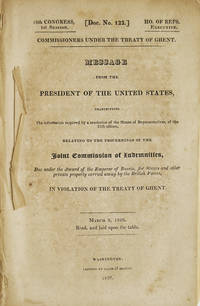
182634337Washington: Printed by Gales & Seaton 1826. 181 pp. 1 vols. 8vo. Disbound some browning to title page else a good tightly sewn copy. 181 pp. 1 vols. 8vo. John Quincy Adams' brief memorandum transmits Secretary of State H. Clay's report; a detailed list of slave owners and the names of their slaves comprises the bulk of this document. <br/><br/> Printed by Gales & Seaton unknown
8996(Paris ), de l' Imprimerie Nationale, Floréal an 10 ; Brochure in-8° en feuilles de 20pp., sans couverture comme parue, imprimé sur papier bleuté.
410 p. Foxed. 8vo. 220 mm. Spine rebacked in black leather. Original boards, worn. First American edition. Hardbound. Good. Scots born Thomas Hamilton (1789-1842) was generally overshadowed by his famous father - William Hamilton (1758-1790), professor of anatomy and botany at Glasgow, and his brother Sir William Hamilton (1788-1856) the metaphysician and antiquary. In 1810, after fully showing, in Glasgow and Liverpool, his incapacity for business, he got a commission in the 29th Regiment. Twice on active service in the Peninsula, he received from a musket bullet, at Albuera, a somewhat serious wound in the thigh. He was also in Nova Scotia and New Brunswick with his regiment, which at length was sent to France as part of the army of occupation. About 1818 Hamilton retired to Edinburgh on half-pay. He became a valued member of the 'Blackwood' writers. Hamilton married in 1820, and for several summers he and his wife lived near Abbotsford, Sir Walter Scott finding them very congenial neighbors and friends. In 1827 he wrote the ten popular novel Cyril Thornton. In 1829 they went to Italy, where Mrs. Hamilton died. Some time after his return, Hamilton visited America, bringing back materials for a this book on the Americans. 'Men and Manners in America' first appeared in 1833. 'Here his fund of humour and his genial satire, characteristics that struck Carlyle in his interviews with him in 1832-3 found scope, but his fun, if occasionally extravagant, was never unfair, nor were his criticisms directed by prejudice or charged with ill-nature.' - DNB. In the book he insightfully comments on all aspects of American culture, industry and government, he frequently expresses fascinating insight into the mores of this country. Especially interesting is his observations on American blacks - both Free and Slave. S&S/AI 19191; Sabin 30035; Howes 4481/H-138. PAIMP 22
0267513542.Ghardcover. Good. Access codes and supplements are not guaranteed with used items. May be an ex-library book. hardcover
1817SLAVERY005957W. Alexander York. 1817. First U.K. edition with additions to the Philadelphia printing. 12mo. 156 pages including 4 pages of adverts. Frontispiece. Original boards with paper backstrip and title label. Anthony Benezet 1713-1784 was a leading abolitionist.Early nameplates Thomas Marsh and Robert Langdon on front pastedown. Some foxing to prelims. Cup ring to front cover. Backstrip defective label rubbed. Very good. Scarce in original state. W. Alexander, York. hardcover
1976R240073023ABC. 1976. In-4. Relié. Etat d'usage, Couv. légèrement passée, Dos satisfaisant, Intérieur acceptable. 45 pages - nombreuses illustrations en monochrome hors texte - textes sur trois colonnes.. . . . Classification Dewey : 326-Esclavage
231551Philadelphie, The American philosophical society, 1957 in-4, xii pp., 180 pp., texte sur deux colonnes, toile Bradel marine, titre poussé en lettres dorées au centre du plat supérieur (reliure de l'éditeur).
in-8°, 552 pages, notes, biblio, gloss., broche, couverture. Papier jauni sinon bel exemplaire. [CA32-3] Excellente étude sur l’esclavage au Brésil dans la célèbre collection dirigée par Roger Caillois. Importante bibliographie.
1997193291Gallimard Paris, Éditions Gallimard, 1997. Collection « Tel. In-8 broché (19 x 12,5 cm) de 550 pages. Traduit du portugais par Roger Bastide. Préface de Lucien Febvre. Réédition de ce classique de l'anthropologie historique. Gilberto Freyre y étudie les structures économiques, familiales et sexuelles de la société de plantation sucrière au Brésil, soulignant le rôle du métissage dans l'identité nationale. Bon état
MON001Tome I : 2007 / 270 pages Tome II : 2007 / 313 pages
1842106407<p>Folded letter sheet four pages and remnant of wax seal. Creases at folds normal aging; otherwise very good or better. The letter is to Henry J. Carter Stockbridge Mass. from his brother. An unemployed 20 year-old Massachusetts teacher who had left home the year before in "exceeding hard times" Edward had gone to Baltimore – where some 50 teachers were out of work – and taken a job working for a wealthy man who had 4 acres of farm land worked by slaves. "…he has given me the office of overseer to look after the blacks in their work. O but you ought to see me walk over the lot with my cane in my hand to see how my work is going on. Then you ought to see the darky when he wants anything of me come up and take off his hat before he speaks…" Praising the "fine folks live in this beautiful part of the world" Carter proves that even a Massachusetts Yankee could quickly adapt to Southern culture and make peace with slavery. The letter is unsigned. </p> books
1842106407<p>Folded letter sheet four pages and remnant of wax seal. Creases at folds normal aging; otherwise very good or better. The letter is to Henry J. Carter Stockbridge Mass. from his brother. An unemployed 20 year-old Massachusetts teacher who had left home the year before in "exceeding hard times" Edward had gone to Baltimore – where some 50 teachers were out of work – and taken a job working for a wealthy man who had 4 acres of farm land worked by slaves. "…he has given me the office of overseer to look after the blacks in their work. O but you ought to see me walk over the lot with my cane in my hand to see how my work is going on. Then you ought to see the darky when he wants anything of me come up and take off his hat before he speaks…" Praising the "fine folks live in this beautiful part of the world" Carter proves that even a Massachusetts Yankee could quickly adapt to Southern culture and make peace with slavery. The letter is unsigned. </p>
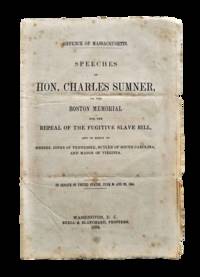
1854176351854. Abolition African Americana SUMNER Charles. Defence of Massachusetts. Speeches of Hon. Charles Sumner on the Boston Memorial for the Repeal of the Fugitive Slave Bill and in Reply To Messrs. Jones of Tennessee Butler of South Carolina And Mason of Virginia in the Senate of the United States June 26 and 28 1854. Washington D.C.: Buell & Blanchard Printers 1854. At the time that this description is being written just three copies are recorded in American institutions. OCLC search results are at best an estimate and can vary over time. The Memorial referred to in the title was a request by 2900 undersigners chiefly men of Boston Mass. to repeal the Fugitive Slave Bill of 1850. What follows is a transcription of Massachusetts Senator and famous abolitionist Charles Sumner's speeches in the ensuing debate: "Mr Jones. asks 'Can anyone suppose that if the Fugitive Slave Act be repealed this Union can exist' To which I reply at once that if the Union in any way be dependent on an Act-- I cannot call it a law-- so revolting in every regard as to that which he refers then it ought not to exist." Sumner goes on to argue amongst other things that the Fugitive Slave Act is parallel to the hated Stamp Act that sparked the Revolutionary War as well as to make spirited rebukes against the pro-slavery Senators Butler Mason and Jones: "The veteran Senator from Virginia Mr. Mason complained that I had characterized one of his "constituents" a person who went all the way from Virginia to Boston in pursuit of a slave as a Slave-Hunter. Sire I choose to call things by their right names. White I call white and black I call black. And where a person degrades himself to the work of chasing a fellow man who under the guidance of the north star has saught a freeman's home far away from the cofle and the chain that person whomsoever he may be I call a Slave-Hunter." Eight sheets folded to make one sixteen-page signature which is stitched along the left edge. Foxing throguhout pages chipped along margins. Dampstaining along two page edges. Delicate but in good condition. <br /> <br /> Charles Sumner January 6 1811 - March 11 1874 was an American statesman and United States Senator from Massachusetts. As an academic lawyer and a powerful orator Sumner was the leader of the anti-slavery forces in the state and a leader of the Radical Republicans in the U.S. Senate during the American Civil War. During Reconstruction he fought to minimize the power of the ex-Confederates and guarantee equal rights to the freedmen. During the war he was a leader of the Radical Republican faction that criticized President Lincoln for being too moderate on the South. Sumner specialized in foreign affairs and worked closely with Lincoln to ensure the British and the French refrained from intervening on the side of the Confederacy during the Civil War. As the chief Radical leader in the Senate during Reconstruction Sumner fought hard to provide equal civil and voting rights for the freedmen on the grounds that "consent of the governed" was a basic principle of American republicanism and to block ex-Confederates from power so they would not reverse the gains made from the Union's victory in the Civil War. unknown
in-12, 534 pp., cartonnage éditeur avec jaquette i Jaquette lég. insolée sinon bel exemplaire. [JU-4]