1 560 résultats
1935GITc022Marseille Editions Publiroc 1935. In-8 broché couverture illustrée 136pp. Illustrations dans le texte et à pleine page. Bel exemplaire.
053869Paris Librairie Charles Gosselin 1840 in 8 (19,5x12) 1 volume reliure demi basane havane de l'époque, dos à nerfs soulignés de filets à froid, 392 pages. Quatrième édition. Bel exemplaire ( Photographies sur demande / We can send pictures of this book on simple request )
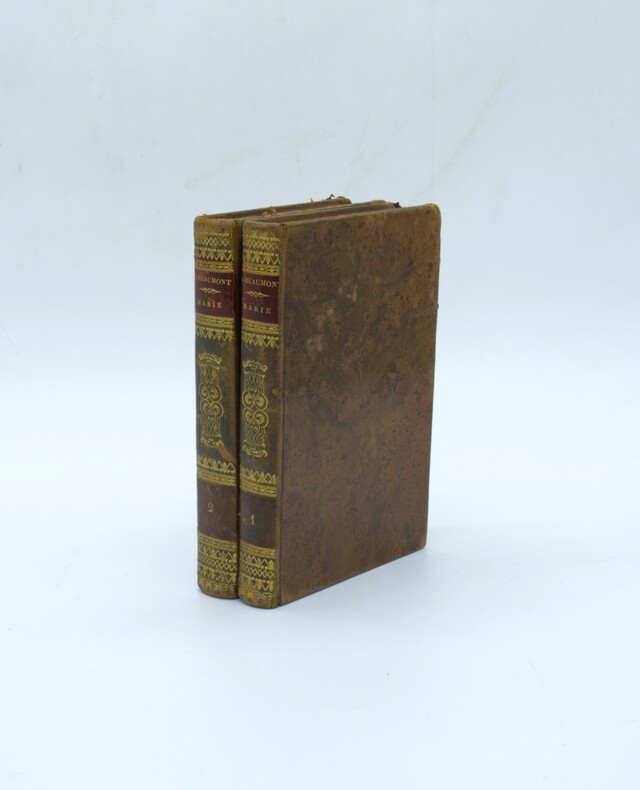
1836PHO-2331Paris, Gosselin, 1836. 2 volumes in-8 (20x13), VIII-396 pp., 2 ff.-334 pp., basane époque, dos lisse orné avec pièce d’auteur et titre, tomaison. Frottements, coins usés, rousseurs éparses.
184212540Paris Gosselin 1842 Un volume in-8 demi chagrin bordeau, reliure XXe, dos à nerfs, titre doré, couverture conservée, 588 pages. Quelques passages soulignés au crayon, néanmoins bel exemplaire.
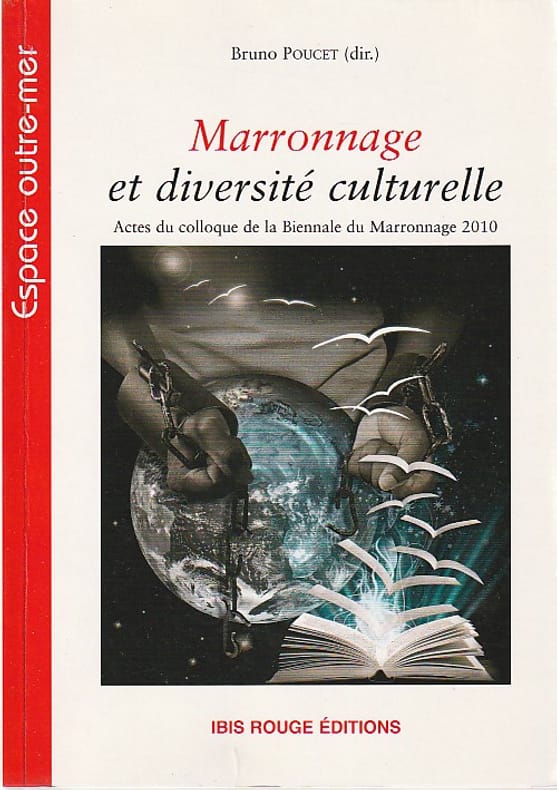
59643Ibis Rouge, Espace Outre-mer, 2012, 269 pp., broché, annotations en première page (ex-dono), bon état.
11074Valence, imp. Chaléat, 1872, 1 br. in-8 de 178 pp. ;
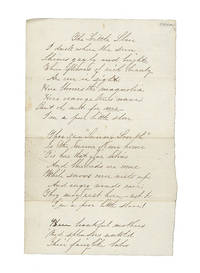
186134365Waterford Maine Feb 3rd 1861. In a neat nineteenth-century hand on a single leaf torn from a larger sheet of note paper. 1 vols. 5 x 8 inches. Old folds else fine. In a neat nineteenth-century hand on a single leaf torn from a larger sheet of note paper. 1 vols. 5 x 8 inches. "My mammy's worked out". Thirty-two line poem expressing pious sentiments at the plight of the child slave: "Here orange trees wave / But oh not for me -- / I'm a poor little slave . My mammy's worked out / And lies here in the grave / There's none to kiss me / I'm a poor little slave". unknown books
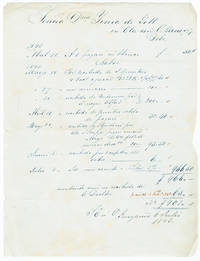
1843WRCAM55715Guayama Puerto Rico 1843. 1p. Quarto. Old folds a few short closed tears minor wrinkling. About very good. A record of a slave sale in Puerto Rico during the late Spanish colonial period. The document records various expenditures for "Senora Dna Yrma de Gott" for the spring and summer of 1843. Along with other expenditures from April to July 1843 the present manuscript document includes a line item from March 30 reading "recibido de Antonini por el negro Alfred." Apparently the señora received 200 Spanish dollars or pesos for Alfred the slave. The Spanish brought slavery to the island of Puerto Rico during the early colonial period. Slave labor fueled sugar production on the island reaching its peak in the early to mid-19th century. Slavery was finally abolished in Puerto Rico 1873 after years of slave revolts against Spanish colonial rule which began in 1868. Despite its long history of slavery records of slave sales from Puerto Rico are rarely encountered in the market. unknown books
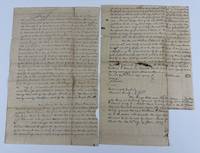
1793106470<p>12 lines in brown ink with paper seal on sheet of paper 34x21 cm 13½x8¼". Signed by Thomas Hamilton clerk. Remnant of seal old folds with splitting along them normal aging and browning some offsetting very good overall. Amazing little document relating to the enforcement of Pennsylvania's groundbreaking effort to begin the abolition of slavery "An Act for the Gradual Abolition of Slavery" passed by the Pennsylvania legislature in 1780. The Act prohibited further importation of slaves into the state required Pennsylvania slaveholders to annually register their slaves with forfeiture for noncompliance and manumission for the enslaved and established that all children born in Pennsylvania were free persons regardless of the condition or race of their parents. Those enslaved in Pennsylvania before the 1780 law entered effect remained enslaved for life. The present document seems to reveal non-compliance with the law by Hugh Neilly in part: "I hereby certify on application of Ralph Cherry that a careful search hath been made by me among the Records of Negro's sic entered on the Records of Westmoreland County and that on such search it doth not appear that any Negro's hath been registered in the name of Peter or any other name as his property by Hugh Neilly of Westmoreland County aforesaid under the laws passes for the gradual abolition of slavery. Thomas Hamilton clerk." Docketed on the back "Certificate that no Negro's hath been registered in Westmoreland as the property of Hugh Neilly." </p> books
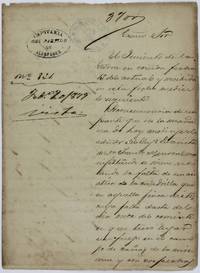
18772027Havana 1877. Very good. 1p. on a bifolium. Removed from a a bound volume with unobtrusive stabholes at gutter margin. Light wear at edges; light dust soiling and damp staining. Remarkable bidsheet submitted by a Cuban business in response to a newspaper advertisement for an auction of slaves for hire held in Havana during November 1877. The firm Jado Sarasúa y Compañia writes that "Enterada del anuncio publicado en la Gaceta fecha 9 del corriente para el arrendamineto en publica subasta de los esclavos existentes en el Asilo de San Jose pertenecientesa Bienes Embargados y sujentadose en un todo al pliego de Condiciones inserto en la misma Gaceta hace la siguente proposicion." Below is a list of fourteen slaves mostly women and the prices that the company is willing to offer for the slaves being rented ranging from ten to seventeen pesos per month. Signed and dated at the bottom "Habana Noviembre 14 de 1877. unknown books
18784011Various places in Cuba 1878. Overall good. 29 leaves varying sizes. In contemporary ad hoc selfwrappers loosely stitched. Rear wrap tattered. Varying degrees of toning and wear. Scattered offsetting throughout. Fascinating gathering of documents and letters that present several cases of Cuban slaves applying for their own freedom in 1878. The gradual abolition of slavery on the island was enacted by Spain in 1880 but prior to this there were several bureaucratic mechanisms by which enslaved people could apply for or purchase their own manumission. The most interesting case amongst the present manuscript documents is the claim of a male slave that states he was born free in Puerto Rico but was somehow included in an inheritance as a young boy transported to Cuba and sold into slavery:<br /> <br /> "Un individuo que hoy se encuentran en la Cárcel del Alacranes y que dice nombrase Juhan ó José Julian Quintana y ser esclavo actualmente de Dn. Serapio Hernandez dueño de los ingenios Escorial ubicado en Colon y Sta. Rosa en Limonar y vecino de esa Ciudad calle del Rio ha solicitado se le restituyan un derechos de libertad por haber nacídolibre en Puerto Rico de donde á la edad de 5 ó 6 años le trajeron à esta Ysla y vencieron como esclavo."<br /> <br /> Interesting for the study of manumission in late-colonial Cuba and certainly worthy of further research. unknown
18792090Cuba 1879. About very good. 3pp. on a small bifolium. Contemporary ink stamps; accomplished in a fairly legible hand. Minor wear. A few small wormholes. Light tanning and dust soiling. Brief but very interesting manuscript report on the case of a missing Chinese indentured servant in the district of Alagranes near Matanzas. On February 18 1879 the owner of the plantation Juanita reports the missing person stating that there was a fire in his sugar cane field and it is thought that the laborer might have been burned. It seems that the present document serves to register the case with regional authorities in Matanzas and is a good record of the bureaucracy controlling indentured servitude in Cuba at this time. unknown
1864106752<p>9 leaves of blue lined paper written in ink on rectos only. 31.5x20 cm 12¼x8" set in custom-made half cloth folder .Minor aging old folds; near fine. Official court document from Bexar County Texas summarizing the case of "Jim Owen a free person of African descent thirty years of age a resident of said county and state" who "desires to choose an owner and mistress and has selected for his mistress Sephrony Kerr…" Owen states that "he was brought from the State of Illinois to his state in 1850 before he was of lawful age by one John H. Burrus… who has since said time assumed a kind of guardianship over your petitioner without lawful authority…" All seemed on track until John H. Burrus filed suit stating that he was the "owner of said petitioner Owen" and "proof was not made that said petitioner is a free man of African descent" and "the negro Jim Owen… is his slave that he was brought to this State by the respondent in January 1850 as is slave and has been so held and owned up to the present time…" A new trial was granted and Kerr and Owen's petition denied. An appeal was allowed contingent on paying to Burrus a surety bond of $1500. A fascinating glimpse into the legal morass surrounding slavery as the Civil War raged and the "peculiar institution" of slavery was soon to be ended by force of arms.</p>
18393013Washington D.C. 1839. Fair. 3pp. Large folio. Separated into six pieces with a very small section of the final attestation lacking altogether. Still highly readable. A wounded but important document. A rare and historically-important document relating to slavery in the District of Columbia which was outlawed on April 16 1862 nearly nine months before the issuance of the Emancipation Proclamation. The present document is an indenture made between William G. Howison and Alexander Hunter Esquire both citizens of Washington D.C. associated with property conveyed to Hunter by the deceased Joseph Birch. In 1824 Birch conveyed to Hunter land "and also a negro man slave for life named Lewis - another named George - two horses - 4 cows - 3 calves." The document indicates that Lewis was subsequently sold for four hundred dollars and George was sold to Birch in his lifetime. Documents recording the movement of slaves within the District especially among two citizens of the city are rare in the market. unknown
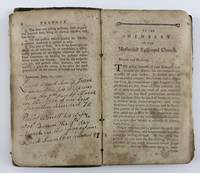
18353546Southampton Va 1835. Fair. 8pp. of manuscript plus a loose sheet of manuscript measuring 12.5 x 4 inches written within a book on family medicine. Book disbound lacking title page and first text leaf some gatherings and leaves loose or detached. Some age toning to manuscript leaves. A unique manuscript family genealogy for the Worrell family of Virginia as recorded by several hands in the margins and blank portions of two middle pages and on a few terminal and end leaves of a contemporary copy of a sammelband of two early American imprints -- The Family Adviser 1793 and John Wesley's Primitive Physic 1795 revised and corrected and on a single folded sheet folded and laid into the book. The entries within the book detail the births of the children of Josiah and Alice Worrell and sometimes their in-laws. An example of the former: "Lewis Worrell Son of Josiah Worrell & Alice his wife was born March 7 / 1774." And an example of the latter: "Polley Worrell wife of the said Lewis Worrell was born March the 9th / 1781." The entries continue much the same with the latest-dated entry reading: "Benj. Eldridge Worrell Son of Lewis Worrell & Temperance his wife was born June 21st 1835." Sometime presumably in the 1790s a member of the family also listed out a long accounting of the births of Josiah Worrell's children on a longer piece of paper folded into the present work. Titled in manuscript "Ages of Josiah Worrell's children" this sheet again begins with Lewis Worrell and lists a total of six members of the Worrell family.<br /> <br /> Most interestingly the bottom of this sheet also contains the births of four family slaves. This listing reads as follows: "Negro Ages. Ben was born the 8th day of June 1783. Solomon was born Dec. 20th 1785. Simon was born Feby. the 14th 1790. Isam was born the 20th Dec. 1792." The inclusion of the birth dates of four slaves is highly unusual in a family record of this type but remains valuable information on the lives of these four enslaved men owned by the Worrell family. unknown
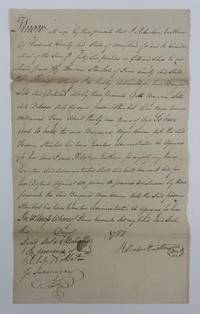
17884111Frederick County Md: March 7 1788. About very good. 1p. folio docketed on verso. Old folds short splits along a couple of fold lines minor toning. An impactful manuscript document from the early national period in Maryland formalizing the sale of a slave woman in Frederick County. The sale was made by Robertson Eastburn whose family emigrated from England to Maryland in the early 18th century. The document reads in part: "In consideration of the sum of forty six pounds in Gold and Silver to me in hand and paid by Frederic Strombol.I do hereby Acknowledge have Bargain'd Sold and Delivered and by these presents doth Bargain Sell and Deliver Unto the said Frederic Strombol One Negro Woman named Torry about thirty years of age To Have and to hold the said Bargained Negro woman unto the said Frederic Strombol."<br /> <br /> Slavery in Maryland lasted over 200 years from its beginnings in 1642 when the first Africans were brought as slaves to St. Mary's City to its end following the Civil War. In 1664 under the governorship of Charles Calvert 3rd Baron Baltimore the Assembly ruled that all enslaved people should be held in slavery for life and that children of enslaved mothers should also be held to the same standard of law. 19th-century American slave sale documents are growing increasingly scarce in the market. March 7 unknown
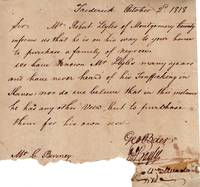
181812956Frederick MD: October 2 1818. 1p. docketed on verso. Roughly torn along bottom edge minor foxing and spotting. Good condition. An uncommon document in Maryland slave history in which George Baer the future mayor of Frederick and a few other men attest that another local citizen named Robert Lyles is not a slave trader. The document reads in part: "Lyles is on his way to your house to purchase a family of negroes. We have known Mr. Lyles many years and have never heard of his Trafficking in Slaves nor do we believe that in this instance he has any other view but to purchase them for his own use." Baer served as mayor of Frederick from 1820 to 1823; his correspondent "C. Burney" is perhaps Clotworthy Birney 1765-1845 a farmer and real estate trader living near Taney Town. An unusual Maryland slave document concerning a slave owner who just wants to buy slaves for his own use not traffic in them because that's somehow better. October 2 unknown
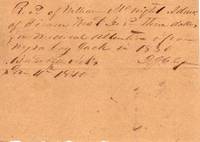
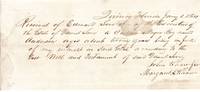
184012966Batesville AR: January 11 1840. 1p. 4 x 5.5 inches docketed on verso. Old horizontal fold toning. Very good. An interesting manuscript record of slave care in Arkansas in the 1830s. The short but impactful document reads in full: "Recd of William McNight Admin. Of Hiram West Decd three dollars for medical attention upon negro boy Jack in 1836. Batesville Ark. Jan 11 1840 DJ Chipman." Such documents are increasingly rare in the market and more uncommon than slave sale documents from the same period. Arkansas has just achieved statehood four years before the presetn document was written. January 11 unknown
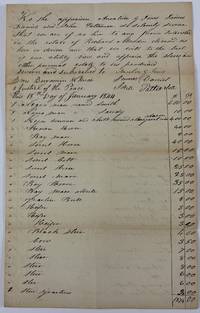
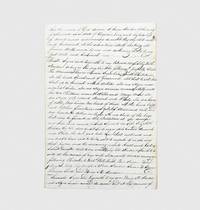
184413105St. Genevieve County MO: January 18 1844. 4pp. on a single folded sheet. Original folds minor wear. Very good condition. A sobering manuscript inventory from the estate of Richard Maddin following his death in Missouri in 1843 detailing his "slaves and other personal" property. The inventory begins by listing the enslaved persons by name along with an assignation of value for each of them as such: "1 Negro man named Smith $600. 1 Negro man named Sandy $10. 1 Negro woman and child named Margaret and Jason $400." The inventory then goes on to list the other property beginning with a long list of livestock followed by equipment household goods and so forth. The document is certified and witnessed by a number of local citizens who attest to the "full and perfect inventory of the goods chattles and personal estate" of the deceased Mr. Maddin. The reasoning is unclear why the second listed slave Sandy was worth only $10. January 18 unknown
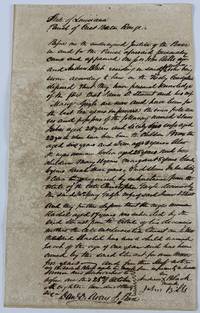
183613107East Baton Rouge Parish LA: October 25 1836. 1p. on a single folded sheet integral blank docketed on verso. Old folds moderate toning and foxing short closed tear along one fold line a few small instances of ink burn. Overall good condition. An interesting document of legal testimony involving numerous named slaves in Louisiana in 1836 ranging in age from one year to almost thirty years of age and including seven children. According to the docketing the document is effectively a "Title to Slaves." The deponents were two local citizens John Bills and Andrew Black who had "personal knowledge of the fact that James D. Stuart and his wife Mary Gayle are now and have been for the last ten years & upwards the bona fide owners and possessors of the following named slaves: Juba Aged 25 and Sicily his wife aged 22 to whom have been born the children Braxton aged six years and Dan aged 3 years. Also the negro woman Celia aged 28 years and her children Mary 11 years Margaret 8 years Charley 6 years Sarah three years which slaves Juba Sicily & Celia were acquired by inheritance from the estate of Christopher Gayle. And they further depose that the negro woman Rachel aged 17 years was inherited by the said Stuart from the estate of his deceased mother.and that the said Rachel has now a child named Jacob of the age of one year." The document is signed by Black Bills and the Justice of the Peace Daniel D. Avery. Documents involving slave inheritance of and subsequent ownership by not one but both members of a marriage are exceedingly rare. October 25 unknown
186413103Quincy FL: January 1 1864. 1p. of manuscript docketed on verso. Old crease minor staining. Very good. A short but impactful and somewhat unusual document memorializing the inheritance of a young slave named "Anderson aged about twenty years" from a Florida estate in the penultimate year of the Civil War. Anderson was formerly owned by Daniel Love of Gadsden County and is here inherited by "John Shaw for Margaret E. Shaw" by Love's executor and likely brother Edward Love. The document is dated New Year's Day 1864. An unusual occurrence of a Florida slave being transmitted to a woman through inheritance. January 1 unknown
1819190417Albemarle County VA: 1819-1823. A revealing survival from early 19th-century Virginia: the last will and testament of Isaac Hardin a prominent citizen and first legal owner of the land now known as the Greenwood historic district in Albemarle County. The will transfers ownership of 13 enslaved persons. In his will written in June 1819 and notarized and effected in May 1823 the ailing Hardin leaves the vast majority of his possessions to his wife Elizabeth. This includes the mansion house and plantation along with a number of enslaved persons: Juber Milly Milly's children Willis and Mary Ann and two girls named Hannah and Pheby. The enslaved people are mentioned in the will after Hardin's property and before the listing of his livestock. Later in the will he also transfers legal ownership of a man named Anderson to his oldest son Berry M. Hardin and of six other enslaved people to his daughter Lucinda Scott. The will was signed by Hardin with his mark and witnessed by four individuals on June 26 1819 and was later notarized on May 31 1823. We can assume that Hardin's will was carried out upon his death in 1820 and advertisements for a trust sale in 1830 tell us that much of this same property was later auctioned off including all of the enslaved men and women left to Elizabeth except for Hannah and Pheby who were singled out as Elizabeth's "to have and to hold and to dispose of as she may think proper". Bifolium handwritten on three pages docketed and with remnants of wax seal on fourth page. Old folds some damage to second leaf from where seal was removed not touching text. Very good. unknown
11095Bale, chez Jean Schweighauser, 1775, 1 demi basane à coins, tranches rouge, petit manque sur la coiffe supérieure. in-8 de 307-(19) pp. ;
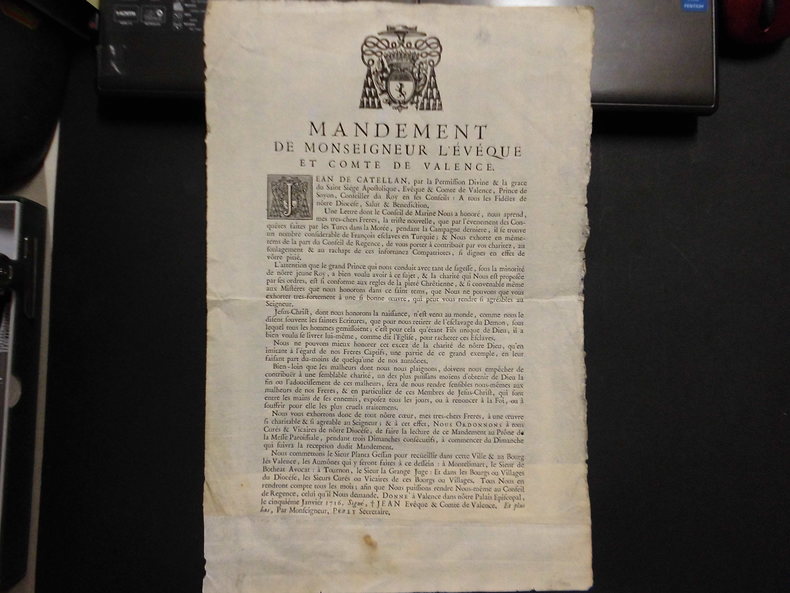
1716106Petite affichette (23,5 X 35,8 cm) "Une lettre dont le conseil de marine nous a honoré nous apprend la triste nouvelle que par l'évènement des conquêtes faites par les turcs dans la Morée, pendant la campagne dernière, il se trouve un nombre de français considérable esclave en Turquie et nous exhorte en même temps de la part du conseil de régence de vous porter à contribuer par vos charités au soulagement et au rachat de ces infortunés compatriotes si dignes de votre pitié". A noter sur le bas un rajout de papier le document ayant été coupé sans manque de texte. Jean de Catellan, né à Toulouse vers 1659 et mort le 7 janvier 1725, est évêque de Valence.
193088051930 Paris, Firmin-Didot, 1930.histoire d'outre-mer, In-8 broché de 230pp.