2 100 résultats
1981BN110682Dumbarton Oaks Center for Byzantine Studie 1981. 1981. Hardcover. Nicholas I. Patriarch of Constantinople : Miscellaneous Writings <br/><br/>Nicholas I. Patriarch of Constantinople : Miscellaneous Writings Dumbarton Oaks Center for Byzantine Studie hardcover
New New English Original bdg. Dust wrapper. 4to. (29 x 24 cm9. In English. 2 volumes set: (678 p.), richly ills., photos. A history of Robert College: The American College for Girls and Bogaziçi University (Bosphorus University). This two volume slipcased set is the story of two American Schools in Istanbul – Robert College and American College for Girls- both of them founded in the third quarter of the nineteenth century. The story takes the two schools through the last half-century of the Ottoman Empire and the first half-century of the Turkish Republic. The last part of the book tells the story of the founding of Bogazici University on the campus of the old Robert College in Bebek-Rumeli Hisarý , and the establishment of the new co-educational Robert College on the campus of the old American College for Girls in Arnavutköy. The principal characters in the story are the men and women who worked at the two colleges as teachers and administrators, and the students who studied there, many of them going on to distinguished careers, including two prime ministers of Turkey and two of Bulgaria. Bogazici University and the new Robert College, both founded in 1971, continued a tradition that has now linked east and west for over a century, perpetuating bonds of culture and friendship that have endured through wars and the fall and rise of nations. Hundreds of photographs in each volume visually trace the history of these two venerable institutions. A very heavy and oversize set.
Very Good English Original color engraving with its frame. Oblong folio. (28 x 41 cm). Description in English. Originally folded. It's in frame. It's from the book named 'A Journey through Albania, and other Provinces of Turkey in Europe and Asia, to Constantinople, during the years 1809 and 1810' by John Cam Hobhouse printed in 1813, London. Attractive one of 17 color plates in the book. Scarce.
Bumping to top and bottom of spine; 41 papers, 650 pages including 105 illustrations. CONTENTS: Narrative in Historians, Chronicles & Fiction: Margaret Mullett Novelisation in Byzantium: Narrative after the Revival of Fiction; Roger Scott Narrating Justinian: From Malalas to Manasses; Ingela Nilsson To Narrate the Events of the Past: On Byzantine Historians, and Historians on Byzantium; Brian Croke Tradition and Originality in Photius' Historical Reading; Bronwen Neil Narrating the Trials and Death in Exile of Pope Martin I and Maximus the Confessor; Elizabeth McCartney The Use of Metaphor in Michael Psellos' Chronographia; Penelope Buckley War and Peace in the Alexiad; Theoni Sklavos Moralising History: The Synopsis Historiarum of John Skylitzes; Emma Strugnell The Representation of Augustae in John Skylitzes' Synopsis Historiarum; John Burke The Madrid Skylitzes as an Audio-Visual Experiment; Andrew Gillett The Goths and the Bees in Jordanes: A Narrative of No Return; Eamon H. R. Kelly From 'Fallen Woman' to Theotokos: Music, Women's Voices and Byzantine Narratives of Gender Identity; Nick Nicholas How the Entertaining Tale of Quadrupeds became a Tale: Grafting Narrative; Vicky Panayotopoulou-Doulavera Lamenting the Fall or Disguising a Manifesto? The Poem Conquest of Constantinople; Dean Sakel A Probable Solution to the Problem of the Chronicle of the Turkish Sultans. NARRATIVE IN BYZANTINE ART: Felicity Harley The Narration of Christ's Passion in Early Christian Art; Matthew Martin Observations on the Paintings of the Exodus Chapel, Bagawat Necropolis, Kharga Oasis, Egypt; Julia Kelly The Column of Arcadius: Reflections of a Roman Narrative Tradition; Debbie Del Frate Biblical Narrative in the Mosaics of Bishop Theodore's Cathedral, Aquileia; Balsa Djuric Plato, Plutarch and the Sibyl in the Fresco Decoration of the Episcopal Church of the Virgin Ljeviska in Prizren; Nira Stone Narrativity in Armenian Manuscript Illustration; Joan Barclay Lloyd Sources for the Story of the Creation in the Mosaics of Sicily and Venice; Ursula Betka Icon and Narrative: Memorializing Saint Francis in Assisi; Margaret Manion Authentication, Theology and Narrative in the Gospel Book of Theophanes; Nancy P. Sevcenko Spiritual Progression in the Canon Tables of the Melbourne Gospels. CHRISTIAN NARRATIVE AND ESCHATOLOGY: Eric Osborn Clement of Alexandria - From Prophecy to Plato; John Wortley The 'Sacred Remains' of Constantine and Helena; Bill Leadbetter A Byzantine Narrative of the Future and the Antecedents of the Last World Emperor; Michael Champion Kosmas Indikopleustes and Narratives in Sixth-century Liturgy and History; Annamma Varghese Kaiserkritik in Two Kontakia of Romanos; Andrei Timotin Byzantine Visionary Accounts of the Other World: A Reconsideration; Peter A. L. Hill A Ninth Century Passion Harmony. ARCHITECTURE, ARCHAEOLOGY, ECONOMY AND TA EXOTIKA: Geoffrey Nathan 'Pothos tes Philoktistou': Anicia Juliana's Architectural Narratology; Nigel Westbrook Spoliation and Imitation: Continuity and Radical Disjunction in Byzantine Palatine Architecture; Hartmut Ziche Historians and the Economy: Zosimos and Prokopios on Fifth- and Sixth- Century Economic Development; Tamara Lewit Stories in the Ground: Settlement Remains and Archaeology as Narrative in the Fourth- to Sixth-century Eastern Mediterranean; Timothy E. Gregory Narrative of the Byzantine Landscape; Jialing Xu Narratives of the Roman-Byzantine World in Ancient Chinese Sources Chen Zhi-Qiang Narrative Materials about the Byzantines in Chinese Sources; Robert Mihajlovski Three Byzantine Lead Seals from Devolgrad (Ancient Audaristos) near Stobi; Bob Priestley The Varangian Guard; Australian Association for Byzantine Studies. Byzantina Australiensia 16; 650 pages
Still wrapped in plastic. ; 41 papers, 650 pages including 105 illustrations. CONTENTS: Narrative in Historians, Chronicles & Fiction: Margaret Mullett Novelisation in Byzantium: Narrative after the Revival of Fiction; Roger Scott Narrating Justinian: From Malalas to Manasses; Ingela Nilsson To Narrate the Events of the Past: On Byzantine Historians, and Historians on Byzantium; Brian Croke Tradition and Originality in Photius' Historical Reading; Bronwen Neil Narrating the Trials and Death in Exile of Pope Martin I and Maximus the Confessor; Elizabeth McCartney The Use of Metaphor in Michael Psellos' Chronographia; Penelope Buckley War and Peace in the Alexiad; Theoni Sklavos Moralising History: The Synopsis Historiarum of John Skylitzes; Emma Strugnell The Representation of Augustae in John Skylitzes' Synopsis Historiarum; John Burke The Madrid Skylitzes as an Audio-Visual Experiment; Andrew Gillett The Goths and the Bees in Jordanes: A Narrative of No Return; Eamon H. R. Kelly From 'Fallen Woman' to Theotokos: Music, Women's Voices and Byzantine Narratives of Gender Identity; Nick Nicholas How the Entertaining Tale of Quadrupeds became a Tale: Grafting Narrative; Vicky Panayotopoulou-Doulavera Lamenting the Fall or Disguising a Manifesto? The Poem Conquest of Constantinople; Dean Sakel A Probable Solution to the Problem of the Chronicle of the Turkish Sultans. NARRATIVE IN BYZANTINE ART: Felicity Harley The Narration of Christ's Passion in Early Christian Art; Matthew Martin Observations on the Paintings of the Exodus Chapel, Bagawat Necropolis, Kharga Oasis, Egypt; Julia Kelly The Column of Arcadius: Reflections of a Roman Narrative Tradition; Debbie Del Frate Biblical Narrative in the Mosaics of Bishop Theodore's Cathedral, Aquileia; Balsa Djuric Plato, Plutarch and the Sibyl in the Fresco Decoration of the Episcopal Church of the Virgin Ljeviska in Prizren; Nira Stone Narrativity in Armenian Manuscript Illustration; Joan Barclay Lloyd Sources for the Story of the Creation in the Mosaics of Sicily and Venice; Ursula Betka Icon and Narrative: Memorializing Saint Francis in Assisi; Margaret Manion Authentication, Theology and Narrative in the Gospel Book of Theophanes; Nancy P. Sevcenko Spiritual Progression in the Canon Tables of the Melbourne Gospels. CHRISTIAN NARRATIVE AND ESCHATOLOGY: Eric Osborn Clement of Alexandria - From Prophecy to Plato; John Wortley The 'Sacred Remains' of Constantine and Helena; Bill Leadbetter A Byzantine Narrative of the Future and the Antecedents of the Last World Emperor; Michael Champion Kosmas Indikopleustes and Narratives in Sixth-century Liturgy and History; Annamma Varghese Kaiserkritik in Two Kontakia of Romanos; Andrei Timotin Byzantine Visionary Accounts of the Other World: A Reconsideration; Peter A. L. Hill A Ninth Century Passion Harmony. ARCHITECTURE, ARCHAEOLOGY, ECONOMY AND TA EXOTIKA: Geoffrey Nathan 'Pothos tes Philoktistou': Anicia Juliana's Architectural Narratology; Nigel Westbrook Spoliation and Imitation: Continuity and Radical Disjunction in Byzantine Palatine Architecture; Hartmut Ziche Historians and the Economy: Zosimos and Prokopios on Fifth- and Sixth- Century Economic Development; Tamara Lewit Stories in the Ground: Settlement Remains and Archaeology as Narrative in the Fourth- to Sixth-century Eastern Mediterranean; Timothy E. Gregory Narrative of the Byzantine Landscape; Jialing Xu Narratives of the Roman-Byzantine World in Ancient Chinese Sources Chen Zhi-Qiang Narrative Materials about the Byzantines in Chinese Sources; Robert Mihajlovski Three Byzantine Lead Seals from Devolgrad (Ancient Audaristos) near Stobi; Bob Priestley The Varangian Guard; Australian Association for Byzantine Studies. Byzantina Australiensia 16; 650 pages
New English Paperback. In publisher's special box. Folio. 4to. (24 x 34 cm). In Turkish. 2 volumes set: (919 p.), richly color and b/w ills. A comprehensive monograph and guide study on Pera / Beyoglu of Istanbul / Constantinople with collected articles by collective authors. Geçmisten günümüze Beyoglu. 2 volumes set in special hardbox.
Very Good French A fine original chromo-lithograph print from "Souvenirs de Constantinople" by Brindesi, printed in 1845. Framed, but will be sent no frame. 52x49 cm / 39x 44 cm print area. Stains on right bottom margins of the paper. The Ottoman navy, stationed in front of the Tophane Artillery barracks, is preparing to sail under the leadership of Kapudan Pasha's ship "Amiraute". Jean Brindesi was born in 1826 and worked primarily as a watercolour artist. During the Abdulmecid period (1831-1861), he worked on scenes involving soldiers in Istanbul. Two albums of lithographs after his drawings were produced by Lemercier in Paris: Elbicei Atika - Musee des Anciens Costumes Turcs de Constantinople, 1855, and Souvenirs de Constantinople, 1860; these two works are collections of picturesque views of the city of Constantinople. The originals are kept at the Istanbul Topkapi Palace Museum and at the University of Istanbul. (Source: Levantine Heritage).
Very Good German Original color map on cloth. Chipped on folded places. Otherwise a clean copy. Oblong atlas folio. (46 x 52 cm). Scale: 1/300.000. Toponyms in German. Shows Gallipoli [and the Hellespont, Edremid Gulf, Imbros, Tenedos, Lesbos (Midilli), Aivali (Ayvalik) and North Aegean shores of Anatolia]. A sheet of the collection of 'The general map of Central Europe'. appeared in the years between 1873-1876 with the work of Joseph Ritter von Scheda, (1815-1888) who was a general, geographer and cartographer.
New English Original bdg. HC. Oblong 4to. (22 x 30 cm). In English and Romanian. 115, [140] p., fully color ills. Byzantine manuscripts in Bucharest's collections.= Manuscrise bizantine în colectii bucurestene. Project coordinator: Ileana Stanculescu. From the first article: "From the photographs taken over time, we chose those which best capture a special artistic quality with their strictly documentary value. This selection of manuscripts ends before the dawn of the 16th century, given the common view that after the fall of Constantinople (1453) we can no longer speak of a truly Byzantine culture, but only of a Byzantine style, albeit one which continued to shine. The selection of images was also intended to emphasize not only the aesthetics of the illuminated folios, but also those details that are significant for the codices as a whole, things which would dryly translate today as typeface font type, page layout and binding. Far from the sight of all interested parties, the Byzantine manuscripts in the Bucharest repositories are still full of mysteries waiting to be discovered and explained by researchers. We present these images here to provide a platform for a wider discussion of the significance of the Byzantine legacy for Romanian pre-modern culture. For the identification and description of the items chosen we used several catalogues, either manuscript or in print, which we then compared with the corresponding labels used by the repositories. The bibliography at the end of the volume indicates the various catalogues used for each collection. We found a wealth of details pertaining to the manuscript collections of the Romanian Patriarchy in the album published by the archimandrite Policarp. This is an excellent occasion to thank the specialists involved in the inventory of the collection for the additional information they supplied. We extend our warmest gratitude to them.Here and there we updated and corrected the information found in the aforementioned sources in the light of recent research: the dating of ms. sl. II 280, from the Library of the Holy Synod of the Romanian Orthodox Church at the Antim Monastery. We thank Mrs Tatiana Popova (University of St. Petersburg in Severodvinsk), for the observation that we are dealing with a direct copy, made at the end of the 14th century, of the Russian metropolitan Kyprian's reworking (dated 1385) of the Ladder of John Climax. Ms. sl. II 280 belongs to a group of manuscripts kept at Antim Monastery, but originates from a collection in Slava Rusa, a settlement in Dobrogea and a known...".
Fine Turkish Paperback. Roy. 8vo. (24 x 17 cm). In Turkish. Set: 1-48. Most issues include two issues. Publishing still goes on. B/w and color ills. Yeni film. No.: 1-48. Nisan-Mayis 2003 / 2017. Owner: Necati Sönmez. Edited by Aysun Sayin. A heavy set.
19042P., Editions de l'Ibis, 1983 ; in-4 (23 X 33 cm) pleine basane verte de l'éditeur, plats entièrement estampés de motifs à froid, encadrement de fleurs de lis dorées, dos à nerfs, fers à froid, tête dorée, étui doublé et bordé revêtu de moire vert bronze. 191 pp.22 miniatures de Jean-François Mincet (page de titre, double page, 4 hors texte, 8 dans le texte en bleu et 8 dans le texte en couleurs). La page de titre, la double page et les hors texte sont rehaussées à l'or et protégées d'un papier fin. Chaque page est en outre ornée d'un large encadrement répété, constitué de volutes en couleurs.Tirage limité à 950 exemplaires. 1/ 643 numérotés sur vélin chiffon de Lana (N°536). Il est joint le certificat des Editions de l'Ibis, signé par l'éditeur, Roger Antic.Dos de l'ouvrage uniformément passé, sinon parfait état,etui .Bel ouvrage dont le texte est celui du manuscrit du XIIe siècle du British Museum reproduit par Francisque Michel. Les illustrations de l'artiste ont été mises en couleurs à la main dans l'atelier d'art d'enluminure au pochoir des éditions de l'Ibis.
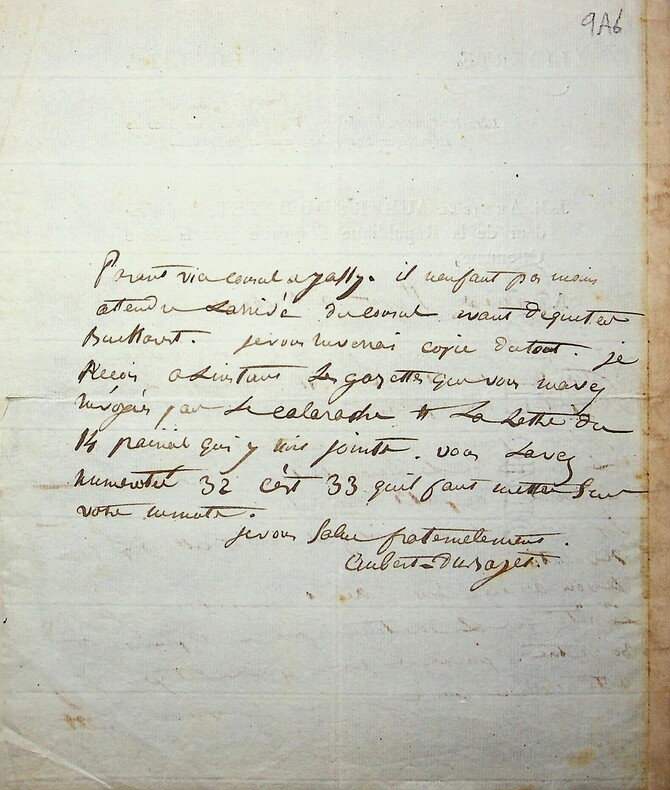
012729Jean-Baptiste Annibal Aubert du Bayet (1757-1797), militaire français né en Louisiane, ayant servi lors de la guerre d'Indépendance des Etats-Unis, député en 1791, général de la révolution, ministre de la guerre, ambassadeur à Constantinople où il meurt. L.A.S., Péra-lez-Constantinople [quartier d'Istanbul aujourd'hui], 25 prairial an 5 [13 juin 1797], 2p in-4. Belle lettre à entête imprimé de l'ambassadeur avec mention en haut « Liberté Égalité ». Au « général St Cyr à Bucharest », i.e. Claude Carra-Saint-Cyr (1760-1834), fidèle d'Aubert qu'il accompagne à Constantinople. Il prendra sa place à sa mort et épousera aussi sa veuve. Cette sympathique lettre mentionne la réception de deux lettres de Saint-Cyr, numérotées, et l'envoi de réponses. Ce sont probablement des lettres confidentielles, d'où la tournure des phrases. « Je reçois aujourd'hui par le courrier tardif de la Bosnie les nouvelles de la démocratisation de ces odieux aristocrates, ou plutôt aulicrates, de Venise. Il y a six mois qu'il nous aurait fallu avoir cette trop tardive révolution ». « Je vous annonce avec regret que je reçois aujourd'hui les arrêtés que le directoire a pris le 18 pluviôse et 30 ventôse par lesquels je vois que le citoyen Flury a été nommé consul général de la Valachie et Parent vice-consul à Jassy. Il n'en faut pas moins attendre l'arrivée du consul avant de quitter Bucharest ». Il s'agit ici de Charles Flûry (1765-1842) et de Joseph Parant (1776-1806, mort à Bucarest). Les principautés de Valachie et de Jassy (Ia?i) sont des parties de la Roumanie actuelle. Carra-Saint-Cyr attendra bien les deux diplomates qui arriveront le 24 décembre 1797, après de décès d'Aubert du Bayet (17 décembre). Il partira peu après pour Constantinople. Très intéressante lettre. [69-2]
Very Good English In original cloth. HC. Small Roy. 8vo. (23 x 15 cm). In English. 224 p., 35 photographic ills. in 24 plates. Lady Dorothy Mills who started her Istanbul journey with a wrong train, noticed this in Budapest and got off the train in Romania border, after all succeeds to got on the Sofia Express. She became very happy when she arrived to Istanbul. However the pouring rain, her wet aching feet, cold wind of Bosphorus, seeing her dreams about the city were not real made her unhappy and she did not love Istanbul. Afterwards Istanbul, with its mosques especially Hagia Sophia (St. Sophia), its Grand Bazaar, Bosphorus and with its all other beauty impressed Doroty Mills. The writer continues her journey visiting Ankara, South Anatolia, Syria, Jerusalem, Tel-Aviv, Jordan and Iraq, wrote her observations about historical, geographical, cultural and social qualities of countries, qualities and traditions of nations of the countries that she travelled as a diary with a riveting style.
Very Good English Modern aesthetic leather bound. Roy. 8vo. (24 x 17 cm). In Ottoman script. 200 p. Including Greek - Ottoman Turkish dictionary on last page. Roumi: 1328 = Gregorian: 1912. Ozege: 19912. First and only edition of Kritovulos' history in Ottoman world. OTTOMANIA Chronicle Ottoman history Byzantium Mehmed the Conqueror Conquest Istanbul - Constantinople.
Very Good German Original b/w city plan. Atlas folio. (58x47 cm). In German. Folded. [CITY PLAN of BRAILA -IBRAIL-] Stadtplan von Braila. Scale (Masstab): 1/10.000. No cartographer. 33 descriptive articles on bottom-right corner of the plan. Slightly chipped at extremities of paper and soiling. It shows Braila and Donau. Braila (Turkish: Ibrail) is a city in Muntenia, eastern Romania, a port on the Danube and the capital of Braila County.
New New English Original bdg. Dust wrapper. In special slip-case. 4to. (32 x 23 cm). In Turkish. 3 volumes set (251 p.; [xvi], 340 p.; 536 p.). Mimar Kemalettin Anma Programi Dizisi. 3 volumes set. Vol. 1. Mimar Kemalettin çagi. Mimarlik / Toplumsal yasam / Politika. Vol. 2. Istanbul Vakiflar Bölge Müdürlügü Mimar Kemaleddin Proje Katalogu. Vol. 3. Imparatorluktan Cumhuriyete Mimar Kemaleddin, 1870-1927. A comprehensive study on Kemaleddin the Architect, 1870-1927.
Very Good English Paperback. Pbo. Roy. 8vo. (23 x 16 cm). In Ottoman script. 11 p., 6 folding b/w plts. Hegira 1339 = Roumi 1337 = Gregorian 1921. First and Only Edition. Architectural and photographic report on restoration of Topkapi Palace in Constantinople in the last period of Ottoman Empire. Extremely rare. Topkapi Saray-i Humayununun tamirâti münasebetiyle encümenin hükûmet-i seniyyenin nazar-i dikkatine arz eyledigi rapor suretidir. 10 Tesrin-i evvel 1333.
Very Good Serbian Paperback. Roy. 8vo. (23 x 16 cm). In Serbian. 2 b/w portraits, 17, [18] p., ix numerous b/w plates. Izlojva Turskih slika i publikatsiya. Muzej Kneza Pavla. [Exhibition catalogue]. 14 April - 30 April, Beograd 1937. Extremely rare. Exhibition catalogue of Turkish / Ottoman masterpieces.
Very Good Turkish Paperback. Roy. 8vo. (24 x 17 cm). In Turkish. 24 issues set. Ills. Yedinci Sanat. Aylik sinema dergisi. Owner: Nezih Cos. Genel yayin yönetmeni: Atilla Dorsay. Yazi isleri sorumlusu: Engin Ayca. No: 1-24. SET.
8vo., First Edition, on laid paper, with 34 plates; original green cloth, upper board blocked in gilt, gilt back, uncut, backstrip mildly sunned else a very good, bright, clean, crisp copy. Bright copy of a scarce, valuable and important eye-witness account.
1897237507Constantinople 1897. 10 x 7-3/4 inches. Mounted. Slightly faded. 10 x 7-3/4 inches. Photo/Wh/2/up unknown
1897237507Constantinople 1897. 10 x 7-3/4 inches. Mounted. Slightly faded. 10 x 7-3/4 inches. Photo/Wh/2/up unknown books
Very Good Turkish, Ottoman (1500-1928) Original color lithograph map. Folded. Oblong folio. (35 x 52 cm). In Ottoman script (Old Turkish with Arabic letters). It shows Sudan and West Africa, Atlas Ocean shores, Sahra Desert, and other parts of Africa. Scale: 1:15.000.000. A very detailed and attractive map. Slightly fading. Otherwise a very good copy. Dated Hegira: 1310 = [Gregorian 1894]. Taken from his attractive atlas titled "Yeni cografya atlasi. [i.e. New Geographical Atlas]". The cartographer, Ali Seref, or Hafiz Ali Seref (or Esref) Pasha (1840-1907) was an Ottoman soldier and mapmaker who was schooled in Paris as a cartographer around 1862. While in Paris he published his first atlas with 22 maps, called the Yeni atlas. Upon his return to Istanbul, he became the chief cartographer at the Matbaa-i Amire Printing Press in Beyazit. Chipping on extremities. Slight foxing. Overall a good copy. Not in OCLC.; Not in TBMM Map Collection.
Very Good German Original color map on cloth. A little foxing on cloth. Very good. Folded. Oblong folio. (45 x 51 cm). In German. Shows N. Enyed, Zalathna, Mediasch, Hermannstadt, Hatszeg, Petroseni, Ôzt River, etc. Scale: 1/300,000. Sibiu (Sibiiu - Hermannstadt - Nagyszeben) is a city in Romanian Transylvania. The city straddles the Cibin River, a tributary of the river Olt. The first official record referring to the Sibiu area comes from 1191 when Pope Celestine III confirmed the existence of the free prepositure of the German settlers in Transylvania, the prepositure having its headquarters in Sibiu, named Cibinium at that time. In the 14th century, it was already an important trade center. As of the year 1376, the craftsmen were divided into 19 guilds. Sibiu became the most important ethnic German city among the seven cities that gave Transylvania its German name Siebenbürgen (literally "Seven Citadels"). It was home to the Universitas Saxorum (Community of the Saxons), a network of pedagogues, ministers, intellectuals, city officials, and councilmen of the German community forging an ordered legal corpus and political system in Transylvania since the 1400s. During the 18th and 19th centuries, the city became the second -and then the first most important center of Transylvanian Romanian ethnics. The first Romanian-owned bank had its headquarters here (The Albina Bank), as did the ASTRA (Transylvanian Association for Romanian Literature and Romanian's People Culture). After the Romanian Orthodox Church was granted status in the Habsburg Empire from the 1860s onwards, Sibiu became the Metropolitan seat, and the city is still regarded as the third-most important center of the Romanian Orthodox Church. Between the Hungarian Revolution of 1848 and 1867 (the year of the Ausgleich), Sibiu was the meeting-place of the Transylvanian Diet, which had taken its most representative form after the Empire agreed to extend voting rights in the region (Source: Wikipedia). A sheet of the collection of 'The general map of Central Europe'. appeared in the years between 1873-1876 with the work of Joseph Ritter von Scheda, (1815-1888) who was a general, geographer, and cartographer.
Very Good Turkish, Ottoman (1500-1928) Original color map on cloth. Oblong atlas folio. (49 x 60 cm). Toponyms in Turkish with Arabic letters. In Ottoman script. Scale: 1/25.000. [MAP of ISTANBUL / CONSTANTINOPLE] Küçükköy, Petnahor, Makriköy, Kagidhane [Kagithane]. A rare Istanbul map including some old Byzantine toponyms.