Abdullah Freres (active 1858 - 1899)Livre Rare Book
2 100 résultats
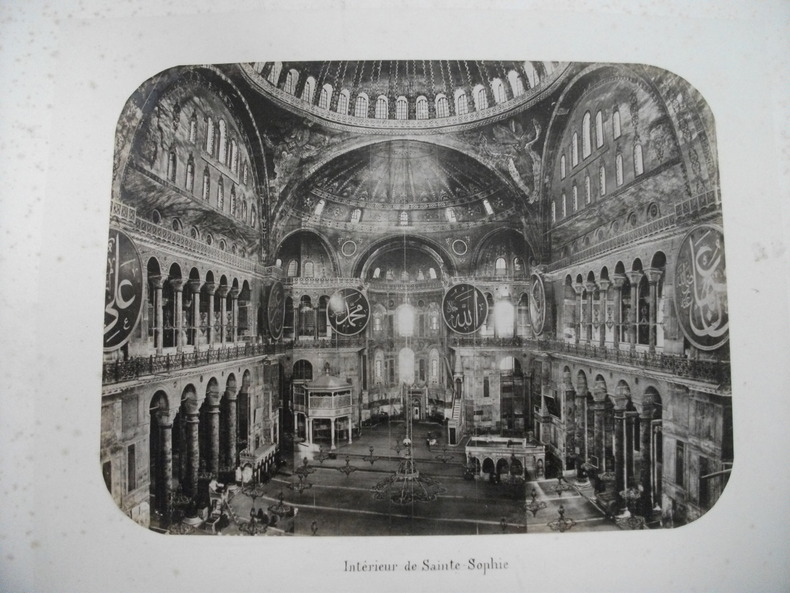
FO0572 albumen photographs c. 1875 mounted on strong paper recto/verso, photos dimensions 20 x 25 cms. Humidity light stains on the frames not affecting the photos, light undulation on the paper.
New New English Original bdg. Dust wrapper. Folio. (31 x 22 cm). In English and Turkish. 404 p., ills. Istanbul through a bow's sight.= Nisangâh-i Istanbul. 'Okmeydans' in Istanbul in the period of the Ottoman Empire and Istanbul Archers Tekke - Archers in the classical Ottoman age - Evliya Çelebi and archers - Famous archers in Istanbul and their 'Nisantas's - Turkish / Ottoman manuscript literature on archery - Production and producers of composite bows - Story of 'Tekke of Archers'.
Very Good Turkish, Ottoman (1500-1928) In contemporary leather bounds. 4to. (29 x 21 cm). In Ottoman script. 2 volumes set: ([22], 528 p.; 257 p., 183 illustrations, 1 plate of map, 2 folding maps, 1 folding plate.). Özege: 8283. An extremely important work on the history and ethnography of Constantinople and heritage of Byzantine Empire. Istanbul ve Bogaziçi. Bizans ve Osmanli medeniyetlerinin asar-i bakiyesi. 2 volumes set.
Fine Turkish In modern clothes. 4to. (33 x 24 cm). In English and Turkish. 2 volumes set: (xvii, [3], 357 p.; [8], 447 p.), b/w and color plates. Sedad Hakki Eldem was a Turkish Architect. One of the pioneers of nationalized modern architecture in Turkey. He was born in Constantinople (1908). He graduated from the Academy of Fine Arts (department of Architecture). Between 1931 and 1932 he travelled to France, England and Germany with a scholarship of the academy. In 1932 he opened his own office, also started teaching at the Academy of Fine Arts and continued until retirement in 1978. In 1934 he worked for the National Architecture Seminar in Turkey which was a complete disaster for him because of the discussions between modern architecture and traditional architecture. In 1938 he designed the Turkish Pavilion in New York Exhibition. Sedad Hakki Eldem represented Turkish Republic at International Union of Architects in Lausanne (1948) after Second World War. Also in the same year Sedad Hakki worked with his colleague Emin Onat on the project of Istanbul Palace of Justice. He worked on proportions and architectural organizations of Ottoman domestic houses, 18th and 19th century palaces and mansions. He was known as a role model and pioneer to reinterpret the Classical Ottoman Patterns in modern architecture. He was a part of Former Artifacts Maintain Council (Eski Eserleri Muhafaza Encümeni) between 1941 and 1945 and also a part of Supreme Council of Antiquities and Monument Real Estate (Gayrimenkul Eski Eserler ve Anitlar Yüksek Kurulu) between 1962 and 1978. His thought was about nationalizing the Modern Architecture. He basically thought that International Style in architecture should not applied everywhere. Some things should be changed in the design by considering the national and domestic texture. He has won the international Aga Khan Award for Architecture in 1986 with the project of Zeyrek Social Security Facilities. Sedad Hakki Eldem's architecture has basically 4 main periods. The first of them, between 1928 and 1934, is known by the instability of his work. After that, the second period is popular with modern trials on Ottoman architectural organization. The time frame of this period spans from 1934 until 1952. The third period of his architecture has lost its Ottoman influence, it looks more modernized between 1952 and 1962. The last part of Eldem's Architecture known for his double approach on projects.This final period started in 1962, and lasted until his death in 1988. (Source: Wikipedia). Extremely rare.
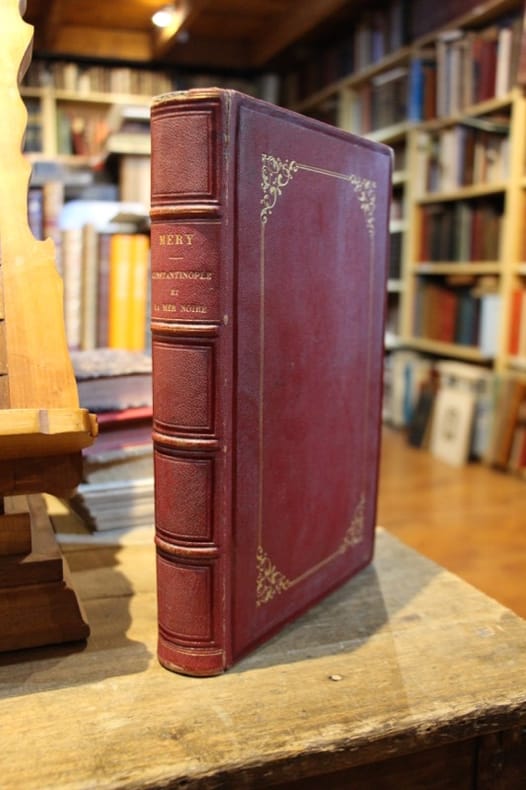
1855111244Paris, Belin-Leprieur et Morizot 1855 In-4 26,5 x 17 cm. Reliure plein chagrin cerise, dos à nerfs ornés d’un filet doré, caissons ornés d’un double cadre à froid, plats en cadrés d’un double filet à écoinçons, dorés, tranches dorées, XI-487 pp., 21 gravures à pleine hors texte sous serpentes, dont 6 coloriées, table des matières, placement des gravures. Reliure légèrement frottée avec accroc en tête dos, faibles rousseurs marginales, planches d’une grande fraîcheur, gouttière régulière.
Very Good French Original autograph letter signed (ALS) by P.pon "[We hereby declare that Ms. L. Cassinelli occupied our house located in Pera Rue, Hodja Ali No 19. On December 1, 1887, and left him on September 30, 1899. That during all time, he did not pay me the tax... P. pon de la succession de feu le Comte A. de Camondo. [i.e. On behalf of the succession of Count A[braham Salomon] Camondo, (1781-1873)]. Probably it's signed by his advocate of Moise de Camondo. Recipient is not defined. Letter indicates one of Camondo family's houses in Pera, Constantinople. 26,5x21 cm. Completely in French. 14 lines. On a paper watermarked "William Brown & Co., London". William Brown and Co. were located in London in this 'St. Mary Axe, and 40 to 41, Old Broad Street, London, E.C.' address according to Grace's guide to British industrial industry; they worked on 'Lithographic and Letterpress Printers'. 1887 Registered as a Limited Company. Count Moïse de Camondo, (1860-1935), was an Ottoman Empire-born French banker and art collector. He was a member of the prominent Camondo family. As a child, Camondo moved with his family from their home in Constantinople, Ottoman Empire, to Paris around 1869, where he grew up and continued the career of his father, Nissim de Camondo (1830-1889), as a banker. He was born into a Sephardic Jewish family that owned one of the largest banks in the Ottoman Empire, established in France since 1869. Starting in 1911, he completely rebuilt the family's Parisian mansion on the Parc Monceau in order to house his collection of 18th-century French furniture and artwork. Working closely with the architect René Sergent, he created a palatial home conforming to certain 18th-century traditions, even planning the room dimensions to match exactly the objects in his collection. The entryway is inspired by the Petit Trianon of Versailles. The home includes a kosher kitchen with separate sections for meat and dairy. The dining room includes a beautifully-carved green marble fountain in the shape of a shell, with a dolphin spigot for the ritual washing of hands before eating a meal. Some highlights of his collection include a French silver service that had been ordered by Russian Empress Catherine the Great, a set of Buffon porcelain (with exact reproductions of ornithological drawings) from the Sèvres manufacturer, and perhaps the only existing complete set of Gobelin royal tapestry sketches. He married Irène Cahen d'Anvers, daughter of Louis Cahen d'Anvers, in 1891. They separated in August 1897 after her affair with de Camondo's stable master, Count Charles Sampieri, whom she would later marry and divorce. The children, Nissim and Beatrice, remained with de Camondo. The mansion was completed in 1914, but his son did not reside there very long, as he rejoined the French Army to fight in The Great War. It had been de Camondo's great hope that his son, whom he adored, would take over the family empire. Following Nissim's death in 1917, de Camondo closed all banking activities. He largely withdrew from society and devoted himself primarily to his collection and to hosting dinners for a club of gourmets at regular intervals. Camondo died in 1935, and the museum opened the following year. He donated the home to Paris's Decorative Arts society as a museum (Musée Nissim de Camondo) in honor of the loss of his son Nissim in World War I. In addition to the collection, the meticulously-restored service areas, elevator, and woodwork of the mansion are noteworthy. During the German occupation of France during World War II, his daughter Béatrice, his son-of-law Léon Reinach, and their children (Fanny and Bertrand) were deported from France and died in the Auschwitz concentration camp. As a result, the de Camondo family died out.
Very Good German Original color map on cloth of Constantinople, the Bosphorus, the Golden Horn, Princess' Islands, Pera, Galata, Scutari and environment. Map on cloth. 50x60 cm. Toponyms are in German entirely. Folded. Scale: 1:100000. A detailed toponyms list titled "Verzeichnis der mit Ziffern bezeichneten öffentlichen Gebaude" under the sections A: Pera und Galata, B: Stambul, C: Skutari; and "Erlauterung der Abkürzungen". Some toponyms are transcripted Turkish into western characters like Karadenis - Bahr-i Siach, Burgas Adassi, Kisil Adalar, Jeni Djami, etc. A rare Istanbul map printed in 19th century.
Fine Turkish Original typescript letter signed by Semavi Eyice. Some autograph corrections as well by Eyice. 31x22,5 cm. In Turkish. Twenty lines. 7.5.1981 dated. He mentions Fatih Mosque in Silivri which transformed from an old Byzantine church. The letter includes very interesting information Silivri, and Selimbria, with its ancient name. For instance, in the 1960s, the district governor of Silivri sold the land of this church/mosque for five Turkish Lira per square meter. In addition to this, he says that Silivri is a Turkish district were always destroyed its own historical artifacts. In the continuation of the letter, he indicates that he adds to this sending an off-print including his article related to the Byzantine monuments in Thrace and containing mentioned church in Silivri.
16511221324London: Roger Daniels 1651. ESTC R12717. Folio; 393 pp.; recased in modern tan leather with gilt title; moderately worn 18th century leather boards preserved; endpapers freshened; contents very good; spine: tan leather with gilt titles. Consignment. 1221324. Rockville Non-Retail Listings. Roger Daniels unknown books
New English Paperback. Pbo. Roy. 8vo. (24 x 17 cm). In French. La Turquie d'Asie. 7 volumes set. Vol. I: L'Anatolie Orientale: Trebizonde, Erzeroum, Bitlis, Van, Diarbekir. Vol. II: Les Provinces Arabes: Alep, Mossoul, Bagdad, Bassorah. Vol. III: Provinces des Iles de l'Archipel et de la Crete. Vol. IV: Vilayet de Constantinople et Mutessariflik d'Ismidt. Vol. V: Le Vilayet de Smyrne et le Mutessariflik de Bigha. Vol. VI: L'Anatolie Centrale: Angora, Koniah, Adana, Mamouret-ul-Aziz, Sivas. Vol. VII: L'Anatolie Occidentale: Broussa et Castamouni. 7 volumes set: (428 p.; 464 p.; 187 p.; 158 p.; 341 p.; 424 p.; 390 p.).
9033Leipzig, 1905. In 12 percaline rouge de l’éditeur, XXIV-275 pp.
19372Londres et Parois, Fisher, Son & Cie, s.d. 3 séries en 1 vol. in-4, XLII-60 pp. 30 (sur 32) pl. + 58 pp. 31 (sur 32) pl. + 54 pp. 32 pl., demi-basane havane (dos manquant, reliure défraîchie, rousseurs et taches, 3 planches manquantes).
9807Paris, chez Mondhare, fin XVIIIéme. 31 x 45 cm contrecollé sur carton fort et entouré d'un filet doré.
1894025738Paris 1894 Alphonse Picard et Fils Full-Leather
Front cover illustration of a raving Bolshevik. Secrets of the London Air Raids - Where Zepps and Gothas dropped their bombs - article. Allied flags at Constantinople and Cattaro - two photos. New World Knights Guard River of Old Romance - 5 photos of American troops in Germany. Two photos of British soldiers in Germany. Four photos related to the escape of 29 British officers from the POW camp at Holzminden. Bolshevism in its True Colours - article by Sir Sidney Low. Photogravure centerfold includes images of the British in Cologne. Shall we Hang the Kaiser - article by Lovat Fraser. Equine and Canine Transport Bound for the Rhine. Ships of the Allies Anchor Off Sebastopol Again - 4 photos. Two photos of a British 'mystery' aeroplane' dropping a torpedo. And more. Average wear. Unmarked. Staples disintegrated. A sound copy. Book
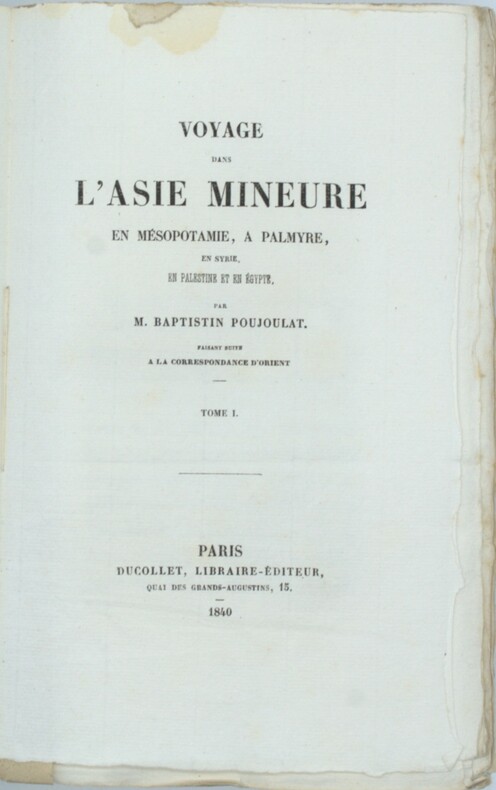
1840PHO-1534Paris, Ducollet, 1840-1841. 2 vol. in-8, XII-456pp.-612pp., brochage éditeur, non coupé, non rogné, petit manque de papier à la couverture du tome 1 et dernière de couv. tome 2.
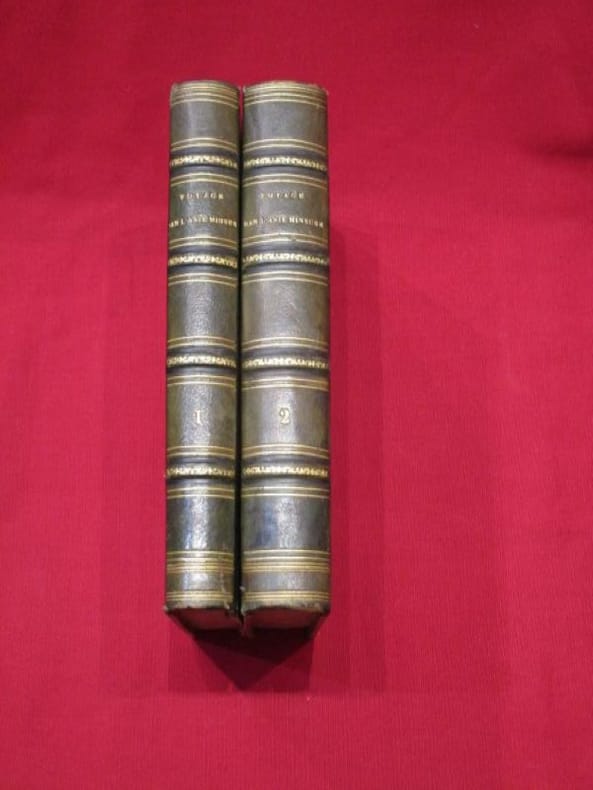
118922Paris, Ducollet, 1840, 2 volumes in-8 de XII, 456 pages - 612 pages. Demi-reliure verte, dos à nerfs portant titres et tomaisons dorés, tranches mouchetées, gardes de papier marbré. Dos insolés, quelques épidermures sur le cuir, ex libris papier sur les contreplats, taches d'oxydation par endroits, sinon bon état général.
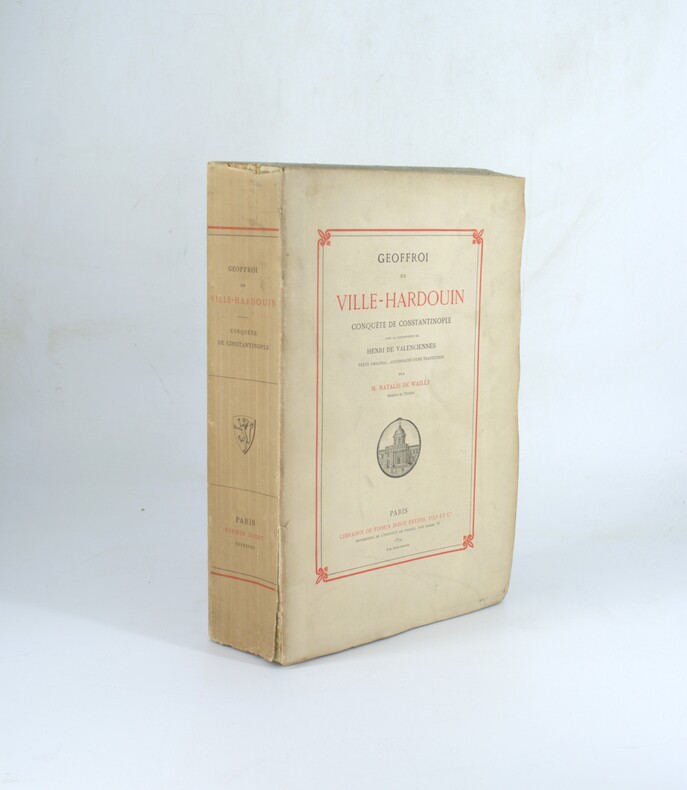
1874PHO-2270Paris, Firmin Didot, 1874. In-4° de xxiv, 616 pp. Frontispice en couleur et 1 carte dépliante. Brochage éditeur. Tirage de luxe à 220 exemplaires sur papier à la forme, celui-ci n° 122. Petite déchirure au dernier plat, petite fente et léger
16709Paris, Librairie de Firmin-Didot et Cie, 1882. In-4 ; demi-chagrin rouge, dos à 4 nerfs, plat avec l'écusson du Lycée Henri IV ; faux-titre, fronstipice couleurs et page de titre imprimée en noir et rouge - XXIV pp (préface, notice sur la présente édition, note explicative de la carte, observations sur les culs-de-lampe et autres ornements), 616 pp.
Paris, Librairie de Firmin-Didot et Cie, 1882. In-4 ; demi-chagrin rouge, dos à 4 nerfs, plat avec l'écusson du Lycée Henri IV ; faux-titre, fronstipice couleurs et page de titre imprimée en noir et rouge - XXIV pp (préface, notice sur la présente édition, note explicative de la carte, observations sur les culs-de-lampe et autres ornements), 616 pp. Texte original avec la traduction en regard. Edition ornée de lettres intiales et de bordures empruntées aux manuscrits du XIIe et du XIIIe siècle et accompagné d'une carte géographique dépliante en noir et blanc sur fond vert, dressée par Auguste Longnon et gravée par Erhard (en fin d'ouvrage). Planches hors-texte, culs-de-lampe. Bel exemplaire (sans rousseurs).
198215850Walter De Gruyter & Co. . 1982. Hardcover. Very Good in No Dust Jacket dust jacket. Scholars' bookplate to inner cover. Slight spine slant. Very minor shelfwear.; Volume 1 Only.; 1; 461 pages . 3110085305 . Walter De Gruyter & Co. hardcover
1998186332Berlin: De Gruyter 1998. Hardcover. VG Covers have very minor wear. Greek Text. Volumes I & II. Green cloth boards with light green lettering. Includes bibliographical references. De Gruyter hardcover books
1998186332Berlin: De Gruyter 1998. Hardcover. VG Covers have very minor wear. Greek Text. Volumes I & II. Green cloth boards with light green lettering. Includes bibliographical references. De Gruyter hardcover
New New English Original bdg. Dust wrapper. 4to. (34 x 24 cm). In English. 368 p., color and b/w ills. A garden for the Sultan: Gardens and flowers in the Ottoman culture. Contents: Ottoman and other gardens. The features of Ottoman gardens. Ottoman gardens and Europe. Flowers among the Ottomans. The concepts of paradise and garden among the Ottomans. Ottoman palace gardens. Imperial gardens in Istanbul other than palace agdrens. References to Istanbul gardens and flowers in contemporary memoirs. Treatises on gardening and flowers. "True lover who has exprienced this blossoming of eternal rose in himself understands that the gardens of this world are only a lovelyn pretext for the Beloved to veil and unveil Himself at the same time. The hidden treasure of his beauty needs the garden to become visible to those who are still bound to sensible and tangible beauty. The eye of love sees behind the roses and trees, in the shade of the slender cypress and in the modest genuflection of the little violet, in the limpid water of basins and in the gushing fountains faint remembrances of the garden of Paradise with its Tuba tree, kauthar and salsabil; a Paradise which is, in turn, only a sensual symbol of God's everlasting beauty". OTTOMANIA Ottoman court Palace Istanbul Constantinople Flower Garden Turkish and Islamic art.
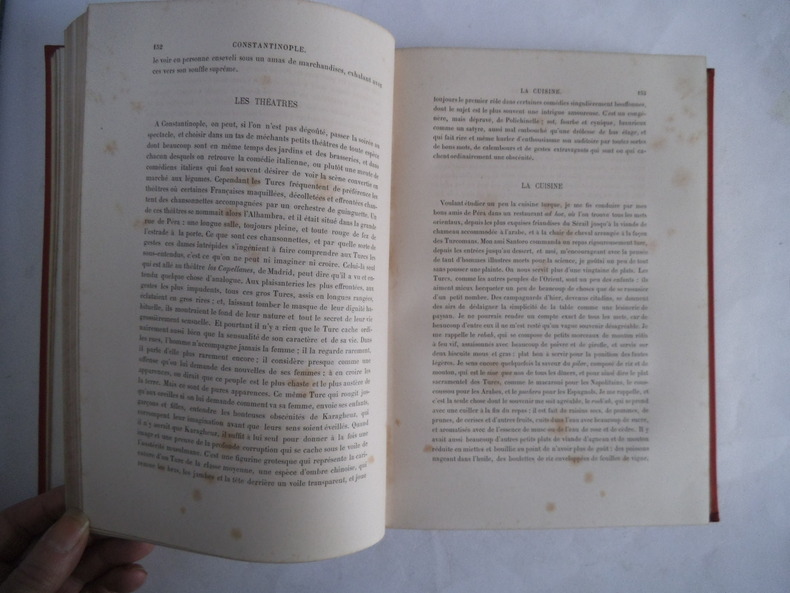
5525ouvrage traduit de l’italien avec l’autorisation de l’auteur par Mme COLOMB.Petit in 4 pleine toile rouge d’éditeur titre et caissons dorés,titre doré sur le premier plat encadré d’un filet et d’une frise décorative.Faux-titre,portrait de l’auteur d’après RONJAT,titre en noir et rouge 452 pages,tranches dorées, 183 illustrations dans et hors-texte d’après les dessins pris sur nature par C. BISEO.Hachette & Cie 1883,rousseurs éparses plus ou moins fortes à certaines pages, ainsi qu'en début et fin de volume habituelles