[manuscript; original drawings]Biblio.com

24 120 résultats
1857D11024Aix-en-Provence probably 1857-1860. Hardcover. Near Fine. Marbled paper over boards backed in red sheep gilt-stamped lettering in spine compartments; 311 x 230 mm; contains 70 double-page pen-and-ink drawings open they measure 311 x 445 mm some enhanced with ink wash or watercolor each with the artist's name and the professor's signatures 4 signatures in all. Boards and spine rubbed and scuffed; top corner of front board lacking. Contents are very near fine -- just some light foxing and a few small spots of soiling. <br/><br/>Highly skilled technical drawings by Michel Clement a student at the École Impériale d'Arts et Métiers d'Aix. The period of training was set at three years with the first year devoted to arithmetic geometry and drawing; the second year to descriptive geometry trigonometry and mechanical drawing of both stationary and moving parts; and the third year to industrial mechanics and advanced drafting techniques. This album affords a fascinating glimpse into the type and extent of the skills required of graduates of French technical schools in the mid-19th century. The course in design cours de dessins is structured and presented here in 4 sections: Troisieme division premiere annee; deuxieme division these drawings dated 1858-1859; deuxieme annee; and premiere division. The drawings include ornements 6 architecture 6 lavis 4 lever a l'equerre 1 echelles 1 epures 5 boulons et rivets 2 assemblages 1 geometrie descriptive 22 cinematique 5 organes de machine 3 topographie 2 machine outil 1 engrenages 6 machine a vapeur 1 treuil 1 machine a vapeur 2 hydraulique 1. hardcover
1857D11024Aix-en-Provence probably 1857-1860. Hardcover. Near Fine. Marbled paper over boards backed in red sheep gilt-stamped lettering in spine compartments; 311 x 230 mm; contains 70 double-page pen-and-ink drawings open they measure 311 x 445 mm some enhanced with ink wash or watercolor each with the artist's name and the professor's signatures 4 signatures in all. Boards and spine rubbed and scuffed; top corner of front board lacking. Contents are very near fine -- just some light foxing and a few small spots of soiling. <br/><br/>Highly skilled technical drawings by Michel Clement a student at the École Impériale d'Arts et Métiers d'Aix. The period of training was set at three years with the first year devoted to arithmetic geometry and drawing; the second year to descriptive geometry trigonometry and mechanical drawing of both stationary and moving parts; and the third year to industrial mechanics and advanced drafting techniques. This album affords a fascinating glimpse into the type and extent of the skills required of graduates of French technical schools in the mid-19th century. The course in design cours de dessins is structured and presented here in 4 sections: Troisieme division premiere annee; deuxieme division these drawings dated 1858-1859; deuxieme annee; and premiere division. The drawings include ornements 6 architecture 6 lavis 4 lever a l'equerre 1 echelles 1 epures 5 boulons et rivets 2 assemblages 1 geometrie descriptive 22 cinematique 5 organes de machine 3 topographie 2 machine outil 1 engrenages 6 machine a vapeur 1 treuil 1 machine a vapeur 2 hydraulique 1. hardcover books
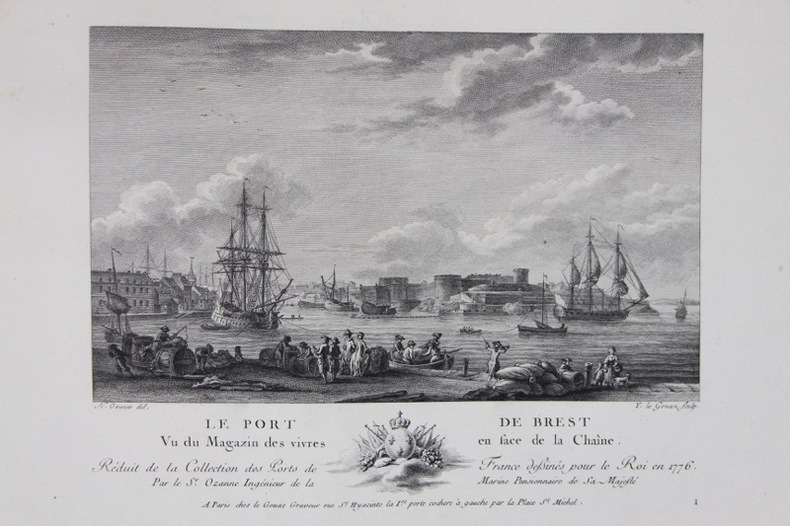
179151808P., Le Gouaz, sd 1791 Suite de 75 planches oblong 21,5 X 32 cm comprenant un titre gravé, une carte pour la collection, 55 sur les 60 vues de la collection manquent les n 54 à 58, la carte de la collection, une suite additionnelle de 18 planches de vues élargies et différentes provenant de la Collection des vues des rades de France et des ports des colonies. Humidité angulaire pour l’ensemble de la série, de légère à marquée, sans atteinte aux gravures de la série principale, avec légère atteinte pour la série de vues élargie. La planche de titre est roussie, poussiéreuse et effrangée, une planche est unif. brunie Camaret. L’ensemble sous chemise factice. En l’état.
1819143871819 Bruxelles, Editions du Nord, (18 novembre 1936), 2 vol. : - in-8° (254 x 187 mm) (texte) et in-folio (383 x 285 mm) (suites) plein maroquin prune, plat supérieur orné de la silhouette d'une femme nue filetée dorée, dos à nerfs, filets dorés sur les coupes et remplis, tête dorée, doublure bordée de maroquin orné dun jeu de 5 filets dorés, gardes et doubles gardes de même papier marbré, couvertures et dos conservés, sous étui bordé, de 191 pp. - (2) ff. (table et achevé dimprimer). - in-folio en œ maroquin prune à coins, dos à nerfs, filet doré bordant les plats, étui. Les deux reliures ont été exécutées par Georges Dubois d'Enghien.Dos insolés, beaux exemplaires par ailleurs
14353Lavis d'encre brune signé en bas à droite. En feuille Très bon 50 x 66 cm
21-EFo.J. Bleistift, auf chamoisfarbenem Bütten mit Wasserzeichen: bekröntes Wappen mit Posthorn und den Initialen ?KM?, rechts unten bezeichnet ?Kochelsee?. 23,2:39,4 cm. - Einriß und kleine Randläsuren sorgfältig restauriert.
18-EFo.J. Bleistift, auf cremefarbenem Velin, unten bezeichnet ?bey Abach an Donau?. 21,4:35,6 cm. - Verso: Blick auf Kelheim an der Donau. Bleistift, rechts unten bezeichnet ?Donau Kellheim?. - Mit mehreren Braunflecken verso. [2 Warenabbildungen]
196565211Bruxelles 9 janvier 1965 | 13.50 x 20.50 cm | deux pages sur un feuillet
RF1353<p><b>Original Watercolors on Native American Civilizations: </b></p><p><b>Mayas Aztecs and Incas.</b></p><p>176 ILLUSTRATIONS FROM THE SERIES "CIVILIZACIONES AMERICANAS" - WATERCOLORS AND ACRYLIC ON ACETATE. Various sizes.</p><p>UNIQUE: We present the originals that were used in Spain for informative publications of three Native American civilizations: MAYAS 54 images AZTECAS 54 images and INCAS 64 images. Made for pedagogical purposes they are of great interest from different points of view youth educational history American native civilizations in addition to being noted for their beauty.Ideal for research</p>
064-Do.J. Schwarze Kreide, braun laviert, auf Bütten, rechts unten mit dem braunen Pinsel gemalte Signatur ?Schüz?, auf Sammlungsuntersatz des 18. Jahrhunderts montiert. 25,3:34,5 cm. Literatur: Ph. F. Gwinner, Kunst und Künstler in Frankfurt am Main... Frankfurt am Main, J. Baer, 1862, p. 313ff.
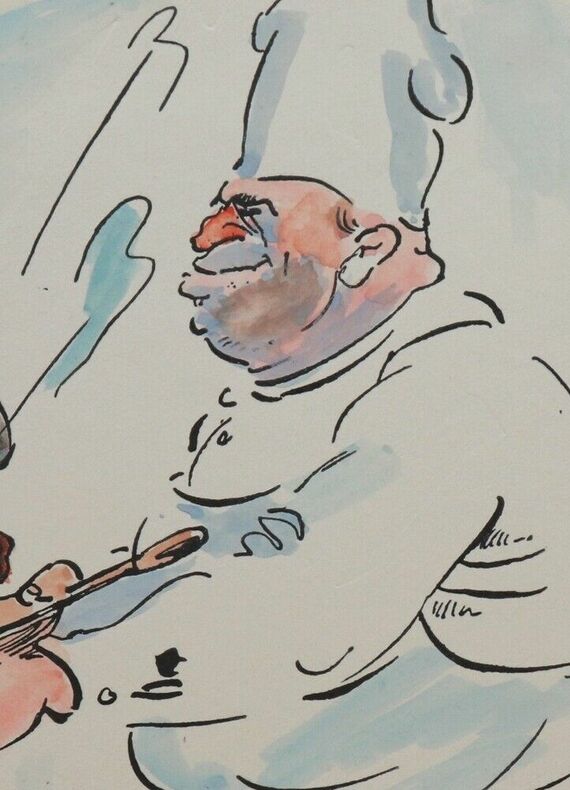
1940AMO-4517Vers 1945 Voici la liste et la taille des dessins : - Mon curé dans les bois (environ 24 x 22,5 cm) - Mon curé chez les riches (environ 19 x 19 cm) - [Les gymnastes] (avec légende que nous ne comprenons pas) (environ 23 x 18,5 cm) - [Enculine Paris] (texte dans le dessins) (environ 21 x 20 cm) * ce dessin n'est pas montré dans cette fiche - Derrière la scène (environ 19 x 18,5 cm) - L'affaire ... légendée au crayon en dessous La vengeance du juif (environ 21 x 19,5 cm) ** ce dessin daterait la série de l'année 1945 - Cuisine bourgeoise (environ 18 x 16 cm) - Education spirituelle (environ 17,5 x 15 cm) - ... du nègre (environ 16,5 x 16 cm) *** nous ne lisons pas le premier mot avec certitude - Vive la lieberté (environ 17,5 x 17,5 cm) ** ce dessin daterait la série de l'année 1945 - Mon curé chez les pauvres (environ 21,5 x 19,5 cm) * ce dessin n'est pas montré dans cette fiche - Séduction (environ 25 x 20 cm) * ce dessin n'est pas montré dans cette fiche Chaque dessin a une forme différente, soit rectangulaire, soit carré, soit avec des pans coupés. Ces dessins sont sur papier bristol blanc. Excellent état de l'ensemble des dessins. Ces dessins se trouvaient depuis tout ce temps conservés dans une enveloppe de papier kraft accompagnés d'un billet autographe de l'éditeur parisien René Kieffer. Dans ce billet d'instruction René Kieffer s'adresse à son photograveur en ces termes : "Toute la série. Des dessins au crayon doit être en simili détourée comme vous avez fait le dernier. Signé René Kieffer. Même réduction. Très soigné (au crayon). [un mot illisible à droite]. Ce billet est rédigé au verso d'une photogravure d'un dessin par Jacques Touchet.
273-Eo.J. Feder in Grau und Braun, braun laviert, über Bleistift, auf cremefarbenem Velin. 29,7:41,7 cm. Wahrscheinlich gehört diese Zeichnung zur ?Voyage pittoresque de Basle à Bienne par les Vallons de Mottiers-Grandval? im Rahmen der Birstal-Reisebeschreibungen, ab 1802 im Eigenverlag erschienen, die im Katalog zur Baseler Ausstellung 1998 in mehrere Kategorien eingeteilt wird. Unsere Zeichnung gehört zur Kategorie 5: Darstellung kleiner und kleinster Landschaftsausschnitte mit kleinen Wasserfällen, Felsblöcken, Einzelbäumen, Baumgruppen, Kräutern, Astwerk, Wurzeln. ?Der Maler wirft seinen Blick nicht von oben auf die darzustellenden Gegenstände, er betrachtet sie von der Seite oder von unten her. Sehr häufig setzt er sich direkt ans Flussbett. Diese Tafeln sind eine der Besonderheiten der Birmann?schen Voyage Pittoresque. Ihre Motive sind fast ausnahmslos nur von Birmann, vor oder nach ihm von keinem andern Maler, dargestellt worden. Dadurch erhält das Werk einen unverwechselbaren Charakter? (zitiert aus: Ausst. Katalog: Peter und Samuel Birmann. Künstler, Sammler, Händler, Stifter, Basel 1998, S. 49).
205-Do.J. Pinsel in Braun, braun laviert, über Bleistift, auf Bütten. 28,3:40 cm. - Mit einem Braunfleck im Bereich des oberen Brunnenrandes. Provenienz: Sammlung SRH im Dreieck mit einer Schale (Wiener Sammlung), nicht bei Lugt; Sammlung Anton Schmid, Wien, nicht bei Lugt; Sammlung Helmut Märkt, Reutlingen; Galerie Sabrina Förster, Düsseldorf, Herbstkatalog 2006/2007, Nr. 33 mit Abb. Gutachten: Dr. George Knox, Vancouver (29.06.2006).
37-EFo.J. Feder in Braun, auf Bütten mit Wasserzeichen: bekrönter Wappenschild mit Adler und den Initialen ?GM?, unten von fremder Hand falsch bezeichnet ?Perugia Assisi?. 21,1:30,1 cm. - Geringfügig stockfleckig.
40-EFo.J. Bleistift, auf dünnem Bütten. 30,3:30,7 cm. - Insgesamt etwas stockfleckig, zwei dünne Stellen im Randbereich.
206-Do.J. Feder in Braun, braun laviert, über Bleistift, mit brauner Feder umrandet, links signiert und datiert ?CLabruzzi 1796?. 22,8:18,7 cm. Auf alten Sammlungsuntersatz mit grün laviertem Rand aufgezogen. Vergleichsliteratur: Ausst. Katalog: Carlo Labruzzi. The Grand Tour. Cur. by Sir Timothy Clifford. Simon C. Dickinson Ltd., London, 12 Juni - 13 July, 2012, Nr. 38, Venustempel in Bajae (Vergleich zur Signatur); Auktion Pandolfini Casa d?Aste, Florenz, 15.12.2014, Stampe e Disegni dal XVI al XX secolo,? Nr. 56 Figure di Carlo Labruzzi. Aquatinta, 1788; Auktion Koller, Zürich, 18.09.2015, Zeichnungen des 15.-20. Jahrhunderts, Nr. 3418 Zwei Mönche im Gespräch. Zeichnung.
281-Eo.J. Bleistift, weiß gehöht, auf graugrünem Papier, rechts unten signiert, bezeichnet und datiert ?Preller fe. Roma, d. 2. Januar 1860?, links unten bezeichnet ?Domenico Antonio Murgiotti di Picinescu.?, unten mittig alter handschriftlicher Besitzvermerk mit zartem Bleistift ?Elise Sigismund. Weimar d. 6. Sept. 1881?. 44,5:35 cm. Entlang des linken Randes leichte Papierverfärbung, wahrscheinlich ein Wasserrand.
682014 sheets ranging from 2000 x 377 mm. to 670 x 385 mm. the 12 drawings to 567 x 380 mm. the furnace plus the wrapper. All on fine thin paper. Japan: ca. 1855-63.<br/> <br/> With the first demonstration of steam power in Japan thanks to Commodore Perry’s visit in July of 1853 the feudal domains immediately began to organize the construction of a fleet of large Western-style warships. By the August 1853 arrival in Nagasaki of the Russian Admiral Yevfimy Putyatin who gave a demonstration of a steam engine on his ship the Palladia. Hisashige Tanaka 1799-1881 the founder of the future Toshiba Corporation and the “Thomas Edison of Japan†promptly copied these models and built Japan’s first steam engine. The first steam-powered warship to enter the Japanese navy was the Kanko Maru given by the Dutch government in 1855. Western naval technologies were quickly assimilated; the earliest Japanese steam-powered warships were based on Dutch shipbuilding manuals and with direct assistance from Dutch representatives. In 1863 Japan completed is first domestically built steam warship the Chiyodagata. Following the humiliations at the hands of foreign navies in the Bombardment of Kagoshima in 1863 the shogunate began to rely more on French and British warship technologies.<br/> <br/> The large drawing of the steam engine and its parts is captioned in trans.: “The steamship’s measurements: length is ca. 50 meters width is ca. 11 meters and depth is ca. 7 meters. Steam engine’s structure and the parts described with measurements.†From right to left we see about thirty of the parts of the steam engine often with katakana labels and measurements the latter written in red ink. On the farthest left of this sheet is a remarkable and fine drawing 770 x 380 mm. in brush with wash in various grays yellow and pink of the assembled engine.<br/> <br/> On the first leaf of the series of 12 numbered sheets of drawings of the naval architecture of the proposed warship a label pasted-on states in trans.: “The 12 sheets of illustrations are copies of red-haired origin of the ship.†These sheets contain hundreds of drawings many heightened with gray wash and many with specific measurements of various aspects of the ship’s design in preparation for construction. Included are numerous depictions of the hull deck bulkheads rudders winches and gears from different viewpoints and of structural and strengthening elements with many manuscript labels in katakana of Dutch terms.<br/> <br/> There is some worming on the sheets which does touch some drawings and characters but it is not offensive. unknown
682014 sheets ranging from 2000 x 377 mm. to 670 x 385 mm. the 12 drawings to 567 x 380 mm. the furnace plus the wrapper. All on fine thin paper. Japan: ca. 1855-63. With the first demonstration of steam power in Japan thanks to Commodore Perry's visit in July of 1853 the feudal domains immediately began to organize the construction of a fleet of large Western-style warships. By the August 1853 arrival in Nagasaki of the Russian Admiral Yevfimy Putyatin who gave a demonstration of a steam engine on his ship the Palladia. Hisashige Tanaka 1799-1881 the founder of the future Toshiba Corporation and the "Thomas Edison of Japan" promptly copied these models and built Japan's first steam engine. The first steam-powered warship to enter the Japanese navy was the Kanko Maru given by the Dutch government in 1855. Western naval technologies were quickly assimilated; the earliest Japanese steam-powered warships were based on Dutch shipbuilding manuals and with direct assistance from Dutch representatives. In 1863 Japan completed is first domestically built steam warship the Chiyodagata. Following the humiliations at the hands of foreign navies in the Bombardment of Kagoshima in 1863 the shogunate began to rely more on French and British warship technologies. The large drawing of the steam engine and its parts is captioned in trans.: "The steamship's measurements: length is ca. 50 meters width is ca. 11 meters and depth is ca. 7 meters. Steam engine's structure and the parts described with measurements." From right to left we see about thirty of the parts of the steam engine often with katakana labels and measurements the latter written in red ink. On the farthest left of this sheet is a remarkable and fine drawing 770 x 380 mm. in brush with wash in various grays yellow and pink of the assembled engine. On the first leaf of the series of 12 numbered sheets of drawings of the naval architecture of the proposed warship a label pasted-on states in trans.: "The 12 sheets of illustrations are copies of red-haired origin of the ship." These sheets contain hundreds of drawings many heightened with gray wash and many with specific measurements of various aspects of the ship's design in preparation for construction. Included are numerous depictions of the hull deck bulkheads rudders winches and gears from different viewpoints and of structural and strengthening elements with many manuscript labels in katakana of Dutch terms. There is some worming on the sheets which does touch some drawings and characters but it is not offensive. unknown books
196087769s.d. (ca 1960) | 15 x 21.20 cm | en feuilles
222-Do.J. Feder in Braun, teils laviert, auf Bütten, auf China aufgezogen. 14,2:9,2 cm.
113-Do.J. Aquarell und Feder in Grau, auf Bütten mit Wasserzeichen: C & I Honig (vgl. W.A. Churchill, Watermarks in Paper. Nieuwekoop de Graaf Publishers, 1990 (Reprint), Nr. 99), links unten signiert und datiert "(D)uncker del: 1775". 27,8:21,8 cm. - Löchlein innerhalb der Darstellung restauriert, rechte untere Ecke ergänzt. Provenienz: Hess. Privatbesitz.
296-Wo.J. Aquarell über Bleistift, mit schwarzer Tuschlinie umrandet, Darstellung oben rundbogig geschlossen, auf cremefarbenem Velin, rehts unten mit Bleistift monogrammiert und datiert ?M. E. September 1839?. Darstellungsgröße 20,5:13,3 cm, Blattgröße 26:19 cm. - Papier leicht vergilbt. Literatur: Nicht im WV von S. von Blanckenhagen in: F. W. Fischer, Marie Ellenrieder. Leben und Werk der Konstanzer Malerin. Konstanz/Stuttgart, 1963. Charakteristische Arbeit der Künstlerin, entstanden während der 2. Italienreise 1838-1840, bei der sie von ihrer Schwester Josephine und einem Dienstmädchen begleitet wurde. Über diese Zeit berichtet Bärbel Kovalevski in: Marie Ellenrieder 1791-1863. Kleine Galerie. Berlin, Selbstverlag 2008, S. 42, ?Die Belastung in psychischer und physischer Hinsicht führten dazu, dass sie sich während der zweiten Italien-Reise nie so frei und glücklich fühlte, wie sie es sich in ihren Vorstellungen gewünscht hätte: Kraft und neuen Mut zu gewinnen zu weiteren größeren Aufgaben im künstlerischen Schaffen war ihr Ziel. Aber Marie Ellenrieder kehrte 1840 in die Heimat zurück, ohne den ersehnten Auftrieb und die Stärkung ihrer Kräfte erhalten zu haben. Dabei war der zweite Aufenthalt von Marie Ellenrieder in Rom von Ehrungen begleitet. Bedeutende Persönlichkeiten besuchten ihr Atelier, wie der König Ludwig von Bayern. Sie wurde am 16.4.1840 in die Congregation dei Virtuosi al Panteon aufgenommen und wird am 6.2.1841 als korrespondierendes Mitglied aufgeführt. Auch an den Ausstellungen der deutschen Künstler im Januar 1839 und am 16.3.1840 nahm sie teil.?
11-EFo.J. Bleistift auf chamoisfarbenem Velin. 23,8:32,5 cm. - Durchgehend leicht braunfleckig, zwei Löchlein sorgfältig geschlossen.
20-EFo.J. Bleistift, auf gelblichem Velin, links bezeichnet ?Starenberg? (sic!). 25,3:34,6 cm. - Leicht fleckig.