Zagorodnjaja I.A.MareMagnum

15 963 résultats
(Codice BM/0275) In 8° (cm 27,5) 279 pp. Presenta 106 antichi gioielli e oggetti preziosi del tesoro imperiale, 186 foto a colori con accurate schede descrittive. Dedica al frontespizio. Brossura editoriale illustrata. Ottimo stato. ~~~ SPEDIZIONE IN ITALIA SEMPRE TRACCIATA
1774ZB259278Roma: Per Giovanni Bartolomicchi 1774. Part 1 only; 12mo xi 1 327 pp later plain paper wrappers soiled and chipped previous owner's name on title text very good and an untrimmed copy. - If you are reading this this item is actually physically in our stock and ready for shipment once ordered. We are not bookjackers. Buyer is responsible for any additional duties taxes or fees required by recipient's country. Photos available upon request. Roma: Per Giovanni Bartolomicchi, unknown
2017100060501Wagram 2017 13x14x1cm. 2017. CD.
Madrid, Espasa-Calpe, 1972. 4to.; XXX pp., 222 pp. Cubiertas originales.
México, Editorial Séneca, 1940 ("Primavera y Flor"). 4to. menor, 147 pp., 3 hs. Cubiertas originales.
193513086AB(um, 1935. Schön illustrierter Leinenband. + Wichtig: Für unsere Kunden in der EU erfolgt der Versand alle 14 Tage verzollt ab Deutschland / Postbank-Konto in Deutschland vorhanden +
193513086AB(um 1935 Schön illustrierter Leinenband.
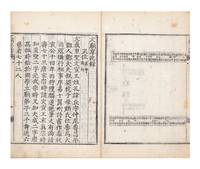
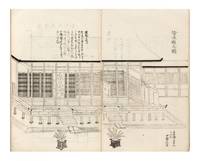
9430Four leaves of illus. 30 folding leaves. Large 8vo 305 x 208 mm. orig. yellow semi-stiff wrappers upper wrappers somewhat soiled both wrappers with some worming new stitching. Korea: 1765.<br /> <br> <br> <br /> First edition of this book published on royal command by King YÅngjo of ChosÅn. The book was compiled by Kim Kwi-ju 金龜柱 1740-86 the older brother of Queen Consort ChÅngsun 1745-1805. The royal Preface is furthermore written in Kim’s standard script calligraphy. Years after the compilation of this book factional intrigue under YÅngjo’s successor ChÅngjo led to Kim being exiled after which he soon died.<br /> <br> <br> Our book outlines sacrifices at the Confucian temple in Seoul including the KyesÅng å•“è–ç¥ and SongjÅl å´‡ç¯€ç¥ shrines. The KyesÅng shrine built in 1669 was the site of sacrifices to the fathers of several Confucian sages including Confucius and Mencius. At the temple as a whole a number of Chinese and Korean Confucian sages and worthies were worshipped. The book contains illustrations outlining the layout of the shrines with the placement of the tablets for the various Confucian scholars marked with their names.<br /> <br> <br> The royal Preface is dated 1765. Ordering the compilation of a record of past exemplars apparently made the king reflect on his own character and actions. He wrote “when I with my shallow learning recite the writings of the sages and worthies but remain unable to learn the Way of the sages and worthies and when I admire the deeds of the sages and worthies but cannot act in their manner it is like knowing what something tastes like but not get to eat it or like knowing the road but being unable to follow it. Even though I might laugh at people of the past why would people of the future not laugh at me tooâ€<br /> <br> <br> Minor worming mostly marginal towards end. See WorldCat 855527023 for a digital copy. unknown
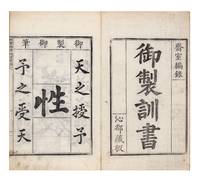
942941 folding leaves. Large 8vo 337 x 206 mm. orig. semi-stiff wrappers new stitching. Korea: Simdo æ²éƒ½ 1756.<br /> <br> <br> <br /> First edition and rare; WorldCat lists only one printed copy at Berkeley. This book of exhortations on good government with striking royal calligraphy was written by King YÅngjo or Yeongjo of ChosÅn 1694-1776 in 1756. At this time YÅngjo was commemorating the death of his father the previous king. According to Fang Chaoying 1908-85 YÅngjo then in his 65th year “could not foresee that he was to live twenty more years and so it appears that he was trying to justify himself in his own mind with regard to posterity as well as to the ancestors whom he expected to face any day†The Asami Library 115. YÅngjo offered three main principles for a king to follow: “to venerate Heaven to love the people and to treat the officials with respect†ibid.<br /> <br> <br> Large standard script characters written by the king himself are reproduced in the beginning of the book. The king’s brush records Confucian assertions such as “the following of human nature is called the Way / the cultivation of the Way is called instruction.†Accepting the Mencian dictum that human nature is inherently good the king continues: “I possess the good human nature / to realize the bright mandate of Heaven.â€<br /> <br> <br> The main text of the book is reproduced in the handwriting of the important scholar-official SÅ MyÅng-Ång or Seo Myeong-eung å¾å‘½è†º 1716-87. SÅ wrote in many genres and had a cosmopolitan outlook. For example he wrote a Preface to one of the major multilingual lexicographical works produced in ChosÅn in the 18th century see Söderblom Saarela “Mandarin over Manchu†379-80.<br /> <br> <br> Very fine and fresh copy beautifully printed.<br /> <br /> <br> <br> References<br /> <br> <br> Fang Chaoying. The Asami Library: A Descriptive Catalog. Edited by Elizabeth Huff. Berkeley: University of California Press 1969.<br /> <br> <br> Söderblom Saarela MÃ¥rten. “Mandarin over Manchu: Court-Sponsored Qing Lexicography and Its Subversion in Korea and Japan.†Harvard Journal of Asiatic Studies 77.2 2017. unknown
ria9780750701587_inpHardcover. New. New Book; Fast Shipping from UK; Not signed; Not First Edition; First published in 1993. The purpose of this book is to help those who help others. Research has consistently demonstrated that those in the professions particularly helping professions have significantly higher levels of stress and b hardcover
1993Q-0750701587The Falmer Press 1993-02-01. Hardcover. New. In shrink wrap. Looks like an interesting title! The Falmer Press hardcover
A9780750701587Hardback. New. "Burnout" and "stress" are recognizable words to individuals in the teaching profession. Based on analysis of the psychological needs of teachers this book aims to provide insights into the nature of stress and burnout outlining a programme for dealing with these issues. hardcover
1993DADAX0750701587Routledge 1993-02-16. 1. hardcover. New. 6.29x0.89x9.46. Buy with confidence. Excellent Customer Service & Return policy. Routledge hardcover
6506396Pearson Education pp. 304 1st Edition . Hardback. Used. Pearson Education hardcover
softcover, 224 pages, Illustrated. 26.25cm. ISBN 9782080136312. Showcases jewelry pieces by the designer best known for his glass works, noting his influence on the art nouveau style, use of mythological beings in his art, and material selection. Original.
1999500057386CHERCHE MIDI 1999 199 pages 15 4x1 8x23 4cm. 1999. Broché. 199 pages.
19592090202120403424Kisetsufu shoten 1959. Soft Cover. Fine. Number of books: 1 Kisetsufu shoten paperback
1980KOS01207212Bunshu shunshu NEW 1980. Soft Cover. Fine. KOS01207212 Bunshu shunshu NEW paperback
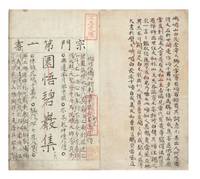
7036Printed in Chinese with Japanese reading marks. 11 columns per page 21 characters per column. 79; 59; 51; 49; 67 folding leaves. Ten parts in five vols. 8vo 240 x 149 mm. orig. brown wrappers new stitching. Japan: mid-Muromachi ca. 1440-50. An extremely rare and important "mid-Muromachi" Gozan-ban edition of The Blue Cliff Record in Chinese: Pi yen lu a collection of Chan Buddhist koan. These were verbal tests used to practice or test a student's progress in Zen compiled in the Song Dynasty and expanded by the great Northern Song Chan master Yuanwu Keqin 1063-1135 abbot of Tianning Wanshou Chan Monastery in Beijing. The text was first printed in China in 1125 or 1128 and has long been celebrated for both its startling beauty and profound complexity. Around 1140 one of Yuan Wu's successors Ta Hui destroyed the printing blocks and copies of the Pi yen lu because the work's rapid and widespread popularity made him fear that its beauty of expression would distract its readers from seeking enlightenment directly within themselves. The text was brought back from China by Dogen 1200-53 the Japanese Buddhist priest who was a founder of the Soto school of Zen in Japan. He had studied in China for four or five years and returned to stay at the Kenninji temple where he introduced many texts. This text was first printed in Japan about 1336-50 early-Nanbokucho by Gyokuho Shorin at the Kenninji; there is a copy at the National Diet Library. Our edition is a reprint of that first Japanese edition using the same woodblocks with minor changes. A later edition appeared in the Donald and Mary Hyde sale lot 65. "For some time Chan monks had been in the habit of extracting snippets from the 'records' yulu of past masters isolated them as 'ancient precedents' and commenting on them sometimes in verse sometimes in prose. By the mid-eleventh century the core situation was known as a 'case to be investigated' or a gong'an. The process was incremental and difficult to stop. Yuanwu's Emerald Cliff Record for example took a previous eleventh-century collection entitled Master Xuetou's verses on a hundred old cases and added an introduction and extensive commentary to each 'case' sometimes also dropping in comments on the appositeness or more usually inappositeness of the relevant verse so becoming in his turn 'magistrate.' A gong'an collection therefore reveals many layers all of them dedicated to undercutting the stability of language while at the same time playing a complex game of competing authorities. Herein lies their fascination."-Richard Bowring The Religious Traditions of Japan Cambridge U.P. p. 301. "Gozan-ban is a general term embracing all those books published by monks of the Zen sect chiefly at the five Zen monasteries at Kamakura and the five at Kyoto over a period of more than 200 years between mid-Kamakura and late Muromachi. The appearance of the printed page in most Gozan editions follows a distinctly Chinese style. The effect is somewhat dense and crowded caused by packing the Chinese characters tightly together with more regard for economy of space than for aesthetic effect. In this the Gozan editions differ markedly from all other early Japanese printed books which are more generously spaced. The reasons for this are twofold: the books tend to be chiefly reprints of Chinese song and Yuan editions and during the fourteenth century many Chinese blockcutters came over from the continent and practised their craft of a semi-commercial basis and on a fairly large scale."-K.B. Gardner "Centres of Printing in Medieval Japan: late Heian to early Edo period" in British Library Occasional Papers 11. Japanese Studies ed. by Yu-Ying Brown London: 1990 p. 164. PROVENANCE: This copy has the seals of Hirokata Yashiro 1758-1841 "Shinobazu Bunko"; Awa no Kuni Bunko; and Goroza Uchino b. 1873 "Kyotei Bunko". It later belonged to the great collector and bibliographer of early Japanese books Kazuma Kawase 1906-99 and has his seal. The chitsu has Kawase's manuscript title label stating in trans.: "Gozan-ban. Hekiganroku. Mid-Muromachi edition. Shinobazu Bunko provenance. Kazuma put the title on this label" also with his seal. There are four Prefaces: the first is undated the second dated 1300 the third dated 1305 and the fourth is dated 1304. Two leaves of manuscript probably written by Yashiro have been inserted at the beginning of Vol. I. They provide a commentary and a sort of title-page the work was issued without a title. Following Part I there are another two leaves of manuscript relating to this text. Following the tenth part are five Afterwards dated 1125 undated 1302 1317 and 1317. In fine condition all contained in a modern wooden box. The top of the box has been covered in a most attractive silk brocade. A few natural paper flaws and minor staining. Berkeley has an edition of this text but because of the very vague WorldCat cataloguing it is impossible to tell which exact edition it is. ❧ Kornicki Language Scripts and Chinese Texts in East Asia p. 245. unknown books
7036Printed in Chinese with Japanese reading marks. 11 columns per page 21 characters per column. 79; 59; 51; 49; 67 folding leaves. Ten parts in five vols. 8vo 240 x 149 mm. orig. brown wrappers new stitching. Japan: mid-Muromachi ca. 1440-50.<br/> <br/> An extremely rare and important “mid-Muromachi†Gozan-ban edition of The Blue Cliff Record in Chinese: Pi yen lu a collection of Chan Buddhist koan. These were verbal tests used to practice or test a student’s progress in Zen compiled in the Song Dynasty and expanded by the great Northern Song Chan master Yuanwu Keqin 1063-1135 abbot of Tianning Wanshou Chan Monastery in Beijing. The text was first printed in China in 1125 or 1128 and has long been celebrated for both its startling beauty and profound complexity. Around 1140 one of Yuan Wu’s successors Ta Hui destroyed the printing blocks and copies of the Pi yen lu because the work’s rapid and widespread popularity made him fear that its beauty of expression would distract its readers from seeking enlightenment directly within themselves.<br/> <br/> The text was brought back from China by Dogen 1200-53 the Japanese Buddhist priest who was a founder of the Soto school of Zen in Japan. He had studied in China for four or five years and returned to stay at the Kenninji temple where he introduced many texts.<br/> <br/> This text was first printed in Japan about 1336-50 early-Nanbokucho by Gyokuho Shorin at the Kenninji; there is a copy at the National Diet Library. Our edition is a reprint of that first Japanese edition using the same woodblocks with minor changes. A later edition appeared in the Donald and Mary Hyde sale lot 65.<br/> <br/> “For some time Chan monks had been in the habit of extracting snippets from the ‘records’ yulu of past masters isolated them as ‘ancient precedents’ and commenting on them sometimes in verse sometimes in prose. By the mid-eleventh century the core situation was known as a ‘case to be investigated’ or a gong’an. The process was incremental and difficult to stop. Yuanwu’s Emerald Cliff Record for example took a previous eleventh-century collection entitled Master Xuetou’s verses on a hundred old cases and added an introduction and extensive commentary to each ‘case’ sometimes also dropping in comments on the appositeness or more usually inappositeness of the relevant verse so becoming in his turn ‘magistrate.’ A gong’an collection therefore reveals many layers all of them dedicated to undercutting the stability of language while at the same time playing a complex game of competing authorities. Herein lies their fascination.â€â€“Richard Bowring The Religious Traditions of Japan Cambridge U.P. p. 301.<br/> <br/> “Gozan-ban is a general term embracing all those books published by monks of the Zen sect chiefly at the five Zen monasteries at Kamakura and the five at Kyoto over a period of more than 200 years between mid-Kamakura and late Muromachi. The appearance of the printed page in most Gozan editions follows a distinctly Chinese style. The effect is somewhat dense and crowded caused by packing the Chinese characters tightly together with more regard for economy of space than for aesthetic effect. In this the Gozan editions differ markedly from all other early Japanese printed books which are more generously spaced. The reasons for this are twofold: the books tend to be chiefly reprints of Chinese song and Yuan editions and during the fourteenth century many Chinese blockcutters came over from the continent and practised their craft of a semi-commercial basis and on a fairly large scale.â€â€“K.B. Gardner “Centres of Printing in Medieval Japan: late Heian to early Edo period†in British Library Occasional Papers 11. Japanese Studies ed. by Yu-Ying Brown London: 1990 p. 164.<br/> <br/> PROVENANCE: This copy has the seals of Hirokata Yashiro 1758-1841 “Shinobazu Bunkoâ€; Awa no Kuni Bunko; and Goroza Uchino b. 1873 “Kyotei Bunkoâ€. It later belonged to the great collector and bibliographer of early Japanese books Kazuma Kawase 1906-99 and has his seal. The chitsu has Kawase’s manuscript title label stating in trans.: “Gozan-ban. Hekiganroku. Mid-Muromachi edition. Shinobazu Bunko provenance. Kazuma put the title on this label†also with his seal.<br/> <br/> There are four Prefaces: the first is undated the second dated 1300 the third dated 1305 and the fourth is dated 1304.<br/> <br/> Two leaves of manuscript probably written by Yashiro have been inserted at the beginning of Vol. I. They provide a commentary and a sort of title-page the work was issued without a title. Following Part I there are another two leaves of manuscript relating to this text. Following the tenth part are five Afterwards dated 1125 undated 1302 1317 and 1317.<br/> <br/> In fine condition all contained in a modern wooden box. The top of the box has been covered in a most attractive silk brocade. A few natural paper flaws and minor staining. Berkeley has an edition of this text but because of the very vague WorldCat cataloguing it is impossible to tell which exact edition it is.<br/> <br/> ⧠Kornicki Language Scripts and Chinese Texts in East Asia p. 245. unknown
39549London, New York, Frederick Warne and Co. ltd., ohne Angaben. 719 Seiten , 26 cm, Hardcover/Pappeinband
024453Does not appear to have a title page so the title "Acupuncture" is something I have added. Possibly the title page has been removed but I have no way of knowing. Several sections are credited to H. Grady Young. Several sections are: Historical Highlights of Acupuncture; Understanding Veterinary Acupuncture; The Principle of "Mutation of Energy"; The Great Law of Stimulation and Sedation of Energy; The Principle of Yin and Yang; etc. etc. etc. 10 tabs on page foredges have been added by a previous owner for ten parts of the body. 4to spiral bound 11" tall. 108 pages hand numbered in pen at upper right. Some sections have printed page numbers at bottom or at top as so: 6 4 25 31 6 3 2 2 pages plus many plates with pages unnumbered and also some pages unnumbered. No date however possibly from the mid 70s. A good deal of neat red highlgihting. Tightly bound. Good condition. . unknown
711427 folding leaves. 8vo 234 x 158 mm. orig. wrappers manuscript title label on upper cover new stitching. Japan: on final page in trans.: "Copied 1854 by Wakabayashi in today's Tottori Prefecture a member of the Shinshoken." Manipulative therapy has a long history in Japan. "Healing of the sick through rubbing of the body was known to the earliest Japanese physicians who brought the art to a high state of development. Massage was early pre-Nara period linked with the treatment of fractures and bandaging and remained one of the chief factors in the care of the body sharing with mineral baths acupuncture gymnastics and 'deep breathing' in the preliminary development of physical therapy in Japan.The achievements and learning in the practice of massage also contributed to the establishment in the latter part of the 17th century of the 'Seikotsu-Jutsu' which was a system of treatment for fractures and dislocations."-Mestler A Galaxy of Old Japanese Medical Books II pp. 484-85. Gento Yoshiwara d. 1800 was one of the three most important orthopedic specialists in Japan during the final years of the 18th century along with Bunken Kagami and Genka Ninomiya. Yoshiwara whose trade name or mark was "Kyoinsai" studied both Dutch medicine in Nagasaki and Chinese medicine and was greatly influenced by the Chinese Dao yin treatment of massage and exercise. Unlike the works of Kagami and Ninomiya Yoshiwara's most important work - "Seikotsu yoketsu" - remained in manuscript as it was restricted to students of Yoshiwara's school; the present manuscript contains a reworking of that text. The beginning of the main part of the text on the fifth leaf provides the name of Yoshiwara and the location of his school in Hizen province today's Nagasaki Prefecture and the name of two disciples Wada and Abe. The text describes 13 types of treatment in detail including treatments of dislocated shoulders fingers and jaws; spinal stretching dealing with hip problems etc. Many of these treatments have rather fanciful names: "Windmill" "Bear Hug" "Bird's Wing" "Control the Wind" "Crane Feather" "Playing with a Fish" "Worm" "Playing with a Jewel" "Tail of the Bird" "The Snail Method" "Riding on the Dragon" "Swallow's Tail" etc. Some relatively minor worming at the beginning and light marginal dampstaining. ❧ Mestler A Galaxy of Old Japanese Medical Books III p. 152. unknown books
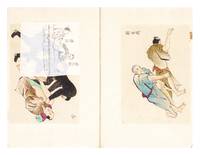
691531 finely hand-colored mounted drawings with eight fine black & white brush drawings on slips also pasted on. 36 folding leaves of which 20 are text. 8vo 253 x 180 mm. orig. patterned wrappers manuscript title label on upper cover new stitching. Japan: late Edo. Gento Yoshiwara d. 1800 was one of the three most important orthopedic specialists in Japan during the final years of the 18th century along with Bunken Kagami and Genka Ninomiya. Yoshiwara studied both Dutch medicine in Nagasaki and Chinese medicine being greatly influenced by the Chinese Dao yin treatment of massage and exercise. Unlike the works of Kagami and Ninomiya Yoshiwara's most important work - "Seikotsu yoketsu" - remained in manuscript as it was restricted to students of Yoshiwara's school Ninomiya was a student. Yoshiwara's trade name or mark was "Kyoinsai." Following the 20 leaves of manuscript text which describe 13 types of treatment in detail is a series of 31 finely drawn and hand-colored illustrations of treatments and manipulations including fixing dislocated shoulders fingers and jaws; spinal stretching dealing with hip problems etc. Many of these treatments have rather fanciful names: "Windmill" "Bear Hug" "Bird's Wing" "Control the Wind" "Crane Feather" "Playing with a Fish" "Worm" "Play with a Jewel" "Tail of the Bird" "The Snail Method" "Riding on the Dragon" "Swallow's Tail" etc. An additional eight smaller pasted-on black & white drawings show further treatments. A number of pharmaceutical ointments and plasters are described. In fine and fresh condition although the outer upper corner of all the leaves has been a little nibbled by a mouse. The scribe of this manuscript has used one incorrect character when spelling Yoshiwara's name on the first leaf giving his name as "Yoshio." ❧ Mestler A Galaxy of Old Japanese Medical Books III p. 152. unknown books
Zaragoza, Institución Fernando el Católico, 1986. 4to. alargado; 175 pp., Con cuatro ilustraciones para la reproducción fotográfica de los textos. Cubiertas originales.