542 résultats
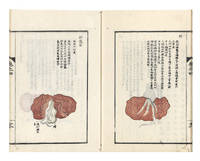
6006Numerous fine woodcut illus. 18 of which are finely handcolored. 48 irregularly paginated; 33; 39; 26; 28 3 folding leaves. Five vols. 8vo orig. wrappers some worming in upper margin of each vol. orig. block printed title label on each upper cover new stitching. Tokyo: Mankyudo Hanabusa Heikichi Preface dated 1810. First edition of one of the three most important early Japanese books on the history and technique of Chinese and Japanese acupuncture. This work is very different from all earlier Chinese and Japanese books on the subject. For the first time the illustrations are finely and realistically rendered and are anatomically accurate clearly influenced by European medical works which had circulated in Japan. Another important aspect of this book is that eighteen of the woodcuts each depicting organs of the body are finely handcolored. Also the body is described in full from head to foot and is not entirely dependent on the fourteen meridians. Kosaka was a court physician of the fiefdom of Kameyama who had studied under the famous physician Motonori Taki 1731-1801 who was himself a member of a distinguished family of doctors. The publisher of this work was the exclusive publisher for the government sponsored medical school. Very good set. unknown books
1972145005Burbank CA: Warner Brothers 1972. Original maquette demonstrating an early poster design for the 1973 film featuring a vintage silver gelatin photograph of the legendary streetlit scene of Father Merrin's first arrival to Georgetown in the film mounted to the poster.<br/><br/>A minimal design without the credits information seen in the completed original "purple style" poster variant and with a proposed but ultimately unrealized release date of Christmas Day shown at the bottom margin. This maquette compares both to the "purple style" poster in its use of said purple text but also to the original black and white "special poster" design both in size and compositional austerity. The "special poster" measured 25 x 19 inches as opposed to the standard 27 x 41 inches for the one sheet and stated nothing but the film's title and the stark photo of Father Merrin. <br/><br/>Based on the 1971 novel by William Peter Blatty and written for the screen by Blatty. One of the great genre films of the 1970s that accomplished the uncommon feat of being an over-the-top sensation upon its release and gaining subsequent status as a classic with a strangeness and depth supplied by Ellen Burstyn and Max von Sydow that only increases with repeated viewings. Another distinction was that it walked away with two Oscars including Best Screenplay for Blatty along with eight nominations including Best Picture a feat nearly unheard for a horror film. <br/><br/>Set in Washington DC and shot on location in Washington DC notably Georgetown University New York City and Mosul Iraq. <br/><br/>18 x 12.5 inches mounted on a 30 x 20 inch mat. Black with the vintage black and white photo of Father Merrin affixed at the center and a hand painted release date. Title letters are hand cut from purple paper and affixed in place. Good condition with water damage to the bottom three inches of the mat and with soil and loss of glue adhesion to the white mat. Archivally matted and framed in a museum-quality frame with UV glass.<br/><br/>National Film Registry. Clover "Men Women and Chainsaws. Warner Brothers unknown books
1938312786N.p.: Privately printed for the members of the Royal Guild of Wisconsin Fisherman 1938. First edition one of a very few copies known. Illustrations from photographs. vi 25 pp. 1 vols. 8vo. White printed wrappers stapled. Very good. Some minor wear. Green quarter morocco slipcase. First edition one of a very few copies known. Illustrations from photographs. vi 25 pp. 1 vols. 8vo. Rare. Salmon fishing during four days in the first part of July 1938 by a party of six who styled themselves the Royal Guild of Wisconsin Fishermen comprising: Evan A. Evans Louis M. Hanks Roy F. Tomlinson Theodore G. Montague William S. Kies and George I. Haight to whom authorship is attributed by the Wisconsin Historical Society. The last page of text records their catch by weights. Rare. Wetzel p. 171 tentatively ascribed to William Kies. "A rare work."; Bruns K-45 not seen; Bibliotheca Salmo Salar 105. OCLC 2 copies Princeton Wisconsin Historical Society Privately printed for the members of the Royal Guild of Wisconsin Fisherman] unknown books
16113462Latin manuscript on vellum with large 6 in diameter suspended black wax seal of James I of England and autograph of Anne of Denmark dated July 23 1610 granting title to Corrodownan Manor in County Cavan Ulster to one John Browne Gent. of Gorgiemill near Edinburgh and his descendants during the Plantation i.e. colonization of Ulster under James I beginning in 1609. The colonists were settled on land confiscated from the Irish inhabitants following the conquest of Ulster 1594-1603 under James's predecessor Elizabeth I. The Plantation was intended to consolidate royal control of Ulster and repress rebellion by importing a substantial Protestant population. Like John Browne and indeed James himself many of the new colonists were Scottish. Some of these families went on to form the backbone of the Protestant Ascendancy in the province. John Browne and his heirs however were not among them. Sir George Carew sent by the king in 1611 to report on the progress of the Plantation noted that "he Browne . sent an agent who took possession set the lands to the Irish returned to Scotland and . performed nothing." The land was sold in 1613 to another Scottish colonist Archibald Acheson. Acheson's descendants were raised to the peerage of Ireland in 1806 as Earls of Gosford and still owned the property in the late nineteenth century. The first nineteen lines of the document grant the Scottish Browne the rights and privileges of James's English and Irish citizens. Especially notable are the requirement that the grantee maintain an adequate supply of arms for defense against the king's enemies lines 77-80 the attempt to encourage the growth of towns 74-76 and the ban on sale of the property to "mere Irish" or to anyone who failed to acknowledge the sovereign as head of the church thus excluding all Catholics by swearing the Oath of Supremacy 114-121. See Rev. George Hill The Conquest of Ireland. An Historical Account of the Plantation of Ulster at the Commencement of the Seventeenth Century 1608-1620 Belfast 1877 308; idem Plantation Papers. Containing a Summary Sketch of the Great Ulster Plantation in the Year 1610 Belfast 1889 188-190; F.J. McCaughey Arvagh. Sources for a Local History Arvagh 1998 16.; Moiré chemise lined with exact recess for seal housed in handsome ruled red morocco clamshell case with gilt title to front cover and raised bands gilt particulars and decoration to spine; gilt rolled edges. Two leaves 65 x 81 cm; the first illuminated with a portrait of the king. Stain to upper left see image.; 65 x 81 cm; 1 pages; Signed by Notable Personage Related; All shipments through USPS insured Priority Mail. . hardcover books
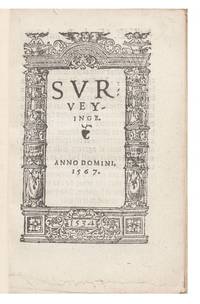
6566Title within architectural woodcut border incorporating the date "1534." Largely printed in black letter. 67 leaves 8 pp. Small 8vo antique calf by Sangorski & Sutcliffe spine gilt red leather lettering pieces on spine. London: Printed by H. Wykes 1567. An early edition of the first text on surveying printed in English. The first edition was printed by Richard Pynson in 1523; all early editions are rare as copies were used to death. Our copy is most unusual as it is fine and large with a number of lower edges uncut. Fitzherbert's book is concerned primarily with giving instruction to land stewards and overseers of the manor. The authorship of this work has long been disputed: was it Anthony Fitzherbert ca. 1470-1538 judge and legal writer or his older brother John d. 1531 The current scholarship supports John Fitzherbert as the more likely author. The book is "addressed to the landed interest and is an explanation of the laws relating to manors. Fitzherbert sets forth the relation between the landlord and the tenant with observations on their respective moral rights and mutual obligations to each other. The author is also concerned with the best means of developing and improving an estate to the advantage of both the lord and the tenant. "As defined by Fitzherbert the duties and functions of the surveyor were many and varied. In the preface he states that the surveyor should prepare his findings in a small book or put them on a large piece of parchment. This parchment or book should show the 'buttes' and 'bounds' of all the holdings as well as the leases grants and tenures. Along with this information he should state the number of buildings and their location and give a description of the lands specifying whether they are meadow grainland or woodland and by whom held. He should also record the value of all properties along with their rents and fines. The author then goes into considerable detail in giving the form for the preparation of this information. "The author states that the word 'surveyor' is from the French signifying an overseer and that the surveyor must appraise and make recommendations to the lord of the manor."-Richeson English Land Measuring to 1800: Instruments and Practices pp. 33-34. Fine copy. ❧ Fussell I p. 6-"contains a great deal of matter of service to farmers in particular as well as to the agricultural community in general." ODNB. hardcover books
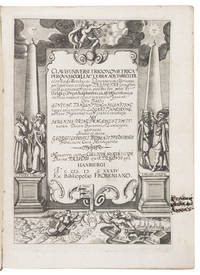
6761Finely engraved added title & numerous woodcut diagrams & printed tables in the text. Printed title in red & black. 9 p.l. incl. engraved title 323 184 pp. Two parts in one vol. Large 4to cont. vellum over boards covers nicely decorated with coats-of-arms in gilt & silver now oxidized on each cover a.e.g. ties gone. Hamburg: Frobenius 1634. First edition of this handsome and rare work on trigonometry by a student of Tycho Brahe. Frobenius 1566-1645 after studying in Tübingen and Wittenberg went in 1591 to the island of Hven where he intended to live and study with Tycho Brahe. Upon leaving he wrote a recently discovered memorandum see John Robert Christianson's On Tycho's Island. Tycho Brahe and His Assistants 1570-1601 which is full of "critical insight" on Tycho and his relationships with his students and assistants. Later Frobenius moved to Hamburg where he married well and became a leading printer publisher and bookseller of that city specializing in learned and scientific works. He wrote and self-published a number of works - like this one - a number of works on trigonometry astronomy and philology. The first part of the present book is devoted to spherical trigonometry as applied to astronomy and the text contains many references to Brahe and Longomontanus. The second part includes the famous trigonometric tables of Rheticus which first appeared in 1596. A very fine and large copy with the Nordkirchen bookplate. The attractive engraved title-page present here is usually missing ❧ Poggendorff I 809. Tomash & Williams F101. hardcover books
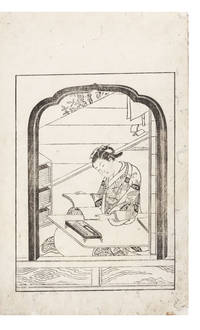
6330Edited by Yusuishi Tanaka. Woodcut frontis. & eight fine double-page woodcut illus. 21; 18 folding leaves. Two vols. Large 8vo orig. blue wrappers wrappers rather worn & rubbed orig. block-printed title labels on upper covers rubbed new stitching. Osaka Edo & Kyoto: 1749. First edition of this beautifully illustrated book; the fine woodcuts are by Sukenobu Nishikawa 1671-1750 or -51 or -54 who "counts among the foremost masters of so-called ukiyo-e primitive prints. His subject matter like that of his contemporaries revolved around images of women walking. These images are stylised lending the rhythmic movement of the sumptuous robes an almost sculptural effect. Nishikawa also did many book illustrations.Nishikawa founded a whole school and according to his family archives Harunobu 1725-1770 was a follower of his."-Oxford Art Online. This work is concerned with the education of women in its widest sense combining knowledge with taste. Four types of girls' "play" are described and illustrated; each providing instruction in behavior and ethics. The fine woodcut frontispiece depicts a young woman reading a book surrounded symbols of knowledge and refinement: bookshelves and brushes for calligraphy. Her clothes and hairstyle are appropriate. The first volume is concerned with dolls hina. In Japan dolls are not for play but have high spiritual value which offer girls preparation for adulthood and marriage. For the Japanese dolls are living creatures possessing heart and soul from which girls can learn discipline obedience and control. Nakanishi 1634-1709 was a scholar and writer on Shintoism and the present text was edited and posthumously published by Yusuishi Tanaka who has contributed a preface. The theme of the text is instructional and written for girls and young women: there are many references to texts essential for proper behavior and ethics. Nakanishi draws on the Nihon Shoki the oldest chronicle of Japan; Man'yoshu the eighth-century anthology of Japanese poetry; the Tale of Genji; and Makura no Soshi the famous Pillow Book. There are four fine double-page woodcut illustrations in the first volume. The first illustration depicts an upper-class woman sending her dolls away in a boat thereby sending her suffering away. The second illustration depicts the hinamatsuri doll festival with dolls arranged on shelves. The following illustration depicts a young woman facing her suitor her dowry behind her all are objects of knowledge and culture: a calligraphy set fine papers in a box picture scrolls books etc. The final illustration in this volume depicts an offering made to the sky referencing tanabata the star festival. According to legend the Milky Way separates two lovers; they are allowed to meet only once a year on the seventh day of the seventh lunar month of the lunisolar calendar. The second volume is concerned with kai-awase the Japanese shell-matching game. Again there are four fine double-page illustrations each filled with deep meaning. Matching the shells symbolizes the unity of partners in a marriage. There are many references to the Tale of Genji and Lady Murasaki; scenes from this novel were often used to illustrate the shells. One of the illustrations depicts the traditional card game called uta-garuta being played by several women. A very good set and rare. Some carefully repaired worming mostly confined to the margins. The lower outer corners of many leaves are "thumbed." ❧ Brown Block Printing & Book Illustrations in Japan p. 131. hardcover books
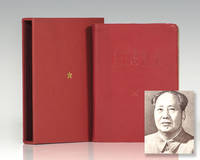
1964100159Beijing: Central Political Department of the Chinese People's Liberation Army 1964. First edition of Quotations from Chairman Mao. Duodecimo in the original iconic red vinyl title to front cover in blind frontispiece portrait of Chairman Mao. With the textual error on pp. 82/83 corrected and Lin Biao's calligraphic endorsement leaf after the frontispiece tipped in from a later printing. In 1972 an edict was issued that Lin's name was to be obliterated from history following disclosures that he had plotted a coup and planned to assassinate Mao; consequently "many surviving copies in the Chinese language have that page legitimately torn away mutilated or censored" Schiller p. 36. In near fine condition. Housed in a custom red slipcase. Printed for the General Political Department of the People's Liberation Army the first edition of Mao's Quotations was issued in two states and bindings: the uncorrected first state text in red vinyl plastic and the corrected second state in paper wrappers. The corrected copies issued in wrappers and intended for high-ranking officers were released first; the uncorrected copies issued in red vinyl and for use by brigade teams were released shortly afterwards as the sturdier binding took longer to manufacture. By the start of the Cultural Revolution in 1966 the red vinyl design had become symbolic of Mao's slogan "The East is Red" and the paper wrappers were discontinued. The year 1966 also "signaled the start of a major translation and publication project when the Little Red Book was issued in over 50 different languages of countries where Socialism might triumph" Schiller p. 55. The book was printed in large quantities until Mao's death in 1976; by the late 1970s however a change of government meant further circulation of the book was discouraged with millions of copies were collected and destroyed. His Little Red Book however sometimes referred to as the "Chinese Bible" "forms a brilliant compilation that is still readable and admired today for its political theories and strategies" ibid. p. 57. Central Political Department of the Chinese People's Liberation Army unknown books
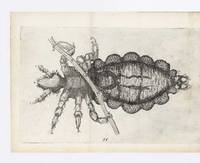
5444Added engraved title & 40 engraved plates three are folding. 1 p.l. 106 pp. one blank leaf. Small 4to cont. English panelled calf corners renewed rebacked some dampstaining in gutter at foot to first ten leaves. Rome: A. de Rubeis 1703. First separate edition originally published as the second part of the author's Observationes circa viventia 1691. Our edition - which is actually the original printing of the second part with a new title-page - is very rare with only one copy located by WorldCat. Buonanni 1738-1725 one of the most learned Jesuits of his time was a pupil of Athanasius Kircher and succeeded his master as teacher of mathematics at the Collegium Romanum. This work is one of the earliest Italian treatises on microscopy. It contains interesting observations on early microscopes and a precise description of Buonanni's own compound microscopes which are illustrated on two plates. The rest of the plates show objects seen through the microscope including a number of illustrations of insects. "The quality of his illustrations of various insects was excellent - particularly those of the fly louse mite flea and mosquito. Indeed his drawings of the Culex pipiens common house mosquito are the best of the seventeenth century."-D.S.B. II p. 591. Very good copy. Duplicate from the British Museum with their duplicate stamp dated 1787. Armorial bookplate of Sir John Ingilby Bart. 1758-1815 M.P. and Fellow of the Royal Society. ❧ Clay & Court The History of the Microscope pp. 84-86. Garrison-Morton 264-1st ed. of 1691. unknown books
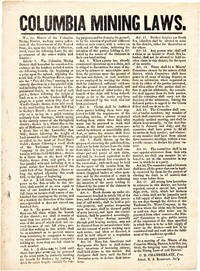
1853WRCAM46036Columbia Ca.: Gazette Print 1853. Broadside 10 3/4 x 8 inches. Printed in three columns. A bit of light foxing mostly in margins. Near fine. In a folding cloth clamshell case spine gilt. A rare broadside printing of the laws of the Columbia Mining District in California in 1853 created and enforced by the miners for their own self-government. The seventeen articles all deal with regulations for mining and claims. The first nine set out rules for making and operating claims. The next three address foreign ownership of claims. Article 10: "None but Americans and Europeans who have or shall declare their intentions of becoming citizens shall hold claims in this district." Article 11: "Neither Asiatics nor South Sea Islanders shall be allowed to mine in this district either for themselves or for others." Article 12 sets out a punishment for any miner who sells a claim to an Asian or a Polynesian. The final five articles set out rules for enforcing the laws including the creation of a Miners Committee and a system of binding arbitration. According to the text the laws were adopted "at a meeting of the Miners of the Columbia Mining District held Oct. 1st 1853." and the laws are signed in print by "C.H. Chamberlain Pres." and "R.A. Robinson Sec'y." <br> <br> "The item is of basic importance.as an example of how the California miners - or men beyond the reach of government anywhere else in our States and Territories for that matter - banded together and enacted and enforced codes of law for their own protection" - Eberstadt. The COLUMBIA GAZETTE which printed this broadside was according to Kemble the second newspaper to operate in Columbia starting operations in the fall of 1852. The first newspaper in the area the COLUMBIA STAR apparently printed only two or three issues in October-November of 1851 before the printing press was destroyed by vandals. <br> <br> Greenwood locates only three copies at the California Historical Society and the Bancroft Library and the Streeter copy which was sold at the Clifford sale in 1994. Rocq lists a copy at the Huntington Library. OCLC adds copies at Yale Library of Congress University of California at San Diego Stanford and DeGolyer Library at Southern Methodist University. A rare and interesting example of the search for order in the tumult of the gold rush. <br> <br> The Streeter copy sold to Howell for $550 in 1968. It later reappeared in the sale of California collector Henry Clifford in 1994. GREENWOOD 381. ROCQ 15427. EBERSTADT 131:105. STREETER SALE 2735. CLIFFORD SALE 26. OCLC 29876358. Gazette Print hardcover books
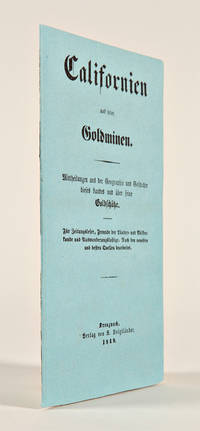
1849WRCAM52151Kreuznach: R. Voigtlander 1849. 32pp. Printed blue wrappers rear wrapper original front wrapper in facsimile. Small corner repairs to rear wrapper. Some foxing two ink stamps on titlepage. Else very good. In a half morocco slipcase and cloth chemise. The first edition of an exceedingly rare Gold Rush pamphlet printed in the hallowed year of that epochal event. "Like many guidebooks for Europeans this pamphlet gives general information on California's physical features history and 'Notes for Emigrants' on the gold discovery. The portion on California's gold riches consists primarily of an article reprinted from the KOELNER ZEITUNG of January 14 1849 which in turn summarizes R.B. Mason and others. The guide mentions the many German settlers in the Sacramento Valley and speaks proudly of Captain Sutter" - Kurutz. <br> <br> Only four institutions worldwide report a copy of this book: the California State Library the University of California at Berkeley Yale and the State Library in Berlin. It is even more difficult to encounter at auction this copy being the only one on record to pass through the rooms. COWAN II p.102. HOWES C43 "aa." KURUTZ 112. SABIN 9984. R. Voigtlander hardcover books
19047900Cleveland: The Arthur H. Clark Co. 1904 32 octavo volumes and large atlas. First edition. Very scarce. Number 555 of 750 complete sets SIGNED and numbered by the publisher. Edited with Notes Introductions Index etc. by Reuben Gold Thwaites. 32 octavo volumes large atlas. Each volume approx. 300 pages. Illustrated with plates from original sources; atlas with 81 plates by Karl Bodmer. All volumes bound in matching burgundy cloth gilt. 2 bookplates on inner cover of all volumes. Slight but even fading to volumes 14-31. Atlas is an ex-library binding. Last 2 volumes provide the index. With the exceptions noted a fine and complete set most volumes are unopened and unread. The large atlas contains 81 full-page plates by Karl Bodmer to illustrate Prince Maximilians travels volumes XXII XXIII and XXIV of the set. An extremely important collection of significant early travels and expeditions of exploration into the uncharted West reprinted from scarce original editions. Contains the journals of Brackenridge Bradbury Bullock De Smet Farnham Flagg Franchere Gregg James Long Maximilian Michaux Nuttall Pattie Ross Wyeth and others. The Arthur H. Clark Co. hardcover books
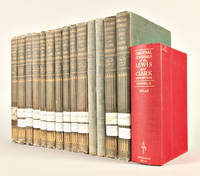
1905WRCAM52627New York: Dodd Mead & Company 1905. Seven volumes bound in fourteen parts plus atlas volume. Plates many in color facsimiles. Quarto. Original gilt green cloth. Octavo atlas maps laid in a red cloth drop-front box. Cloth somewhat worn particularly at spine ends. Library bookplates with withdrawal stamps on front pastedowns shelf labels on spines reference stamps across top edges. Some occasional offsetting from plates but generally clean internally. A solid set. Text volumes untrimmed. One of 200 large paper sets on Van Gelder paper with the atlas supplied from the reprint edition done by Argosy-Antiquarian Press. "The most elaborate work on this expedition" - Howes. A cornerstone of modern historical research printing for the first time many major primary documents which did not appear in the Biddle edition including the Floyd and Whitehouse journals and material from the Clark-Voorihis papers along with facsimile manuscripts maps portraits and other illustrative matter. Also valuable is Victor Paltsits' bibliography of the Lewis and Clark expedition in the first volume. "This edition is notable for its thorough Introduction covering the history of the expedition and earlier exploration and a detailed account of the original journals and their various editions.In its maps and numerous illustrations the Thwaites edition is an outstanding source of visual materials relating to the expedition" - LITERATURE OF THE LEWIS AND CLARK EXPEDITION. HOWES L320 "c." LITERATURE OF THE LEWIS AND CLARK EXPEDITION 5d.1. WAGNER-CAMP 13:7 note. TWENEY WASHINGTON 76. REESE BEST OF THE WEST 233 note. Dodd, Mead & Company hardcover books
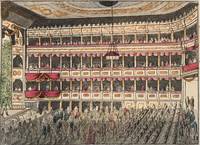
181210794Vienna: Maria Geisler 1812. Contemporary light green glazed paper boards with a ropework roll for an outer frame ochre endleaves gilt-ruled flat spine hinges rubbed gilt-lettered red paper label all edges gilt. The Austro-Hungarian capital in your pocket - her only view book. The prints include theaters opera houses the Imperial Riding School gardens parade grounds a swim club an obelisk coffee houses porcelain and weapons factories hospitals painting galleries the bustling Danube christoph de bac's famous hexadecagon circus building etc. The publisher's address 1200 Graben dates the suite. I have not located a set outside Austria. Individual prints were and are offered for sale. In good condition; two double-page views were likely issued later and are not present here. Two plates have been neatly mounted at the time of issue on the paper stock of the edition nos. 89 and 99. All but two views are in their first or only state.¶Nebehay & Wagner Bibliographie altösterreichischer Ansichtenwerke 193. Maria Geisler unknown books
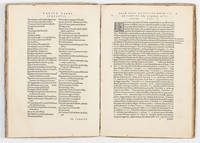
675816 p.l. 74 leaves. Folio later vellum-backed boards foot of spine defective occasional light soiling & dampstaining. Basel: H. Petri 1529. First edition of the two texts together. The De Temporum Ratione is a significant book in several ways. Most notably "this book helped to establish the custom of counting years from the birth of Christ. When we say that Queen Elizabeth II was born in 1926 not 'in the 16th year of the reign of George V' or 'in the year 2678 after the foundation of Rome' or in the '2nd year of the 481st Olympiad' we are indebted to the Venerable Bede."-Printing & the Mind of Man 16n. "Bede's greatest practical effect was on the Western calendar. His decisions beginning the year calculation of Easter names of days and months calculations of eras and so forth in most instances finally determined usage that was only refined not changed by Gregorian reform."-D.S.B. I p. 565. "The De Ratione Temporum first published in 1505 is particularly important. It contains a remarkable theory of tides based upon Pliny but also upon personal observation; first mention of the establishment of a port i.e. the mean interval between the moon's meridian passage and high water following; this interval is different in different ports."-Sarton I p. 511. Pierre Duhem described Bede's establishment of a port as the only original formulation of nature to be made in the West for some eight centuries. This is the first printing of De Natura Rerum which contains such physical science as was then known. It collects the wisdom of the ancient world on these subjects and has the special merit of referring phenomena to natural causes. It contains a particularly important section - the "De Comptu vel Loquela digitorum" - which is "our main almost our only source for the study of mediaeval finger reckoning or symbolism."-Sarton I pp. 510-11. See also Smith History of Mathematics II p. 200. This work was edited by Johannes Sichardt 1499-1552 professor of law who during the years 1526-30 lived in Basel and while teaching also edited and prepared for printing Latin manuscripts he had found in libraries in monasteries. He also served as adviser to the Basel printers Cratander Bebel and Henricus Petri. Good copy preserved in a box. Early signature of "Mallarii" on title with motto in Greek. Armorial bookplate dated 1915 of Bishop's College Cheshunt an Anglican theological college that closed in 1968. ❧ Sichardt: Bietenholz ed. Contemporaries of Erasmus Vol. III p. 247. hardcover books
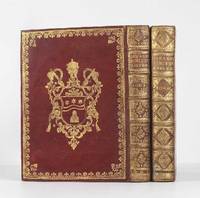
5035Woodcut printer's device on titles. 4 p.l. xxvii 1 368 pp.; 547 pp. Large 4to cont. Italian red morocco covers of Vol. II a little rubbed sides richly gilt with the arms of Pope Clement XIV in gilt in center of each cover spines richly gilt each tooled slightly differently a.e.g. Faenza: G.A. Archi 1769. First edition and a very handsome set with the arms of Pope Clement XIV on covers of the first bio-bibliographical guide to the writers of Ravenna; about 2500 works by more than 600 authors are included. Ginanni 1698-1774 the learned Italian bibliographer and historian was a professor in Florence and then in Ravenna where he developed a great knowledge of Italian history and writers. He formed an important collection of books and medals and was a member of many academic societies. Very fine set. Stamp on titles of the Biblioteca Piervissana on titles. From the library of A.R.A. Hobson with bookplate. ❧ Besterman 5346. N.B.G. Vol. 20 cols. 570-71. unknown books
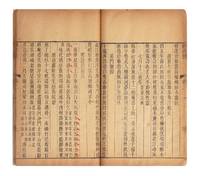
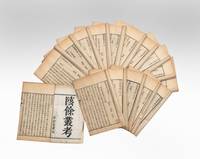
737576; 99 folding leaves of which two in Vol. II are in manuscript replacing missing printed leaves. Six parts in two vols. 8vo modern wrappers text leaves lightly browned new stitching. China: Prefaces dated 1754 & 1756.<br /> First edition and very rare not in WorldCat of this collection of the poetry and prose of Ren Huang 1683-1768 one of "the foremost lyrical poets" Ko p. 92 see below of the Guangdong region and a member of the artistic circle whose center was Gu Erniang a famous woman inkstone carver whose shop was located in Zhuanszhu Lane in the imperial city of Suzhou. This collectors and scholars of this circle were both patrons and clients of Gu Erniang and in fact Ren's main asset late in life was his collection of precious carved inkstones.<br /> Ren 1683-1768 whose literary name was Xintian or Shentian Ren was a native of Yongful county in Fujian. Born into a well-educated family of generations of government officials he learned poetry and painting as a child. He received the juren degree in 1702 and served as a county magistrate in Sihui in Guangdong province.<br /> Most of the poetry in this work is from manuscripts and appears here for the first time whereas the essays and other prose writings were previously published. The second preface dated 1754 is signed by Tingheng Xu and the third preface of 1756 is signed by Tiaoyuan Sang 1695-1771 scholar.<br /> A nice set but with two leaves of text replaced in early manuscript. Several natural paper flaws not touching text and mended. With the seal of Yosaburo Takekoshi 1865-1950 Japanese historian and politician. Preserved in a chitsu.<br /> ❧ Dorothy Ko The Social Life of Inkstones. Artisans and Scholars in Early Qing China 2017. unknown books
599537; 22; 17; 25; 21 folding leaves. Five vols. 8vo orig. wrappers orig. block-printed title labels on upper covers new stitching. Edo Osaka & Kyoto: 1832. First edition in Japanese and an important book. "Kincho or Rikkyo or Rikkei or Ryukei Sugita 1786-1846 the son of the famous Gempaku Sugita published a work in five volumes in 1830 this is wrong or a typo; the correct date is 1832 entitled Yoka shinsen which was a translation of the Dutch translation of Joseph Jakob von Plenck's Compendium institutionum chirurgicarum. Viennae: R. Graeffer 1780. The Yoka shinsen was important as the first complete translation of a Dutch surgical work into the Japanese language."-Mestler A Galaxy of Old Japanese Medical Books. III p. 157. Vols. I and II are concerned with tumors; Vol. III with ulcers; Vol. IV with wounds; and the fifth volume deals with pharmacology. In this volume many of the drugs appear with Latin and Dutch names and Japanese translations. Plenck 1738-1807 a member of the Viennese School was at one time or another professor of chemistry botany surgery anatomy and obstetrics at the Joseph Academy at Vienna. Fine fresh set. ❧ Sugimoto & Swain Science & Culture in Traditional Japan p. 386-"the crucial work on surgery was Yoka shinsen New selections on surgery by Sugita Ryukei 1786-1845; Genpaku's son by a mistress which was printed in 1832.". unknown books
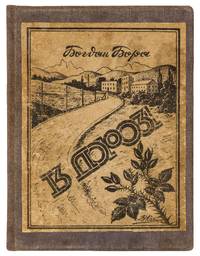
1946423496Rimini Italy: Zyttia w tabori 1946. Hardcover. Very Good. Limited edition one of 280 copies. Mimeographed. Octavo. pp. 1-4 i-iv v-vi 1-104. Illustrated with a portrait of Bogdan and four other full-page illustrations. Bound in original army linen over boards with mimeographed illustration mounted on the front cover. Small contemporary name in ink on front free endpaper slight staining and rubbing to the boards small marginal tears to endpapers very good. A very scarce book of poetry by the Ukrainian poet Bogdan Bora 1920-97 written and published at a prison camp in Rimini Italy about one year after World War II. Bora had been captured by British forces and sent to the prison camp in Rimini where he spent the following two years and published three books of poetry including this collection the title of which translated as "On the Road." Bora's poems written in Ukrainian are moving works evocative of the turbulent era. The cover design and a full-page portrait of Bogdan Bora were made by fellow inmate Volodimir Kaplun. In 1947 Bora was moved to Britain where he was given his freedom and lived out the rest of his days. Very scarce. OCLC locates only six copies in institutional holdings worldwide. Zyttia w tabori hardcover books
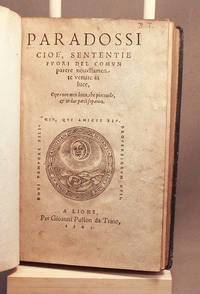
15436296Lyon: per Gioanni Pullon da Trino" i.e. Jean Pullon dit de Trin 1543. First edition. Very Good/Exquisitely rare first printing of Ortensio Lando's most famous book his first in a modern language that in later editions and in translations became a 16th-century best seller. Lando's name does not appear on the title page or anywhere in the book except in code. His real name shows up on no edition published in the 16th century. A dedicatory leaf after the colophon attributes the text to "M.O.L.M" interpreted generally as "Messer Ortensio Landi Milanese." More cryptically there is a phrase printed after the telos "SVISNETROH TABEDVL" mirror writing for "ludebat Hortensius" Ortensio has played. It is serious play. The Paradossi undertakes in the key of popular "world upside down" folklore to prove black what is commonly accepted as white. For instance it is better to be poor than rich better ugly than handsome better drunk than sober and so on. Biographical sketches of Lando are remarkable for how little information about him is available. Peer of Aretino and Doni friend to Etienne Dolet later incinerated for heresy he was a non-believer who nevertheless took Augustinian orders and later deserted them. Member of a prestigious literary club L'accademia degli elevati he was above all an outsider. All of his books landed on the Index of Prohibited Books and "I paradossi" in particular was widely banned and copies of it were confiscated. Probably the first book printed by the obscure Italian printer working in Lyon Giovanni Pullone da Trino later called "Jean Pullon de Trin". Following Pullon's modest press run the text was quickly taken up and reprinted badly by Bindoni and others in Venice twice in 1544 1545 1563 1594 etc. and translated into Latin into French by Charles Estienne 1553 and into English 1596. If you Google "Jean Pullon" you will get dozens of pages advertising pull-on jeans. . Octavo 17cm; 112 leaves signed A-O8. Printer's device on title page Ferraris 1 showing a human-faced moon in the sky reflected on the surface of the land. Bound in later 18th-century or 19th-century dark green leather in neoclassical style with gilt central losenge within gilt borders on both boards; gilt-tooled spine with leather title label. Joints reinforced but tender; light marginal stain along bottom edge; O7 torn and repaired remains of tape. Early marginalia trimmed close. Later c19 notes in French on endleaves. Pages not bright. All in all a very good copy of a very rare book. References: Ferraris "Giovanni Pullone e altri stampatori trinesi a Lione" in "Trino e l'arte tipografica nel XVI secolo." 2014 #1; USTC 116008 BM Italian 399; Grendler "Critics of the Italian World" #8; Gültlingen "Bibliographie des livres imprimés à Lyon." vol. X p. 7; Bongi "Catalogo delle opere di M. Ortensio Lando" p. xxxvi "eseguita in bel carattere rotonde cui la originalità e la bellezza danno il pregio sopre le ristampe"; not in Adams; not in Baudrier. per Gioanni Pullon da Trino" (i.e., Jean Pullon dit de Trin) hardcover books
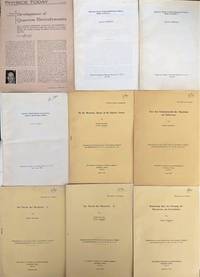
1940S13395Tokyo:: Scientific Papers of the Institute of Physical and Chemical Research 1940. 1940. 8 offprints 1 extract. Original wrappers. From the collection of Abraham Pais. Very good. INVENTORY: 1. TOMONAGA Sin-itiro. Uber den Zusammenstoß des Mesotrons mit Elektronen. Offprint from: Scientific Papers of the Institute of Physical and Chemical Research no. 976 vol. 37 pp. 399-413 June 1940. Original yellow printed wrappers. Signed by Pais. "In 1940 Dr. Tomonaga directed his attention to the meson theory and developed the intermediate coupling theory in order to clarify the structure of the meson cloud around the nucleon." :: Nobel Lectures 1972. 2. TOMONAGA Sin-itiro. Zur Theorie des Mesotrons. I. Offprint from: Scientific Papers of the Institute of Physical and Chemical Research no. 1071 vol. 39 pp. 247-266 Dezember 1941. Original yellow printed wrappers. Signed by Pais. 3. TOMONAGA Sin-itiro. Bemerkung uber die Streuung der Mesotronen am Kernteilchen. Offprint from: Scientific Papers of the Institute of Physical and Chemical Research no. 1105 vol. 40 pp. 73-86 September 1942. Original yellow printed wrappers. Signed by Pais. 4. TOMONAGA Sin-itiro; Miyazima Tatuoki. Zur Theorie des Mesotrons. II. Offprint from: Scientific Papers of the Institute of Physical and Chemical Research no. 1103 vol. 40 pp. 21-67 August 1942. Original yellow printed wrappers. Signed by Pais. 5. TOMONAGA Sin-itiro; Miyazima Tatuoki. On the Mesotron Theory of the Nuclear Forces. Offprint from: Scientific Papers of the Institute of Physical and Chemical Research no. 1124 vol. 40 pp. 274-310 March 1943. Original yellow printed wrappers. Signed by Pais. 6. TOMONAGA Sin-itiro. Remarks on Bloch's Method of Sound Waves applied to Many-Fermion Problems. Offprint from: Progress of Theoretical Physics vol. 5 no. 4 pp.544-569 July-August 1950. Signed by Pais. 7. TOMONAGA Shin-ichiro. Elementary Theory of Quantum-Mechanical Collective Motion of Particles I. Offprint from: Progress of Theoretical Physics vol. 13 no. 5 pp.467-481 May 1955. 8. TOMONAGA Shin-ichiro. Elementary Theory of Quantum-Mechanical Collective Motion of Particles II. Offprint from: Progress of Theoretical Physics vol. 13 no. 5 pp. 482-496 May 1955. 9. TOMONAGA Sin-itiro. Development of Quantum Electrodynamics. Extracted from: Physics Today vol. 19 no. 9 pp. 25-32 September 1966. Signed by Pais. . / BIOGRAPHY: Tomonaga was a prominent Japanese physicist influential in the development of quantum electrodynamics work for which he was jointly awarded the 1965 Nobel Prize in Physics :: along with Richard Feynman and Julian Schwinger :: for the study of QED specifically for the discovery of the renormalization method. Nobel biography: Tomonaga completed work for Rigakushi bachelor's degree in physics at Kyoto Imperial University in 1929 with one of his intimate friends. Dr. Hideki Yukawa Nobel laureate. He was engaged in graduate work for three years at the same university and was then appointed a research associate by Dr. Yoshio Nishina at the Institute of Physical and Chemical Research Tokyo where he started to work in a newly developed frontier of theoretical physics quantum electrodynamics - under the guidance of Dr. Nishina. His paper on the photoelectric pair creation is well-known. Tomonaga stayed in Leipzig Germany from 1937 to 1939 to study nuclear physics and the quantum field theory in collaboration with the theoretical group of Dr. W. Heisenberg where he published a paper "Innere Reibung und Warmeleitfahigkeit der Kernmaterie" which was chosen as the thesis for Rigakuhakushi Doctor of Science at Tokyo Imperial University in December1939. In 1940 Dr. Tomonaga directed his attention to the meson theory and developed the intermediate coupling theory in order to clarify the structure of the meson cloud around the nucleon. He joined the faculty of Tokyo Bunrika University which was absorbed into the Tokyo University of Education in 1949 as Professor of Physics in 1941. It was in 1942 when he first proposed the covariant formulation of the quantum field theory in which the concept of the quantum state was generalized so as to be relativistically covariant. During the Second World War Dr. Tomonaga was interested in developing a theory of microwave systems. He solved the motion of electrons in the magnetron and also developed a unified theory of the systems consisting of wave guides and cavity resonators. As soon as the War was over Tomonaga came back to academic research again with a programme in which he was first to summarize and extend the intermediate coupling theory and secondly to apply the covariant field theory to actual physical systems. His aim was to investigate the nature of field reaction in the meson theory as well as in quantum electrodynamics. He was confident prior to the Lamb-Retherford experiment by means of a model calculation that divergence difficulty in quantumelectrodynamics could be overcome simply by handling the infinite mass and charge due to field reactions in some way or another. It was only a step further for him to develop the renormalization theory with covariant formalism in his right hand and experimental support in his left. Dr. Tomonaga was invited to the Institute for Advanced Study Princeton in 1949 where he was engaged in the investigation of a one-dimensional fermion system. Thus he first succeeded in clarifying the nature of collective oscillations of a quantum-mechanical many-body system and opened a new frontier of theoretical physics modern many-body problem. In 1955 he published an elementary theory of quantum mechanical collective motions. Dr. Tomonaga took the leadership in establishing the Institute for Nuclear Study University of Tokyo in 1955. From 1956 to 1962 he was appointed President of the Tokyo University of Education and since 1963 he has been President of the Science Council of Japan and Director of the Institute for Optical Research Tokyo University of Education. He occupies an important position in various governmental committees for scientific research and policymaking. Tomonaga's honours and awards include the Japan Academy Prize 1948; the Order of Culture 1952; the Lomonosov Medal U.S.S.R. 1964. Dr. Tomonaga is a member of the Japan Academy the Deutsche Akademie der Naturforscher "Leopoldina" and a foreign member of the Royal Swedish Academy of Science. He is a corresponding member of the Bayerische Akademie der Wissenschaften and a foreign associate of the National Academy of Science of U.S.A. Tomonaga has published widely in scientific journals on such subjects as quantum electrodynamics the meson theory nuclear physics cosmic rays and the many-body problem. His book "Quantum Mechanics" was published in 1949 and translated into English in 1963. Scientific Papers of the Institute of Physical and Chemical Research, 1940. unknown books
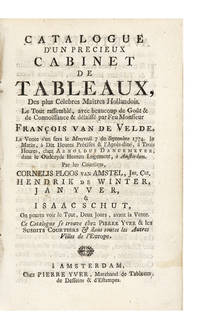
61592 p.l. 72 pp. Small 8vo cont. red sheep-backed marbled boards extremities slightly rubbed spine gilt green morocco lettering piece on spine. Amsterdam: P. Yver 1774. bound with: -. Catalogue d'un precieux Cabinet de Desseins Coloriés & Non-Coloriés des plus célebres Maîtres Hollandois & Flamands &c. De même que d'une tres belle Collection d'Estampes de Choix. Parmi lesquelles il y a quelques Petits Oeuvres & des Ouvrages d'Estampes Reliées & non-Reliées presque Toutes Premieres Epreuves & des mieux conservées.La Vente s'en fera le Lundi 16 de Janvier 1775 & les Jours suivants.Par les Courtiers. 2 p.l. 235 1 78 pp. 8vo. Amsterdam: P. Yver 1775. The rare sale catalogues largely priced in a contemporary hand of this comprehensive collection of 17th-century Dutch and Flemish pictures prints and drawings. These are the French editions bound together there were editions in Dutch published simultaneously. The first catalogue 124 lots with most buyers' names and fully priced consists exclusively of Dutch paintings mostly 17th-century by artists such as Berchem Eeckhout van Goyen Lairesse Maas Metsu Potter Steen Teniers van de Velde Elder & Younger Wouwerman Wynands etc. The contents of each painting are described along with comments and measurements. According to the contemporary annotator Yver Amstel and Fouquet bought many of the lots. Devoted to drawings and prints the second catalogue 1545 lots fully priced in a contemporary hand as well as the annotator's comments on several lots describes 1006 drawings 537 prints and two armoires. The majority of the contents are gathered in 17 recueils A-Q but the pieces were sold separately. The remaining lots were either grouped into 24 livres or offered individually. Despite the exceptional volume of artworks the catalogue frequently offers descriptions of the contents quality and condition of the lots. Fine copies copiously annotated. Engraved bookplate of the Parisian art dealer Georges Pannier 1853-1944. ❧ I. Lugt 2323. II. Lugt 2349. hardcover books
718743 parts in 16 vols. 8vo orig. wrappers new stitching. China: Zhan yi tang Prefaces dated 1790 & 1791. First edition. Zhao 1727-1814 "was an important poet and historian from Yanghu. He was born poor and supported himself at first as a private tutor. In 1761 he passed the imperial examination and in a long career served in many official capacities. Upon being appointed the prefect of Zhenan Guanzi province in 1766 he showed himself to be a reformer dedicated to helping the common people. From 1784 to 1786 he became the director of the Anting Academy in Yangzhou. In addition to writing a collection of 'poetry talk' critical notes on poetry he wrote a dynastic history histories of military campaigns and other important works. He was a friend of Yuan Mei 1716-1798 and was considered along with Yuan Mei and the poet and playwright Jiang Shiquan 1725-1785 one of the three greatest poets of Southern China."-Barnstone & Chou eds. The Anchor Book of Chinese Poetry p. 339. The present work is a collection of Zhao's miscellaneous poetry and writings on classical Chinese literature especially poetry history and historiography one volume is devoted to a discussion of the Tongjian Gangmu of 1172 politics dynastic history philosophy and various other subjects. One of the foremost historians of his day he was among the first to turn his attention to the larger more fundamental problems of historiographical method and social and institutional history. Fine set. ❧ Nienhauser ed. The Indiana Companion to Traditional Chinese Literature Vol. 1 pp. 229-30-"Chao's literary talents were manifold encompassing those of poet essayist calligrapher and critic. He mastered many poetic forms including both old- and new-style verse.Chao was a prolific writer producing many works on a great variety of subjects including history politics and philosophy.". unknown books
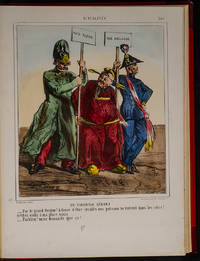
05043Paris: A. de Vresse & Maison Martinet 1862. A Fine French Album of Sixty-Six Caricatures Including Twenty-Eight with Hand-Coloring<br/><br/>PELCOQ Jules illustrator. Actualités. Paris: A. de Vresse & Maison Martinet 1862-1863. <br/><br/>Folio 13 3/4 x 10 1/8 inches; 350 x 257 mm. Twenty-eight fine and mainly amusing hand colored lithograph plates all heightened with gum arabic and thirty-eight black and white lithograph plates making a total of sixty-six plates all signed numbered and titled Actualités. All plates mounted on stubs. A few of the black & white plates and one color plate No. 363 with light mainly marginal foxing. One of the color plates No. 133 lightly toned and color plate No. 226 with neat marginal repair just touching image.<br/><br/>Contemporary half red morocco over red pebbled cloth boards ruled in gilt. Front cover with rectangular black morocco label lettered in gilt. Smooth spine decoratively tooled and lettered in gilt marbled endpapers. A wonderful collection.<br/><br/>The Plates:<br/><br/>Color: Numbers 13 14 15 19 31 56 78 133 137 215 226 227 241 251 281 291 317 318 331 335 337 342 346 347 349 356 360 & 363 <br/><br/>Black & White: Numbers 4 5 6 43 77 99 102 107 115 116 122 135 147 148 155 161 162 163 165 168 201 210 217 223 227 265 282 292 317 318 324 325 363 386 389 389 397 & 398.<br/><br/>Note: Some plate numbers are duplicated but the plates are all different.<br/> <br/>Pelcoq Jules 1825-1887. "Jules Pelcoq born in Belgium was a Parisian book illustrator and colleague of Honoré Daumier and contributed to Le Charivari and other French periodicals of the time. He also covered the French side for the Illustrated London News during the Franco-Prussian War. While covering the 1870 siege of Paris Pelcoq dispatched his work by balloon to London. Wood engravings were then made from his sketches once they arrived in England. His work captures the attempt by Parisian troops to break through the surrounding Prussian army and the plight of citizens on the edge of starvation forced to eat animals from the Parisian zoo. Pelcoq often signed his name with pseudonyms such as: Jipé or Pipey<br/><br/>By the 19th century caricature in France had become a highly evolved form of public discourse about famous figures politicians artists and writers etc. and the events of the day. During the 19th and early 20th centuries French periodicals such as La vie Parisienne Le journal amusant Le petit journal pour rire and Le Charivari became well-known for the caricatures they published. Caricaturists many of whom published under pseudonyms themselves became public figures. Paris: A. de Vresse [&] Maison Martinet, 1862 unknown books
6449viii 268 pp. 8vo early 19th-cent. marbled boards spine defective. Amsterdam: P. Yver 1785. The extremely rare French edition there was an edition in Dutch the same year of this catalogue of an impressive sale. A contemporary annotator has supplemented it with prices buyers' names and commentary on the artworks almost all dismissive in the margins. Van Slingelandt 1701-82 a great patron of the arts who lived in Dordrecht amassed one of the most notable Dutch painting collections of the 18th century. This heavily annotated volume is the first and most important part of the sale describing 701! paintings along with eight drawings. The second part of drawings and sculptures followed shortly thereafter. Van Slingelandt's collection consisted of Old Masters and contemporary Dutch artists some of whom the collector himself patronized. The present catalogue details the works of Asselijn Bakhuizen Berghem J. Brueghel père et fils Cuyp 38 lots Dou van Dyck Jordaens Metsu Netscher Adrian and Isaac van Ostade Potter Rembrandt Rubens Ruysdael Steen Teniers ter Borch Wouwerman etc. etc. All lots are priced with buyers' names. It is clear the annotator viewed and attended the sale. For almost every item he has provided the name of the buyer. The annotator likely a connoisseur has written generally disparaging comments on the works for sale deriding them as copies or incorrectly attributed: "mauvais" "bizarre" "lourd" "médiocre" "not by Rembrandt." There are additional remarks on condition and provenance which are very interesting. The rare positive observation praises the work of a young artist or salutes a master's finest painting. This sale presided over by Pierre Yver 1712-87 and Abraham Delfos 1731-1820 the preeminent Dutch art dealers of the period was attended by many of their competitors including Pierre Fouquet who frequently purchased on behalf of the famous French expert Jean Baptiste Pierre Lebrun 1748-1813 as corroborated by several annotations in this copy. Lebrun solidified his position as the leading dealer in Netherlandish pictures by purchasing directly from the source and was buying heavily at sales such as these. Other notes indicate there were dealers from Brussels Lyon Antwerp Amsterdam Germany the Hague and Rotterdam. An extremely interesting annotated copy. A few of the annotations are cropped. ❧ Lugt 3936. Oxford Art online Delfos & Yver. hardcover books