542 résultats
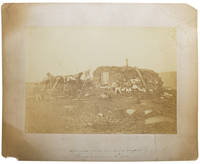
1872303445London 1872. Albumen print measuring 11-5/8 x 16-1/4 in 295 x 412 mm. Laid down on thick cream card with manuscript caption measuring 17 x 21 in. Image slightly faded card chipped with some minor soiling one tear not affecting image. Albumen print measuring 11-5/8 x 16-1/4 in 295 x 412 mm. A rare survival. This image appears in William Bradford's fabled book of photographs Arctic Regions. It was taken by either Dunmore or Critcherson the two professional photographers from Boston who accompanied Bradford on his 1869 expedition to the Arctic on the steamship Panther. It was probably taken at Upernavik a settlement on an island off Greenland's west coast or Godhavn.<br/><br/>Arctic Regions included 141 albumen prints in addition to Bradford's account of the voyage. The title of the photograph here varies from the printed caption in the book where it reads: "Plate Number: 116 Esquimaux igloe or winter hut made of turf and stones. The entrance is to the left through a door which is about three and a half feet high. The length of the passage is about twelve or fifteen feet and at the farther end is another door through which one almost has to crawl on his hands and knees. After passing through there is then room to stand erect but one is forced to leave very soon owing to the bad air." <br/><br/>This photograph is slightly larger than the one in the book which is 277 x 365mm. Furthermore the image in the book is cropped closer on the right and left margins. <br/><br/>The New York Public Library has a folio of 26 images of near identicle size mounted on card. The portfolio was donated to the library in 1892 as part of the Robert Stuart Collection. According to Horch originally all of these images were captioned in manuscript though were later remounted with typed captions as "the original ink-written captions for the photographs had badly faded by 1940." It's interesting that the caption on their duplicate of this image is the same as ours and the image itself has not been cropped. Horch writes that Bradford probably not only selected these images himself but "closely directed the actual taking of the photographs." <br/><br/>It's entirely likely that Bradford would have had extra prints made to distribute to friends repay favors and most of all to solicit subscribers to what was a very expensive book to publish. Given how it conforms to the examples in the Robert Stuart portfolio this particular image is probably one of them. Horch Frank. "Photographs and Paintings by William Bradford". American Art Journal 5.2 1973: pp 61-70; cf Parr and Badger I p31Prm/photo unknown books
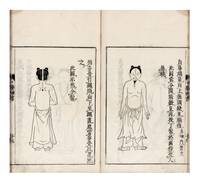
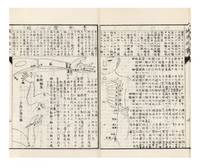
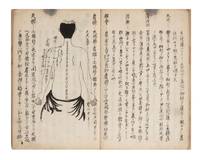
7008Twelve full-page woodcuts & numerous woodcuts in the text. 36 folding leaves. Two parts in one vol. 8vo orig. blue wrappers wrappers rubbed & somewhat wormed orig. block-printed title label on upper cover no longer present modern stitching. "Ichijo-dori" a street in Kyoto: Tomikura Tahei 1690. First edition of this early and rare book providing prescriptions for treatments in the different stages of tuberculosis. The author describes ten drugs made from vegetables that give miraculous results in treating the disease. The second part entitled "Mujo Gengen santen shinden gyokudo shoshi chiden shirochu soho" describes the parasitic worms said to grow in the stomach and intestinal system of patients suffering from tuberculosis. The text illustrations depict many of these parasites. The text is Chinese with Japanese reading marks presumably compiled in the 14th century by Ge 1305-53 a Yuan dynasty physician and writer. He came from a family of hereditary physicians and wrote a number of books. The Japanese reading marks have been provided by Shuhaku Asai 1643-1705 who was a fellow student with Ippo Okamoto of the prominent doctor Sanpaku Ajioka. There are substantial sections on acupuncture and moxibustion several of the full-page woodcuts depict pressure points. Very good copy. Minor marginal worming towards end. unknown books
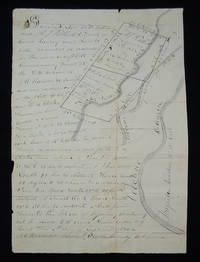
68368A Gold Rush Manuscript Land Survey GOLD RUSH. Gold Rush Map Manuscript. Being a Survey for the adjoining plots of land belonging to H.H. Watson and A.J. Polhill. Placer County California: 1852. Two pages on a single sheet 17 1/8 x 10 7/8 in.; 438 x 275 mm. Manuscript document with map dated variously between 4-24 September 1852 and signed by H.H. Watson A.J. Polhill and others. Sheet with some mild staining and ink blots. Some minor chipping at edges and some separations at the creases. Creases reinforced with nearly invisible tape. Overall a very interesting piece of gold rush history. We could not find any other California mine surveys at auction in the past 50 years. "Survey for H.H. Watson and A.J. Polhill. A Tract of land laying near ville bounded as described in the annex plot commencing point as the S.W. corner of J.H. Hancock survey." "Survey made by N.O. Hinman County Surveyor." "In the present survey the tracts of land being issued to Watson and Polhill are bounded on the right by the Volcano Mining Company Ditch and Volcano Canion sic with the Todds sic Valley Company Ditch running through each plot. The Volcano Gold Gravel Mining Company was one of the most extensive gravel mines during the Gold Rush and hundreds of acres of valuable mining lands were drained by its enterprises. Placer County falls in both the Sacramento Valley and Sierra Nevada regions in what is known as the Gold Country. The discovery of gold in this region in 1848 brought tens of thousands of miners from around the world and thousands more settled in the area to provide goods and services to them. The name "Placer" is taken from the Spanish word for gravel or sand deposits containing gold." From Sotheby's. HBS 68368. $4500 1852 unknown books
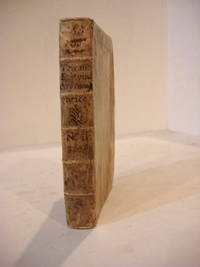
634118 leaves. Small 4to attractive modern marbled boards red morocco lettering piece on spine. Wittenberg: C. Heyden 1619. First edition of this rare book which is considered by A.D.B. to be the author's most important scientific work; it is a careful record of the third of the three bright comets of 1618-19. Schmidt 1570-1637 was "one of the last of the scholars of Germany who taught the language and literature of Greece in the spirit of Melanchthon. Schmidt was professor first of Greek and next of Mathematics at Wittenberg. His principal work was an edition of Pindar with a Latin translation and a careful commentary 1616."-Sandys II p. 272. Fine copy. ❧ A.D.B. Vol. 32 pp. 27-28. Zinner 4785. hardcover books
16711002105London: E.T. and R.H. for H. Brome B. Tooke and T. Sawbridge 1671. First edition in English of the complete Colloquia Familiaria of Erasmus first published in 1518 and expanded by Erasmus over the next fifteen years a lively collection of Latin dialogues that found a readership far beyond the Renaissance schoolroom. Originally intended to model colloquial conversation for students of Latin the dialogues feature pointed free-thinking exchanges on modern political religious and philosophical questions. In "Of the Abbot and Learned Woman" an ignorant abbot tries and fails to get the better of the classically educated Magdalia a character almost certainly based on Thomas More's eldest daughter: "I think thou art some sophistress thou protest so wittily." Magdalia: "I will not tell thee what I think thou art." And later: "I have often heard it usually spoken that a wise woman is twice a fool." Magdalia: "Indeed it useth to be said so but by fools." The Colloquia Familiaria was widely read and debated across Europe drawing immediate notice for its anticlerical satire: "its influence on the dialogues of Reformation Germany and Tudor England is a critical commonplace" Zlatar Reformation Fictions 11. The original purpose of the Colloquies as a text for teaching Latin postponed its direct translation; this first complete English edition was published more than 150 years after the work's first appearance. The edition opens with a short life of Erasmus and concludes with the first appearance in English of De utilitate colloquiorum Erasmus's 1526 defense of the Colloquies published after the Sorbonne condemned the book for impiety. In response Erasmus makes a case for the educational value of his dialogues' humor: "I cannot tell whether any thing be learned more successfully than that which is learned in playing." Despite his efforts the Colloquies would remain on the Papal Index of banned books through the end of the nineteenth century. Wing E-3190; PMM 53. A very good copy of a humanist landmark in a handsome contemporary binding. Octavo measuring 6.5 x 4.25 inches: 8 555 1. Contemporary Cambridge-style full speckled calf boards ruled and ornamented in blind raised bands red morocco spine label lettered and decorated in gilt top edge stained black. Engraved frontispiece portrait of Erasmus. Final leaf containing second page of bookseller catalogue excised. Joints and spine head expertly repaired; evidence of bookplate removal on front pastedown; effaced signature on title page; some running titles shaved. E.T. and R.H. for H. Brome, B. Tooke, and T. Sawbridge unknown books
185128441New York: Nagel & Weingaertner 1851. Hand-coloured lithograph after Hanson titled below the image. Expert restoration closing tears into the image. The first America's Cup: a scarce hand coloured lithographed view of the winning yacht which gave its name to the cup.<br/> <br/>In 1851 the Royal Yacht Squadron proposed a race around the Isle of Wight. A group of New York Yacht Club members led by Commodore John Cox Stevens built a yacht designed to compete in such races. Designed by Steers and Co. and captained by Richard Brown the yacht America would win the race by eighteen minutes giving its name to one of the oldest and best-known trophies of the sport: the America's Cup. This lithograph and lithographer are unrecorded by Harry T. Peters; we find no other extant examples of this rare print.<br/> <br/>On Nagel and Weingaertner see Peters America on Stone pp. 291-294. Nagel & Weingaertner unknown books
1636D6036Rome: Typis S. Cong de propag: Fide 1636. Hardcover. Very Good. 4to 230 x 170mm. xxiv 338pp. ii. Illustrated throughout with woodcut tables and charts of Egyptian characters and hieroglyphs. Contemporary vellum; intermittently browned occasional spots. <br/><br/>Father Athanasius Kircher was a 17th-century German Jesuit scholar and polymath who published around 40 works most notably in the fields of oriental studies geology and medicine. He was heralded as possessing the secret of deciphering hieroglyphics and was widely regarded as the physical embodiment of all the learning of his age. He had over 760 correspondents including scientists Jesuit missionaries and world potentates and wrote about an enormous range of interests ranging from optics to music from Egyptology to magnetism. Perhaps best known of his correspondents is Jan Marek Marci of Kronland 1595-1667 for sending Kircher a mysterious illustrated manuscript written in an unknown script famously known today as the Voynich Manuscript. In 1635 Kircher began to write his book Prodromus Coptus Introduction to Coptic Language and in the autumn of 1636 the book was printed. Kircher saw the ancient languages as an essential foundation for any pious philosophy. Kircher envisioned Rome as a unique center within to unlock the mysteries of Hermetic knowledge inscribed on the obelisks. The project of restoring Egyptian wisdom entailed nothing less than an effort to renovate the lost arts of communication that linked divine and human languages. Unfortunately while in other disciplines he made valuable discoveries his explanation of hieroglyphs was absolutely incorrect. We can probably explain it by his passion that might have sometimes blinded his reasoning. Yet Kirchers Prodomus remains an important study from a most respected scholar. Brunet III 668; Caillet II 5790. Typis S. Cong de propag: Fide hardcover books
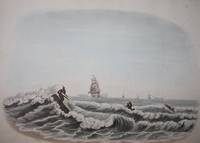
1806004050London: G. and W. Nicoll spelled on the plates with one "l". Printed by Bunney and Co. 1806. Half Leather Marbled Boards. Very Good Minus. Folio 34.5 by 27.5 cm. Only 25 of 49 hand-colored aquatint plates but including several of the most interesting of plates including the Cattamarans -- possibly the earliest depiction of surfing -- a Gentoo Zealot Snake-Men Plates are watermarked 1798 to 1801. A few bear no date. Abbey Travel 428. Rebacked with most of original spine preserved and laid on missing lower compartment. The surviving spine is rubbed cracked and dry but nonetheless a plus to have. Marbled boards are rubbed and worn. Corners are heavily rubbed and abraded. Hinges restored. Scattered light soiling and a few minor closed tears. <br/><br/> G. and W. Nicoll (spelled on the plates with one "l"). Printed by Bunney and Co. hardcover books
1963C1354Program for the First Piatigorsky Cup: International Grandmaster Chess Tournament July 2 to 27 1963 48 pages with photographs including photographs of the contestants table and diagrams. Octavo 8 1/2" x 4 1/2" bound in original publisher's spiral binding in blue felt wrappers with black and silver Piatigorsky Cup stamped to cover. Included nine first day tickets for the cup. Signed or inscribed by all the contestants to Mrs Piatigorsky. <br /><br />The Piatigorsky Cup was a triennial series of double round-robin grandsmaster chess tournaments held in the United States in the 1960's. Sponsored by the Piatigorsky foundation only two events were held in 1963 and 1966. the Piatigorsky Cups were the strongest U S Chess tournaments since New York 1927. Jacqueline Piatigorsky was married to cellist Gregor Piatigorsky. One of the strongest woman chess players in the U S and a regular competitor in the U S Women's Chess Championship she designed the cup and was the primary organizer of the tournaments. The prize funds were among the largest of any chess tournament up to that time. Every player was guaranteed a prize and all traveling and living expenses were paid. The First Piatigorsky Cup was held in the Ambassador Hotel Los Angeles in July 1963. The tournament field of eight included players from five countries. the soviet representatives Paul Keres and World Champion Tigran Petrosian finished equal first to share the cup with a score of 8 1/2/14 receiving more than half of the $10000 prize fund $3000 for first. Keres won most of the games in the tournament six but lost twice to Samuel Reshevsky. The Cup was Petrosian's first tournament since winning the 1963 World Championship match with Mikhail Botvinnik and was one of two first prizes he shared in his six-year reign as champion. He was the first reigning champion to play in an American tournament since Alexander Alekhine at Pasadena 1932. After losing the second round to Svetozar Gligoric Petrosian was never in danger the rest of the tournament. The remainder of the tournament field included to Americans Reshevsky and Pal Benko two Argentinians Oscar Panno and Miguel Najdorf and two Europeans Gligoric Yugoslavia and Frank Olafsson Iceland. U S Champion Bobby Fischer decline an invitation after his demand for $2000 appearance fee was refused by the tournament organizers. Gligoric led halfway through the tournament with 4 1/2/7 but scored only three draws in the last seven games and finished fifth behind Najdorf and Olafsson. Petrosian finished the strongest with 5/7 in the second half. Before the last round Petrosian led with 8 points followed by Keres with 7½ and Najdorf and Ólafsson with 7. Both Petrosian and Keres had Black in the final round. Petrosian drew his game against Reshevsky but Keres beat Gligorić to result in a tie for first place with 8½ points each.<br /><br /><b>Condition:</b> Edges sunned inscriptions to front end paper and title else spiral spine cracked else very good. Piatigorsky Cup Committee paperback books
167535334London: William and John Leake 1675. Two parts in one 8vo. 28 148; 16 159 1pp. Contemporary mottled calf covers ruled in blind rebacked to style flat spine ruled in blind red morocco lettering piece<br/> <br/>Provenance: F. H. early initials on the title<br/> <br/>The final edition complete with both parts of among the most influential English gardening books of the 17th century.<br/> <br/>"Sir Hugh Platt 1552-1608 held by Richard Weston to be 'the most ingenious husbandman of the age he lived in' . devoted his life to literary work and to the study of husbandry and gardening. He was also interested in all kinds of inventions and experiments and in consideration of his services in this field was knighted by James I on 22 May 1605 . His work on gardening entitled Floraes paradise . appeared in 1608 the year of his death . He wrote his book from his own practical experience as well as from information supplied to him by other gardeners . Floraes paradise continued to be published after the author's death but with the new title of The Garden of Eden and edited by Charles Bellingham . In 1660 was issued The second part of The Garden of Eden . Readers who questioned the authenticity of this work were invited to 'see the original manuscript under the authors own hand.'" Henrey. Styled on the title as the sixth edition it is the second combined edition of both parts and the final edition published in the 17th century. The second part includes its own title and pagination.<br/> <br/>Fussell pp.15-16; Henrey 299; Hunt 340; Wing P2388; ESTC R31801. William and John Leake unknown books
15386173Venice: Per Agostino de Bindoni 1538. Sm. 8vo. 344pp. Illustrated with a large woodcut vignette on title page verso of title and colophon with devices and 78 woodcuts of hands keyed to the text. Cont. vellum with manuscript spine lettering. Light browning and soiling including title page but overall a very nice copy in a contemporary binding. An early Italian language edition of one of the most popular works on chiromancy of the 16th century. Tricasso 1491-c.1550 was a disciple of Barthelemy Cocles. At variance with Cocles on a number of points he set out in this work to analyze the significance of 78 configurations of hands as well as to outline the supposed astrological implications. His work is frequently cited by many later writers on the subject. As with other copies cited in OCLC the date at the conclusion of the author's preface is misprinted "1635" it should be "1535" the date of the first Italian edition of this title. Brunet V:945; STC of Italian Books p. 680. Caillet 10830. Per Agostino de Bindoni hardcover books
15384474Venice: Per Agostino de Bindoni 1538. Sm. 8vo. 344pp. Illustrated with a large woodcut vignette on title page verso of title and colophon with devices and 78 woodcuts of hands keyed to the text. Nicely rebound in faux period calf gilt tooled spine in 3 compartments. Small chip and tear into blank upper margin of B1 and small printing flaw at bottom corner of A2 verso. An early Italian language edition of one of the most popular works on chiromancy of the 16th century. Tricasso 1491-c.1550 was a disciple of Barthelemy Cocles. At variance with Cocles on a number of points he set out in this work to analyze the significance of 78 configurations of hands as well as to outline the supposed astrological implications. His work is frequently cited by many later writers on the subject. As with other copies cited in OCLC the date at the conclusion of the author's preface is misprinted "1635" it should be "1535" the date of the first Italian edition of this title. Brunet V:945; STC of Italian Books p. 680. Caillet 10830. Per Agostino de Bindoni unknown books
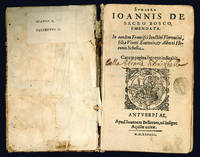
158273<p>COPY CONTAINING THE MINUTE OF A LETTER ADDRESSED BY GIORGIO RAGUSEO TO HIS COLLEAGE OF THE UNIVERSITY OF PADUA GIROLAMO PALLANTIERI</p><p>8vo 153x93 mm. 16 327 1 pp. and 1 folding plate with the movable parts to be cut out and the instructions on how to assemble them. Collation: †8 A-V8 X4. Printer's device on title page and several woodcut diagrams and illustrations in text. On the front pastedown label with the shelf mark "Scansia N. G10 Palchetto N.". On title page is the ownership's entry "Della libraria di Brisighella" and an old faded stamp. Contemporary binding made with a manuscript vellum leaf datable to the 12th-13th century inked title on spine and on the upper edge round worm holes and small losses to the panels heavier loss to the bottom part of the spine lacking ties and front flyleaf. Leaves †6 and †7 stained and with minor losses of paper and occasionally also of text small hole in the middle of quire M affecting a few letters other hole in the lower blank margin of ll. V3-X4 with no loss of text uniformly browned throughout first quire slightly loose. A genuine copy.</p><p>On back flyleaf recto is a manuscript note containing the minute of a letter presumably autograph by Giorgio Raguseo d. 1622 dated "Patavi ex academia nostra V. Non. Marti 94" 3 March 1594 and addressed to the "Admodum Rev.do ac Ecellentiss.o Patri Magistro Hieronimo Palanterio in almo Patavino Gimnasio theologiam publice proficienti" in which Raguseo thanks his colleague and professor of theology Girolamo Pallantieri 1533-1619 and asks his permission to print some not better specified academic "conclusiones ex variis doctoribus scholasticiis" which he thinks are worth publishing. It is also not clear which academy he is referring to in the letter.</p><p>On the verso of the same leaf is another note by the same hand quoting as a reminder the 1566 Giovanni Battista & Marchiò Sessa edition of <i>Le nuove teoriche de i pianeti</i> by Georg Peurbach in the translation by Orazio Toscanella.</p><p>RARE EDITION published in Antwerp of Sacrobosco's famous astronomical treatise accompanied by notes of Francesco Giuntini 1523-1590 Elie Vinet 1509-1587 and Albert Hero d. 1589 which appeared for the first time in the Lyon edition of 1562.</p><p>"Sacrobosco's <i>Sphaera</i> written in Paris around 1220 enjoyed a long popularity as the leading introduction to spherical astronomy. First printed in 1472 it went through at least a score of editions in the fifteenth century and something over 100 in the sixteenth … Publishing Sacrobosco entered a new and different phase in Wittenberg in 1531. Prior to that year all the editions were folio or quarto that is large often quite beautiful and presumably expensive volumes. In 1531 the Lutheran University of Wittenberg apparently sponsored a version cheap enough to become a required textbook for the astronomy course. It is fully illustrated with didactic figures and comes with a preface in praise of astronomy by Philipp Melanchthon … Demand for the small Sacrobosco textbook remained high at Wittenberg and a new edition was issued every few years. In 1538 a revised revision appeared: for the first time three of the diagrams incorporated moving parts. This proved to be such a popular feature that virtually every octavo Sacrobosco from the 1540s on – regardless of whether it was printed in Paris Antwerp Cologne or Venice – included these same identical volvelles. Incidentally these volvelles were not pre-cut and pasted by the printer. They were issued on ancillary sheets together with instructions for assembling them. Hence it is possible to find copies of these text books with no sign that the volvelles were ever in place and very occasionally the original sheet with the instructions and cutouts can still be found with the book" O. Gingerich <i>Sacrobosco as a Textbook</i> in: "Journal of History of Astronomy" 19 no. 4 Nov. 1988 pp. 269-273.</p><p>The letter contained in the present copy is particularly interesting as it connects two prominent figures of the University of Padua at the end of the 16th century highlighting their academic and professional ties. It is also worth noting that Raguseo wrote a commentary on Sacrobosco's <i>Sphaera</i> <i>Expositio super spheram Ioannis de Sacrobosco</i> Milan Biblioteca Ambrosiana manuscript N.207 sup. which has remained unpublished.</p><p>Giorgio di Ragusa or Raguseo as he was called after the name of his hometown today's Dubrovnik in Dalmatia was born on an unspecified date in the second half of the 16th century. He spent his youth in Venice where he was educated in mathematics by his father in the letters by L. Natali and in astrology his favourite discipline by Osvaldo da Gent and F. Barozzi. He then studied and graduated at the Studio of Padua first in the arts the exact date is not known then in 1592 in theology and in 1601 in medicine. In the meantime he took the minor orders and gained a certain reputation as an expert in Lull's art taking part in two public disputes over theological conclusions exposed according to R. Lull's method one in Venice in 1594 and the other in Padua in 1595. In 1599 he set off on a journey that kept him away from Venice for two years. In Pisa he met G. Mercuriale while in Naples he made the acquaintance of G. Della Porta. When he returned to Padua in the spring of 1601 he was appointed to the second ordinary chair of natural philosophy at the local Studio replacing C. Cremonini recently promoted to the first chair. In the following years he was deeply involved in all academic activities not only in teaching. His name in fact is one of those that most often appears in the commission that conferred the doctorate titles according to the practice of the Palatine counts and in this capacity on April 25 1602 he conferred the title of doctor in philosophy and medicine to W. Harvey. In 1613 in Venice he published twenty-four Aristotelian disputes under the title of <i>Peripateticae disputationes</i>. Around 1618 Raguseo took part in the discussions raised by the appearance of a comet. Despite his academic Aristotelianism he expressed an original position in the debate supporting the need for critical scrutiny by the senses and experience. From a letter of 1611 we also know that he used the telescope to verify some of discoveries announced by Galileo in the <i>Sidereus nuncius</i>. Raguseo died in Padua on 13 January 1622 cf. C. Preti <i>Giorgio da Ragusa</i> in: "Dizionario Biografico degli Italiani" LV 2001 s.v.; see also L. Thorndike <i>A history of magic and experimental science</i> VI New York 1941 pp. 198-202; M. Josipovic <i>Il pensiero filosofico di G. Raguseo</i> Milan 1985; and G.F. Tomasini <i>Gymnasium Patavinium</i> Udine 1654 pp. 309 and 445 for Ragueseo and p. 284 for Girolamo Pallantieri professor of theology from 1580 to 1603.</p><p>Bernardino Pallantieri was born in Castel Bolognese in 1533. In 1547 at the age of fourteen he entered the order of friars minor conventual taking the name of Girolamo. In Ferrara he studied philosophy with the theologian Filippo Braschi and the famous philosopher Vincenzo Maggio. He then continued his studies in Bologna under the guidance of Giovanni Antonio Delfini and Franceschino Visdomini. At first appointed regent of the Studio of Pavia in 1566 Pallantieri took up the chair of theology at that university. In 1568 he was called to Milan by St Charles Borromeo archbishop of that city who appointed him as preceptor of the candidates for priesthood and as his personal theologian. Pallantieri remained in Milan for 5 years then in 1573 he resumed his teaching in Pavia. Between 1575 and 1581 he was in Rome at the service of Cardinal Felice Peretti as his personal advisor and theologian. In 1581 he was called back to Bologna and in 1582 he was elected minister provincial of the friars minor of the province of Bologna. He was also a member of the Accademia degli Infiammati of Parma with the name of "Solingo". When his three-year mandate in Bologna expired in 1585 Pallantieri was called by the Reformers of the Studio of Padua to occupy the chair of theology and at the same time he was appointed superior of the convent of the Saint Anthony the patron of the city. Girolamo remained in Padua for ten years until about 1595. In 1603 he was appointed bishop of Bitonto by Pope Clement VIII but he moved to his diocese only in 1605. Pallantieri died in Bitonto in 1619 at the age of eighty-six cf. E. Papagna <i>Pallantieri Bernardino</i> in: "Dizionario Biografico degli Italiani" LXXX 2014 s.v.</p>Houzeau-Lamcaster no. 1658; L. Desgraves <i>Elie Vinet</i> Genève 1977 no. 125. Jean Bellère books
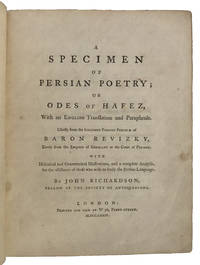
1774ME1081London:: Printed and Sold at No. 76 Fleet-Street 1774. 1774. 4to. iv xv 1 68 pp. Original full calf gilt spine; neatly rebacked to style preserving original endsheets. Inscribed by an early owner "This Book belonging to Monsieur Pierre Monneron." Extremely rare. This is the first edition in English of the ghazals of Hafez translated by one of the leading Persian orientalists of his day John Richardson FAS of Wadham College Oxford and famous for his seminal work written in conjunction with Sir William Jones the work being A Dictionary Persian Arabic and English 1777. / Hafez was previously unknown to the western world until Count Karl Emerich Reviczky von Revisnye 1737-1793 the Hungarian Orientalist and bibliophile 'discovered' him and brought his poetic classic to Europe with this Vienna printing. The work features an extensive text on Hafez and a translation of selected ghazals . Reviczky von Revisnye also issued in 1784 1794 a catalogue of his Greek and Latin library using the pseudonym of "Periergus Deltophilus". In the prefatory essay for that volume he shows an interest in the printing of Nicolas Jenson Aldus Manutius and the Estiennes. / Hafez was born in Shiraz Persia and lived approximately from 1325/26–1389/1390. He is considered a mystic and poet. His life and poems are the subject of much analysis commentary and interpretation influencing post-fourteenth century Persian writing more than any other author. FULL TITLE: A Specimen of Persian Poetry; or Odes of Hafez With an English Translation and Paraphrase. Chiefly from the Specimen Poeseos Persicae of Baron Revizky Envoy from the Emperor of Germany to the Court of Poland. With Historical and Grammatical Illustrations and a complete Analysis for the assistance of those who wish to study the Persian language. Printed and Sold at No. 76, Fleet-Street, 1774. unknown books
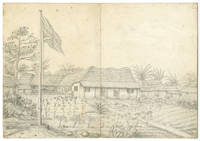
1836WRCAM52991N.p. but near present-day Prampram Ghana 1836. Three pencil sketches on wove paper each approximately 7 x 10 inches. Central vertical crease to each drawing the first two titled in a contemporary hand in pencil to verso the third similarly titled below the image. Very good. An attractive set of skillfully-executed original pencil sketches featuring British colonial structures in Prampram Gold Coast present-day Ghana likely between 1819 and 1836. The sketches are titled in pencil as follows: "Commandant's Residence Pam Pram Gold Coast" "Lower Town Pam Pram from the Upper Town" and "Abandoned Fort at Appolonia from the Beach." <br> <br> The Union Jack flies proudly in the foreground of the sketch of the Commandant's residence. Officially Great Britain colonized the Gold Coast region from 1867 until the independence of Ghana in 1957 though the British had maintained and controlled forts along the West African coastline since long before 1867. Fort Appolonia in the extreme southwestern corner of the country had been a British trading and military outpost from 1691 until 1819 and then again from 1836 onwards when it changed hands from the British to the Dutch then back to the British again. As such if the artist here labeled Fort Appolonia as "Abandoned" he or she must have sketched the fort during the period it was shuttered between 1819 and 1836. <br> <br> A fascinating trio of original sketches offering unique views from a rarely- visualized period in British colonial affairs in West Africa. unknown books
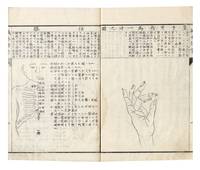
6530Numerous woodcut illustrations in the text. 31 folding leaves. 8vo orig. wrappers wrappers a little rubbed orig. block printed title label on upper cover label a little defective new stitching. Kyoto & Tokyo: 1864. First edition and rare. Imamura 1814-90 a leading doctor and historian of Japanese medicine was physician to the future Emperor Taisho when he was a youth. Imamura professor of medicine at Tokyo University found that many of the contemporary Japanese works on acupuncture had strayed from the classic teachings of the Chinese physicians. In this work Imamura makes a series of highly detailed and organized corrections to refine the fourteen meridians. The numerous striking woodcuts depict various parts of the body and pressure points. Very nice copy. Some light dampstaining. ❧ Mestler Old Japanese Medical Books I p. 297. unknown books
7485Numerous woodcut illustrations in the text. Title-page 31 folding leaves one leaf of colophon. 8vo orig. patterned blue semi-stiff wrappers orig. block-printed title label on upper cover label rubbed new stitching. Tokyo Kyoto & Osaka: 1864.<br /> First edition and rare. Imamura 1814-90 was a leading physician and historian of Japanese medicine of his period. Professor of medicine at Tokyo University he was physician to the future Emperor Taisho when he was a youth.<br /> Imamura found that many of the contemporary Japanese works on acupuncture had strayed from the classic teachings of the Chinese physicians. In this work he makes a series of corrections to refine the fourteen meridians.<br /> The numerous woodcuts depict various parts of the body and pressure points.<br /> Very nice copy. Light stain to first few leaves.<br /> ⧠Mestler Old Japanese Medical Books I p. 297. unknown books
6812Eight full-page drawings & one illus. in the text. 17 folding leaves. 8vo 243 x 165 mm. orig. blue semi-stiff wrappers some dampstaining to upper portion of each leaf. Japan: mid-Edo. Kagawa 1683-1755 a member of the medical family dynasty studied in Kyoto with Ryozan Goto and Jinsai Ito from whom he learned moxibustion and the therapeutic value of the waters of hot springs. Kagawa established the successful Ippondo medical school and was one of the most enthusiastic practitioners of moxibustion of his time. There is another manuscript of this text at Kyoto University attributed to Kagawa. Some of the illustrations are very different. The introductory remarks describe the importance of the precise placement of the moxa on the skin how to measure the placements based on distance from certain bones or joints of the body and the various techniques and occasions for moxibustion applications. Following this the text precisely describes the moxibustion locations on the body and how to locate each one with references to Simiao Sun's classic text Qian jin fang Essential Prescriptions Worth a Thousand Gold Pieces compiled in 650-59. Kagawa lists many diseases and injuries for which moxibustion is appropriate. There is a most interesting section on how to treat unsuccessful moxibustion procedures application of certain ointments etc. The attractive illustrations depict moxibustion loci on an osteological background and loci on the stomach arms legs and feet. As mentioned above there is dampstaining to the upper fifth of each leaf but all the characters remain completely legible. unknown books
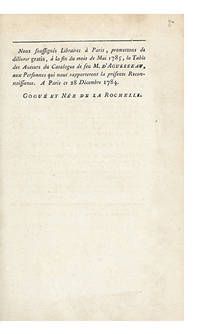
5858xxxvi 366 pp. one leaf but lacking as is often the case the 12-page schedule of sale & the 80-page author index. 8vo cont. speckled calf two corners a bit worn joints a little cracked but strong flat spine gilt red morocco lettering piece on spine. Paris: Gogué & Née de la Rochelle 1785. The rare sale catalogue of the great library of books and early manuscripts many illuminated founded by Henri François d'Aguesseau 1668-1751 Chancellor of France a man of great learning. According to the preface of the catalogue he had acquired the collection of the poet Florent Chrestien 1541-1596 and his son Claude b. 1567. His library passed to his second son Jean Baptiste Paulin d'Aguesseau Marquis de Mannoevre 1701-84 who considerably enlarged it. Between the two generations they created a most remarkable collection. The father and son employed fifteen versions of their coat-of-arms on their bindings. The sale included 5583 lots and was sold over a 57-day period. Payne and the Marquis de Méjanes were major buyers. Very good copy with some minor foxing. Short tear due to a paper flaw to title but with no loss of text. Bookplate of the great French bookseller Georges Heilbrun. As mentioned above this copy lacks - as does the Grolier Club copy - the schedule of sale and index but it does have a final leaf in which the auctioneers promise to deliver the index at no charge by the end of May 1785 to anyone who requests a copy. ❧ Gustave Brunet Dictionnaire de Bibliologie Catholique col. 405-"cette vaste réunion d'ouvrages importants." Grolier Club Printed Catalogues of French Books Auctions.1643-1830 318-lacking both the schedule of sale and author index. Guigard II p. 173. Peignot p. 76. unknown books
169619590Lugduni Batavorum: Hackium Boutesteyn Vivie Vander AA & Lucthmans 1696. Two volumes bound in one of this first collected edition of Giraldi's works; 20 772 26 928 30 pages Index Rerum et Verborum 1 page Catalogus Amicorum Lilii Quorum Meminit in epistola Direptionis Urbanae.; paginated in two columns except for the 'Varia' section; collated complete; text printed double-column; engraved illustrated frontispiece 7 full page and 2 double-page plates beautifully accomplished by Avele after Botard superb engravers' work with full and lively compositions realistically posed and drawn with action; title page with publishers' woodcut ornament and printed in red and black; the text with title and endpiece ornamentation and initial ornamentation as well nicely printed and with good wide margins; 11th ed. Britannica cites Giraldi Giglio Gregorio Lilius Gregorius Gyraldus 1470-1552 Italian scholar and poet born at Ferrara ".where he early distinguished himself by his talents and acquirements. he removed to Naples hwere he lived on familiar terms with Jovianus Pontanus and Sannazaro; and subsequently to Lombardy where he enjoyed the favour of the Mirandola family. At Miland in 1507 he studied Greek under Chalcondylas; and shortly afterwards at Modena he became tutor to Ercole afterwards Cardinal Rangone. About the year 1514 he removed to Rome where under Clement VII he held the office of apostolic protonotary; but having in the sack of that city 1527 which almost coincided with the death of his patron Cardinal Rangone lost all his property he returned in poverty once more to Mirandola whence again he was driven by the troubles consequent on the assassination of the reigning prince in 1533. The rest of his life was one long struggle with ill-health poverty and neglect; and he is alluded to with sorrowful regret by Montaigne in one of his Essais i. 34 as having like Sebastian Castalio ended his days in utter destitution. He died at Ferrara.a man of very extensive erudition; and numerous testimonies to his profundity and accuracy have been given both by contemporary and by later scholars. His Historia. marked a distinctly forward step in the systematic study of classical mythology; and by his treatises De Annis et Mensibus and on the Calendarium. he contributed to bring about the reform of the calendar which was ultimately effected by Pope Gregory XIII.Giraldi was also an elegant Latin poet."; approximately 15" tall by 10"; bound in full probably contemporary leather; seven raised spine bands gilt floral roll tool rectangles with fruit & leafy spray devices at corner of inner box surrounding a heavily-impressed and complex gilt central device with heroic figure surrounded by winged angel figures & cherubs figure holding a spear and a book shield below with cross device and the motto Sic Itur Ad Astra onward to the heavens; all edges tinted red; spine leather covering 1/3 gone very charred and worn; both boards still attached and the binding firm; first leaves a bit maladjusted at the inner margin from the heaviness of the binding pulling at them; text block with some spotting and darkening section at back with old bit of creasing at top corners; nevertheless mostly very fresh and clean free from markings or wear; in good condition and worthy of a rebacking or rebinding. First Edition. Leather Binding. Good. Hackium, Boutesteyn, Vivie, Vander AA, & Lucthmans books
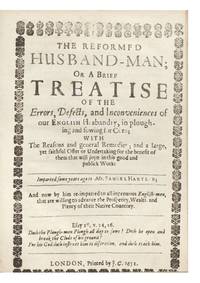
6509Title within typographical border shaved at foot. 2 p.l. 14 pp. one blank leaf. Small 4to attractive antique panelled calf some shaving to bottom line or catchwords on several pages spine gilt red morocco lettering piece on spine. London: Printed by J.C. 1651. First edition. "The Reformed Husbandman.is sometimes attributed to Speed although it was probably written by Cressy Dymock.It is a pamphlet of some 16 pages and full of moral reflections a melodious exhortation to industry."-Fussell I p. 45. "The most visible impact of Hartlib's circle lay in the numerous pamphlets that he published.They comprised letters and treatises solicited or received from individuals in his circle upon a particular subject which had then been circulated for additional comments the results edited and then launched upon the public often without the express consent of the original author anticipating utility and inviting comment and amendment.His treatises spread a solvent of new ideas in a variety of contexts but they were particularly successful in husbandry. He publicized the advantages of planting new leguminous crops experimenting with fertilizers and manures and using seed drills and new ploughs and advocated the possibilities of apiculture rabbit farming fruit-tree propagation and silk cultivation in Virginia. His network included a group of innovative farmers willing to experiment. But his pamphlets should also be read as ideas models or patterns as to how the processes of reformation would occur. "-ODNB. Very good copy. Small rust-hole on one leaf. unknown books
7077Many fine brush & black ink illus. in the text. 45 folding leaves. 8vo 245 x 170 mm. orig. wrappers wrappers somewhat soiled old stitching. Japan: at end in trans.: "copied in 1807." We learn from the first leaf of the index at the beginning of this manuscript that this is a later copy of a unpublished manuscript by Hori 1725-62 a native of Kyoto whose father was also a prominent physician. Hori began to lecture in 1758 but died early. In this work Hori provides a guide to finding pressure points for acupuncture based on bone measurement. Using bone length measurement for the measurement of acupoints location is called the "bone length method." Hori was remarkable for his unique and influential expansion of this method by incorporating the "twelve zodiac method" in establishing pressure points on the body and determining whether the meridian is open at a certain moment. The text makes many references to the classics of Chinese and Japanese acupuncture. For each of the 14 meridians Hori has listed their pressure points the organs to which they are associated illnesses etc. The fine illustrations depict the meridians and pressure points. Fine copy. Minor staining in upper margin and a little wormed. unknown books
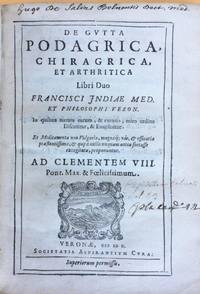
1600M13168Verona: Societatis Aspirantium cura 1600. 1600. Two parts in 1. Small 4to. xxiv 118 1 pp. Printer's woodcut device 5 snakes over landscape woodcut initials and tailpiece rear errata & colophon; old ink marginalia p.36 underlining pp. 97-99. Original vellum; lacks ties. Ownership inscription on title: Hugo De Salins Belnensis Doct. Med. d.1659 and another signature obscured. Bookplate of Château de Montrevost Cuisery France. EARLY SEVENTEENTH CENTURY WORK ON GOUT & RHEUMATOID ARTHRITIS: : HUGUES DE SALINS' COPY. First edition of this rare work on the nature cause and treatment of rheumatoid arthritis and gout. The status of gout in the late sixteenth century was such that gout was said by Turberville to be found in "horses capons and falcons." p. 64. John Gerard's Herball 1597 stated that Gout-wort or Herba Gerardi was a native herb that could be used with some benefit supported further by Culpeper. According to Copeman Thomas Sydenham 1624-1689 suffered from gout and wrote the classic description of the disease and was the first to be able to differentiate between rheumatoid arthritis and gout. The present work was written decades earlier. Francesco India cites Galen Chap. 1 Ambroise Pare Chap. 12 and Jean Fernel Chapters 5 7 8. India makes two 15-page tables of causes which he uses to organize his data. <br /><br /> PROVENANCE: Hugues de Salins: The British Library catalogue lists a "Hugues de Salins; see: Jean Baptiste de Salins Defense du vin de Bourgogne 1704." This may be a descendent. See: Societe d'Histoire d'Archeologie et de Litterature de l'arrondissement de Beaune Memoires annee 1890 Volumes 15-16 Beaune 1891 pp. 75 177. Mentions the wife of Hugues de Salins as buried in 1626 and Hugues de Salins buried in 1659. <br /><br /> Francisci Indiae an Italian philosopher and physician who is little known wrote the present work and two others: Hygiphylus: sive de febre maligna dialogus 1593. Hygiophilvs Tertivs Vel De Symptomatvm Febri Malignae Svper 1599. See: Frederic Paulhan Catalogue des legs Gide & Teissier-Rolland 1892 p. 212. Showing a copy of Strabo's Strabonis rerum geographicarum libri XVII 1571 with the same provenance inscription is this book. This inscription must date prior to 1892. <br /><br /> Copeman W.S.C. A Short History of the Gout and the Rheumatics Diseases pp. 53 64. Locations: British Library; Edinburgh University; Middle Temple Library; Wellcome Library. Societatis Aspirantium cura, 1600. hardcover books
6126Engraved frontis. viii 47 pp. 8vo later wrappers title a little browned uncut. London: Printed for W. Parker. 1777. First edition of "an important milestone in the early literature of gas analysis.Magellan 1722-90 was an Augustinian prior who emigrated to England and Protestantism in 1764. Elected F.R.S. 1774 he published this account of his researches on gases addressed to Joseph Priestley. The glass apparatus for impregnating water with fixed air carbon dioxide is described in detail. Newly improved by 'Mr. Parker' the apparatus was superior to that used by Priestley and described by him in 1772. Carbon dioxide was prepared by dissolving marble calcium carbonate in dilute sulphuric acid. Magellan also describes three new types of eudiometer he had designed; these and the apparatus for making carbonated waters are illustrated in the frontispiece."-Neville II p. 125. Very nice copy inscribed by Magellan at the head of the title-page: "Comte de Castelbourgh par L'Auteur." The attractive frontispiece depicts 24 figures of apparatus. ❧ D.S.B. IX pp. 5-6. unknown books
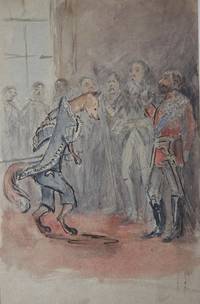
18800064001880-1917. Full Morocco. Very Good. Oblong 21 by 30 cm. 92 numbered leaves with content with log entries more or less statistical on all the versos and pictures and/or original drawings mostly mounted on 58 rectos with some additional loose material. 129 numbered leaves in all. Several of the log pages have mounted photos obscuring the log as it is clear that this game book was at some point re-purposed to be a more general album with some emphasis on sports including also fishing foxhunting and sailing but also there are two pages of photos from South Africa with photos of native tribesmen ostriches a hut Cecil Rhodes house etc. 13 original works of art -- watercolored pencil pen and ink -- in addition to numerous painted fish hook and fly vignettes these sometimes done directly onto the page. Most charming are the comical illustrations of anthropomorphic foxes. Sepia photos are of the country estates their stately homes and rural settings of the hunts as well as the people involved -- the hosts and guests during these country weekends. Many but by no means all of the photos have captions helpfully identifying the participants or the locations. And the log proper provides the names of those participating in the shooting and often what would now be regarded as obscenely large kills. Among the many aristocrats and wealthy in the photographs and/or logs are Lady Randolph Churchill Jennie Churchill Arthur Balfour Lady Minto Mary the famous 4th Countess Henry Lascelles the 5th Earl of Harewood the 5th Earl of Carnavon of King Tut fame as well as the owner of the castle used in Downton Abbey Baron Rothschild Lord de Grey Lord Ashburton Prince Murat the Duke of Buccleuch Prince Duleep de Singh Lord Rosebery and on and on. Country homes include Longleat Greystoke Castle the Hirsel Highcliffe Castle etc. Alexander McDonnell was a son of the 5th Earl of Antrim and a clerk in the House of Lords. Obviously he was very well connected and surely very popular among the upper echelons of English society back then. And we would note that many of the most illustriously titled have frequent entries here; what we have here is a window into a cohesive social network it is our sense. Condition: morocco binding has moderate to heavy wear along edges some scuffs on the boards and spine. The leaves can have a waviness the result of the interaction of the mounted material upon the leaves. A few photos are loose. There is a little bit of a scrappy quality to the book as befitting a log book that was partially turned into something much more and this quality is part of its charm as well. <br /><br /> books