7 654 résultats
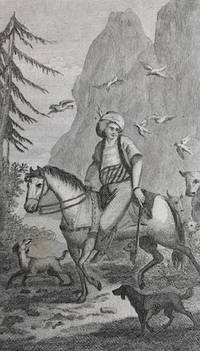
17893236<br /><p>The scarce first edition of this delightful collection of moral tales attributed to the prolific children's writer Richard Johnson. Illustrations by Bewick were added to the second and subsequent editions of which there were many including four in America in Philadelphia Wilmington and New York. The author is given on the title page as 'by the editor of the Looking Glass for the Mind' which was printed by Newbery in 1787 and which was actually by the French children's writer Arnaud Berquin. It was translated by 'J. Cooper' one of the many pseudonyms of Richard Johnson.</p><p>In his preface the editor praises Berquin and other foreign writers whose books for the juvenile market 'merit the highest encomiums' and who have humbled themselves to deal in 'the plain language of youth in order to teach them wisdom virtue and morality'. The text comprises some 23 short stories of varied length style and setting including such titles as 'Juvenile Tyranny conquered' 'The Book of Nature' 'The happy Effects of Sunday Schools on the Morals of the rising Generation' 'The Happy Villager' 'The Indolent Beauty' and 'Female Courage properly considered'. </p><i>12mo 170 x 100 mm attractive engraved frontispiece and pp. vi 212 engraved title-page vignette tear to p. 85 through text but with no loss</i> <i>in contemporary plain sheep spine cracking some scuffing to covers plain spine ruled in gilt with faded ink title headcap chipped worn at extremities with the contemporary ownership inscription of Ann Elliot on the front pastedown.</i><p>Roscoe J39 1; Osborne II 900. </p> Elizabeth Newbery
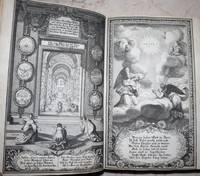
1702007452Augsburg 1702. First Edition. Full Straight-Grained Morocco. Very Good. A fine collection of highly detailed Baroque copper engravings. 8vo. 18.5 by 13 cm. 188 leaves of plates. Plates most often have two copper engraved illustrations each approximately half the page but a good number of plates two or more smaller vignettes in lieu of a larger rectangular illustration in the bottom half of the page. There are also an abundance of title pages -- these are included in the pagination -- with two title pages per section each with a frontis and also a title for the work overall. Well over 300 separate illustrations. Printing on only one side of each leaf. Condition: rubbing along joints and some other scratches and wear to straight grained morocco. Scattered foxing and/or other soiling never disconcerting fortunately. A few short-ish closed tears. unknown
19594585New York: Vanguard Press 1959. First American edition. Hardcover. Fine/fine. 8vo charcoal cloth <br/><br/>Advance Review Copy with Review Slip and glossy drawing laid in. Author's first book. Extraodinarily fresh condition. Vanguard Press hardcover
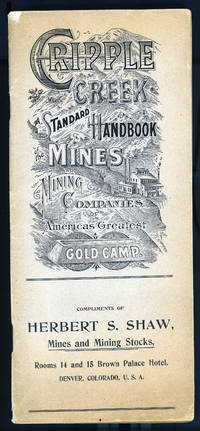
1901215<p><strong>CRIPPLE CREEK: A Standard Handbook of the Mines and Mining Companies 1901</strong> of America's Greatest Gold Camp and other Mining Camps of Colorado U.S.A. Correct To Date. Compiled from the Land Office Records and Official Reports of the Various Companies Mentioned Herein By O. R. Salmans and J. M. Auld No. 19 Midland Block Colorado Springs Colorado January 1901 App-Stott Co. Engravers and Printers Denver Colorado "Compliments of Herbert S. Shaw Mines ands Mining Stocks Rooms 14 and 15 Brown Palace Hotel Denver Colorado" printed on front cover. Handbook dimensions: 4-1/2 inches by 10-1/4 inches; 96 pages. Condition: very good plus to near fine; light chipping near spine ends; internal pages brtight and clean; complete with front and back wrappers. Stock broker's investment handbook detailing property production development and other details for mining companies throughout the Cripple Creek Gold Mining District of Colorado. Hundreds of mining companies listed. Numerous mining plat maps. One 2-page township map of the Cripple Creek Gold District.</p><p>Excellent reference for collecting Cripple Creek mining stock certificates and finding mining properties in the district. COLORADO ARTIFACTUAL.</p> App-Stott Co., Engravers & Printers paperback
196315874Garden City: Doubleday Crime Club 1963. First edition. Hardcover. Very Good/Very good . Police novel which was made into the Steve McQueen film "Bullitt". Bump on bottom front board corner. Two tiny specks at top of front free endpaper. Dust jacket with $3.50 price has a little rubbing on the rear panel. Jacket is bright except for the publisher's name at bottom of spine which is somewhat faded. <br/><br/> Doubleday, Crime Club hardcover
First Edition (?) of thisColophon on m7r: Basel: Joannes Oporinus March 1551. 2 Parts in 1 with separate titles. 8vo. pp. 188 4incl final blank; 90 30index. woodcut initials. 17th century vellum title backed repairing 2 marginal holes resulting from erasures light dampstaining in first gatherings some light foxing & a few underlines [Colophon on m7r:] Basel: Joannes Oporinus, March 1551 hardcover
19470001605ASHLAND DAYTON ORRVILLE OHIO OH. Good. 1947. On offer is an original very intriguing 1947 manuscript diary and journal of a terrible post World War II child custody case and divorce. Unique for the times this was handwritten by an unidentified rural Ohioan who may have been either a Myers or Garver as he identifies 2 uncles. The author tells of his daily life which usually revolved around his large extended family the churches he attended and automobiles which he repaired and worked on all the time though he did do other work including farming. But right from the start the reader sees a pattern begin: the first entry is January 5th where he writes he has loaded up his car went to Ashland by 6:30 pm and then slept on his mother's davenport. He is also sick with a cold that never seems to end. Other entries mention more family travels large amounts of cash buying a car selling a house long and late hours weather reports and concerns and social observations. Yet all the while in the background are his health and the ups and downs of his divorce. He appears to be ill a lot perhaps the stress he sees the doctor many tests different shots and so on. In July he is in trouble with the law who seem only too glad to give him a hard time even though he has legal counsel. A part of the diary tells of his struggles with his own child custody case in which he is trying to get custody of his child. He notes trial dates of which he was never informed. The custody case and visitation get very dramatic as his ex-wife or girlfriend tries hiding the child from him in Alabama. He travels to Jacksonville to talk to the Mayor who took him to the High School where he had traced his daughter Sylvia. He also travels to Alabama and Florida searching for his high school age daughter Sylvia. Later he went to Birmingham to enlist the help of the Sherriff. This whole case would have been very unusual for the time. He does a super job recording each and every visitor companion and family member: Uncles Charles Myers Uncle Newton Garver Woodford Howard Leroy Reynolds Glen McFern Paul Sharpe heard Dr. Davis missionary 35 years in India at a lecture sleeps at the church one night Joe Bagelys Chippewa Lakes Park Lattasburg downtown Dayton Mansfield Perrysville Jeromeville plus dozens of places on his travels. The 7 1/2" x 5" book is has a broken rear hinge but is overall G.; 16mo - over 5¾" - 6¾" tall; KEYWORDS: HISTORY OF RAILROAD RAILWAYS FIREMAN ENGINEER WYOMING STEWARTSVILLE STOKER AMERICANA HANDWRITTEN MANUSCRIPT DOCUMENT LETTER AUTOGRAPH DIARY JOURNAL LOG KEEPSAKE WRITER HAND WRITTEN DOCUMENTS SIGNED LETTERS MANUSCRIPTS HISTORICAL HOLOGRAPH WRITERS DIARIES JOURNALS LOGS AUTOGRAPHS PERSONAL MEMOIR MEMORIAL PERSONAL HISTORYantiquité contrat vélin document manuscrit papier Antike Brief Pergament Dokument Manuskript Papier oggetto d'antiquariato atto velina documento manoscritto carta antigüedad hecho vitela documento manuscrito papel. . unknown
41377Lyon. Pierre Bailly. 1645. 8vo. 8's 17cm xii590p. bound in early full dark brown calf raised bands gilt center panel decorations and gilt borders and title neat restoration to edges of binding and original spine laid down new endpapers contemporary ink signature on first prelim. and title; a very good to fine sound copy ho8.4. ~ Brunet V-795; vide Graesse VI2 p.122 vide Tchemerzine V: 866. ~ This French poet 1591-1626 was the acknowledged leader of a group of Parisian "libertines"; he was a Huguenot and a freethinker and made good use of his sharp wit in writing about the Church and the government. He wrote and produced his work on "Pyramus and Thisbe" around 1623 and wrote several satirical pieces as well as poetry. He was banished from Paris several times on grounds of blasphemy indecency etc. yet managed always to return usually under the protection of the Duc de Montmorency and in fact died in Paris. Lyon. Pierre Bailly. 1645 unknown
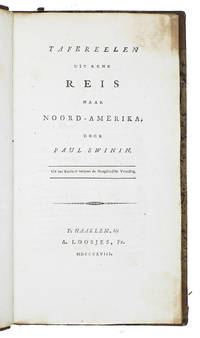
1818ABC_45491Haarlem 1818. Large 8vo. A. Loosjes Pz. Contemporary half calf marbled sides. 4 IV 127 pp. Very rare first and only edition of the only Dutch translation of a Russian description of the United States of America. The title-page notes that it is translated from the German translation 1816 and the preface notes that the first edition in Russian appeared in 1815. A second Russian edition appeared at St. Petersburg in 1818 and has sometimes been described as the first.The great Russian author Pavel Petrovic Svinyin or Svin'in here westernized to "Paul Swinin" is best known for his Sketches of Russia published in the West under the name "Suinine". The identity of the Dutch translator of the present work is unknown. It gives an interesting "picturesque" travel account of the United States spanning the year 1813 and provides five main accounts covering different subjects: a statistical survey; a religious overview with descriptions of the several Christian communities naming Methodists Quakers Shakers Baptists and more; a description of the different types of steamboats used in North America; a biography of the French general Jean Victor Moreau who lived in exile in the United States from 1805 to 1812; and a description of the dancing rituals of indigenous American "Indians" naming the Osage Arkansas Sioux and Saki tribes which the Russian author interestingly compares with tribes in the Caucasus.With the bookplate of the society Doctrina & Amicitia on the front paste-down. Some browning on the first and last few pages. Covers very slightly rubbed. Otherwise in very good condition.l NCC; Sabin 93997; WorldCat 10553560 & 656756512; not in Howgego. ABE CAT Anthropology & Ethnography unknown
6709233Edition: First . Good Condition. No Hassle 30 Day Returns Ships Daily Underlining/Highlighting: NONE Writing: NONE Publisher: Technical Department of Editorial Escudo De oro Pub Date: 7/1/1983 Binding: Paperback Pages: 95 paperback
51-5902Antwerp: colophon dated 1599. Small folio. 19 x 29.5cm. Mottled goatskin binding by the artisan binder Sasha Mosalov. Some pages stained and repaired.Lacking the title page and the engraved arms of Albert and Isabel on verso of title-page and the 1 double-page map of Brabant. 35 copper-engraved protraits by Phillipe Galle or his students after drawings by Antonio de Succa Otto Vaenius Jan Woutneel and Jan Collaert II.OCLC Number / Unique Identifier:310908849 for the 1603 edition Antwerp: colophon dated 1599 unknown
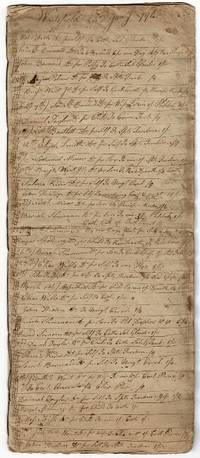
180559752Waitsfield Vermont 1805. Narrow tall folio approx. 15½" x 6¾" 112 pp. in ink five separately sewn signatures; a few pages loose some pages darkened or chipped at edges; some entries faint. This account book is the record of the practice of either Stephen Pierce or Simeon Stoddard practicing in Waitsfield Vermont between 1795 and 1806. These were the second and third physicians to have settled and practiced in Waitsfield. Most likely it is the record of Pierce who is supposed to have settled in Waitsfield in 1795. The first physician in Waitsfield Moses Heaton remained there only between 1793 and 1796. Depending on the source Pierce was the third physician to practice in Waitsfield and/or the first to practice in Moretown a settlement to the northeast of Waitsfield. He farmed as well as doctored and his farm lay mostly in Moretown his office in Waitsfield. He was a respected and successful physician who served the community in other capacities: as selectman representative delegate to the Constitutional Convention of 1814 and Assistant Judge of the County Court. One source claims that he succeeded Judge Kinne December 1 1814 and served one year and that he was a justice of the peace in Waitsfield. He died either in 1854 after living in Waterbury and Berlin Vermont or he died in Barnard in 1864. See: History of the Town of Waitsfield Vermont 1782-1908 by Matt Bushnell Jones Boston 1909 p. 182. Simeon Stoddard on the other hand was born December 12 1761 either in Saybrook Connecticut or in Waitsfield. On August 19 1784 he married Abiah Thompson who had been born in 1763 in Waitsfield. Some sources state that he moved to Waitsfield from Saybrook in 1794. He served the southwestern area of Waitsfield and died in 1841. This account book records each date of visit the householder's name the relationship of patient to householder the medicine prescribed and its price and the cost of the doctor's visit. The doctor whether it be Stoddard or Pierce treated thirty to forty patients each month and as many as fifty-six in December of 1801. He charged as little as 4 pence and as much as 42 shillings 10 pence for his services. As a comparison the tax on an acre of land in Waitsfield was 2 pence an acre. The poll tax list of 1795 showed fifty voters so the doctor seems to have treated the members of nearly every family. The diseases treated are not stated in the entries made but he seems to have prescribed antimonium tartaricum in many instances and also digitalis. Waitsfield was founded by Col. Benjamin Wait or Waite and others who were granted a charter on February 25 1782. Wait had served under Gen. Jeffery Amherst in the French and Indian Wars and had fought in the Revolutionary War. Both Waitsfield and Moretown are now somewhat renowned as the areas around Mad River a popular ski resort. Mad River has been remarkable from the settling of the area as the source of numerous sudden destructive and deadly floods. The Green Mountains the northern extent of the Appalachians rise just to the west of the town. The doctor records having treated members of the Wait family including Benjamin's wife Martha d. April 3 1804 Ezra Thomas and Gilbert. The family names of the community are listed making this a good source for early settlement history and genealogical research. Among the householders who required the doctor's services are Smolly Skinner Taylor Spalding Hitchcock Parkhurst Carpenter the family had a tannery and potash works Heaton Burdick Johnson Rider Fuller Symonds McNight Chamberlain Atherton Lyon Butterfield Barnave Osgood Foster Hobson Robinson Brun Latimer and Sherman. Many of the names appear often. unknown
2111902160200807Nagamatsu Do kura-ban N.A. Soft Cover. Fine. Volume: 1 Nagamatsu Do kura-ban paperback
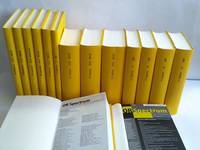
1M756Springer-Verlag Berlin 1988-2010. Zusammen ca. 6.000 S. mit jeweils zahlreichen Formeln u. Abb. Leineneinbände teilweise quart. - sehr gute Exemplare / very good condition / Ab Band 21 mit dem Untertitel: "Quantitative Approaches im Management" - unknown
a66736Paris 1564 1565 Ex officina Gabrielis Buoni in clauso Brunello. In Latin with much Greek. Two volumes. Sm4to. Attractive c. 1850 binding in 3/4 brown leather red and brown marbled boards and orange spine labels and gilt trim. All edges rouged. Tiny neat owner signature in each volume on front end paper. Volume 1: 6 240pp. 3 errata 27pp. index; bound with Ad Expositionem Disputationis de Methodo contra Thessalum Ossatum Academiae Parisiensis methodium responsio. Iacobi Carpentari Claromontani Bellouaci. 6 31p. Volume 2: 6 304pp. 3 errata 24pp. index. A few small ink notations and brown spots in text. A bit of pitting in leather on spine of vol 2. Spine labels lightly chipped on edges . Good plus light wear. 2 volumes. Very Scarce early first edition. Pictures available on request. Attractive set. . hardcover
18990001206WASHINGTON DC LEIPZIG LEIPSIC. Very Good. 1899. On offer is the original 1899 manuscript diary handwritten by Rebecca P. Warner known by one and all as Bess or Bessie who was 26 at the time. Bess the oldest of 9 children offers the reader a unique view of how a prominent wealthy Washington DC family the lived at the end of the 19th century but even more important is the very intimate interesting view of Germany during one of the country's most fascinating eras of historical development pror to World War I. Bess' father was Brainard Warner Sr. who was a lawyer but made his fortune in banking real estate and land development. His company was responsible for the oversight or building of over 1000 buildings and homes in the Washington DC area. Bess's mother was Mary Jacobs Parker Warner who was descended from Edward Doty a Pilgrim and indentured servant who sailed over on the Mayflower signed the Mayflower Compact and helped to settle Plymouth Colony. This diary describes Bess' trip with her sister Anna and brother Brainard Jr. to Leipzig Germany where Brainard Jr. was the US Consul. Bess does a super job of detailing setting up house in Leipzig and also about their daily lives there. They also did a lot of traveling within Germany and she describes that as well. Research notes that the Warner family endured a lot of sadness. They lost three children at birth or very early in life. They lost their mother Mary Jacobs after the birth of Lucy who then died. They lost their son and brother Southard who committed suicide at age 33 by shooting himself while stationed as a consul in China. Then Brainard Warner Sr died two years after the death of Southard. Here are some snippets and observations from a casual reading: They went to the motette at St Thomas Kirche which was very beautiful. The church was crowded. Students belonging to a club were there. They stayed after the service and thought they might see a German wedding. They have them nearly every Saturday after motette. They got caught in the middle of a religious service. They were sitting right in front of the minister and Bess was afraid they'd get called up to do something In the evening Mrs Young telephoned to ask them over. Brainard had an engagement but Bess and Anne went. They left Leipzig for Chemnitz and went directly to the consulate where they had supper. They went with Mr Monaghan to Schellenburg where his family was summering. "This was a queer little town located on the top of a mountain" There is a beautiful castle and some old walls. Aside from that Bess thought it was an uninteresting place to spend a summer. They left on Monday. They went to a parade in honor of the King of Saxony. About 5000 men were received. They expected to see the King on horseback but he was on foot with other officers. They met Professor Gregory who showed them around some parts of the University. In the afternoon Brainard Anne and Bess called on Mrs Monroe. Brainard went out in the evening with friends. "Today is the Emperor's birthday and all the flags are out. We stood for a long time to watch the Lieut General review the officers. It was a fine sight. what little we could see though the crowd But we were nearly frozen it was so cold" Bess practiced and then went for a lesson with Herr Krause only he wasn't in. She went again at 4 pm. "He was very discouraging and said I had no independence of fingers" Bess thought it would take her several lessons to get the right finger position and that there was no royal road to piano playing. "Hard work is the only road to success in anything". She went home. They had letters from Mamma and Pa. Then they went over to hear the St Thomas Kircke choir practice such beautiful voices. They had a number of people who stopped by for visits." We actually had a count call on us Graf Laisher who was very bright and interesting. He is studying medicine at the University" He said he couldn't speak English but he was very fluent. He proceeded to show them some of his feats of exercise and they were petrified because of their rented furniture. But everything was whole when he left. In the evening Bess and Anne went to the home of Mrs Morris. They danced but it was more of a lesson for the young grandson. He fancied Bess as a teacher and so they whirled around in a circle for 2 hours. Bess wrote that dancing on the ship over was "nothing compared to my feelings after dancing in the mad German fashion" Bess Anne and Lucy went to the Catholic Church which the royal family attended. "I must say I was thoroughly disappointed in royalty as exhibited here. The king queen and two other members of the family sat in boxes on a level with the gallery of the church and just to the left of the altar. Princess Matilda is one of the coarsest people I have ever seen. She spent most of her time yawning. She must weigh at least 200 lbs. We only stayed while the King and Queen were there." The diary has approximately 141 pages of entries from January 1 1899 to August 2 1899 with some gaps in this 4" x 6 ½" diary. Overall G.; English; 12mo - over 6¾" - 7¾" tall; MAYFLOWER GENDER STUDIES TRAVEL PRE WORLD WAR I BRAINARD WARNER DOTY WOMEN'S STUDIES GERMAN ROYALTY DEUTSCHLAND ANTI SEMITISM GERMANY AUTOGRAPH HANDWRITTEN MANUSCRIPT Gründerzeit Emperor William II antiquité contrat vélin document manuscrit papier Antike Brief Pergament Dokument Manuskript Papier oggetto d'antiquariato atto velina documento manoscritto carta antigüedad hecho vitela documento Manuscrito HANDWRITTEN MANUSCRIPT DOCUMENT LETTER AUTOGRAPH DIARY JOURNAL LOG KEEPSAKE WRITER HAND WRITTEN DOCUMENTS SIGNED LETTERS MANUSCRIPTS HISTORICAL HOLOGRAPH WRITERS DIARIES JOURNALS LOGS AUTOGRAPHS PERSONAL MEMOIR MEMORIAL PERSONAL HISTORY . unknown
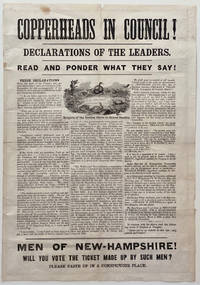
1863List1004New Hampshire: Printer Unknown 1863. First Edition. Printed broadside 16 ½ x 11 ½ inches archivally mounted and matted. A very good copy with some light toning small closed tear at upper margin light foxing at upper margin very tiny spot of loss to illustration at fold. Franklin Pierce remained politically active upon his return to New Hampshire following his presidency advocating for the Democratic cause and generally opposing the Civil War and Lincoln’s policies. This scarce pro-Union anti-slavery broadside printed for the 1863 New Hampshire elections which happened March 12 takes aim at Pierce and his fellow Democrats repeating the unfounded claim first made in 1862 by William Seward that Pierce belonged to the secret Knights of the Golden Circle the secret society formed with the goal of forming a new territory out of the CSA Mexico Central America and the Caribbean. There was never evidence that Pierce had any involvement in the KGC though the society had members in southern parts of some Union states such as Indiana Ohio Illinois and Missouri.<br /> <br /> The broadside printed for the March 12 elections quotes heavily from Pierce as well as the other Democrat candidates and party officials who were either running for office in New Hampshire or involved in politics a group which included Ira Eastman John Goerge Josiah Minot Thomas Treadwell Daniel Marcy William Burns and George Stevens. The broadside includes an engraving of coiled snakes each with these politicians named and the caption “et id omne genus.†Eastman the Democratic candidate for governor won the popular vote but lacked the constitutional majority necessary for election. Marcy was successful in his bid for the First District. “Men of New Hampshire!†the broadside asks: “Will you Vote the Ticket Made up by Such Men†with the final line imploring to “Please paste up in a Conspicuous Place.†<br /> <br /> Overall an uncommon survival from the 1863 elections. A very good copy with some light toning small closed tear at upper magin light foxing at upper margin very tiny spot of loss to illustration at fold. Quite scarce with OCLC locating two copies only at the Huntington Library and the New York Historical Society. Printer Unknown unknown
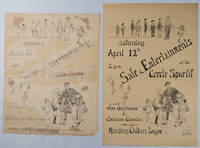
1924170069Hong Kong.: The South China Morning Post Ltd. circa1924. A fund raising poster in aid of World War I war orphans and children's charities organised by the Ministering Children's League at the Cercle Sportif Shanghai or Saigon Saturday April 12th at 3pm. 1924 76 x 50.5cm. <br>The original art work is in pencil and ink on tracing paper with some art work pasted down. It is fascinating to see the work in progress compared with the finished poster which is printed in black - on fragile paper but in very good condition. Original works from East Asia at this time are extremely scarce because of their ephemeral nature. Even though we have extensively researched this poster published by the South China Morning Post in Hong Kong there remains the possibility that this event could have taken place either in Cercle Sportif in Saigon or in Shanghai. <br> <br>Cercle Sportif Français- Shanghai. 1926 Rue Cardinal Mercier French Concession. <br>Known universally as the "French Club" this building was the home of Shanghai's most popular social and sporting clubs. Unlike the stuffier Shanghai Club and the American Club this was the most cosmopolitan club in town even extending its membership to women quelle horreur!; although to balance this madness female membership was limited to 40. The club featured a roof-top terrace for summer dances restaurants a ballroom restaurants bars billiards room and games room. For the more active there was a huge swimming pool and twenty tennis courts. <br>The clubhouse was designed by Shanghai's leading French architects Alexandre Leonard and Paul Veysseyre of Leonard Veysseyre et Kruze in the French Renaissance style. <br> <br>Cercle Sportif Saigon: The rebuilt Cercle Sportif Saïgonnais at 55 rue Chasseloup-Laubat was inaugurated on 5 December 1925 at “a brilliant reception attended by the Governor of Cochinchina and key notables of the colony.” <br> <br>According to a press release issued on 31 January 1926 by the Agence économique de l’Indochine the Cercle’s upgraded facilities included “10 tennis courts a football field with spectator stands which may rarely be found in France and comfortable buildings with rooms for fencing billiards games and reading a dance hall and vast changing rooms.” It concluded: “Saigon now has a club worthy of the colony which can easily be compared with those in Shanghai Hong Kong or Singapore.” <br> <br>The Ministering Children's League was founded by the Countess of Meath in her London house 83 Lancaster Gate February 10 1885. It owed its inception to the deep impression made upon Lady Meath about a child by M. L. Charles-worth's delightful story "Ministering Children." The idea of the book haunted her and she determined to form a society under that name. <br> <br>A small children's league thus started in a London parish would spread until it encircled the globe. It travelled quickly through the parishes of England was welcomed in Scotland and Ireland and crossed the Atlantic and rooted itself in the United States and in Canada. It had flourishing branches in Australia South Africa New Zealand and Tasmania and has penetrated to India China and Japan. As an international organisation it had no distinction of race colour or creed. . The South China Morning Post Ltd. unknown
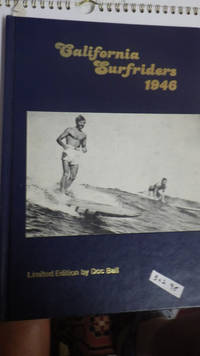
30298<p>HB NODJ ISSUED Slightly Oversized 7 3/4 wide X 10 1/2 inches tall Silver & Blue LEATHERETTE Pictorial Cover lettered in Gold Gilt with 2 Surfers on Cover 1979 2ND LIMITED EDITION.</p><p>Throughout his final years he continued to skateboard and surf without a wetsuit in Shelter Cove in Northern California. Doc had been riding waves since 1929 and wrote the classic photo book about early California surfing CALIFORNIA SURFRIDERS 1946 History & Testimony of How it Was with Surfers back in Those Days includes George Freeth 1st Man ride Surfboard Calif. Coast includes Pedro Valley Santa Cruz Malibu Venice Long Beach Hermosa Beach Windansea includes Poem Surf Fever by Doc Ball ETC about ten different surfing locations in California in the 1940s</p> Mountain & Sea Books LOS ANGELES hardcover
9707Five full-page woodcuts. 51; 58 folding leaves. Two vols. 8vo orig. semi-stiff wrappers orig. block-printed title labels on upper covers new stitching. Japan: 1737<br /> <br> <br> <br /> <br /> An illustrated record of the truly gruesome sacrifices made by the Pure Land monk TaijÅ 1685-1731. He began studying Buddhism in 1715 and in 1719 decided to become a monk leaving his wife and child as well as his elderly mother. Following the example of the master who initiated him to Buddhism TaijÅ in 1720 severed his penis and took the tonsure. Among his other exploits we note the writing of the name of Amitabha Buddha on 5000 sheets of paper and the burning of two fingers of his right hand in a ceremony. He continued with the other fingers. In 1731 in front of monks and laymen TaijÅ sacrificed his body to send it to Buddhist sites. He gouged his eyes out cut off his tongue both ears cheeks lips his twelve toes and other parts of his mouth abdomen and legs and placed the pieces on a table. They were then placed in boxes and sent out to 87 locations. TaijÅ died from his wounds.<br /> <br> <br> The biography was written by Getsusen 1691-1760 who studied with the same master as Taijo. The book was collated by HÅshÅ« 寶洲 d. 1738.<br /> <br> <br> The book has a Preface by HÅshÅ« dated 1734 and one by Getsusen 月泉 dated 1733. The colophon is dated 1734. Our book does not contain an imprint but Biography of Taijo was first published by KÅshÅdÅ å‘æ¾å ‚ in Kyoto in 1734. It was reprinted in that city in 1736 by KÅto shorin 皇都書林. The first edition contains two woodblock illustrations in its first volume: one of a mountain and one of TaijÅ reciting the Buddha’s name with burning candles on his fingerless hands and head. In the second volume there is an illustration of TaijÅ climbing onto the roof to recite the Buddha’s name underneath the moon and one of him reciting it for seven days submerged in a river in winter. The KÅto shorin edition contains only the illustration of the mountain. There is also a printing from 1737 with an unclear relationship to the two aforementioned editions. Our book contains all four illustrations gathered in the first volume plus a fifth woodcut. It might be a later printing of the 1734 edition with the material somewhat rearranged.<br /> <br> <br> Fine and fresh set.<br /> <br /> <br> <br> References<br /> <br> <br> Sekiguchi Shizuo é–¢å£éœé›„ and Miyamoto Hanae 宮本花æµ. “Dewa TaijÅ hÅshi ningyÅ nenbutsu den jÅ honkoku to kaitai†『出羽待定法師å¿è¡Œå¿µä»ä¼ä¸Šã€ç¿»åˆ»ã¨è§£é¡Œ. Gakuen å¦è‹‘ 852 2011: 15-75. unknown
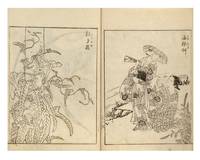
974339 leaves. Two parts in one vol. 8vo orig. patterned semi-stiff wrappers wrappers a little wormed new stitching. Osaka: Kashiwabaraya Seiemon 1764.<br /> <br> <br> <br /> <br /> First edition. SekkÅsai was an artist active in Osaka ca. 1740-50. He illustrated books and theater programs and also designed a number of prints. This is “the best of SekkÅsai’s sumi-printed books consisting of a wide range of miscellaneous pictures some in KanÅ or even ItchÅ style. The profile drawing of a girl wearing a kimono patterned with white hares and drooping willow wands is unusually winning.â€â€“Hillier The Art of the Japanese Book p. 299.<br /> <br> <br> A fresh copy with some worming occasionally repaired touching images. We do not find it offensive.<br /> <br /> <br> <br> References<br /> <br> <br> Brown Louise Norton. Block Printing & Book Illustrations in Japan. London: 1924 p. 64. unknown
19305178London: Noel Douglas. 1930 1930. First UK edition printed in the same year as the first edition in America. 185x120mm. pp. 319 1bl. Green cloth spine lettered in gold. Fading to spine. Original dustjacket torn at top and foot of spine and with chipping to corners with some slight loss and rubbing to joints of jacket. A little shaken but overall a very good copy of a rare book and extremely hard to find in the jacket no copies appearing in the auction records. Jews without Money is a semi-autobiographical work sometimes referred to as the first important Lower East Side novel and the progenitor of "an entire cycle of novels about a racialized US working class". The publisher's blurb describes it brilliantly thus: "With untrimmed speech the author's tailors gangsters and prostitutes reflect the despairing effort of the Jewish spirit to survive the degradation of American slumdom: a tragic yet humorous story of Ancient Israel struggling in the Underworld of the most modern City". An important book in the development of the American novel. London: Noel Douglas. 1930 hardcover
18670001244SS ALEPPO EUROPE MT. VESUVIUS ITALY. Good. 1867. Full-Leather. On offer is an original manuscript travel diary of a young woman who travels from America to Ireland on the S.S. Aleppo and then spends time in London and Paris before going to Italy. Stating "Bought at Dublin 12 Nov. 1867" then a later hand in pencil on the fep suggests the names of Julia L. Hale or Julia de Rubignir. Entries range from 1867 to 1868 and our diarist does a great job describing the journey from America to Ireland on the ship as well as all the places she visits. The passages of her witnessing the eruption of Mount Vesuvius and their attempt to be 'tourists' of the lava flow while in Italy are great. She adds further dimension by drawing a lovely folk art picture of the volcano in action. She also sees the Prince and Princess of Italy shortly after their marriage. Here are some snippets: We first caught sight of Vesuvius an hour and a half or two hours before we reached Naples it was then quite light and we could just see a silvery white cloud hanging over it but it became brighter and showed the fire as the day grew darker and we drew nearer. The first night at Naples we went to the Hotel Washington. I shall never forget the scene as we drove up to the door there was Vesuvius black as night except where the volcanic fires rose and fell while above the mountain a cloud hung even darker but a little on the right the full moon was just rising at first we could not see it but only its effects in the silver edges of the clouds and a lovely silver light which seemed to float up from a cloud then gradually it rose into sight flooding the whole city with light gleaming on the water in strange contrast to the reflection of the Red lights on the volcano. We could scarcely tear ourselves away from the windows that night and were very sorry to leave the Hotel the next morning but there was an odor which could not be explained away so we walked away We went ashore and went to the ruin of the temple of Jupiter we went to the amphitheatre which is believe the most perfect one in the world we killed quite a large snake which was nearly at the very top then all the others except John and I went to Solfatara which is a mountain called the back door of Vesuvius. First we went to Vesuvius and drove up as far as we could then walked about two mils till we came to the lave which was thrown up or down or both as Mary wrote. It looks something like as if very thick black or brownish mush had been boiling furiously and suddenly congealed or like a storm raging at sea. We only went about half way up but it was not considered safe to go farther but we could see the mountain perfectly of course and had a good idea of the lava. Here another accident happened while we were in the tunnels there was so much smoke and steam that the engineer was poisoned by it and first fainted and then had convulsions very badly but they fanned them with branches and after an hour or two he was well enough to go on. We then went to San Lazzaro an island about a mile and a half from Venus there is a learned and celebrated Armenian convent there the monks are all so handsome and look so intelligent we had such a lovely monk to go around with us he was very small but quite handsome he had large bright black eyes and such a merry pleasant expression he had curly black hair and wore spectacles and was very restless indeed we could scarcely glance at a thing before he would say No we will go. The most interesting things we saw were the autographs of Byron his portrait which was very handsome and the room which he occupied for three months while studying the Armenian language. Thursday morning the Prince and Princess and attendants came into town about half past ten there was a rope drawn across the grand canal just above the depot and none but private gondolas were allowed to go inside of it and our gondola was just outside and when the rope was taken away the jam was so great that no one could move scarcely the men shouted agua agua and there was the greatest hubbub and confusion and I really never saw anything so exciting in my life. Many of the hired gondolas go way ahead of the private ones ours was next but one to the prince's just before they landed so we could see them splendidly. The gondola or rather barge was finely ornamented there were a great many rowers the boys took off their hats and bowed the prince did the same to them he looked very tired and dusty he had a melancholy look as usual but we all liked him. The princess looked very pretty as usual she was dressed in a very handsome suit of dove colored silk. There were also several ladies of honor and two celebrated generals one has the highest position in the army or rather the command of the army I believe." Included is a CDV of Will Morgan who is talked about throughout the diary and was traveling with her although their connection is not fully explained in a casual reading. The spine is gone for the most part but otherwise overall G.; English; 12mo - over 6¾" - 7¾" tall; VOLCANO ERUPTIONS VESUVIUS ITALY TRAVEL EUROPE GENDER STUDIES WOMEN'S STUDIES antiquité contrat vélin document manuscrit papier Antike Brief Pergament Dokument Manuskript Papier oggetto d'antiquariato atto velina documento manoscritto carta antigüedad hecho vitela documento Manuscrito HANDWRITTEN MANUSCRIPT DOCUMENT LETTER AUTOGRAPH DIARY JOURNAL LOG KEEPSAKE WRITER HAND WRITTEN DOCUMENTS SIGNED LETTERS MANUSCRIPTS HISTORICAL HOLOGRAPH WRITERS DIARIES JOURNALS LOGS AUTOGRAPHS PERSONAL MEMOIR MEMORIAL PERSONAL HISTORY Monte Vesuvio Mons Vesuvius Pompeii Herculaneum. . hardcover
22666English. The twelve dated in pencil between 1811 and 1829. Twelve pencil portraits executed in the same extremely capable style probably for the purposes of engraving. Each on a separate piece of 4to paper. All in good condition with light signs of age and wear a couple with minor flecking with red paint. All dated in pencil between 1811 and 1829 and all but two captioned. Several of the items with watermark date supporting the pencil dating. Three of the portraits have the tiny signature at bottom left of 'Bestland' and all would appear to be the work of the same artist although the last appears to be signed with the initials 'C H'. Apparently the work of the artist and engraver Charles Bestland 1763-c.1837 otherwise Cantelowe Bestland possibly of West End Hampstead who entered the Royal Academy Schools in 1779 as 'Cantlo Bestland' and exhibited miniatures from 1783 to 1837. See the 1802 engraving by 'Cantelowe Bestland' of Henry Singleton's painting of the Royal Academicians in council. Several embossed with details of a Bath stationers and a number of the sitters from Dorset perhaps implying a West Country connection. The last of the twelve is of particular interest as it is depicts a countryman while the other eleven portraits are of members of the middle classes. The only sitter of note is the editor of the fourth edition of Encyclopaedia Britannica James Millar 1762-1827 of the Royal College of Physicians of Edinburgh lecturer at Edinburgh University. The sketch in light pencil is on a 22.5 x 18.5 cm piece of watermarked laid paper captioned in pencil at top left 'J Millar Esqr. March 20. 1823'. It shows a seated Millar in early old age in waistcoat and unbuttoned frock coat holding a book or papers in his right hand. The only other likeness of Millar noted in his entry in the Oxford DNB a crayon drawing by John Henning now in the Scottish National Portrait Gallery shows a younger Millar in profile but the set of the mouth and lower face are the same. The other eleven portraits are as follows. TWO: 28 March 1811. 'Mrs Donne' wife of Rev. Henry Donne 1767-1830 of Cranborne Dorset whose obituary see in Gent. Mag. August 1830 Seated shrewd old lady in bonnet. THREE: 20 September 1811. Head and shoulders of balding old man in buttoned jacket staring with set mouth at viewer. FOUR: 30 November 1814. 'Mrs Cooper'. Only the head of a middle-aged woman with ringlets. FIVE: 12 November 1821. 'Mr Trenchard Pickard Monday November 12 1821 at Doctors Commons' John Trenchard Pickard later John Trenchard Trenchard d.1875 of Greenhill House Dorset Seated owlish young man in stock and buttoned frock coat. SIX: 19 June 1823. 'Robert Belt Esqr' d.1839 of the Inner Temple see obituary in Gent. Mag. February 1840 Signed 'Bestland'. Self-important figure in frock coat standing with hand on hip. SEVEN: 10 November 1823. 'Mrs Bridge'. Seated portly older woman in bonnet. EIGHT: 18 October 1823. 'Mr W. Trenchard' William Trenchard d.1830 of Litchet Maltravers Dorset see his obituary Gent. Mag. January 1830 Signed 'Bestland'. Upper body of seated older man in stock and buttoned jacket calmly seated with hands clasped on lap. NINE: 21 December 1824. 'Colol. Serle'. Col. Peter Serle d.1826South Hants Militia of Montague Place Russell Square whose daughter married Horace Twiss Signed 'Bestland'. Seated balding old man flapping book on right knee. TEN: 6 October 1827. 'Mrs Pain'. Attractive younger woman in bonnet head finished with outline of body. ELEVEN: 29 April 1829. Young man in stock and buttoned jacket hair somewhat unkempt. TWELVE: October 1829. Striking image of countryman with stick cradling in his arms a broadbrimmed hat while staring at the viewer. 'At the Revd Prettyman's Sherington'. i.e. taken at the vicarage of Rev. John Pretyman sic Sherington Bucks Signed at bottom right 'C H'. English. The twelve dated in pencil between 1811 and 1829. unknown
699232 pp. 8vo 195 x 129 mm. late 19th-century marbled boards spine a bit rubbed red morocco lettering-piece on spine. Paris: Bonnefons & Henry 1818.<br/> <br/> A very scarce sale catalogue mostly priced; we locate no copy in North America. A later 19th-century pencil inscription in the present copy as well as in two other inscribed catalogues suggests that the contents of this auction belonged to the art collector Hippolyte de Livry 1765-1834 — not to be confused with the author of the same name. Our Hippolyte had previously dispersed a portion of his collection through the expert and art critic Charles Landon in 1814 one sale but in two parts Lugt 8473 & 8515.<br/> <br/> The present catalogue details 134 lots of paintings by Boilly S. Bourdon Le Brun Guido Reni B. van der Helst Lairesse Largillière Oudry Leprince van Spaendonck D. & A. Teniers Tintoretto J. Vernet Veronese Vouet etc. and various curiosities lots 119-134 including sculptures clocks vases and drawings. Each painting is listed with measurements.<br/> <br/> In very good condition. Engraved bookplate of Georges Pannier 1853-1944 the Parisian art dealer and collector of auction catalogues on the front paste-down and stamp of the Bibliothèque Heim on verso of title. <br/> <br/> ⧠Lugt 9325. unknown