15 958 résultats
6709233Edition: First . Good Condition. No Hassle 30 Day Returns Ships Daily Underlining/Highlighting: NONE Writing: NONE Publisher: Technical Department of Editorial Escudo De oro Pub Date: 7/1/1983 Binding: Paperback Pages: 95 paperback
51-5902Antwerp: colophon dated 1599. Small folio. 19 x 29.5cm. Mottled goatskin binding by the artisan binder Sasha Mosalov. Some pages stained and repaired.Lacking the title page and the engraved arms of Albert and Isabel on verso of title-page and the 1 double-page map of Brabant. 35 copper-engraved protraits by Phillipe Galle or his students after drawings by Antonio de Succa Otto Vaenius Jan Woutneel and Jan Collaert II.OCLC Number / Unique Identifier:310908849 for the 1603 edition Antwerp: colophon dated 1599 unknown
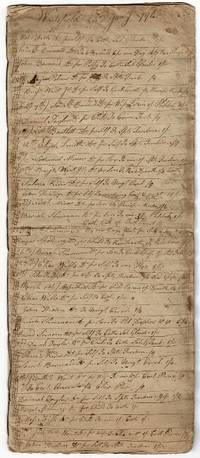
180559752Waitsfield Vermont 1805. Narrow tall folio approx. 15½" x 6¾" 112 pp. in ink five separately sewn signatures; a few pages loose some pages darkened or chipped at edges; some entries faint. This account book is the record of the practice of either Stephen Pierce or Simeon Stoddard practicing in Waitsfield Vermont between 1795 and 1806. These were the second and third physicians to have settled and practiced in Waitsfield. Most likely it is the record of Pierce who is supposed to have settled in Waitsfield in 1795. The first physician in Waitsfield Moses Heaton remained there only between 1793 and 1796. Depending on the source Pierce was the third physician to practice in Waitsfield and/or the first to practice in Moretown a settlement to the northeast of Waitsfield. He farmed as well as doctored and his farm lay mostly in Moretown his office in Waitsfield. He was a respected and successful physician who served the community in other capacities: as selectman representative delegate to the Constitutional Convention of 1814 and Assistant Judge of the County Court. One source claims that he succeeded Judge Kinne December 1 1814 and served one year and that he was a justice of the peace in Waitsfield. He died either in 1854 after living in Waterbury and Berlin Vermont or he died in Barnard in 1864. See: History of the Town of Waitsfield Vermont 1782-1908 by Matt Bushnell Jones Boston 1909 p. 182. Simeon Stoddard on the other hand was born December 12 1761 either in Saybrook Connecticut or in Waitsfield. On August 19 1784 he married Abiah Thompson who had been born in 1763 in Waitsfield. Some sources state that he moved to Waitsfield from Saybrook in 1794. He served the southwestern area of Waitsfield and died in 1841. This account book records each date of visit the householder's name the relationship of patient to householder the medicine prescribed and its price and the cost of the doctor's visit. The doctor whether it be Stoddard or Pierce treated thirty to forty patients each month and as many as fifty-six in December of 1801. He charged as little as 4 pence and as much as 42 shillings 10 pence for his services. As a comparison the tax on an acre of land in Waitsfield was 2 pence an acre. The poll tax list of 1795 showed fifty voters so the doctor seems to have treated the members of nearly every family. The diseases treated are not stated in the entries made but he seems to have prescribed antimonium tartaricum in many instances and also digitalis. Waitsfield was founded by Col. Benjamin Wait or Waite and others who were granted a charter on February 25 1782. Wait had served under Gen. Jeffery Amherst in the French and Indian Wars and had fought in the Revolutionary War. Both Waitsfield and Moretown are now somewhat renowned as the areas around Mad River a popular ski resort. Mad River has been remarkable from the settling of the area as the source of numerous sudden destructive and deadly floods. The Green Mountains the northern extent of the Appalachians rise just to the west of the town. The doctor records having treated members of the Wait family including Benjamin's wife Martha d. April 3 1804 Ezra Thomas and Gilbert. The family names of the community are listed making this a good source for early settlement history and genealogical research. Among the householders who required the doctor's services are Smolly Skinner Taylor Spalding Hitchcock Parkhurst Carpenter the family had a tannery and potash works Heaton Burdick Johnson Rider Fuller Symonds McNight Chamberlain Atherton Lyon Butterfield Barnave Osgood Foster Hobson Robinson Brun Latimer and Sherman. Many of the names appear often. unknown
2111902160200807Nagamatsu Do kura-ban N.A. Soft Cover. Fine. Volume: 1 Nagamatsu Do kura-ban paperback
in-4° pp. [8], 86 Legatura in piena pelle marrone
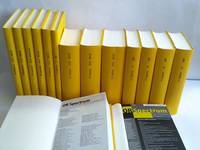
1M756Springer-Verlag Berlin 1988-2010. Zusammen ca. 6.000 S. mit jeweils zahlreichen Formeln u. Abb. Leineneinbände teilweise quart. - sehr gute Exemplare / very good condition / Ab Band 21 mit dem Untertitel: "Quantitative Approaches im Management" - unknown
166258118Graz, Widmannstetter, 9. August 1662. 4°. Titel m. Holzschn.-Bordüre u. großem Wappenholzschnitt (Doppeladler). Mit einigen Holzschn.-Bordüren bzw. -Initialen. 2 Bll., 16 S., Geheftet.
1956011155London Calder and Boyars 1956 plaquette in-12 Reliure de l'éditeur
Seltenes Werk über die franz. Gold- u. Silbermarken. Nur in 1020 numerierten Exemplaren erschienen.
Erfaßt und beschrieben sind alle, dem Verfasser in mehrjähriger Bemühung erreichbar gewordenen Arbeiten Leipziger Goldschmiede. Ein Verzeichnis derjenigen Leipziger Goldschmiede mit ihren Werken, von denen Arbeiten bekannt sind - erstmalige Zusammenstellung dieser Art - vervollständigen das Werk. Nur in kleiner Auflage gedruckt, und sehr selten.
183666509Pesth, C. A. Hartleben?s Verlag, 1834-1836. 8°. Mit 8 gefalt. Kupferstichkarten u. einem großen, mehrf. gefalt. Kupferstichplan von Konstantinopel. Zus. ca. 3.600 S., HLdr.-Bde. d. Zt. a. 4 Bünden m. Rückenverg., je 2 goldgepr. Rückenschildern u. Farbschnitt.
Äußerst seltenes und erschöpfendes Werk über die schwedische Gold-. u. Silberschmiedekunst und ihre Meister. Bd.1: Renaissance u. Barock 1520-1700. Von O. Källström u. C. Hernmarck. - Bd.2: Spätbarock u. Rokoko 1700-1780. Von C. Hernmack, A. Stevenow u. G. Munthe. - Bd.3: Gustavianischer Stil, Empire u. Romantik 1780-1850. Von C. Hernmarck u. E. Andren. - Bd.4: Abschlußband mit 9000 Markenabbildungen.
15483ABVienna?, Wiener Werkstätte?, n.d. 9 : 7 cm 10 original water-colours mounted under passepartout.
2864Moscou, 1882, un volume in 8, broché, couverture imprimée, (mouillures), (1), 104pp.
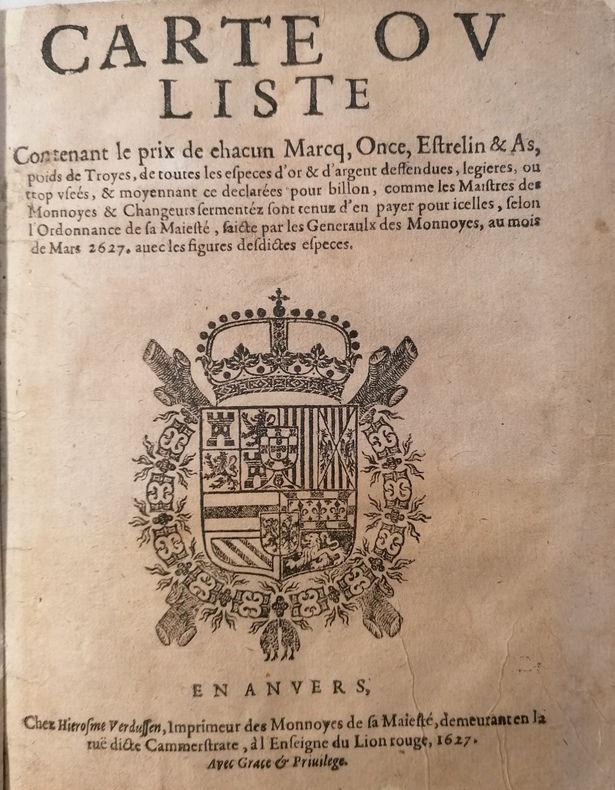
1627WOC-795Contenant le prix de chacun Marcq, Once, Eftrelin & As, poids de Troyes, de toutes les efpeces d'or & d'argent deffendues, legieres, ou trop vfeés, & moyennant ce declarées pour billon, comme les Maiftres des Monnoyes & Changeurs fermentez font tenuz d'en payer pour icelles, felon l'Ordonnance de fa Maiefté, faicte par les Generaulx des Monnoyes, au mois de Mars 2627, auec les figures defdictes efpeces. Anvers, Chez Hierofine Verduffen, Imprimeur des Monnoyes de fa Maiefté, demeutanten la ruë dicte Cammerftrate, à l'Enfeigne du Lion rouge, 1627, Avec Grace & Priuilege. In-8 (20x16cm) reliure moderne imitation demi veau ancien à coins, dos nerfs orné de fleurons doré et titre sur maroquin rouge. Ouvrage non paginé. Ouvrage contenant 3 ex-libris.
a66736Paris 1564 1565 Ex officina Gabrielis Buoni in clauso Brunello. In Latin with much Greek. Two volumes. Sm4to. Attractive c. 1850 binding in 3/4 brown leather red and brown marbled boards and orange spine labels and gilt trim. All edges rouged. Tiny neat owner signature in each volume on front end paper. Volume 1: 6 240pp. 3 errata 27pp. index; bound with Ad Expositionem Disputationis de Methodo contra Thessalum Ossatum Academiae Parisiensis methodium responsio. Iacobi Carpentari Claromontani Bellouaci. 6 31p. Volume 2: 6 304pp. 3 errata 24pp. index. A few small ink notations and brown spots in text. A bit of pitting in leather on spine of vol 2. Spine labels lightly chipped on edges . Good plus light wear. 2 volumes. Very Scarce early first edition. Pictures available on request. Attractive set. . hardcover
18990001206WASHINGTON DC LEIPZIG LEIPSIC. Very Good. 1899. On offer is the original 1899 manuscript diary handwritten by Rebecca P. Warner known by one and all as Bess or Bessie who was 26 at the time. Bess the oldest of 9 children offers the reader a unique view of how a prominent wealthy Washington DC family the lived at the end of the 19th century but even more important is the very intimate interesting view of Germany during one of the country's most fascinating eras of historical development pror to World War I. Bess' father was Brainard Warner Sr. who was a lawyer but made his fortune in banking real estate and land development. His company was responsible for the oversight or building of over 1000 buildings and homes in the Washington DC area. Bess's mother was Mary Jacobs Parker Warner who was descended from Edward Doty a Pilgrim and indentured servant who sailed over on the Mayflower signed the Mayflower Compact and helped to settle Plymouth Colony. This diary describes Bess' trip with her sister Anna and brother Brainard Jr. to Leipzig Germany where Brainard Jr. was the US Consul. Bess does a super job of detailing setting up house in Leipzig and also about their daily lives there. They also did a lot of traveling within Germany and she describes that as well. Research notes that the Warner family endured a lot of sadness. They lost three children at birth or very early in life. They lost their mother Mary Jacobs after the birth of Lucy who then died. They lost their son and brother Southard who committed suicide at age 33 by shooting himself while stationed as a consul in China. Then Brainard Warner Sr died two years after the death of Southard. Here are some snippets and observations from a casual reading: They went to the motette at St Thomas Kirche which was very beautiful. The church was crowded. Students belonging to a club were there. They stayed after the service and thought they might see a German wedding. They have them nearly every Saturday after motette. They got caught in the middle of a religious service. They were sitting right in front of the minister and Bess was afraid they'd get called up to do something In the evening Mrs Young telephoned to ask them over. Brainard had an engagement but Bess and Anne went. They left Leipzig for Chemnitz and went directly to the consulate where they had supper. They went with Mr Monaghan to Schellenburg where his family was summering. "This was a queer little town located on the top of a mountain" There is a beautiful castle and some old walls. Aside from that Bess thought it was an uninteresting place to spend a summer. They left on Monday. They went to a parade in honor of the King of Saxony. About 5000 men were received. They expected to see the King on horseback but he was on foot with other officers. They met Professor Gregory who showed them around some parts of the University. In the afternoon Brainard Anne and Bess called on Mrs Monroe. Brainard went out in the evening with friends. "Today is the Emperor's birthday and all the flags are out. We stood for a long time to watch the Lieut General review the officers. It was a fine sight. what little we could see though the crowd But we were nearly frozen it was so cold" Bess practiced and then went for a lesson with Herr Krause only he wasn't in. She went again at 4 pm. "He was very discouraging and said I had no independence of fingers" Bess thought it would take her several lessons to get the right finger position and that there was no royal road to piano playing. "Hard work is the only road to success in anything". She went home. They had letters from Mamma and Pa. Then they went over to hear the St Thomas Kircke choir practice such beautiful voices. They had a number of people who stopped by for visits." We actually had a count call on us Graf Laisher who was very bright and interesting. He is studying medicine at the University" He said he couldn't speak English but he was very fluent. He proceeded to show them some of his feats of exercise and they were petrified because of their rented furniture. But everything was whole when he left. In the evening Bess and Anne went to the home of Mrs Morris. They danced but it was more of a lesson for the young grandson. He fancied Bess as a teacher and so they whirled around in a circle for 2 hours. Bess wrote that dancing on the ship over was "nothing compared to my feelings after dancing in the mad German fashion" Bess Anne and Lucy went to the Catholic Church which the royal family attended. "I must say I was thoroughly disappointed in royalty as exhibited here. The king queen and two other members of the family sat in boxes on a level with the gallery of the church and just to the left of the altar. Princess Matilda is one of the coarsest people I have ever seen. She spent most of her time yawning. She must weigh at least 200 lbs. We only stayed while the King and Queen were there." The diary has approximately 141 pages of entries from January 1 1899 to August 2 1899 with some gaps in this 4" x 6 ½" diary. Overall G.; English; 12mo - over 6¾" - 7¾" tall; MAYFLOWER GENDER STUDIES TRAVEL PRE WORLD WAR I BRAINARD WARNER DOTY WOMEN'S STUDIES GERMAN ROYALTY DEUTSCHLAND ANTI SEMITISM GERMANY AUTOGRAPH HANDWRITTEN MANUSCRIPT Gründerzeit Emperor William II antiquité contrat vélin document manuscrit papier Antike Brief Pergament Dokument Manuskript Papier oggetto d'antiquariato atto velina documento manoscritto carta antigüedad hecho vitela documento Manuscrito HANDWRITTEN MANUSCRIPT DOCUMENT LETTER AUTOGRAPH DIARY JOURNAL LOG KEEPSAKE WRITER HAND WRITTEN DOCUMENTS SIGNED LETTERS MANUSCRIPTS HISTORICAL HOLOGRAPH WRITERS DIARIES JOURNALS LOGS AUTOGRAPHS PERSONAL MEMOIR MEMORIAL PERSONAL HISTORY . unknown
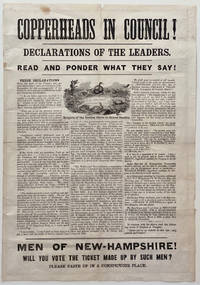
1863List1004New Hampshire: Printer Unknown 1863. First Edition. Printed broadside 16 ½ x 11 ½ inches archivally mounted and matted. A very good copy with some light toning small closed tear at upper margin light foxing at upper margin very tiny spot of loss to illustration at fold. Franklin Pierce remained politically active upon his return to New Hampshire following his presidency advocating for the Democratic cause and generally opposing the Civil War and Lincoln’s policies. This scarce pro-Union anti-slavery broadside printed for the 1863 New Hampshire elections which happened March 12 takes aim at Pierce and his fellow Democrats repeating the unfounded claim first made in 1862 by William Seward that Pierce belonged to the secret Knights of the Golden Circle the secret society formed with the goal of forming a new territory out of the CSA Mexico Central America and the Caribbean. There was never evidence that Pierce had any involvement in the KGC though the society had members in southern parts of some Union states such as Indiana Ohio Illinois and Missouri.<br /> <br /> The broadside printed for the March 12 elections quotes heavily from Pierce as well as the other Democrat candidates and party officials who were either running for office in New Hampshire or involved in politics a group which included Ira Eastman John Goerge Josiah Minot Thomas Treadwell Daniel Marcy William Burns and George Stevens. The broadside includes an engraving of coiled snakes each with these politicians named and the caption “et id omne genus.†Eastman the Democratic candidate for governor won the popular vote but lacked the constitutional majority necessary for election. Marcy was successful in his bid for the First District. “Men of New Hampshire!†the broadside asks: “Will you Vote the Ticket Made up by Such Men†with the final line imploring to “Please paste up in a Conspicuous Place.†<br /> <br /> Overall an uncommon survival from the 1863 elections. A very good copy with some light toning small closed tear at upper magin light foxing at upper margin very tiny spot of loss to illustration at fold. Quite scarce with OCLC locating two copies only at the Huntington Library and the New York Historical Society. Printer Unknown unknown
1863List1004New Hampshire: Printer Unknown 1863. First Edition. Printed broadside 16 ½ x 11 ½ inches archivally mounted and matted. A very good copy with some light toning small closed tear at upper margin light foxing at upper margin very tiny spot of loss to illustration at fold. Franklin Pierce remained politically active upon his return to New Hampshire following his presidency advocating for the Democratic cause and generally opposing the Civil War and Lincoln's policies. This scarce pro-Union anti-slavery broadside printed for the 1863 New Hampshire elections which happened March 12 takes aim at Pierce and his fellow Democrats repeating the unfounded claim first made in 1862 by William Seward that Pierce belonged to the secret Knights of the Golden Circle the secret society formed with the goal of forming a new territory out of the CSA Mexico Central America and the Caribbean. There was never evidence that Pierce had any involvement in the KGC though the society had members in southern parts of some Union states such as Indiana Ohio Illinois and Missouri.<br /> <br /> The broadside printed for the March 12 elections quotes heavily from Pierce as well as the other Democrat candidates and party officials who were either running for office in New Hampshire or involved in politics a group which included Ira Eastman John Goerge Josiah Minot Thomas Treadwell Daniel Marcy William Burns and George Stevens. The broadside includes an engraving of coiled snakes each with these politicians named and the caption "et id omne genus." Eastman the Democratic candidate for governor won the popular vote but lacked the constitutional majority necessary for election. Marcy was successful in his bid for the First District. "Men of New Hampshire!" the broadside asks: "Will you Vote the Ticket Made up by Such Men" with the final line imploring to "Please paste up in a Conspicuous Place." <br /> <br /> Overall an uncommon survival from the 1863 elections. A very good copy with some light toning small closed tear at upper magin light foxing at upper margin very tiny spot of loss to illustration at fold. Quite scarce with OCLC locating two copies only at the Huntington Library and the New York Historical Society. Printer Unknown unknown books
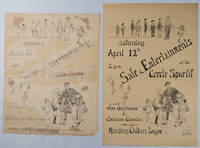
1924170069Hong Kong.: The South China Morning Post Ltd. circa1924. A fund raising poster in aid of World War I war orphans and children's charities organised by the Ministering Children's League at the Cercle Sportif Shanghai or Saigon Saturday April 12th at 3pm. 1924 76 x 50.5cm. <br>The original art work is in pencil and ink on tracing paper with some art work pasted down. It is fascinating to see the work in progress compared with the finished poster which is printed in black - on fragile paper but in very good condition. Original works from East Asia at this time are extremely scarce because of their ephemeral nature. Even though we have extensively researched this poster published by the South China Morning Post in Hong Kong there remains the possibility that this event could have taken place either in Cercle Sportif in Saigon or in Shanghai. <br> <br>Cercle Sportif Français- Shanghai. 1926 Rue Cardinal Mercier French Concession. <br>Known universally as the "French Club" this building was the home of Shanghai's most popular social and sporting clubs. Unlike the stuffier Shanghai Club and the American Club this was the most cosmopolitan club in town even extending its membership to women quelle horreur!; although to balance this madness female membership was limited to 40. The club featured a roof-top terrace for summer dances restaurants a ballroom restaurants bars billiards room and games room. For the more active there was a huge swimming pool and twenty tennis courts. <br>The clubhouse was designed by Shanghai's leading French architects Alexandre Leonard and Paul Veysseyre of Leonard Veysseyre et Kruze in the French Renaissance style. <br> <br>Cercle Sportif Saigon: The rebuilt Cercle Sportif Saïgonnais at 55 rue Chasseloup-Laubat was inaugurated on 5 December 1925 at “a brilliant reception attended by the Governor of Cochinchina and key notables of the colony.” <br> <br>According to a press release issued on 31 January 1926 by the Agence économique de l’Indochine the Cercle’s upgraded facilities included “10 tennis courts a football field with spectator stands which may rarely be found in France and comfortable buildings with rooms for fencing billiards games and reading a dance hall and vast changing rooms.” It concluded: “Saigon now has a club worthy of the colony which can easily be compared with those in Shanghai Hong Kong or Singapore.” <br> <br>The Ministering Children's League was founded by the Countess of Meath in her London house 83 Lancaster Gate February 10 1885. It owed its inception to the deep impression made upon Lady Meath about a child by M. L. Charles-worth's delightful story "Ministering Children." The idea of the book haunted her and she determined to form a society under that name. <br> <br>A small children's league thus started in a London parish would spread until it encircled the globe. It travelled quickly through the parishes of England was welcomed in Scotland and Ireland and crossed the Atlantic and rooted itself in the United States and in Canada. It had flourishing branches in Australia South Africa New Zealand and Tasmania and has penetrated to India China and Japan. As an international organisation it had no distinction of race colour or creed. . The South China Morning Post Ltd. unknown
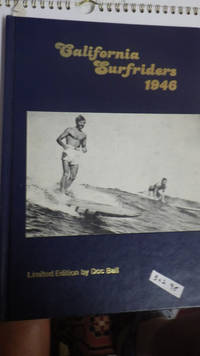
30298<p>HB NODJ ISSUED Slightly Oversized 7 3/4 wide X 10 1/2 inches tall Silver & Blue LEATHERETTE Pictorial Cover lettered in Gold Gilt with 2 Surfers on Cover 1979 2ND LIMITED EDITION.</p><p>Throughout his final years he continued to skateboard and surf without a wetsuit in Shelter Cove in Northern California. Doc had been riding waves since 1929 and wrote the classic photo book about early California surfing CALIFORNIA SURFRIDERS 1946 History & Testimony of How it Was with Surfers back in Those Days includes George Freeth 1st Man ride Surfboard Calif. Coast includes Pedro Valley Santa Cruz Malibu Venice Long Beach Hermosa Beach Windansea includes Poem Surf Fever by Doc Ball ETC about ten different surfing locations in California in the 1940s</p> Mountain & Sea Books LOS ANGELES hardcover
9707Five full-page woodcuts. 51; 58 folding leaves. Two vols. 8vo orig. semi-stiff wrappers orig. block-printed title labels on upper covers new stitching. Japan: 1737<br /> <br> <br> <br /> <br /> An illustrated record of the truly gruesome sacrifices made by the Pure Land monk TaijÅ 1685-1731. He began studying Buddhism in 1715 and in 1719 decided to become a monk leaving his wife and child as well as his elderly mother. Following the example of the master who initiated him to Buddhism TaijÅ in 1720 severed his penis and took the tonsure. Among his other exploits we note the writing of the name of Amitabha Buddha on 5000 sheets of paper and the burning of two fingers of his right hand in a ceremony. He continued with the other fingers. In 1731 in front of monks and laymen TaijÅ sacrificed his body to send it to Buddhist sites. He gouged his eyes out cut off his tongue both ears cheeks lips his twelve toes and other parts of his mouth abdomen and legs and placed the pieces on a table. They were then placed in boxes and sent out to 87 locations. TaijÅ died from his wounds.<br /> <br> <br> The biography was written by Getsusen 1691-1760 who studied with the same master as Taijo. The book was collated by HÅshÅ« 寶洲 d. 1738.<br /> <br> <br> The book has a Preface by HÅshÅ« dated 1734 and one by Getsusen 月泉 dated 1733. The colophon is dated 1734. Our book does not contain an imprint but Biography of Taijo was first published by KÅshÅdŠ呿¾å ‚ in Kyoto in 1734. It was reprinted in that city in 1736 by KÅto shorin 皇都書林. The first edition contains two woodblock illustrations in its first volume: one of a mountain and one of TaijÅ reciting the Buddha’s name with burning candles on his fingerless hands and head. In the second volume there is an illustration of TaijÅ climbing onto the roof to recite the Buddha’s name underneath the moon and one of him reciting it for seven days submerged in a river in winter. The KÅto shorin edition contains only the illustration of the mountain. There is also a printing from 1737 with an unclear relationship to the two aforementioned editions. Our book contains all four illustrations gathered in the first volume plus a fifth woodcut. It might be a later printing of the 1734 edition with the material somewhat rearranged.<br /> <br> <br> Fine and fresh set.<br /> <br /> <br> <br> References<br /> <br> <br> Sekiguchi Shizuo é–¢å£éœé›„ and Miyamoto Hanae 宮本花æµ. “Dewa TaijÅ hÅshi ningyÅ nenbutsu den jÅ honkoku to kaitai†『出羽待定法師å¿è¡Œå¿µä»ä¼ä¸Šã€ç¿»åˆ»ã¨è§£é¡Œ. Gakuen å¦è‹‘ 852 2011: 15-75. unknown
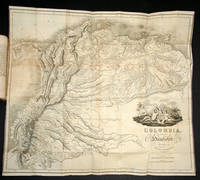
1824WRCAM35060ALondon: G. Cowie 1824. xvi208pp. plus folding map. 20th-century tan buckram spine gilt with a wax seal presumably covering a library call number. Bookplate removed from front pastedown. Light scattered foxing. A good solid copy. Published anonymously but attributed by the British Museum to John Hankshaw while THE ECONOMIC LITERATURE OF LATIN AMERICA Palau and OCLC assign authorship to Francis Hall. This record of a journey was published according to the anonymous author due to the desire "so universally felt in Great Britain of information as to the actual condition of the Republic of Colombia. The more that rich and beautiful country becomes known the greater will be the interest excited towards it among all Europeans. So extensive a field for the exercise of European industry and intelligence has not for ages presented itself." <br> <br> A travel journal composed in the form of letters the author describes the landscape the inhabitants the climate and soil natural resources commodities government and the possibilities for commerce. The highly detailed map of Greater Colombia is "taken from Humboldt and various other recent authorities." ALBERICH 1336. NAYLOR 85. SABIN 14598. PALAU 112082. G. Cowie hardcover books
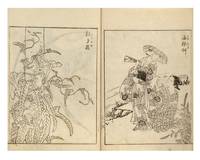
974339 leaves. Two parts in one vol. 8vo orig. patterned semi-stiff wrappers wrappers a little wormed new stitching. Osaka: Kashiwabaraya Seiemon 1764.<br /> <br> <br> <br /> <br /> First edition. SekkÅsai was an artist active in Osaka ca. 1740-50. He illustrated books and theater programs and also designed a number of prints. This is “the best of SekkÅsai’s sumi-printed books consisting of a wide range of miscellaneous pictures some in KanÅ or even ItchÅ style. The profile drawing of a girl wearing a kimono patterned with white hares and drooping willow wands is unusually winning.â€â€“Hillier The Art of the Japanese Book p. 299.<br /> <br> <br> A fresh copy with some worming occasionally repaired touching images. We do not find it offensive.<br /> <br /> <br> <br> References<br /> <br> <br> Brown Louise Norton. Block Printing & Book Illustrations in Japan. London: 1924 p. 64. unknown
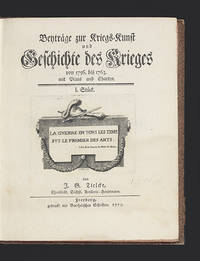
5632Finely engraved vignette on titles each different 48 engraved plates of maps plans & charts six heightened in color on 40 folding sheets & one folding printed table. Six vols. Large 4to cont. speckled boards several with minor rubbing red vellum lettering pieces on spines. Freiberg: Barthel 1775-76-78-81-84-86. First edition of this outstanding history of the German campaigns during the Seven Years' War describing the strategies employed during the conflict. Tielke 1731-87 wrote a series of works on military history and science based on his extensive theoretical knowledge as well as first-hand combat experience - he was wounded at the Battle of Torgau. Tielke not only recapitulates the decisive moments of these campaigns he also furnishes case studies regarding tactics artillery and fortification. The present work received much praise for its precise methodology presentation of arguments and judicious use of historical examples. The finely executed plates include highly detailed maps and battle-plans including those for Schweidnitz and Maxen plans and cross-sections of fortifications and charts of formations and their evolution during the course of the battles. Many of the plates contain complex diagrams highlighting trajectories and lines-of-sight and are clearly intended for the instruction of field engineers. A fine copy. ❧ A.D.B. Vol. 38 pp. 286-88. Jähns 1870f.: "Die wissenschaftliche Gründlichkeit der Beiträge die Sicherheit der Behandlung die Genauigkeit in den Angaben und nicht zum wenigsten die kluge und massvolle Art in welcher der Verfasser die geschichtliche Darstellung für seine theoretischen Anschauungen nutzbar macht verschafften dem votrefflichen Werke den lebhaften Beifall aller Einsichtigen.In so lehrreicher Weise wie dieser Ingenieur für sein Fach hat kein damaliger Taktiker Friedrichs Feldzüge für das seinige ausgebeutet.". hardcover books