15 958 résultats
19305178London: Noel Douglas. 1930 1930. First UK edition printed in the same year as the first edition in America. 185x120mm. pp. 319 1bl. Green cloth spine lettered in gold. Fading to spine. Original dustjacket torn at top and foot of spine and with chipping to corners with some slight loss and rubbing to joints of jacket. A little shaken but overall a very good copy of a rare book and extremely hard to find in the jacket no copies appearing in the auction records. Jews without Money is a semi-autobiographical work sometimes referred to as the first important Lower East Side novel and the progenitor of "an entire cycle of novels about a racialized US working class". The publisher's blurb describes it brilliantly thus: "With untrimmed speech the author's tailors gangsters and prostitutes reflect the despairing effort of the Jewish spirit to survive the degradation of American slumdom: a tragic yet humorous story of Ancient Israel struggling in the Underworld of the most modern City". An important book in the development of the American novel. London: Noel Douglas. 1930 hardcover
1928011166Paris René Kieffer 1928 In-4 Reliure éditeur
195723590ABLausanne, André et Pierre Gonin, (1957). 4°. 23 Bl. Mit zahlr. farb., z.T. ganzs. Textillust. von Hans Fischer. Lose Lagen in Orig.-Umschlag, Halbpergament-Chemise u. Schuber. + Wichtig: Für unsere Kunden in der EU erfolgt der Versand alle 14 Tage verzollt ab Deutschland / Postbank-Konto in Deutschland vorhanden +
18670001244SS ALEPPO EUROPE MT. VESUVIUS ITALY. Good. 1867. Full-Leather. On offer is an original manuscript travel diary of a young woman who travels from America to Ireland on the S.S. Aleppo and then spends time in London and Paris before going to Italy. Stating "Bought at Dublin 12 Nov. 1867" then a later hand in pencil on the fep suggests the names of Julia L. Hale or Julia de Rubignir. Entries range from 1867 to 1868 and our diarist does a great job describing the journey from America to Ireland on the ship as well as all the places she visits. The passages of her witnessing the eruption of Mount Vesuvius and their attempt to be 'tourists' of the lava flow while in Italy are great. She adds further dimension by drawing a lovely folk art picture of the volcano in action. She also sees the Prince and Princess of Italy shortly after their marriage. Here are some snippets: We first caught sight of Vesuvius an hour and a half or two hours before we reached Naples it was then quite light and we could just see a silvery white cloud hanging over it but it became brighter and showed the fire as the day grew darker and we drew nearer. The first night at Naples we went to the Hotel Washington. I shall never forget the scene as we drove up to the door there was Vesuvius black as night except where the volcanic fires rose and fell while above the mountain a cloud hung even darker but a little on the right the full moon was just rising at first we could not see it but only its effects in the silver edges of the clouds and a lovely silver light which seemed to float up from a cloud then gradually it rose into sight flooding the whole city with light gleaming on the water in strange contrast to the reflection of the Red lights on the volcano. We could scarcely tear ourselves away from the windows that night and were very sorry to leave the Hotel the next morning but there was an odor which could not be explained away so we walked away We went ashore and went to the ruin of the temple of Jupiter we went to the amphitheatre which is believe the most perfect one in the world we killed quite a large snake which was nearly at the very top then all the others except John and I went to Solfatara which is a mountain called the back door of Vesuvius. First we went to Vesuvius and drove up as far as we could then walked about two mils till we came to the lave which was thrown up or down or both as Mary wrote. It looks something like as if very thick black or brownish mush had been boiling furiously and suddenly congealed or like a storm raging at sea. We only went about half way up but it was not considered safe to go farther but we could see the mountain perfectly of course and had a good idea of the lava. Here another accident happened while we were in the tunnels there was so much smoke and steam that the engineer was poisoned by it and first fainted and then had convulsions very badly but they fanned them with branches and after an hour or two he was well enough to go on. We then went to San Lazzaro an island about a mile and a half from Venus there is a learned and celebrated Armenian convent there the monks are all so handsome and look so intelligent we had such a lovely monk to go around with us he was very small but quite handsome he had large bright black eyes and such a merry pleasant expression he had curly black hair and wore spectacles and was very restless indeed we could scarcely glance at a thing before he would say No we will go. The most interesting things we saw were the autographs of Byron his portrait which was very handsome and the room which he occupied for three months while studying the Armenian language. Thursday morning the Prince and Princess and attendants came into town about half past ten there was a rope drawn across the grand canal just above the depot and none but private gondolas were allowed to go inside of it and our gondola was just outside and when the rope was taken away the jam was so great that no one could move scarcely the men shouted agua agua and there was the greatest hubbub and confusion and I really never saw anything so exciting in my life. Many of the hired gondolas go way ahead of the private ones ours was next but one to the prince's just before they landed so we could see them splendidly. The gondola or rather barge was finely ornamented there were a great many rowers the boys took off their hats and bowed the prince did the same to them he looked very tired and dusty he had a melancholy look as usual but we all liked him. The princess looked very pretty as usual she was dressed in a very handsome suit of dove colored silk. There were also several ladies of honor and two celebrated generals one has the highest position in the army or rather the command of the army I believe." Included is a CDV of Will Morgan who is talked about throughout the diary and was traveling with her although their connection is not fully explained in a casual reading. The spine is gone for the most part but otherwise overall G.; English; 12mo - over 6¾" - 7¾" tall; VOLCANO ERUPTIONS VESUVIUS ITALY TRAVEL EUROPE GENDER STUDIES WOMEN'S STUDIES antiquité contrat vélin document manuscrit papier Antike Brief Pergament Dokument Manuskript Papier oggetto d'antiquariato atto velina documento manoscritto carta antigüedad hecho vitela documento Manuscrito HANDWRITTEN MANUSCRIPT DOCUMENT LETTER AUTOGRAPH DIARY JOURNAL LOG KEEPSAKE WRITER HAND WRITTEN DOCUMENTS SIGNED LETTERS MANUSCRIPTS HISTORICAL HOLOGRAPH WRITERS DIARIES JOURNALS LOGS AUTOGRAPHS PERSONAL MEMOIR MEMORIAL PERSONAL HISTORY Monte Vesuvio Mons Vesuvius Pompeii Herculaneum. . hardcover
22666English. The twelve dated in pencil between 1811 and 1829. Twelve pencil portraits executed in the same extremely capable style probably for the purposes of engraving. Each on a separate piece of 4to paper. All in good condition with light signs of age and wear a couple with minor flecking with red paint. All dated in pencil between 1811 and 1829 and all but two captioned. Several of the items with watermark date supporting the pencil dating. Three of the portraits have the tiny signature at bottom left of 'Bestland' and all would appear to be the work of the same artist although the last appears to be signed with the initials 'C H'. Apparently the work of the artist and engraver Charles Bestland 1763-c.1837 otherwise Cantelowe Bestland possibly of West End Hampstead who entered the Royal Academy Schools in 1779 as 'Cantlo Bestland' and exhibited miniatures from 1783 to 1837. See the 1802 engraving by 'Cantelowe Bestland' of Henry Singleton's painting of the Royal Academicians in council. Several embossed with details of a Bath stationers and a number of the sitters from Dorset perhaps implying a West Country connection. The last of the twelve is of particular interest as it is depicts a countryman while the other eleven portraits are of members of the middle classes. The only sitter of note is the editor of the fourth edition of Encyclopaedia Britannica James Millar 1762-1827 of the Royal College of Physicians of Edinburgh lecturer at Edinburgh University. The sketch in light pencil is on a 22.5 x 18.5 cm piece of watermarked laid paper captioned in pencil at top left 'J Millar Esqr. March 20. 1823'. It shows a seated Millar in early old age in waistcoat and unbuttoned frock coat holding a book or papers in his right hand. The only other likeness of Millar noted in his entry in the Oxford DNB a crayon drawing by John Henning now in the Scottish National Portrait Gallery shows a younger Millar in profile but the set of the mouth and lower face are the same. The other eleven portraits are as follows. TWO: 28 March 1811. 'Mrs Donne' wife of Rev. Henry Donne 1767-1830 of Cranborne Dorset whose obituary see in Gent. Mag. August 1830 Seated shrewd old lady in bonnet. THREE: 20 September 1811. Head and shoulders of balding old man in buttoned jacket staring with set mouth at viewer. FOUR: 30 November 1814. 'Mrs Cooper'. Only the head of a middle-aged woman with ringlets. FIVE: 12 November 1821. 'Mr Trenchard Pickard Monday November 12 1821 at Doctors Commons' John Trenchard Pickard later John Trenchard Trenchard d.1875 of Greenhill House Dorset Seated owlish young man in stock and buttoned frock coat. SIX: 19 June 1823. 'Robert Belt Esqr' d.1839 of the Inner Temple see obituary in Gent. Mag. February 1840 Signed 'Bestland'. Self-important figure in frock coat standing with hand on hip. SEVEN: 10 November 1823. 'Mrs Bridge'. Seated portly older woman in bonnet. EIGHT: 18 October 1823. 'Mr W. Trenchard' William Trenchard d.1830 of Litchet Maltravers Dorset see his obituary Gent. Mag. January 1830 Signed 'Bestland'. Upper body of seated older man in stock and buttoned jacket calmly seated with hands clasped on lap. NINE: 21 December 1824. 'Colol. Serle'. Col. Peter Serle d.1826South Hants Militia of Montague Place Russell Square whose daughter married Horace Twiss Signed 'Bestland'. Seated balding old man flapping book on right knee. TEN: 6 October 1827. 'Mrs Pain'. Attractive younger woman in bonnet head finished with outline of body. ELEVEN: 29 April 1829. Young man in stock and buttoned jacket hair somewhat unkempt. TWELVE: October 1829. Striking image of countryman with stick cradling in his arms a broadbrimmed hat while staring at the viewer. 'At the Revd Prettyman's Sherington'. i.e. taken at the vicarage of Rev. John Pretyman sic Sherington Bucks Signed at bottom right 'C H'. English. The twelve dated in pencil between 1811 and 1829. unknown
699232 pp. 8vo 195 x 129 mm. late 19th-century marbled boards spine a bit rubbed red morocco lettering-piece on spine. Paris: Bonnefons & Henry 1818.<br/> <br/> A very scarce sale catalogue mostly priced; we locate no copy in North America. A later 19th-century pencil inscription in the present copy as well as in two other inscribed catalogues suggests that the contents of this auction belonged to the art collector Hippolyte de Livry 1765-1834 — not to be confused with the author of the same name. Our Hippolyte had previously dispersed a portion of his collection through the expert and art critic Charles Landon in 1814 one sale but in two parts Lugt 8473 & 8515.<br/> <br/> The present catalogue details 134 lots of paintings by Boilly S. Bourdon Le Brun Guido Reni B. van der Helst Lairesse Largillière Oudry Leprince van Spaendonck D. & A. Teniers Tintoretto J. Vernet Veronese Vouet etc. and various curiosities lots 119-134 including sculptures clocks vases and drawings. Each painting is listed with measurements.<br/> <br/> In very good condition. Engraved bookplate of Georges Pannier 1853-1944 the Parisian art dealer and collector of auction catalogues on the front paste-down and stamp of the Bibliothèque Heim on verso of title. <br/> <br/> ⧠Lugt 9325. unknown
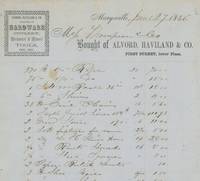
1860List2417Marysville 1860. Marysville 1850s-1860s the bulk mid-1850s. A collection of documents including eleven receipts three manuscript legal documents four manuscript documents relating to land claims; five partially printed documents relating to land claims; two letters from the US Land Office in Marysville 1858 regarding land claims; six billheads from Marysville firms with receipts for a range of goods some illustrated; one letter from Marysville written in 1853 concerning a death in a family. Generally fine condition. Fine. A mini-archive or assemblage of documents relating to the early Euro-American citizens of Marysville and its environs in the 1850s. The population of Marysville grew quickly after the town’s incorporation to 10000 by the mid-1850s due to its strategic location close to the gold fields but the levee system put in place to control flood damage limited the town’s growth beyond this initial phase. The documents here relate to Marysville in this early period of growth and include several quitclaim land deeds as well as illustrated billheads. As a group they offer an ephemeral record of the city in its early period with the legal documents and deeds showing the means with which the area was settled. A well preserved group overall. unknown
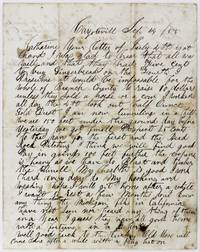
18553206Coyoteville: September 12 1855. Very good. 2pp. plus integral blank. Original mailing folds moderate toning staining and ink spotting but still easily readable. Bottom fourth of integral blank excised. An informative Gold Rush letter about mining in the long-vanished ghost town of Coyoteville which was an extraordinarily rich gold area for a couple of years in the early 1850s. A noted tunneling method nicknamed "coyoteing" was developed in the town and subsequently inspired the name of the town. In the present letter Moses Pine writes to "Catherine" in Branch County Michigan and signs his name simply as "Mose Esq" at the conclusion. The author informs Catherine presumably his wife or sister of his activities some of the economic realities and some of the practical details of prospecting for gold in California. Presuming that "it would be impossible for the whole of Branch County to raise $10 unless they sell a horse" Pine comments that he had ginger bread on the Fourth of July after working all day and yielding a "half Ounce Gold Dust." He then provides a detailed description of his mining: "I am now tunneling in a hill. We are 150 feet under the ground. Day before yesterday we got small respect 25 cents to the pan for the first and the bed rock pitching. I think we will find good pay in the going 100 feet further the expense is heavy as we have to blast and timber the tunnel." Pine also talks of his health and that "I work hard every day do my cooking and baking." He then expresses his hope to get back to Michigan to "rest a few months" but knows nothing of other Michigan folks in California: "Have not seen nor heard anything of them in a year. I guess they have all gone home with a fortune in a horn. Well good luck to the lucky. Old Mose will come home after a while with a pretty hat on." A nicely-detailed letter from an unusual and obscure Gold Rush location. September 12 unknown
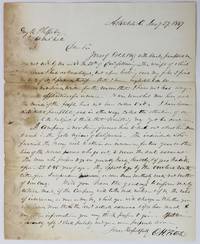
18492389Ashtabula Oh: January 29 1849. About very good. 1pp. on a bifolium. Previously folded. Light dampstaining and short closed tears along gutter somewhat affecting first few lines of text but not overall sense. An interesting letter from O.H. Field an aspirational field representative of the Connecticut Mutual Life Insurance Company in Ashtabula Ohio to the company secretary George R. Phelps inquiring about a policy for a group of men headed to the Gold Rush in California in January 1849. Connecticut Mutual was founded in Hartford three years prior to the composition of this letter in 1846. Fitch's missive begins with a report on his efforts to drum up interest in life insurance in his area with pamphlets and other materials sent to him by Phelps: <br /> <br /> "Yours of Oct 1 1849 with blanks pamphlets &c was not received by me until the 25th of Dec. following. I have not had any definitive applications for insurance. It was somewhat new here and the minds of the people had not been called to it. I have however distributed pamphlets and in other ways called the attention of our citizens to the subject. I think that something yet might be done.<br /> <br /> The letter goes on to describe a potential policy for a group soon leaving for the Gold Rush and requests a favorable rate in order to stimulate interest in policies from additional parties: <br /> <br /> "A company is now being formed to head out about ten men to work in the gold regions of California. The individuals who furnish the money wish to obtain an insurance for two years on the lives of the several persons who go out to secure the amount advanced. The men who propose to go are generally hardy healthy & of good habits & from 25 to 45 years of age. They expect to go by the overland route either from Independence Missouri or some more southerly route not south of Vera Cruz. Will you have the goodness to inform me by return mail if the company will take such risks -- & if so the rates of insurance as near as may be which you will charge -- whether you will insure more than the amt. actually advanced & if so how much & any other information you may think proper to give. If I receive a favorably sic reply I shall probably send you more proposals soon."<br /> <br /> A neat letter concerning the preparations and considerations necessary for a journey to California in the early days of the Gold Rush and the role and rise of early American insurance companies in the planning of such lengthy and dangerous overland travel. January 29 unknown
1969List910Chicago 1969. Poster. 24 x 20 inches. Minimal wear fine condition. Fine. An iconic poster protesting the arrest of the Chicago 8 on conspiracy charges relating to the protests at the 1968 Democratic Convention. The group originally as eight members consisted of Abbie Hoffman and Jerry Rubin founders of the Youth International Party YIPPIES Tom Hayden a co-founder in Students for a Democratic Society Black Panther Chairman Bobby Seale whose case would be declared a mistrial during the trial leading to his exclusion from the Chicago 7 David Dellinger and Rennie Davis members of the National Mobilization Committee to End the War in Vietnam MOBE and John Froines and Lee Weiner. The address 28 E. Jackson was a building where Rennie Davis rented a space so it is possible that the MOBE printed this though we cannot confirm. unknown
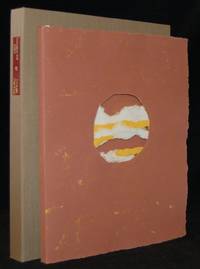
1983257195New York: Sarabande Press 1983. Limited Edition numbered 18 of 33. Disbound. Near Fine binding. Marsha Eva Gold. Signed by Clampitt Gold and the designer and printer Joe Marc Freedman on the colophon. A beautifully designed accordion binding on handmade paper designed by Marsha Eva Gold; housed in designed paper portfolio; an elegant production housed in a cloth drop-back box with marbled paper trays and maroon morocco title label;. Near Fine binding. Sarabande Press unknown books
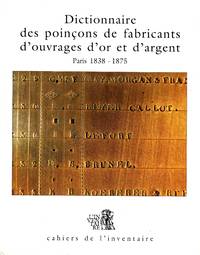
199423242Paris: Imprimerie Nationale Editions 1994. 1st. Soft cover. Fine. 10.6x8.4x1.4in. Illustrated with 3992 photographs of hallmarks of manufacturers of gold and silver works in Paris and the Seine for the period 1838-1875. Contains an index of symbols an index of surnames and an index of Paris street names. The Brumaire Law of Year VI 1797 the basis of the legislation on hallmarks still in force today is presented in its entirety in facsimile. Text in French. <br>410pp 3.90lb 10.6x8.4x1.4in Imprimerie Nationale Editions paperback
699232 pp. 8vo 195 x 129 mm. late 19th-century marbled boards spine a bit rubbed red morocco lettering-piece on spine. Paris: Bonnefons & Henry 1818. A very scarce sale catalogue mostly priced; we locate no copy in North America. A later 19th-century pencil inscription in the present copy as well as in two other inscribed catalogues suggests that the contents of this auction belonged to the art collector Hippolyte de Livry 1765-1834 - not to be confused with the author of the same name. Our Hippolyte had previously dispersed a portion of his collection through the expert and art critic Charles Landon in 1814 one sale but in two parts Lugt 8473 & 8515. The present catalogue details 134 lots of paintings by Boilly S. Bourdon Le Brun Guido Reni B. van der Helst Lairesse Largillière Oudry Leprince van Spaendonck D. & A. Teniers Tintoretto J. Vernet Veronese Vouet etc. and various curiosities lots 119-134 including sculptures clocks vases and drawings. Each painting is listed with measurements. In very good condition. Engraved bookplate of Georges Pannier 1853-1944 the Parisian art dealer and collector of auction catalogues on the front paste-down and stamp of the Bibliothèque Heim on verso of title. ❧ Lugt 9325. hardcover books
188461664Cleveland OH: S. Brainard's Sons 1884. Second edition. 4to. 11 pp. Long introduction on the verso of the title page the music with printed notes indicating stages of the battle. Thomas "Blind Tom" Wiggins Bethune 1849-1908 an African-American autistic savant and musical prodigy was born a slave on a plantation in Harris County Georgia near Columbus and began his musical career at an early age on his master's piano. At eight Tom was hired out to a promoter who toured him extensively in the United States earning prodigious sums of money; his former master took him to Europe in 1866 for a successful tour there. A series of custodial battles and other problems essentially ended Blind Tom's career in the mid-1890s. "In the wave of euphoria after Manassas Tom turned his hypersensitive ear into the music of the big-mouthed guns. He then framed these sounds with the South's triumphant version of events before composing what many believed was his masterpiece . Tom's impressionistic musical description of the battle pits the harmony of the right hand against the discord of the left. An insistent bass conjures the trudge of marching columns tonal clusters evoke the roar of cannon and musketry. A brooding soundscape then ducks weaves and punches its way into a medley of popular and patriotic songs . discord tugging at the heels of melody until it finally explodes into the chaos of a harem-scarem finale" from Deidre O'Connell's "The Ballad of Blind Tom Slave Pianist America's Lost Genius". The first edition of "The Battle of Manassas" was published in 1866 by Root & Cady in Chicago; this second edition including a catalogue of other war related pieces of sheet music available from the publisher was issued by Brainard's in 1884. Both editions are uncommon in institutional holdings and in trade. Not in Dichter & Shapiro Levy or Wolf. OCLC locates 9 copies of the first edition and 8 for the one offered here Yale Columbus State Allen County Public Detroit Public Michigan Virginia SE Illinois Library of Virginia; it's unclear how many of those still retain the color illustrated front wrapper but at least two include it. Spine with tape repairs several marginal tears to interior leaves one leaf with tape repairs not extending into text old tidelines in upper margin of several leaves not extending into text lower front wrapper chipped a good copy of a scarce printing of Blind Tom's masterpiece. Original chromolithographic wrappers illustrated with a Civil War battle scene by Goes & Quensel Lith. Chicago. 8686. <br/><br/> S. Brainard's Sons unknown books
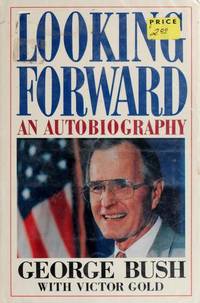
198781416New York: Doubleday 1987. First Edition stated presumed first printing. Hardcover. Very good/Good. Dave Valdez Jacket photograph. 26 cm. xii 4 270 pages. Illustrated endpapers. Illustrations. Index. Signed on Vice President of the United States bookplate on fep. Below this is a gift inscription not from Bush referencing campaign help. George Herbert Walker Bush June 12 1924 - November 30 2018 was an American politician and businessman who served as the 41st president of the United States from 1989 to 1993. A member of the Republican Party Bush also served as the 43rd vice president from 1981 to 1989 in the U.S. House of Representatives as U.S. Ambassador to the United Nations and as Director of Central Intelligence. Bush served in the navy during World War II. After the war he graduated from Yale and moved to Texas where he built a successful oil company. He won election to the 7th congressional district in 1966. President Nixon appointed Bush Ambassador to the United Nations in 1971 and as chairman of the Republican National Committee in 1973. In 1974 President Gerald Ford appointed him as the Chief of the Liaison Office to the People's Republic of China and in 1976 Bush became the Director of Central Intelligence. Bush was elected vice president in 1980 and 1984 as Reagan's running mate. In the 1988 presidential election Bush defeated Democrat Michael Dukakis becoming the first incumbent vice president to be elected president since Martin Van Buren in 1836. Bush navigated the final years of the Cold War and played a key role in the reunification of Germany. Bush presided over the invasion of Panama and the Gulf War ending the Iraqi occupation of Kuwait in the latter conflict. Publishers Weekly described this book as an early salvo in the vice-president's campaign for the White House in 1988. It describe it as a standard candidate's biography but livelier than others because Bush has held such a variety of important positions. As a young man from Connecticut and a former Navy pilot in World War II he went to Texas and made a fortune in the oil fields. After serving in the House of Representatives and two failed attempts at the U.S. Senate he served as U.S. representative to the United Nations chairman of the Republican National Committee steering the party through the Watergate scandal envoy to China in the last years of Chairman Mao and head of the CIA. Bush writes about his seven years as vice-president stressing his belief that the prime requisite of the number-two spot is loyalty and concludes by emphasizing his political conservatism. Victor "Vic" Gold September 25 1928 - June 5 2017 was an American journalist author and Republican political consultant. Gold began his career as a lawyer and advisor to the Democratic Party in Alabama before switching to the Republican Party. He worked as deputy press secretary for Senator Barry Goldwater during the 1964 presidential election and press secretary for Vice President Spiro T. Agnew from 1970 to 1973. Gold left politics for a time to work as a writer and political commentator returning in 1979 as a speechwriter to the presidential campaign of George H. W. Bush and was an advisor to Bush's 1988 and 1992 campaigns. He was the author of several published works of non-fiction. He co-wrote George H. W. Bush's 1987 autobiography and co-wrote a novel in 1988 with Lynne Cheney. Doubleday hardcover
1969List910Chicago 1969. Poster. 24 x 20 inches. Minimal wear fine condition. Fine. An iconic poster protesting the arrest of the Chicago 8 on conspiracy charges relating to the protests at the 1968 Democratic Convention. The group originally as eight members consisted of Abbie Hoffman and Jerry Rubin founders of the Youth International Party YIPPIES Tom Hayden a co-founder in Students for a Democratic Society Black Panther Chairman Bobby Seale whose case would be declared a mistrial during the trial leading to his exclusion from the Chicago 7 David Dellinger and Rennie Davis members of the National Mobilization Committee to End the War in Vietnam MOBE and John Froines and Lee Weiner. The address 28 E. Jackson was a building where Rennie Davis rented a space so it is possible that the MOBE printed this though we cannot confirm. unknown books
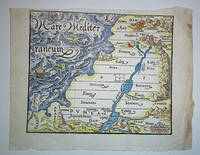
16-6432Lyon: 1568. Engraved map on old laid paper Handcolored. 14.5 X 17cm. Unevenly trimmed in upper margin. Very rare. "Pierre Eskrich born Pierre Krug and known variously as Pierre Cruche or Pierre Vase c. 1518 – c. 1590 was a French engraver illustrator and painter. Connected with humanists during the Reformation one of his major works was the 16 piece Mappe-Monde Nouvelle Papistique made in 1566 for Jean Baptiste Trento to depict the Protestant's satirical view of the Catholic world. He also illustrated an unpublished project on birds." Lyon[?]: 1568 unknown
201639593Amsterdam: Rijksmuseum 2016. Hercules Segers. Two volumes complete. THE STANDARD CATALOGUE RAISONNE OF THE PRINTS DRAWINGS AND PAINTINGS. 700 pp. Profusely illustrated with outstanding color plates. Includes seven essays and an entry for each painting and drawing and FOR EACH KNOWN IMPRESSION OF ALL OF SEGER'S PRINTS. Folios. Publisher's cloth. Original slipcase. FINE AND BRIGHT. A monumental work of scholarship and very scarce--and very rare in the original slipcase. <br/><br/> Rijksmuseum hardcover
1631026131Lugduni Batavorum Leiden Holland: Apud Franciscum Hegerum 1631. Book. Very Good. Vellum. ffep title page 26 preliminary pages 384 plus 2 misnumbered pages between pp. 244 and 245 numberd 245 and 244 respectively and 2 blank pp. between pp. 266 and 267 colophon blank rfep. Engraved title page with portrait medallion "vatis amatoris iulia sculpta manu"; author's portrait on verso of tenth preliminary leaf. Page 353 mis-number 353 and p. 361 misnumbered 369 but page sequence is correct. Vellum overlapping fore-edges Vellum is soiled spine darkened with chip in red leather label. Front hinge is split between ffep and title page but binding stitching is secure and tight. Owner's name and pencil markings on ffep. Text block is very tight pages are very clean throughout with only a corner off of leaf five and a tiny closed tear in the margin of pp. 105-106 neither of which affects the text. Two lines underscored on p. 151. Latin. Iohannis Secundi Johannes Secundus Janus Secundus Jan Everaerts 1511-1536 was a New Latin poet of Dutch nationality. He wrote elegies epigrams odes epistles epithalimia itineraries and other prose. His most famous work was Liber Basiorum Book of Kisses which is among the works in this volume. The compiler Peter Schrijver 1576-1660 was was a Dutch writer and scholar on the history of Holland and Belgium. A remarkably tight and clean copy of this very scarce book. Size: 12mo. Apud Franciscum Hegerum Hardcover
1897WRCAM43100Circle City Alaska and on a steamer between Juneau and Seattle 1897. 12pp. typed on folio sheets of onion-skin paper plus three hand-drawn maps. A total of some 6750 words. Stapled at upper edge. Three horizontal folds. Near fine. A very interesting pair of typed letters from a young man in Alaska during the Klondike Gold Rush. The anonymous author wrote these two letters to his parents describing his journey overland and by water to the Birch Creek mining district his experiences mining for gold and his decision to go into business as a merchant. The letters are written in a detailed style that indicates an educated author. They include three manuscript sketches showing the routes traversed in Alaska and provide a great deal of information about the writer's experiences in the Klondike. These letters are typed but they were likely originally handwritten by the author who later typed them and included his manuscripts maps and sketch in order to send them to his family when he arrived in Seattle or San Francisco. <br> <br> The letter dated Nov. 10 begins with a description of the writer's boat journey from Juneau to Dyea which was a popular disembarkation point for the Chilkoot Trail to Dawson City a center of the gold rush. He arrived at Dyea on April 23 and notes that "dinner at the Dyea post was the last square meal I have had up to the present date November 10." After dinner he loaded his equipment on horses for the journey inland: <br> <br> "My outfit consisted of about 1000 lbs. of provisions guns amunition sic tools for boat building a whip-saw jack-plane cross- cut saw hand saw rip saw hatchet hammer draw knife brace and bits square etc. and clothing blankets tent sheet-iron stone and in fact I think I had about every thing that ever went down the Yukon. Altogether my outfit weighed about 1302 pounds which is much more than is usually taken into the interior." <br> <br> The author spent the next several days transporting his provisions between Dyea and Lake Linderman and he includes in his letter a sketch of the route from Dyea through the valley to the lake noting several camps along the way as well as a sketch of his sled. <br> <br> The second letter dated Feb. 17 1897 was written on board the steamer Al Ki between Juneau and Seattle. He continues the narrative of his trip inland explaining that he arrived at Lake Linderman on May 14. A month later on June 14 the author and a partner their canoe loaded with provisions departed for Circle City which they reached on June 29. There they stored most of their provisions and headed for the mines in the Birch Creek region. Mining was at its height in the middle of the summer but rather than seek out a claim on their own the author and his companion Jim Wishard decided to work for other miners earning some $10 a day. He describes working at mining from 7 p.m. until 6 a.m. the long days making the task of working at night possible. In August the author bought a claim in the Harrison Creek region but decided to forego mining in favor of establishing himself as a merchant: <br> <br> "From what I could see the miners are poorly supplied with food by the two companies and there is always a great demand for luxuries; that is something out of the ordinary and even the necessaries of life. I made up my mind last summer that I could do as well bringing in some food - in other words being something of a merchant - as in any other way to start and having a good knowledge of the country and keeping my eyes open I would undoubtedly have many good chances for speculation. It is a conceded fact that one cannot lose money taking in such an outfit. Everything brings in an average profit of 400 per cent. over the original cost and whatever any one has to sell in the 'grub' line is in demand." <br> <br> The author then describes his construction of a small cabin in Circle City and his decision soon afterward to leave Alaska for the winter. He describes the trip to Dyea undertaken in January and the hardships of winter overland travel in Alaska. Included are some very practical tips: <br> <br> "In crossing water when it is thirty or forty degrees below zero one should dip his moccasins into the water very quickly taking them out before the moccasin is wet through. They will then freeze in a mass on your feet and will serve the same purpose as rubber boots. You can then walk right through water though I would not advise any one to tempt Providence too much." <br> <br> The letter concludes with a description of a recently discovered gold strike called "Bonanza" not far from the Forty Mile camp. The author describes the high hopes around the strike and includes a manuscript map of the region indicating the location of a claim in which he himself has invested. He hopes that his mine will bring him some wealth but reiterates his belief that the way to wealth in the Yukon Gold Rush is by supplying miners with goods and that he is on his way to Seattle and San Francisco to buy provisions to resell. hardcover books
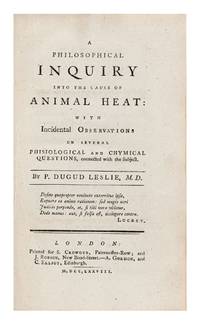
10694viii 362 pp. 8vo cont. tree calf flat spine gilt red morocco lettering piece on spine. London: S. Crowder & J. Robson 1778.<br /> <BR> <BR> First edition in English. “The greatly enlarged and only English version of Dissertatio physica inauguralis de caloris animalium causa Edinburgh 1775 by Patrick Dugud ca. 1755-1783 who changed his name to Leslie. In this work he further develops his ideas on the origin and maintenance of animal heat ascribing it to the presence of phlogiston. The second and major part pp. 91-352 discusses the nature and properties of phlogiston with good accounts of the theories of animal heat by Black Cullen Hales Lavoisier Priestley and others. The importance of this book in the history of chemistry is discussed by Partington and McKie Annals of Science 2 1937 384-387. Elected F.R.S. 1781 Leslie practiced as a physician in Durham but died prematurely at age twenty-eight.â€â€“Neville II p. 58.<br /> <BR> <BR> Very nice copy with Christie’s facsimile bookplate of Matthew Boulton sold London December 1986. Boulton 1728–1809 manufacturer and entrepreneur was a partner of James Watt in the development of the steam engine.<br /> <BR> <BR> â§ Cole 821–“The author has expanded his doctoral dissertation considerably and developed further his ideas concerning animal heat. Critical examinations are made of past and contemporary theories. Leslie gives an extended discussion of phlogiston.â€. unknown
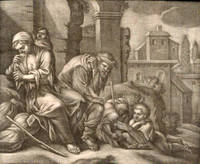
16-48891676. Mezzotint. 21.3 x 25.7 cm. On old laid paper. Very rare. Monogrammed and dated in the plate. Likely Dutch 1676 unknown
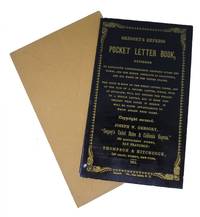
185148314San Francisco / New York: "Gregory's United States & California Express" 280 Montgomery Street / Thompson & Hitchcock 149 Pearl Street 1851. Shiny dark blue paper covers with gilt stamped lettering stapled. Buff paper mailing envelope. Wrapper insides: front instructions for use; rear 2 estimonials dated 1851 from the Panama Star newspaper. Unused Nr Fine with an envelope in similar condition. Unpaginated blank pages. 4-3/4" x 2-7/8" <br/><br/>From the inside of the front cover: "Gregory's California Express. This line one of the oldest established in the business dispatch messengers BY EVERY STEAMER leaving New-York and San Francisco in charge of Letters Parcels Packages Gold Dust and valuables for distribution throughout the United States and California. If possible letters should be directed to the care of mercantile houses or well-known residents in San Francisco or other parts of California by which means their earlier delivery may be insured. Letters directed simply to 'California' or 'at the mines' will not be forwarded as little probability exists of their reacing the persons so vaguely addressed." From the rear cover: "The Central Office of this Express is located in the throughly fire-proof building corner of Montgomery and Merchant Streets San Francisco from which the proprietor Daily dispatches Expresses by steamboat to all parts of the Mines and to Portland Oregon and Honolulu Sandwich Islands on the arrival of ecah steamer with packages from the States." A rare Gold Rush survivor documenting the 'letter & dispatch' business of the era. "Gregory's United States & California Express," 280 Montgomery Street / Thompson & Hitchcock, 149 Pearl St unknown books
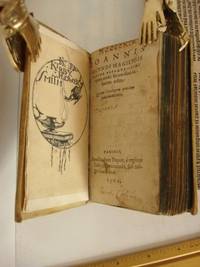
15617610Paris: Jacobum Dupuis 1561. Second edition. Vellum. Very Good. 16mo. ff.172. BOUND WITH: Marullo Michele or Marullo Tarcaniota Michele. EPIGRAMMATA & HYMNI. Paris: Jacobum Dupuis. 1561. ff.92. Title with outer margin restoration 1/2" vertical strip of later paper with a few letters of title & imprint in manuscript. 2 pages of cont. manuscript notes in German at back. Both works bound togetherin cont. vellum soiled. Large bookplate of American classical scholar Kirby Flower Smith 1862-1918. I: The second edition of the works of Secundus. Also found with the variant imprint of A. Wechelum as in both Adams S838 and BL French STC p. 397. II: Uncommon edition of the Greek scholar and Neo Latin poet Marullo 1458-1500. Not in BL French STC. Adams T145 under "Tarchaniota" and with the variant imprint of Wechelum. Jacobum Dupuis hardcover books
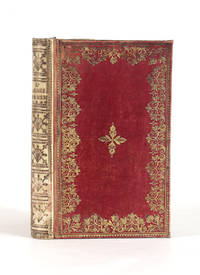
6010Decorative woodcut initials tables in the text & one large engraved folding table heightened in gold & watercolor. 3 p.l. 139 1 pp. Small 8vo cont. red vellum over boards spine faded to white sides richly decorated in gilt a.e.g. fore-edges painted & gauffered. Amsterdam: "Aux depens de la Compagnie" n.d. 1759. First edition in a most attractive decorated binding of this pioneering survey of the Prussian army. Seyfart 1727-86 a military administrator was the first to systematically compose biographies of units and generals in the Prussian army. The present work provides detailed histories of units in the order of their creation. It describes infantry cavalry dragoon hussar garrison skirmisher and grenadier units. The finely engraved and large table approximately 520 mm long notes the name of every regiment in the Prussian army at the beginning of 1759 as well as the rank of each unit's ranking officer the colors of the unit uniform many heightened in gold and the number of men and horses. At the bottom of the table Seyfart determines that the Prussian army consists of 204546 men and 38562 horses in 121 regiments. Fine copy. 18th-century engraved bookplate of Max Emanuel of Toerring-Jettenbach 1715-73 Bavarian nobleman and president of the Bavarian Academy of Sciences. hardcover books