BUSH, George with GOLD, VictorBiblio.com

15 958 résultats
1987018589New York: Doubleday & Company Inc. 1987. First Edition. hardcover. Fine in a Fine dustwrapper. Illustrated with photographs. INSCRIBED and SIGNED by the former President on the front free endpaper in December 1987: "To ---------/with Friendship/Respect and Lasting/Appreciation for helping/me 'Look Forward'/George Bush." Advance Review Copy with a letter from the publisher laid in. <br/><br/> Doubleday & Company, Inc. hardcover
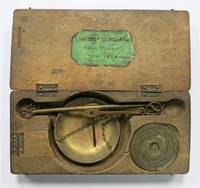
42777New York: E. Fabreguettes Fils & Morra n. d. Circa 1850. Wooden case with a hinged lid and hook clasps seller's label to inside of lid. Interior has carved compartments for the brass scale and weights including a small compartment for grain weights with a hinged lid. Light general wear to case and weights brass balances a bit tarnished. Only contains the three grain weights so perhaps others missing VG overall. Suspension gold scale made of brass with troy and grain weights. Troy weights nested ranging from 1/16 to 4 oz; grain weights include 2 6 and 10. Case: 1-11/16" x 6-11/16" x 3-1/8". Scale when hanging: ~8-1/4" x 7-1/8" brass balances 2-1/2" in diameter. <br/><br/>In 1850 the New York firm of E. Fabreguettes Fils & Morra importers of French fancy goods attempted to capitalize on the California Gold Rush by adding gold scales to their wares. Notices in several of the city's papers in late October and early November of that year including the Monday November 4th edition of The Evening Post advertised the following: "GOLD SCALES. The subscribers offer for sale the best and most approved pattern of French Standard Gold Scales adjusted exactly to the United States Mint Standard of every size and weight. These scales are so made that they take but very little compass when packed and are much more neatly and conveniently finished than either the English German or American article. As we have all that are made of this pattern parties having orders for shipment to California are solicited to examine them before purchasing elsewhere. Also for sale a variety of French fancy goods accordeons sic &c. E. Fabreguettes Fils & Morra 73 William Street up stairs." E. Fabreguettes Fils & Morra was located at 61 Maiden Lane until at least 1847 moving to their William Street address in 1848 or 1849. No later advertisements for these scales appear to have been issued in New York newspapers leading us to conjecture that the firm's venture into the gold mining market was perhaps not particularly successful. It is of course impossible to say with any certainty if this particular scale was originally used during the Gold Rush though this one here offered was purchased in California giving rise to possibility it may very well have been. In either case a nice artifact from the California Gold Rush era. E. Fabreguettes Fils & Morra unknown books
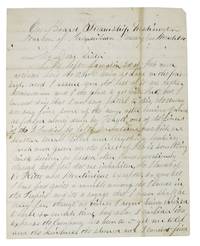
1851476391851. Now housed in an archival mylar sleeve. Age-toning especially along fold-line. Penmanship clear & easily read. Bifolium i.e. 4 pages of lined paper 23 lines per page ~ 10 words per line ~ 900 words. 9-3/4" x 7-5/8" <br/><br/>While no year is written on the ALs itself we posit 1851 as the Maritime Heritage website shows the only visit to San Francisco by the Washington was July 21 1851 arriving from Baltimore per a newspaper entry in the Daily Alta. That said per a online perpetual calender March 14th came on a Tuesday in 1852 not 1851. We lean towards 1851 as the actual year this letter was written. And this historic letter is replete with interesting content written by a man bound for the promised land of California. Chamberlin is from Boston writing a newsy letter his sister posted from the Harbor of Pernambuco Brazil March 14 where the ship in taking on supplies including coal. He describes the voyage thus far the expense of the company that sent him and the trip ahead around the Horn expecting to arrive in California in about 30 days. He describes conditions aboard the ship the places he has visited the people he has met in Brazil his own experiences with the heat and fever and more. Letters from this era are apprearing ever more infrequently on the market. unknown books
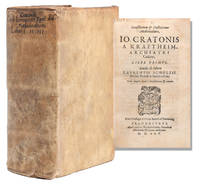
15737394Bologna: Ex Typographia Joannis Rosii 1573. First edition. Vellum. Very Good . 4to. 864pp. Woodcut device on title. Modern vellum lightly soiled hand lettered spine. A work on oratory inspired by orations of Demosthenes. All that is known of Carlo is that he was Professor of Greek at Bologna University between 1571 and 1582. Not in Adams or BL Italian STC. OCLC records 1 copy in the U. S. Ex Typographia Joannis Rosii hardcover books
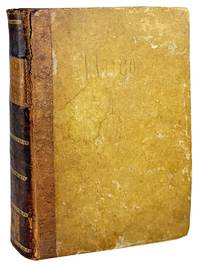
172546352Stivagii: Joannis Martini Heller Typographi & Bibliopolae 1725. Very Good. Stivagii: Joannis Martini Heller Typographi & Bibliopolae 1725. First Edition. Folio; contemporary calf over paper-covered boards with leather title label to spine; edges sprayed red; 566 8pp. index collated and complete. Contemporary library label to spine; boards lightly worn with general scuffing; cracked along top of front hinge but boards secure and binding sound; interior unmarked. A Very Good copy of a scarce title. The second volume would be published in 1731 and neither currently available in retail. Joannis Martini Heller, Typographi & Bibliopolae unknown
160927318Frankfurt Hanover & Hanover: Apud Andrea Wecheli heredes Claudium Marnium & Joann Aubrium; Parts 2 & 3 Typis Wechelianis apud Claudium Marnium & Heredes Joan. Aubrii 1609. First published 1591-94. 1 vols. Sm. 8vo. Three parts in one volume. Vellum. Some soiling and browning of vellum and text ties lacking else a very good copy with bookplate of Alfred Jerome Brown. First published 1591-94. 1 vols. Sm. 8vo. This work was ultimately completed in seven parts. <br /> 'The Polish-German physician was the personal physician to both Emperor Ferdinand and Maximilian II in Austria. He wrote several medical works and was a follower of the Galenic school of medicine. He was one of the first to study the contagiousness of certain diseases. "Sixteenth Century Books in the National Library of Medicine" 1077 for the 1591-94 edition; Osler 2387 & 2388 earlier editions Apud Andrea Wecheli heredes, Claudium Marnium & Joann Aubrium; [Parts 2 & 3] Typis Wechelianis, apud Claudium Marnium & Heredes unknown
160927318Frankfurt Hanover & Hanover: Apud Andrea Wecheli heredes Claudium Marnium & Joann Aubrium; Parts 2 & 3 Typis Wechelianis apud Claudium Marnium & Heredes Joan. Aubrii 1609. First published 1591-94. 1 vols. Sm. 8vo. Three parts in one volume. Vellum. Some soiling and browning of vellum and text ties lacking else a very good copy with bookplate of Alfred Jerome Brown. First published 1591-94. 1 vols. Sm. 8vo. This work was ultimately completed in seven parts. <br/> 'The Polish-German physician was the personal physician to both Emperor Ferdinand and Maximilian II in Austria. He wrote several medical works and was a follower of the Galenic school of medicine. He was one of the first to study the contagiousness of certain diseases. "Sixteenth Century Books in the National Library of Medicine" 1077 for the 1591-94 edition; Osler 2387 & 2388 earlier editions Apud Andrea Wecheli heredes, Claudium Marnium & Joann Aubrium; [Parts 2 & 3] Typis Wechelianis, apud Claudium Marnium & Heredes unknown books
1848DEMO015918IGand / Ghent: Chez Ve Vander Schelden 1848. First Belgian edition. Hardcover. Very Good. Small octavo 589 pages contemporary full green sheep extra gilt aeg scuffed. Inked presentation in 1912 from Rev. Francis J. Harbe: Harbe died in 1913 at age 37 in San Antonio Texas. He may have acquired this when a seminarian at Belgium in 1900. <br/><br/>Howes D286; Graff 3826; Field 1425; Sabin 82266; Smith 9549; Strathern 511:iii. "This edition seems to have been prepared by the author himself. It contains more material than the edition in English "Oregon Missions" the illustrations are different and the three maps are entirely new - Sabin 82265." It has several additional letters and an Appendix pp. 360 - 378. "Origine des Americains." Contains Fr. De Smet's description of his travels through and about the central Columbia River Plateau . he continued . to the Fort Vancouver by way of Fort Colville -- Wagner-Cam-Becker 141.2." Contains 16 plates including the pictorial title-age and 3 folding maps. Chez Ve Vander Schelden hardcover
1910010179Peking Beijing China 1910. Envelope or Cover. Very good. <p>This three-page letter is written on illustrated Chinese stationery each leaf has a different illustration measuring 5" x 9". It was sent on 29 May 1910 by a young woman in Peking Debra or Delia Seavens to her Uncle Wilson Smith in Montclair New Jersey. It is enclosed in a "red-band" envelope that is franked with a 10-cent dragon stamp Scott #129 and bears two Peking postmarks. A Peking transit mark is on the reverse along with an indistinct U.S. receiving mark. The letter was routed "Via Siberia" as indicated on the front of the envelope. A typed onion-skin enclosure is included. In nice shape. Transcript will be included.</p> <br /> <br /> <p>Ms. Seavens was serving within Peking as she references travelling out of the city with a female associate. Although the letter doesn't indicate the mission's name it was likely associated with the Anglican Society to Propagate the Gospel as at the time it had the most prominent presence in the city.<br /> </p> <br /> <br /> <p>Red-band envelopes which were prized by the Chinese for their attractiveness and as a symbol of good luck were usually reserved for sending auspicious personal or commercial messages. They were seldom used by foreigners. As explained by Ms. Seavens </p> <br /> <br /> <p style="margin-left:5%; margin-right:5%;">"Please do not be shocked by the envelope. It is truly Chinese. The proper form of address would be on the red line 'Uncle Wilson Great Man' and at one side 'Please give to Mr. Smith' with the address." She also thanks him and her aunt for a thermos bottle which she used while visiting Chinese families to provide them with untainted cold water and hot milk. </p> <br /> <br /> <p>As well she enclosed a most interesting note from her Board Secretary regarding a visit from a Chinese woman . It reads in part:</p> <br /> <br /> <p style="margin-left:5%; margin-right:5%;">"The caller was a serving woman from one of the more well-to-do- families in the village. She came on an errand when Miss Andrews and Miss Browne were both out. Following her errand she said coyly 'Would you have time to take me up stairs' It was quite evident that she was not used to stairs for she mounts it with great caution feeling of the carpet at every step. Stair carpets are interesting . . . but they can't compete with beds to one who has never dreamed of anything . . . but a k'ang. 'Oh how white and how soft' she said 'how many of you sleep here' This question was answered several times till she really took it in that we had a bed apiece. . . She was dumb founded and crawled half way under the bed to see what could be making it behave so strangely as to regain its shape when vacated. She perched gingerly on the side of a rocking chair so that I expected to see her tip over any minute. . . She picked up a book and proudly showed me that she could read a few characters and fairly swelled with pride . . . as she recited a little hymn running her fingers along the lines pretending that she was reading it. . . Then we sang. . . I hit the tune once in a while and she never by any chance did. . ."</p> <br /> <br /> <p>An original source historic philatelic and visual treasure.</p> . unknown
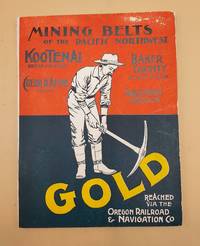
189763736Portland OR: Issued by the Passenger Department of the Oregon Railroad and Navigation Company 1897. First edition. Good. 68pp. With Map. Covers detached but present map still attached to rear wrap. There is a small abraded area in the top fore-edge corner of the title page. The map has a handful of small closed tears. Scarce. The map entitled "Oregon Railroad and Navigation Co. Map of Principal Mining Districts of the Pacific Northwest" has an inset of the "Baker City Mining Region."<br /> <br /> From the opening of the text-<br /> <br /> "What the typical easterner never read or heard or imagined of that vast and varied empire vaguely characterized as The West includes about all there is to be told or written of it. Half the world- a mighty hemisphere incomparable in grandeur incomputable in riches and illimitable in possibilities- lies west of all their geographies. Their maps are all too narrow their ideas all too small. 'Having eyes they see not and having ears they hear not; neither do they understand' that all the boundless productive powers and possibilities of the new-world republic lie in the matchless region which they in their arrogant ignorance stigmatize as 'the wild and wooly west.' Issued by the Passenger Department of the Oregon Railroad and Navigation Company unknown
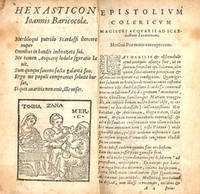
01-0240Venice: Apud Jacobum Simbenium 1572. Small 12mo. Publisher's device on title and 26 woodcut illustrations some repeats. Contemporary vellum. Some soiling light browning of text. There are marginal tears signatures and notations on the title page. Venice: Apud Jacobum Simbenium, 1572. hardcover
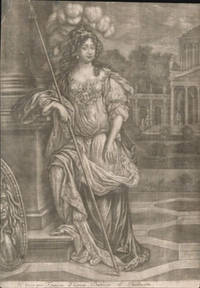
16-4835circa 1678. Mezzotint. 38 x 26.2 cm. Slightly trimmed. Mounted on a support sheet. Portrait standing full-length in character of Minerva holding lance beside a shield with a classical building in background.Bibliographic reference:Chaloner Smith 1883 / British Mezzotinto portraits from the introduction of the art to the early part of the present century circa 1678 unknown
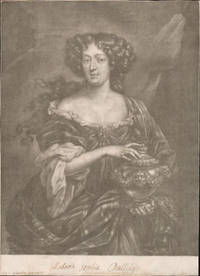
16-4836circa late 17th early 18th Century. Mezzotint. Large version. 33.5 x 25 cm. Portrait; half-length standing to right head turned and glancing towards the viewer left hand on an urn in front of her wearing a loose gown revealing her shoulder and a cloak her hair dressed up with tresses flying behind her back; proof before letters. Titled in ink. This is the the large version described by Chaloner Smith under Gascar no. 3. before the small version by Robert. Reverse image of British Museum no. 18860617.67. Dunkarton.Chaloner Smith 1883 / British Mezzotinto portraits from the introduction of the art to the early part of the present century p. 236-237.Sophia Bulkeley was born Sophia Stewart daughter of Walter Stewart son of Lord Blantyre and as the inscription copied onto the back of the lining canvas attests was the sister of Frances Stewart ''La Belle Stewart'' the celebrated beauty who married the Duke of Richmond. Although she has never equalled her sister's reputation Pepys records seeing her walking with her sister in St James's Park Diary August 30th 1668 and describes her as very handsome. circa late 17th early 18th Century. unknown
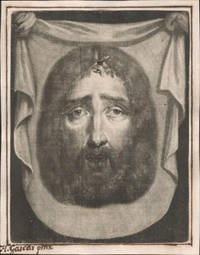
16-4852Circa late 17th- early 18th Century. Mezzotint.18 x 13cm. Slightly trimmed. Mounted on a support sheet. with a contemporary ink annotation: "H. Gascarpinx." Circa late 17th- early 18th Century. unknown
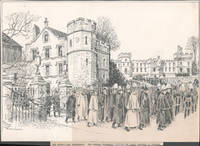
16-6204Windsor: Feb. 7 1901. Ink on board. Signed annotated and dated. 20 x 28.2cm.Intended as an illustration for The Daily Graphic. Caption for the illustration as published is attached.Edward Frank Gillett was born at Worlingham Suffolk on 23 July 1874 and baptised on 19 August 1874 son of Revd Jesse Gillett 1833-3 December 1893 curate of Worlingham and his wife Eliza Marten née Duplock 1842-19 September 1908 who married at Crewe Cheshire on 8 June 1864. In September 1875 his father Jesse was licensed to the vicarage or perpetual curacy of Aldeby near Loddon Norfolk and in 1881 young Edward was a 6-year-old living at The Vicarage Beccles Road Aldeby with his parents 47-year-old Jesse and 38-year-old Eliza and his three siblings Charles William 5 who was born at Worlingham with Emily Harriett 3 and newly born Maud Elizabeth who were both born at Aldeby. After schooling at Gresham School Holt Norfolk Frank became a clerk at Lloyd’s moving to London and together with his older brother Frederick who was also a Lloyd’s clerk both lodging with Frederick Daniels a law writer at 56 Thornton Street Stockwell London. In 1891 an 18-year-old ‘clerk at Lloyds’ lodging at 56 Thornton Street a position he retained until 1896 when he became a full-time illustrator on the staff of the 'Daily Graphic' 1898-1908 moving to 'The Black & White' 1908-1911 and 'The Illustrated Sporting and Dramatic News' 1910-1923. A painter black and white artist and illustrator elected to the Royal Institute of Painters in Water Colours in 1909 and in the same year he became a founder member of the Pencil Society and was also a member of London's Langham Sketching Club. He specialised in foxhunting and hare-coursing scenes including his painting 'Beccles–Coursing' exhibited at Wingfield Sporting Gallery London also exhibiting at Fine Art Society; Royal Glasgow Institute of the Fine Arts; Walker Art Gallery; the Royal Academy and Royal Institute of Painters in Water Colours from St Alban’s Hertfordshire in 1909 London in 1911 and Beccles Suffolk 1918. He illustrated 'St George for England' by G.A. Henty and many other Henty books. In 1901 an artist painter living at 23 Gayton Road Hampstead with his widowed mother and six siblings. He married firstly at St Augustine’s Church Highbury London on 22 April 1903 Elsie Joanna Bastard 1870-4 January 1912 and secondly at Aldeby Norfolk in 1914 Margaret Helen Mickelburgh 12 February 1891-1974 and they had one son David born in 1915. After spending some time in London he returned to Aldeby in 1916. Edward Frank Gillett was of Red Tiles Northgate Street Beccles when he died at the London Hospital on 1 May 1927 aged 52 and after his death his widow remarried in 1948 William Morris. Sometimes known as Frank Edward Gillett. Windsor: Feb. 7, 1901 unknown
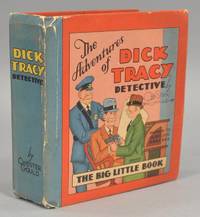
1932887121932. GOLD CHESTER. THE ADVENTURES OF DICK TRACY THE DETECTIVE. Racine Wisconsin: Whitman Publishing Co. 1932. 4" x 4 3/8"x 1 5/8". First Big Little Book to be published. Dick Tracy debuted as a daily strip in the Detroit Mirror on October 4 1931. This book is a reprint for the second month of the daily strip. November 19 through December 28 1931 and April 12 through May 24 1932. According to the entry for this book in: Big Little Book Club #GW2 707. this book only had one press run. The measurements vary slightly from that descibed in the BLBC reference their's being 3 3/8" by 4 3/8" x 1 1/2". This is an exceptionally fresh clean copy with just a little rubbing at the corners and a tiny crack at the top edge of the spine. unknown books
195838938Tel Aviv: Edition "Olamenu 1958. First edition. Hardcover. g to vg. Folio. 12172 82281pp. Original red paper-covered boards decorative paper-covered board of deluxe edition of volume two with gilt lettering on cover and spine in original photo-illustrated dustjackets. Illustrated title page in vol. 1 color reproduction of a painting tipped-in on title page of vol. 2. Comprehensive history of the Jews in the administrative division of the Habsburg Monarchy known as the Bukovina an area now spilt between Romania and the Ukraine. Contributions by Dr. Samuel Josef Schulsohn Dr. Manfred Reifer Dr. N. M. Gelber and Dr. Leon Arie Schmelzer give a detailed account of the Jewish migration after the destruction of the first temple and the erection of the second temple tracing Jewish presence in the area north and northwest of the Black Sea Schulsohn the era of the Moldavian Counts from 1360-1774 Reifer the Habsburg Monarchy until 1914 Gelber and the time from 1914-1919 Schmelzer. Additional contributions by various historian cover the whole spectrum of the Jewish culture in Moldavia through the ages. Illustrated with numerous additional plates with b/w photographs mostly portraits groups and relevant architecture. Text in German. Dustjackets rubbed with light sunning of spines. Very light age toning of blocks. Dj in overall good binding and interior in very good condition. Edition "Olamenu hardcover
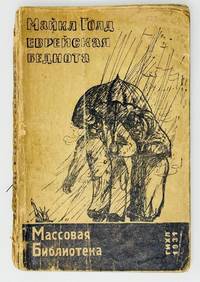
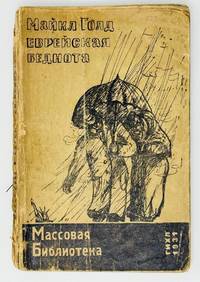
2660Moscow: Gos. izd-vo khud. lit-ry 1931. 214 1 p. 175 × 11 cm. Original illustrated wrappers. Good condition. Spine is chipped and two small fragments are missing from the edges. Minor soiling of the covers. <br /> <br /> Scarce. 1 of 5000 copies. First edition. Second edition followed the next year. Original English version published in 1930. Translated from English by the Soviet translator Mark Volosov 1895-. The book design by Leonid Zusman 1906—1984. At different times Zusman attended private art studios of F. Rerberg and A. Miganadzhian in Moscow the workshop of I. Mashkov etc. In 1924—1926 he studied at the Higher Art and Technical Institute in Leningrad under K. Petrov-Vodkin and in 1927—1929 at the Higher Art and Technical Institute in Moscow under D. Shterenberg. Zusman’s work was closely connected to the illustration of children’s books design of various newspapers and magazines. Some of his most famous works in book design include: Thousand and One Nights 1958—1960Oleshi’s Zavist’ i.e. Envy 1979 etc.<br /> <br /> The Russian translation of a semi-autobiographical novel by the Jewish American writer and lifelong Communist Mike Gold 1894- 1967. The only novel written by the author Yevreyskaya bednota i.e. Jews without Money became a manifestation of the American proletarian spirit of the 1930s. The novel is set in a slum populated mainly by Jewish immigrants from Eastern Europe. The father of the hero is a painter who suffers from lead poisoning. When he falls from a scaffold he is disabled and can no longer work. His business fails and the family is pushed into poverty. Although he is a bright boy young Michael decides he must leave school. On the final page of the book the poor Jewish boy prays for the arrival of a Marxist worker’s revolution that will emancipate the working class.<br /> Born in New York to Romanian Jewish immigrant parents American writer Mike Gold was an ardent supporter of the Bolshevik Revolution. In 1921—1922 Gold became Executive Editor of the magazine The Liberator on the pages of which the journalist wrote: The Russian Bolsheviks will leave the world a better place than Jesus left it. They will leave it on the threshold of the final victory - the poor will have bread and peace and culture in another generation not churches and a swarm of lying parasite minister dogs the legacy of Jesus. Three years later Mike visited Moscow where his fascination with Communism reached its peak. Throughout the 1920s Gold worked on his only novel Jews Without Money. Published in 1930 it was an immediate success and was translated into over 14 languages. The popularity of Jews Without Money made Gold a national figure and cultural commissar of the Communist Party. The Russian society got acquainted with the writings of Mike Gold in the mid-1920s. In the period from 1925 to 1931 Mark Volosov who was the classic translator of the American writer issued 3 Russian translations of Mike’s works: Proklyatyy agitator i.e. The Damned Agitator 1925 120 millionov i.e. 120 Million 1930 and this title 1931; 1932. With the gradual introduction of the anti- semitic campaign in the Soviet Union works by Mike Gold and other Jewish authors vanished from the print. At the age of 19 Volosov was drafted into WWI and taken prisoner by the Nazis. After escaping from captivity Volosov fled to Norway and then to the United States returning to the USSR only in 1923. Knowledge of English allowed him to start translating fiction. With his help Soviet readers got acquainted with such authors as Theodore Dreiser Michael Gold Grace Lampkin etc. Volosov was reported missing during WWII.<br /> <br /> Worldcat shows only one copy in NYPL. unknown
2685Moscow: Gos. izd-vo khud. lit-ry 1931. 214 1 p. 175 × 11 cm. Original illustrated wrappers. Good condition. Spine is chipped and two small fragments are missing from the edges. Minor soiling of the covers.<br /> <br /> Scarce. 1 of 5000 copies. First edition. Second edition followed the next year. Original English version published in 1930. Translated from English by the Soviet translator Mark Volosov 1895-. The book design by Leonid Zusman 1906—1984. At different times Zusman attended private art studios of F. Rerberg and A. Miganadzhian in Moscow the workshop of I. Mashkov etc. In 1924—1926 he studied at the Higher Art and Technical Institute in Leningrad under K. Petrov-Vodkin and in 1927—1929 at the Higher Art and Technical Institute in Moscow under D. Shterenberg. Zusman’s work was closely connected to the illustration of children’s books design of various newspapers and magazines. Some of his most famous works in book design include: Thousand and One Nights 1958—1960Oleshi’s Zavist’ i.e. Envy 1979 etc. The Russian translation of a semi-autobiographical novel by the Jewish American writer and lifelong Communist Mike Gold 1894- 1967. The only novel written by the author Yevreyskaya bednota i.e. Jews without Money became a manifestation of the American proletarian spirit of the 1930s. The novel is set in a slum populated mainly by Jewish immigrants from Eastern Europe. The father of the hero is a painter who suffers from lead poisoning. When he falls from a scaffold he is disabled and can no longer work. His business fails and the family is pushed into poverty. Although he is a bright boy young Michael decides he must leave school. On the final page of the book the poor Jewish boy prays for the arrival of a Marxist worker’s revolution that will emancipate the working class. Born in New York to Romanian Jewish immigrant parents American writer Mike Gold was an ardent supporter of the Bolshevik Revolution. In 1921—1922 Gold became Executive Editor of the magazine The Liberator on the pages of which the journalist wrote: The Russian Bolsheviks will leave the world a better place than Jesus left it. They will leave it on the threshold of the final victory - the poor will have bread and peace and culture in another generation not churches and a swarm of lying parasite minister dogs the legacy of Jesus. Three years later Mike visited Moscow where his fascination with Communism reached its peak. Throughout the 1920s Gold worked on his only novel Jews Without Money. Published in 1930 it was an immediate success and was translated into over 14 languages. The popularity of Jews Without Money made Gold a national figure and cultural commissar of the Communist Party.<br /> <br /> The Russian society got acquainted with the writings of Mike Gold in the mid-1920s. In the period from 1925 to 1931 Mark Volosov who was the classic translator of the American writer issued 3 Russian translations of Mike’s works: Proklyatyy agitator i.e. The Damned Agitator 1925 120 millionov i.e. 120 Million 1930 and this title 1931; 1932. With the gradual introduction of the anti- semitic campaign in the Soviet Union works by Mike Gold and other Jewish authors vanished from the print. At the age of 19 Volosov was drafted into WWI and taken prisoner by the Nazis. After escaping from captivity Volosov fled to Norway and then to the United States returning to the USSR only in 1923. Knowledge of English allowed him to start translating fiction. With his help Soviet readers got acquainted with such authors as Theodore Dreiser Michael Gold Grace Lampkin etc. Volosov was reported missing during WWII.<br /> <br /> Worldcat shows only one copy in NYPL. unknown
1866WRCAM26697Washington 1866. 6pp. Folio. Disbound leaves. Minor chipping staining. Very good. One of the Fort Sully treaties. "These famous treaties were concluded at Fort Sully Dakota Territory by Newton Edmunds E.B. Taylor and Generals S.R. Curtis and H.H. Sibley. They stipulate a cessation of hostilities and depredations by the various bands and their withdrawal from the overland routes established or to be established through their country etc. Among the witnesses is Hezeiah L. Hosmer Chief Justice of Montana Territory" - Eberstadt. EBERSTADT INDIAN TREATIES 130. unknown books
1866WRCAM26696Washington 1866. 7pp. Folio. Dbd. Minor chips tears. Very good. One of the famous Sioux treaties of Fort Sully. "These famous treaties were concluded at Fort Sully Dakota Territory by Newton Edmunds E.B. Taylor and Generals S.R. Curtis and H.H. Sibley. They stipulate a cessation of hostilities and depredations by the various bands and their withdrawal from the overland routes established or to be established through their country etc. Among the witnesses is Hezekiah L. Hosmer Chief Justice of Montana Territory" - Eberstadt. EBERSTADT INDIAN TREATIES 130. unknown books
1828D2439Paris: Firmin Didot pour Lami Denozan 1828. First Edition. Hardcover. Very Good. 8vo 210 x 132mm. viii cxlvi 48pp. notes and glossary. Illustrated with hand-colored engraved title with marginal vignettes of female personifications and muses by Richard Parkes Bonington. Illustrated throughout with 10 half-page lithographs printed on chine-collé carefully hand-colored heightened in gilt and mounted; six are by Richard Parkes Bonington and four are by Henry Monnier and 15 decorative initials highlighted with colors inspired by ornaments found on the Books of Hours printed in the fifteenth and sixteenth centuries. 19th-century full red morocco decoratively tooled in gilt five raised bands gilt doublures marbled endpapers all edges gilt; lightly foxed throughout miniatures remain bright and fresh; spine slightly scuffed. Armorial bookplate of J. Austin Stevens Junior to front pastedown. First Edition of this rare and unusual book OCLC locates only four copies all in German libraries. Férdinand Langlé littérateur dramatist and occasional necromancer focused his literary interests on the nostalgic and the romantic. In 1828 he edited Les Contes du Gay-Sçavoir a witty collection of medieval ballads and fables. The text is printed in Gothic characters and illustrated to imitate the style of medieval manuscript illumination; it is followed by endnotes and a glossary printed in Roman type. The major illustrator of the work Richard Parkes Bonington was an English Romantic landscape painter who also worked in lithography. He was a close and admired friend of painters Eugene Delacroix and Antoine-Jean Gros. Gordon Ray speaking of Bonington says his importance in the development of lithography can hardly be overstated.His designs for Vues pittoresques de lEcosse and Contes des Gay-Sçavoir are by no means negligible. Boningtons career as a lithographer was short but splendid. - Art of the French illus. book pp. 173 & 176. Fine fresh and bright rare colored copy of this nostalgic work on the medieval period. Brunet III 819; Carteret III p. 172 livre tres rare; Curtis 54-60; Ray 114 <br/><br/> Firmin Didot pour Lami Denozan hardcover books
1976122182Milano: Rizzoli Editore 1976. Hardbound. VG/VG in VG slipcase. A large weighty book. Red maroon cloth with color pictorial glossy dustjacket all contained in a custom slipcase. Appx. 217 pp. 138 mostly color plates tipped-in to the text portion and 50 full sheet 13.5" x 16" color plates. A most impressive book both by it's content and it volumetric displacement. Vital in the study of Caravaggio. Another version of this appears to have been printed in 1971 and this edition has a few extra illustrations at least and likely some additional or revised text. Text is in Italian. Transit mass would be 272 ounces. A stunning production. Rizzoli Editore hardcover books
1976122182Milano: Rizzoli Editore 1976. Hardbound. VG/VG in VG slipcase. A large weighty book. Red maroon cloth with color pictorial glossy dustjacket all contained in a custom slipcase. Appx. 217 pp. 138 mostly color plates tipped-in to the text portion and 50 full sheet 13.5" x 16" color plates. A most impressive book both by it's content and it volumetric displacement. Vital in the study of Caravaggio. Another version of this appears to have been printed in 1971 and this edition has a few extra illustrations at least and likely some additional or revised text. Text is in Italian. Transit mass would be 272 ounces. A stunning production. Rizzoli Editore hardcover
1775BOOKS050960IParis: Chez Clousier 1775. HC. very good full calf raised bands hardcover EXCEPTIONAL !!. engravings by C. Boissel. Title translates roughly to: "The Philosopher without Claim or the Rare Man Works Physical Chemical Political and Moral." A curious work of science fiction in which the author expounds upon his theories in physics and chemistry. A visitor from Mercury arrives on Earth ina an 'electrical flying machine' as seen in the frontispiece. This machine is considered the first forerunner of the dynamo powered by static electricity when its two globes are rubbed with camphor. The Mercurian Ormaris presents Lafolie's own scientific opinions in the fields of electricity geology mineralogy and chemistry. In addition he scoffs the theories of the fixed air of Priestley as well as the conversion of air into water. The author was the first to discover the yellow dyeing extracted and to successful fix it on wire of the red color of the Indies. Text in French. An exceptional copy of museum quality!!! Frontis is bound instead with Chapter 1. 350pp. Chez Clousier unknown